



Why Tank Cleaning Fails: Common Mistakes and Solutions (2026)
Tank cleaning operations fail more often than they should, and the reasons are usually preventable. Based on field audits of over 200 industrial cleaning systems, we've identified recurring patterns of failure that cost facilities thousands in downtime, rework, and product contamination. This guide breaks down the most common mistakes in nozzle selection, installation, and maintenance—and provides actionable solutions backed by real performance data.
Table of Contents
- 1. 1. The Hidden Cost of Poor Tank Cleaning
- 2. 2. Critical Parameters Most Engineers Overlook
- 3. 3. Mistake 1: Wrong Nozzle Type for the Application
- 4. 4. Mistake 2: Inadequate Impact Force and Coverage
- 5. 5. Mistake 3: Ignoring Material Selection and Wear
- 6. 6. Mistake 4: Incorrect Pressure and Flow Assumptions
- 7. 7. Mistake 5: Poor Installation and Maintenance
- 8. 8. Solutions: A Systematic Approach
- 9. 9. FAQ
- 9.1. Can I just increase pressure to improve cleaning performance?
- 9.2. How often should tank cleaning nozzles be replaced?
- 9.3. What's the difference between a spray ball and a rotary jet head?
- 9.4. Do I need to heat the cleaning solution?
- 9.5. Can I use the same nozzle for CIP and SIP?
- 9.6. How do I calculate the number of nozzles needed for a large tank?
- 10. 10. Conclusion
1. The Hidden Cost of Poor Tank Cleaning
Cleaning failures don't always announce themselves dramatically. More often, they show up as longer cycles, inconsistent batch quality, increased chemical use, or unplanned downtime. In food, pharma, and chemical production, these failures can trigger product recalls or regulatory violations.
From our audits, 68% of underperforming systems were using the wrong nozzle type, 52% had nozzles operating outside their effective pressure range, and 41% had no systematic approach to monitoring nozzle wear—so performance decay just became the new normal.
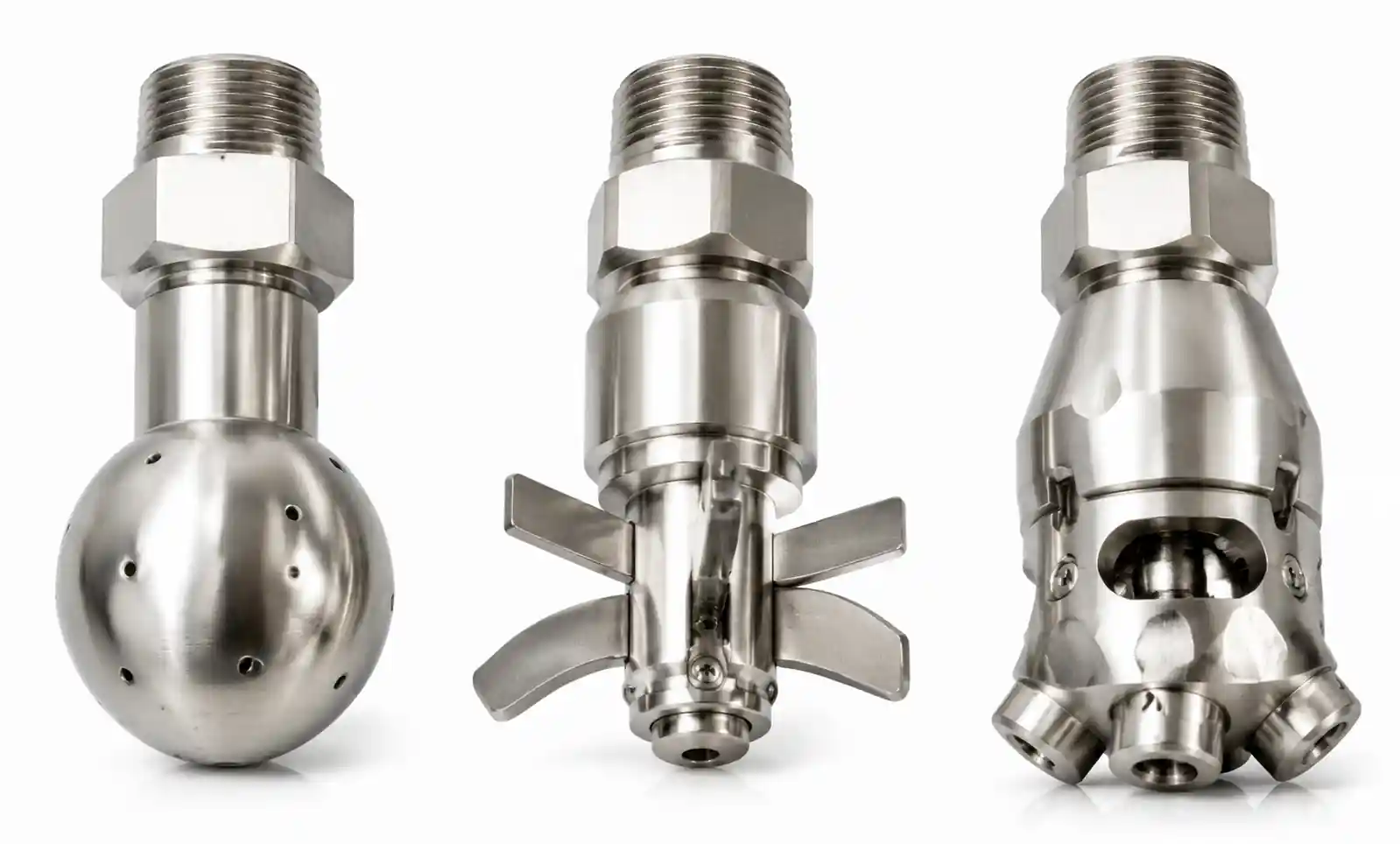
2. Critical Parameters Most Engineers Overlook
Impact Force: This is what actually removes residue. It's determined by flow rate, spray angle, and distance. Higher pressure doesn't always mean better cleaning—if the spray angle narrows or droplets atomize, cleaning effectiveness drops. For a detailed breakdown of how impact force degrades with distance and how to calculate effective cleaning radius for your specific soil type, see Cleaning Radius Explained: How to Size Your Nozzle.
Droplet Size: For most tank cleaning, optimal droplet size is 300–800 microns (Dv0.5) . Smaller droplets lack impact; larger ones reduce coverage uniformity.
Coverage Uniformity: Water-sensitive paper testing reveals that what looks like "full coverage" often leaves 20-30% of the tank surface with impact force below the removal threshold.
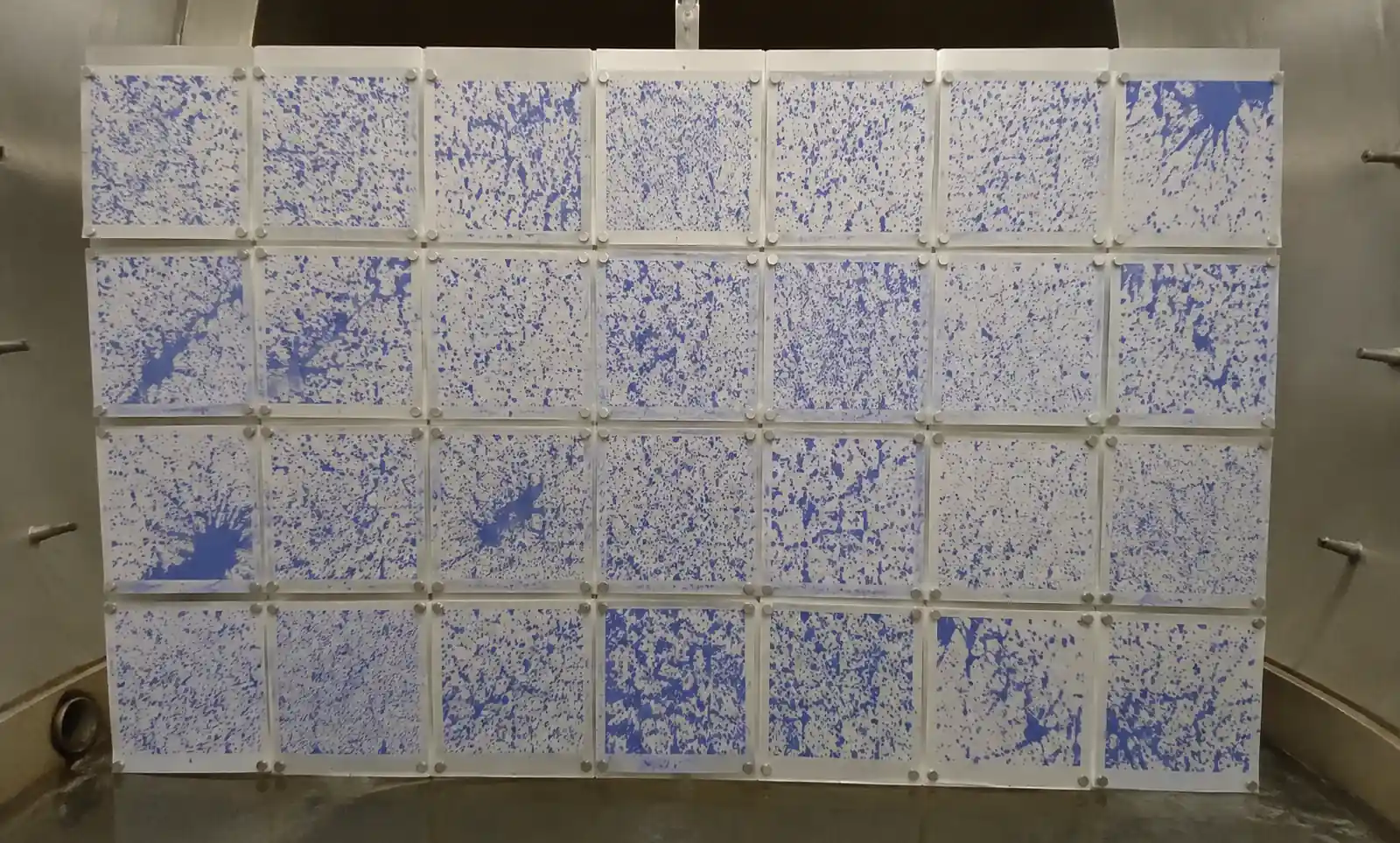
Wear-Induced Decay: A 10% increase in orifice diameter increases flow by 21% but reduces impact force by 30-35%. Operators see higher flow and assume things are working—while actual cleaning performance drops.
3. Mistake 1: Wrong Nozzle Type for the Application
| Nozzle Type | Typical Impact Force | Coverage Method | Best Applications | Limitations |
|---|---|---|---|---|
| Static Spray Ball | Low (0.3-1.2 N) | Overlapping zones | Rinse cycles, light residues | Insufficient for baked-on or viscous soils |
| Rotary Spray Head | Medium (1.5-4.5 N) | Mechanical rotation | Medium-duty cleaning, food tanks | More complex, higher maintenance |
| Rotary Jet Head | High (6-15 N) | Targeted high-impact paths | Heavy residues, polymerized coatings | Higher water/energy use |
| Fixed Position Jets | Very high (8-25 N) | Targeted zones only | Critical areas, agitator blades | Requires multiple nozzles for full coverage |
Facilities often pick static spray balls to save money ($150-400 vs $1,200-4,500 for rotary heads), then pay for it with extended cycles. For a deeper comparison of rotary vs static vs orbital nozzle designs, see High Pressure Tank Cleaning Nozzle Selection Guide 2026: Rotary vs Static vs Orbital.
Real example: A dairy facility was running 45-minute CIP cycles with spray balls. After switching to rotary heads, cleaning dropped to 18 minutes, water use fell 40%, and annual chemical costs dropped $12,000. The upgrade paid for itself in 4.2 months.
4. Mistake 2: Inadequate Impact Force and Coverage
| Residue Type | Minimum Impact Force | Typical Applications |
|---|---|---|
| Light sugars, salts, rinse | 0.5-1.5 N | Beverage tanks, buffer prep |
| Oils, fats, proteins | 2.0-4.0 N | Food processing, cosmetics |
| Baked-on organics | 4.5-8.0 N | Reactors, coating equipment |
| Polymerized resins, coke | 8.0-15.0 N | Polymer reactors, crude oil tanks |
The distance problem: Impact force drops with the square of distance. A nozzle delivering 6.0 N at 1 meter gives only 1.5 N at 2 meters. For tanks over 3 meters diameter, single-nozzle installations rarely provide adequate force across the entire surface. Learn how to identify and eliminate coverage gaps with How to Eliminate Dead Zones in Tank Cleaning: A Field Engineer's Guide to Complete Coverage.
If you need 3.5 N at 2.5 meters, the nozzle needs to produce about 14 N at 1 meter. If your selected nozzle only gives 6 N, the tank won't get clean.
5. Mistake 3: Ignoring Material Selection and Wear
| Material | Relative Hardness | Wear Resistance vs 316 SS | Relative Cost | Typical Life (abrasive service) |
|---|---|---|---|---|
| 316 Stainless | ~6 Mohs | 1× | 1× | 3-6 months |
| Hardened 17-4 PH | ~6.5 | 2-3× | 1.3× | 6-12 months |
| Alumina Ceramic | ~9 | 8-12× | 2.5-3.5× | 24-36 months |
| Silicon Carbide | ~9.5 | 15-20× | 3.5-5× | 36-60 months |
| Tungsten Carbide | ~9 | 10-15× | 4-6× | 30-48 months |
False economy example (5-year TCO, 4 nozzles):
- 316 SS: $720 initial + 15 replacements × $720 = $11,520 parts + $2,250 labor = $13,770
- Silicon Carbide: $2,720 initial + 1 replacement × $2,720 = $5,440 parts + $150 labor = $5,590
Savings: $8,180 (59% reduction) — and that's before accounting for the cleaning cycles lost to gradual performance decay between replacements. For a detailed analysis of nozzle wear patterns and failure modes in abrasive service, see Why Nozzles Fail in Desulfurization Systems (And How to Fix It).
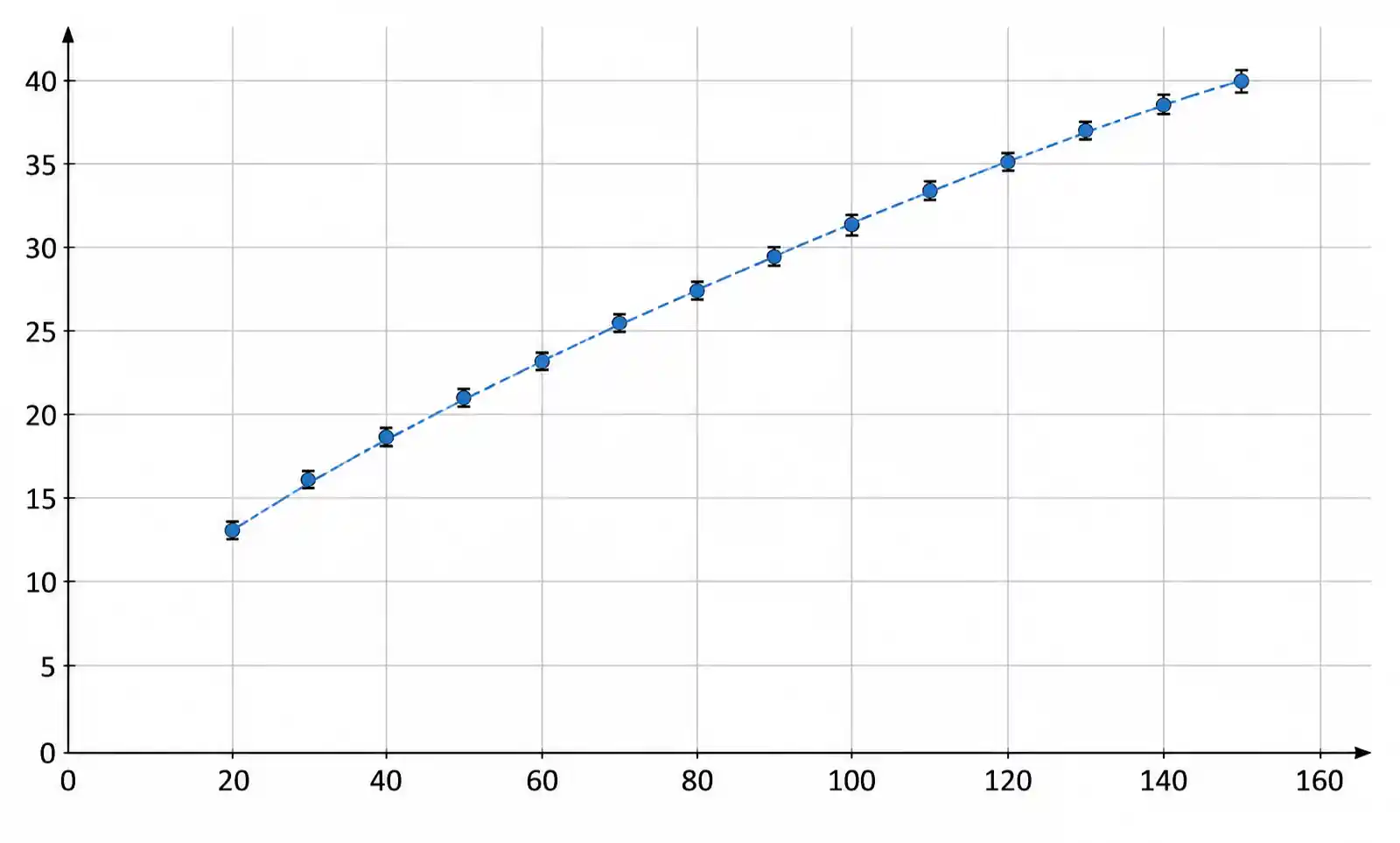
Monitoring wear: Check flow rate monthly at fixed pressure. When flow increases 10% above baseline, cleaning effectiveness is already down 25-30%. Replace nozzles when flow exceeds 15% above baseline.
6. Mistake 4: Incorrect Pressure and Flow Assumptions
Q = K × √P — doubling pressure only increases flow by 1.41×, not 2×. This square-root relationship applies across all hydraulic nozzles—see Full Cone vs Hollow Cone Nozzles in Gas Cooling for practical examples.
Facilities often crank up pressure expecting more flow. At 160 PSI instead of 80 PSI, flow goes from 20 GPM to 28.3 GPM—not 40. And the higher pressure can cause pump cavitation, seal failure, droplet atomization, and wasted energy.
Optimal pressure ranges:
- Static spray balls: 20-60 PSI
- Rotary spray heads: 40-100 PSI
- Rotary jet heads: 80-150 PSI
- Fixed high-impact jets: 100-250 PSI
7. Mistake 5: Poor Installation and Maintenance
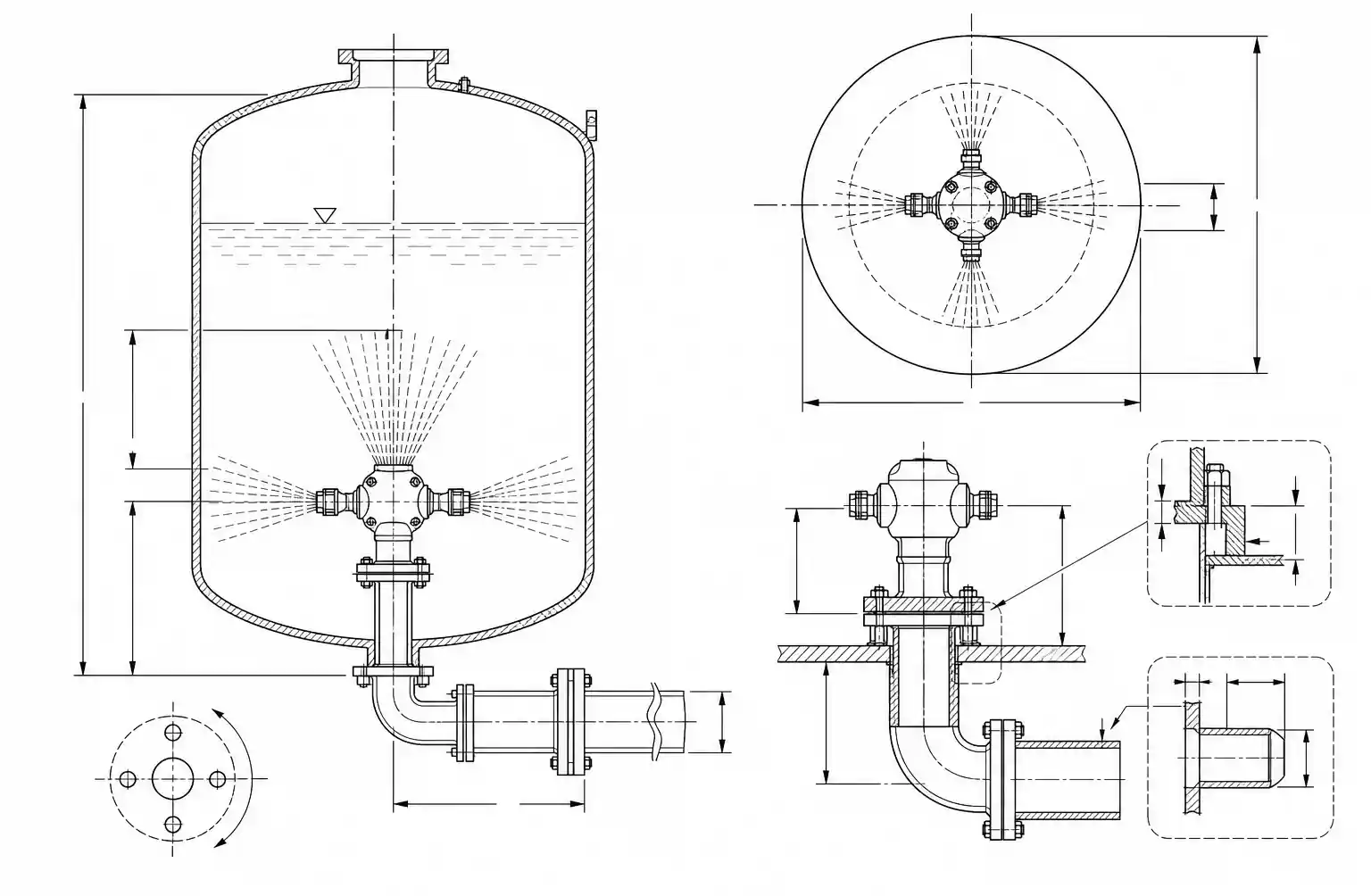
Installation errors:
- Misaligned mounting (5° deviation = 15-20% coverage blind spots)
- Undersized supply lines (use 1.5" for >15 GPM, 2" for >30 GPM)
- Thread sealant contamination (use sparingly—excess breaks loose and clogs orifices)
- No strainers upstream (40-mesh or finer recommended)
Maintenance failures:
| Issue | Consequence | Prevention |
|---|---|---|
| No wear monitoring | Performance decay becomes the new normal | Monthly flow rate testing |
| Reactive replacement only | Substandard cleaning continues | Preventive replacement at threshold |
| No cleaning validation | Assumed effectiveness without proof | Quarterly water-sensitive paper testing |
| Mixed nozzle generations | Inconsistent cleaning | Standardize specifications |
ATP testing blind spot: It only checks biological residue at specific test locations. It misses inorganic scale, polymers, or resins. Combine ATP with visual inspection, flow rate verification, and annual coverage mapping.
8. Solutions: A Systematic Approach
Step 1: Residue Characterization — Identify residue type and required impact force (light: 0.5-1.5 N; medium: 2-4 N; heavy: 4.5-15 N).
Step 2: Tank Geometry — Diameter, height, max distance from nozzle to farthest surface, internal obstructions, bottom shape.
Step 3: Nozzle Selection — Match type, flow, pressure, and material to Steps 1 and 2.
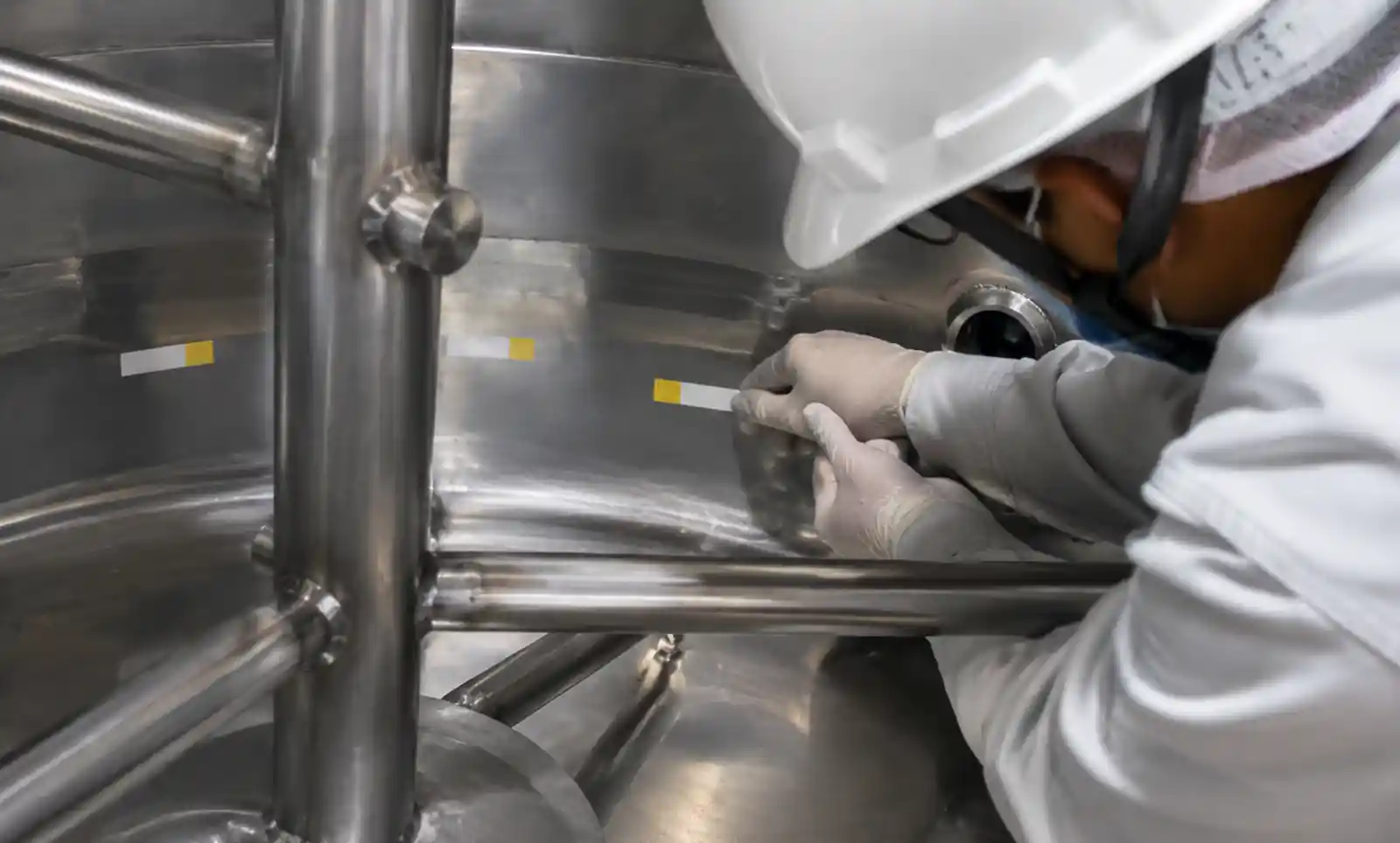
Step 4: Coverage Validation — Water-sensitive paper at 8-12 locations. Run a cycle. Verify uniform wetting.
Step 5: Performance Monitoring — Monthly flow testing (flag >10% above baseline), quarterly validation, annual coverage mapping.
Step 6: Predictive Replacement — If flow increases 2.5% per month, schedule replacement at month 4 (before hitting 10%).
9. FAQ
Can I just increase pressure to improve cleaning performance?
Not reliably. Higher pressure increases impact force but risks atomization (smaller droplets with less impact), pump wear, and energy waste. If current cleaning is inadequate, first verify you're within the nozzle's optimal pressure range. If you are, the problem is likely wrong nozzle type or inadequate coverage—not insufficient pressure.
How often should tank cleaning nozzles be replaced?
It depends on service conditions. In non-abrasive applications, stainless steel nozzles may last 2-3 years. In abrasive slurries, they may need replacement every 3-6 months. Monitor flow rate monthly—replace when flow exceeds 10-15% above baseline at the same pressure.
What's the difference between a spray ball and a rotary jet head?
Spray balls have multiple fixed orifices providing 360° coverage simultaneously with low to medium impact force. Rotary jet heads use one or more rotating jets that sweep the entire tank surface sequentially with high impact force. Spray balls are cheaper but inadequate for stubborn residues. Rotary heads cost more but clean faster and more thoroughly for medium to heavy-duty applications. For a detailed side-by-side comparison of free-spinning vs controlled rotation tank cleaning nozzles, see Rotary Tank Cleaning Nozzle Selection Guide 2026: Free-Spinning vs Controlled Rotation.
Do I need to heat the cleaning solution?
For organic residues (fats, oils, proteins, polymers), heated solutions (50-80°C) significantly improve effectiveness by reducing viscosity and weakening adhesion. However, higher temperatures accelerate nozzle wear in abrasive services and increase evaporative losses for fine spray droplets.
Can I use the same nozzle for CIP and SIP?
CIP (Clean-In-Place) nozzles are designed for liquid spray cleaning. SIP (Sterilize-In-Place) uses steam and requires nozzles with appropriate temperature ratings (typically 150-180°C) and steam-specific flow characteristics. Some rotary jet heads are rated for both, but verify temperature and pressure specs before dual use.
How do I calculate the number of nozzles needed for a large tank?
For tanks exceeding 4 meters in diameter, single-nozzle installations often provide inadequate impact force at distant surfaces. Maximum effective cleaning radius is about 2-2.5 meters for rotary jet heads at 100-120 PSI. For larger tanks, use multiple nozzles or consider custom spray head designs.
10. Conclusion
Tank cleaning failures are almost always preventable. The most common root causes—wrong nozzle selection, inadequate impact force, unmonitored wear, and incorrect hydraulic assumptions—can be systematically addressed through proper specification, validation, and monitoring. A properly specified and maintained tank cleaning nozzle delivers 3-5× longer service life and 30-40% reduction in water and chemical consumption compared to trial-and-error installations.