



Rotary Tank Cleaning Nozzle Selection Guide 2026: Free-Spinning vs Controlled Rotation
Table of Contents
- 1. Key Takeaways (Quick Summary)
- 2. 1. What This Guide Helps You Solve
- 3. 2. Fundamental Difference: Torque Generation and Rotation Control
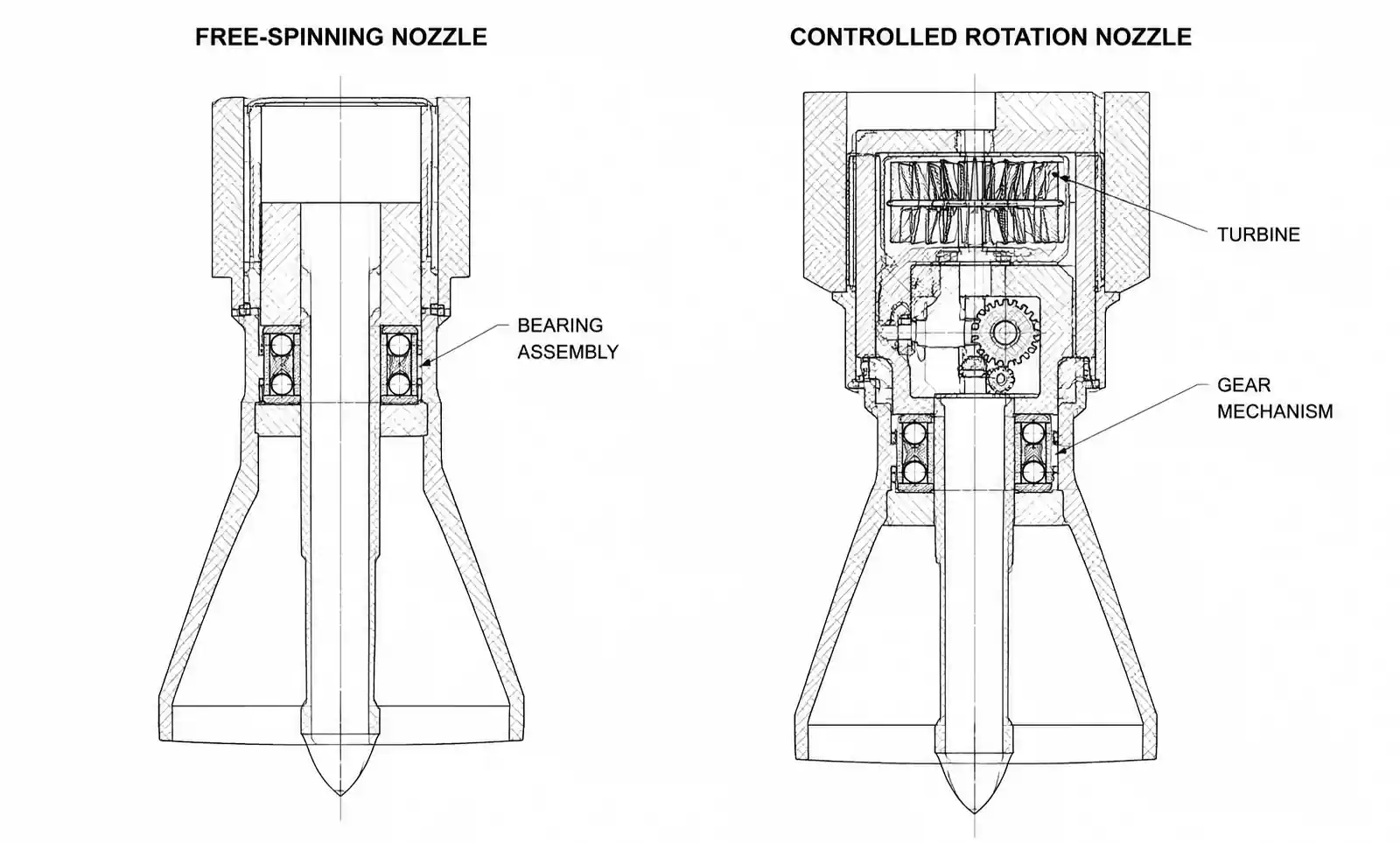
- 3.1. 2.1 Free-Spinning Nozzles: Jet Reaction Torque
- 3.2. 2.2 Controlled Rotation Nozzles: Gear or Turbine Mechanisms
- 3.3. 2.3 Comparison Summary Table
- 4. 3. Performance Comparison: Coverage, Cycle Time, and Cleaning Efficiency
- 4.1. 3.1 Spray Coverage and Overlap
- 4.2. 3.2 Impact Force and Soil Removal
- 4.3. 3.3 Water and Chemical Consumption
- 5. 4. Mechanical Reliability and Wear Life Analysis
- 5.1. 4.1 Bearing and Seal Wear
- 5.2. 4.2 Clogging Resistance
- 5.3. 4.3 Abrasive/Corrosive Fluid Considerations
- 6. 5. Application-Specific Selection Guide
- 6.1. 5.1 Food & Beverage CIP
- 6.2. 5.2 Pharmaceutical (cGMP)
- 6.3. 5.3 Industrial & Bulk Storage (Cost-Sensitive)
- 6.4. 5.4 Heavy Soil & Polymer Residues
- 6.5. 5.5 Decision Matrix
- 7. 6. Total Cost of Ownership Calculation
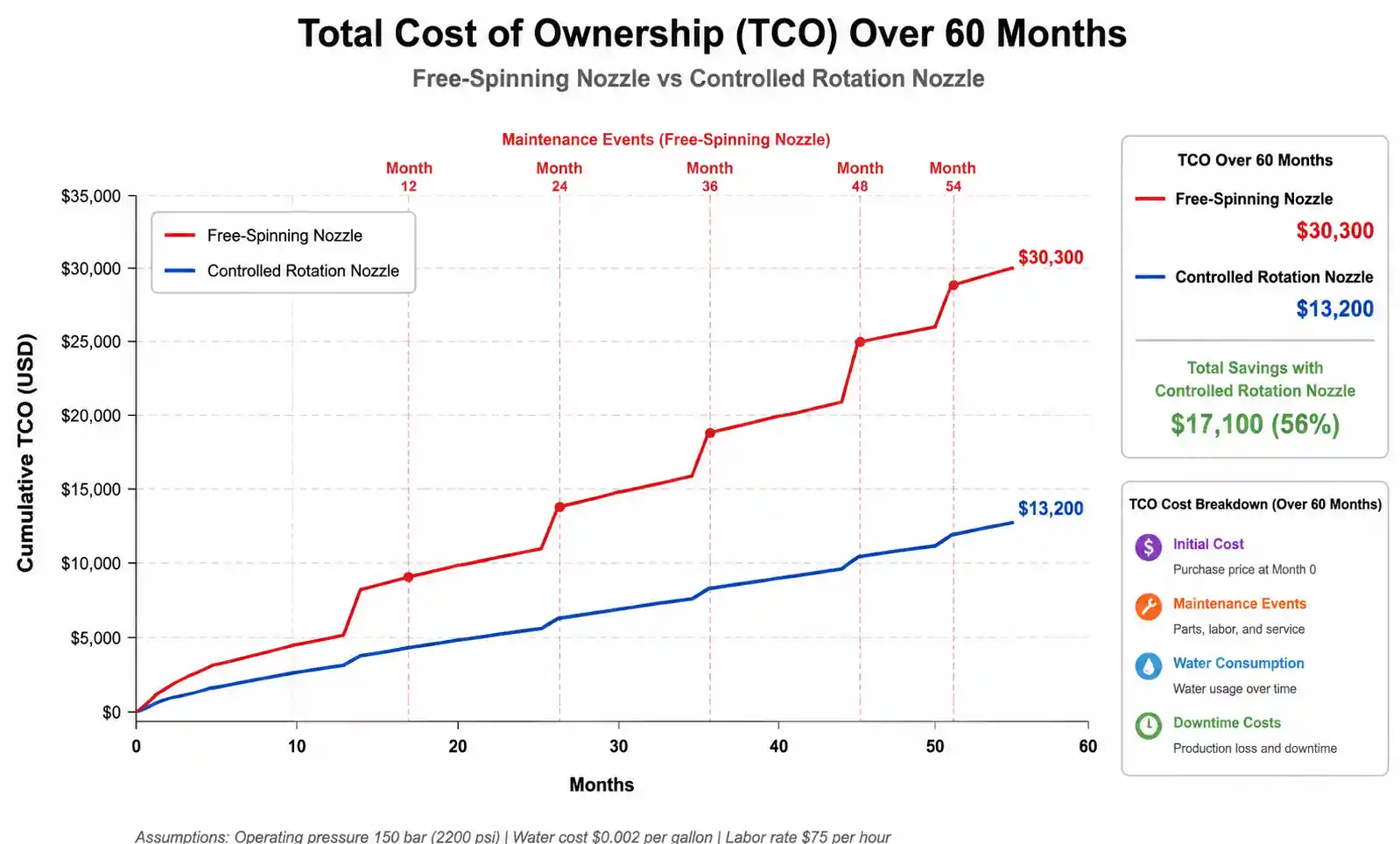
- 7.1. 6.1 Worked Example: 3,000-Gallon Pharmaceutical Tank, 5-Year Horizon
- 7.2. 6.2 Sensitivity
- 8. 7. Common Installation and Maintenance Mistakes
- 9. 8. FAQ
- 9.1. Which is better for high-temperature CIP (180–200°F)?
- 9.2. How do I calculate the right rotation speed for my tank size?
- 9.3. What is the typical pressure drop across a controlled rotation nozzle?
- 9.4. Can I use a free-spinning nozzle in a validated pharmaceutical application?
- 10. 9. Conclusion and Next Actions
Key Takeaways (Quick Summary)
- Free-spinning nozzles are simpler and 20–40% cheaper, but rotation speed varies with pressure — a drop from 60 to 45 PSI can reduce coverage from 100% to 80%.
- Controlled rotation nozzles maintain constant speed (typically 2–6 RPM) across 30–120 PSI, delivering repeatable, validated cleaning — essential for pharmaceutical and food-grade CIP.
- Viscosity matters: Free-spinning nozzles slow by ~40% in 150 cP fluids; controlled rotation compensates with turbine drive.
- TCO wins: In a 5-year, 5,000-cycle pharma example, free-spinning was 27% lower cost ($9,000 vs $11,450), but a single cleaning failure per year flips the economics.
- Selection rule: Validated/regulated applications → controlled rotation. Light soils + stable pressure → free-spinning. Heavy soils or viscous fluids → controlled rotation.
1. What This Guide Helps You Solve
Tank cleaning is rarely a "one nozzle fits all" problem. Common issues — extended cycles, incomplete soil removal, premature bearing failure, unpredictable coverage, excessive water usage — often trace back to a mismatch between nozzle rotation mechanism and application requirements.
Free-spinning nozzles rely purely on jet reaction force to rotate. They are simple, low-cost, and have fewer moving parts. However, rotation speed depends entirely on inlet pressure and fluid viscosity, meaning coverage consistency varies between cycles.
Controlled rotation nozzles use internal gears, turbines, or vanes to regulate rotational speed independently of pressure fluctuations. They deliver predictable, repeatable spray patterns but come with higher initial cost and more complex maintenance.
This guide provides the quantitative basis for a selection that balances cleaning performance, mechanical reliability, and lifecycle cost.
2. Fundamental Difference: Torque Generation and Rotation Control
2.1 Free-Spinning Nozzles: Jet Reaction Torque
Free-spinning rotary nozzles generate torque through jet reaction force. Rotational speed ω is governed by:
ω ∝ (Flow × Velocity × Moment arm) / (Inertia + Bearing friction)
Rotation speed increases roughly proportionally with inlet pressure. For a typical 1-inch free-spinning nozzle: 3–5 RPM at 20 PSI up to 15–20 RPM at 80 PSI. In field tests with 150 cP corn syrup, rotation speed dropped ~40% compared to water at the same pressure.
The key limitation: No speed regulation. If inlet pressure fluctuates (common in multi-zone systems), rotation speed changes, affecting spray pattern overlap. A nozzle designed for 100% coverage in 5 minutes at 60 PSI may only achieve 80% coverage at 45 PSI.
2.2 Controlled Rotation Nozzles: Gear or Turbine Mechanisms
Controlled rotation nozzles incorporate a turbine driving a gear train that regulates speed. A governor or escapement mechanism constrains rotation to a predetermined value (e.g., 3 RPM or 6 RPM) across a wide operating range (typically 30–120 PSI).
Rotation speed = Constant (within design pressure range) Pressure drop = Orifice loss + Turbine extraction + Bearing friction
The pressure drop penalty is typically 5–10 PSI higher than a free-spinning nozzle — the cost of mechanical regulation. The benefit: predictable, repeatable coverage. A controlled rotation nozzle at 3 RPM at 40 PSI delivers the same 3 RPM at 80 PSI.
2.3 Comparison Summary Table
| Parameter | Free-Spinning | Controlled Rotation |
|---|---|---|
| Speed control | Proportional to pressure | Constant across 30–120 PSI |
| Typical speed range | 3–20 RPM (pressure-dependent) | 1–6 RPM (fixed per model) |
| Pressure drop | Lower | Higher (+5–10 PSI) |
| Coverage predictability | Variable | Consistent |
| Mechanical complexity | Low | Higher (gears/turbine + bearings) |
| Initial cost | 20–40% lower | Higher |
| Viscous fluid suitability | Poor | Good |
3. Performance Comparison: Coverage, Cycle Time, and Cleaning Efficiency
3.1 Spray Coverage and Overlap
For a rotary nozzle with 360° vertical indexing:
Cycle time = (360° / Indexing speed) × (360° / Rotation speed)
Free-spinning: Pressure drop from 60 to 40 PSI mid-cycle extends a 5-minute nominal cycle to 7.5 minutes — 50% longer water usage and delayed turnaround.
Controlled rotation: Fixed cycle time regardless of pressure variation — critical for pharmaceutical and food-grade validation where regulatory requirements demand repeatable performance.
📘 For a deeper understanding of how cleaning radius and impact force determine effective coverage, see our Cleaning Radius Explained: How to Size Your Nozzle guide.
3.2 Impact Force and Soil Removal
Impact force F depends on flow Q and jet velocity v:
F ≈ ρ × Q × v
Higher pressure always increases impact force — for both types. But there is an interaction effect:
- Free-spinning: Higher pressure = faster rotation = reduced dwell time per area.
- Controlled rotation: Constant speed = higher pressure increases impact force without reducing dwell time.
In heavy soil applications (baked-on proteins, polymer resins), this can make the difference between acceptable and unacceptable cleaning.
3.3 Water and Chemical Consumption
Cleaning 3,000-gallon stainless steel mixing vessels with dairy residues:
| Nozzle Type | Pressure | Speed | Cycle Time | Water Used | Result |
|---|---|---|---|---|---|
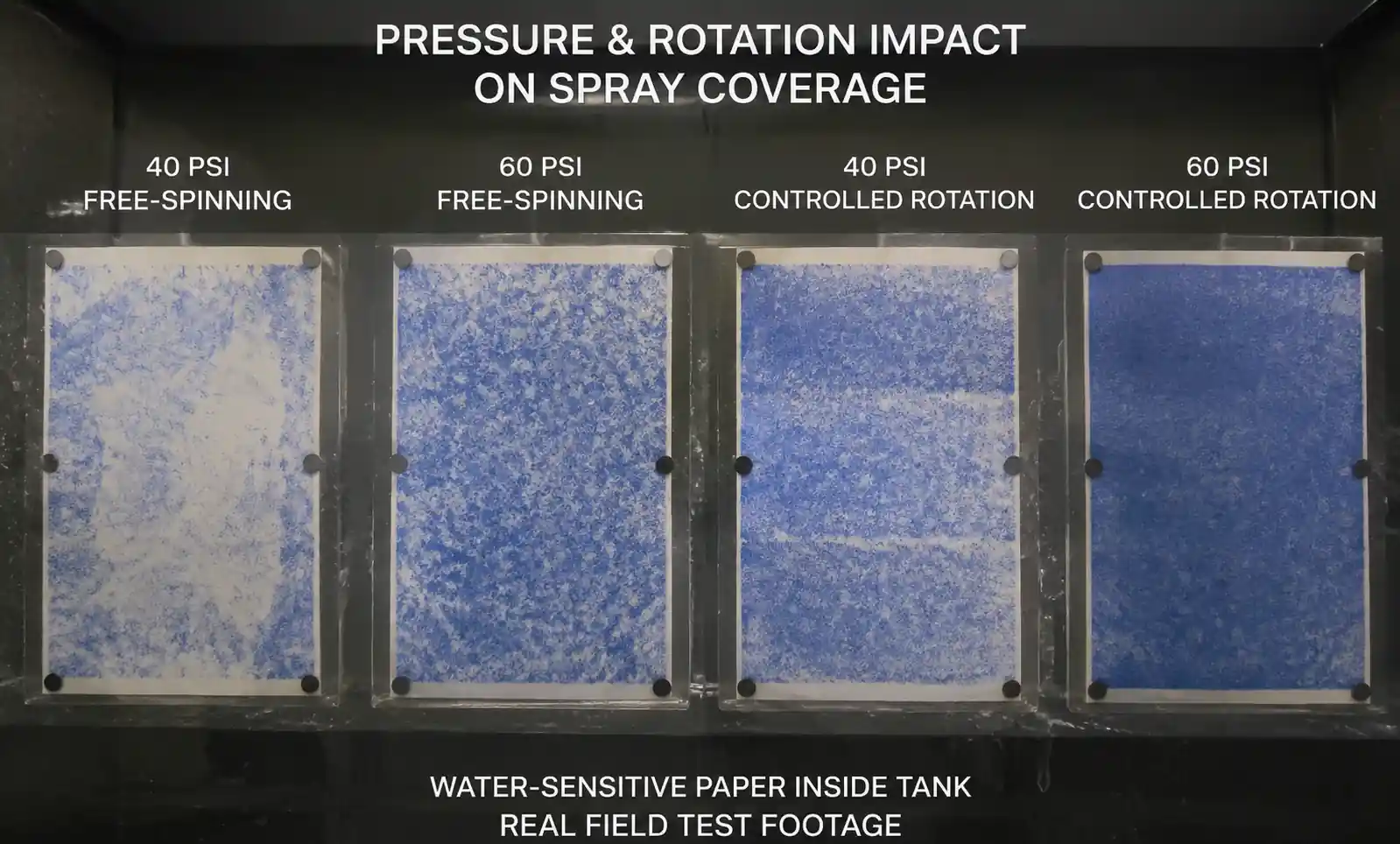
| Free-spinning | 40 PSI | ~6 RPM | 6 min | 180 gal | Incomplete (2nd cycle) |
| Free-spinning | 60 PSI | ~10 RPM | 4.5 min | 135 gal | Complete |
| Controlled (4 RPM) | 40 PSI | 4 RPM | 5 min | 150 gal | Complete |
| Controlled (4 RPM) | 60 PSI | 4 RPM | 5 min | 150 gal | Complete |
Key insight: At low pressure, free-spinning required a second cycle (360 gal total). Controlled rotation completed in one cycle across the pressure range.
4. Mechanical Reliability and Wear Life Analysis
4.1 Bearing and Seal Wear
From a 24-month field study across 15 pharmaceutical tank cleaning installations:
| Nozzle Type | Hours Before Maintenance | Primary Failure Mode | Cost per Event |
|---|---|---|---|
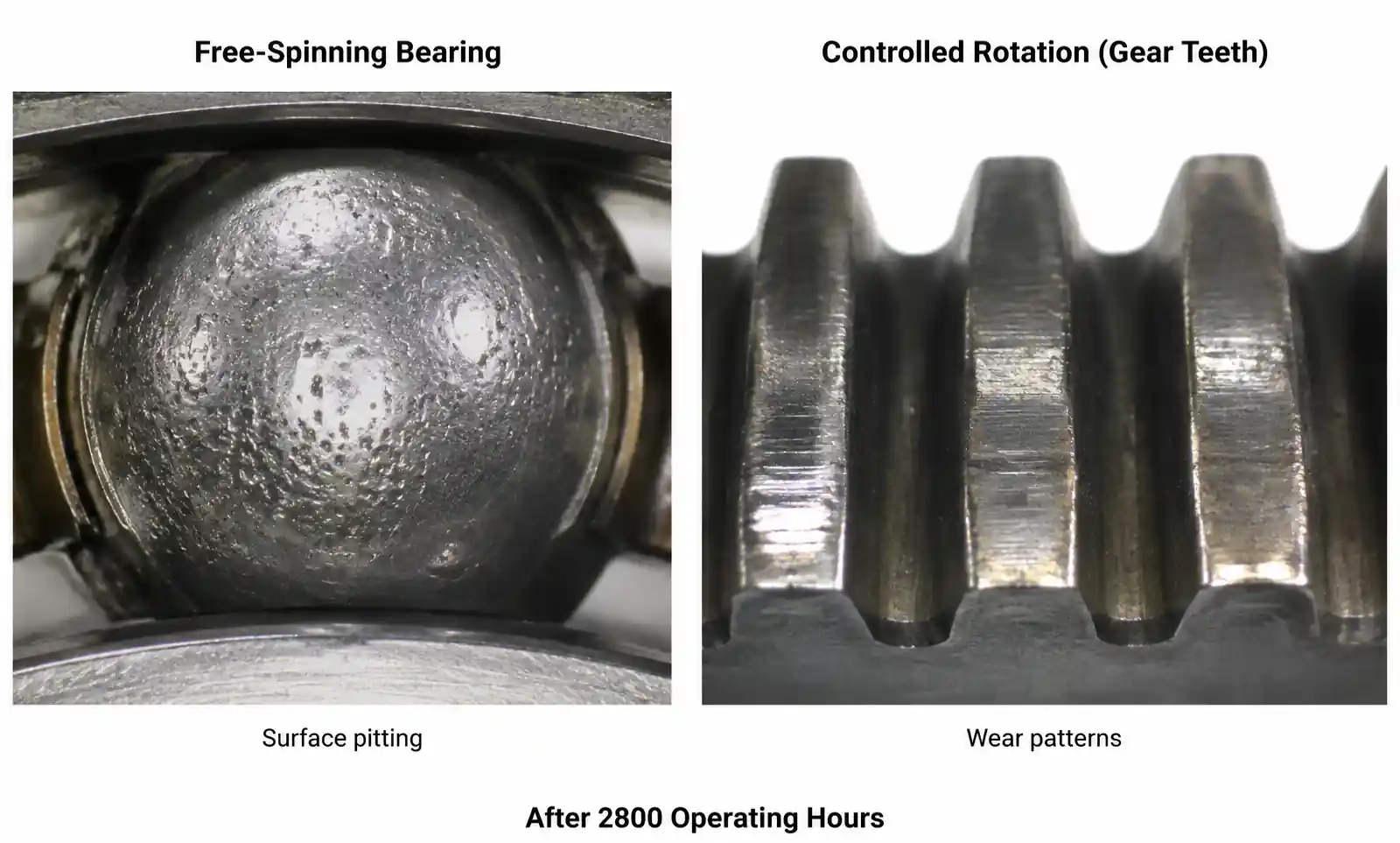
| Free-spinning (ball bearing) | 2,800 | Bearing wear / wobble | $120 |
| Controlled (gear-driven) | 2,200 | Gear tooth wear / jamming | $280 |
| Controlled (ceramic, fluid-lubricated) | 4,500 | Seal degradation | $200 |
Free-spinning had longer intervals but lower per-event cost. Advanced controlled nozzles with ceramic bearings outperformed both, justifying their premium in high-use applications.
🔧 For a systematic approach to diagnosing nozzle wear and preventing premature failure, refer to our Nozzle Failure Analysis in Desulfurization Systems guide.
4.2 Clogging Resistance
Free-spinning nozzles have simpler internal geometry — straight-through flow with minimal turbulence — making them less prone to debris accumulation. Controlled rotation nozzles have turbine blades and tight clearances that trap particles.
Rule of thumb:
- Suspended solids or no fine filtration → Free-spinning
- Clean or pre-filtered fluid → Controlled rotation is acceptable
4.3 Abrasive/Corrosive Fluid Considerations
Abrasive slurries accelerate wear on all moving parts. Controlled rotation requires ceramic or carbide gears (expensive). Free-spinning eliminates gears entirely — using ceramic bearing inserts and hardened orifices can extend life significantly.
Example: Alumina slurry (5% solids, pH 10) — stainless free-spinning nozzles lasted 800 hours; switching to silicon carbide bearings/jets extended this to 3,000 hours.
5. Application-Specific Selection Guide
5.1 Food & Beverage CIP
Regulatory agencies (FDA, USDA, EHEDG) require documented proof of coverage. Controlled rotation is strongly preferred for validation consistency.
Recommendation: 3–4 RPM for tanks up to 5,000 gal, 2–3 RPM for larger vessels. 316L stainless, EPDM seals for up to 180°F. Annual seal/bearing inspection.
5.2 Pharmaceutical (cGMP)
Controlled rotation is nearly universal. Repeatability justifies higher cost. Viscous fluids (syrups, suspensions) also favor controlled rotation.
Recommendation: 316L wetted parts, PTFE or FFKM seals, 40–100 PSI. Supplier must provide IQ/OQ documentation and material traceability.
5.3 Industrial & Bulk Storage (Cost-Sensitive)
Light soils, stable pressure, no validation requirement → Free-spinning excels. A $400 free-spinning nozzle delivers ~90% of the cleaning effectiveness of a $1,200 controlled nozzle with half the maintenance cost.
5.4 Heavy Soil & Polymer Residues
Controlled rotation allows independent optimization of pressure (impact) and speed (dwell time). Free-spinning couples these variables — higher pressure increases impact but reduces dwell.
Recommendation: 2–3 RPM controlled nozzles at up to 120 PSI. Consider staged cycles: high-pressure soak phase (stationary/slow), followed by dynamic cleaning.
5.5 Decision Matrix
| Application | Recommended Type | Key Reason |
|---|---|---|
| Validated CIP, regulatory compliance | Controlled rotation | Repeatability, documentation |
| Viscous fluids (>50 cP) | Controlled rotation | Free-spinning slows excessively |
| Light soil, stable pressure | Free-spinning | Lower cost |
| Heavy soil, baked-on residues | Controlled rotation (2–3 RPM) | Maintain dwell at high pressure |
| Abrasive/particulate fluids | Free-spinning (carbide inserts) | Fewer clog points |
| High-temperature (>180°F) | Either (material-dependent) | Verify seal ratings |
6. Total Cost of Ownership Calculation
6.1 Worked Example: 3,000-Gallon Pharmaceutical Tank, 5-Year Horizon
Assumptions:
- 2× cycles/day, 250 days/year = 1,000 cycles/year, 5,000 cycles total
- Free-spinning: $450 initial, $120 maintenance every 2,800 hr (~1,400 cycles), 5 min cycle, 150 gal/cycle
- Controlled: $1,100 initial, $200 maintenance every 2,200 hr (~1,100 cycles), 5 min cycle, 150 gal/cycle
- Water: $0.005/gal; maintenance labor: $80/hr; downtime: $500/hr
| Cost Component | Free-Spinning | Controlled |
|---|---|---|
| Initial cost | $450 | $1,100 |
| Maintenance (parts + labor) | $800 | $1,600 |
| Water | $3,750 | $3,750 |
| Downtime | $4,000 | $5,000 |
| Total TCO | $9,000 | $11,450 |
Free-spinning is 27% lower TCO. However, if even one cleaning failure per year requires manual intervention (4 hours × $500 = $2,000/year, $10,000 over 5 years), controlled rotation becomes the lower-risk choice.
6.2 Sensitivity
- High throughput (3–5 cycles/day): Controlled rotation pulls ahead (downtime savings dominate).
- Low frequency (1–2 cycles/week): Free-spinning wins on economics.
Run your own TCO with actual operating parameters. The difference can be $5,000–$20,000 over the asset's life.
7. Common Installation and Maintenance Mistakes
Mistake #1: Incorrect Inlet Pressure Verify pressure at the nozzle inlet — gauges at the pump discharge may read 10–20 PSI higher due to piping losses. Install a gauge at the tank inlet or calculate pressure drop.
Mistake #2: Inadequate Filtration
- Controlled rotation: minimum 100-mesh (150 micron)
- Free-spinning: minimum 40-mesh (400 micron) Many CIP systems use 10–20 mesh strainers — insufficient.
⚠️ Understanding the root causes of nozzle failure—from erosion to clogging—can help you avoid these costly mistakes. See our guide on nozzle failure modes and fixes for detailed diagnostics.
Mistake #3: Ignoring Fluid Viscosity Water-based data does not translate to viscous fluids. If viscosity exceeds 20 cP, request manufacturer data at actual viscosity. A free-spinning nozzle rated 10 RPM at 60 PSI with water slowed to 4 RPM in 80 cP corn syrup — batch rejections.
Mistake #4: Insufficient Bearing Lubrication/Seal Inspection Externally lubricated controlled nozzles require grease every 500–1,000 hours. Fluid-lubricated types depend on clean process fluid. Inspect seals every 1,000 hours or annually — reactive maintenance leads to unplanned downtime.
Mistake #5: Overlooking Spare Parts Lead Time Specialty components (turbines, gear cartridges, ceramic bearings) can have 4–8 week lead times. Maintain one complete spare nozzle assembly plus consumables for two maintenance cycles.
8. FAQ
Can I convert a free-spinning nozzle to controlled rotation? No. The mechanisms are fundamentally different. You must replace the entire nozzle.
Which is better for high-temperature CIP (180–200°F)?
Both can work with the right seals. EPDM handles up to 180°F; FFKM or graphite extends to 200°F+. Verify with your manufacturer.
Do controlled rotation nozzles work at low pressure (20–30 PSI)? Most require 30–40 PSI minimum to generate sufficient turbine torque. Free-spinning can operate down to 15–20 PSI but rotates very slowly.
How do I calculate the right rotation speed for my tank size?
Target 100–120 seconds of dwell time per vertical degree for light soils, 180–240 seconds for heavy soils. For a 360° indexing nozzle, this translates to 2–6 RPM.
What is the typical pressure drop across a controlled rotation nozzle?
5–10 PSI higher than an equivalent free-spinning nozzle at the same flow rate. Factor this into pump sizing.
Can I use a free-spinning nozzle in a validated pharmaceutical application?
Yes — if you can demonstrate repeatable performance across the operating pressure range. This requires tight pressure control (±5 PSI) and documented validation. Most pharma operations choose controlled rotation to avoid this burden.
9. Conclusion and Next Actions
Free-spinning and controlled rotation nozzles solve the same problem — automated tank cleaning — using fundamentally different approaches.
| If You Need... | Choose... |
|---|---|
| Validated, consistent cleaning for regulatory compliance | Controlled rotation |
| Viscous or variable fluids | Controlled rotation |
| Light soils, stable pressure, cost sensitivity | Free-spinning |
| Heavy soils requiring high impact + adequate dwell | Controlled rotation |
| Abrasive or particulate-laden fluids | Free-spinning (carbide inserts) |
Your Next Steps:
- Measure actual inlet pressure, flow rate, and fluid properties (viscosity, temperature, particulate load).
- Define cleaning requirements: cycle time, soil removal criteria, validation needs.
- Calculate TCO using your actual cycle frequency, maintenance costs, and downtime penalties.
- Request performance data — flow curves, speed vs. pressure, wear life estimates for your specific fluid.
- Run field trials if possible — test both types in your actual tank before committing.
📚 Further Reading:
Master the fundamentals of impact force, coverage, and nozzle sizing for optimal tank cleaning performance — check out our detailed guide: Cleaning Radius Explained: How to Size Your Nozzle.
All external and internal links are provided as additional resources to support your selection process. For specific application advice, consult your nozzle manufacturer or process engineering team.