



Air Atomizing Nozzles: Complete Guide for Fine Spray Applications
Air atomizing nozzles deliver droplets down to 10-50 microns—far finer than hydraulic alternatives. After evaluating spray systems across 30+ manufacturing facilities, I've observed that properly configured air atomizing systems consistently outperform conventional nozzles in applications demanding ultra-fine particle distribution, controlled coverage, and minimal overspray.
This guide explains how air atomizing nozzles work, when they deliver measurable advantages, and how to configure systems for optimal performance.
Table of Contents
1. How Air Atomizing Nozzles Work
Air atomizing nozzles use compressed air to break liquid into extremely fine droplets through a process fundamentally different from hydraulic pressure atomization.
The Atomization Mechanism involves two distinct fluid streams converging at high velocity. Compressed air (30-100 PSI) flows through dedicated passages while liquid (5-40 PSI) flows through separate channels. When these streams meet, the high-velocity air shears the liquid into progressively smaller droplets through aerodynamic forces.
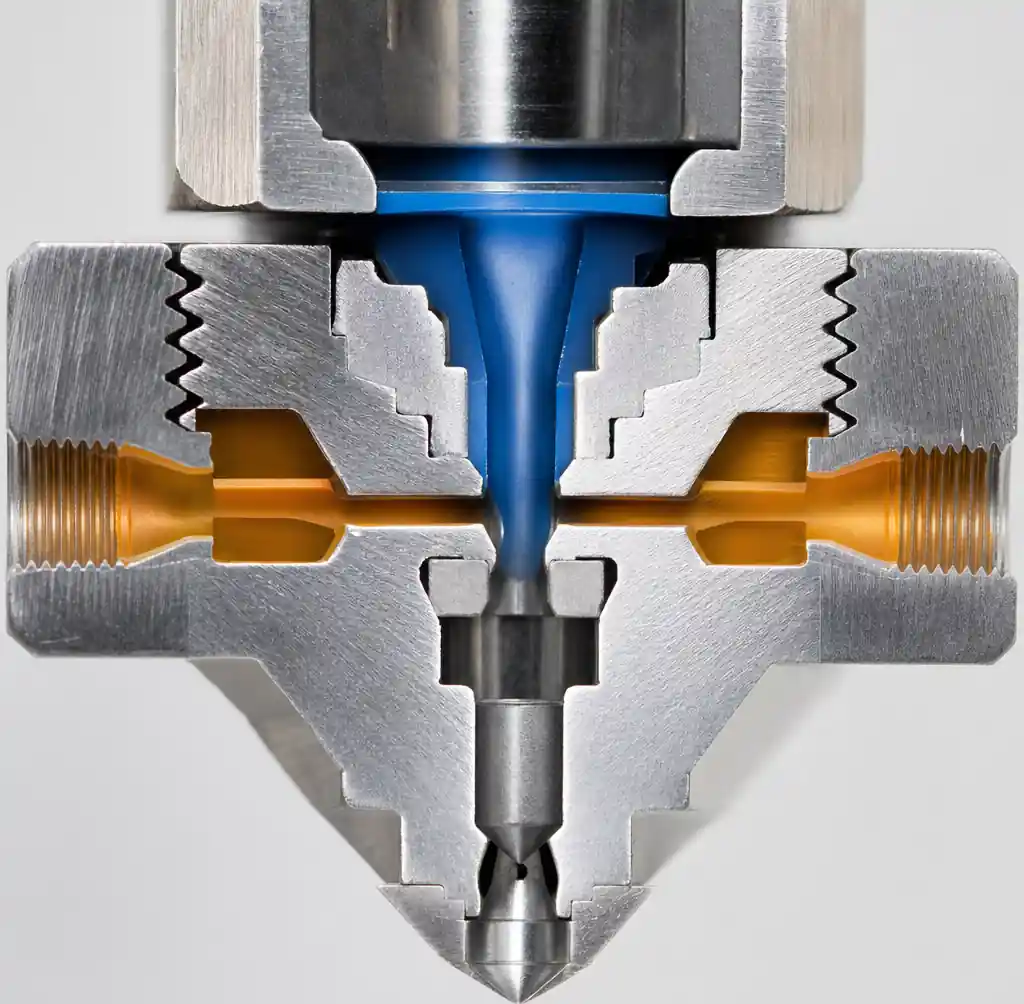 Air atomizing nozzle two-fluid mixing mechanism showing compressed air and liquid streams converging
Energy Transfer: Compressed air transfers kinetic energy to the liquid stream, overcoming surface tension and viscous forces. This occurs in microseconds as air accelerates to near-sonic velocities at the mixing point.
Unlike hydraulic nozzles relying solely on liquid pressure (500-3,000 PSI) through small orifices, air atomizing nozzles achieve superior atomization at much lower liquid pressures. A hydraulic nozzle producing 80-micron droplets requires 1,000+ PSI, while an air atomizing nozzle produces 30-micron droplets with just 15 PSI liquid and 60 PSI air.
Primary Atomization occurs at the air-liquid interface. Secondary Atomization continues as turbulent air flow further breaks larger droplets. This two-stage process enables the 10-50 micron range.
Compressed air serves three functions: breaks liquid into fine droplets, propels spray toward the target, and shapes the spray pattern through air cap geometry.
2. Droplet Size Control and Distribution Quality
Droplet size directly determines coating quality, evaporation efficiency, and surface coverage—making precise control essential.
Droplet Size Ranges by Nozzle Type:
| Nozzle Type | Typical VMD | Liquid PSI | Air PSI | Application Fit |
|---|---|---|---|---|
| Air Atomizing (Internal Mix) | 10-80 µm | 5-30 | 40-100 | Fine coating, lubrication |
| Air Atomizing (External Mix) | 30-150 µm | 10-40 | 30-80 | Heavier coatings, cooling |
| Hydraulic Pressure | 80-400 µm | 500-3,000 | None | Tank cleaning, washing |
| Ultrasonic | 8-40 µm | Near-zero | None | Pharmaceutical, electronics |
Volume Median Diameter (VMD) represents the size where 50% of liquid volume is smaller and 50% larger. Quality coatings typically require VMD between 25-60 microns.
Span Value measures distribution uniformity: (D90 - D10) / D50. Lower values indicate more uniform distributions. Air atomizing nozzles achieve span values of 0.8-1.4, while hydraulic nozzles produce 1.6-2.8—demonstrating significantly tighter control.
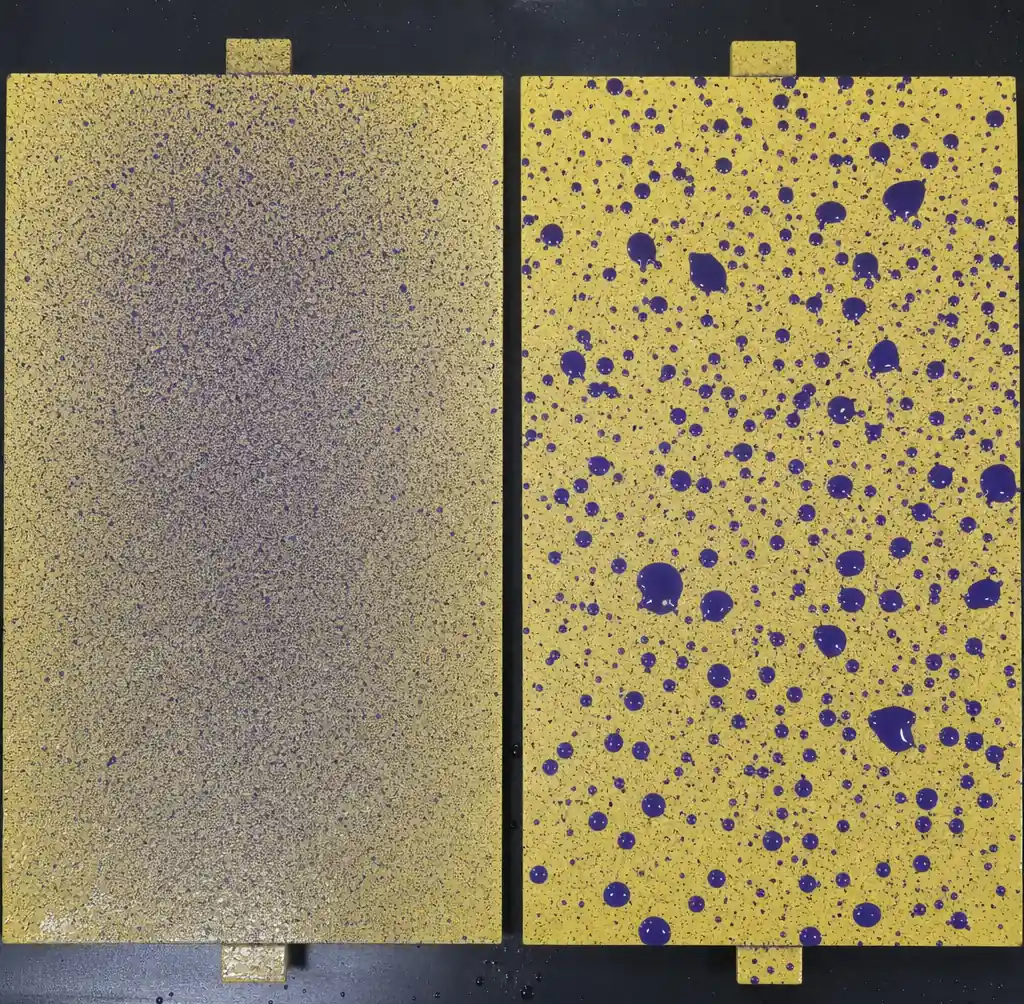 Droplet size comparison between air atomizing and hydraulic pressure nozzles on water-sensitive paper
One automotive coating line reduced defect rates from 8.2% to 1.7% after switching to air atomizing nozzles. The tighter distribution eliminated coarse droplets (>150 µm) causing orange peel and ultra-fine mist (<15 µm) creating dry spray defects.
Adjustability allows real-time droplet size adjustment by varying air pressure (±10-20 PSI) without stopping production.
3. Air-to-Liquid Ratio: The Critical Variable
The volumetric ratio between compressed air and liquid determines atomization quality, operating costs, and application success.
Defining the Ratio: ALR compares volumetric flow of compressed air (SCFM) to liquid flow (GPH). An ALR of 10:1 means 10 cubic feet of air per gallon of liquid.
Typical Operating Ranges:
- Fine coating: 12:1 to 20:1
- General coating: 8:1 to 14:1
- Humidification: 6:1 to 12:1
- Heavy chemical: 4:1 to 8:1
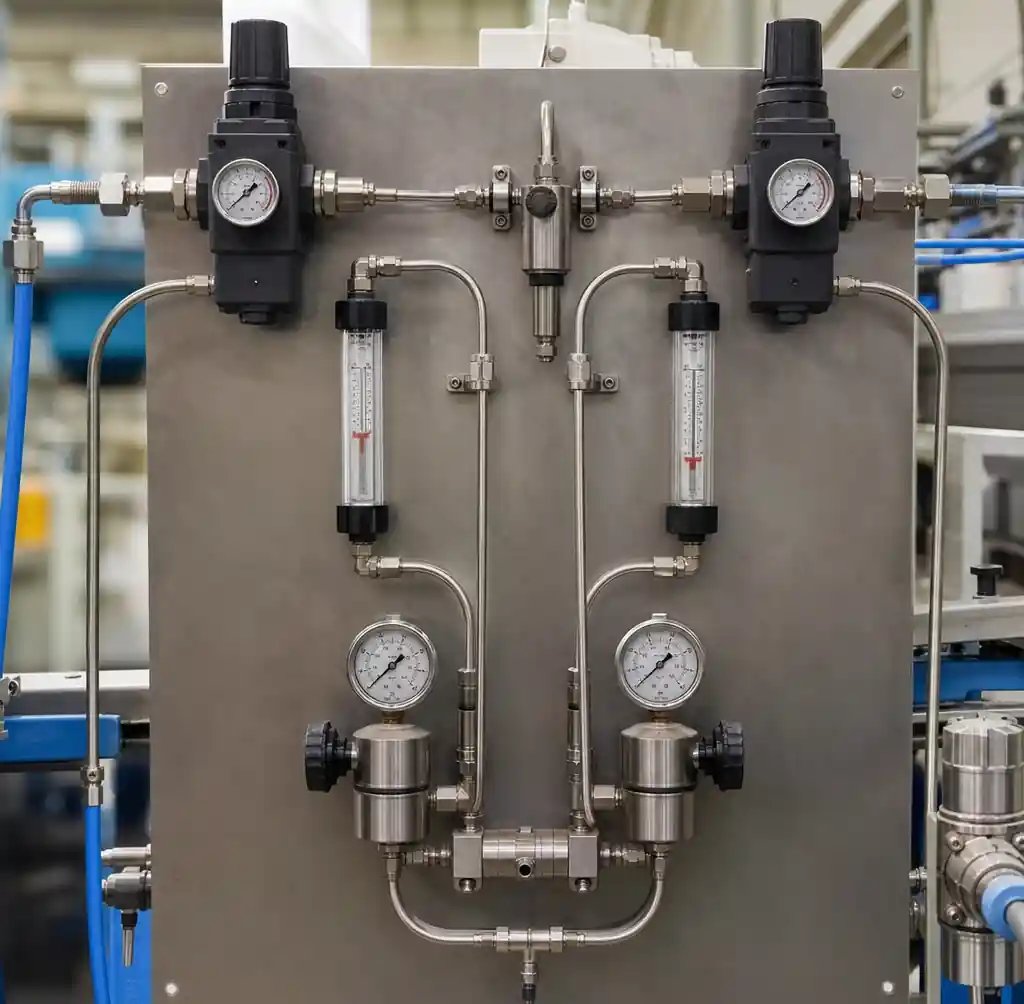 Air atomizing nozzle system control panel with pressure regulators for adjusting air-to-liquid ratio
Performance vs Cost: Higher ALR produces finer droplets but consumes more compressed air. One electronics manufacturer found increasing ALR from 10:1 to 15:1 improved coating uniformity by 18% but increased air costs $12,400 annually per line.
| Application | Target Droplet Size | Recommended ALR | Air Consumption (SCFM/GPH) | Cost Impact |
|---|---|---|---|---|
| Precision Coating | 15-30 µm | 15:1 to 20:1 | 100-133 | High |
| General Coating | 35-60 µm | 10:1 to 14:1 | 67-93 | Moderate |
| Humidification | 50-100 µm | 7:1 to 11:1 | 47-73 | Low |
| Cooling | 80-150 µm | 5:1 to 8:1 | 33-53 | Very Low |
Optimization: Start at manufacturer-recommended ALR, measure droplet size, then adjust air pressure in 5-10 PSI increments until achieving targets.
A pharmaceutical operation reduced ALR from 18:1 to 12:1 after validation proved 45-micron droplets met specs—saving $28,600 annually across 14 booths.
4. Key Applications
Air atomizing nozzles deliver measurable advantages where fine droplets, controlled deposition, or minimal surface impact matter.
Coating and Finishing: Automotive paint booths, industrial equipment finishing, and wood coating benefit from 20-60 micron droplets creating smooth, uniform films. Transfer efficiency reaches 65-85% versus 45-60% for hydraulic spray guns.
Precision Lubrication: 15-30 micron oil mist coats bearing surfaces and cutting tools with minimal volume. One stamping facility reduced lubricant consumption from 42 to 18 gallons/month after installing MQL systems on 20 presses.
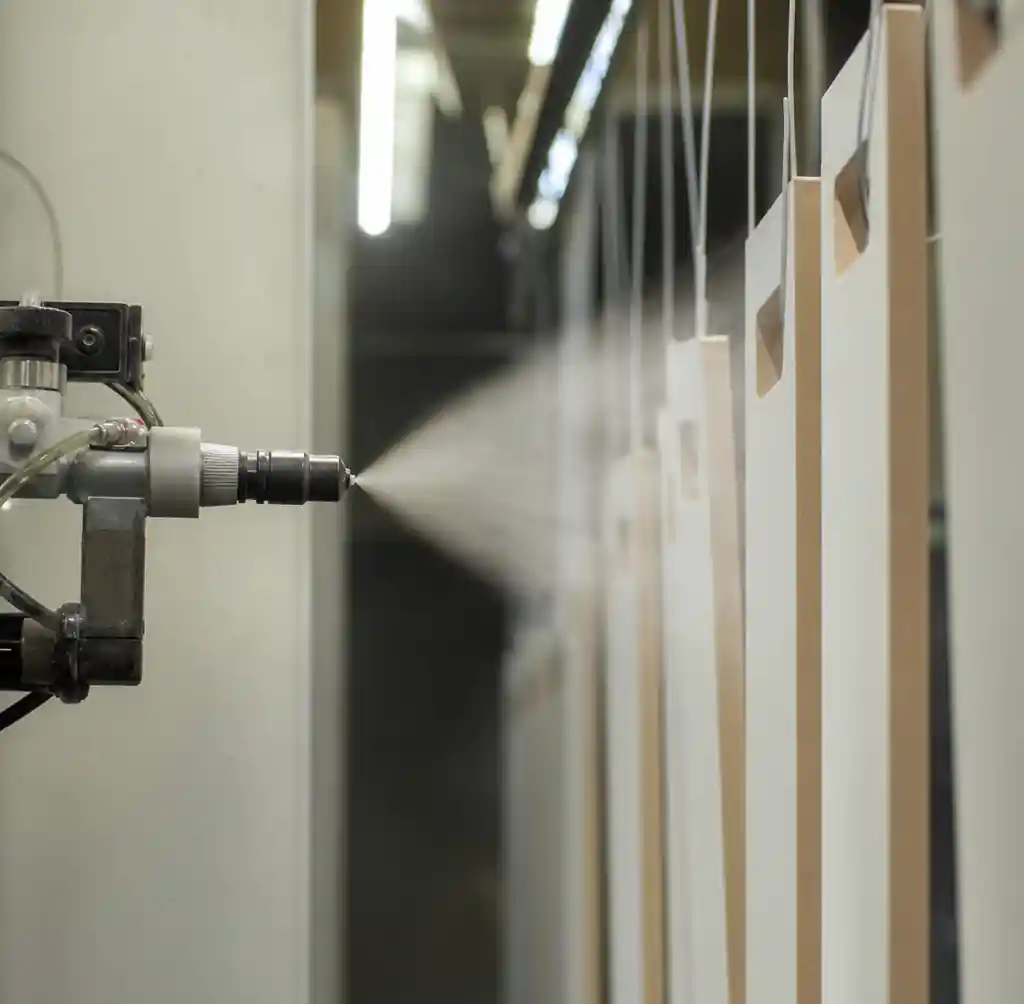 Air atomizing nozzle applying fine coating spray in industrial coating booth
Humidification: 50-100 micron droplets evaporate before reaching surfaces. Textile mills and electronics assembly areas maintain 45-55% RH without wetting products. One printing facility eliminated paper curl defects with ±2% RH stability.
Pharmaceutical and Food: 316 stainless steel external mix designs meet 3-A standards for coating tablets and spraying release agents. Low liquid pressure (10-25 PSI) prevents product damage.
Dust Suppression: 80-120 micron droplets capture airborne particles through impaction. Mining and waste facilities create fog barriers suppressing fugitive dust without wet surfaces.
Cooling: 60-100 micron droplets flash-evaporate in high-temperature environments. Steel mills and glass tempering lines cool products rapidly while minimizing water use.
For broader context, see spray nozzle applications in manufacturing.
5. System Setup Requirements
Air atomizing nozzles demand specific infrastructure and precise configuration.
Compressed Air: 40-100 PSI, 3-25 SCFM per nozzle, ISO 8573-1 Class 4 or better (oil <1 mg/m³), dew point 10°F below ambient.
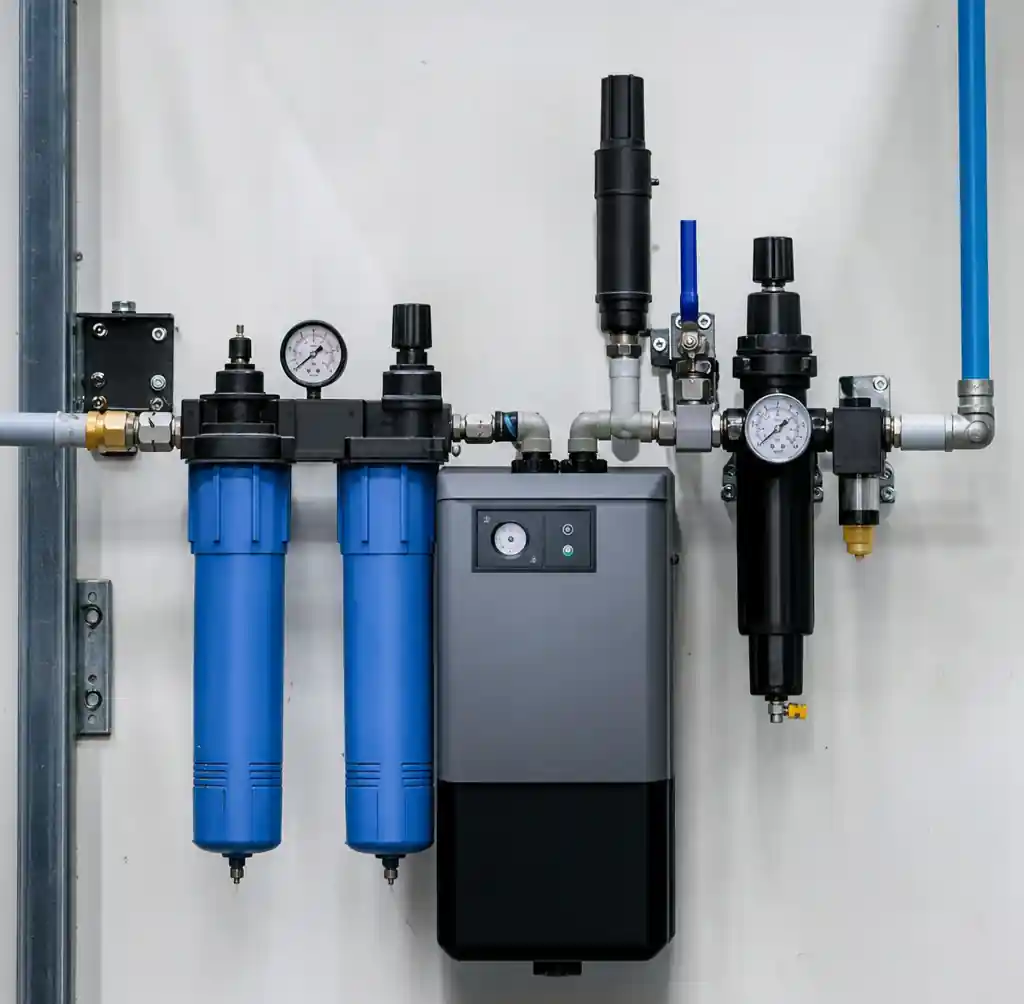 Compressed air preparation system with filters, dryers and regulators for air atomizing nozzles
Air Preparation: Pressure regulators (±1 PSI stability), coalescing filters (5-micron minimum), desiccant dryers for Class 2-3 air, and pressure gauges at each zone.
One food facility experienced coating defects from compressor oil carryover. Installing 0.01-micron coalescing filters and carbon adsorbers eliminated the problem.
Liquid Supply: 5-40 PSI, 100-200 mesh filtration (74-149 microns), flow meters, and pressure regulators for consistent flow.
Piping: Dedicated lines to each nozzle, liquid velocity below 20 ft/sec, air below 30 ft/sec, drip legs with automatic drains, and isolation valves for servicing.
Controls: Manual needle valves for steady-state operations; solenoid valves for automated intermittent spraying—reducing waste by 40-70%.
See our industrial nozzle accessories category for components.
6. Internal vs External Mix
The location where air and liquid meet determines performance characteristics and application suitability.
Internal Mix combines air and liquid inside the nozzle body before discharge through a single orifice. Creates finest droplets (10-50 µm) with highly uniform distribution. Air and liquid meet within converging passages where turbulent shear forces atomize, then exit through a precisely sized orifice.
External Mix keeps air and liquid separate until they converge outside. Liquid exits through a central orifice while compressed air flows through an external ring, shearing the stream in open air. Produces larger droplets (30-150 µm) with wider patterns and higher flow.
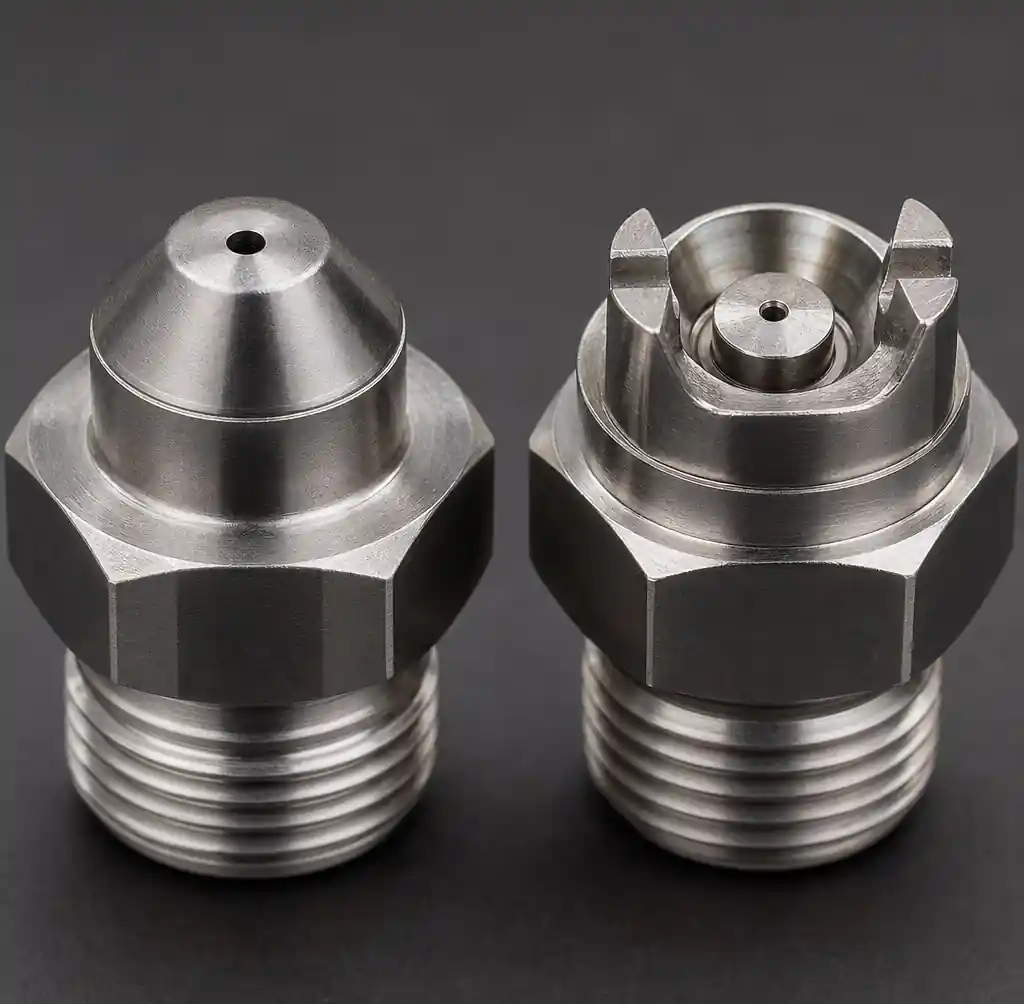 Internal mix and external mix air atomizing nozzle designs side by side showing structural differences
Comparison:
| Characteristic | Internal Mix | External Mix |
|---|---|---|
| Droplet Size | 10-50 µm | 30-150 µm |
| Atomization | Excellent, very uniform | Good, moderate |
| Flow Capacity | 0.1-2.0 GPH | 0.5-10 GPH |
| Viscosity Limit | Up to 300 cP | Up to 2,000 cP |
| Clogging Risk | Higher | Lower |
| Maintenance | More frequent | Less frequent |
| Liquid Pressure | 5-20 PSI | 10-40 PSI |
| Siphon Feed | Yes (many models) | Limited |
Selection Logic: Choose internal mix for precision coating (15-40 µm), fine lubrication, pharmaceutical/electronics applications, and low-viscosity liquids (<300 cP). Choose external mix for higher viscosities (300-2,000 cP), higher flow rates (>2 GPH), environments needing easy cleaning, and chemical spraying where clogging from crystals is a concern.
Siphon vs Pressure Feed: Siphon-fed internal mix nozzles draw liquid using vacuum—eliminating pumps in low-volume applications. Pressure-fed systems require pumps but deliver more consistent flow and precise metering.
One precision coating operation switched from external to internal mix, reducing thickness variation from ±12 to ±4 microns across curved surfaces—but increased maintenance from monthly to weekly.
FAQ
What droplet size do air atomizing nozzles produce? 10-150 microns depending on design. Internal mix: 10-50 µm; external mix: 30-150 µm. Hydraulic nozzles generate 80-400+ µm.
How much compressed air do they consume? 3-25 SCFM per nozzle. A 0.5 GPH nozzle at 12:1 ALR consumes ~6 SCFM. Ten nozzles may require 60-200 SCFM compressor capacity.
Can they handle viscous liquids? Internal mix handles up to 300 cP; external mix up to 2,000 cP. Beyond these limits, heated systems or specialized designs are needed.
What maintenance is required? Daily visual inspection; weekly external cleaning. Internal mix: disassemble and clean every 1-4 weeks; external mix: every 4-8 weeks. Replace orifices when pattern degrades or flow drops >10%.
Do they save liquid vs hydraulic nozzles? Yes—transfer efficiency of 65-85% vs 45-60% for hydraulic, meaning 20-40% less waste. However, compressed air costs must be factored in.
What air pressure is optimal? 40-80 PSI typically. Lower pressures (40-60 PSI) for humidification/cooling; higher (60-100 PSI) for precision coating. Balance atomization quality against operating costs.
Conclusion
Air atomizing nozzles deliver proven advantages in applications demanding fine droplet control, uniform distribution, and precise coverage. The 10-150 micron range, achieved through compressed air shear rather than high liquid pressure, enables coating quality and efficiency unattainable with conventional hydraulic nozzles.
Success requires matching nozzle design to application needs, providing adequate compressed air infrastructure, and optimizing ALR to balance performance against costs. Internal mix excels in precision applications; external mix handles higher viscosities and flow rates with less maintenance.
At YuechenPrecision Technology, we provide engineered air atomizing nozzle systems with configuration guidance, air consumption analysis, and technical support to ensure measurable performance improvements from installation forward.