



When to Replace vs Clean Spray Nozzles: Cost Analysis
Replace spray nozzles when flow rate increases by more than 10% or visible wear appears on the orifice—cleaning only works for clogging, not erosion. In most industrial applications, the labor cost of cleaning ($15-45 per nozzle) often exceeds replacement cost ($8-50), making replacement more economical for worn components while cleaning remains effective for mineral buildup and debris blockages.
Table of Contents
Understanding Nozzle Degradation: Clogging vs. Wear
Industrial spray nozzles fail through two distinct mechanisms, and identifying which one affects your equipment determines whether cleaning or replacement is warranted.
Clogging occurs when foreign particles, mineral deposits, or chemical residues accumulate in the nozzle orifice or internal passages. This is reversible through proper cleaning procedures. Water with high mineral content leaves calcium and magnesium scale, while particulate-laden fluids create physical blockages. In our experience with tank cleaning applications, clogging accounts for approximately 60% of performance complaints in systems without adequate filtration.
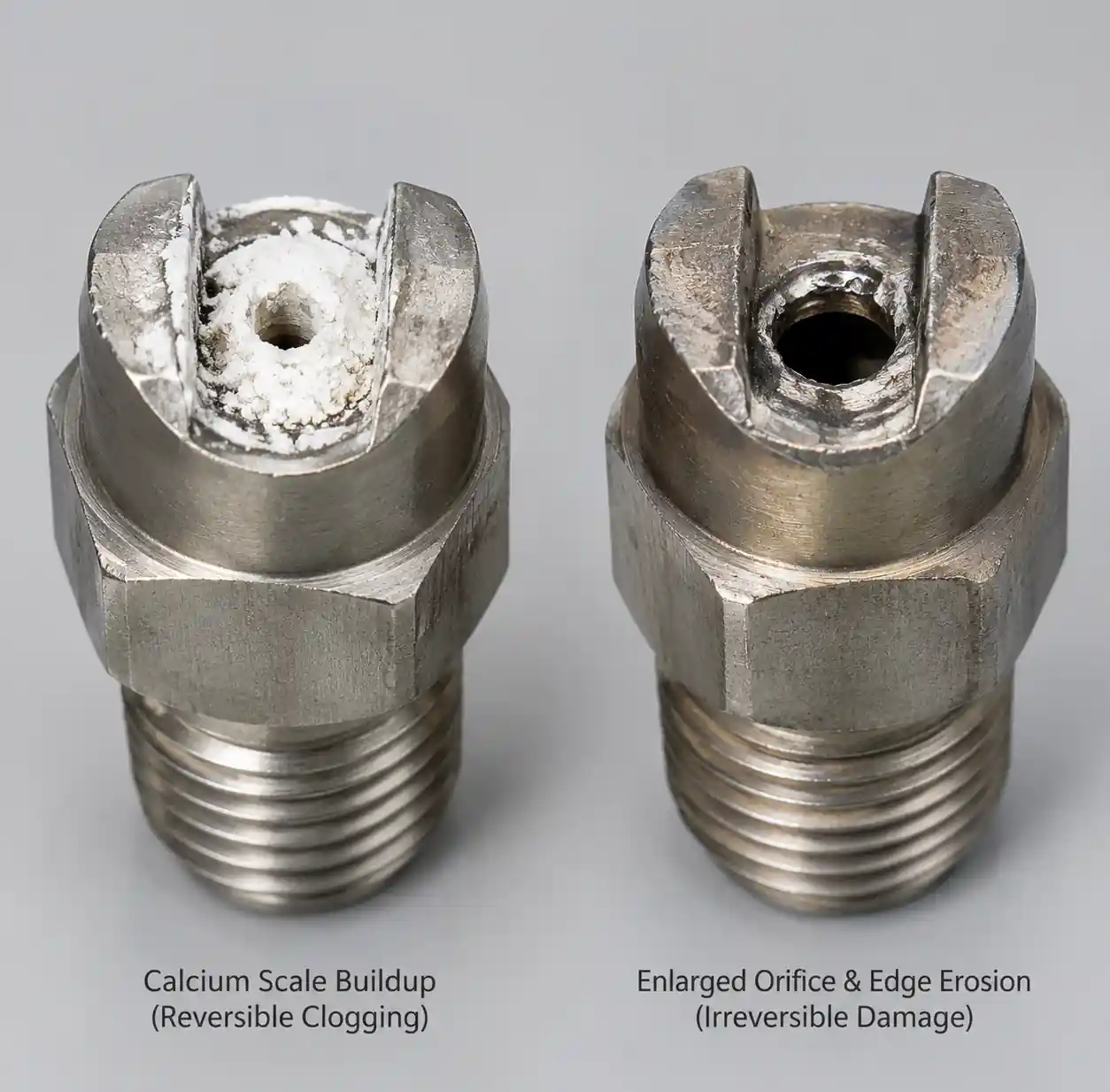 Visual comparison showing clogged spray nozzle with mineral deposits versus worn nozzle with eroded orifice
Wear results from abrasive fluids, high-velocity impacts, or corrosive chemicals gradually eroding the nozzle orifice and internal surfaces. This process is irreversible. Research shows that nozzle flow rates can increase by 30% due to orifice erosion long before visible damage appears. Unlike clogging, no amount of cleaning restores a worn nozzle's original spray pattern or flow characteristics.
The distinction matters financially: cleaning a clogged nozzle costs $15-45 in labor and materials, while replacing a worn nozzle costs $8-50 for the component plus installation. Attempting to clean a worn nozzle wastes resources without solving the underlying problem.
The True Cost of Nozzle Performance Loss
Degraded nozzle performance creates cascading costs that far exceed the component's replacement price. Understanding these hidden expenses reveals why proactive replacement delivers superior ROI compared to reactive maintenance.
Excess Fluid Consumption: A worn full cone nozzle operating at 110% of rated flow wastes 10% of fluid volume continuously. For a cooling system running 6,240 hours annually at 100 GPM with water costing $2.75 per 1,000 gallons, this represents $1,716 in annual waste per worn nozzle—before accounting for pumping energy or treatment chemicals.
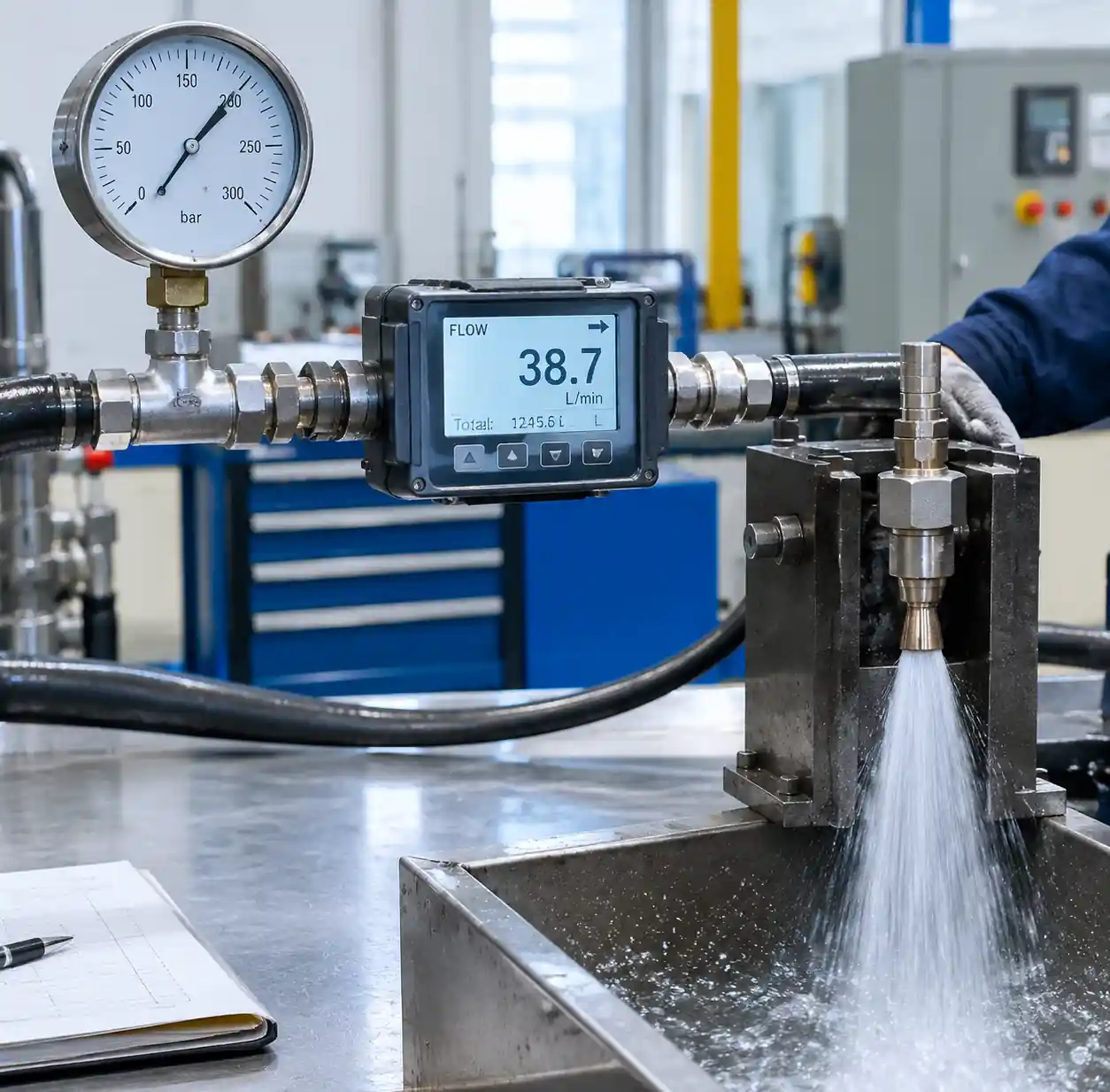 Flow meter measurement showing increased flow rate from worn industrial spray nozzle
Energy Penalties: Pumps work harder to maintain pressure when worn nozzles allow excessive flow. Our field data from chemical processing plants shows energy consumption increases of 8-15% in spray systems with nozzles worn beyond 10% of specification. For a 50 HP pump running continuously, this penalty costs $4,800-9,000 annually at $0.12/kWh.
Quality Control Failures: Inconsistent spray patterns from degraded nozzles cause coating thickness variations, incomplete surface coverage, and process instabilities. A single scrap event in automotive coating operations can waste $15,000-50,000 in materials and rework, dwarfing the $200-800 cost of replacing an entire nozzle array.
| Cost Category | Annual Impact per Worn Nozzle | Hidden Multiplier |
|---|---|---|
| Excess water/fluid | $1,200-2,500 | Chemical additives increase this 2-3x |
| Pumping energy | $800-1,500 | Compounds across all nozzles in system |
| Quality defects | $5,000-25,000 | One failure event exceeds years of nozzle costs |
| Unscheduled downtime | $10,000-100,000 | Production loss varies by industry |
According to Spraying Systems Co. research, facilities that implement quarterly nozzle inspections reduce total spray system operating costs by 22-35% compared to run-to-failure approaches.
When Cleaning Makes Economic Sense
Cleaning delivers positive ROI when nozzles are clogged but not worn, the cleaning process is faster than replacement logistics, and the nozzles have sufficient remaining service life to justify the labor investment.
Optimal Cleaning Candidates:
- Air atomizing nozzles with mineral scale buildup from hard water
- Precision nozzles ($100+) with debris blockages but intact orifices
- Arrays where replacement requires system shutdown but cleaning can be performed in-place
- Stainless steel or ceramic nozzles less than 50% through expected service life
Effective Cleaning Methods: Ultrasonic cleaning at 40 kHz frequency removes 95% of deposits without damaging precision orifices, completing the process in 10-15 minutes per nozzle. Chemical descalers containing phosphoric or citric acid dissolve mineral scale effectively; we recommend pH-balanced formulations that won't attack stainless steel or brass substrates.
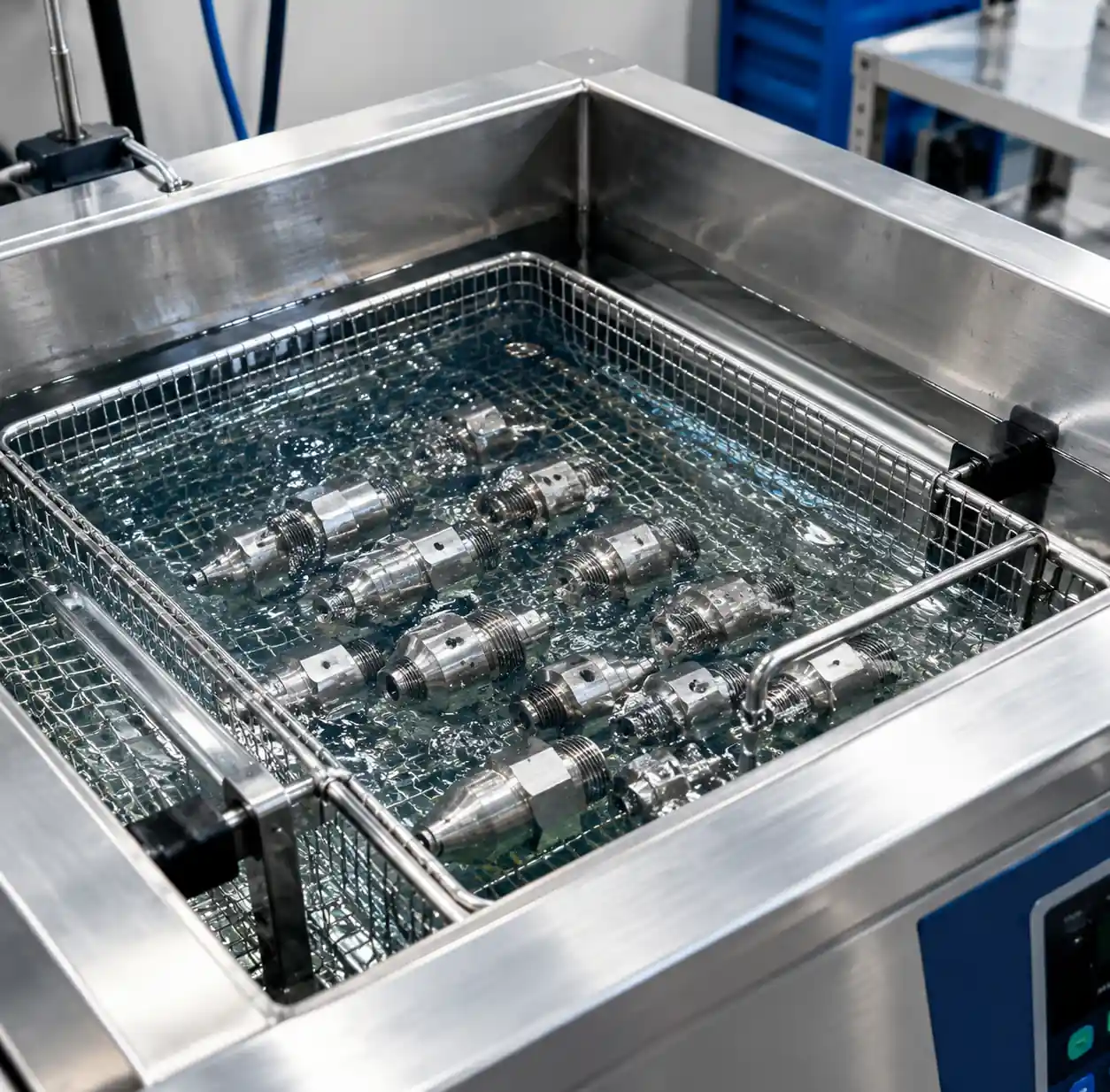 Ultrasonic cleaning tank with industrial spray nozzles being cleaned
Manual cleaning with soft brass brushes works for external deposits but risks scratching precision orifices. Never use steel wire brushes or drill bits to clear blockages—these tools invariably enlarge the orifice, creating the same performance degradation as natural wear.
Cost-Benefit Analysis for Cleaning:
| Nozzle Type | Replacement Cost | Cleaning Cost | Cleaning ROI Threshold |
|---|---|---|---|
| Standard brass nozzle | $8-15 | $20-30 labor | Negative—replace instead |
| Precision hollow cone nozzle | $45-80 | $25-35 | Positive if <3 years old |
| Ceramic or tungsten carbide | $150-400 | $30-50 | Positive if >40% life remains |
| Custom-engineered array | $500-2000 | $100-200 | Almost always positive |
The SmartMist analysis reveals a critical insight: a $3 misting nozzle costs less than 17 minutes of technician time to clean. At $60/hour labor rates, cleaning makes sense only when nozzle replacement cost exceeds $17—ruling out most standard industrial nozzles.
When Replacement Is the Only Option
Certain conditions eliminate cleaning as a viable option, making immediate replacement the only technically and economically sound decision.
Absolute Replacement Indicators:
-
Flow Rate Increase >10%: Industry standards, including those from ASABE, specify replacement when measured flow exceeds nominal rating by 10% at standard pressure. This threshold indicates orifice erosion has progressed beyond acceptable tolerances.
-
Visible Orifice Damage: Scratches, chips, oval distortion, or edge wear visible under 10x magnification confirm irreversible damage. Even microscopic irregularities disrupt laminar flow, degrading spray pattern uniformity.
-
Spray Pattern Distortion: Streaking, off-center patterns, or incomplete cone angles indicate internal passage erosion. Our testing shows that flat fan nozzles with pattern deviations exceeding 15° from specification cannot be restored through cleaning.
-
Operating Hour Thresholds: Material-specific replacement intervals apply regardless of visible wear. Brass nozzles in abrasive slurry service typically require replacement every 1,200-2,000 hours, while tungsten carbide versions last 15,000-25,000 hours in identical conditions.
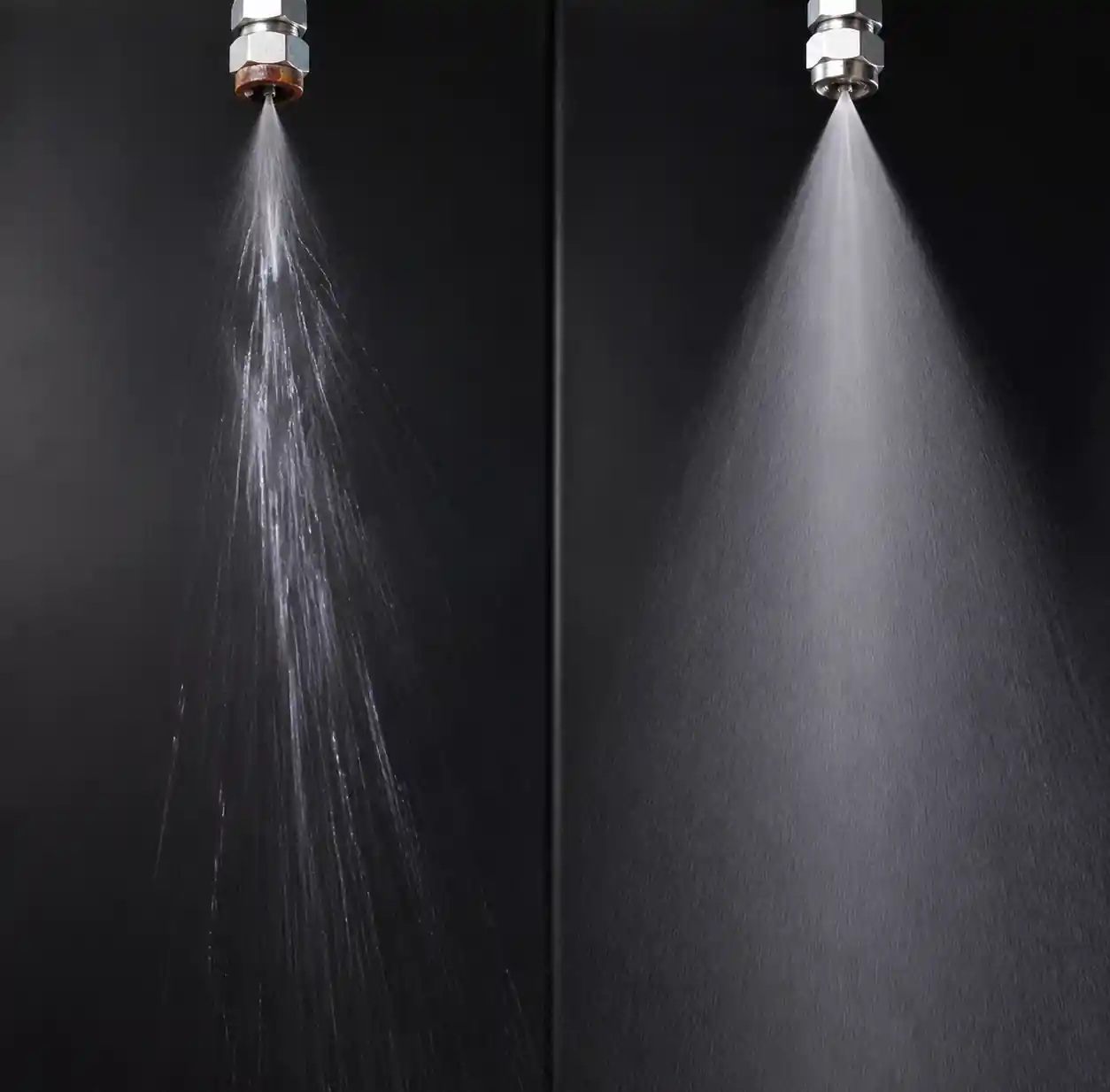 Spray pattern testing showing distorted pattern from worn nozzle versus uniform pattern from new nozzle
High-Priority Replacement Scenarios: Safety-critical applications including firefighting systems, emergency cooling, and chemical neutralization demand immediate replacement at the first sign of degradation. The liability exposure and potential consequences of spray system failure in these applications make preventive replacement the only acceptable strategy.
Production coating and finishing operations similarly cannot tolerate degraded performance. Automotive paint lines, for instance, replace entire nozzle arrays every 2,000-3,000 hours regardless of apparent condition, as the cost of a single defect event exceeds the entire annual nozzle budget.
Cost of Delayed Replacement: Facilities that defer nozzle replacement to "get the last bit of life" consistently experience higher total costs. One chemical processor we consulted continued operating nozzles at 125% of rated flow for six months, saving $400 in nozzle costs while incurring $8,400 in excess water charges and $12,000 in wasted treatment chemicals—a net loss of $20,000.
Decision Framework: Replace or Clean?
A systematic evaluation process eliminates guesswork and ensures maintenance decisions align with economic and operational objectives. Follow this four-step framework to make evidence-based choices.
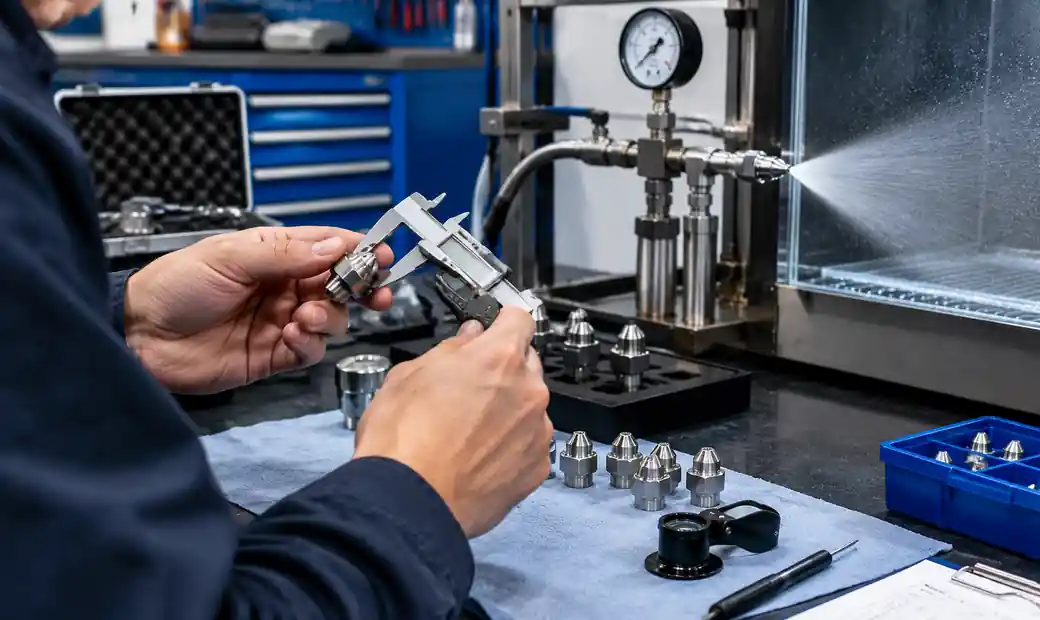 Technician using inspection tools to measure spray nozzle performance
Step 1: Measure Current Performance
- Flow rate at operating pressure (compare to nameplate specification)
- Spray angle and pattern uniformity (visual inspection and pattern test)
- Pressure drop across nozzle (indicates partial clogging)
Step 2: Calculate Economic Threshold
Cleaning Cost Justification = (Nozzle Replacement Cost + Installation Labor) - Cleaning Labor Minimum Justifiable Nozzle Value = Cleaning Labor / Potential Additional Service Life (in years)
For standard applications with $30 cleaning cost and 2-year potential remaining life, cleaning makes sense only for nozzles valued at $15 or more.
Step 3: Assess Root Cause
- Deposits/scale/debris visible = clogging (cleanable)
- No visible blockage but performance loss = wear (replace)
- Pattern distortion with normal flow = internal erosion (replace)
- Intermittent performance = partial clogging (cleanable)
Step 4: Decision Matrix
| Condition | Flow Rate Change | Pattern Quality | Decision |
|---|---|---|---|
| Visible deposits | <5% increase | Good | Clean |
| Visible deposits | 5-10% increase | Good | Clean, then monitor weekly |
| No visible deposits | >10% increase | Degraded | Replace immediately |
| Visible orifice wear | Any increase | Any quality | Replace immediately |
| High-value nozzle ($100+) | <10% increase | Good | Clean, measure again after 100 hrs |
| Low-value nozzle (<$20) | Any increase | Any quality | Replace—cleaning cost exceeds nozzle value |
This framework aligns with maintenance best practices documented by Spraying Systems Co. and reflects real-world performance data from over 15 years of industrial spray system optimization.
Real-World Example: A food processing facility used this framework to evaluate 240 sanitary spray nozzles in their clean-in-place system. Testing revealed 85 nozzles with clogging (cleaned at $25 each = $2,125), 45 nozzles with >10% flow increase (replaced at $35 each = $1,575), and 110 nozzles within specification (no action). Total maintenance cost: $3,700. The previous year's blanket replacement approach cost $8,400 for identical nozzle inventory. Framework adoption saved $4,700 annually while improving system reliability.
Preventive Maintenance to Extend Nozzle Life
Proactive maintenance strategies can double or triple nozzle service life while reducing both cleaning frequency and replacement costs. These practices pay for themselves within the first year of implementation.
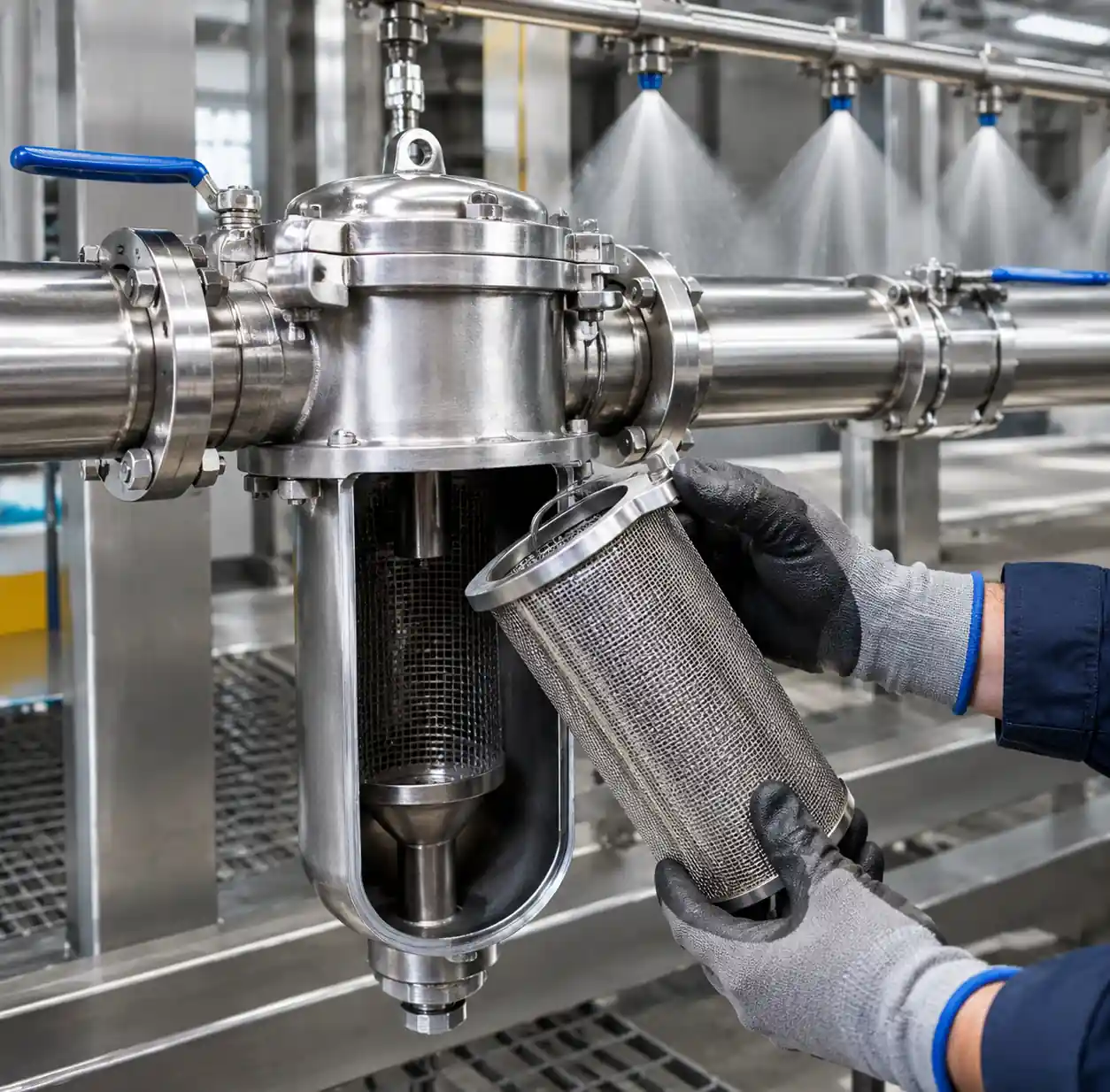 Inline filter strainer installed upstream of spray nozzle system for preventive maintenance
Filtration: Installing 50-mesh (297 micron) filters upstream of nozzle arrays prevents 90% of clogging incidents. For precision nozzles with orifices below 0.5mm, upgrade to 100-mesh (149 micron) or finer filtration. One automotive plant reduced nozzle cleaning frequency from monthly to quarterly after installing properly-sized strainers, saving 180 labor hours annually.
Water Treatment: Softening systems that reduce hardness below 3 grains per gallon (51 mg/L) virtually eliminate mineral scale formation. For operations where water softening is impractical, polyphosphate dosing at 2-5 ppm keeps minerals in suspension, preventing deposition. The treatment cost of $0.15-0.30 per 1,000 gallons is insignificant compared to cleaning expenses.
Inspection Schedules: Quarterly performance testing identifies degrading nozzles before they impact production or waste significant resources. Create a simple test protocol:
- Measure flow rate at standard pressure (requires calibrated flow meter)
- Visually inspect spray pattern against reference template
- Record data in maintenance management system
- Replace or clean any nozzle exceeding thresholds
Material Selection: Nozzle longevity depends heavily on matching materials to service conditions. Our product line demonstrates these principles:
- Brass: Adequate for clean water, mild chemicals, non-abrasive service (12-18 month life)
- Stainless steel 316: Superior corrosion resistance, moderate abrasion resistance (24-36 month life)
- Ceramic: Excellent abrasion resistance, brittle under impact (36-48 month life in abrasive service)
- Tungsten carbide: Maximum wear resistance for severe abrasive applications (60-120 month life)
While tungsten carbide nozzles cost 8-12x more than brass equivalents, they deliver 5-10x the service life in abrasive applications, providing superior total cost of ownership. See our complete product range for application-specific material recommendations.
Documentation: Maintain records of nozzle installation dates, performance test results, and replacement history. This data reveals wear patterns, optimizes replacement intervals, and identifies system problems causing premature failure. Digital maintenance systems with automated alerts provide the best ROI for facilities operating 50+ nozzles.
FAQ
How often should industrial spray nozzles be inspected?
Quarterly inspections suit most applications, with monthly checks for critical systems and annual reviews for low-duty equipment. High-wear environments (abrasive fluids, high-pressure, continuous operation) benefit from monthly flow rate verification. Industry guidance suggests weekly visual inspections during routine operations, with formal testing every 90 days.
Can I clean spray nozzles with vinegar or household cleaners?
Distilled white vinegar (5% acetic acid) effectively dissolves mineral scale on brass and stainless steel nozzles without causing corrosion. Soak for 2-4 hours, then flush with clean water. Avoid vinegar on aluminum nozzles. Commercial descalers work faster but cost more. Never use bleach, drain cleaners, or harsh alkalis, as these damage most nozzle materials.
What causes spray nozzles to wear out faster than expected?
Premature wear stems from four primary causes: (1) abrasive particles in the fluid, (2) operating pressure exceeding design specifications by >20%, (3) corrosive chemicals incompatible with nozzle material, and (4) cavitation from excessive pressure drops. Adding filtration, verifying system pressure, confirming material compatibility, and properly sizing nozzles address these issues.
Is it worth cleaning or should I just replace cheap nozzles?
Replace any nozzle costing less than 3x your hourly labor rate. At $60/hour shop rate with 20-minute cleaning time, replace nozzles under $60. The math rarely favors cleaning standard brass nozzles ($8-25 range). Reserve cleaning for precision, ceramic, or custom nozzles valued above $50.
How do I measure if a spray nozzle is worn beyond acceptable limits?
Install a calibrated flow meter and pressure gauge in your test setup. Run the nozzle at its rated pressure and measure actual flow rate. Calculate: (Measured Flow - Rated Flow) / Rated Flow × 100 = Percentage Increase. Replace immediately if >10%. Also visually inspect the spray pattern—streaking, off-center spray, or incomplete angles indicate wear regardless of flow rate measurements.
What's the best way to clean clogged spray nozzles without damaging them?
Ultrasonic cleaning provides the safest and most effective method for precision nozzles. For manual cleaning: (1) disassemble nozzle components, (2) soak in appropriate descaler or solvent for 2-4 hours, (3) gently brush external surfaces with soft brass or nylon brush, (4) flush internal passages with clean fluid under pressure, (5) inspect orifice under magnification for damage, (6) reassemble and test. Never use steel tools, drill bits, or wire to clear orifices.
How long do industrial spray nozzles typically last?
Service life varies dramatically by application: brass nozzles in clean water service last 18-36 months with proper maintenance, while identical nozzles in abrasive slurry fail in 3-6 months. Stainless steel extends life 2-3x over brass, ceramic provides 3-5x improvement in abrasive service, and tungsten carbide delivers 8-15x longevity in severe wear applications. Operating hours matter more than calendar time—a nozzle running 24/7 experiences 8x the wear of one operating 8 hours daily.
Conclusion
The replace-versus-clean decision fundamentally depends on whether nozzle degradation stems from reversible clogging or irreversible wear. Clean when deposits are visible, the nozzle retains adequate service life, and replacement cost significantly exceeds cleaning labor. Replace immediately when flow rate increases beyond 10%, orifice damage is visible, or spray pattern distortion appears—cleaning cannot restore worn components.
Economic analysis consistently shows that proactive replacement based on measured performance delivers lower total cost than reactive maintenance. Facilities implementing quarterly inspection programs with evidence-based replacement criteria reduce spray system operating costs by 22-35% while improving process reliability. The key insight: nozzle component cost is insignificant compared to the hidden expenses of degraded performance, making timely replacement a high-ROI investment rather than a maintenance expense.