



Industrial Parts Washing: Nozzle Systems for Effective Cleaning
Effective parts washing requires matching nozzle type to contamination: flat fan nozzles (15-25 psi impact) for surface chips and coolant, full cone nozzles (60-90° angles) for complex geometries with internal passages, and oscillating nozzles (100-120 psi) for removing hardened scale from precision components. Operating at optimal 60-100 psi delivers superior cleaning without energy waste, with proper nozzle selection reducing cycle times by 15-20%.
Table of Contents
- 1. Why Nozzle Selection Determines Cleaning Outcomes
- 2. Spray Pattern Mechanics: Matching Nozzle Types to Contamination
- 2.1. Flat Fan Nozzles for Surface Contamination
- 2.2. Full Cone Nozzles for Complex Geometries
- 3. Oscillating Nozzle Technology: The Latest Performance Breakthrough
- 4. Pressure Requirements and Energy Efficiency
- 5. Detergent Compatibility: Chemistry Meets Engineering
- 6. System Configuration Comparison: Cabinet vs. Continuous Flow
- 6.1. Cabinet Washer Systems
- 6.2. Continuous Flow Belt Systems
- 7. Maintenance Protocols That Prevent Downtime
- 8. Quality Control Integration
- 9. FAQ
- 10. Conclusion
Why Nozzle Selection Determines Cleaning Outcomes
Industrial parts washing success depends on three factors: impact force, coverage area, and solution delivery consistency. The nozzle sits at the intersection of all three. A precision-machined aerospace component with blind holes requires fundamentally different spray characteristics than a stamped automotive bracket with large surface contamination.
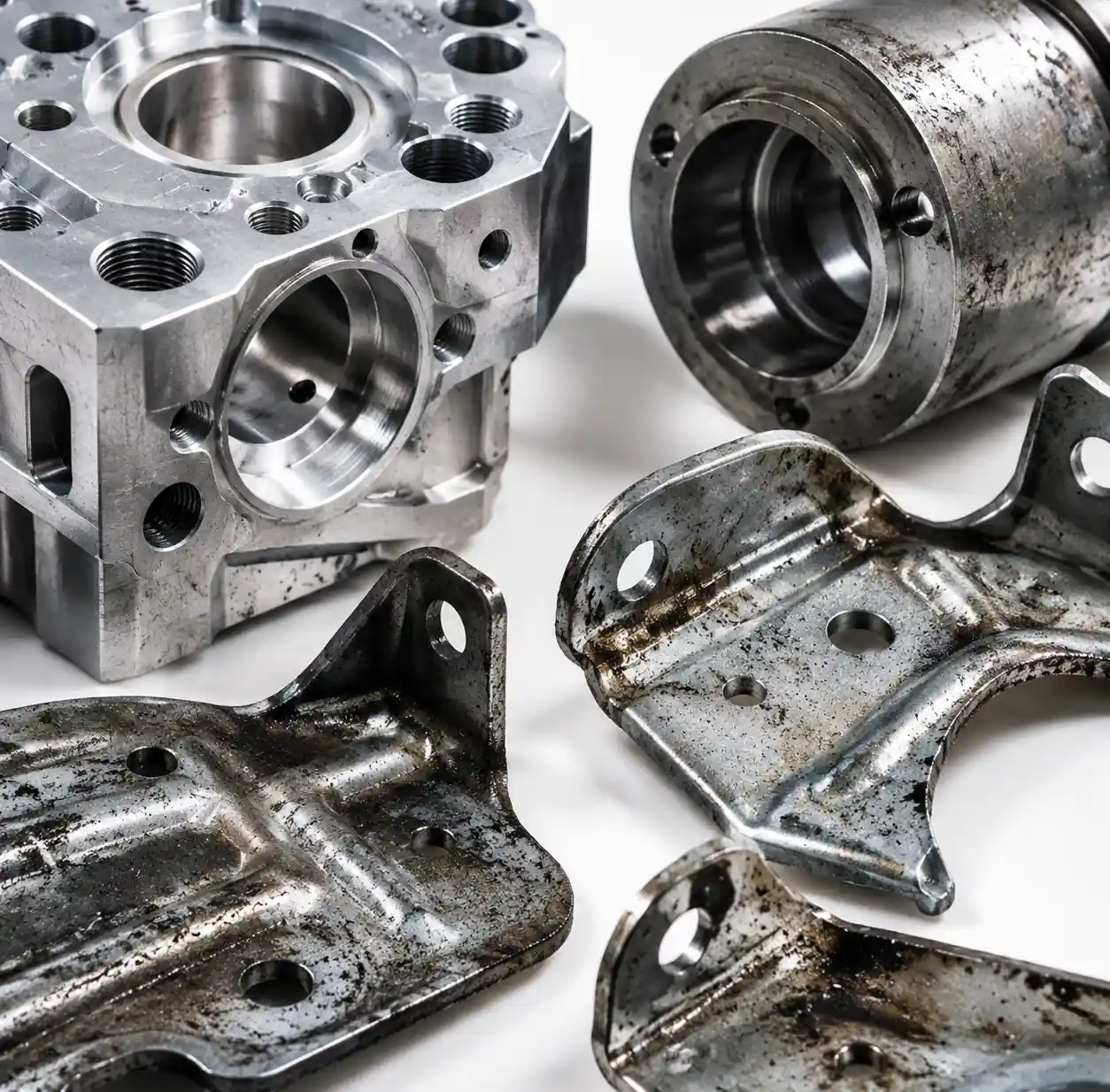 Industrial parts washing nozzle selection showing different contamination types on machined component
YuechenPrecision Technology's engineering data shows that nozzle mismatch causes 60-70% of cleaning failures in automated systems. The issue isn't insufficient pressure or wrong detergent—it's delivering the right fluid dynamics to the contamination site. When manufacturers specify nozzles based solely on connection size or flow rate, they ignore the physics of how spray patterns interact with part geometry.
Spray Pattern Mechanics: Matching Nozzle Types to Contamination
Different spray patterns create distinct cleaning mechanisms. Understanding this relationship eliminates trial-and-error nozzle selection.
Flat Fan Nozzles for Surface Contamination
Flat fan nozzles generate high-impact rectangular spray patterns ideal for removing chips, coolant residue, and scale from flat or cylindrical surfaces. The elliptical distribution concentrates more solution at the pattern edges, creating scrubbing action as parts move through the spray zone. We've measured impact forces of 15-25 psi at 12 inches with standard pressure systems.
Manufacturing lines processing stamped parts, castings, or extruded profiles benefit most from flat fan configurations. The pattern width adjusts from 15° to 110° spray angles, allowing precise coverage without solution waste. For wire belt conveyor systems, positioning flat fan nozzles at 30° to the belt direction prevents solution pooling while maintaining adequate dwell time.
Full Cone Nozzles for Complex Geometries
Full cone nozzles distribute solution in a circular pattern with uniform density from center to edge. This makes them essential for parts with recesses, threaded holes, or irregular surfaces where flat patterns create shadowed zones. The 360° coverage reaches areas that directional sprays miss.
We recommend full cone nozzles for transmission housings, valve bodies, and any machined component where internal passages must be flushed. Flow rates from 0.5 to 50 GPM at 40 psi give flexibility across part sizes. The key specification is spray angle—60° for deep cavities, 90° for general coverage, 120° for shallow, wide features.
| Nozzle Type | Best Application | Coverage Pattern | Typical Pressure | Impact Force |
|---|---|---|---|---|
| Flat Fan | Flat surfaces, removing chips | Rectangular, concentrated edges | 40-100 psi | High (edge impact) |
| Full Cone | Complex geometries, internal passages | Circular, uniform density | 40-80 psi | Medium (distributed) |
| Oscillating | High-precision parts, blind holes | Dynamic sweep pattern | 60-120 psi | Very high (pulsed) |
| Hollow Cone | Fine particle suspension, pre-rinse | Ring pattern, no center coverage | 30-60 psi | Low (atomization) |
Oscillating Nozzle Technology: The Latest Performance Breakthrough
Traditional static nozzles deliver consistent spray patterns, but they can't adapt to varying contamination levels across a part's surface. Oscillating nozzles solve this by mechanically rotating the spray pattern through a controlled arc, typically 30-90° at 3-10 cycles per second.
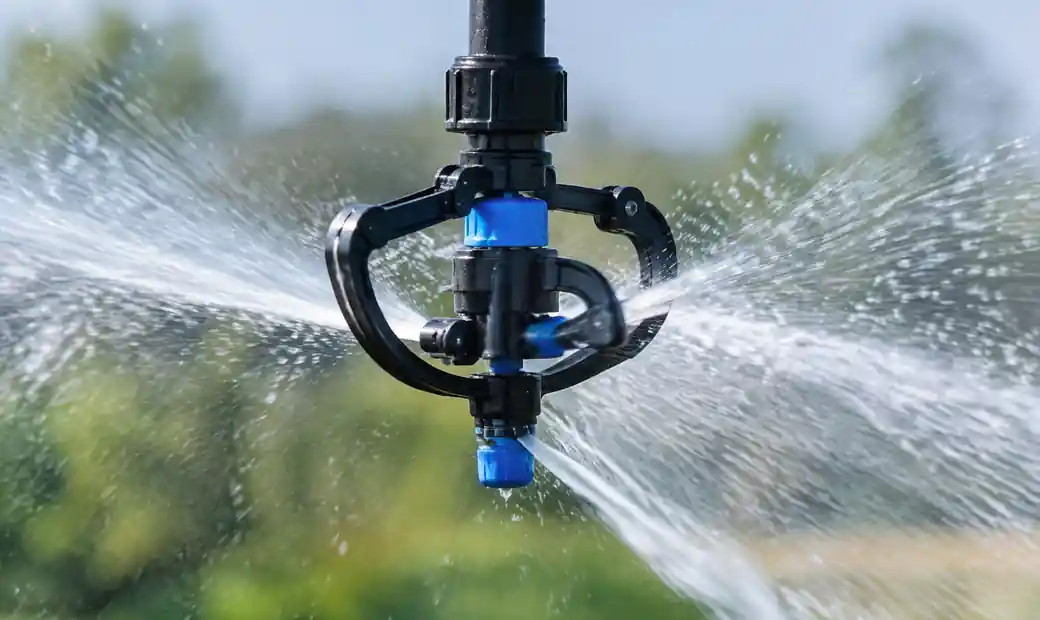 Oscillating nozzle technology demonstrating dynamic spray pattern rotation for industrial cleaning
The performance advantage comes from repeated impact at varying angles. Contaminants lodged in threads, blind holes, or machined pockets experience multiple cleaning vectors instead of a single static force. IPC's recent testing on aerospace components showed oscillating nozzles removed 40% more residual cutting fluid than static equivalents at the same pressure and flow rate.
YuechenPrecision Technology's oscillating nozzle modules integrate into existing spray bar systems without modifying plumbing. The rotation mechanism uses solution pressure—no external power required. We've documented 15-20% reduction in cleaning cycle time for transmission cases and hydraulic manifolds when replacing static nozzles with oscillating units at the same total water consumption.
The engineering trade-off is complexity. Oscillating nozzles have moving parts that require maintenance every 2,000-3,000 hours versus 5,000+ for static designs. For high-volume operations where cycle time directly impacts throughput, the ROI justifies the maintenance overhead. For low-mix, high-variability production, static nozzles with optimized positioning often deliver better total cost of ownership.
Pressure Requirements and Energy Efficiency
Higher pressure doesn't automatically mean better cleaning. The relationship between pressure, flow rate, and cleaning effectiveness follows a curve with diminishing returns above optimal thresholds.
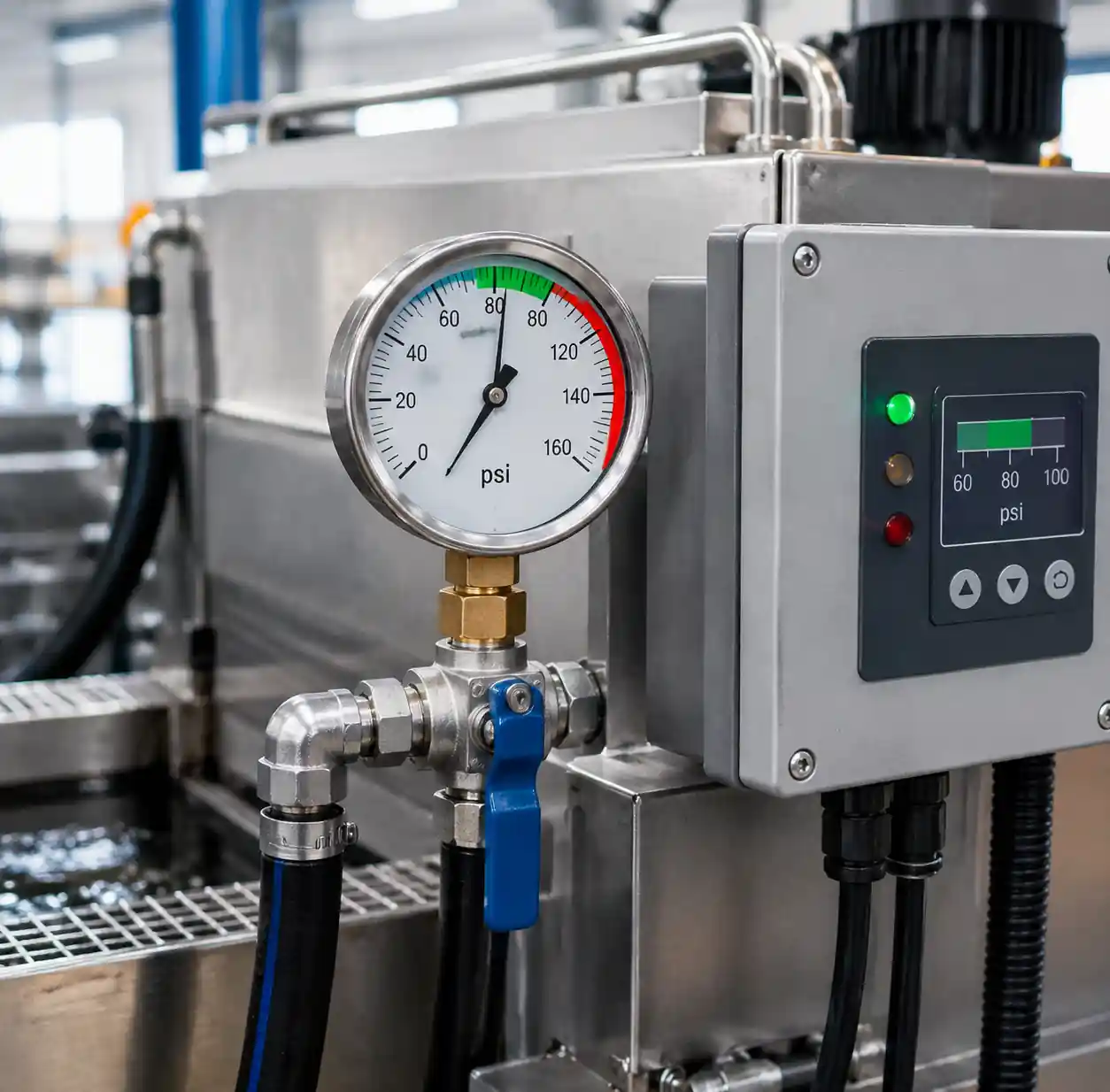 Pressure gauge on industrial parts washing system showing optimal operating range
For most industrial applications, 60-100 psi provides sufficient impact force without excessive pump energy or mist generation. We've measured cleaning performance on machined steel parts:
- 40 psi: Removes free-floating chips and bulk coolant
- 60 psi: Dislodges embedded particles, flushes shallow cavities
- 80 psi: Penetrates blind holes up to 3x diameter depth
- 100+ psi: Required for hardened scale, baked-on lubricants
Cabinet washer systems typically operate at 40-60 psi with 20-40 GPM total flow across multiple nozzles. Continuous flow systems with spray bars use 60-80 psi at 50-150 GPM depending on line speed and part density. Pressure above 120 psi enters high-pressure cleaning territory, often requiring specialized pumps, piping, and safety measures that significantly increase system cost.
Energy efficiency correlates directly to pump sizing. Oversized pumps cycling on-off waste energy through pressure relief valves. Properly matched systems maintain constant pressure with variable frequency drives that adjust pump speed to flow demand. On a 75 GPM system running 16 hours daily, VFD implementation typically reduces energy consumption by 20-30% compared to fixed-speed pumps with bypass control.
Detergent Compatibility: Chemistry Meets Engineering
Nozzle materials and internal geometries must resist the specific detergent chemistry in your process. Alkaline cleaners (pH 10-13) used for removing oils and greases attack brass and aluminum over time. Acidic cleaners (pH 2-5) for scale and rust removal corrode carbon steel and certain stainless alloys.
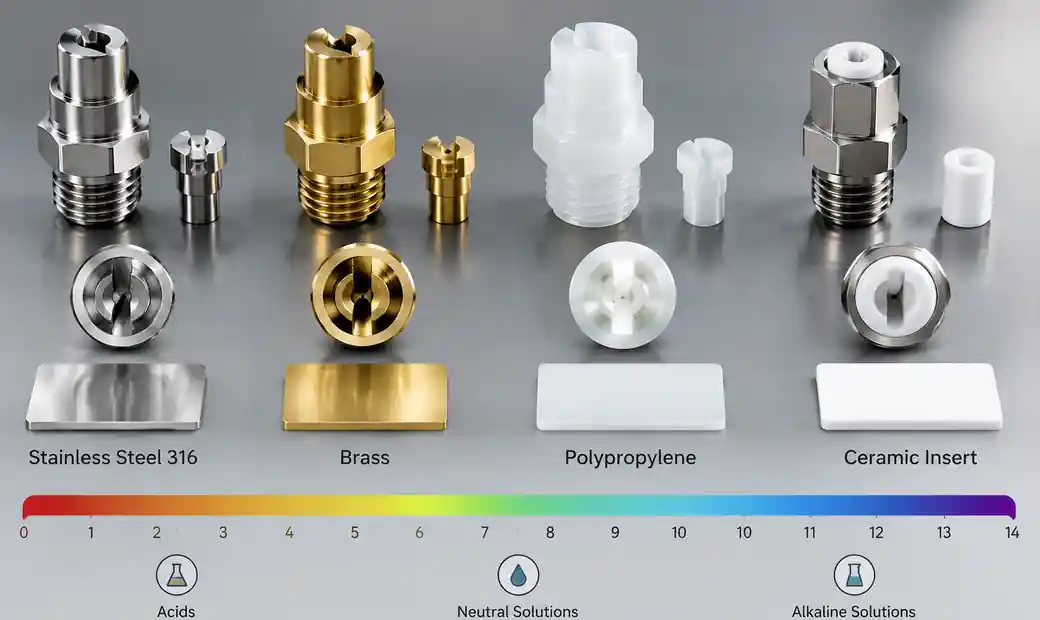 Different nozzle materials including stainless steel, brass, and ceramic for detergent compatibility
Material selection guidelines from YuechenPrecision Technology:
- Stainless steel 316: Universal compatibility, handles pH 2-13, resists chlorides. Standard for automated systems.
- Brass: Economical for neutral pH solutions (6-8), degrades in strong alkaline cleaners after 1,000-1,500 hours.
- Polypropylene: Chemical-resistant alternative for highly aggressive solutions, limited to 180°F maximum temperature.
- Ceramic inserts: Abrasion resistance for slurry-type cleaners with suspended solids, prevents orifice erosion.
The internal orifice size determines whether cleaners with suspended abrasives or fillers will clog. For detergents containing fine abrasive particles (<100 micron), specify nozzles with minimum 0.040" orifice diameter. Smaller orifices risk blockage that degrades spray pattern and reduces impact force. Inline filtration before the nozzle manifold removes particles that cause gradual wear.
Temperature affects both detergent performance and nozzle longevity. Most industrial cleaning occurs at 140-180°F where detergent chemistry is most effective. At these temperatures, thermal expansion can alter spray angles by 2-5% in brass nozzles—negligible for most applications but critical in precision systems with tight clearances. Stainless steel nozzles show minimal thermal distortion up to 200°F.
System Configuration Comparison: Cabinet vs. Continuous Flow
Selecting between cabinet washers and continuous flow systems depends on part size, production volume, and contamination severity.
| Configuration | Parts Per Hour | Part Size Range | Cleaning Intensity | Footprint | Best For |
|---|---|---|---|---|---|
| Cabinet Washer | 50-200 | Small to medium (<24" max dimension) | High (enclosed spray, heat retention) | Compact (8-15 ft²) | Batch processing, high-precision parts, aerospace |
| Continuous Flow (Belt) | 200-1,000+ | Small to large (limited by belt width) | Medium (open system, faster cooling) | Large (30-100+ ft²) | High-volume automotive, stamped parts |
| Rotary Drum | 100-500 | Small parts in bulk | Medium-high (tumbling action enhances cleaning) | Medium (15-30 ft²) | Fasteners, small castings, bulk components |
Cabinet Washer Systems
Cabinet washers enclose parts in a sealed chamber where nozzles mounted on rotating arms deliver 360° coverage. The enclosed environment retains heat and prevents overspray, allowing detergent solutions to maintain optimal temperature throughout the cycle.
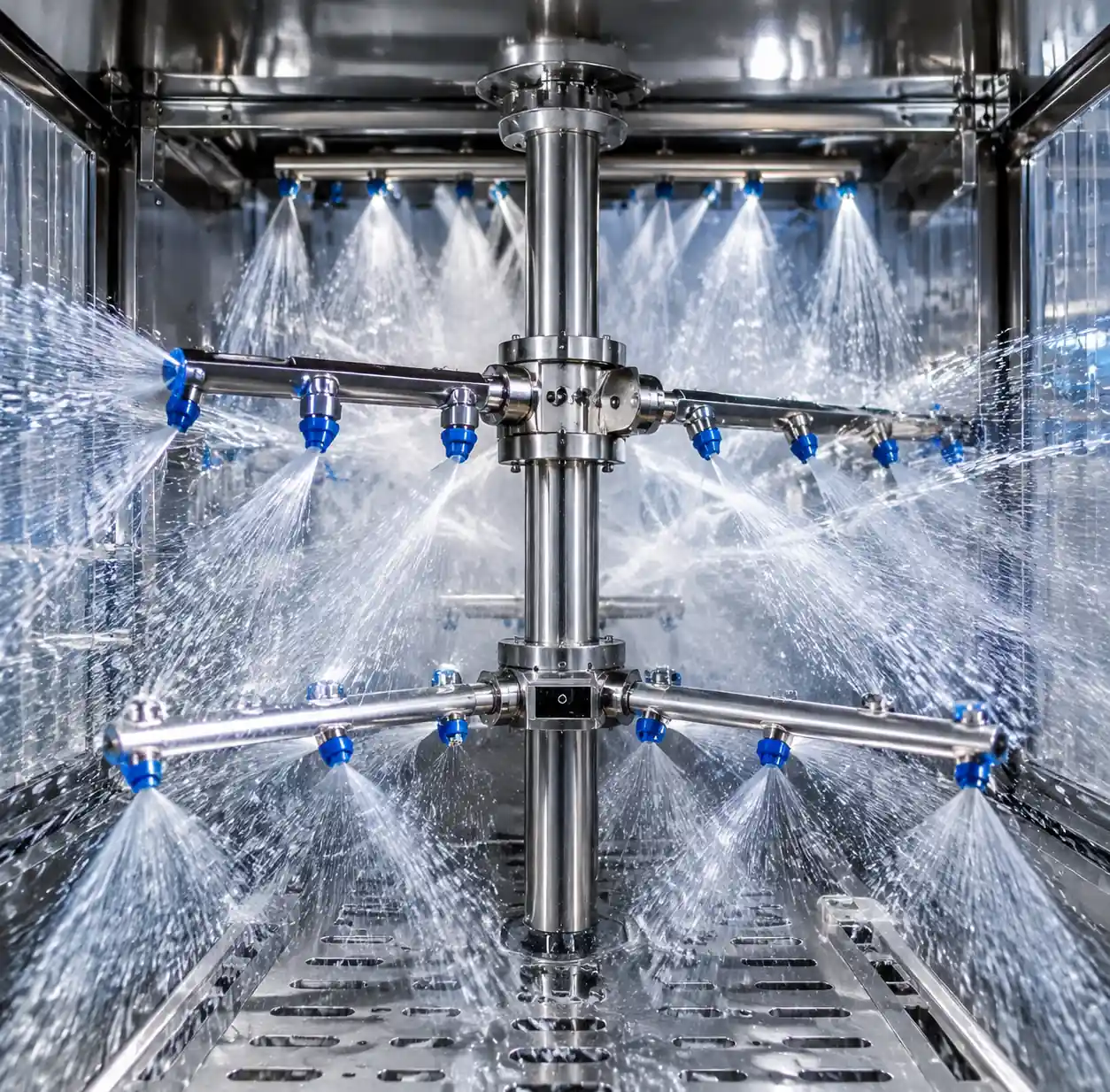 Cabinet washer system with rotating spray arms and multiple nozzles for 360-degree parts coverage
Our testing shows cabinet systems excel for complex geometries requiring 3-5 minute dwell times. Nozzle configurations typically use 8-16 full cone or flat fan nozzles at 40-60 psi, with total flow rates of 20-40 GPM. The rotating arm mechanism (15-40 RPM) changes the spray angle relative to the parts, creating the multiple-vector impact that oscillating nozzles provide in static systems.
Cabinet washers integrate easily with automated loading/unloading. The enclosed design also simplifies ventilation requirements compared to open systems, critical for facilities with strict air quality standards.
Continuous Flow Belt Systems
Continuous flow systems transport parts through sequential spray zones on wire mesh belts. Each zone can use different nozzle types, pressures, and solutions—pre-wash, main wash, rinse, and dry stages in a single pass.
The nozzle arrangement in continuous systems requires careful engineering. Spray bars positioned above and below the belt ensure full coverage as parts travel at 3-12 feet per minute. Nozzle spacing of 6-12 inches on-center provides overlapping coverage without solution waste. We've found that staggering nozzle positions (top bar offset from bottom bar) eliminates shadow zones created by part geometry.
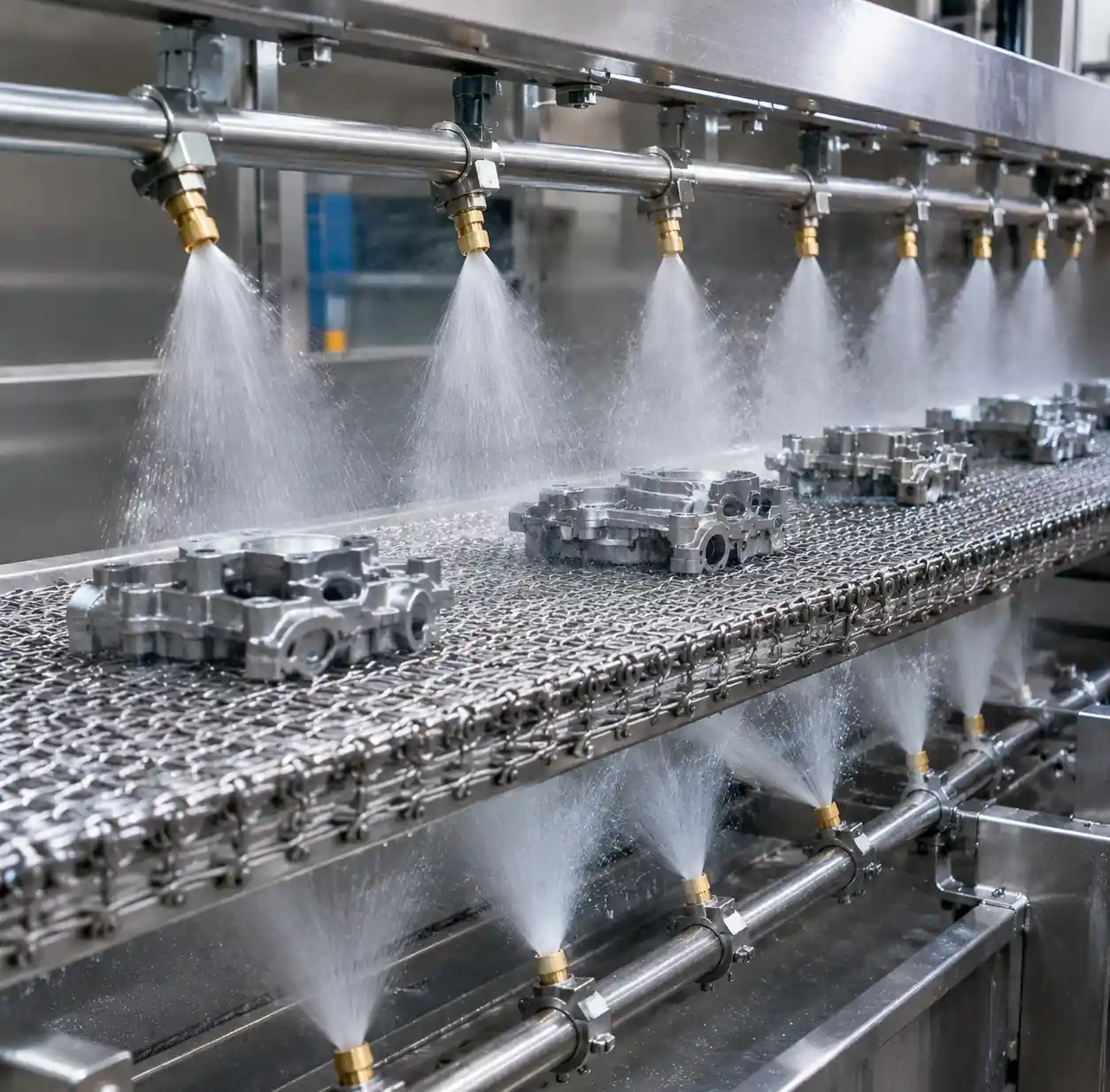 Continuous flow belt system with staggered spray bar nozzle configuration for industrial parts washing
Line speed and nozzle flow rate determine cleaning intensity. A 10 ft/min belt speed with nozzles delivering 2 GPM each gives approximately 12 seconds exposure per linear foot of spray zone. Doubling nozzle count or halving belt speed both increase exposure but have different cost implications—more nozzles require higher water flow and pump capacity, while slower belts reduce throughput.
Maintenance Protocols That Prevent Downtime
Nozzle system reliability depends on three maintenance practices: routine inspection, scheduled replacement, and solution filtration.
Weekly inspections should verify spray pattern consistency. Position a test panel in the spray zone and observe the impact pattern—gaps or streaming indicate partial blockage or orifice wear. For precision systems, flow measurement at each nozzle branch detects developing problems before quality issues appear.
Orifice wear tracking prevents gradual performance degradation. Standard brass nozzles lose 5-10% flow capacity after 2,000 hours in abrasive solutions. Stainless steel extends this to 5,000-8,000 hours. When measured flow exceeds specification by 15%, pressure drops and spray patterns lose effectiveness. We recommend replacing nozzles in complete sets rather than individually—mixed wear rates create uneven coverage.
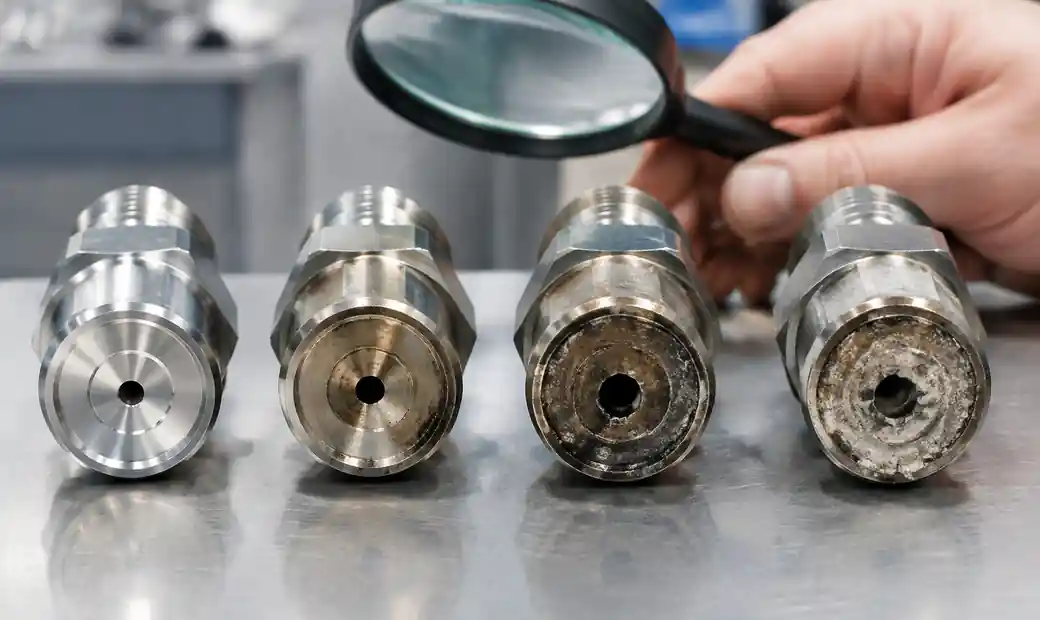 Nozzle maintenance inspection showing orifice wear comparison between new and used industrial spray nozzles
Mineral scale prevention extends nozzle life in hard water areas. Calcium and magnesium deposits accumulate at orifice edges, distorting spray patterns and reducing flow. Installing a water softener upstream of the cleaning system costs less than accelerated nozzle replacement. For systems that must use untreated water, monthly citric acid flushing (2-3% solution at normal operating temperature) dissolves light scale before it becomes problematic.
Filter maintenance protects nozzles from particulate damage. Install 100-mesh (150 micron) inline filters before spray manifolds. Check filter elements weekly in high-particle environments (grinding operations, heavy oil contamination) or monthly in cleaner applications. Pressure gauges before and after the filter bank give early warning of element saturation.
Quality Control Integration
Modern parts washing systems provide data that integrates directly into quality management systems. Pressure transducers, flow meters, and temperature sensors at each nozzle zone create process records proving that cleaning specifications were met for every part.
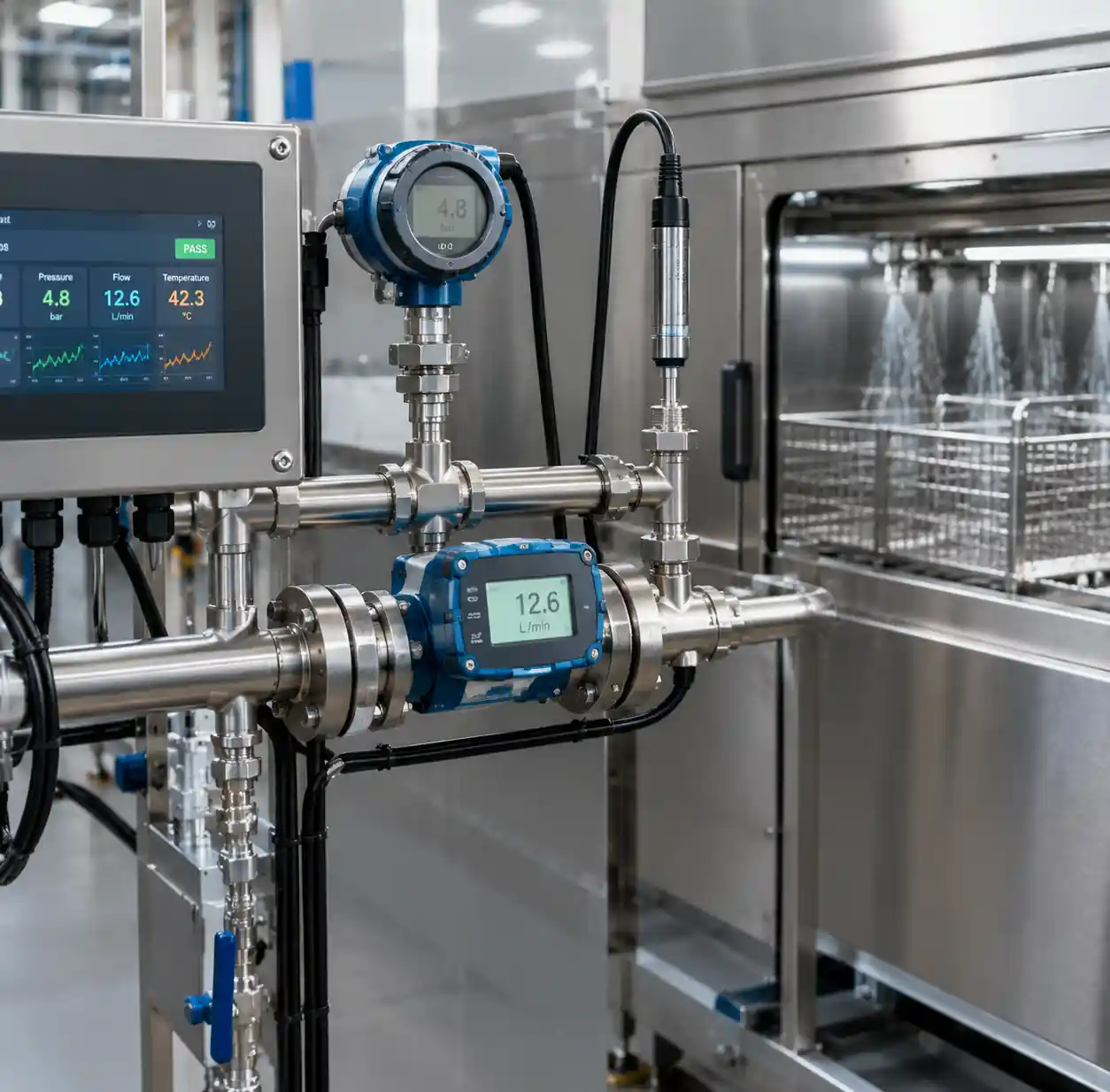 Quality control sensor integration on industrial parts washer showing pressure transducers and flow meters
YuechenPrecision Technology's sensor integration packages monitor:
- Zone pressure: Verifies nozzle performance meets minimum impact force requirements
- Solution temperature: Confirms detergent operates in effective range (140-180°F typical)
- Flow rate: Detects clogged nozzles or pump issues before affecting part quality
- Cycle time: Tracks whether parts received specified exposure duration
These parameters feed into automated pass/fail decisions or SPC charts that identify trends before they become defects. For AS9100 and ISO/TS 16949 certified manufacturers, the digital record satisfies process validation requirements without manual inspection of every cleaned part.
Advanced systems add vision inspection post-cleaning. Cameras image critical surfaces and AI algorithms detect residual contamination, making real-time decisions about whether parts proceed to assembly or return for re-cleaning. This closed-loop quality control reduces downstream defects and warranty claims linked to contaminated parts.
FAQ
How often should nozzles be replaced in an industrial parts washer?
Replacement intervals depend on nozzle material and solution chemistry. Stainless steel nozzles in neutral pH solutions typically last 8,000-12,000 operating hours. Brass nozzles in alkaline cleaners require replacement every 2,000-3,000 hours. Monitor spray patterns weekly and replace when flow rates exceed specification by 15% or visible pattern distortion occurs.
What spray angle works best for parts with deep blind holes?
Full cone nozzles with 60° spray angles provide the focused penetration needed for blind holes. Position the nozzle so the hole opening aligns with the cone centerline at a distance of 6-10 inches. For holes deeper than 4x their diameter, oscillating nozzles deliver 30-40% better residue removal than static designs at the same pressure.
Can I increase pressure to compensate for worn nozzles?
No—increased pressure through worn nozzles doesn't restore original performance. Orifice erosion creates irregular spray patterns that higher pressure amplifies rather than corrects. You'll waste energy and may create excessive mist without improving cleaning. Replace worn nozzles instead of adjusting pressure beyond design specifications.
What's the minimum pressure for removing cutting oil from machined aluminum?
Cutting oil removal from aluminum requires 60-80 psi with alkaline detergent (pH 10-12) at 160-180°F. Lower pressures (40-50 psi) work if you extend cycle time by 50-75%. The combination of chemical emulsification and mechanical spray action removes oil more efficiently than either alone. Rinse stages should maintain similar pressure to flush emulsified residue.
How do I prevent nozzle clogging in systems using recycled wash water?
Install two-stage filtration: bag filters (200 micron) immediately after the wash tank to remove bulk contamination, followed by cartridge filters (100-150 micron) before the nozzle manifolds. Replace bag filters when differential pressure exceeds 15 psi, typically every 40-80 operating hours in moderate contamination environments. Add automatic backflush or self-cleaning filters for 24/7 operations to eliminate manual maintenance downtime.
What nozzle configuration works best for removing rust scale?
Hardened rust scale requires oscillating nozzles at 100-120 psi with acidic cleaners (phosphoric or citric acid, pH 2-4). Position nozzles 8-12 inches from the part surface. The combination of high impact force, varying attack angles, and chemical action removes scale that static nozzles leave behind. Follow with a neutralizing alkaline rinse to prevent flash rusting.
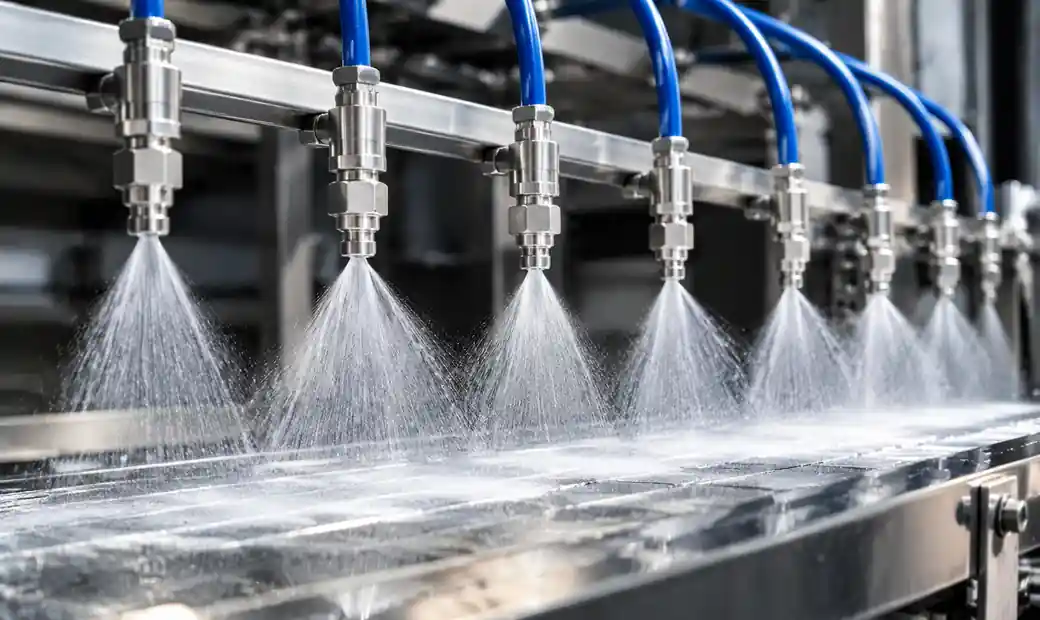 Precision nozzle configuration installed in industrial parts washing system showing proper positioning and spacing
Conclusion
Effective industrial parts washing requires matching nozzle technology to contamination and part geometry. Flat fan nozzles suit simple surfaces, full cone patterns reach complex features, and oscillating nozzles maximize removal from precision components. Operating at 60-100 psi delivers optimal impact without excess energy or mist.
Cabinet washers offer superior intensity for complex parts in batch operations; continuous belt systems maximize throughput for simpler geometries. Both need proper nozzle spacing, compatible materials, and routine maintenance.
Advances in oscillating nozzles and quality control make parts washing a controlled process affecting downstream success. Pressure, flow rate, spray angle, and material must match your contamination challenges. YuechenPrecision Technology's application engineering team can recommend nozzle configurations based on your part geometry, production volume, and quality requirements.