



Cooling Solutions for Hot Climates: Africa and Middle East Guide
The solution for industrial cooling in Africa and Middle East extreme heat (43-49°C): hybrid evaporative-air cooling systems with fine misting nozzles, water pre-treatment for high-TDS conditions, and aggressive maintenance schedules. These systems recover 30-40% capacity lost in standard air-cooled exchangers while achieving 60% energy savings compared to mechanical chillers, with typical payback periods of 14-18 months.
Table of Contents
Understanding Extreme Heat Challenges
Industrial cooling in Africa and the Middle East operates at ambient temperatures regularly exceeding 43°C (110°F), with peaks reaching 49°C in Gulf states. At these temperatures, air-cooled heat exchangers lose 30-40% capacity compared to design conditions at 25°C. The Middle East and North Africa cooling systems market is growing at 4.2% CAGR as industries seek working solutions.
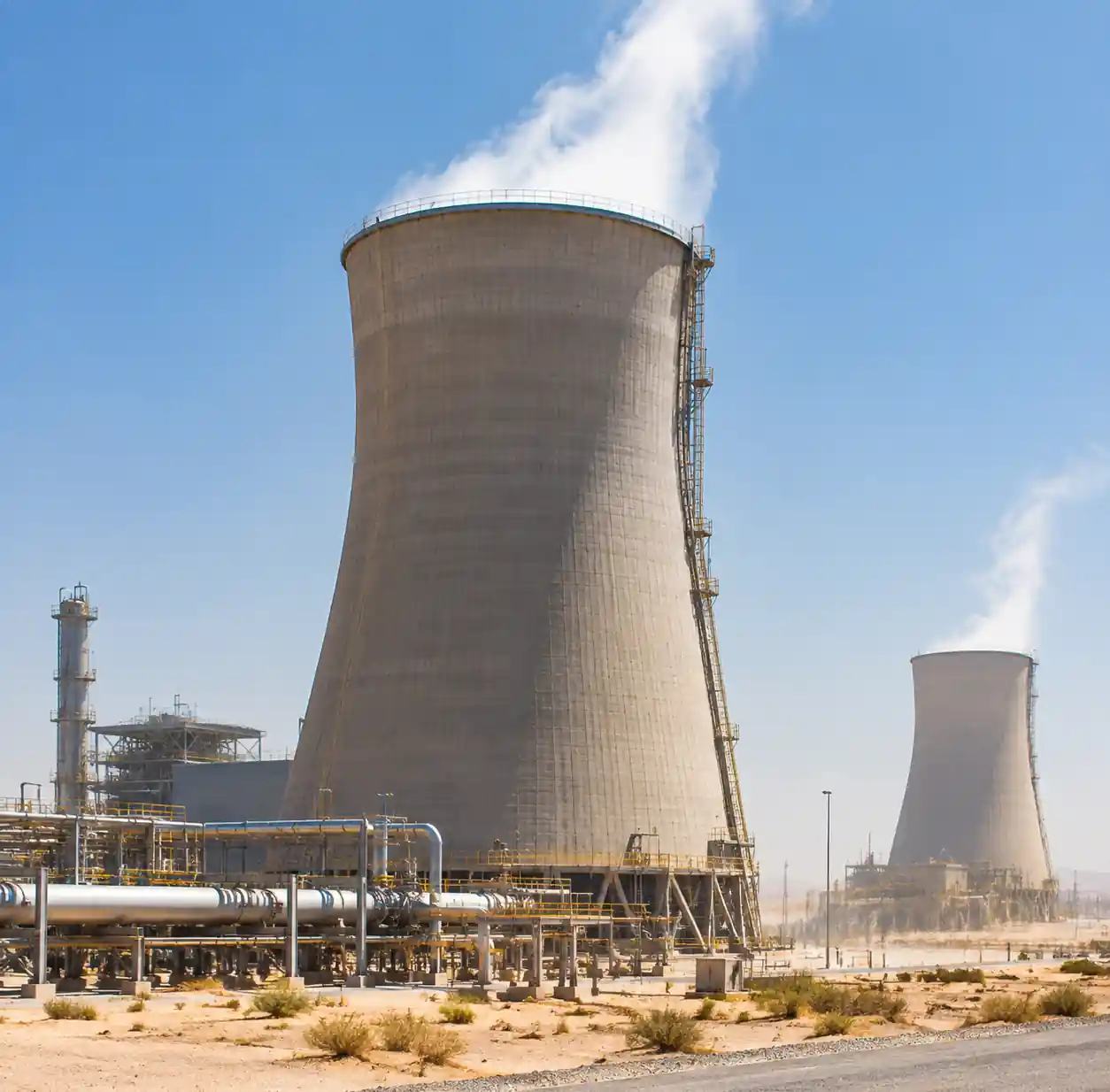 Industrial cooling tower operating in extreme heat conditions in Middle East
Process cooling failures cascade quickly. A Saudi cement plant lost $180,000 in production during a three-day shutdown from scale buildup exacerbated by high water temperatures.
Industrial sectors face specific vulnerabilities:
- Manufacturing facilities: Equipment overheating leads to production shutdowns
- Power generation: Turbine efficiency drops 0.5-1% per degree above design temperature
- Chemical processing: Reaction control becomes unstable when cooling capacity falls short
- Food processing: Product safety risks emerge when cold chain integrity breaks
| Climate Challenge | Impact on Cooling Systems | Engineering Response |
|---|---|---|
| Ambient temperatures 43-49°C | 30-40% capacity loss in air-cooled exchangers | Hybrid evaporative-air cooling (adiabatic systems) |
| Solar radiation 800-1000 W/m² | Equipment surface temperatures exceed 70°C | Reflective coatings, shade structures, nighttime operation |
| Low humidity (10-20% RH) | High evaporation rates, increased water consumption | Water recovery systems, closed-loop designs |
| Seasonal dust storms | Fouling of heat transfer surfaces | Pre-filtration, automated cleaning cycles |
Water Quality and Scale Prevention
Water chemistry presents major challenges. Total dissolved solids (TDS) commonly exceed 1,000 mg/L, with some regions reaching 2,500 mg/L. Calcium hardness above 300 mg/L is standard, creating aggressive scaling in evaporative cooling systems.
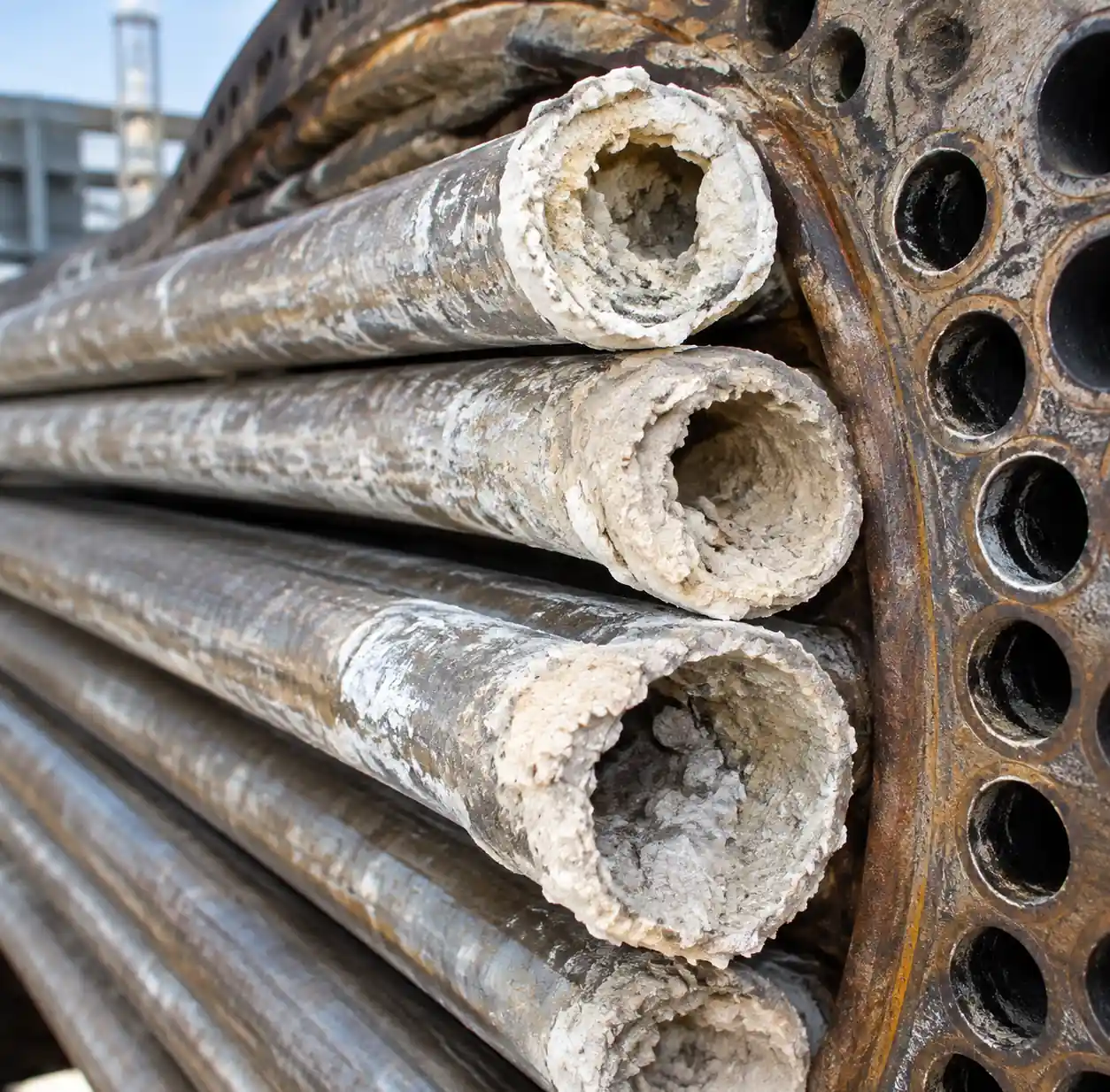 Scale deposits on heat exchanger tubes from high-TDS water
At a Khartoum textile facility, scale deposits reduced cooling efficiency by 45% within six weeks. Water analysis showed calcium hardness at 380 mg/L and alkalinity at 420 mg/L. As water evaporates, minerals concentrate and calcium carbonate precipitates rapidly at elevated temperatures (35-40°C). Scale just 1mm thick reduces heat transfer by 70%.
Effective scale prevention requires:
Pre-treatment: Reverse osmosis or ion exchange reduces feedwater hardness below 100 mg/L. A Dubai pharmaceutical plant achieved three-year payback on RO through reduced maintenance and chemical costs.
Chemical dosing: Phosphonates and polymeric dispersants inhibit crystal formation. Dosing rates increase 40-60% versus temperate climates. Automated dosing with conductivity monitoring maintains optimal levels.
Blowdown management: Maintaining cycles of concentration at 3-4 in high-TDS water balances water conservation and scale control.
pH control: Maintaining pH at 7.5-8.0 optimizes scale inhibitor performance.
Cairo food processing plant water analysis shows typical chemistry and treatment results:
| Parameter | Untreated Water | After RO | Target Range |
|---|---|---|---|
| TDS (mg/L) | 1,450 | 85 | < 500 |
| Calcium hardness (mg/L as CaCO₃) | 380 | 15 | < 100 |
| Alkalinity (mg/L as CaCO₃) | 420 | 20 | < 150 |
| Chlorides (mg/L) | 520 | 25 | < 250 |
Spray Nozzle Cooling Systems
Spray nozzle systems deliver cost-effective cooling in extreme heat. Evaporative cooling using fine misting nozzles maintains performance as evaporation increases with temperature—ideal for hot, dry climates. Each kilogram of water evaporated absorbs 2,260 kJ. At 45°C with 15% humidity, evaporative cooling reduces air temperature by 20-25°C. Industrial cooling systems are projected to reach $2,500M globally by 2030 (6.6% CAGR).
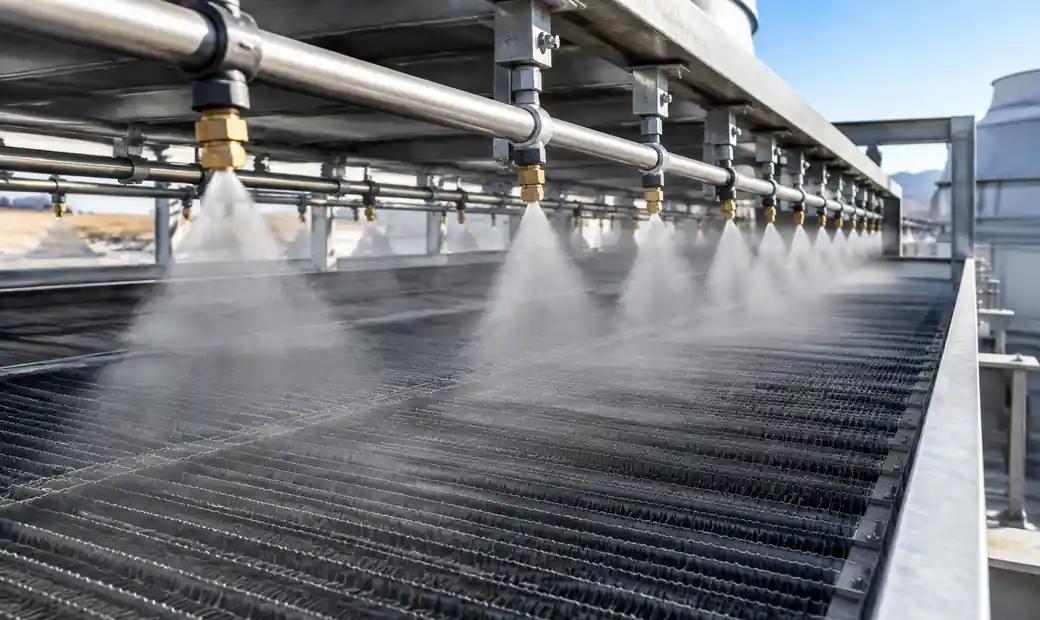 Spray nozzle array in adiabatic pre-cooling system for industrial condenser
Three primary configurations:
Adiabatic pre-cooling: Spray nozzles upstream of air-cooled condensers reduce inlet air temperature. A 15°C reduction increases condenser capacity by 25-30%. Full cone nozzles provide even droplet distribution.
Direct process cooling: Fine mist systems (5-20 micron droplets) cool work areas or equipment enclosures. A Riyadh metals plant reduced workspace temperature from 48°C to 32°C, cutting heat-related incidents by 85%.
Cooling tower optimization: Upgrading to precision atomizing nozzles increases efficiency by 12-18% in high-TDS water through better droplet size distribution.
Material selection is critical. Stainless steel 316 handles most applications, but high-chloride water (>500 mg/L) demands Hastelloy or ceramic. Ceramic nozzles at an Oman desalination plant have operated five years without corrosion degradation.
Dust Management Protocols
Airborne particulate accelerates equipment fouling. Sand and dust concentrations during storms exceed 2,000 μg/m³—twenty times WHO guidelines. A Kuwait power plant documented 35% capacity loss after six weeks without cleaning during dust storm season.
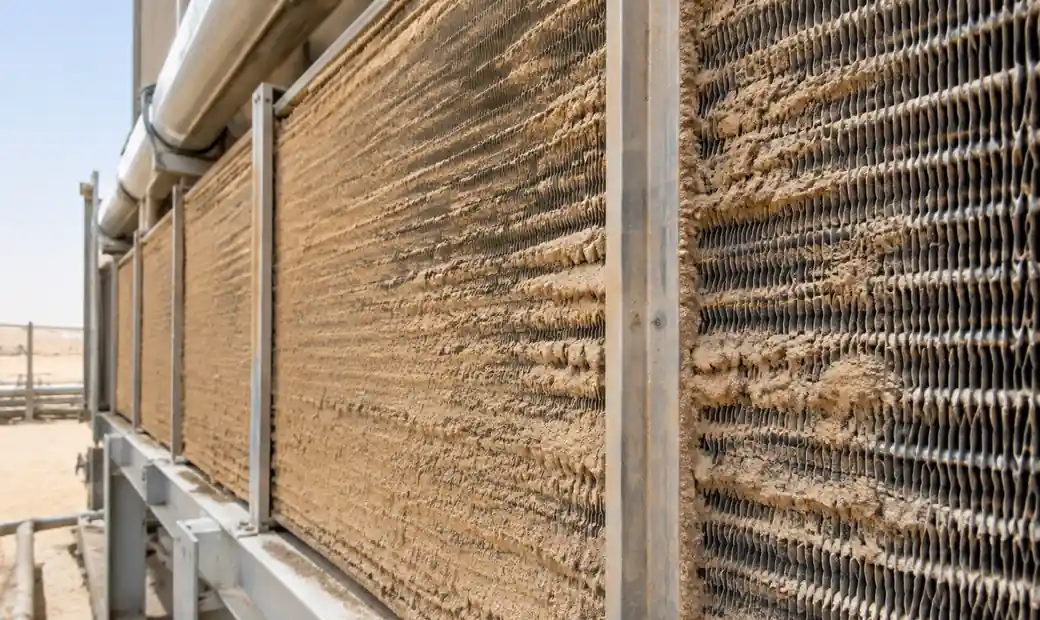 Dust and sand deposits on industrial cooling equipment heat exchanger fins
Multi-layered protection strategies:
Intake filtration: MERV 11-13 filters capture 85-95% of particles >1 micron. Differential pressure monitoring triggers replacement before excessive resistance develops.
Automated cleaning: High-pressure nozzle wash systems (40-60 bar) remove deposits every 48-72 hours during high-dust seasons. A Saudi petrochemical facility reduced cleaning labor by 60% after installation.
Equipment enclosures: Positive-pressure filtered enclosures protect controls and electronics from dust infiltration.
Surface coatings: Hydrophobic coatings extend cleaning intervals by 40-50%.
An Egypt cement plant combined MERV 13 filtration, twice-weekly automated washing, quarterly inspection, and pressure monitoring. Unplanned downtime dropped from 120 hours annually to 8 hours, with capacity maintained above 92% of design.
Energy Efficiency Considerations
Cooling energy can represent 40-50% of facility electricity at regional costs of $0.08-0.15/kWh. Vapor-compression chillers face severe penalties: energy consumption increases 2-3% per 1°C rise in condensing temperature. At 45°C ambient plus 5-10°C approach, condensing temperatures reach 55-60°C—far above 35-40°C design points.
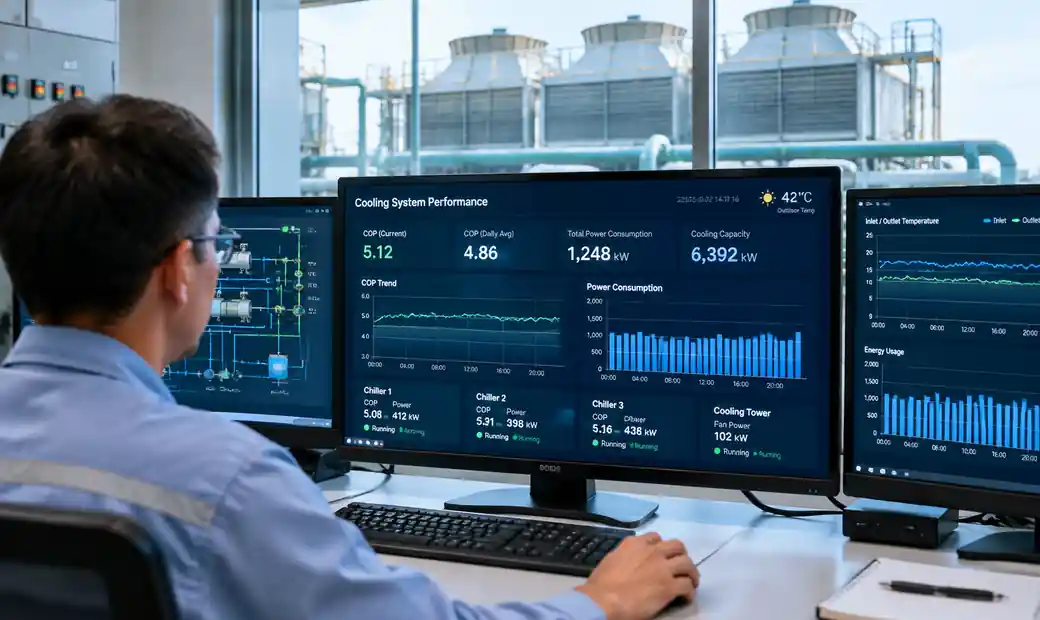 Industrial chiller energy consumption monitoring system display showing efficiency metrics
Three high-ROI strategies:
Evaporative cooling integration: Spray nozzles pre-cooling condenser air reduce condensing temperatures by 12-18°C. A 15°C reduction improves chiller COP from 2.5 to 3.8—52% energy savings.
Thermal storage: Ice or chilled water storage shifts load to nighttime when temperatures drop 15-20°C. A Dubai pharmaceutical facility cuts peak demand by 60% and achieves 30% energy savings.
Free cooling: When wet-bulb temperatures drop below process requirements, direct evaporative cooling eliminates compressor operation. A Bahrain data center achieves 2,200 hours annually of compressor-free operation.
| Cooling Technology | Energy Efficiency (kW/ton) | Water Consumption (L/ton-hr) | Best Application |
|---|---|---|---|
| Air-cooled chiller | 1.8-2.4 | 0 | Water-scarce regions |
| Water-cooled + cooling tower | 0.9-1.2 | 12-18 | Large continuous loads |
| Adiabatic-cooled chiller | 1.2-1.5 | 3-6 | Moderate loads |
| Direct evaporative | 0.1-0.2 | 25-35 | Process cooling |
Maintenance Schedules for Desert Climates
Standard intervals fail in these conditions. Region-specific schedules based on tracking 40+ installations:
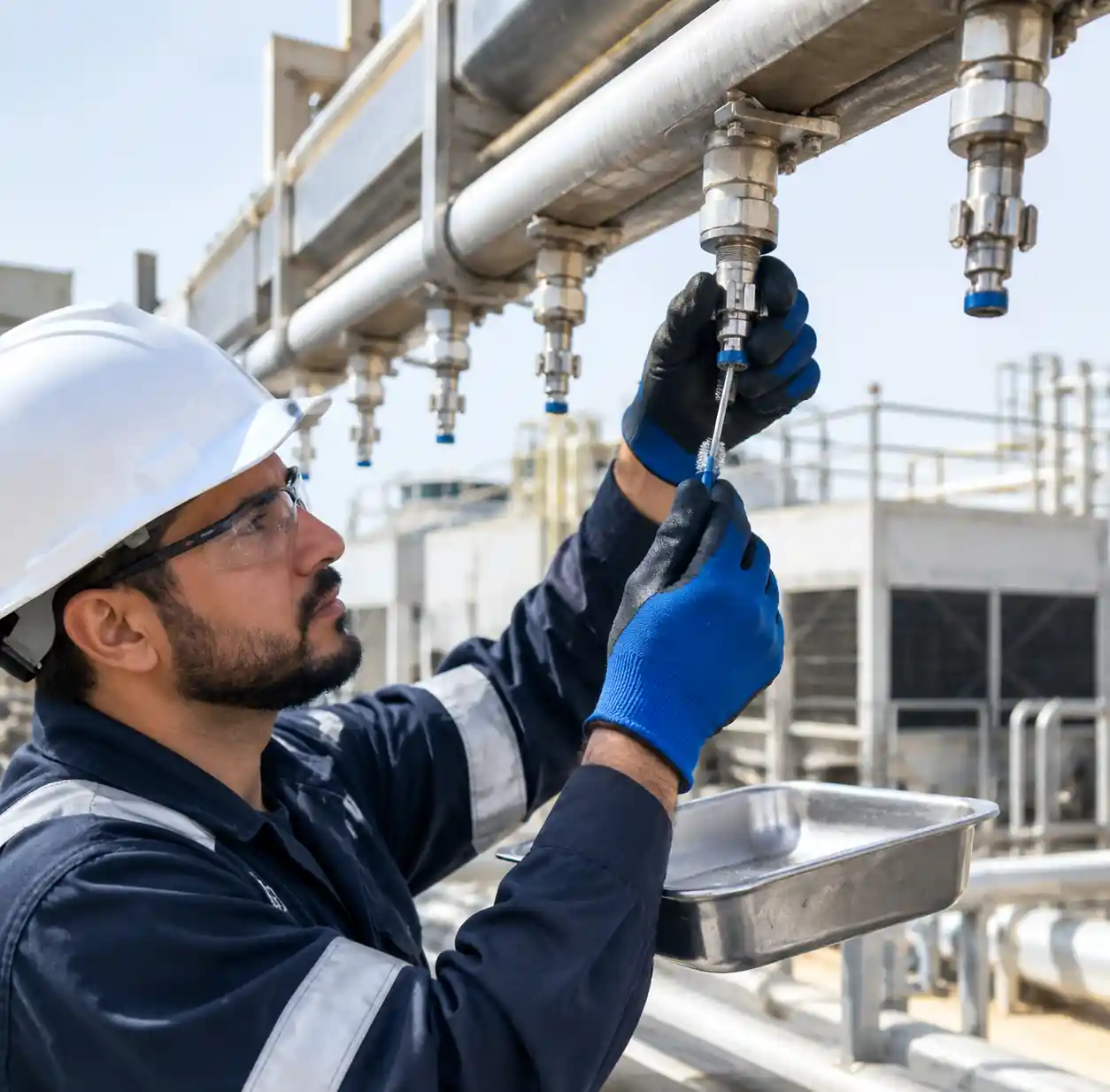 Maintenance technician performing spray nozzle inspection and cleaning
Daily: Visual nozzle inspection, pressure/flow verification, blowdown confirmation, filter differential pressure
Weekly: Strainer cleaning (twice weekly during dust storms), chemical levels, conductivity/pH measurement, tower fill inspection
Monthly: Nozzle ultrasonic cleaning, scale measurement, tower fill cleaning, motor current/vibration checks, water chemistry analysis
Quarterly: Heat exchanger inspection, complete nozzle replacement, fan bearing service, electrical connections, pressure testing
Annual: Complete shutdown and inspection, tower structural integrity, thermal performance testing
Critical spares inventory (8-12 week lead times): Complete nozzle sets, chemical feed pumps, fan drive belts and bearings, filter elements, control valves. A Mauritania mining operation lost 11 days waiting for nozzles. After implementing $8,000 spares inventory, they've maintained >98% availability for three years.
FAQ
Q: Can I use air-cooled systems exclusively in Middle East climates?
Air-cooled systems require 60-80% oversizing for 45-49°C conditions, increasing capital cost by 40-50% and operating cost by 30-40%. For loads above 200 kW, evaporative or hybrid systems provide better economics.
Q: How much water does evaporative cooling consume?
Consumption ranges from 3-6 L/ton-hour (adiabatic pre-cooling) to 15-20 L/ton-hour (cooling towers). A 500-ton facility operating 12 hours daily consumes 1,100-3,600 m³ monthly—2-8% of typical industrial water usage.
Q: What's the payback for water pre-treatment systems?
In high-TDS water (>1,000 mg/L), payback occurs in 2-4 years through reduced chemical costs and maintenance. A facility treating 50 m³/day expects annual savings of $40,000-60,000 after $120,000-180,000 RO investment.
Q: Do spray nozzles need different specs for dusty environments?
Yes. Larger orifice nozzles (>1.5mm) resist clogging better. In extreme conditions, specify minimum 2mm diameter with twice-weekly ultrasonic cleaning. Self-cleaning strainers extend service intervals.
Conclusion
Cooling in Africa and Middle East climates requires engineering that addresses extreme temperatures, poor water quality, dust, and energy costs. Reliable systems integrate evaporative cooling with spray nozzles, comprehensive water treatment, automated cleaning, and aggressive maintenance.
Proper design pays back through reduced downtime, lower energy costs, and extended equipment life. Systems combining appropriate technology with local conditions understanding consistently achieve >95% availability. The industrial cooling market in these regions expands at 4-6% annually. Facilities implementing proper solutions gain competitive advantage through reliable operations and controlled energy costs.