



Ceramic Nozzles: When to Invest in Premium Materials
Ceramic spray nozzles justify their premium cost when you face abrasive applications that destroy metal nozzles within weeks. If your operation handles slurries, suspended solids, or high-velocity particle streams, ceramic delivers 5-20x longer service life than stainless steel, reducing replacement frequency, maintenance downtime, and total cost of ownership. The investment pays off in shot blasting, chemical processing, waterjet cutting, agricultural spraying with abrasive formulations, and any application where wear rate determines your maintenance budget.
Table of Contents
- 1. Understanding Ceramic Nozzle Materials
- 2. When Ceramic Outperforms Metal Nozzles
- 3. Material Comparison: Ceramic vs. Stainless Steel vs. Brass
- 4. Cost-Benefit Analysis and ROI Calculation
- 5. Application-Specific Selection Criteria
- 6. Service Life Expectations by Industry
- 7. Common Mistakes When Specifying Ceramic Nozzles
- 8. FAQ
- 9. Conclusion
Understanding Ceramic Nozzle Materials
Ceramic nozzles use advanced technical ceramics engineered for extreme wear resistance. The three primary materials are silicon carbide (SiC), silicon nitride (Si₃N₄), and zirconia-stabilized boron nitride (ZSBN), each optimized for specific operating conditions.
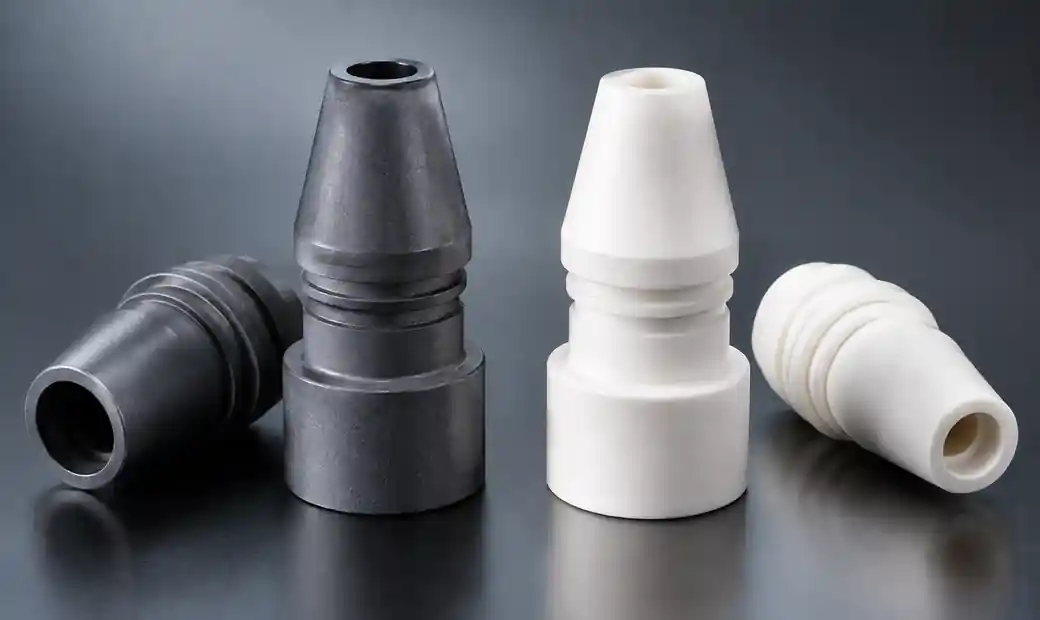 Different ceramic nozzle materials showing silicon carbide and silicon nitride samples
Silicon carbide ranks as the hardest ceramic material for nozzle applications, with Vickers hardness ratings reaching 15-17 GPa. This extreme hardness makes SiC nozzles resistant to continuous bombardment by high-speed abrasive particles without dimensional change. SiC also offers excellent thermal conductivity and chemical stability, maintaining performance in high-temperature or chemically aggressive environments. You should specify SiC when erosion by particles is the dominant wear mechanism.
Silicon nitride delivers slightly lower hardness than SiC but superior toughness and impact resistance. Si₃N₄ withstands mechanical shocks and resists crack propagation under cyclic loading. When nozzles experience repeated particle impact or occasional misalignment during operation, Si₃N₄ provides better operational life than harder but more brittle ceramics. This material works well in air atomizing nozzles where thermal shock can occur.
ZSBN ceramic nozzles combine boron nitride's thermal shock resistance with zirconia's mechanical strength. These nozzles excel in thermal spray operations, molten metal handling, and processes where both heat and wear create constant challenges. ZSBN maintains dimensional stability at temperatures exceeding 1100°C while retaining approximately 50% of room temperature tensile strength.
When Ceramic Outperforms Metal Nozzles
Ceramic nozzles provide measurable advantages over metal alternatives in three specific scenarios: abrasive particle exposure, high-temperature operation, and chemical aggression combined with wear.
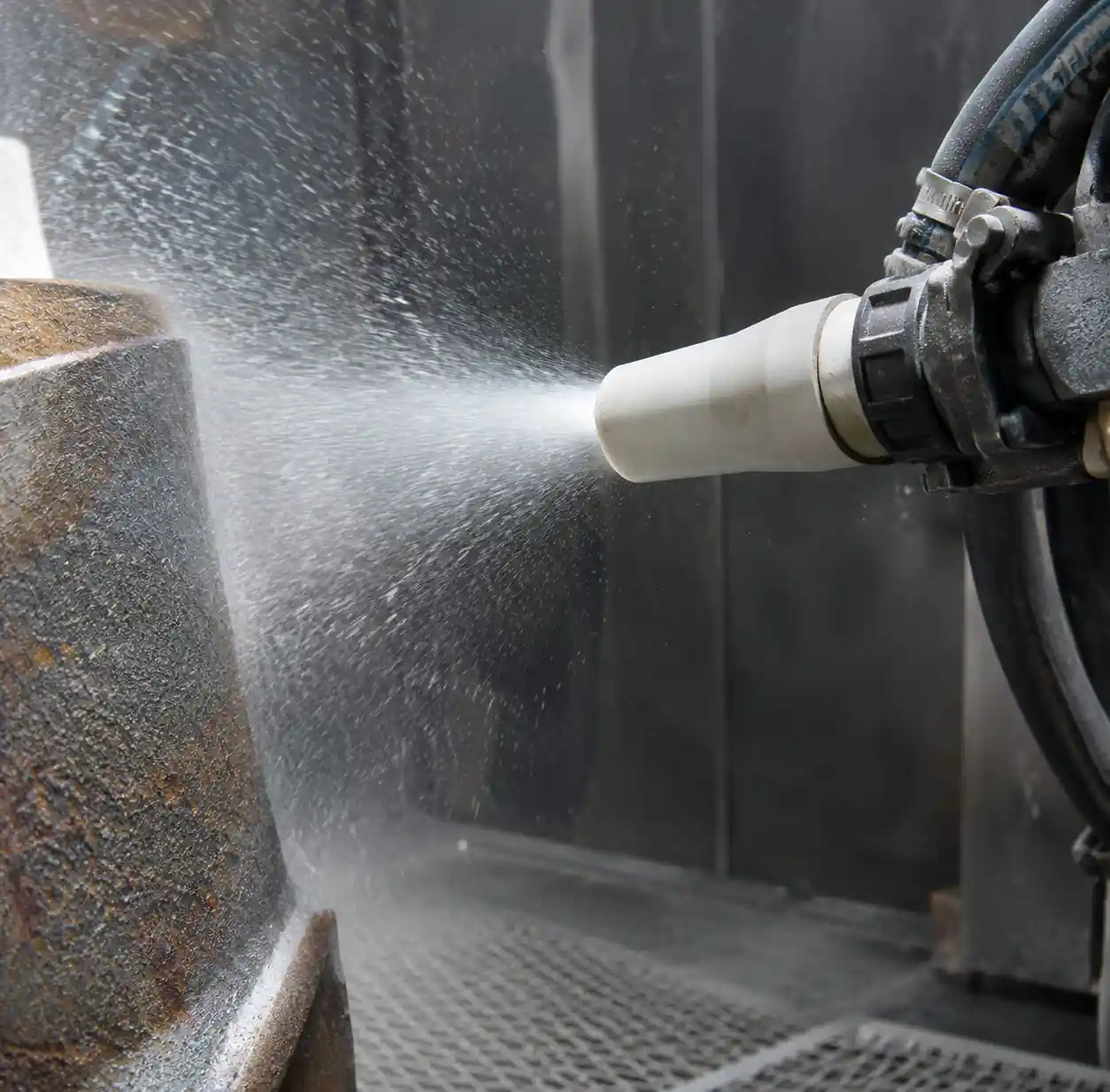 Ceramic nozzle in abrasive shot blasting application with particle flow
Abrasive environments represent the primary use case for ceramic nozzles. When your process fluid contains suspended solids, catalyst particles, or abrasive slurries, ceramic maintains its orifice geometry while metal nozzles degrade rapidly. Silicon carbide nozzles in industrial processes demonstrate this advantage clearly—a ceramic nozzle running waterjet cutting at 2,500 bar typically achieves 150 hours of service life compared to 15-30 hours for hardened steel.
Temperature extremes accelerate metal nozzle failure through oxidation, thermal expansion, and material softening. Ceramic nozzles retain their mechanical properties at temperatures where stainless steel begins to creep. In fluid catalytic cracking units (FCCU), ceramic nozzles withstand 5-20 years of continuous exposure to temperatures exceeding 700°C and abrasive catalyst particles.
Chemical resistance becomes critical in corrosive applications with concurrent abrasion. While stainless steel offers good corrosion resistance, it still erodes when corrosive fluids carry abrasive particles. Ceramic materials are stable oxides that resist both chemical attack and mechanical wear. You will need ceramic nozzles when pumping acidic slurries, alkaline solutions with suspended solids, or any combination where both mechanisms drive wear.
Material Comparison: Ceramic vs. Stainless Steel vs. Brass
Different nozzle materials deliver distinct performance profiles. The table below compares key properties affecting wear resistance and service life.
| Property | Silicon Carbide | Silicon Nitride | Stainless Steel 316 | Brass |
|---|---|---|---|---|
| Vickers Hardness | 24-28 GPa | 14-16 GPa | 2.0-2.5 GPa | 1.0-1.5 GPa |
| Max Operating Temp | 1,650°C | 1,200°C | 800°C | 400°C |
| Abrasion Resistance | Excellent | Excellent | Moderate | Poor |
| Impact Toughness | Moderate | Good | Excellent | Good |
| Chemical Resistance | Excellent | Excellent | Good | Poor |
| Relative Cost | 8-15x | 6-12x | 1x | 0.3x |
| Typical Service Life (abrasive) | 500-1,000 hrs | 400-800 hrs | 50-100 hrs | 10-20 hrs |
This comparison reveals why material selection depends on your specific operating conditions rather than a universal "best" material. Brass offers the lowest upfront cost but delivers the shortest service life, making it economical only for clean water applications or low-duty cycles. Stainless steel provides balanced performance across multiple factors at moderate cost, serving as the industry standard for general-purpose spraying.
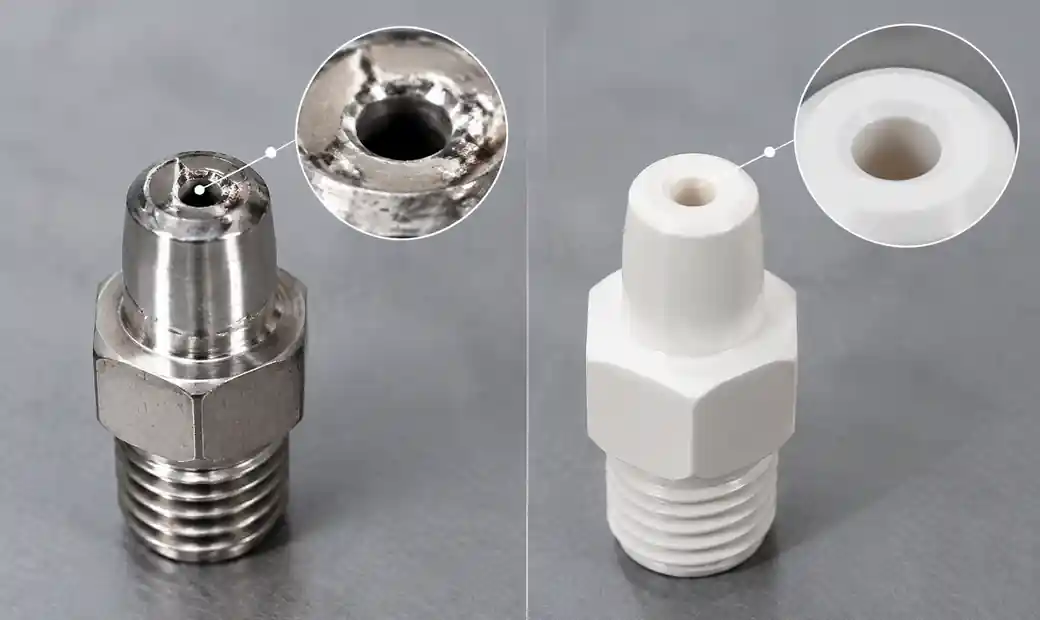 Comparison of worn stainless steel nozzle and intact ceramic nozzle after extended use
Ceramic materials command premium prices but deliver dramatically extended service life when abrasion drives failure. In shot blasting operations, silicon nitride nozzles achieve up to 1,000 hours of continuous operation while maintaining dimensional tolerance within 2%. Equivalent stainless steel nozzles require replacement every 50-100 hours as the orifice erodes and spray pattern degrades.
Cost-Benefit Analysis and ROI Calculation
The ROI calculation for ceramic nozzles depends on four variables: initial material cost differential, service life extension, replacement labor costs, and downtime expenses. Calculate your break-even point using this framework.
Start with the cost differential. A ceramic nozzle typically costs 6-15x more than an equivalent stainless steel nozzle. For example, a 1/4" full cone stainless steel nozzle might cost $25 while the ceramic version costs $200-300. This upfront gap appears significant until you factor in service life and replacement frequency.
Service life extension drives ROI in abrasive applications. When ceramic delivers 10x the operational hours before replacement, you install one ceramic nozzle for every ten stainless steel nozzles you would have used. Your total nozzle expenditure drops despite the higher unit cost. More critically, you eliminate nine replacement cycles—each requiring labor, system shutdown, and quality verification.
| Application Type | Nozzle Material | Initial Cost | Service Life | Replacements/Year | Total Annual Cost | ROI Period |
|---|---|---|---|---|---|---|
| Agricultural spraying (moderate abrasion) | Ceramic | $150 | 2,000 acres | 1 | $150 + $50 labor | 2-3 seasons |
| Agricultural spraying (moderate abrasion) | Stainless steel | $35 | 400 acres | 5 | $175 + $250 labor | - |
| Shot blasting | SiC Ceramic | $400 | 800 hours | 1.25 | $500 + $200 labor | 6-9 months |
| Shot blasting | Hardened steel | $80 | 60 hours | 16.7 | $1,336 + $2,672 labor | - |
| Waterjet cutting | SiC Ceramic | $500 | 150 hours | 6.7 | $3,350 + $1,005 labor | 8-12 months |
| Waterjet cutting | Stainless steel | $120 | 25 hours | 40 | $4,800 + $6,000 labor | - |
Labor costs amplify ceramic's advantage. Each nozzle replacement requires system shutdown, nozzle removal, installation of the replacement, system startup, and spray pattern verification. In automated production lines, this downtime can cost $200-500 per replacement cycle in lost productivity. When ceramic reduces your replacement frequency from 16 events per year to 1-2 events, you eliminate substantial indirect costs.
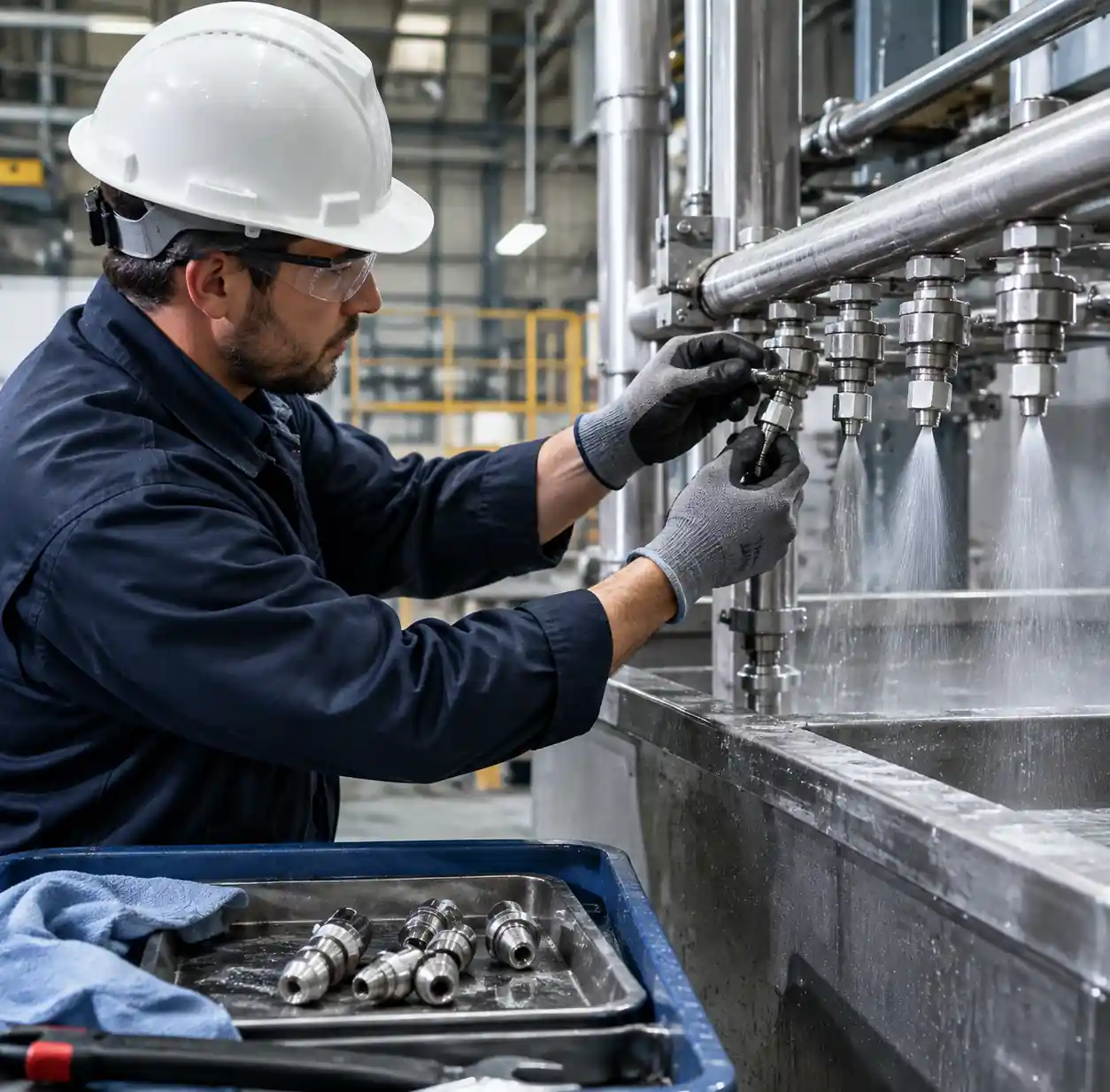 Technician performing nozzle replacement in industrial facility
Calculate your specific ROI using this formula: (Annual metal nozzle cost + Annual replacement labor + Annual downtime cost - Annual ceramic nozzle cost) / Initial ceramic investment = Years to break even. Most abrasive applications show positive ROI within 6-18 months.
Application-Specific Selection Criteria
Different applications create distinct wear mechanisms requiring specific ceramic formulations. Match your material selection to your dominant failure mode.
High-velocity particle impact occurs in shot blasting systems, sandblasting operations, and abrasive waterjet cutting. These applications accelerate particles to speeds exceeding 100 m/s, creating severe erosive wear. Silicon carbide nozzles resist this impact through extreme hardness, maintaining orifice diameter within specification for hundreds of operating hours. Specify SiC when particles larger than 50 microns travel at high velocity.
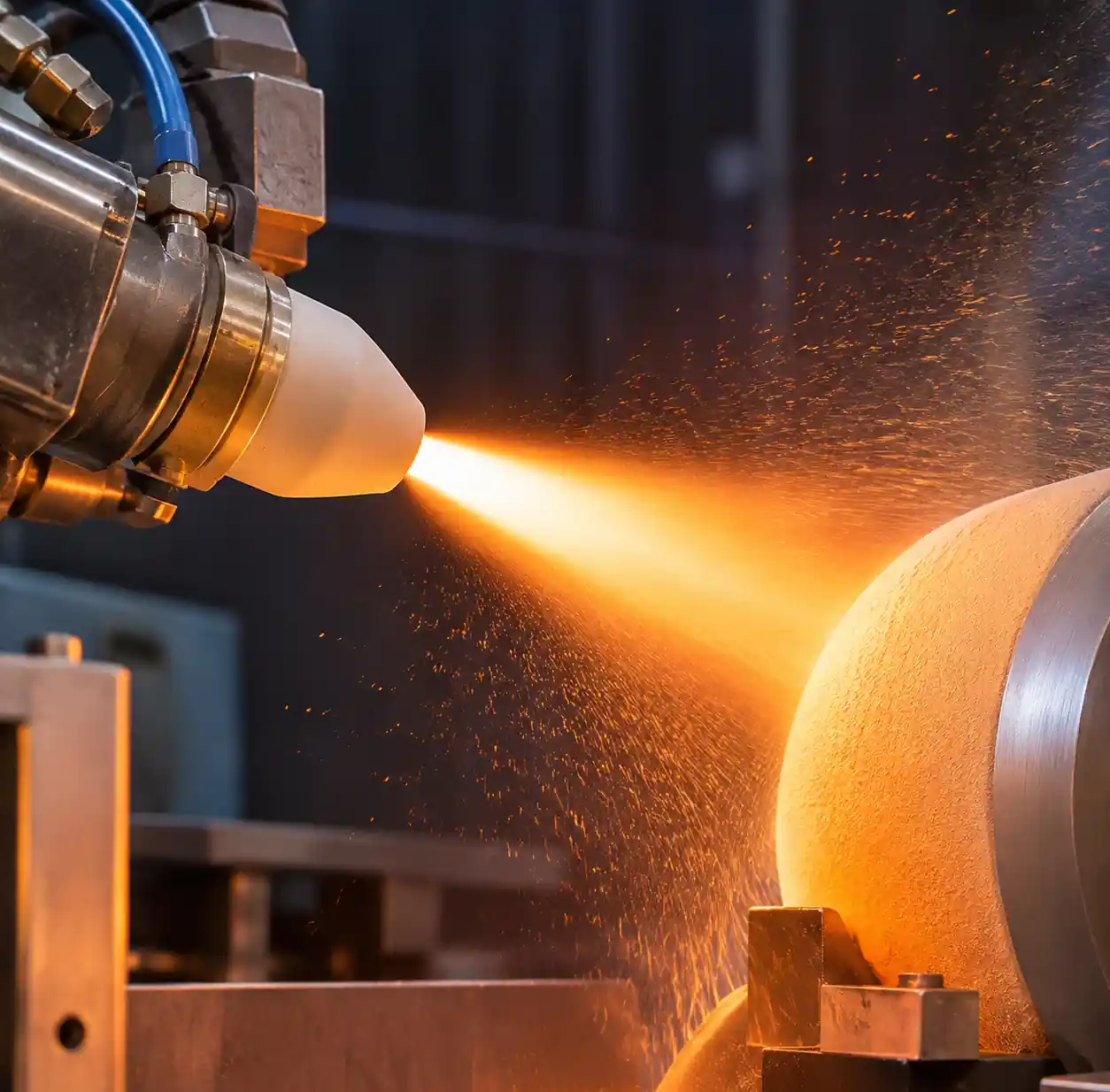 Ceramic nozzle operating in high-temperature thermal spray application
Thermal cycling combined with abrasion challenges nozzles in spray drying, thermal spray coating, and high-temperature chemical processing. Temperature fluctuations create thermal stress while abrasive particles erode the nozzle surface. Silicon nitride's superior thermal shock resistance makes it the preferred material for these applications. Si₃N₄ absorbs thermal expansion stress better than SiC, reducing crack initiation from temperature cycling.
Chemical processing with suspended solids requires both chemical resistance and wear resistance. Pumping catalyst slurries, pigment dispersions, or mineral suspensions exposes nozzles to combined chemical and mechanical attack. ZSBN ceramics excel here, offering chemical inertness and wear resistance in a single material. These nozzles maintain performance when pumping corrosive slurries at elevated temperatures.
Agricultural spraying applications present a special case. Ceramic spray tips for agriculture show clear benefits when you regularly apply formulations with suspended solids or abrasive adjuvants. If you routinely spray products containing abrasive carriers, ceramic maintains aperture shape and flow rate consistency for thousands of acres. For clean liquid formulations without abrasives, polymer or stainless steel tips offer better economics.
Service Life Expectations by Industry
Service life varies significantly by industry and operating conditions. Understanding typical replacement intervals helps you set realistic expectations and plan maintenance schedules.
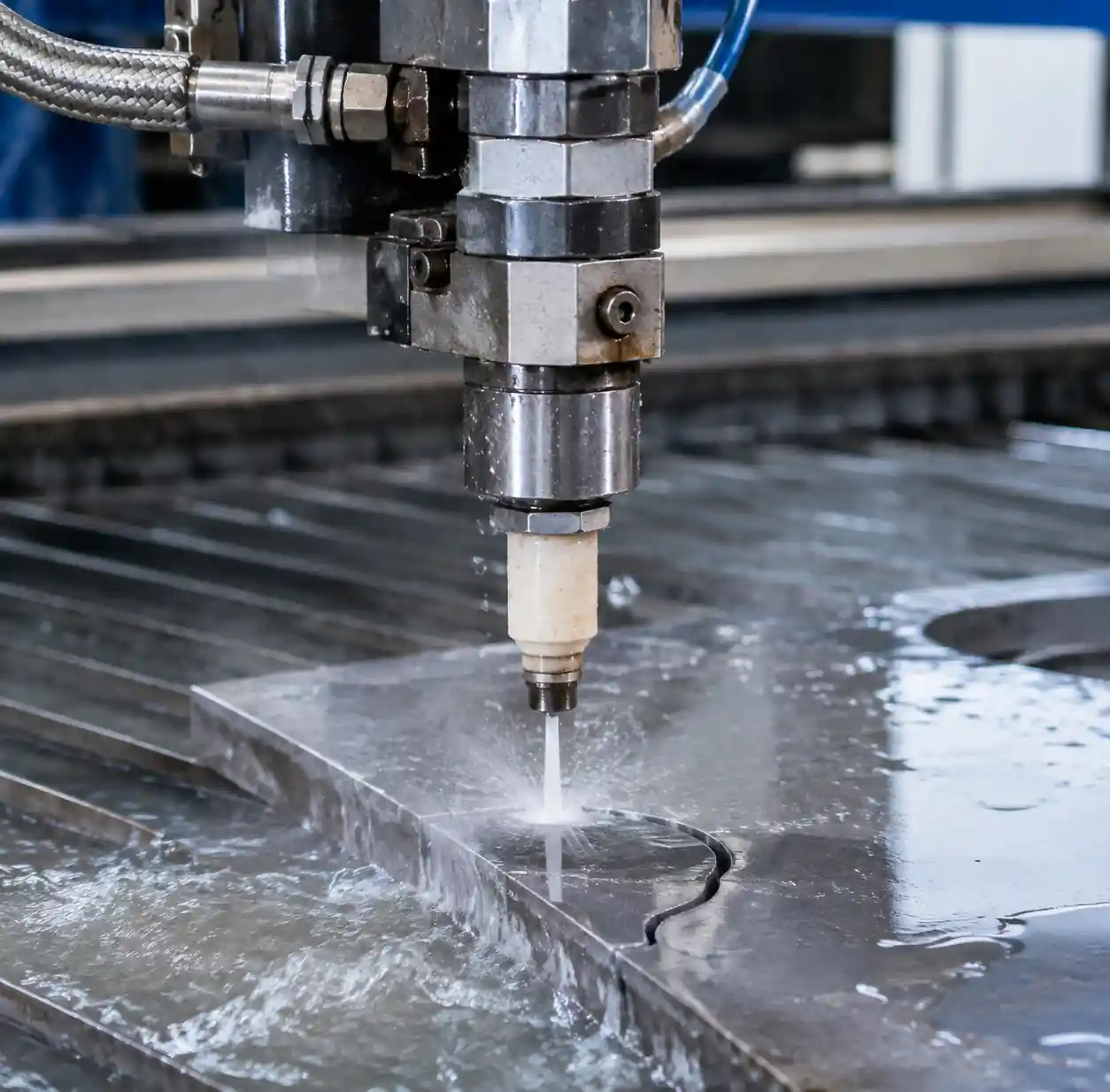 Waterjet cutting system showing ceramic nozzle in operation at high pressure
Shot blasting and abrasive blast cleaning represent the harshest conditions for nozzles. Silicon carbide and silicon nitride nozzles typically achieve 500-1,000 hours of continuous operation in these applications. Equivalent tungsten carbide nozzles last 200-400 hours, while hardened steel fails in 50-80 hours. The ceramic advantage is clear: one ceramic nozzle replaces 10-15 steel nozzles over its service life.
Waterjet cutting at pressures from 2,000-4,000 bar creates extreme erosive forces. Ceramic waterjet nozzles deliver approximately 150 hours of service at 2,500 bar compared to 20-30 hours for hardened stainless steel. Operating at higher pressures reduces both ceramic and metal nozzle life proportionally, but ceramic maintains its relative advantage across the pressure range.
Chemical processing applications see more variable service life depending on fluid properties and operating parameters. When pumping abrasive slurries at moderate pressures (10-50 bar), ceramic nozzles commonly achieve 3,000-6,000 operating hours. Clean chemical solutions without abrasives may extend this to 10,000+ hours. Track your specific wear rates during initial ceramic nozzle trials to establish replacement intervals for your process conditions.
Fluid catalytic cracking units in petroleum refining demonstrate ceramic's ultimate durability. FCCU air grid nozzles fabricated from high-alumina ceramics operate continuously for 5-20 years in temperatures exceeding 700°C with constant exposure to abrasive catalyst particles. No metal nozzle survives these conditions for more than months.
Common Mistakes When Specifying Ceramic Nozzles
Five common specification errors waste money or cause premature ceramic nozzle failure. Avoid these mistakes when transitioning from metal to ceramic nozzles.
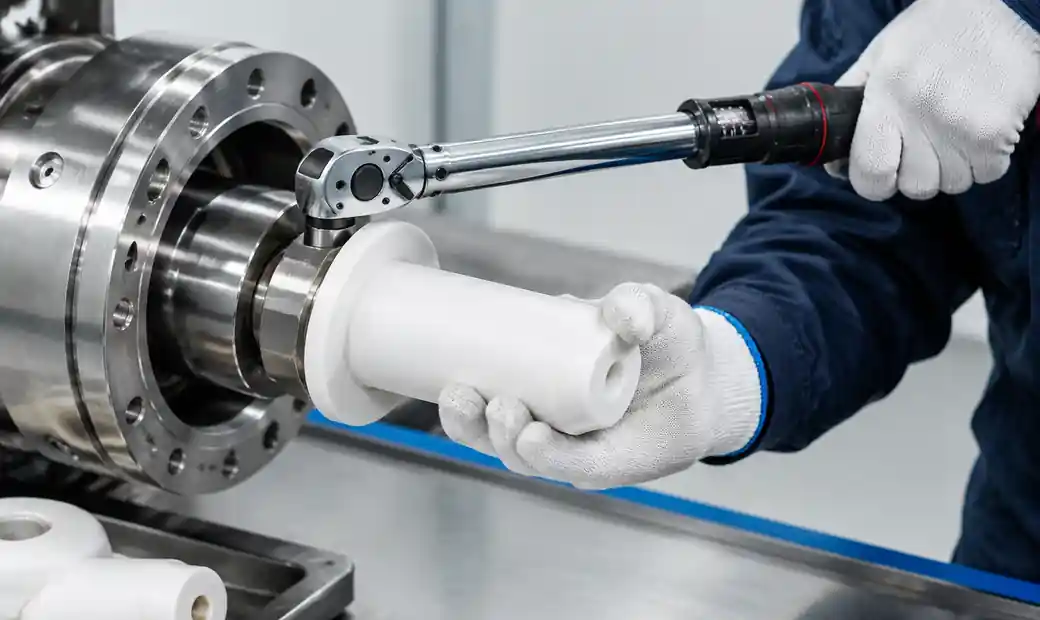 Proper installation technique for ceramic nozzle showing torque control
Mistake #1: Installing ceramic nozzles in clean fluid applications. Ceramic provides no advantage over stainless steel when spraying clean water, light oils, or non-abrasive chemicals. You pay the premium price but gain no service life benefit. Reserve ceramic for applications where abrasion or extreme temperature drives nozzle replacement.
Mistake #2: Ignoring mounting stress and impact loads. Ceramics offer excellent wear resistance but lower impact toughness than metals. Overtightening mounting threads, mechanical shock from hydraulic hammer, or impact during installation can crack ceramic nozzles. Use torque wrenches for installation, provide dampening for pulsating systems, and handle ceramic nozzles more carefully than metal equivalents.
Mistake #3: Selecting the wrong ceramic material for your application. Silicon carbide excels in abrasive particle erosion but shows lower thermal shock resistance than silicon nitride. Specifying SiC for rapid thermal cycling applications leads to premature cracking. Match your ceramic formulation to your dominant failure mechanism—abrasion, thermal cycling, or chemical attack.
Mistake #4: Expecting ceramic to solve clogging problems. Ceramic nozzles resist wear but don't prevent clogging from oversized particles or fluid contaminants. You must still provide adequate filtration upstream of ceramic nozzles. Ceramic maintains orifice geometry longer once clogging is controlled through proper filtration and fluid preparation.
Mistake #5: Failing to verify spray pattern after ceramic installation. Ceramic and metal nozzles with identical nominal specifications may produce slightly different spray patterns due to internal geometry differences in manufacturing. Always verify flow rate, spray angle, and droplet distribution after installing ceramic nozzles to confirm they meet your application requirements. This verification is particularly important for tank cleaning applications where coverage patterns determine cleaning effectiveness.
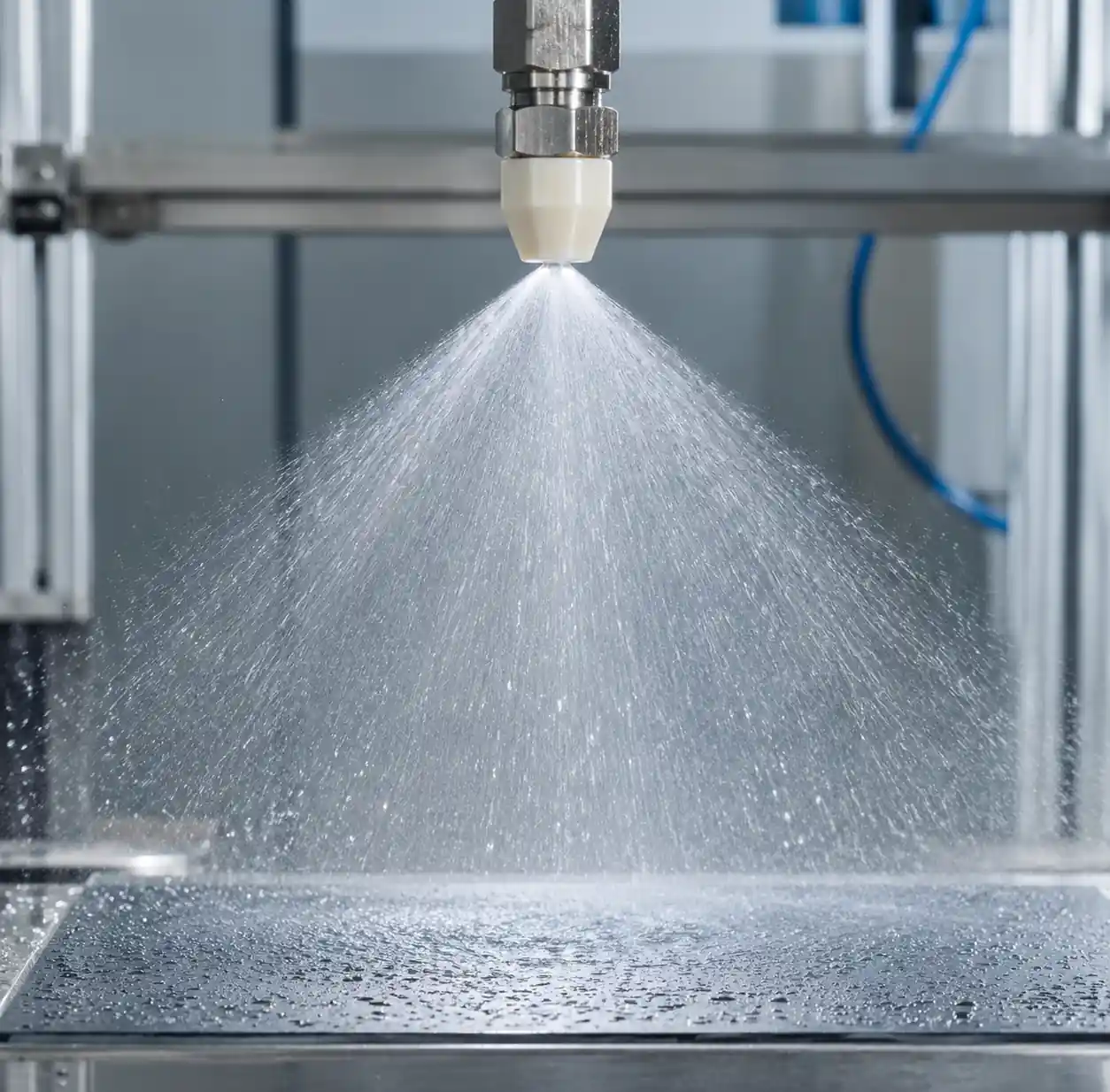 Spray pattern verification test for ceramic nozzle showing uniform coverage
FAQ
Q: How much longer do ceramic nozzles last compared to stainless steel?
A: Service life extension depends on abrasiveness of your application. In highly abrasive conditions like shot blasting or waterjet cutting, ceramic nozzles last 10-20x longer than stainless steel. In moderate abrasion applications like agricultural spraying with suspended solids, expect 5-8x longer life. Clean fluid applications show minimal difference because wear is not the failure mechanism.
Q: Can ceramic nozzles handle the same flow rates and pressures as metal nozzles?
A: Yes. Ceramic nozzles are available in the same orifice sizes, flow capacities, and pressure ratings as metal nozzles. Silicon carbide and silicon nitride maintain dimensional stability at pressures exceeding 4,000 bar. Always verify the manufacturer's pressure rating for your specific nozzle design, as mounting configuration affects maximum operating pressure.
Q: What are the disadvantages of ceramic nozzles?
A: Ceramic nozzles cost 6-15x more initially than stainless steel equivalents. They show lower impact toughness, making them more susceptible to damage from mechanical shock or improper installation. Ceramic nozzles cannot be easily modified in the field—if you need a different orifice size, you must purchase a new nozzle rather than drilling out a metal nozzle. Limited availability of certain configurations may extend lead times compared to standard metal nozzles.
Q: Do ceramic nozzles work for high-temperature applications?
A: Ceramic nozzles excel in high-temperature applications. Silicon nitride maintains strength at temperatures up to 1,200°C while silicon carbide operates effectively to 1,650°C. Both materials resist thermal shock better than most metal alloys. Specify ceramic nozzles when temperatures exceed 600°C or when rapid temperature cycling causes metal nozzle failure.
Q: How do I calculate whether ceramic nozzles will save money in my operation?
A: Calculate ROI using this method: (1) Determine current annual nozzle replacement frequency and total cost including labor and downtime, (2) Estimate ceramic nozzle service life based on industry data for similar applications—typically 5-20x metal nozzle life in abrasive conditions, (3) Calculate new annual replacement cost with ceramic, (4) The difference between current annual cost and ceramic annual cost is your yearly savings. Divide initial ceramic investment by annual savings to find payback period. Most abrasive applications show positive ROI within 6-18 months.
Q: Can I use ceramic nozzles with standard fittings and manifolds?
A: Most ceramic nozzles use standard threaded connections (NPT, BSP) compatible with existing manifolds and mounting hardware. However, you should avoid thread sealants that require high torque and use PTFE tape or appropriate liquid sealants instead. Check mounting torque specifications—ceramic threads typically require lower torque than metal threads to prevent cracking.
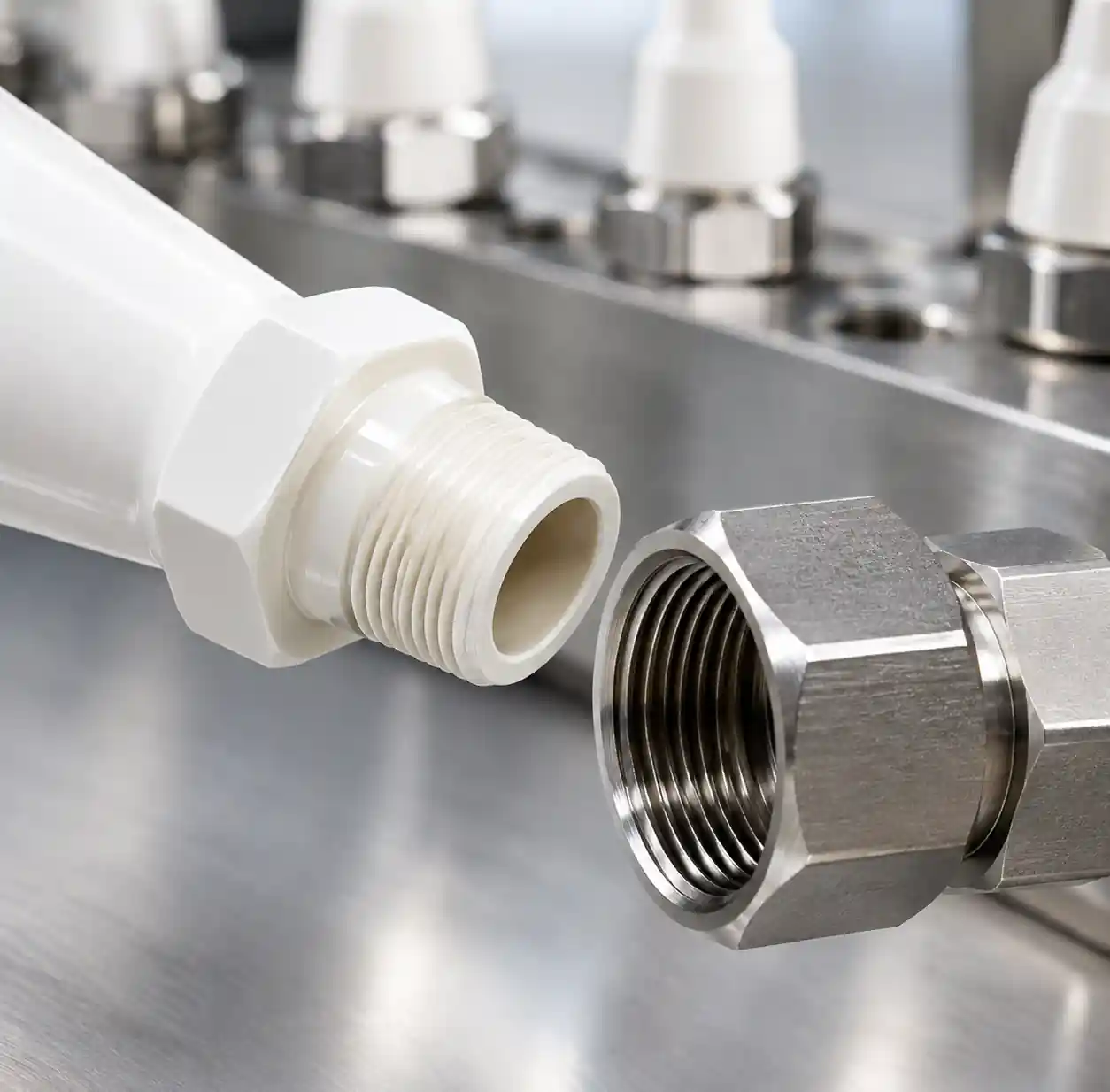 Ceramic nozzle threaded connection showing NPT fitting compatibility
Conclusion
Ceramic nozzles deliver clear ROI when abrasion, temperature, or chemical-mechanical attack drives replacement costs. If metal nozzles wear out more than twice yearly, ceramic likely cuts total cost of ownership despite higher unit price.
Silicon carbide suits severe abrasive erosion; silicon nitride offers better thermal shock resistance; ZSBN excels in corrosive-abrasive conditions.
Track replacement frequency, labor, and downtime, then compare against ceramic's 5-20x longer life. Most operations see payback in 6-18 months.
YuechenPrecision Technology makes ceramic nozzles in silicon carbide, silicon nitride, and custom formulations. Contact our technical team to evaluate your conditions and calculate expected life extension.