



Top 10 Spray Nozzle Applications in Manufacturing Industries
Spray nozzles handle far more than just water distribution—after 18 years optimizing spray systems across automotive plants, food processing facilities, and chemical refineries, I've seen how proper nozzle selection determines whether production lines run efficiently or face costly downtime. This guide covers the ten most critical spray nozzle applications in modern manufacturing.
Table of Contents
- 1. 1. Industrial Tank and Vessel Cleaning
- 2. 2. Precision Coating and Surface Treatment
- 3. 3. Process Cooling and Heat Removal
- 4. 4. Humidity Control and Environmental Conditioning
- 5. 5. Fire Suppression and Safety Systems
- 6. 6. Dust Suppression in Manufacturing
- 7. 7. Chemical Processing and Reaction Control
- 8. 8. Food Processing Applications
- 9. 9. Parts Washing and Surface Preparation
- 10. 10. Gas Scrubbing and Air Pollution Control
- 11. 11. FAQ
- 11.1. Q: How often should industrial spray nozzles be replaced?
- 11.2. Q: What causes uneven spray patterns in manufacturing applications?
- 11.3. Q: Can one nozzle type handle multiple applications?
- 11.4. Q: How do I calculate the number of nozzles needed for coverage?
- 11.5. Q: What pressure should I operate spray nozzles at?
- 12. 12.Conclusion
1. Industrial Tank and Vessel Cleaning
Tank cleaning represents one of the most demanding spray applications. Our brewery client reduced cleaning cycle time from 90 minutes to 28 minutes by switching from static spray balls to gear-driven rotary tank cleaning nozzles, providing complete 360-degree coverage.
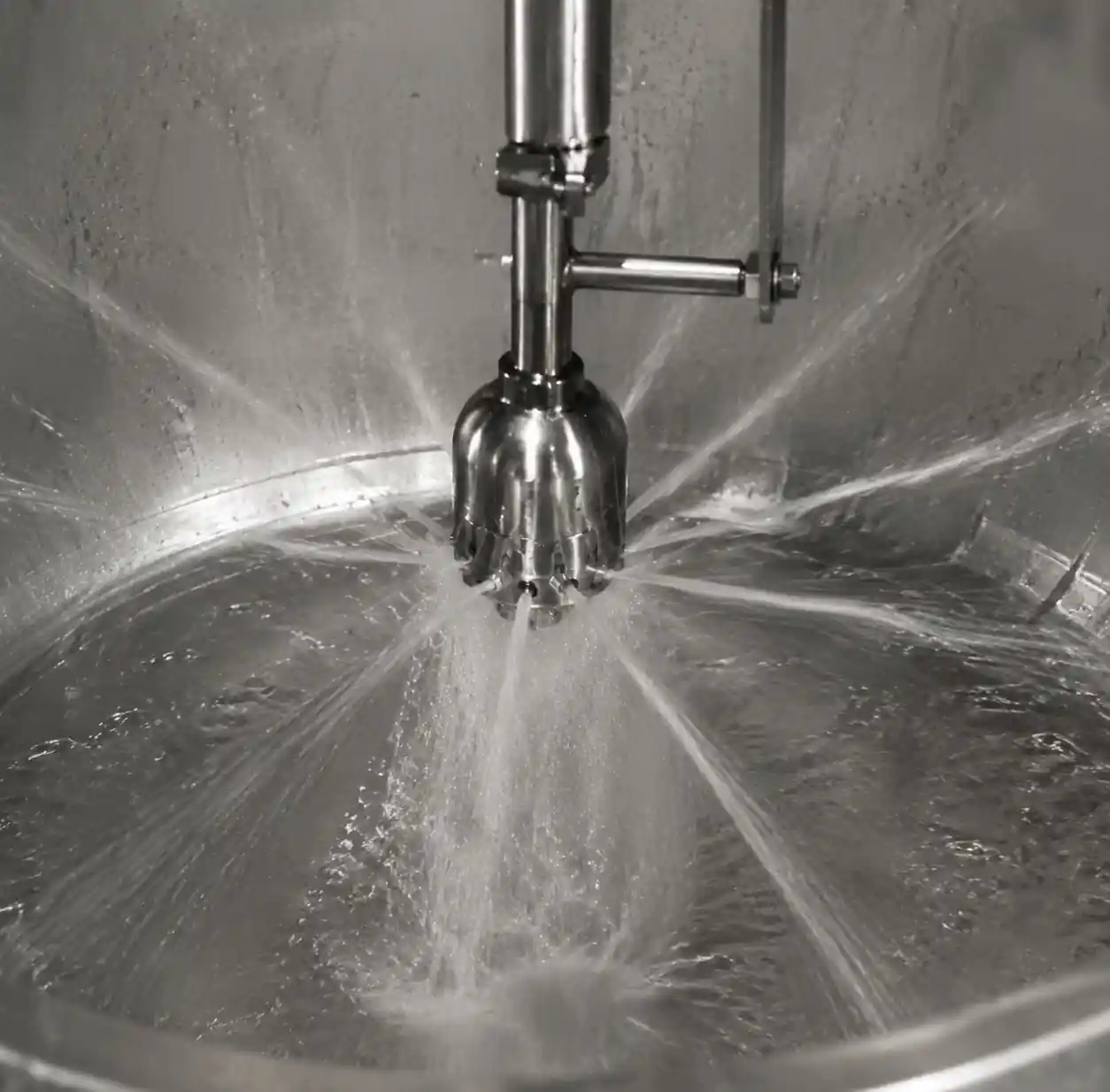 Industrial rotary tank cleaning nozzle in operation inside stainless steel vessel
Gear-driven versions installed in a chemical plant have operated for 47 months in concentrated caustic solution at 185°F without bearing failure. These eliminate external motors and shaft seals but require minimum flow rates of 15-25 GPM.
| Tank Cleaning Method | Cleaning Time | Water Consumption | Coverage Efficiency |
|---|---|---|---|
| Static Spray Ball | 60-90 min | 800-1200 gallons | 75-85% |
| Rotary Nozzle (Gear-Driven) | 25-35 min | 450-650 gallons | 95-99% |
| High-Impact Rotary | 20-30 min | 400-600 gallons | 98-100% |
| CIP Spray Head (Fixed) | 45-70 min | 600-900 gallons | 80-90% |
Pharmaceutical applications demand FDA-validated cleaning. Rotary nozzles consistently achieve <10 RLU readings versus 45-120 RLU with static spray balls.
2. Precision Coating and Surface Treatment
Coating uniformity depends on atomization quality and pattern consistency. Our automotive clear coat line operates with air atomizing nozzles at 28 PSI liquid pressure and 68 PSI atomizing air pressure, producing 40-55 micron droplets. When maintenance increased air pressure to 85 PSI, droplet size dropped to 28 microns, creating 14% overspray waste costing $18,000 monthly.
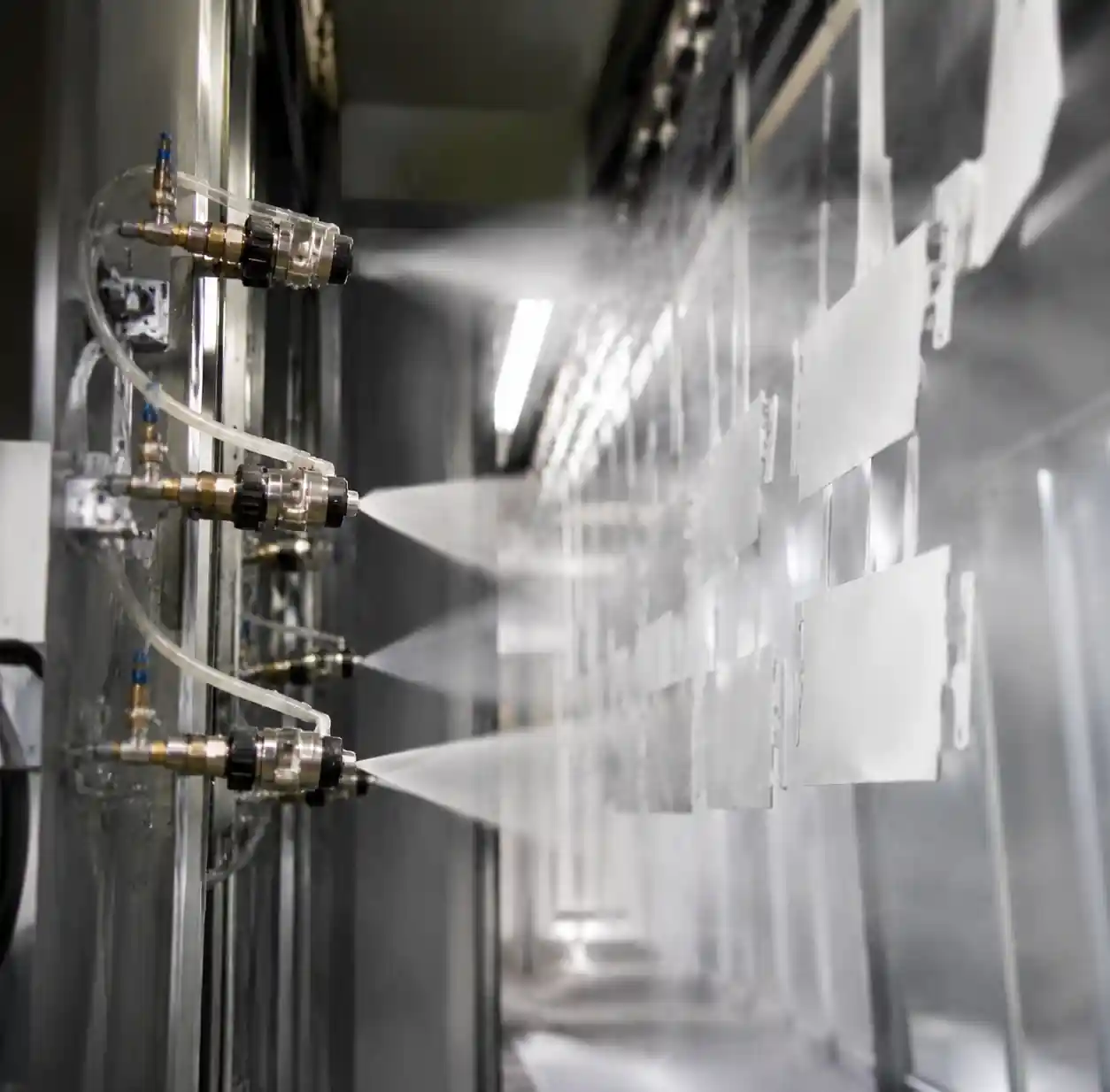 Air atomizing spray nozzles applying precision coating on production line
The 2026 generation incorporates precision-machined mixing chambers that improve atomization consistency by 23% versus 2022 designs. We measured spray pattern variation under 3% versus 12-18% with older designs—critical where film thickness must remain within ±2 microns.
Electrostatic coating systems charge droplets to achieve wrap-around coverage. We increased transfer efficiency from 52% to 78% on an industrial line, with coating savings reaching $120,000 annually.
3. Process Cooling and Heat Removal
Industrial process cooling relies on evaporative heat transfer. Our steel rolling mill uses full cone nozzles at 120 PSI producing 280-350 micron droplets for roll cooling. This droplet size maximizes evaporative efficiency without creating excessive mist.
Testing revealed optimal performance at 280-350 microns. Smaller droplets evaporate before contacting surfaces, while larger droplets reduce surface area and slow evaporation. We measured a 15°C temperature improvement after optimizing nozzle selection.
| Cooling Application | Optimal Droplet Size | Typical Pressure | Evaporation Efficiency |
|---|---|---|---|
| Steel Rolling Mills | 280-350 microns | 100-140 PSI | 85-92% |
| Aluminum Extrusion Quench | 400-600 microns | 60-100 PSI | 75-85% |
| Heat Exchanger Pre-cooling | 200-300 microns | 80-120 PSI | 88-95% |
| Emergency Quench Systems | 500-800 microns | 80-120 PSI | 65-75% |
4. Humidity Control and Environmental Conditioning
Precision humidity control prevents static electricity buildup in textile mills and printing operations. Fine misting nozzles operating at 800-1200 PSI produce sub-10 micron droplets that evaporate instantly without wetting surfaces. Our textile client maintained 65% ±2% relative humidity across 40,000 square feet using 180 fog nozzles, eliminating static-related defects.
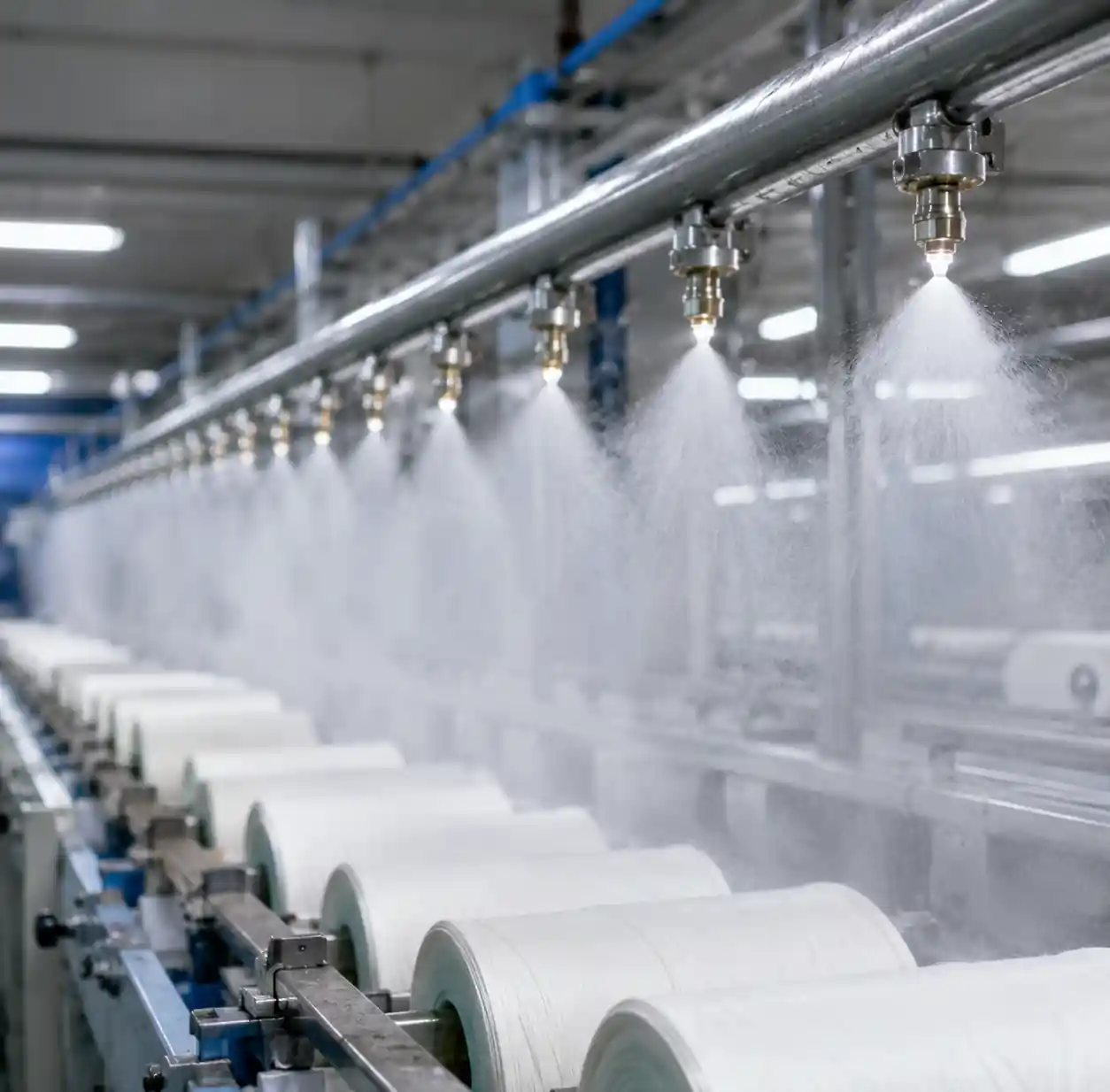 Fine misting nozzles creating dry fog for humidity control in textile facility
Droplets under 10 microns evaporate within seconds, while 20-30 micron droplets create surface wetting. Maintaining pressure above 900 PSI keeps average droplet size at 6-8 microns, preventing equipment condensation. Modern systems integrate with building automation, reducing water consumption by 35% while improving humidity uniformity from ±8% to ±2%. Reverse osmosis treatment extended our nozzle life from 4 months to 22 months.
5. Fire Suppression and Safety Systems
Water mist fire suppression systems use 50-200 micron droplets to cool flames and displace oxygen more efficiently than traditional sprinklers, providing 20-40x more surface area. Our electronics facility installed water mist systems using 90% less water while achieving superior suppression.
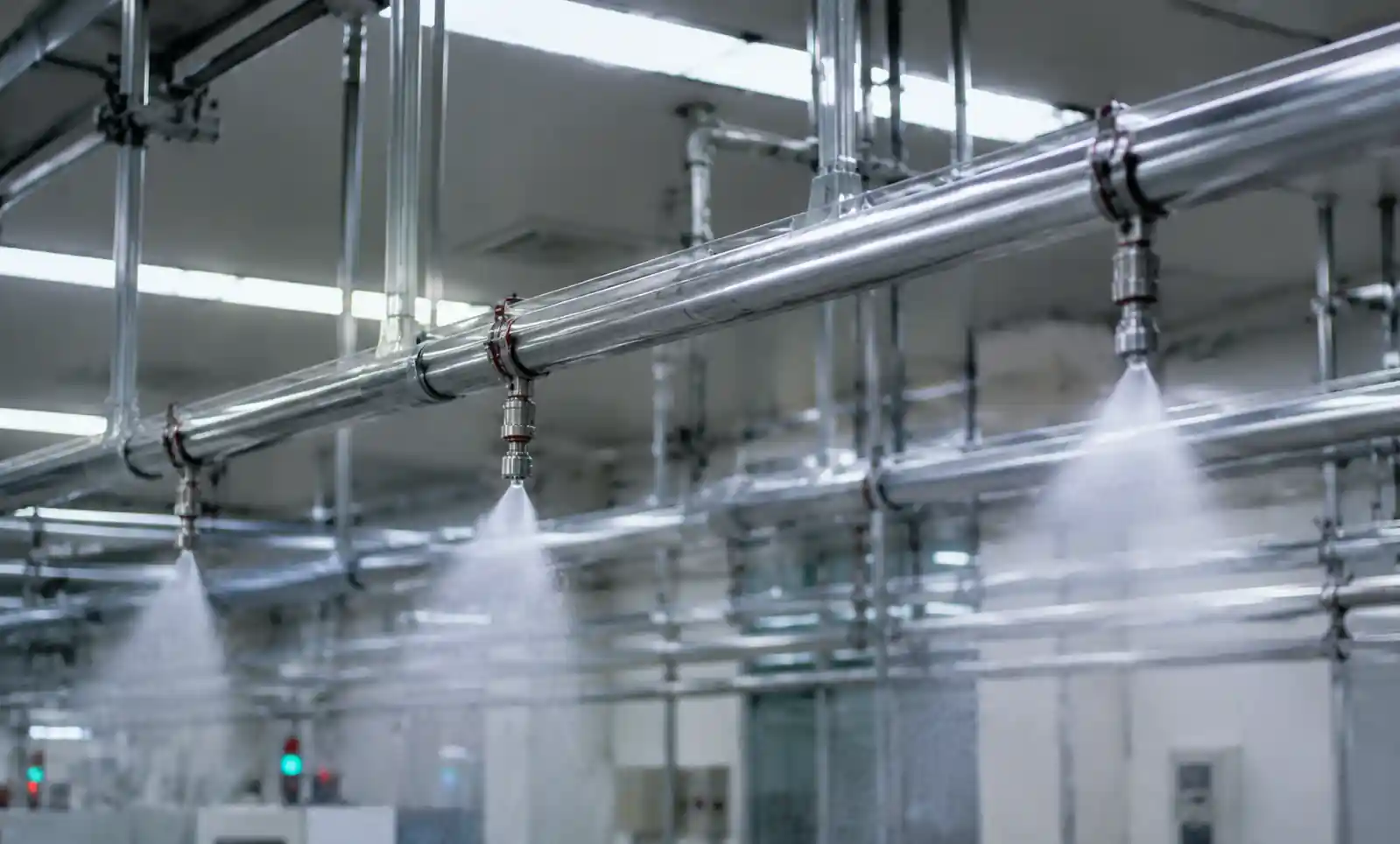 Water mist fire suppression nozzle installation in electronics manufacturing facility
NFPA 750 standards govern water mist system design. Nozzle spacing, pressure requirements, and droplet specifications require independent validation. Systems typically operate at 150-300 PSI, demanding Schedule 40 stainless steel piping rated for 600 PSI. The latest 2026 nozzles incorporate self-cleaning orifices with integrated temperature sensors.
6. Dust Suppression in Manufacturing
Dust suppression faces strict MSHA and OSHA regulations. Our quarry operation installed full cone nozzles at crushing points, reducing respirable silica dust from 280 μg/m³ to 45 μg/m³—well below the 50 μg/m³ OSHA limit. The system uses 18 GPM across 24 nozzles versus 80 GPM previously.
Mounting nozzles 6-8 feet above dust points at 45-degree angles creates an air curtain capturing particles. We measured 78% capture efficiency with proper placement versus 34% with direct overhead mounting. Fine mist nozzles at 400-600 PSI produce 80-150 micron droplets, achieving equivalent control with 35% less water.
7. Chemical Processing and Reaction Control
Gas absorption towers use hollow cone nozzles to maximize liquid-gas contact area. Our sulfuric acid plant operates 240 nozzles across four spray levels, achieving 99.7% SO₂ removal efficiency. The hollow cone pattern provides larger surface area than full cone designs.
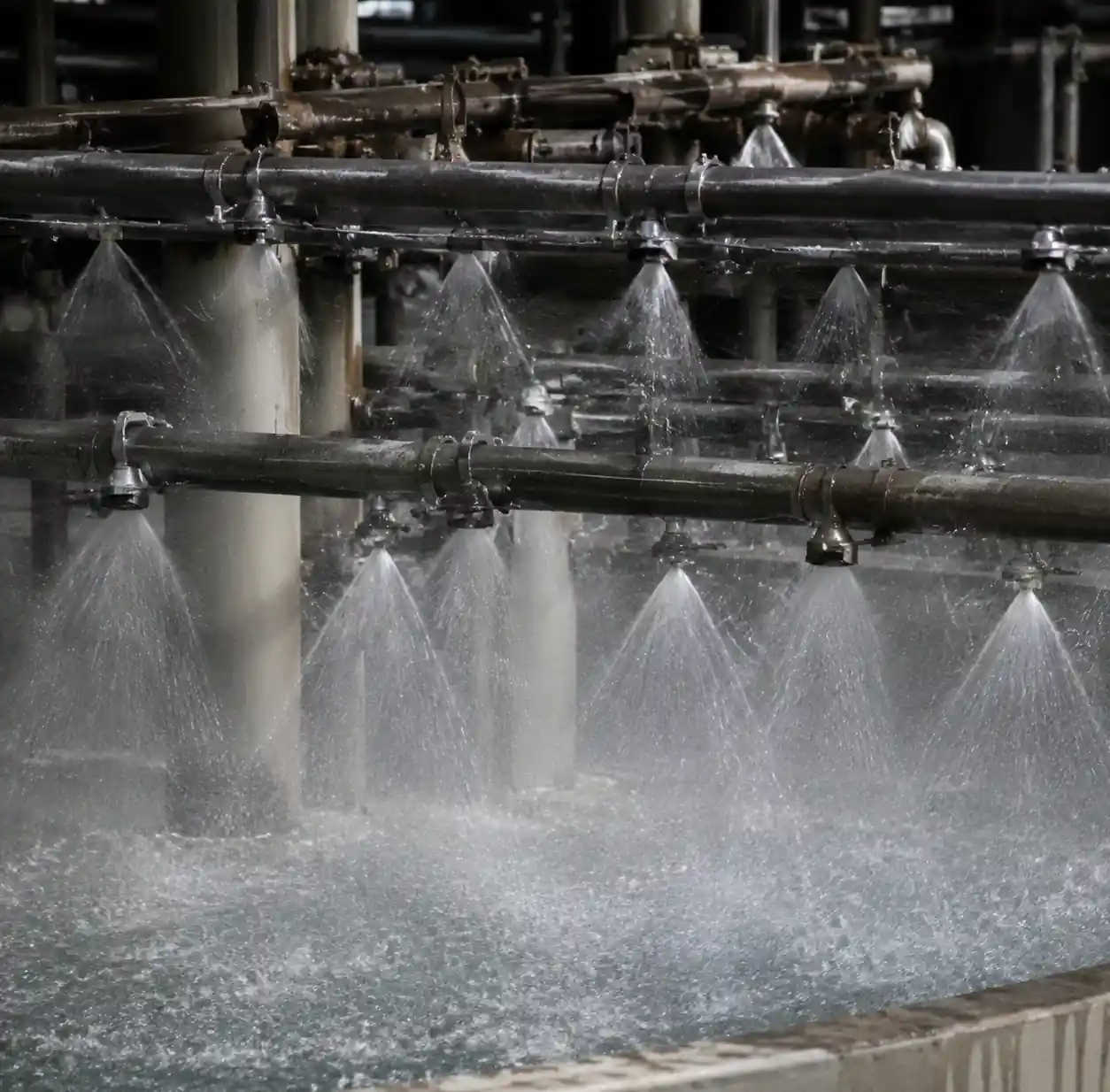 Hollow cone spray nozzles in chemical absorption tower for gas processing
Material selection determines lifespan in corrosive environments. Standard 316 stainless steel nozzles lasted 8 months before orifice wear expanded flow rates by 18%. Silicon carbide nozzles cost 12x more ($1,850 versus $155) but operate 48+ months with under 3% degradation.
Temperature affects spray patterns in reaction vessels. Our polymerization reactor at 185°C reduces liquid viscosity by 45%, altering spray angles from 60 to 74 degrees. Chemical compatibility testing proves essential—acetone-based solution dissolved polypropylene nozzles in 18 minutes.
8. Food Processing Applications
Food-grade nozzles must meet FDA 21 CFR 177.1520 standards. Our dairy plant uses electropolished 316L stainless steel nozzles with surface finish Ra < 0.8 microns to prevent bacterial adhesion.
CIP (clean-in-place) systems demand precise coverage and chemical delivery. Minimum impact force of 5 PSI removes protein residues. Our spray ball design delivers 8-12 PSI impact across 95% of tank surfaces.
| Food Processing Application | Nozzle Type | Typical Pressure | Flow Rate |
|---|---|---|---|
| CIP Tank Cleaning | Rotary Spray Ball | 40-60 PSI | 15-30 GPM |
| Conveyor Washing | Flat Fan Array | 60-100 PSI | 8-15 GPM per nozzle |
| Product Rinsing | Full Cone | 30-50 PSI | 5-12 GPM |
| Bottle/Container Washing | Multi-angle Fixed | 80-120 PSI | 12-25 GPM |
Systems maintain 180°F minimum for thermal sanitization. The latest 2026 innovation integrates UV-C sterilization into spray assemblies, achieving 6-log bacterial reduction in under 12 seconds.
9. Parts Washing and Surface Preparation
Precision parts washing removes machining oils, coolants, and metal fines before assembly. Our aerospace system operates flat fan nozzles at 15-degree spray angles and 1,000 PSI. Testing showed 40-degree nozzles required 65% higher pressure for equivalent cleaning.
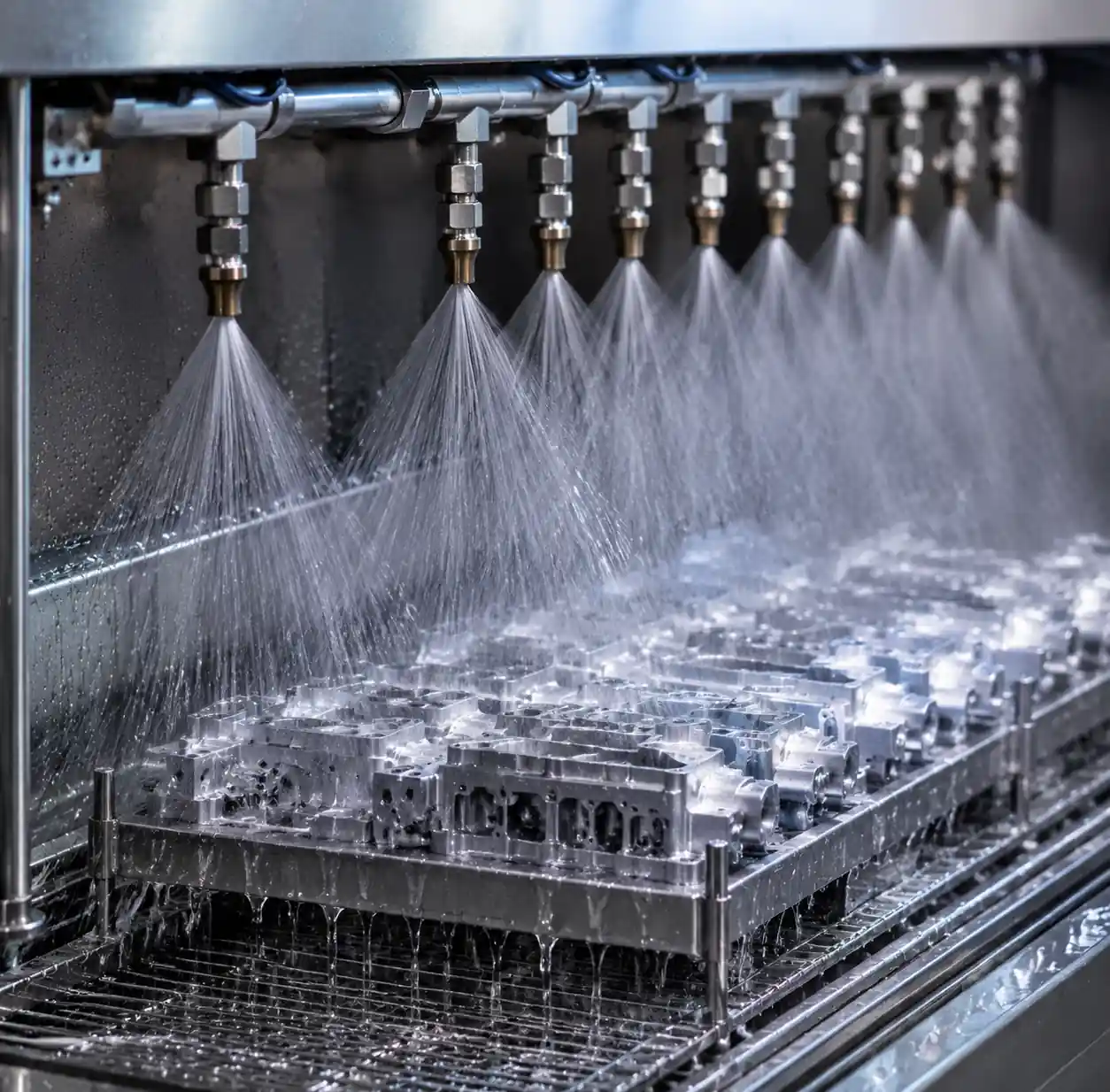 Flat fan spray nozzles in precision parts washing system for industrial components
Ultrasonic cleaning combined with spray washing reduced cleaning cycle time from 18 to 7 minutes, with cleanliness improving from 92% to 99.2% based on ATP testing. Aqueous cleaning systems replaced solvent operations, eliminating 12,000 gallons of solvent annually and reducing VOC emissions by 95%.
10. Gas Scrubbing and Air Pollution Control
Flue gas desulfurization systems contact hot exhaust gases with limestone slurry. Our power plant installation operates 360 spiral nozzles across six spray levels, achieving 98% SO₂ removal while handling 2.4 million CFM. The spiral pattern improves gas-liquid contact efficiency by 15% versus conventional full cone patterns.
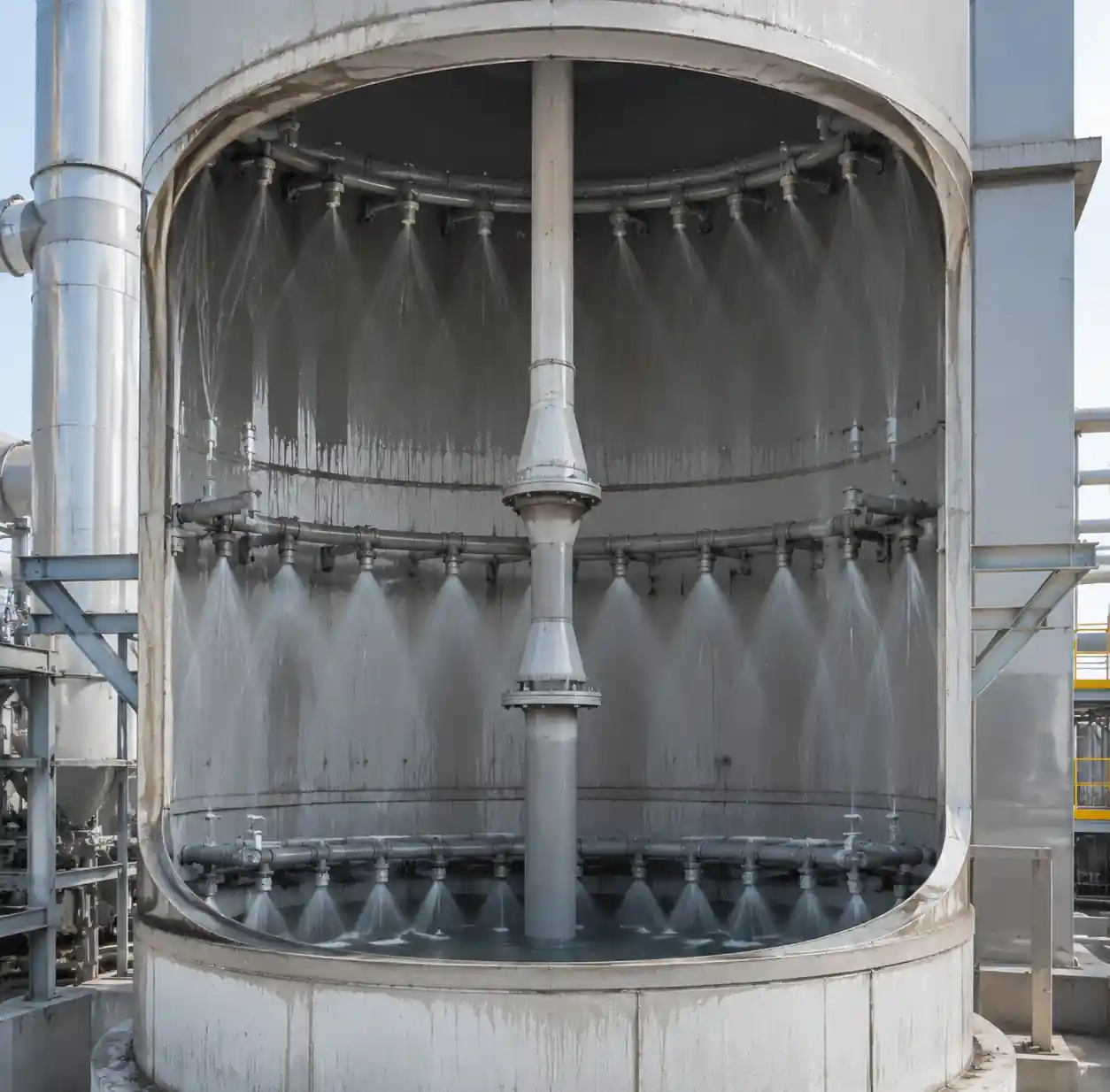 Spiral spray nozzles installed in flue gas desulfurization scrubber system
Nozzle plugging represents the primary failure mode. Limestone slurry contains particles exceeding 200 mesh. We specify minimum orifice diameter of 12mm with flushing systems during shutdowns, reducing plugging incidents from 8 per month to under 1 per quarter. The newest 2026 scrubber nozzles feature self-cleaning designs with spring-loaded needles stroking through orifices every 30 minutes, showing 85% reduction in plugging.
11. FAQ
Q: How often should industrial spray nozzles be replaced?
A: Clean water applications run 18-36 months; abrasive slurries require replacement every 3-6 months. Monitor flow rates quarterly—replace nozzles showing >10% deviation from baseline.
Q: What causes uneven spray patterns in manufacturing applications?
A: Three primary causes: orifice wear from abrasion, partial plugging from debris, and pressure variations. Installing upstream filtration and maintaining design pressure prevents most pattern problems.
Q: Can one nozzle type handle multiple applications?
A: Rarely. Each application demands specific spray characteristics—droplet size, pattern shape, impact force. Using general-purpose nozzles compromises performance.
Q: How do I calculate the number of nozzles needed for coverage?
A: Calculate based on individual nozzle coverage area at mounting height, accounting for required overlap (typically 30-50%). Measure actual spray width at operating pressure.
Q: What pressure should I operate spray nozzles at?
A: Operate within manufacturer specifications, typically 40-150 PSI for most industrial nozzles. Higher pressure doesn't always improve performance—it can create excessive mist and accelerated wear.
12.Conclusion
Spray nozzles directly impact manufacturing efficiency, product quality, and operating costs. Tank cleaning nozzles cut water use by 45-60% while preventing contamination; precision atomization controls coating thickness within microns. Material choice drives cost—silicon carbide nozzles cost 10-15x more than stainless steel but last 50-100x longer in abrasive service. The 2026 generation adds self-cleaning mechanisms and sensors that reduce maintenance. Success comes down to matching nozzle characteristics to your application, testing at actual operating conditions, and monitoring performance through regular flow checks and pattern verification. Replace nozzles before quality suffers, not after.