



What Are Industrial Spray Nozzles? Complete Guide for 2026
Industrial spray nozzles are precision-engineered devices designed to atomize, shape, and control liquid flow in demanding manufacturing environments. From automotive paint booths requiring micron-level consistency to chemical plants operating at extreme pressures and temperatures, these devices transform bulk liquids into precisely controlled spray patterns that drive critical industrial processes.
After fifteen years engineering spray systems across chemical processing, food manufacturing, and industrial coating, I’ve witnessed how proper nozzle selection transforms production efficiency—and how the wrong choice cascades into quality failures and costly downtime. This guide delivers practical insights focusing on what matters in 2026: performance consistency, material longevity, and total cost of ownership.
Table of Contents
- 1. How Industrial Spray Nozzles Work
- 2. Types of Industrial Spray Nozzles
- 3. Spray Pattern Engineering
- 4. Material Selection for Durability
- 5. Critical Selection Criteria
- 6. Real-World Applications
- 7. Innovations Shaping 2026
- 8. FAQ
- 8.1. What’s the difference between hydraulic and pneumatic spray nozzles?
- 8.2. How often should industrial spray nozzles be replaced?
- 8.3. Can I increase spray coverage by raising system pressure?
- 8.4. Why do nozzles clog even with filters installed?
- 8.5. What causes uneven spray patterns?
- 8.6. Are ceramic nozzles worth the 7–10× higher cost?
- 9. Conclusion
How Industrial Spray Nozzles Work
Industrial spray nozzles transform pressurized liquid into controlled spray patterns through three core mechanisms: hydraulic atomization, pneumatic atomization, and mechanical rotation.
Hydraulic Atomization forces liquid through precision orifices at 40–1,500 PSI. As liquid exits into lower-pressure environments, the pressure drop creates turbulence that breaks the stream into droplets. Smaller orifices and higher pressures produce finer atomization, though doubling pressure reduces droplet size by only 30%, not 50%.
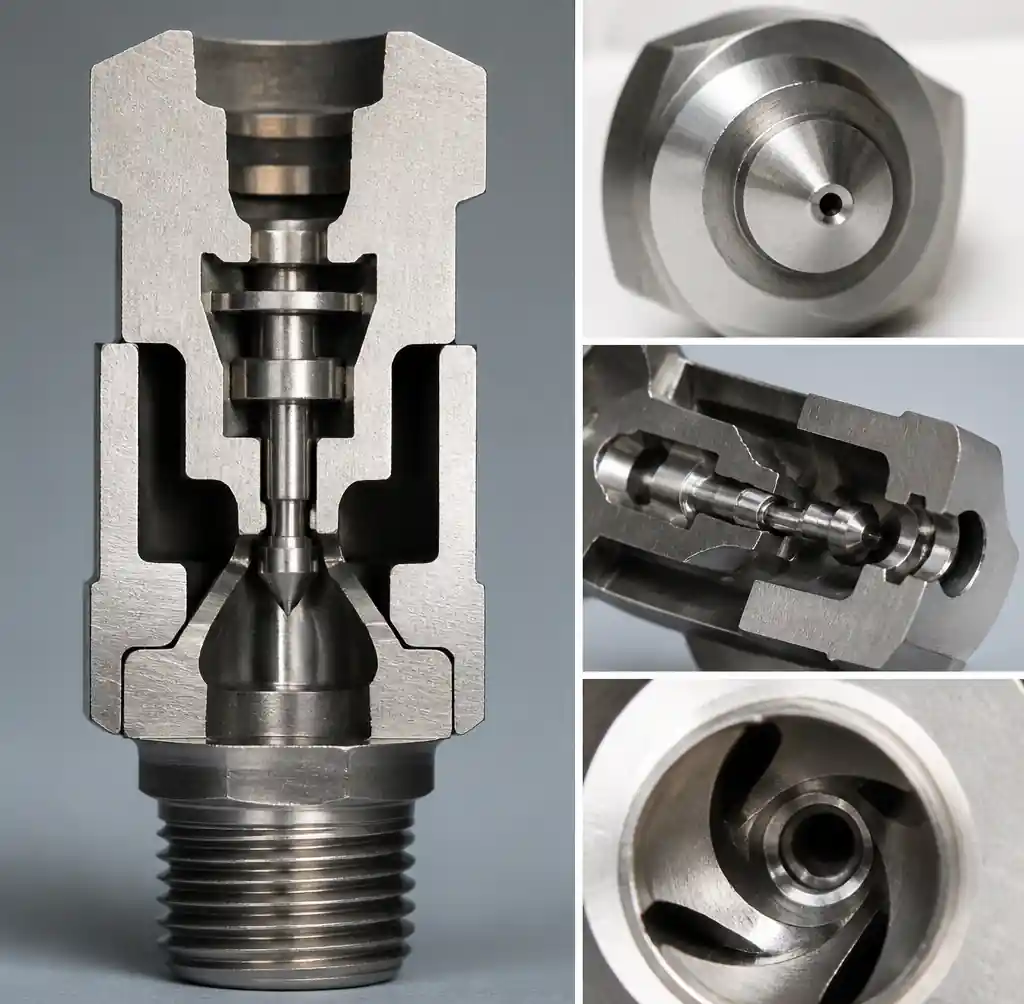 Industrial hydraulic spray nozzle showing precision orifice and internal flow mechanism
Pneumatic (Air) Atomization introduces compressed air to shear liquid streams into ultra-fine droplets—often 10–50 microns versus 100–300 microns from hydraulic nozzles. Air atomizing nozzles excel when coating applications demand extremely fine finishes or when liquid viscosity exceeds hydraulic capability. The tradeoff is higher operating cost: compressed air consumption adds $4,000–$7,000 annually per nozzle.
Mechanical Rotation drives tank cleaning applications where rotary spray heads provide 360° coverage, delivering thorough cleaning with 40–60% less water and time than static spray balls.
The critical difference between industrial and consumer nozzles lies in consistency. Manufacturing tolerances of ±0.0005 inches ensure flow rates remain within ±3–5% across production runs—compared to ±15–20% variation in consumer-grade hardware.
Types of Industrial Spray Nozzles
Each nozzle design optimizes specific spray characteristics for distinct industrial requirements.
| Nozzle Type | Spray Pattern | Operating Pressure | Droplet Size | Primary Applications |
|---|---|---|---|---|
| Full Cone | Solid circular | 40–500 PSI | 100–500 microns | Fire suppression, gas scrubbing, dust control |
| Hollow Cone | Ring-shaped | 40–500 PSI | 50–300 microns | Chemical reactions, cooling towers, washing |
| Flat Fan | Elliptical line | 20–300 PSI | 100–600 microns | Surface treatment, agricultural spraying |
| Air Atomizing | Fine mist | 10–100 PSI liquid | 10–100 microns | Precision coating, pharmaceutical |
| Fine Misting | Ultra-fine fog | 500–1500 PSI | 5–50 microns | Humidity control, evaporative cooling |
Full Cone Nozzles distribute liquid uniformly across the entire circular spray area. Fire protection systems leverage this complete coverage, while gas scrubbing operations maximize contact between liquid droplets and gas molecules. Spiral full cone designs create superior distribution uniformity (±8–10%) compared to axial designs (±15–20%).
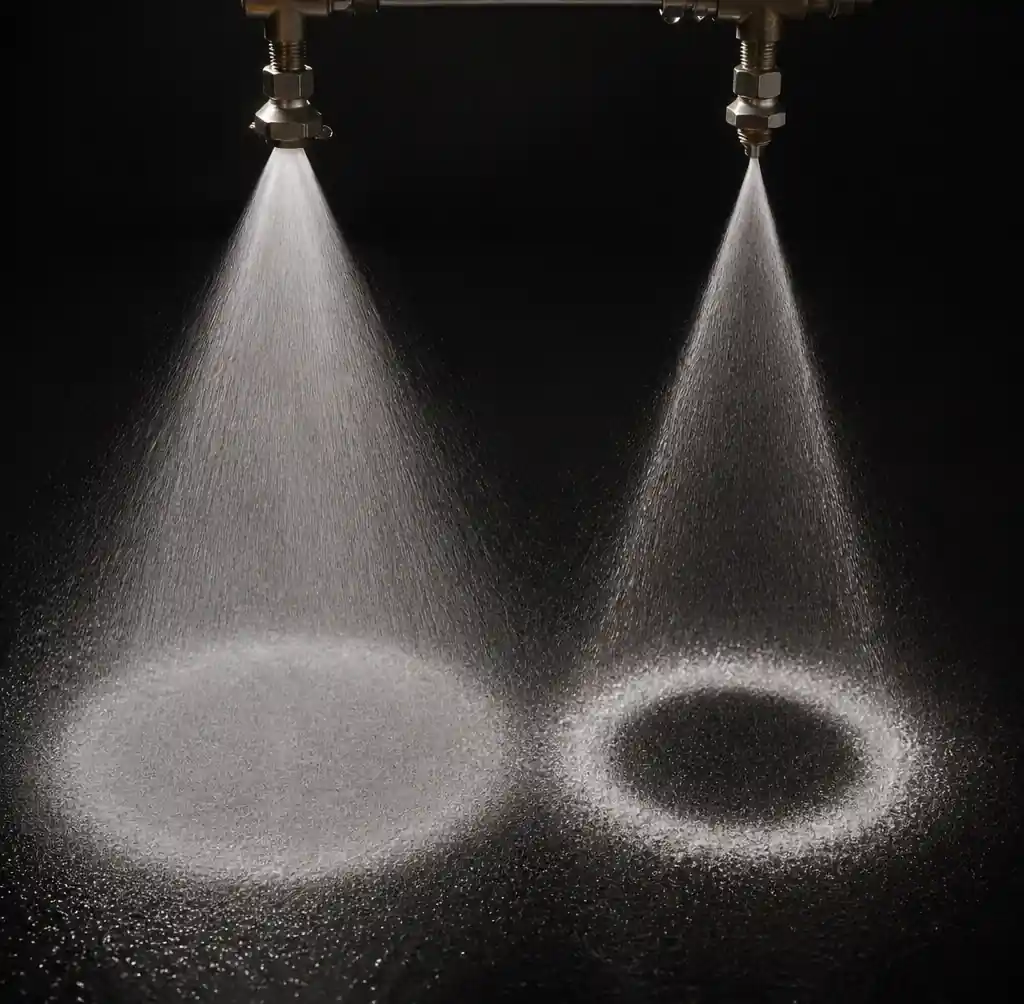 Side-by-side comparison of full cone and hollow cone spray patterns in operation
Hollow Cone Nozzles concentrate liquid in a ring pattern, creating higher droplet velocities for superior washing impact and maximizing surface area for chemical reactions. Cooling tower systems benefit because the ring pattern intersects more air volume than solid cones.
Flat Fan Nozzles project elliptical patterns ideal for rectangular surfaces. Agricultural sprayers use hundreds of overlapping flat fan patterns for uniform herbicide application, while industrial systems exploit narrow-angle (25–40°) designs for high-impact cleaning.
Air Atomizing Nozzles combine low-pressure liquid with compressed air to generate extremely fine droplets. Internal-mix designs consume 30% less air, while external-mix configurations handle high-viscosity materials up to 3,000 centipoise.
Fine Misting Nozzles operating at 800–1,500 PSI create flash-evaporating droplets under 20 microns for humidity control systems, maintaining ±2% relative humidity without surface wetting.
Spray Pattern Engineering
Three characteristics matter most: spray angle, distribution uniformity, and overlap design.
Spray Angle defines coverage area at mounting distance. A 70° nozzle mounted 12 inches away covers approximately 15 inches diameter. Critical: spray angle narrows as pressure drops—that 70° nozzle might deliver only 55° at minimum pressure, shrinking coverage by 25%.
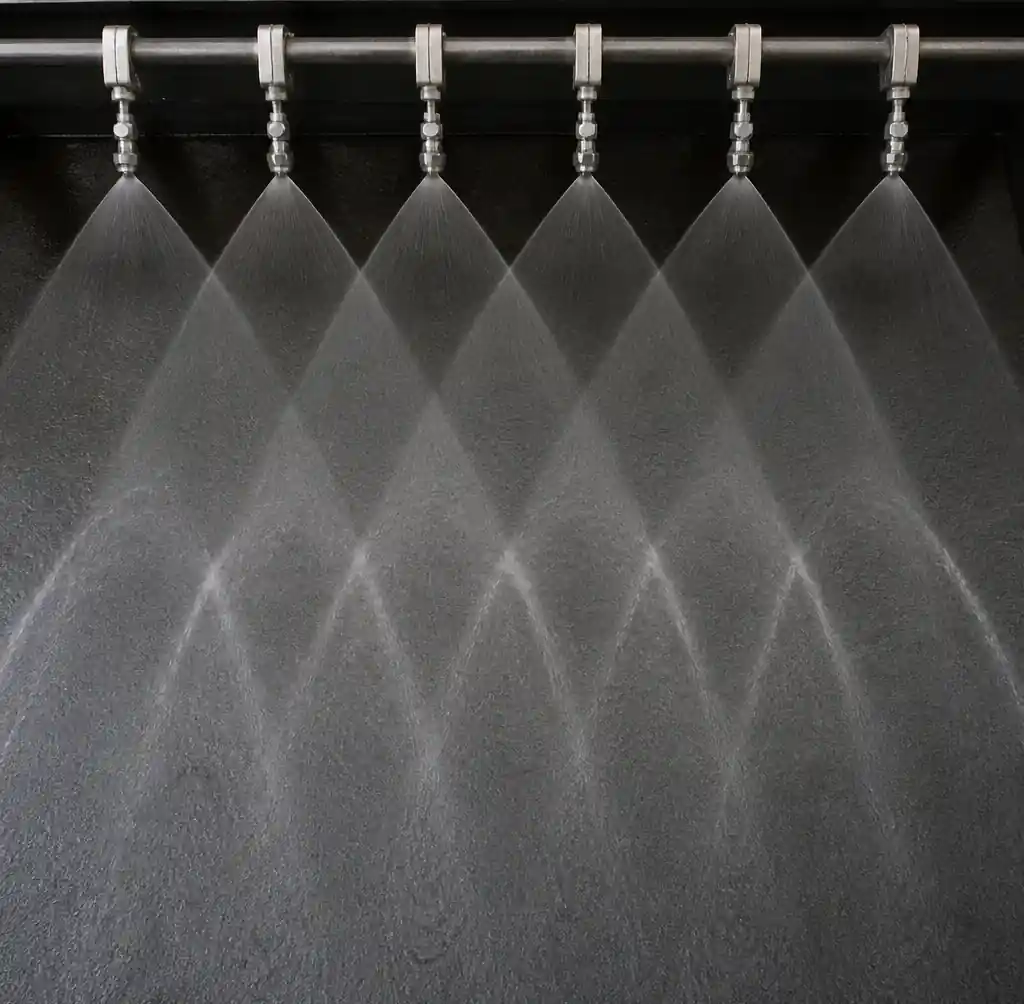 Multiple flat fan nozzles showing proper 30% overlap pattern for uniform coverage
Distribution Uniformity determines consistent application. Premium industrial nozzles maintain ±10% uniformity across 80% of coverage area; budget designs vary ±20–30%, creating hot spots and dry zones.
Overlap Design eliminates streaking. Industry standard calls for 30% overlap between adjacent patterns—spacing nozzles at 70% of individual spray width.
Material Selection for Durability
Material specification determines service life. Field analysis shows 90%+ of premature failures trace to material incompatibility with operating environment.
| Material | Cost Multiple | Chemical Resistance | Abrasion Resistance | Max Temp (°F) | Typical Lifespan |
|---|---|---|---|---|---|
| Brass | 1.0× | Poor | Low | 400 | 6–18 months |
| 316 Stainless | 3.5× | Excellent | Moderate | 900 | 4–7 years |
| Hardened Stainless | 4.5× | Excellent | High | 800 | 5–10 years |
| Plastic (PTFE/PVDF) | 1.5× | Excellent | Low | 300–450 | 2–3 years |
| Ceramic | 7–10× | Excellent | Exceptional | 2000+ | 10–20 years |
Brass Nozzles fail rapidly in chlorinated water or acidic conditions. Chlorine stress corrosion dezincifies brass within weeks.
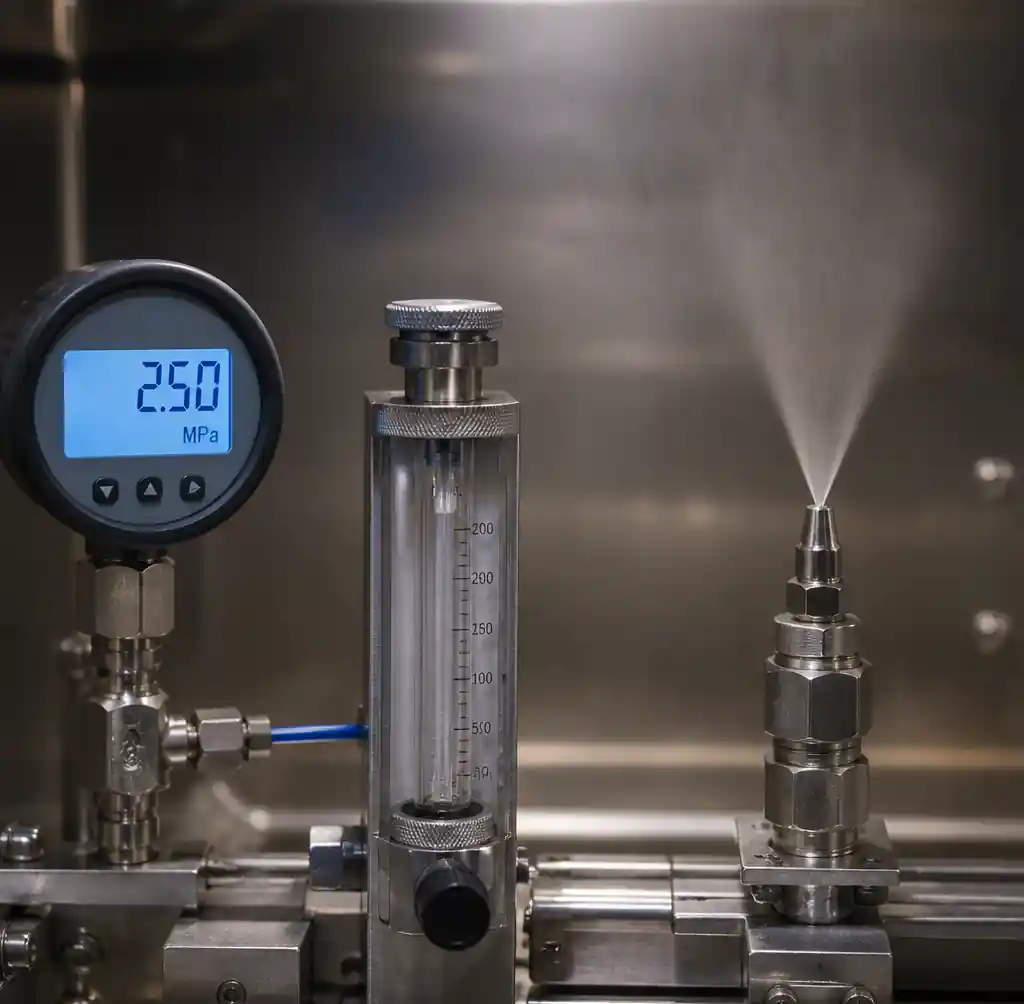 Industrial spray nozzle flow rate testing setup with pressure gauge and flow meter
Stainless Steel 316 represents the industrial standard for chemical processing, food manufacturing, and marine applications. Food-grade applications specify 316L with electropolished surfaces meeting 3-A sanitary standards.
Ceramic Inserts cost 7–10× more but deliver 10–30× longer life in abrasive services. A mining operation replaced 316SS nozzles every 6–8 weeks ($1,560 annually) with ceramic alternatives lasting 18–24 months ($360–480 annually)—reducing costs 70%.
Plastic Nozzles excel in highly corrosive chemical distribution. PTFE and PVDF handle concentrated acids and caustic solutions, though pressure limitations (10–150 PSI) restrict applications.
Critical Selection Criteria
Effective specification balances six factors: flow rate, system pressure, spray pattern, liquid properties, environmental conditions, and maintenance accessibility.
Flow Rate Calculation starts with application requirements. Cooling 1,000 square feet requiring 0.08 GPM per square foot demands 80 GPM total. Design for 70–80% of maximum nozzle capacity—not 100%—preserving adjustment range.
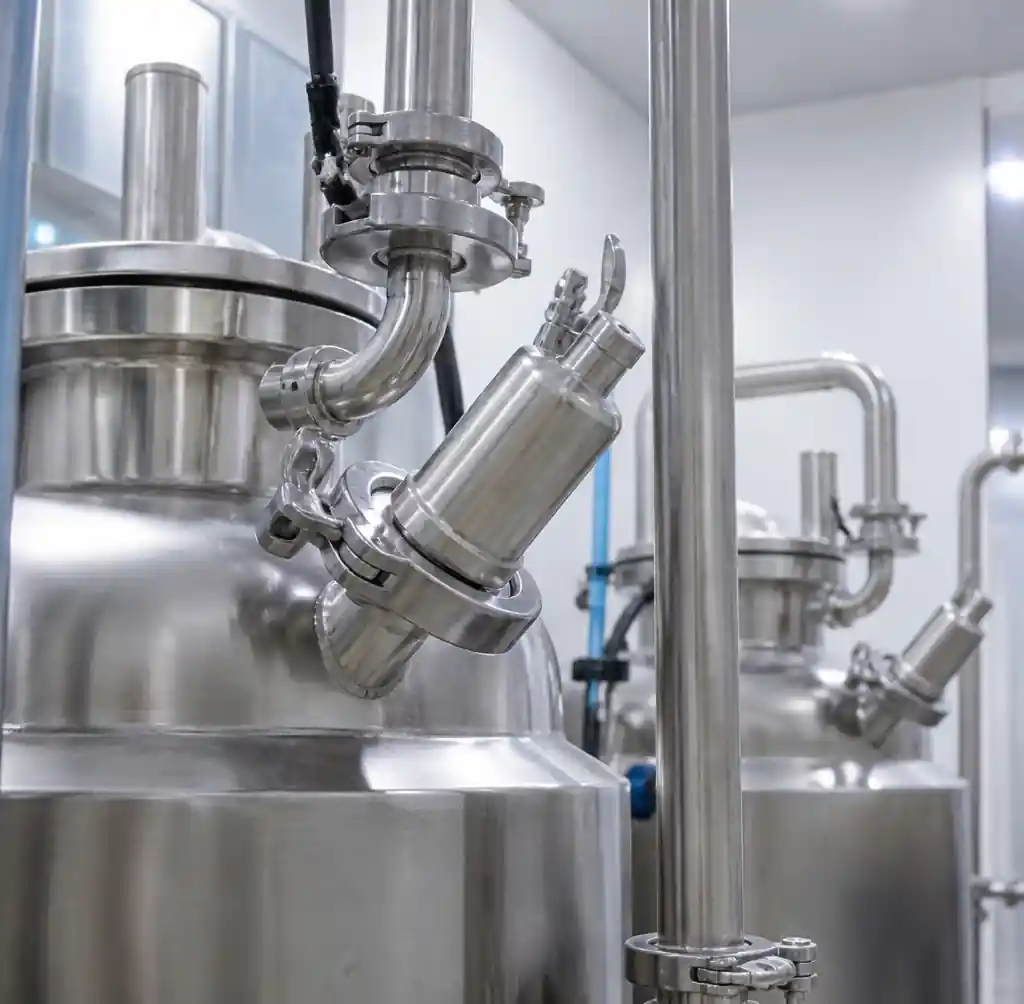 Sanitary spray nozzles and tank cleaning equipment in food processing facility
Pressure-Flow Relationship follows the square root law: Flow = K × √Pressure. Doubling pressure increases flow only 41%. Applications requiring wide flow variation need staged nozzle banks rather than pressure modulation.
Liquid Properties significantly impact performance. Viscosity above 100 centipoise requires larger orifices or air atomization. Surfactant-containing liquids atomize more readily, often requiring 10–15% pressure reduction.
Environmental Considerations include temperature extremes and corrosive atmospheres. Outdoor installations in freezing climates need heated manifolds. High-temperature environments (>400°F) demand stainless steel or ceramic.
Maintenance Accessibility determines reliability. Quick coupling systems enable tool-free nozzle removal in under 60 seconds versus 15–30 minutes for threaded connections.
Real-World Applications
Chemical Processing: Reactor quenching systems cool reactions from 600°F within seconds. Hollow cone designs maximize liquid-gas contact for scrubber towers—SO₂ scrubbing achieves 99%+ removal efficiency.
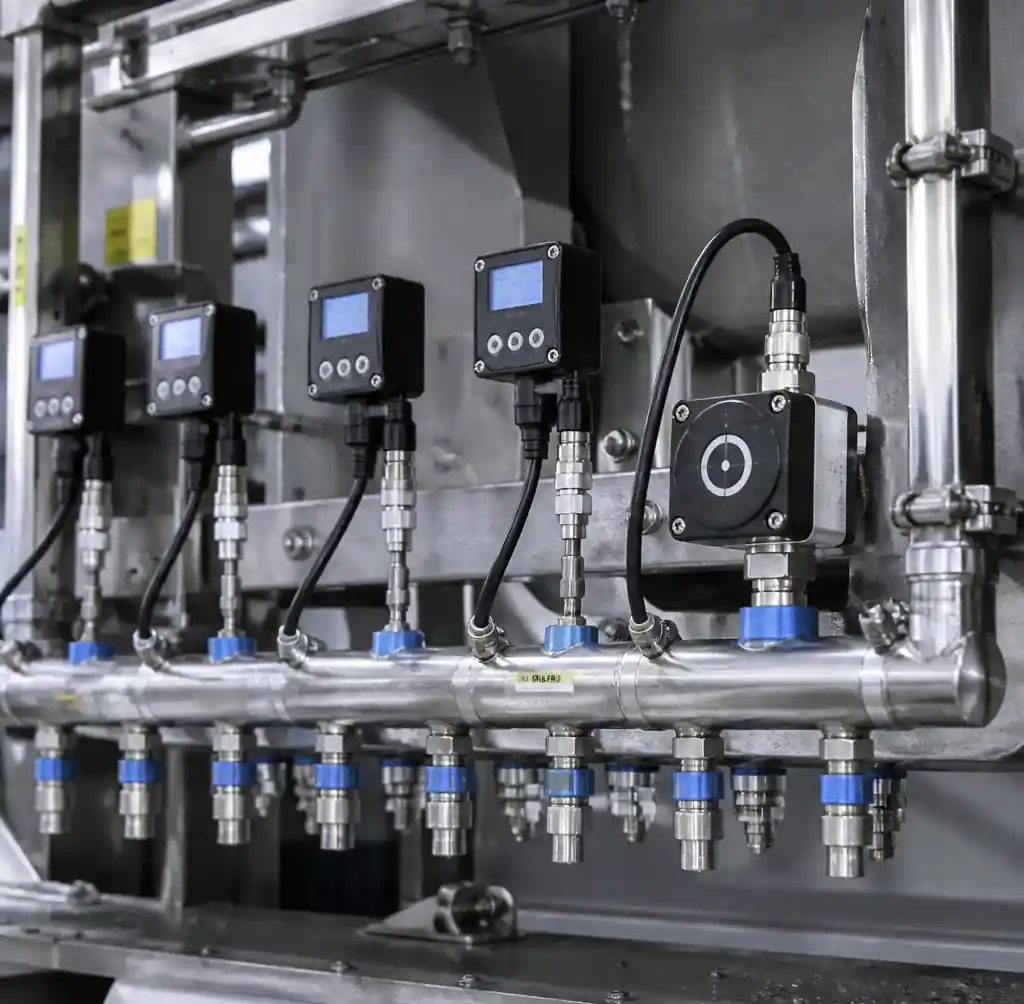 Industrial spray system with integrated flow sensors and IoT monitoring equipment
Food & Beverage: Sanitary requirements mandate 316L stainless with electropolished finishes meeting 3-A standards. Tank cleaning nozzles with rotary spray heads validate complete coverage for CIP protocols. Dry fog systems maintain ±2% relative humidity for pasta drying and meat processing.
Automotive Coating: Paint booths demand ±3% flow variation for color matching between panels. Modern robotic systems integrate dynamic control, reducing paint consumption 15–20%.
Mining & Dust Suppression: Fine misting systems using 50–80 micron droplets reduce airborne silica concentrations 70–85%. Ceramic nozzles handle abrasive slurries where stainless steel wears out in weeks.
Fire Suppression: Water mist systems use 50–200 micron droplets for fire protection with 75–90% less water than conventional sprinklers—ideal for data centers and museums.
Innovations Shaping 2026
IoT-Enabled Smart Nozzles integrate sensors and wireless connectivity for real-time monitoring. Systems trigger maintenance alerts when flow deviates >8% from baseline. Pharmaceutical adopters report 40% reduction in batch rejections through early detection.
Additive Manufacturing enables complex internal geometries impossible through conventional machining. Custom spray patterns can be prototyped in weeks, though costs remain 3–5× higher.
Variable Orifice Technology uses piezoelectric actuators modulating diameter in milliseconds, dynamically adjusting flow and droplet size. Robotic coating systems reduce paint waste 12–18% using this technology.
Anti-Fouling Surface Treatments apply nanostructured hydrophobic coatings reducing mineral buildup. Coated nozzles maintain 92–96% initial flow after 2,000 hours compared to 65–75% for uncoated nozzles.
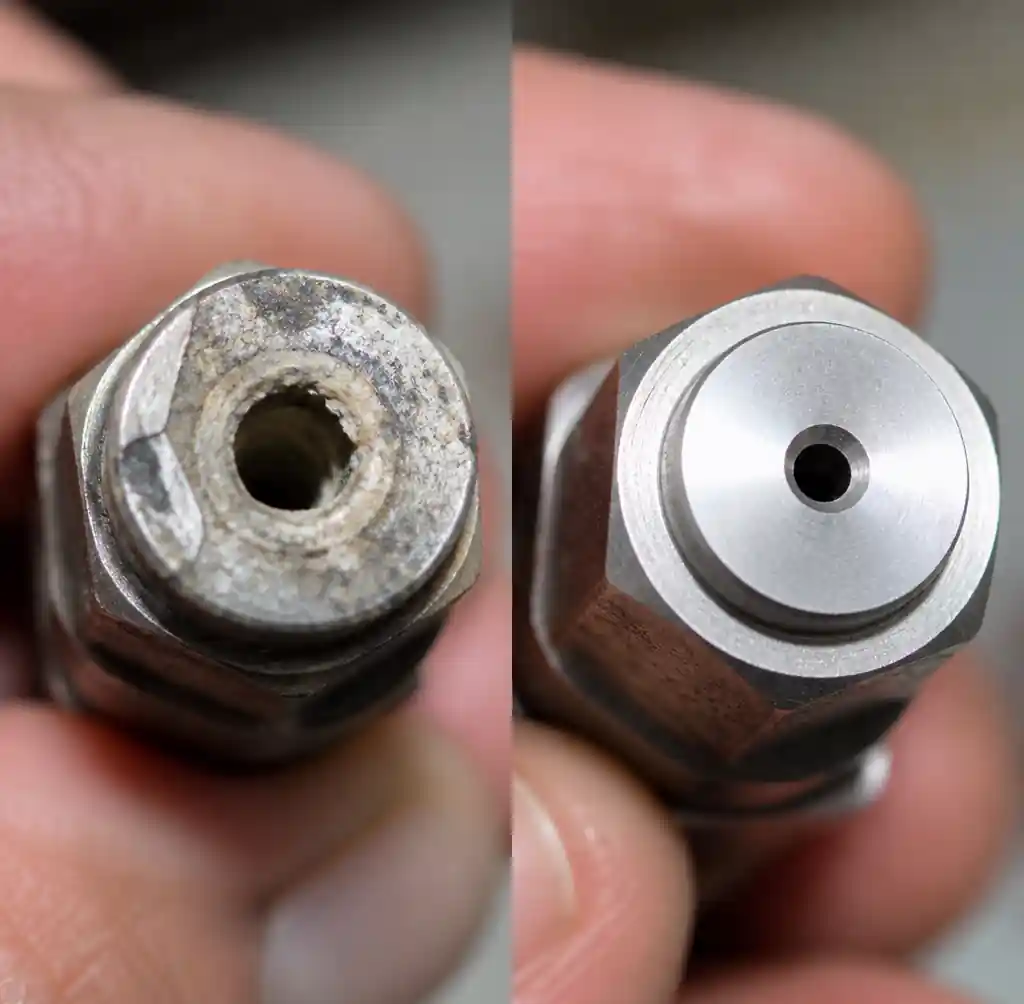 Comparison of worn industrial spray nozzle orifice versus new nozzle showing wear patterns
FAQ
What’s the difference between hydraulic and pneumatic spray nozzles?
Hydraulic nozzles rely on liquid pressure (40–1500 PSI) to create atomization. Pneumatic nozzles use compressed air to shear liquid into fine droplets at lower liquid pressures (5–100 PSI). Hydraulic nozzles cost less to operate but produce coarser droplets (100–500 microns); pneumatic nozzles generate ultra-fine mist (10–80 microns) but add $4,000–$7,000 annually in air costs.
How often should industrial spray nozzles be replaced?
Clean water applications using stainless steel typically last 2–4 years. Abrasive services may require replacement every 3–6 months for stainless, 2–3 years for ceramic. Monitor flow quarterly—replace when measured flow exceeds specification by 10%+ at rated pressure.
Can I increase spray coverage by raising system pressure?
No—spray angle changes minimally with pressure. A 70° nozzle might widen to 75° at double pressure, increasing coverage just 7%. Mount nozzles farther from target or select wider spray angles instead. Excessive pressure accelerates wear and wastes energy.
Why do nozzles clog even with filters installed?
Filters catch particles but cannot prevent crystallization of dissolved minerals inside nozzles or biological growth in stagnant lines. Solutions: size filters at least 3× finer than orifice diameter, flush systems weekly when stagnant, use water treatment to prevent buildup.
What causes uneven spray patterns?
Four causes: partial clogging creating asymmetric flow, damaged orifice edges from improper handling, operation below minimum rated pressure, or incorrect mounting orientation. Inspect nozzles under magnification and verify operating pressure meets specifications.
Are ceramic nozzles worth the 7–10× higher cost?
In abrasive applications, yes. Ceramic nozzles last 10–30× longer than stainless steel when spraying slurries. A $180 stainless nozzle replaced every 6 weeks ($1,560 annually) costs more than a $720 ceramic lasting 18–24 months ($360–480 annually)—a 70% cost reduction. For non-abrasive applications, ceramic provides no advantage.
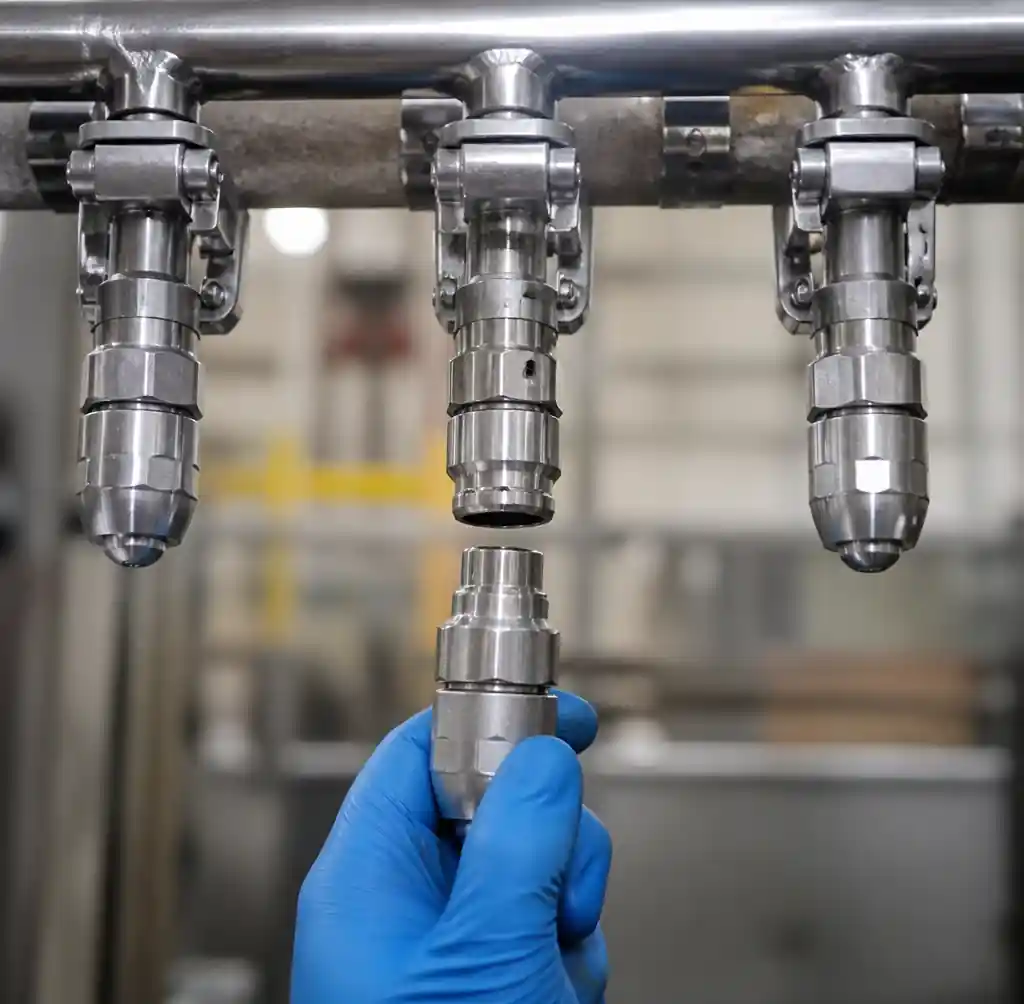 Industrial spray nozzles with quick coupling connections for tool-free installation and maintenance
Conclusion
Industrial spray nozzles are precision tools where material choice and application-specific design directly impact efficiency, quality, and operating costs. Success depends on understanding real operating conditions—fluid properties, pressure fluctuations, and long-term wear.
Reliable specs share three traits: realistic margins (70–80% of max capacity), materials proven in actual service, and maintenance built in from the start. A $50 brass nozzle replaced every 8 weeks costs far more than a $350 ceramic one lasting 24 months.
In 2026, IoT monitoring and additive manufacturing advance the field, but fundamentals endure: match nozzles to process physics, specify materials for actual exposure, and design for operating range. From pharmaceutical coating to chemical processing and industrial cleaning, the right choice delivers measurable gains in efficiency and profit.
Explore our industrial spray products or contact Yuechen Precision Technology for selection support.