



Precision Agriculture: Nozzle Technology for Reduced Chemical Use
Global agriculture consumes over 4 million metric tons of pesticides annually, yet studies show that 40-70% of applied chemicals miss their intended targets. For growers facing rising input costs and tightening environmental regulations, precision nozzle technology offers a practical path to reduce chemical use by 30-50% while maintaining crop protection efficacy.
This shift from blanket spraying to targeted application relies on intelligent nozzle systems that adjust flow rates in real-time, minimize drift, and optimize droplet size for specific crop conditions. Modern variable-rate nozzles integrate with GPS guidance and crop sensors to deliver chemicals only where needed, cutting waste and environmental contamination.
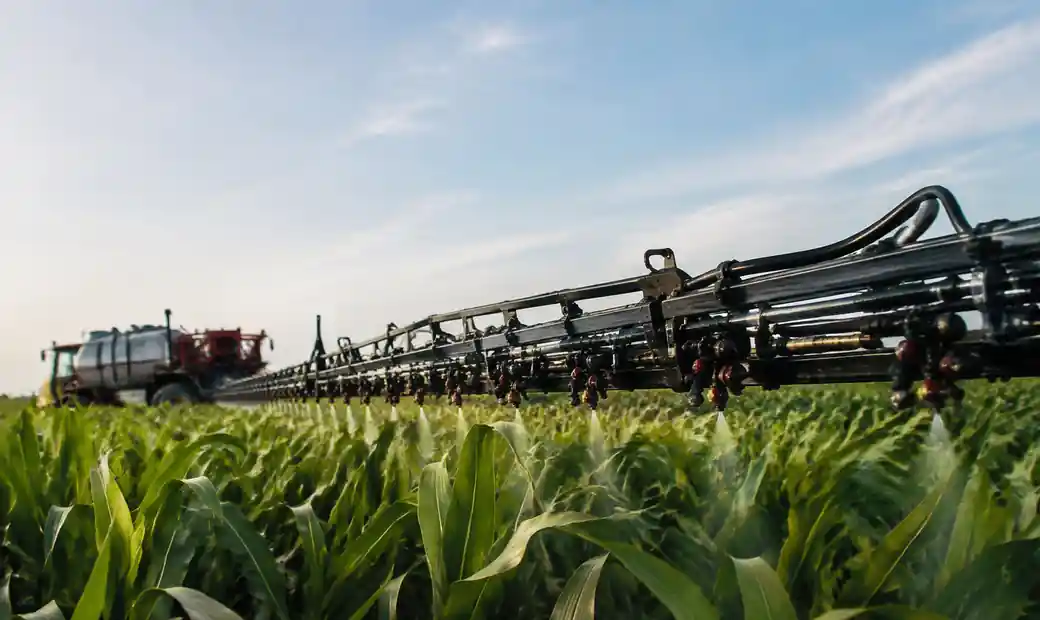 Modern agricultural sprayer with precision nozzle system in cornfield
Table of Contents
- 1. The Economics of Chemical Overuse
- 2. Variable-Rate Nozzle Technology Explained
- 3. GPS Integration and Section Control
- 4. Drift Reduction Through Nozzle Design
- 5. Optimizing Droplet Size for Target Efficacy
- 6. Integrating Nozzles into Precision Spray Systems
- 7. Chemical Savings: Field Data from Commercial Operations
- 8. Selecting Nozzles for Your Precision System
- 9. Maintenance and Calibration Requirements
- 10. Future Directions: AI and Machine Vision
- 11. FAQ
- 11.1. What is the typical ROI period for precision nozzle systems?
- 11.2. Do precision nozzles work with existing sprayers?
- 11.3. How much training is required for operators?
- 11.4. What maintenance costs should I expect?
- 11.5. Can I use precision nozzles for all chemicals?
- 12. Conclusion
The Economics of Chemical Overuse
The financial impact of inefficient spraying extends beyond wasted product. A corn operation covering 1,000 acres using conventional flat fan nozzles at a fixed rate may apply $45,000 in herbicides annually. Switching to variable-rate nozzles with section control can reduce that figure by $13,500-$22,500 per season while achieving equal or better weed control.
Environmental pressure is mounting. The European Union's Farm to Fork Strategy mandates a 50% reduction in chemical pesticide use by 2030. Similar regulations are emerging across Australia, Canada, and parts of Asia.
Variable-Rate Nozzle Technology Explained
Variable-rate spray nozzles adjust chemical output dynamically based on target density, growth stage, and field variability. These systems modulate flow through two primary mechanisms.
Pulse Width Modulation (PWM) uses solenoid valves to rapidly cycle nozzles on and off at frequencies between 10-20 Hz. By varying the duty cycle, PWM systems maintain consistent droplet size across a 10:1 flow range. This prevents the shift to finer, drift-prone droplets that occurs when conventional nozzles operate below optimal pressure. Field trials demonstrate that PWM nozzles reduce drift by 40-55% compared to pressure-based rate control.
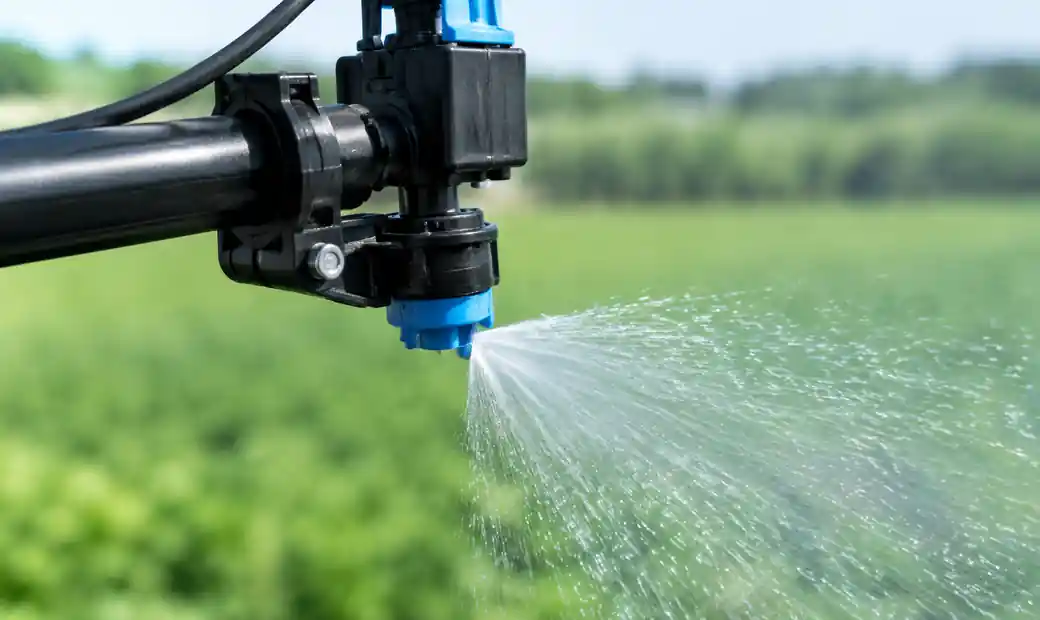 PWM spray nozzle in operation showing precise spray pattern
Electronically Controlled Nozzles adjust individual nozzle bodies through stepper motors or servo actuators. These systems can switch between multiple orifice sizes or needle valve positions in under 0.2 seconds, enabling precise flow adjustment without compromising spray quality. TeeJet's DynaJet and Wilger's Combo-Jet nozzles offer 5:1 turndown ratios while maintaining optimal spray angles and droplet spectrums.
| Technology Type | Flow Range | Response Time | Drift Reduction | Typical Cost/Nozzle |
|---|---|---|---|---|
| PWM Nozzles | 10:1 | 0.1-0.3 seconds | 40-55% | $150-$250 |
| Electronic Valve Nozzles | 5:1 | <0.2 seconds | 35-45% | $200-$350 |
| Pressure-Based Control | 3:1 | 1-2 seconds | 15-25% | $50-$100 |
| Fixed-Rate Conventional | - | - | Baseline | $8-$25 |
GPS Integration and Section Control
Modern sprayers link variable-rate nozzles to GNSS receivers with 2.5 cm pass-to-pass accuracy. This enables section control, automatically shutting off individual boom sections when overlapping previously sprayed areas. On irregularly shaped fields, section control alone can reduce chemical use by 8-15%.
Advanced systems combine GPS positioning with prescription maps generated from yield data, soil electrical conductivity, or satellite imagery. This targeted approach maintains efficacy while cutting total chemical volume.
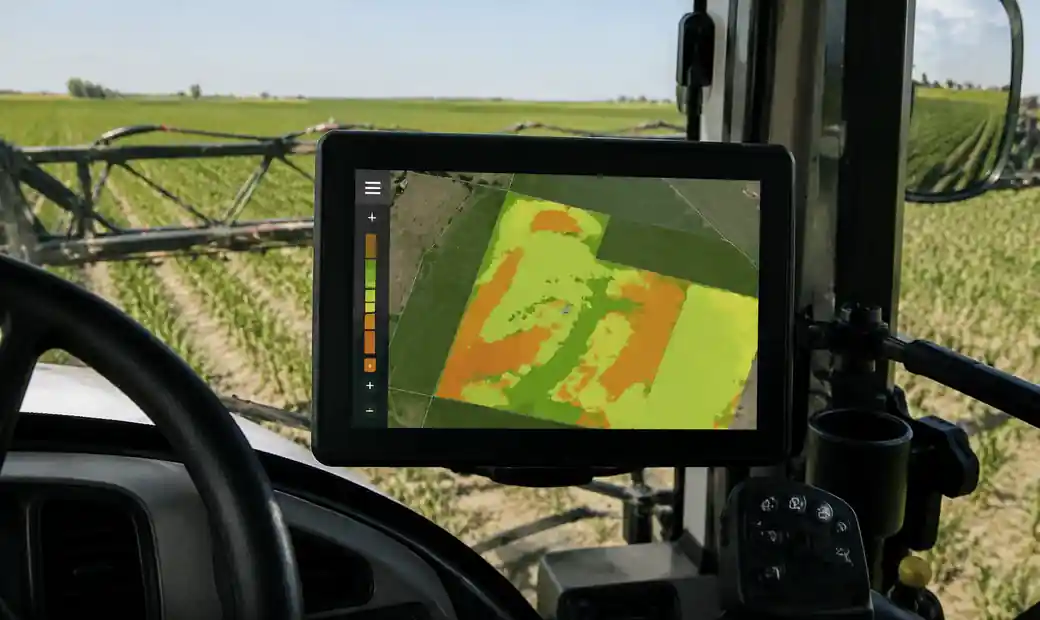 GPS guidance display showing variable rate prescription map in sprayer cab
Real-time crop sensing takes this further. Optical sensors mounted on spray booms detect crop canopy reflectance and adjust nozzle output accordingly. In wheat and barley trials, sensor-based systems reduced nitrogen applications by 25-30% without yield loss.
Drift Reduction Through Nozzle Design
Spray drift occurs when fine droplets—typically below 150 microns—become airborne and travel beyond the target area. Wind, boom height, and pressure all influence drift, but nozzle design remains the primary control factor.
Air Induction (AI) Nozzles draw air into the liquid stream through a venturi chamber, producing larger, air-filled droplets in the 300-600 micron range. These droplets resist wind displacement and shatter upon impact for effective coverage. Field testing shows AI nozzles cut drift by 70-85% compared to standard flat fans. However, the coarser spray requires higher water volumes—12-15 GPA versus 8-10 GPA for conventional nozzles—to achieve adequate coverage on small-leaved weeds.
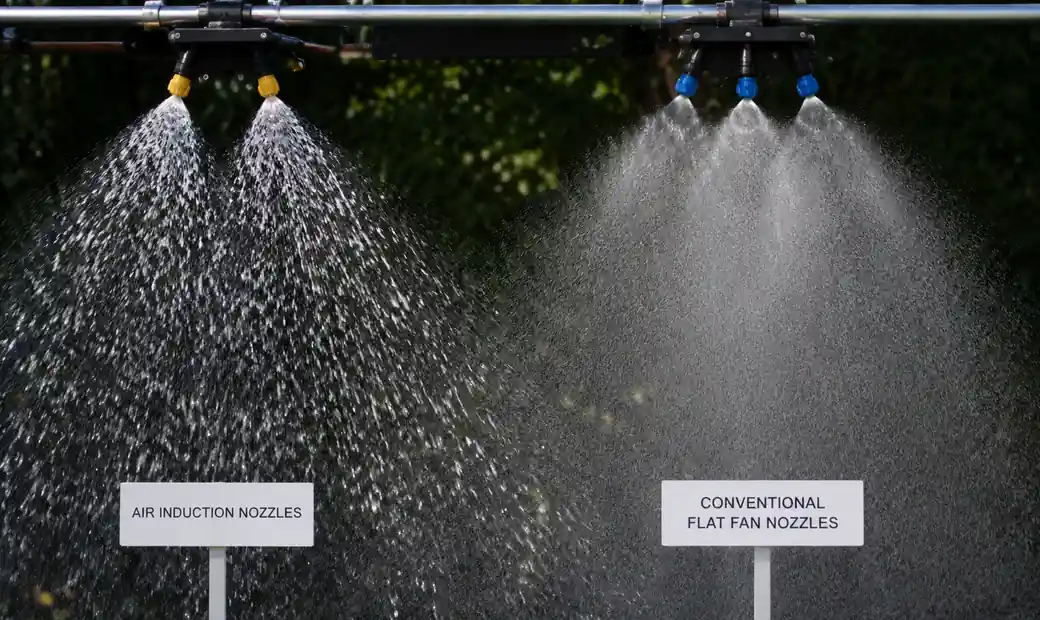 Air induction nozzles showing coarse droplet spray pattern versus conventional nozzle
Low-Drift Flat Fan Nozzles use pre-orifice designs to produce medium-sized droplets (250-350 microns) without air induction. These strike a balance between drift control and penetration, working well for contact herbicides and fungicides.
| Nozzle Type | Droplet Size (VMD) | Drift Potential | Coverage Quality | Best Applications |
|---|---|---|---|---|
| Standard Flat Fan | 150-250 µm | High | Excellent | Systemic herbicides, fine coverage |
| Air Induction (AI) | 400-600 µm | Very Low | Good (requires higher volumes) | Pre-emergence, drift-sensitive areas |
| Low-Drift Flat Fan | 250-350 µm | Moderate-Low | Very Good | Post-emergence, contact products |
| Ultra-Coarse AI | 600-800 µm | Extremely Low | Fair | Buffer zones, high-wind conditions |
Optimizing Droplet Size for Target Efficacy
Droplet size directly affects biological efficacy, coverage uniformity, and drift risk. Systemic herbicides like glyphosate tolerate coarser sprays (300-500 microns) since they penetrate leaf tissue regardless of coverage density. Contact products demand finer droplets (150-250 microns) to maximize surface contact.
The challenge in precision agriculture is matching droplet size to the target while minimizing drift. Flat fan nozzles with adjustable orifices allow growers to shift between fine, medium, and coarse settings without changing tips.
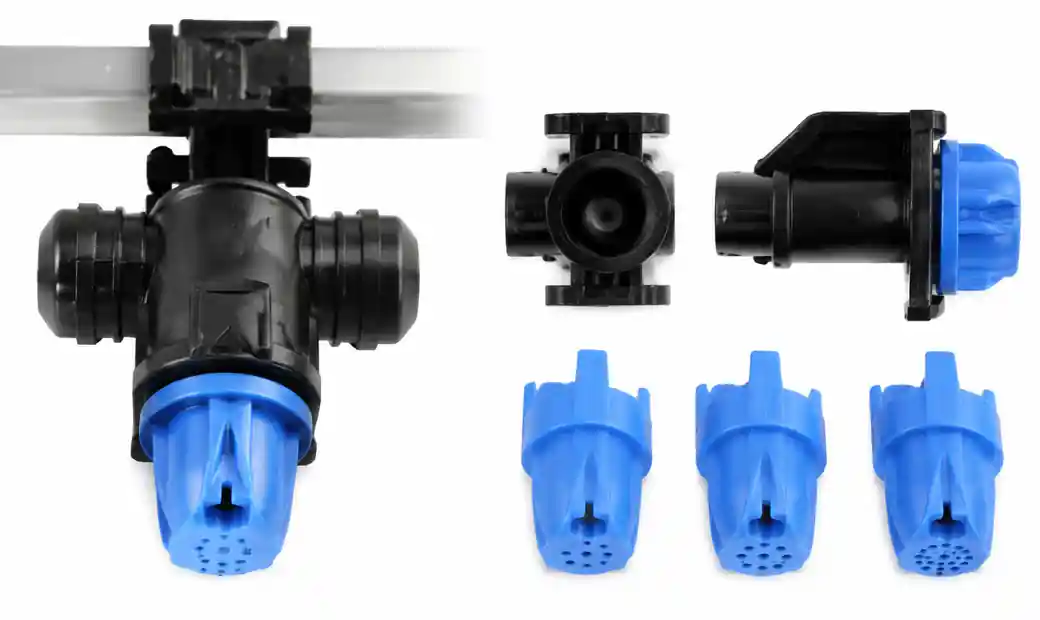 Adjustable flat fan spray nozzle showing multiple orifice size options
Pulse width modulation systems maintain droplet size across the entire flow range. Whereas a conventional nozzle produces increasingly fine droplets as pressure rises, PWM nozzles operate at constant pressure with flow controlled by duty cycle.
Integrating Nozzles into Precision Spray Systems
A complete precision spray system coordinates nozzle technology with rate controllers, boom stability, and application timing. Automated boom height control maintains a consistent 18-24 inch target distance using ultrasonic sensors. Studies show that boom height variations beyond 6 inches reduce coverage uniformity by 25-40%.
Rate controllers link nozzle output to tractor speed, ensuring consistent application rates despite variations in ground speed. Modern systems respond to speed changes within 0.1 seconds, critical when navigating terraces or contours.
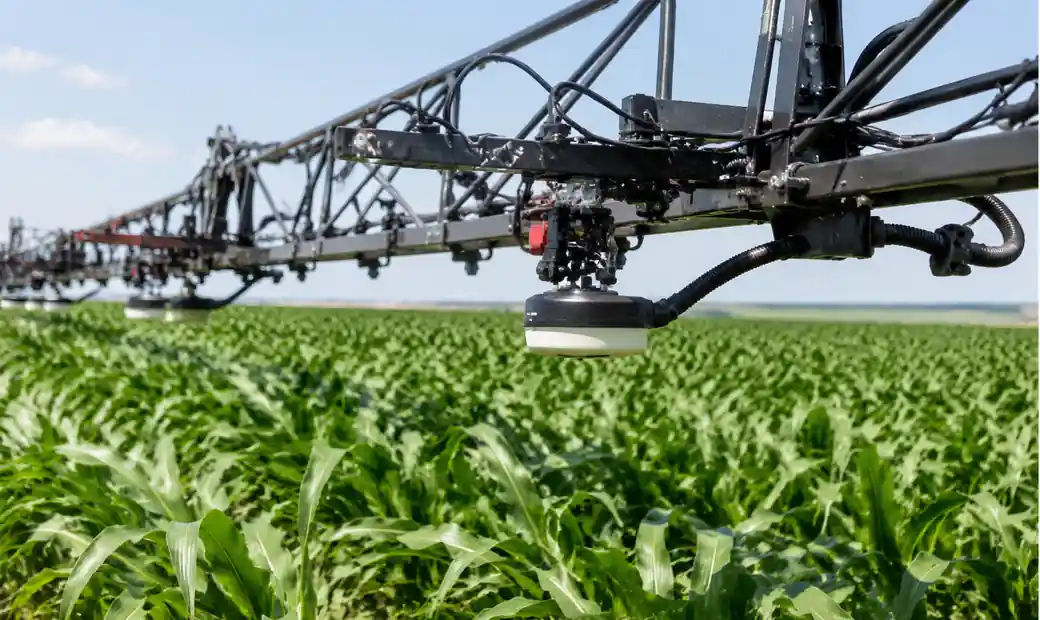 Sprayer boom with automated height control sensors maintaining optimal spacing
Farmers adopting precision spray technology report a learning curve in calibration and system tuning. Initial setup requires mapping field variability through yield monitors or soil sampling, then creating prescription zones that balance agronomic logic with operational efficiency.
Chemical Savings: Field Data from Commercial Operations
A 2,800-acre corn and soybean operation in Iowa installed PWM nozzles with section control in 2023. Over two growing seasons, the farm reduced herbicide use by 32% and fungicide use by 28%. Total chemical savings exceeded $41,000 annually, recovering the $38,000 system investment in under 14 months.
Cotton production in Texas shows similar results, where variable-rate application of defoliants cut chemical costs by $18-$24 per acre. By applying full rates only to thick-canopy areas and reducing rates in sparse zones, growers achieved uniform defoliation while reducing total product use by 35%.
According to research from Purdue University, precision nozzle systems reduce pesticide runoff into waterways by 40-60% and decrease non-target organism exposure by similar margins.
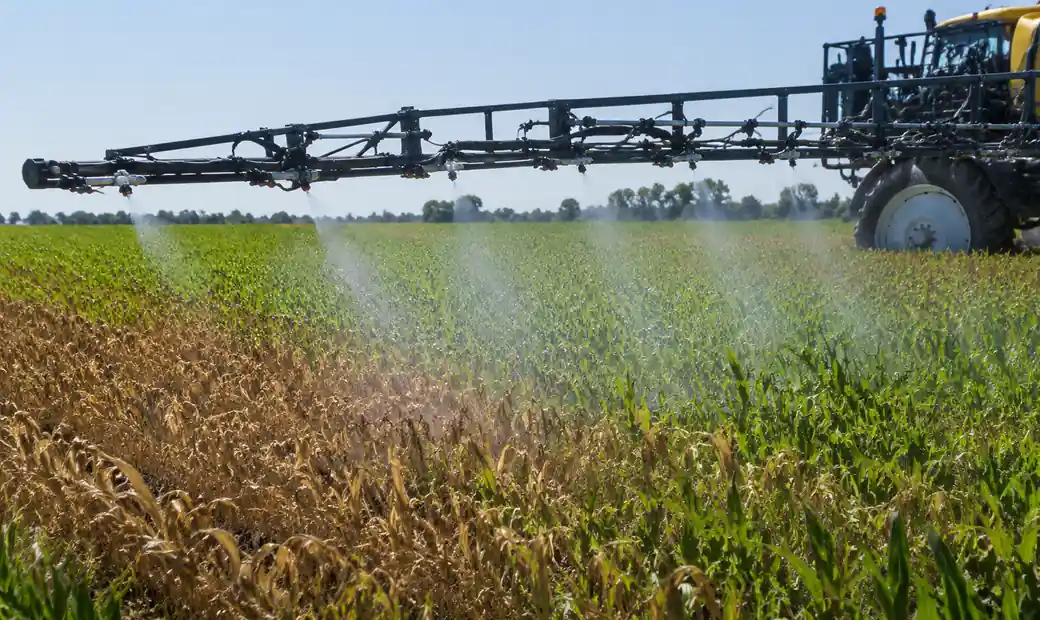 Precision spray system applying herbicide to weed zones in soybean field
Selecting Nozzles for Your Precision System
Choosing the right nozzle configuration depends on crop type, chemical formulations, and field conditions. For broad-spectrum herbicides applied pre-emergence, ultra-coarse AI nozzles provide maximum drift control with minimal efficacy loss. Post-emergence applications targeting small weeds require low-drift flat fans that balance coverage and drift reduction.
Air atomizing nozzles serve specialized roles in precision agriculture, particularly for ultra-low-volume applications. These nozzles use compressed air to shear liquids into 50-150 micron droplets, ideal for fungicides requiring dense coverage.
Compatibility between nozzles, rate controllers, and sprayer hydraulics is critical. PWM systems require nozzles rated for rapid cycling. Electronic nozzles need controllers capable of managing individual actuator channels. Work with equipment dealers to ensure system components integrate properly.
Maintenance and Calibration Requirements
Precision nozzle systems demand more attention than conventional setups. PWM solenoid valves require annual inspection for debris accumulation and seal wear. Operating pressures should be verified weekly during spray season—a 10% pressure deviation translates to 15-20% flow rate error.
Nozzle tip wear affects spray quality before flow rate changes become noticeable. Ceramic or stainless steel tips extend service life to 500-800 acres versus 150-300 acres for polymer tips when applying abrasive formulations.
Controller calibration should occur at the start of each season. This involves checking speed sensors, flow meters, and pressure transducers against known references. GPS accuracy directly affects application uniformity.
Future Directions: AI and Machine Vision
The next generation of precision spray technology integrates computer vision and machine learning. Camera-based systems distinguish crops from weeds at the plant level, triggering individual nozzles only when weeds enter the spray zone. Research from MDPI demonstrates that vision-guided spot sprayers reduce herbicide use by 70-95% in row crops.
These systems use convolutional neural networks trained on thousands of weed images to identify target species in real-time. Processing speeds have reached 25 frames per second, enabling nozzle actuation within 15 milliseconds at 12 mph travel speeds.
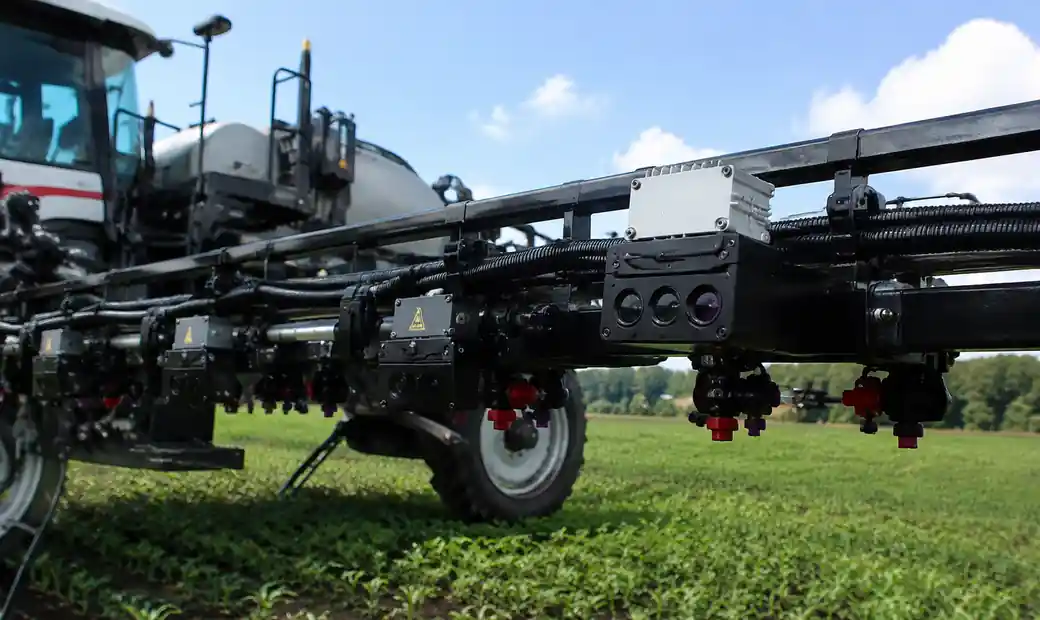 Camera-based weed detection system integrated with precision spray nozzles
FAQ
What is the typical ROI period for precision nozzle systems?
Most farms recover initial investments in 18-36 months through reduced chemical costs. Operations covering over 1,500 acres often see payback within 12-18 months.
Do precision nozzles work with existing sprayers?
PWM systems retrofit onto most boom sprayers manufactured after 2010. Older equipment may require hydraulic modifications. Consult with equipment dealers regarding compatibility.
How much training is required for operators?
Basic PWM system operation can be learned in 4-6 hours. Creating effective prescription maps takes 20-40 hours of experience.
What maintenance costs should I expect?
Annual maintenance typically runs 3-5% of system cost, covering solenoid rebuild kits and GPS subscription services. Nozzle tip replacement ranges from $200-$800 annually.
Can I use precision nozzles for all chemicals?
Most herbicides, fungicides, and liquid fertilizers work with precision systems. Check product labels for spray quality recommendations.
Conclusion
Precision agriculture nozzle technology transforms chemical application from a cost center into a strategic tool for profitability and sustainability. Variable-rate nozzles, GPS integration, and drift-reduction designs enable 30-50% chemical reductions without sacrificing crop protection. These systems pay for themselves through input savings while positioning farms for compliance with emerging environmental regulations.
The technology is mature and field-proven, with thousands of operations demonstrating consistent results across diverse crops and regions. As machine vision and AI advance, even greater efficiency gains are within reach. For growers serious about reducing chemical dependence while maintaining yields, precision nozzle systems represent one of the highest-return investments in modern agriculture. YuechenPrecision Technology offers comprehensive spray nozzle solutions engineered for precision agriculture applications, helping farms worldwide optimize chemical use while protecting crop quality and environmental health.