



Paper and Pulp Industry: Spray Nozzle Applications and Solutions
Industrial paper manufacturing demands precise fluid control at every production stage. From debarking raw logs to coating finished sheets, spray nozzles directly impact product quality, water efficiency, and operational costs. If you want to optimize your paper mill's spray systems, then you will need to understand nozzle selection criteria, performance characteristics, and application-specific requirements for both pulp production and papermaking processes.
Modern paper mills consume massive volumes of water and process chemicals. Studies show that optimized spray nozzle systems can reduce water consumption by 40-70% while maintaining or improving cleaning effectiveness, fiber washing efficiency, and coating uniformity. This comprehensive guide covers industrial spray nozzle applications across the entire paper and pulp production chain, from wood preparation through final coating and winding operations.
Table of Contents
- 1. Understanding Spray Nozzle Requirements in Paper Manufacturing
- 2. Pulp Production: Critical Spray Applications
- 2.1. Wood Preparation and Debarking
- 2.2. Pulp Washing and Fiber Recovery
- 2.3. Fabric and Filter Cleaning
- 3. Paper Machine Applications: Wet End Through Dry End
- 3.1. Headbox and Wire Section
- 3.2. Press Section Felt Cleaning
- 3.3. Dryer Section: Web Conditioning and Moistening
- 4. Coating and Finishing Operations
- 4.1. Pre-metered Coating Systems
- 4.2. Specialized Coating Applications
- 5. Tank and Equipment Cleaning
- 5.1. Pulp Storage and Process Tanks
- 5.2. Chemical Recovery Equipment
- 6. Selecting Nozzles for Paper Industry Applications
- 6.1. Material Selection Criteria
- 6.2. Flow Rate and Pressure Optimization
- 7. Water Conservation and Sustainability
- 8. Maintenance and Performance Monitoring
- 8.1. Inspection and Replacement Schedules
- 8.2. Strainer and Filter Maintenance
- 9. Frequently Asked Questions
- 9.1. What spray nozzles work best for paper machine wire cleaning?
- 9.2. How do I reduce water consumption in my pulp washing system?
- 9.3. What materials handle bleach plant chemical exposure?
- 9.4. Can air atomizing nozzles reduce coating material consumption?
- 9.5. How often should I replace fabric cleaning nozzles?
- 9.6. What causes uneven coating application in spray coating systems?
- 10. Conclusion
Understanding Spray Nozzle Requirements in Paper Manufacturing
Paper and pulp production represents one of the most demanding industrial environments for spray technology. You face challenges including high-pressure cleaning requirements, chemical compatibility needs, continuous operation demands, and strict quality control standards. The process divides into two main stages: pulp production (converting wood into fiber) and paper manufacturing (forming fiber into sheets).
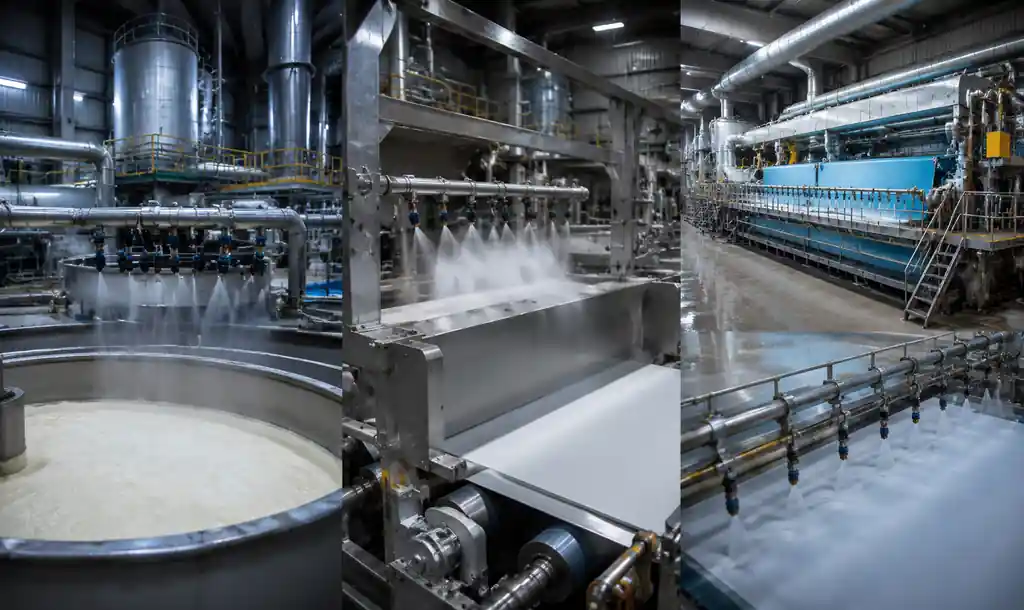 Industrial paper mill production line showing spray nozzle applications throughout the process
Spray nozzles serve critical functions throughout both stages. In pulp mills, nozzles handle debarking operations, fabric washing, drum filter cleaning, and chemical application. Paper machines require precise spray control for wire cleaning, felt conditioning, web moistening, and coating applications. Each application demands specific nozzle characteristics including spray pattern, droplet size, flow rate, and pressure parameters.
Pulp Production: Critical Spray Applications
Wood Preparation and Debarking
Raw logs entering the mill require thorough cleaning and bark removal before processing. High-pressure flat fan nozzles deliver the impact force needed for hydromechanical debarking operations. You can specify nozzles operating at 1000-3000 psi (70-200 bar) with flow rates from 5-50 GPM depending on log diameter and bark characteristics.
The debarking process uses water jets to blast bark from logs while minimizing fiber damage. Flat fan nozzles with 15-40 degree spray angles provide concentrated impact over linear coverage areas. Stainless steel construction (316 grade) ensures corrosion resistance against tannins and organic acids present in bark and wood extractives.
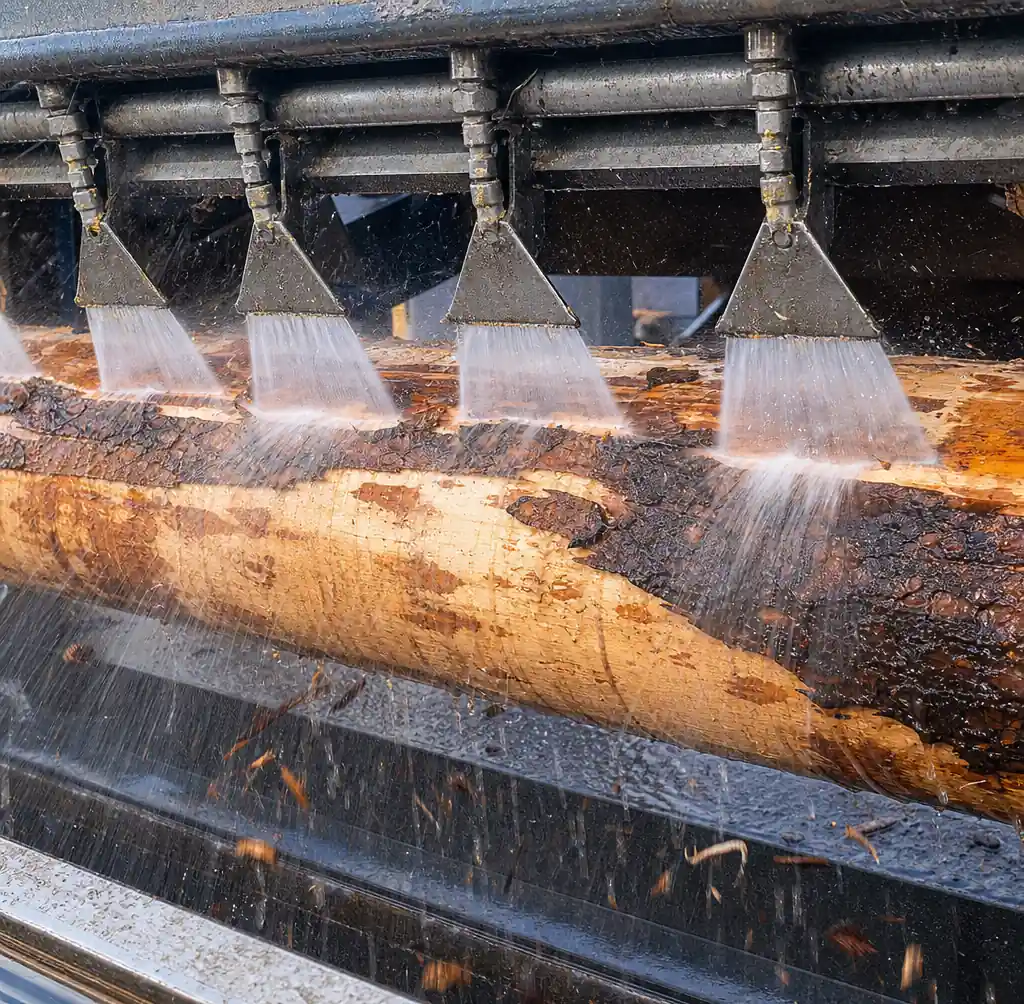 High-pressure flat fan spray nozzles removing bark from logs in paper mill
Stone and dirt separation processes also rely on spray nozzles. Full cone nozzles operating at 40-100 psi create agitation in separation tanks, helping remove debris before pulping. This pre-cleaning step reduces equipment wear and improves final pulp quality. You should install stainless steel or hardened ceramic nozzles in abrasive slurry environments to maximize service life.
Pulp Washing and Fiber Recovery
Chemical pulping processes dissolve lignin and separate wood fibers. After digestion, pulp washing systems remove spent cooking liquor and recover valuable chemicals. This multi-stage washing process represents a major water consumer in pulp mills, making nozzle efficiency critical.
Rotary drum washers use spray nozzles to rinse pulp fibers as they pass over rotating screens. Flat fan nozzles positioned above the drum create continuous water curtains that displace black liquor from fiber mats. Operating pressures range from 20-60 psi with flow rates adjusted to achieve target dilution factors. Proper nozzle selection and positioning can reduce fresh water consumption by 30-50% compared to suboptimal configurations.
| Application | Nozzle Type | Pressure Range | Flow Rate | Key Benefit |
|---|---|---|---|---|
| Debarking | Flat fan high-impact | 1000-3000 psi | 5-50 GPM | Efficient bark removal |
| Drum washer | Flat fan medium-angle | 20-60 psi | 10-100 GPM | Fiber displacement |
| Fabric cleaning | Rotating jet | 500-2000 psi | 2-20 GPM | Self-cleaning action |
| Defoaming | Hollow cone | 40-80 psi | 1-10 GPM | Fine droplet distribution |
Brown stock washers and bleach plant washers also employ spray nozzles for fiber mat conditioning and displacement washing. You will need to consider chemical compatibility when selecting nozzle materials. Bleaching operations using chlorine dioxide, hydrogen peroxide, or ozone require corrosion-resistant materials including 316L stainless steel, Hastelloy, or fluoropolymer plastics (PVDF, PTFE).
Fabric and Filter Cleaning
Pulp processing equipment includes numerous filtering and dewatering stages using fabric screens, wire meshes, and filter belts. These surfaces require continuous cleaning to prevent plugging and maintain processing efficiency. High-pressure cleaning nozzles installed in automated shower systems deliver the cleaning performance needed for 24/7 operation.
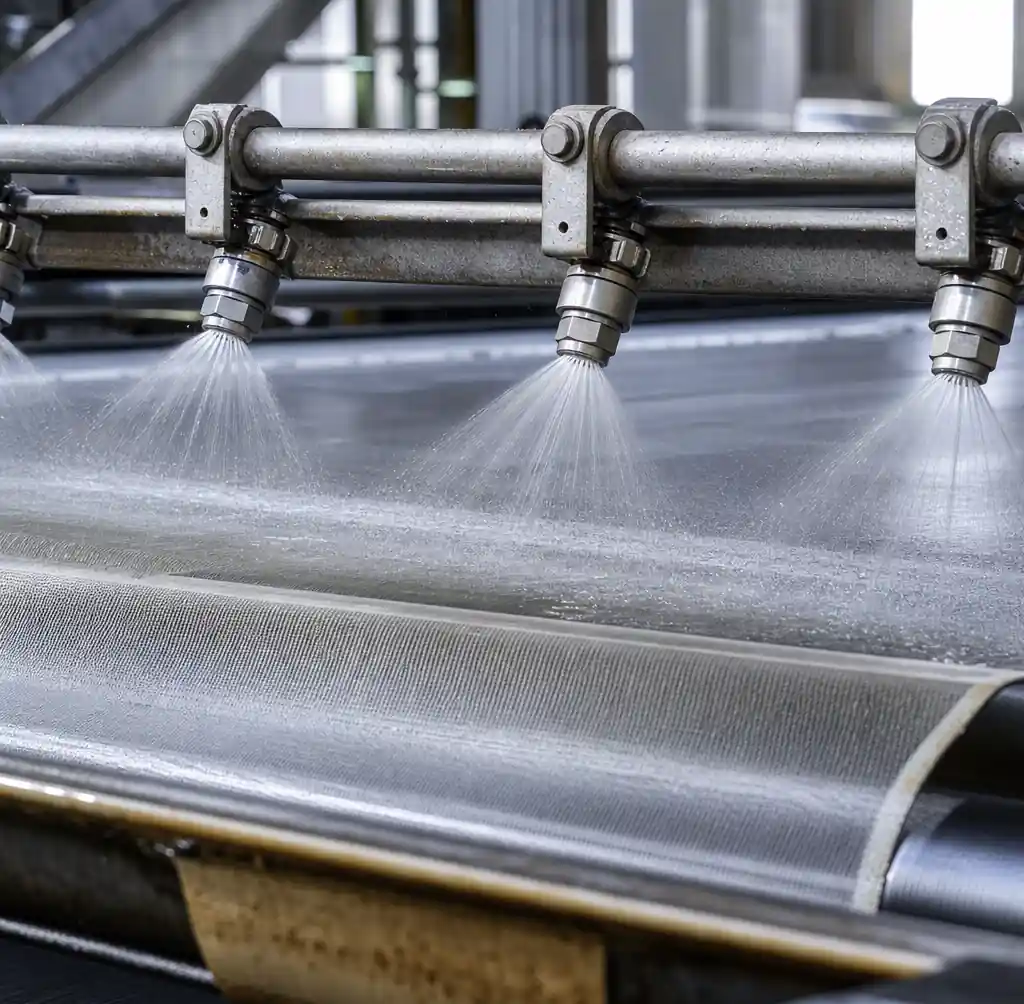 Rotating jet nozzles cleaning pulp processing fabric screens and filters
Fabric showers typically use rotating jet nozzles or oscillating flat fan nozzles operating at 500-2000 psi. The high-velocity jets penetrate fabric openings to dislodge trapped fibers and contaminants. You can achieve effective cleaning with flow rates of 2-20 GPM per nozzle, depending on fabric width and contamination levels.
Proper nozzle spacing and overlap ensure complete coverage across the fabric width. Most installations position nozzles every 6-12 inches with spray angles selected to provide 100-150% overlap at the fabric surface. This redundancy prevents streaking and ensures consistent cleaning performance even as nozzles wear over time.
Paper Machine Applications: Wet End Through Dry End
Headbox and Wire Section
The paper machine wet end begins with the headbox, which distributes diluted pulp slurry onto a moving wire screen. While the headbox itself uses specialized slice openings rather than spray nozzles, the wire section below requires extensive nozzle-based cleaning systems.
Forming fabrics (wires) operate at speeds from 500-6000 feet per minute while removing water from the fiber mat. Fibers, fillers, and additives accumulate on the wire surface, reducing drainage efficiency and causing sheet defects. Wire cleaning showers use flat fan nozzles positioned to spray against wire travel direction, creating a scrubbing action that removes contaminants.
Low-pressure showers (20-60 psi) provide continuous conditioning, while high-pressure showers (500-1500 psi) deliver intensive cleaning. You should install both types in your wire section configuration. Nozzle spacing of 4-8 inches across the machine width ensures complete coverage. Stainless steel or ceramic nozzles resist abrasive wear from fiber and filler particles.
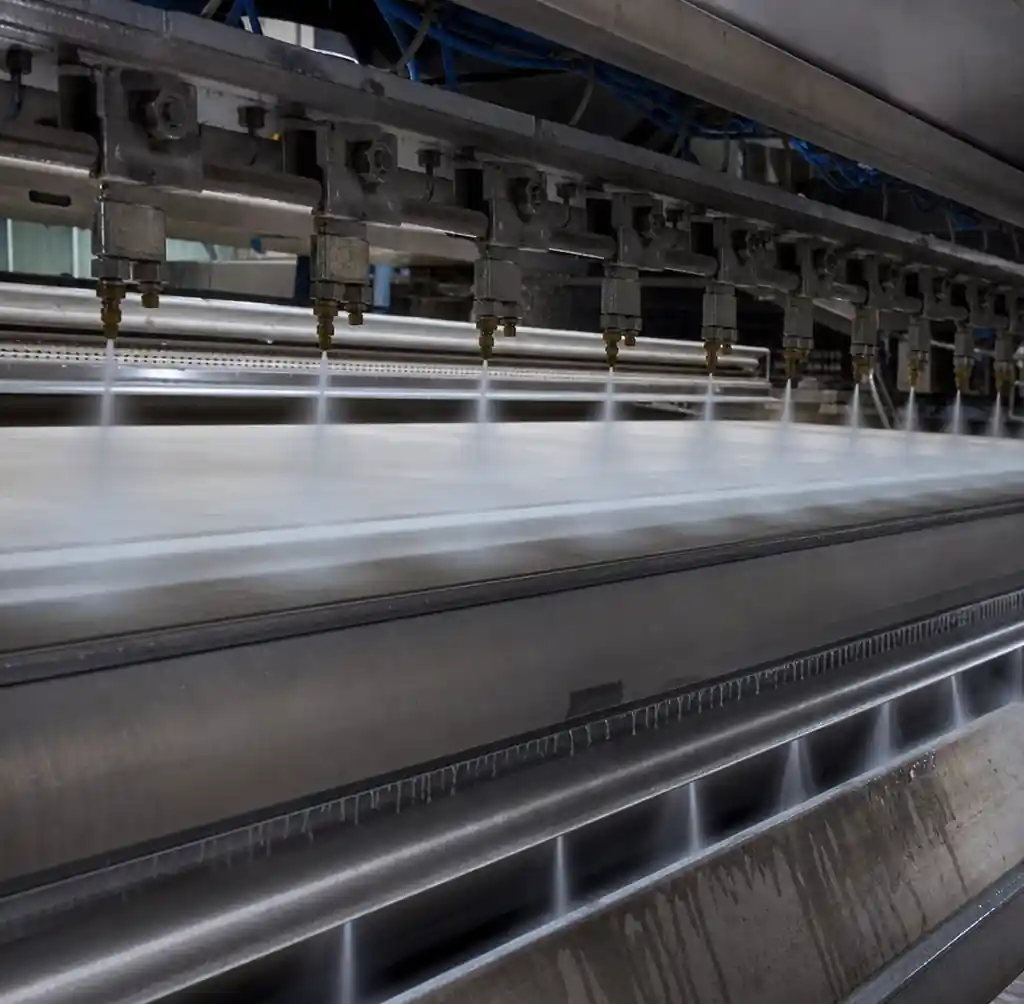 Wire section shower nozzles maintaining paper machine forming fabric cleanliness
Press Section Felt Cleaning
After the wire section, the paper web enters press nips where mechanical pressure removes additional water. Press felts absorb water squeezed from the sheet, then release it through vacuum systems. Felt cleaning determines press efficiency and final sheet moisture content.
Press felt showers use oscillating or rotating nozzles to clean the felt surface and interior structure. Needle showers employ fine water jets (0.010-0.020 inch orifices) at 1500-3000 psi to penetrate felt fibers and remove trapped contaminants. Proper cleaning can improve press efficiency by 10-20%, directly impacting energy consumption in the dryer section.
Chemical cleaning systems also use spray nozzles to apply detergents, dispersants, and biocides to press felts. Lower pressure spray nozzles (40-100 psi) ensure even chemical distribution across the felt width. You will need chemically compatible nozzle materials including stainless steel or plastic depending on the specific cleaning chemistry used.
Dryer Section: Web Conditioning and Moistening
Paper drying involves passing the web over heated cylinders that evaporate remaining moisture. However, excessive drying can cause brittleness, curl, and dimensional instability. Controlled re-moistening systems apply precise water quantities to condition the web for optimal properties.
Air atomizing nozzles provide the fine mist required for web conditioning without causing sheet defects. These dual-fluid nozzles mix compressed air with water to create droplets as small as 10-50 microns. Operating at 60-100 psi air pressure with liquid flows of 0.1-2 GPM per nozzle, air atomizing systems deliver precise moisture control.
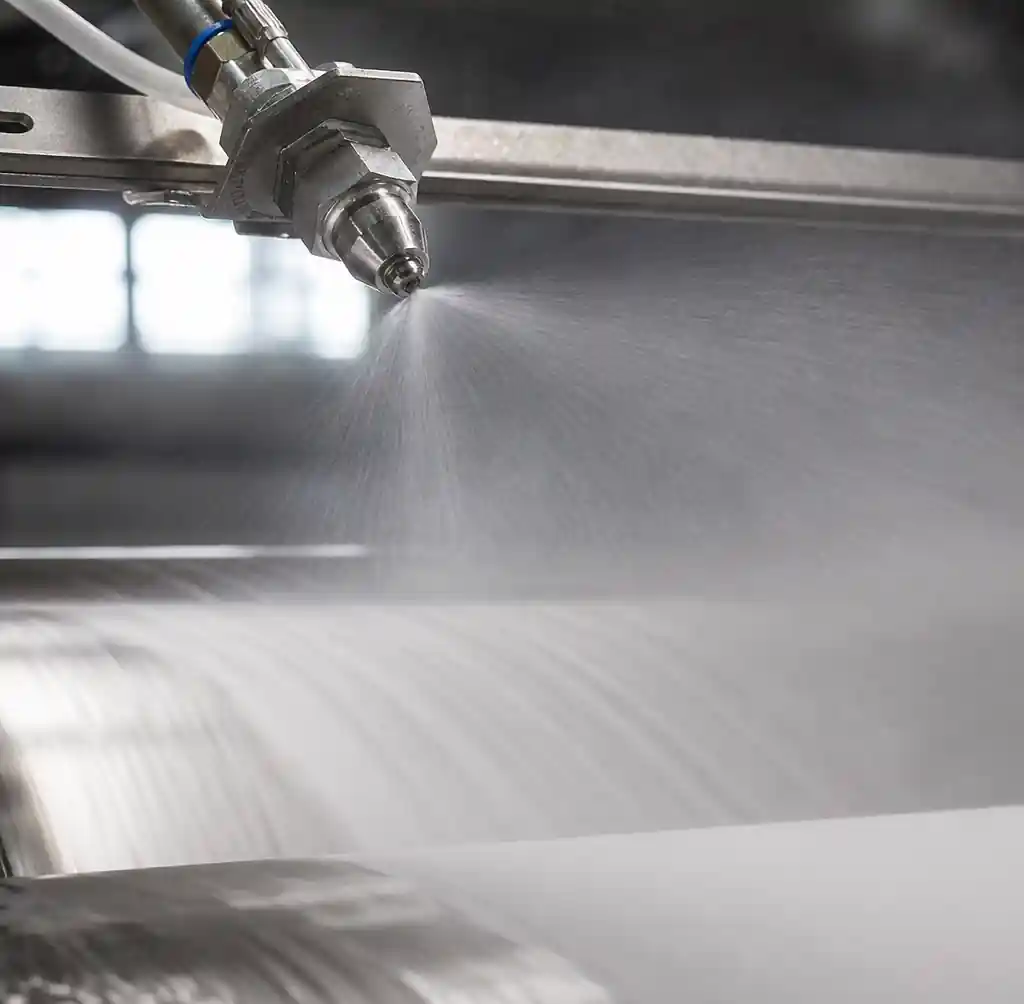 Air atomizing spray nozzles creating fine mist for paper web conditioning
You can install moistening systems between dryer sections or after the final dryer. The ultra-fine droplets evaporate quickly or absorb into the sheet without creating wet spots or cockle defects. This technology enables you to achieve target moisture content with accuracy of ±0.5%, critical for dimensional stability and converting performance.
| Nozzle Application | Operating Pressure | Droplet Size | Coverage Width | Primary Function |
|---|---|---|---|---|
| Wire cleaning (low) | 20-60 psi | 200-500 microns | 12-24 inches | Continuous conditioning |
| Wire cleaning (high) | 500-1500 psi | 100-300 microns | 6-12 inches | Deep cleaning |
| Felt needle showers | 1500-3000 psi | 50-150 microns | 2-4 inches | Penetrating cleaning |
| Web moistening | 60-100 psi air | 10-50 microns | 24-48 inches | Moisture control |
| Coating application | 300-800 psi | 50-200 microns | 18-36 inches | Uniform film formation |
Coating and Finishing Operations
Pre-metered Coating Systems
Many paper grades receive surface coatings to improve printability, brightness, or barrier properties. Spray coating represents one of several application methods used in modern paper mills. Curtain coaters and spray applicators use precision nozzles to deliver controlled coating weights with excellent uniformity.
Hydraulic atomizing nozzles operating at 300-800 psi break coating formulations into fine droplets that form uniform films on the paper surface. Hollow cone nozzles provide circular coverage patterns that can be overlapped for wide-web applications. You should select nozzle spray angles (typically 60-90 degrees) to match your coating bar geometry and achieve desired coating distribution.
Coating consistency and viscosity significantly affect atomization quality. Nozzles must handle suspensions containing pigments, binders, and additives without clogging. Stainless steel nozzles with orifice diameters of 0.040-0.080 inches provide the clog resistance and wear life needed for continuous coating operations.
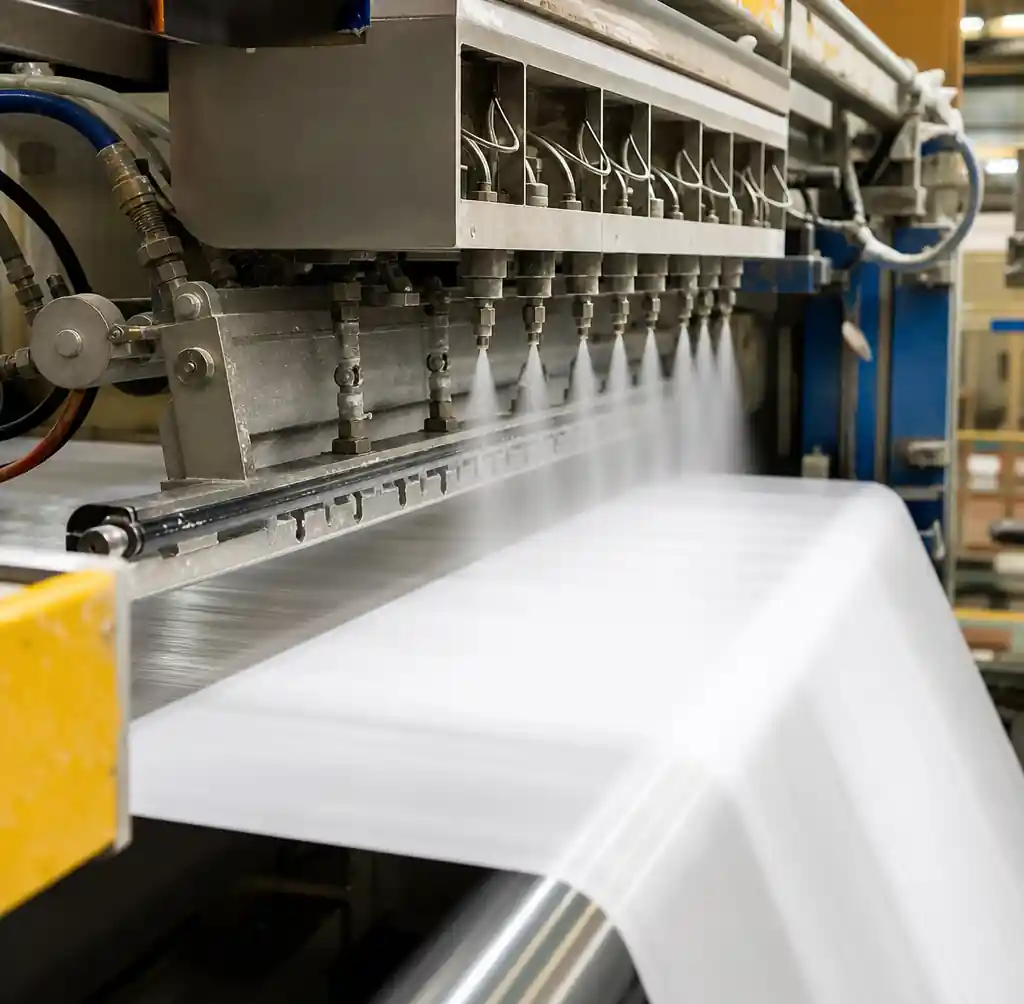 Spray coating system applying uniform coating to paper web in paper mill
Specialized Coating Applications
Functional coatings including water resistance, grease resistance, and barrier coatings often use spray application methods. Air atomizing nozzles excel at applying low-viscosity coating solutions including fluorochemicals, waxes, and polymer dispersions. The fine atomization produces thin, uniform coatings with minimal material consumption.
Some barrier coating applications use heated coating solutions that must be atomized and applied at elevated temperatures. Stainless steel nozzles rated for 200-400°F operating temperatures handle these demanding applications. You will need insulated headers and heat-traced feed lines to maintain coating temperature from storage through application.
Tank and Equipment Cleaning
Pulp Storage and Process Tanks
Paper and pulp mills operate hundreds of storage tanks, blend chests, and process vessels. These tanks require periodic cleaning to remove fiber buildup, chemical residues, and biological growth. Rotary tank cleaning nozzles provide 360-degree coverage with high-impact cleaning jets.
Self-rotating tank cleaning nozzles use fluid pressure to drive gear mechanisms that rotate the nozzle through controlled patterns. Operating at 40-150 psi with flows of 10-100 GPM, these nozzles clean vessel interiors with impact force sufficient to remove stubborn deposits. You can achieve thorough cleaning in vessels up to 30 feet diameter using properly selected rotary nozzles.
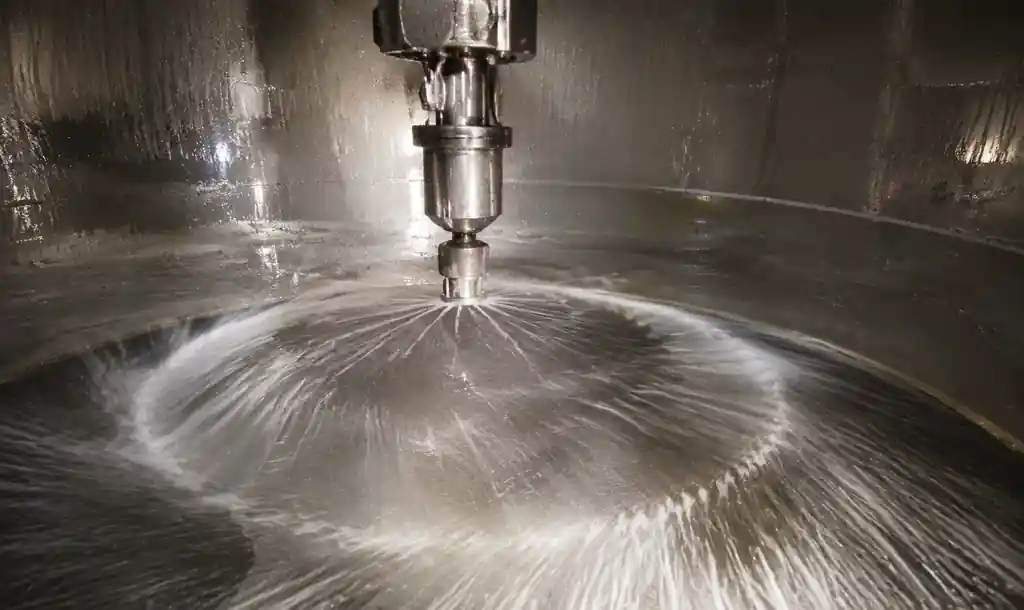 Rotary tank cleaning nozzles providing 360-degree coverage in pulp storage vessel
Static spray ball nozzles offer a simpler alternative for less-demanding cleaning applications. These fixed nozzles distribute fluid in spherical or hemispherical patterns without moving parts. While requiring more cleaning time than rotary nozzles, spray balls provide reliable service in CIP (clean-in-place) systems throughout the mill.
Chemical Recovery Equipment
Pulp mills employing chemical pulping processes operate recovery boilers, evaporators, and causticizing systems that require specialized cleaning. High-pressure rotary nozzles handle scale removal from evaporator tubes and heat exchangers. Nozzle materials must resist extreme pH levels and elevated temperatures encountered in recovery operations.
Selecting Nozzles for Paper Industry Applications
Material Selection Criteria
Nozzle material selection depends on chemical exposure, operating temperature, abrasion resistance requirements, and service life expectations. Stainless steel 316 or 316L provides broad chemical compatibility and good mechanical properties for most papermaking applications. You should specify 316L for bleach plant applications requiring superior corrosion resistance.
Ceramic nozzle inserts offer exceptional wear resistance in highly abrasive applications including debarking, fabric cleaning with recycled fiber, and slurry handling. Ceramic materials including aluminum oxide and silicon carbide provide 10-20 times longer service life compared to stainless steel in abrasive service, though at higher initial cost.
Hardened stainless steel nozzles deliver improved wear resistance at moderate cost increases. Fluoropolymer plastic nozzles (PVDF, PTFE) provide outstanding chemical resistance for aggressive bleaching chemicals and pH extremes, though they cannot withstand high operating pressures or temperatures.
Flow Rate and Pressure Optimization
Proper nozzle sizing balances cleaning performance, water consumption, and energy costs. Undersized nozzles require excessive pressure to achieve target flow rates, wasting pump energy and accelerating wear. Oversized nozzles deliver inadequate velocity and impact force, compromising cleaning effectiveness.
You should calculate nozzle requirements based on coverage area, required impact force or wetting rate, available water pressure, and acceptable flow rates. Nozzle manufacturers provide flow charts and selection software that correlate these variables. Most paper machine applications operate nozzles at 50-80% of maximum rated capacity to ensure stable performance and extend service life.
Water Conservation and Sustainability
Paper mills worldwide face increasing pressure to reduce freshwater consumption and wastewater generation. Optimized spray nozzle systems contribute significantly to water conservation efforts while maintaining product quality and production rates.
Modern wire cleaning systems using properly selected and maintained nozzles can reduce shower water consumption by 30-50% compared to older installations. You can achieve these savings through improved nozzle efficiency, optimized spray patterns, and automated pressure control systems that adjust cleaning intensity based on actual fouling conditions.
Closed-loop water systems reuse clarified white water for multiple cleaning applications before treatment and discharge. Nozzles in these systems must tolerate higher suspended solids and dissolved contaminants compared to fresh water systems. Regular inspection and replacement maintain performance and prevent unexpected failures.
Maintenance and Performance Monitoring
Inspection and Replacement Schedules
Spray nozzles wear through erosion, corrosion, and impact damage during normal operation. Worn nozzles exhibit increased flow rates, altered spray patterns, and reduced impact force. You should establish inspection schedules based on nozzle type, operating conditions, and observed wear rates.
High-pressure cleaning nozzles typically require monthly inspection and quarterly replacement in demanding applications. Lower pressure nozzles in less-abrasive service may operate for 6-12 months before replacement. Keeping spare nozzles in inventory minimizes downtime when failures occur.
Flow testing provides quantitative assessment of nozzle wear. You can measure individual nozzle flow rates using portable flow meters or pressure gauges. Flow increases of 10-15% above nameplate capacity indicate significant wear requiring nozzle replacement. Systematic flow testing helps identify worn nozzles before they compromise process performance.
Strainer and Filter Maintenance
Nozzles operating with insufficient filtration suffer premature clogging and erosive wear from particulates in the water supply. Installing and maintaining appropriate strainers or filters protects your nozzle investment and ensures consistent performance.
Most paper machine spray systems use 50-100 mesh strainers (150-300 microns) to remove fiber fragments, scale particles, and debris. Finer filtration (200 mesh / 75 microns) benefits fine-spray applications including coating and moistening systems. Automatic self-cleaning strainers maintain filtration without manual intervention in critical applications.
Frequently Asked Questions
What spray nozzles work best for paper machine wire cleaning?
Wire cleaning applications typically use flat fan nozzles with 15-40 degree spray angles operating at 20-60 psi for continuous conditioning showers and 500-1500 psi for high-pressure cleaning. Stainless steel or ceramic nozzles provide the wear resistance needed for 24/7 operation. Nozzle spacing of 4-8 inches ensures complete coverage across the machine width.
How do I reduce water consumption in my pulp washing system?
Optimize drum washer shower nozzles by selecting proper spray angles and flow rates for your specific pulp consistency and washing efficiency targets. Properly positioned flat fan nozzles can reduce shower water by 30-50% while maintaining displacement washing effectiveness. Consider flow testing existing nozzles to identify excessive wear that increases water consumption.
What materials handle bleach plant chemical exposure?
Bleaching chemicals including chlorine dioxide, hydrogen peroxide, and ozone require corrosion-resistant nozzle materials. Specify 316L stainless steel for most bleaching applications. Extreme pH environments may require Hastelloy alloys or fluoropolymer plastics (PVDF, PTFE). Always verify chemical compatibility before selecting nozzle materials.
Can air atomizing nozzles reduce coating material consumption?
Air atomizing nozzles create ultra-fine droplets (10-50 microns) that form thin, uniform coatings with excellent coverage. Compared to conventional hydraulic atomization, air atomizing systems can reduce coating weight by 20-40% while maintaining functional performance. This technology works particularly well for specialty barrier coatings and functional treatments.
How often should I replace fabric cleaning nozzles?
Replacement intervals depend on operating pressure, water quality, and nozzle material. High-pressure cleaning nozzles (1000+ psi) in abrasive conditions typically require replacement every 1-3 months. Lower pressure nozzles may operate 6-12 months. Implement flow testing to identify worn nozzles before they compromise cleaning performance.
What causes uneven coating application in spray coating systems?
Uneven coating results from worn nozzles, improper spray overlap, inconsistent coating viscosity, or incorrect nozzle-to-substrate distance. Check nozzle flow rates and spray patterns to identify wear. Verify spray angles provide 100-150% overlap at the coating bar. Maintain coating temperature and viscosity within specified ranges.
Conclusion
Spray nozzle technology plays essential roles throughout paper and pulp manufacturing, from raw material preparation through final product finishing. Proper nozzle selection, installation, and maintenance directly impact water efficiency, energy consumption, product quality, and operational costs. Understanding application-specific requirements enables you to specify optimal nozzle types, materials, and operating parameters for each process stage.
Modern paper mills can achieve substantial water savings (30-70% reduction) through systematic nozzle optimization while maintaining or improving cleaning effectiveness and process performance. As the industry continues advancing toward more sustainable operations, spray system efficiency will remain a critical optimization opportunity. Investing in proper nozzle technology and maintenance programs delivers measurable returns through reduced resource consumption, improved product quality, and extended equipment life.
YuechenPrecision Technology offers comprehensive spray nozzle solutions engineered specifically for pulp and paper industry applications. Our extensive product range covers all papermaking spray requirements, from high-pressure debarking nozzles to precision coating atomizers. Contact our application engineering team for custom spray solutions, technical specifications, and expert support optimizing your paper mill spray systems.