



Industrial Coating Applications: Spray Nozzle Selection
Transfer efficiency in industrial coating operations directly impacts material costs, finish quality, and environmental compliance. Production facilities using optimized spray nozzles can reduce coating waste by 40-60% while achieving superior surface coverage and film build consistency. Selecting the right atomization technology, spray pattern, and operating parameters determines whether your coating line meets throughput targets or struggles with defects.
This guide provides engineering-based criteria for spray nozzle selection in industrial coating applications. You will learn how atomization methods affect droplet size and transfer efficiency, how to match spray patterns to workpiece geometry, and which nozzle configurations optimize performance for specific coating types—from thin automotive finishes to thick protective coatings.
Table of Contents
- 1. What Determines Coating Performance?
- 2. Air Atomizing vs Airless vs HVLP Systems
- 2.1. Air Atomizing Nozzles
- 2.2. Airless Spray Technology
- 2.3. HVLP (High Volume Low Pressure) Systems
- 3. Spray Pattern Selection for Different Geometries
- 3.1. Full Cone Patterns for Complete Coverage
- 3.2. Flat Fan Patterns for Linear Surfaces
- 3.3. Hollow Cone Patterns for Edge Coverage
- 4. Optimizing Air-to-Liquid Ratio (ALR)
- 5. Material Compatibility and Nozzle Construction
- 6. Setup Parameters for Different Coating Types
- 6.1. Thin Coatings (Stains, Sealers, Light Primers)
- 6.2. Medium-Build Coatings (Topcoats, Enamels, Single-Stage Systems)
- 6.3. High-Build Coatings (Industrial Primers, Thick-Film Systems, Protective Coatings)
- 7. Common Coating Defects and Nozzle-Related Solutions
- 8. Maintenance and Performance Optimization
- 9. Coating System Integration Considerations
- 10. Transfer Efficiency and Environmental Compliance
- 11. Industry-Specific Applications
- 11.1. Automotive and Transportation
- 11.2. Industrial Equipment and Machinery
- 11.3. Wood Products and Furniture
- 12. Integration with Existing Production Lines
- 13. Frequently Asked Questions
- 13.1. What droplet size is optimal for industrial coating?
- 13.2. How do I calculate required air compressor capacity?
- 13.3. What causes coating defects like orange peel and dry spray?
- 13.4. How often should I replace spray nozzle components?
- 13.5. Can I use the same nozzle setup for different coating types?
- 13.6. What's the difference between internal and external mix nozzles?
- 14. Conclusion
- 15. Conclusion
What Determines Coating Performance?
Industrial coating success depends on three interconnected factors: atomization quality, transfer efficiency, and application technique. Atomization quality controls droplet size distribution—finer droplets (10-50 microns) create smooth finishes but may drift, while coarser droplets (80-150 microns) provide faster coverage with higher transfer efficiency.
Transfer efficiency measures the percentage of coating that actually reaches and adheres to the target surface. Air atomizing nozzles typically achieve 65-90% transfer efficiency in controlled environments, while electrostatic systems can reach 95% efficiency. Poor transfer efficiency wastes costly coating materials and increases VOC emissions.
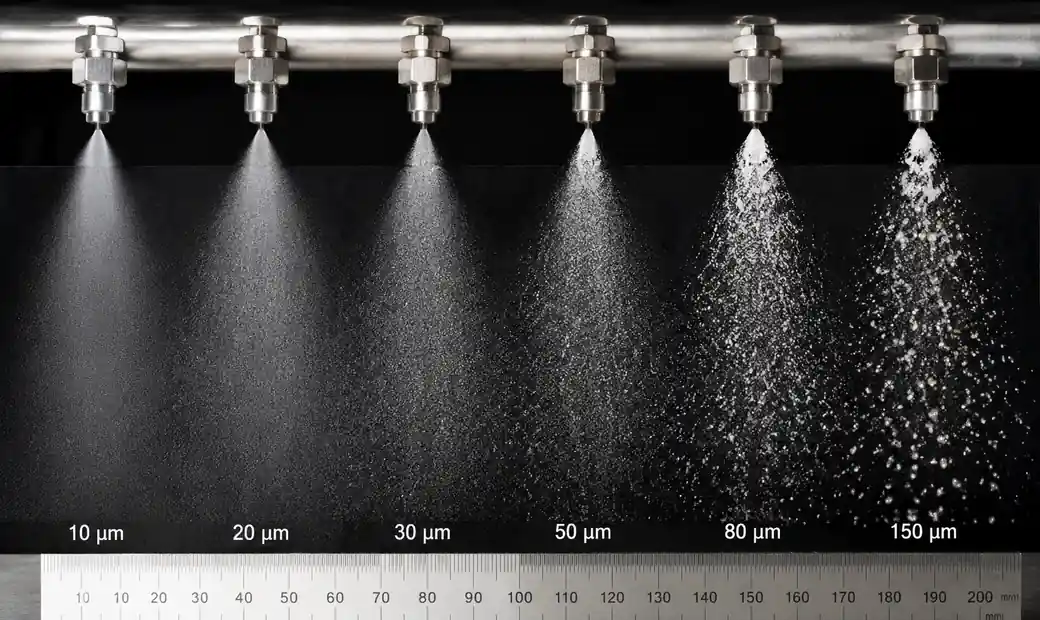 Comparison of coating atomization quality showing different droplet size distributions
Application technique encompasses nozzle positioning, spray overlap, gun-to-target distance, and traverse speed. Even premium nozzles fail when installed incorrectly—maintaining proper 15-30cm standoff distance and 50% spray overlap ensures uniform film build without dry spots or runs.
Air Atomizing vs Airless vs HVLP Systems
Air Atomizing Nozzles
Air atomizing technology uses compressed air to shear liquid into fine droplets through internal or external mix designs. Internal mix nozzles blend air and liquid inside the cap before atomization, producing droplet sizes from 10-80 microns with excellent atomization uniformity. You should specify internal mix when coating thin, low-viscosity materials like stains or sealers.
External mix nozzles keep air and liquid separate until the exit point, allowing higher flow rates and accommodating viscous coatings up to 150 cps. These nozzles work best for medium-build primers and topcoats where smooth finish matters more than material savings. Operating pressures range from 30-70 psi (2-5 bar) liquid and 40-90 psi (3-6 bar) atomizing air.
| Parameter | Internal Mix | External Mix | Best Application |
|---|---|---|---|
| Droplet Size | 10-50 microns | 30-80 microns | Internal: Fine finishes / External: General coating |
| Viscosity Range | Up to 50 cps | Up to 150 cps | Internal: Thin coatings / External: Medium build |
| Transfer Efficiency | 40-60% | 45-65% | Both suitable for indoor controlled environments |
| Air Consumption | 8-15 CFM | 12-20 CFM | Internal: Lower air use / External: Higher volume |
| Typical Pressure | 30-50 psi liquid | 40-70 psi liquid | Depends on material viscosity |
Airless Spray Technology
Airless systems atomize coating through hydraulic pressure alone—forcing liquid through a small orifice at 1500-3000 psi (100-200 bar) creates turbulence that breaks the stream into droplets. This method delivers 60-75% transfer efficiency with minimal overspray, making it ideal for high-production environments applying protective coatings, industrial primers, and heavy-build epoxies.
The primary advantage is speed—airless guns apply 2-4 times more material per minute than air atomizing systems. However, achieving fine finishes requires skill, as airless atomization produces coarser droplets (50-150 microns) than air systems. You can use airless spray for large surfaces where texture is acceptable and material cost outweighs finish quality concerns.
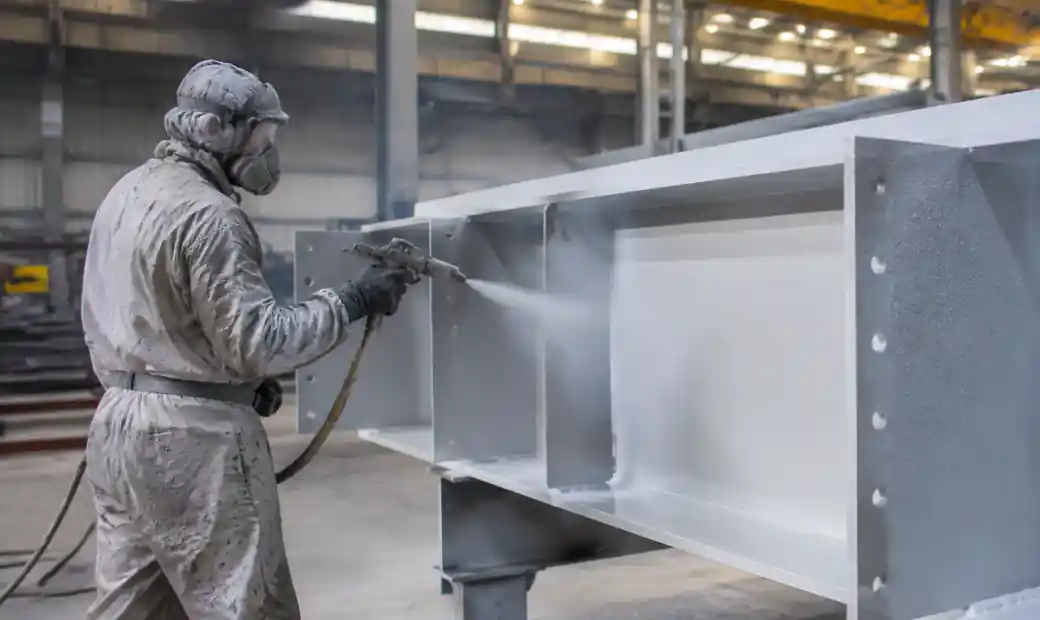 Airless spray nozzle applying industrial protective coating on large metal surface
HVLP (High Volume Low Pressure) Systems
HVLP technology atomizes at lower air pressure (below 10 psi at the air cap) while delivering high air volume, achieving 65-80% transfer efficiency—significantly better than conventional air spray. Regulatory agencies in many regions require HVLP or comparable technology to reduce VOC emissions and coating waste.
For industrial applications, HVLP works best on smaller production runs, refinishing operations, and high-value items where coating cost and environmental impact justify slightly slower application. The fine finish quality rivals conventional air spray, but lower spray velocity means longer gun-to-target distances and more careful technique to avoid sags and runs.
Spray Pattern Selection for Different Geometries
Full Cone Patterns for Complete Coverage
Full cone nozzles produce a solid circular spray pattern with uniform distribution across the entire cone. These patterns work exceptionally well for coating cylindrical objects, pipe exteriors, and round components where 360-degree coverage is needed. The droplet distribution remains consistent from center to edge, preventing the ring-shaped deposit that hollow cone patterns create.
Specify full cone patterns when coating complex 3D geometries that require spray from multiple angles. The solid distribution fills recesses and covers protrusions more effectively than flat fan patterns. Operating pressure between 40-80 psi (3-5.5 bar) provides optimal atomization for most industrial coatings—higher pressure creates finer droplets but increases overspray.
Flat Fan Patterns for Linear Surfaces
Flat fan nozzles create an elliptical spray pattern ideal for coating flat panels, sheet metal, and continuous web applications. The pattern width varies from narrow (15-degree) for detail work to wide (110-degree) for broad coverage. You should select fan angle based on nozzle-to-target distance and desired overlap percentage.
For conveyor line applications, position flat fan nozzles perpendicular to workpiece travel with 50% overlap between adjacent spray patterns. This configuration ensures uniform coating thickness across the web width. Calculate the number of nozzles needed by dividing web width by effective spray width at your operating distance—typical spray width equals 2 × (distance × tan(angle/2)).
Hollow Cone Patterns for Edge Coverage
Hollow cone nozzles create a ring-shaped spray pattern with minimal material in the center, making them particularly effective for coating tube interiors, can seals, and edge applications. The hollow pattern allows you to coat around obstacles or apply material to specific zones without waste.
These patterns excel in coating booth applications where you need to minimize overspray while maintaining good atomization. The ring distribution works well for applying release agents, mold coatings, and specialty treatments where uniform center coverage is unnecessary. Operating hollow cone nozzles at 50-100 psi (3.5-7 bar) provides optimal atomization for viscosities up to 100 cps.
Optimizing Air-to-Liquid Ratio (ALR)
Air-to-liquid ratio represents the volume relationship between atomizing air and liquid coating—typically expressed as a ratio like 10:1 or 15:1. This parameter fundamentally affects atomization quality, transfer efficiency, and finish appearance. Higher ALR values (12:1 to 18:1) produce finer atomization and smoother finishes but reduce transfer efficiency due to increased overspray and bounce-back.
Lower ALR settings (6:1 to 10:1) improve transfer efficiency and reduce material waste, but may compromise finish quality with coarser droplets. You should optimize ALR based on your priority—if achieving Class A automotive finish is critical, accept lower transfer efficiency and run higher ALR. For protective industrial coatings where coverage matters more than gloss, minimize ALR to reduce waste.
| ALR Ratio | Atomization Quality | Transfer Efficiency | Best Application |
|---|---|---|---|
| 6:1 to 8:1 | Coarse (80-120 microns) | 70-85% | Primers, high-build coatings, industrial protective coatings |
| 10:1 to 12:1 | Medium (50-80 microns) | 60-75% | General manufacturing, equipment coating, maintenance painting |
| 14:1 to 16:1 | Fine (30-50 microns) | 50-65% | Automotive topcoats, furniture finishing, decorative applications |
| 18:1+ | Ultra-fine (10-30 microns) | 40-55% | Premium finishes, show cars, high-end furniture, cosmetic coatings |
Adjust ALR by changing air pressure at the nozzle cap while maintaining consistent liquid pressure. Start with manufacturer recommendations, then fine-tune based on observed finish quality and overspray levels. Coating viscosity, ambient temperature, and humidity also affect optimal ALR—warmer, drier conditions typically require slightly lower ALR than cold, humid environments.
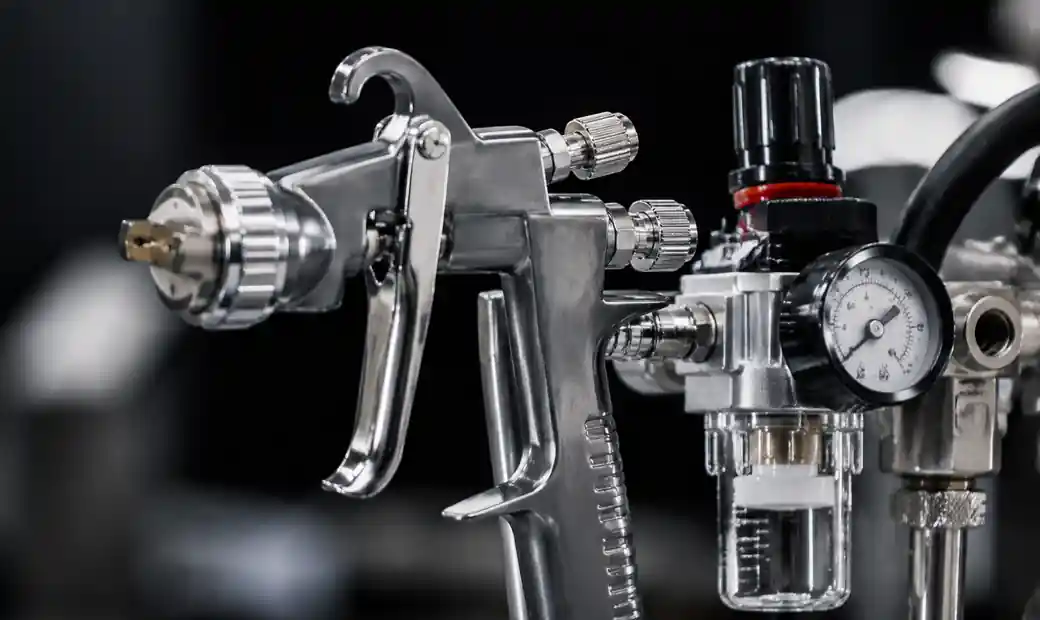 Spray gun showing air and liquid pressure adjustment controls for ALR optimization
Material Compatibility and Nozzle Construction
Coating chemistry dictates nozzle material selection. Aggressive solvents in urethanes, epoxies, and catalyzed coatings attack incompatible nozzle materials, causing swelling, degradation, or complete failure. Stainless steel (316 or 316L) provides broad chemical resistance suitable for most industrial coatings including moderate acid and alkaline formulations.
For highly corrosive coatings containing strong acids or chlorinated solvents, specify Hastelloy or ceramic nozzle components. These materials withstand aggressive chemicals that would rapidly degrade stainless steel. The higher initial cost is justified when nozzle replacement frequency would otherwise cause production interruptions.
Powder coating applications require special consideration—electrostatic powder nozzles must be non-metallic or electrically isolated to prevent grounding the charged powder particles. PTFE (Teflon) and other fluoropolymers provide the necessary electrical isolation while resisting powder buildup and abrasion from the constant particle flow.
Setup Parameters for Different Coating Types
Thin Coatings (Stains, Sealers, Light Primers)
Thin coatings with viscosities below 30 cps require fine atomization and careful application to avoid runs and sags. Use air atomizing nozzles with small orifice diameters (0.8-1.2mm) operating at 25-40 psi (1.7-2.8 bar) fluid pressure. Keep atomizing air pressure low (40-60 psi) to minimize overspray while achieving smooth finish.
Gun-to-target distance should be 20-25cm with faster traverse speeds (80-120 cm/second) to prevent excessive film build. Apply multiple thin coats rather than attempting single-pass coverage—this technique reduces defects and improves overall finish quality.
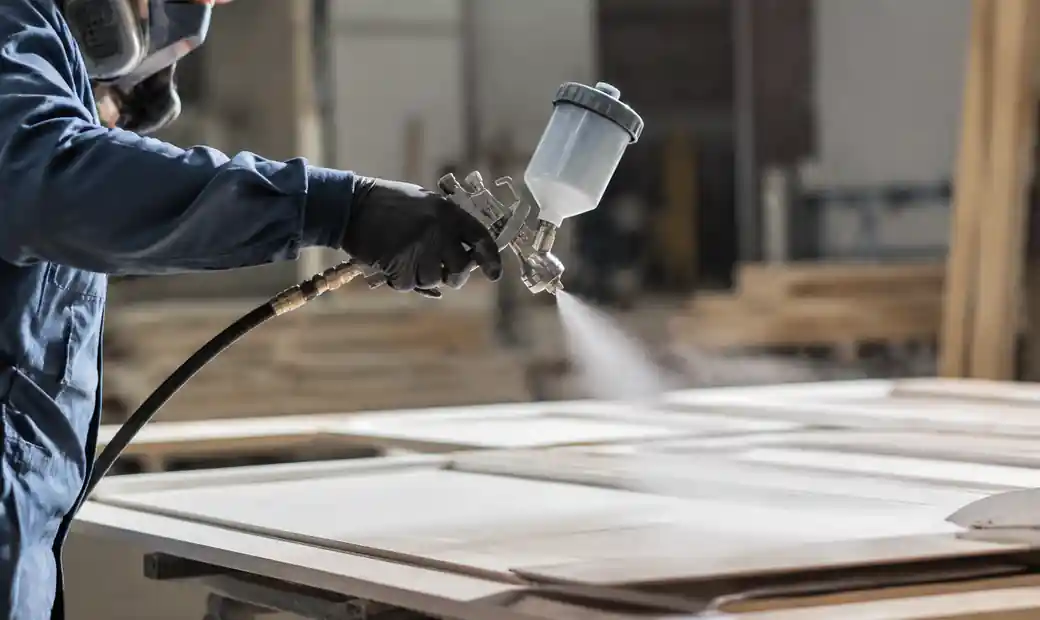 Proper spray technique applying thin stain or sealer coating to wood surface
Medium-Build Coatings (Topcoats, Enamels, Single-Stage Systems)
Medium-viscosity coatings (30-80 cps) represent the bulk of industrial coating applications. These materials flow well through standard orifice sizes (1.2-1.8mm) at moderate pressures—40-60 psi (2.8-4 bar) fluid with 50-70 psi (3.5-5 bar) atomizing air provides optimal atomization.
Maintain 25-30cm spray distance with moderate traverse speeds (60-90 cm/second) and 50% pattern overlap. This configuration delivers consistent 1.5-2.5 mil wet film thickness per coat, which is ideal for most topcoat specifications. Material reduction (dilution) should follow manufacturer guidelines—over-thinning compromises film properties even if it improves atomization.
High-Build Coatings (Industrial Primers, Thick-Film Systems, Protective Coatings)
Viscous high-build coatings (80-150 cps) require larger orifice sizes (1.8-2.5mm) and higher operating pressures to achieve adequate atomization. Airless spray systems work better than air atomizing for these applications—operating at 1800-2500 psi (125-170 bar) provides the hydraulic force needed to atomize thick materials.
If using air atomizing equipment for high-build coatings, increase fluid pressure to 60-80 psi (4-5.5 bar) and atomizing air to 70-90 psi (5-6 bar). Reduce traverse speed to 40-60 cm/second and decrease gun-to-target distance to 20-25cm to compensate for reduced atomization efficiency. Accept coarser finish in exchange for faster build and better hiding.
Common Coating Defects and Nozzle-Related Solutions
Orange peel texture results from improper atomization—droplets too large to flow together before flash-off. Increase atomizing air pressure by 5-10 psi or reduce fluid pressure to produce finer droplets. Alternatively, reduce coating viscosity within manufacturer specifications or slow traverse speed to allow better flow-out.
Dry spray and overspray indicate excessive atomization air relative to fluid delivery. Reduce ALR by decreasing air pressure or increasing fluid pressure. Move spray gun closer to workpiece to reduce distance droplets travel before impact. Check for low material temperature—cold coatings atomize poorly and may require heating to 24-29°C (75-85°F).
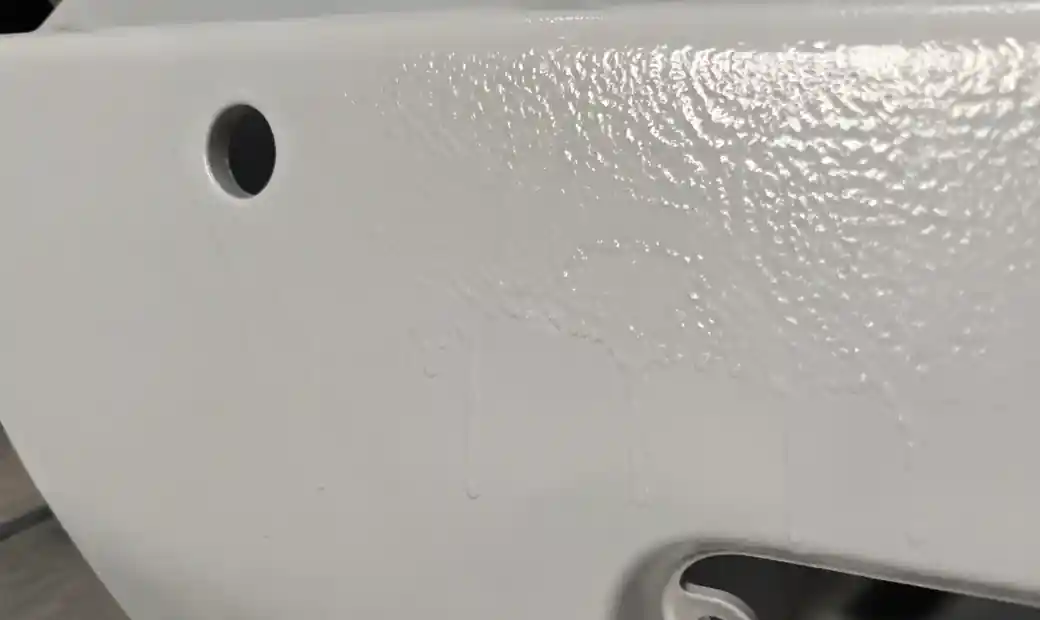 Common coating defects showing orange peel texture and runs on coated surface
Runs and sags occur when wet film thickness exceeds coating's ability to resist gravity flow. Reduce fluid pressure, increase traverse speed, or increase gun-to-target distance. Apply multiple lighter coats instead of attempting full coverage in one pass. Verify coating isn't over-reduced—excessive thinning reduces viscosity and compromises sag resistance.
Maintenance and Performance Optimization
Nozzle performance degrades as precision orifices wear and coating residue accumulates. Establish a cleaning schedule based on production volume—high-volume operations should clean nozzles daily, while intermittent use allows weekly or per-job maintenance. Never allow coating to cure inside nozzle passages—flush immediately after each use with appropriate solvent.
Replace fluid tips and air caps as matched sets when spray pattern becomes distorted or atomization quality declines. Mixing worn and new components creates asymmetric patterns and inconsistent performance. Track nozzle service life by monitoring gallons sprayed or operating hours—typical industrial nozzles provide 100-500 service hours depending on coating abrasiveness and operating pressure.
Inspect nozzles under magnification for orifice wear, erosion, and buildup. Even minor damage to precision orifices significantly affects spray pattern and atomization. Store cleaned nozzles in protective cases to prevent mechanical damage and contamination between uses.
Coating System Integration Considerations
Successful coating operations require more than correct nozzle selection—system design encompasses material supply, pressure regulation, filtration, and environmental controls. Install pressure regulators at each spray station to maintain consistent operating pressure regardless of line pressure fluctuations. Size air compressors to deliver 30% more CFM than peak demand to prevent pressure drops during simultaneous operation of multiple guns.
Filtration prevents nozzle clogging and coating defects from contamination. Install 100-mesh (149 micron) filters upstream of all spray equipment when using conventional coatings—finer 200-mesh (74 micron) filtration protects small-orifice nozzles used for fine finishing. Replace filter elements before pressure drop exceeds manufacturer specifications.
Temperature control affects coating viscosity, atomization quality, and cure rate. Maintain material temperature between 18-24°C (65-75°F) for consistent results—most industrial coatings are formulated and tested at these conditions. Humidity control is equally important, particularly for moisture-sensitive coatings like isocyanates—maintain relative humidity below 70% to prevent defects.
Transfer Efficiency and Environmental Compliance
Transfer efficiency directly impacts operating costs and regulatory compliance. Calculate efficiency by weighing coated parts before and after coating, then dividing deposited coating weight by total coating used (including overspray and booth waste). Target minimum 65% transfer efficiency for conventional air spray, 75% for HVLP, and 70% for airless systems.
Improve transfer efficiency through better technique rather than equipment changes alone. Train operators to maintain proper spray distance, overlap, and gun angle. Use spray pattern test panels to verify correct setup before production runs. Implement quick coupling systems to reduce material waste during color changes and equipment cleaning.
VOC (volatile organic compound) emissions depend on both coating formulation and application efficiency. Switching from conventional air spray to HVLP can reduce VOC emissions by 30-50% through improved transfer efficiency alone. Some jurisdictions mandate HVLP or comparable technology for coating operations—verify local regulations before specifying equipment.
Industry-Specific Applications
Automotive and Transportation
Automotive finishing demands Class A surface quality with minimal orange peel, excellent gloss, and perfect color match. Air atomizing systems with 14:1 to 18:1 ALR ratios deliver the fine atomization required, though transfer efficiency drops to 45-60%. Basecoat/clearcoat systems require different nozzle setups—metallic basecoats need coarser atomization (1.3-1.5mm tip) than clearcoats (1.0-1.3mm tip) to prevent orientation issues.
Large commercial vehicles and agricultural equipment use faster, less critical coating processes. Airless spray systems applying two-component urethanes at 2000-2500 psi provide the productivity needed for high-volume production. Accept slightly textured finish in exchange for 3-4x faster application and better film build control.
Industrial Equipment and Machinery
General industrial coating prioritizes corrosion protection and chemical resistance over cosmetic appearance. Full cone nozzles applying zinc-rich primers and epoxy topcoats provide durable protection with excellent coverage of complex geometries. Operating pressures between 50-80 psi (3.5-5.5 bar) balance atomization quality against transfer efficiency.
Modular spray systems with multiple nozzle positions coat complex machinery more efficiently than handheld guns. Position fixed nozzles to target recessed areas, flanges, and hard-to-reach zones that operators might miss. Combine automated coverage with manual touchup to optimize both quality and labor cost.
Wood Products and Furniture
Wood finishing requires careful balance between coverage and penetration. Stains and sealers need fine atomization but minimal air velocity to prevent blowing material off the surface. Use low-pressure air atomizing systems (25-40 psi fluid, 40-60 psi air) with 10:1 to 12:1 ALR for optimal results. Topcoats require slightly higher atomizing air (60-70 psi) to achieve smooth, level finish.
Flat fan nozzles positioned above conveyor lines provide consistent coverage of panel goods and cabinet components. Vertical panel coating requires bottom-up spray direction to prevent runs—position nozzles to spray upward against gravity, allowing material to level as it descends.
Integration with Existing Production Lines
Retrofit spray systems must integrate with existing conveyors, fixturing, and environmental controls. Measure available mounting space, power supply capacity, and compressed air availability before selecting equipment. Many facilities discover air supply inadequacy only after equipment installation—verify compressor CFM rating matches peak demand plus 30% safety margin.
Coordinate spray booth modifications with existing ventilation systems. Adding spray stations may require airflow rebalancing to maintain proper capture velocity and prevent overspray escape. Booth velocity should be 80-120 fpm (linear feet per minute) at operator breathing zone to ensure adequate capture without creating turbulence that disrupts spray pattern.
Install proper accessories including pressure regulators, filters, and fluid heaters at each spray station. Centralized systems serving multiple stations should include individual regulators to compensate for pressure drop through distribution piping. Size piping to maintain velocity below 20 fps (feet per second) to prevent pressure fluctuations when other stations activate.
Frequently Asked Questions
What droplet size is optimal for industrial coating?
Optimal droplet size depends on coating type and quality requirements. Fine finishes need 30-50 micron droplets, general industrial coatings work well with 50-80 microns, and high-build systems can use 80-150 micron droplets. Match atomization quality to actual requirements—over-atomization wastes compressed air and reduces transfer efficiency.
How do I calculate required air compressor capacity?
Calculate total CFM demand by adding air consumption of all spray guns that might operate simultaneously, then add 30% safety margin. A typical industrial air atomizing gun consumes 12-18 CFM at operating pressure. Four guns operating simultaneously require minimum 60-90 CFM compressor capacity. Account for pressure drop through piping and filters—undersized compressors cause pressure fluctuations that affect coating quality.
What causes coating defects like orange peel and dry spray?
Orange peel results from insufficient atomization—droplets too large to flow together before solvent flash-off. Increase atomizing air pressure or reduce fluid viscosity. Dry spray indicates excessive atomization or spray distance—droplets partially dry before reaching workpiece. Reduce atomizing air pressure, increase fluid pressure, or move gun closer to target. Material temperature below 18°C (65°F) can cause both issues.
How often should I replace spray nozzle components?
Replace fluid tips and air caps as matched sets every 100-500 operating hours depending on coating abrasiveness and operating pressure. High-solid coatings and abrasive fillers accelerate wear. Monitor spray pattern quality and atomization consistency—visible pattern distortion or reduced performance indicate replacement need. Track service hours or gallons sprayed to establish replacement intervals specific to your operation.
Can I use the same nozzle setup for different coating types?
Different coatings require different nozzle configurations. Thin stains need smaller orifices (0.8-1.2mm) and lower pressures than high-build primers requiring 1.8-2.5mm tips. However, many industrial operations successfully use mid-range setups (1.3-1.6mm) for various coatings by adjusting pressure and viscosity. Establish baseline settings for your most common coating, then make minor adjustments for specialized materials.
What's the difference between internal and external mix nozzles?
Internal mix nozzles blend air and liquid inside the nozzle body before atomization, producing very fine droplets (10-50 microns) ideal for thin coatings. External mix nozzles keep air and liquid separate until the exit point, allowing higher flow rates and viscosity range. Choose internal mix for fine finishes with thin materials, external mix for higher production rates and medium-build coatings.
Conclusion
Conclusion
Selecting the right spray nozzle requires balancing atomization quality, transfer efficiency, viscosity, and production needs. Match atomization technology to coating type, pattern to part geometry, and optimize parameters through testing. Air atomizing delivers superior finish quality; airless boosts productivity for high-build coatings.
Critical factors include air-to-liquid ratio (for air atomizing), orifice sizing for viscosity, and correct gun distance and traverse speed. Even premium nozzles fail if installed or operated improperly. Regular maintenance and timely replacement are essential.
Improved transfer efficiency cuts material costs and environmental impact. Understanding nozzle design's effect on droplet size, pattern, and deposition enables process optimization for both quality and efficiency. Yuechen Precision Technology provides comprehensive nozzle solutions and engineering support—contact us for tailored recommendations.