



Bottle Washing in Beverage Industry: Nozzle Selection Guide
In beverage production facilities, bottle washing nozzles are not just about getting glass clean—they determine your line speed, water consumption, and whether you pass hygiene audits. I've seen production lines lose 15% throughput because the wrong nozzle type created incomplete coverage, forcing rewash cycles. The selection process involves matching spray characteristics to your specific bottle geometry, contamination type, and regulatory requirements.
Table of Contents
- 1. Why Nozzle Selection Matters for Beverage Operations
- 2. Understanding Spray Pattern Requirements
- 3. Material and Construction Standards
- 4. Performance Specifications for Effective Cleaning
- 5. Inside vs Outside Cleaning Strategies
- 6. Water Recirculation and Efficiency
- 7. Line Speed Optimization
- 8. Integration with Existing Systems
- 9. FAQ
- 10. Conclusion
Why Nozzle Selection Matters for Beverage Operations
The difference between adequate and optimal bottle washing shows up in your operational costs first. A facility switching from traditional spray balls to rotary Tank Clean nozzles typically reduces water consumption by 30-40% while cutting cleaning time in half. But beyond cost savings, nozzle selection directly impacts compliance—NSF-certified equipment is mandatory for direct food contact surfaces, and audit failures trace back to incomplete residue removal more often than contamination during filling.
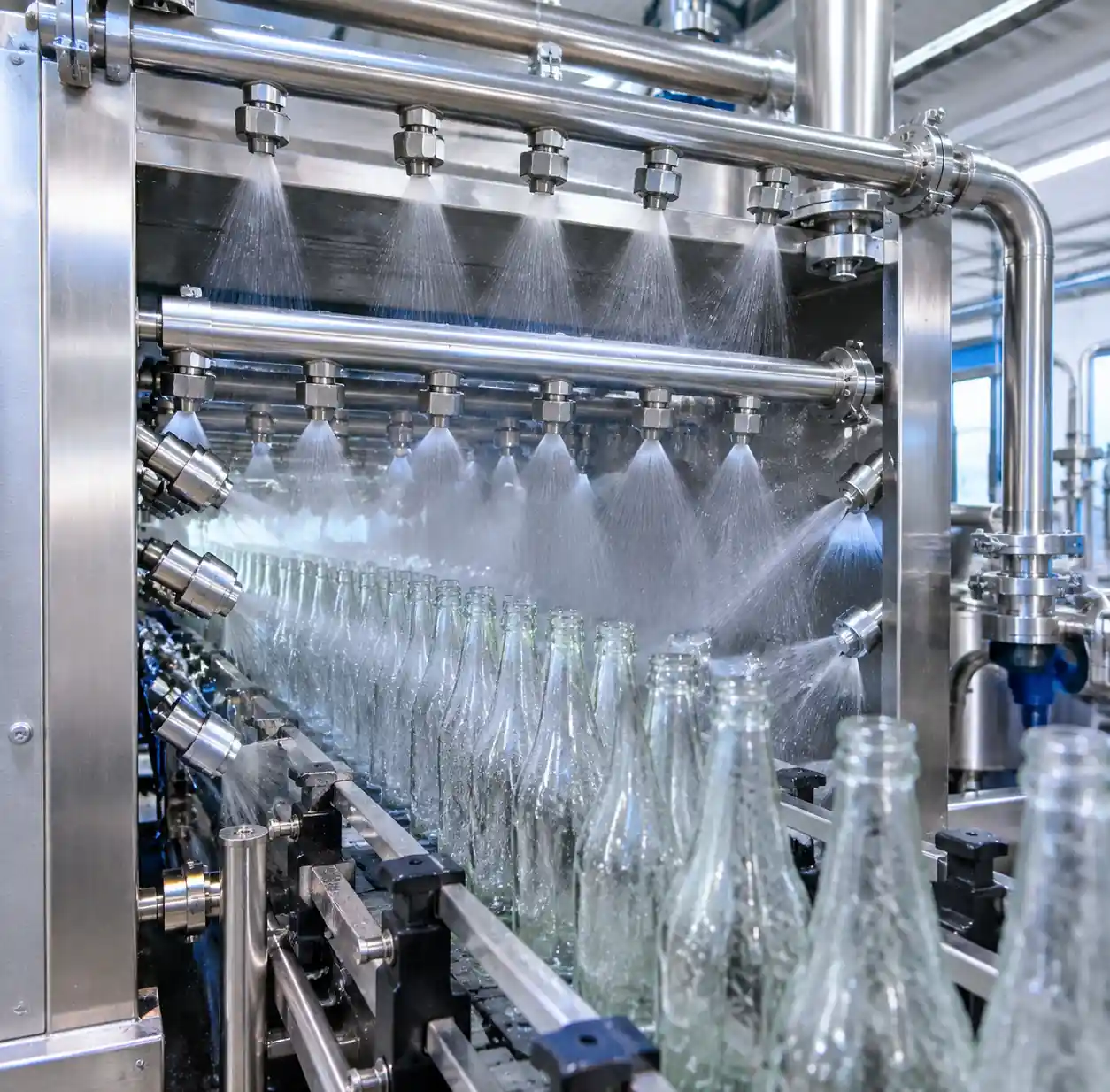 Industrial bottle washing nozzle array installed in beverage production line
The spray pattern determines coverage uniformity. Small-neck bottles need precise internal targeting that only certain nozzle geometries can deliver. Wide-mouth containers allow more nozzle options but require higher flow rates to achieve the same cleaning intensity. Your bottle geometry dictates nozzle geometry, not the other way around.
Understanding Spray Pattern Requirements
Different bottle washing stages require distinct spray characteristics. The pre-rinse removes gross contamination and uses high-flow, low-pressure nozzles to flush debris without forcing it into bottle crevices. The main wash stage demands impact force—this is where Full Cone Nozzles excel, delivering uniform droplet distribution across the entire internal surface.
| Spray Pattern | Best Application | Typical Pressure Range | Coverage Characteristic |
|---|---|---|---|
| Full Cone | Inside washing, complete coverage | 30-80 psi | 360° solid cone, uniform droplet size |
| Hollow Cone | Rinsing, external cleaning | 25-60 psi | Ring-shaped pattern, high impact at perimeter |
| Flat Fan | Targeted zones, label removal areas | 40-100 psi | Rectangular pattern, concentrated impact |
| Rotary | High-impact scrubbing, stubborn residues | 50-120 psi | Dynamic 360° rotation, mechanical action |
Hollow cone nozzles create a ring-shaped spray ideal for external bottle surfaces and final rinse stages where you want complete drainage without pooling. The pattern covers bottle shoulders and neck transitions that full cone spray sometimes misses. For carbonated beverage bottles with complex internal geometries, combining patterns in sequence—full cone for body, hollow cone for shoulder—delivers better results than any single nozzle type.
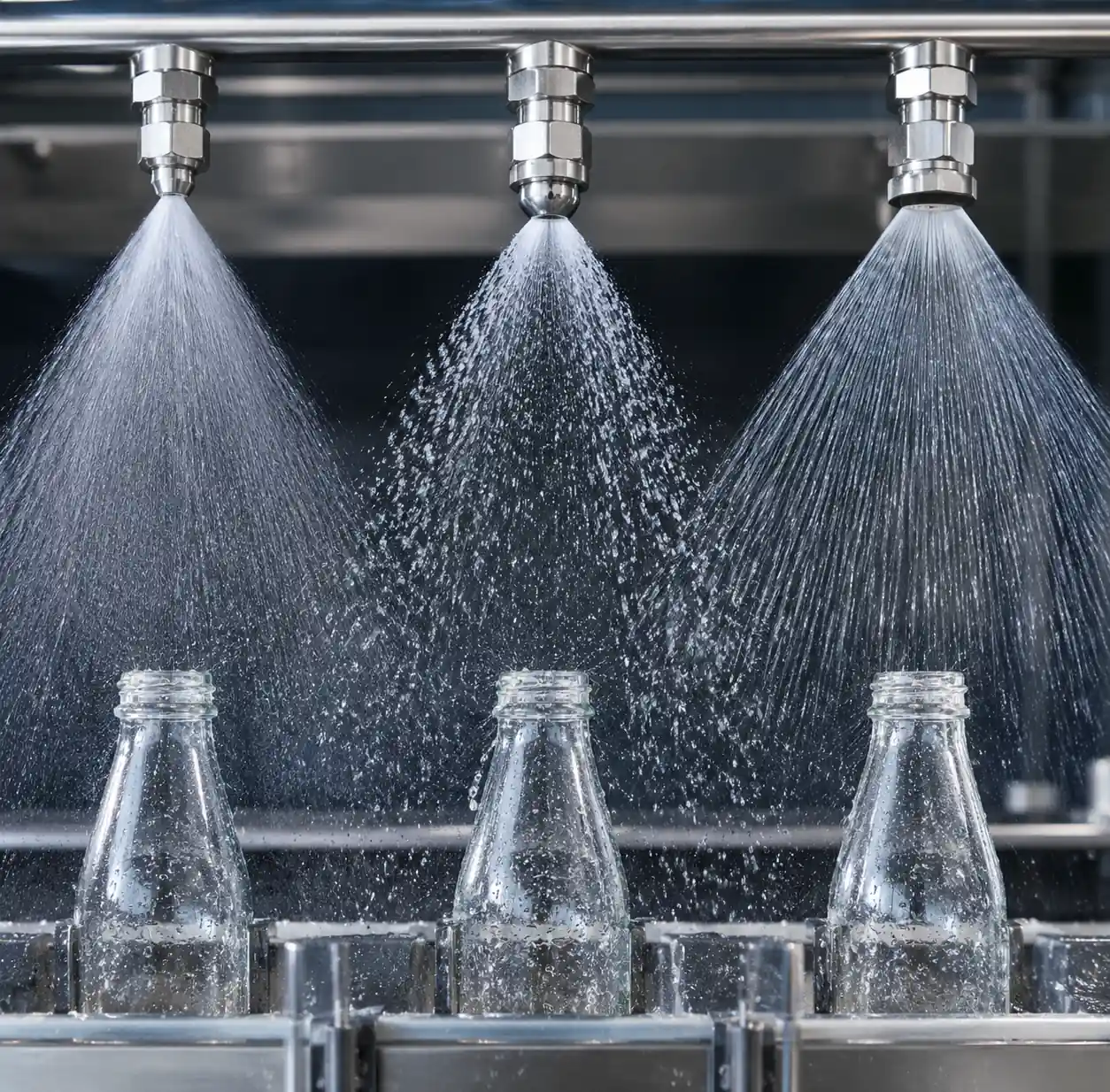 Different spray patterns from full cone, hollow cone, and flat fan nozzles
Hollow Cone Nozzles also handle high-solids rinse water better than full cone designs because the open center prevents clogging from particulate carryover.
Material and Construction Standards
316 stainless steel is the baseline for beverage contact nozzles, offering superior corrosion resistance against caustic detergents and acidic sanitizers. I've encountered facilities using 304 stainless in CIP systems where chloride levels in the wash water caused pitting failure within 18 months. The cost premium for 316 pays for itself by eliminating premature replacement and contamination risk from corroded components.
Sanitary design means more than material choice. Clamp spray nozzles with tri-clamp connections allow tool-free disassembly for inspection and cleaning—critical for FSMA compliance. Avoid nozzles with internal crevices, dead legs, or threads exposed to product contact zones. These harbor biofilm that survives standard CIP cycles.
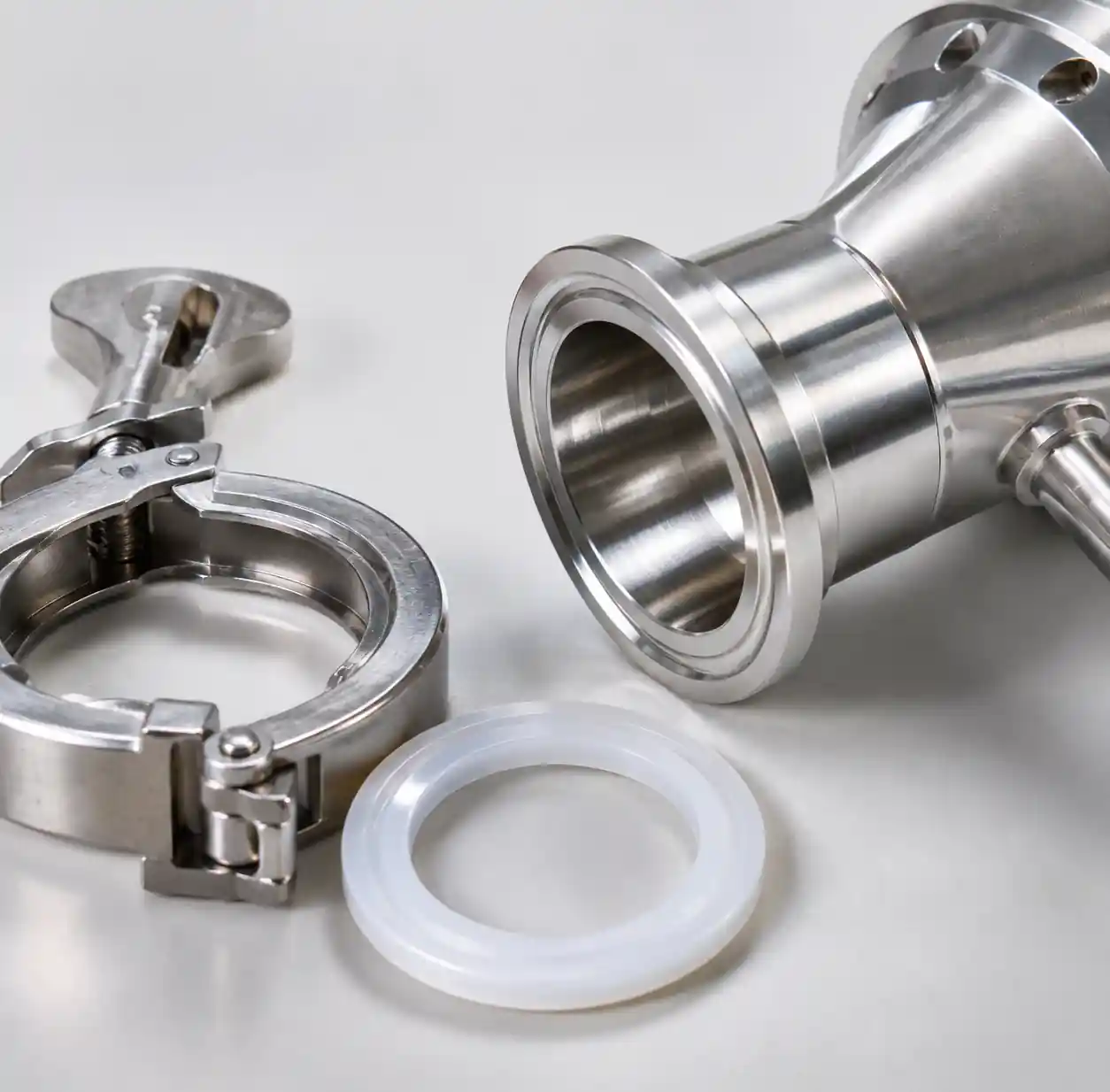 Sanitary tri-clamp connection on beverage-grade spray nozzle
NSF/ANSI Standard 51 certification verifies that nozzle materials, surface finish, and geometry meet food equipment requirements. Non-certified nozzles may function identically but create audit liability. Certification also ensures the manufacturer conducted extractables testing—confirming no metal ions or plastic additives leach into your wash water at operating temperatures.
Performance Specifications for Effective Cleaning
Water pressure below 30 psi rarely provides sufficient impact force to dislodge dried beverage residues. Industry testing shows that sugar-based contamination requires minimum 40 psi at the nozzle orifice to break adhesion bonds, while protein-containing products (dairy-based beverages) need 60+ psi. But higher pressure isn't universally better—exceeding 100 psi on thin-walled PET bottles causes deformation that triggers downstream reject rates.
Flow rate and pressure work together to define cleaning capability. A nozzle rated 5 GPM at 60 psi delivers specific impact force per unit area. Reducing pressure to save energy proportionally reduces both flow and impact, potentially falling below the minimum threshold for effective cleaning. The relationship isn't linear—cutting pressure by 25% might reduce cleaning effectiveness by 60% for certain soil types.
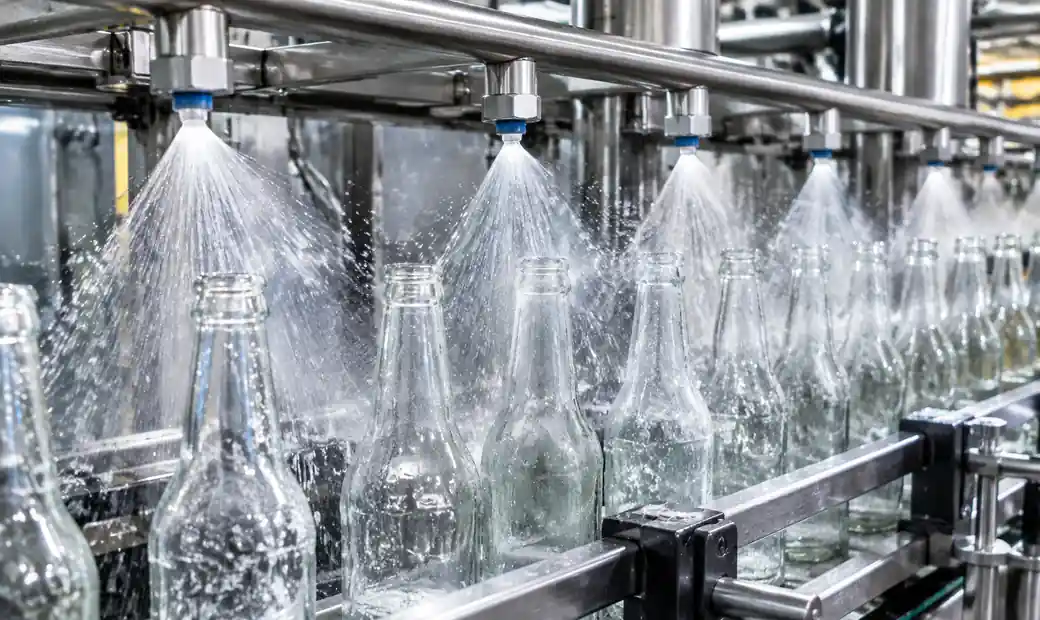 High-pressure spray nozzle cleaning beverage bottles at operational pressure
Temperature amplifies chemical action but affects nozzle performance. Most elastomeric seals in spray nozzles degrade above 180°F, and some adhesives used in bonded assemblies fail at sustained high temperatures. If your wash cycle runs hot (160-180°F range), specify high-temperature seals (EPDM or PTFE) and verify maximum rated operating temperature with the manufacturer. Standard Buna-N seals commonly used in general-purpose nozzles fail quickly in hot caustic solutions.
Inside vs Outside Cleaning Strategies
Internal bottle washing presents different challenges than external cleaning. The inside surface traps residue in shoulder transitions and bottom corners where spray impingement angles matter critically. Full cone nozzles mounted along the bottle path provide vertical spray that reaches bottom corners, but shoulder areas often need supplementary hollow cone spray aimed downward from above.
| Cleaning Zone | Primary Contamination | Recommended Nozzle Type | Critical Parameter |
|---|---|---|---|
| Bottle interior body | Product residue, sugar films | Full cone, wide angle | Coverage uniformity |
| Interior shoulder/neck | Dried foam, product rings | Hollow cone, downward aimed | Spray angle precision |
| Exterior body | Dust, handling contamination | Flat Fan Nozzles, aligned to bottle path | Impact force, water sheets |
| Exterior base | Conveyor lubricant, label adhesive residue | Flat fan, upward aimed | Chemical compatibility |
External cleaning requires less precision than internal washing but often fights more stubborn contamination. Conveyor lubricants and label adhesive residue don't respond to water alone—you need chemical action combined with mechanical force. This is where air-assisted nozzles sometimes outperform liquid-only designs. Compressed air shears surface water into fine droplets while providing scrubbing action that static spray patterns can't match. The trade-off is noise and air compressor capacity—adding air nozzles to a washing tunnel may require compressed air system upgrades.
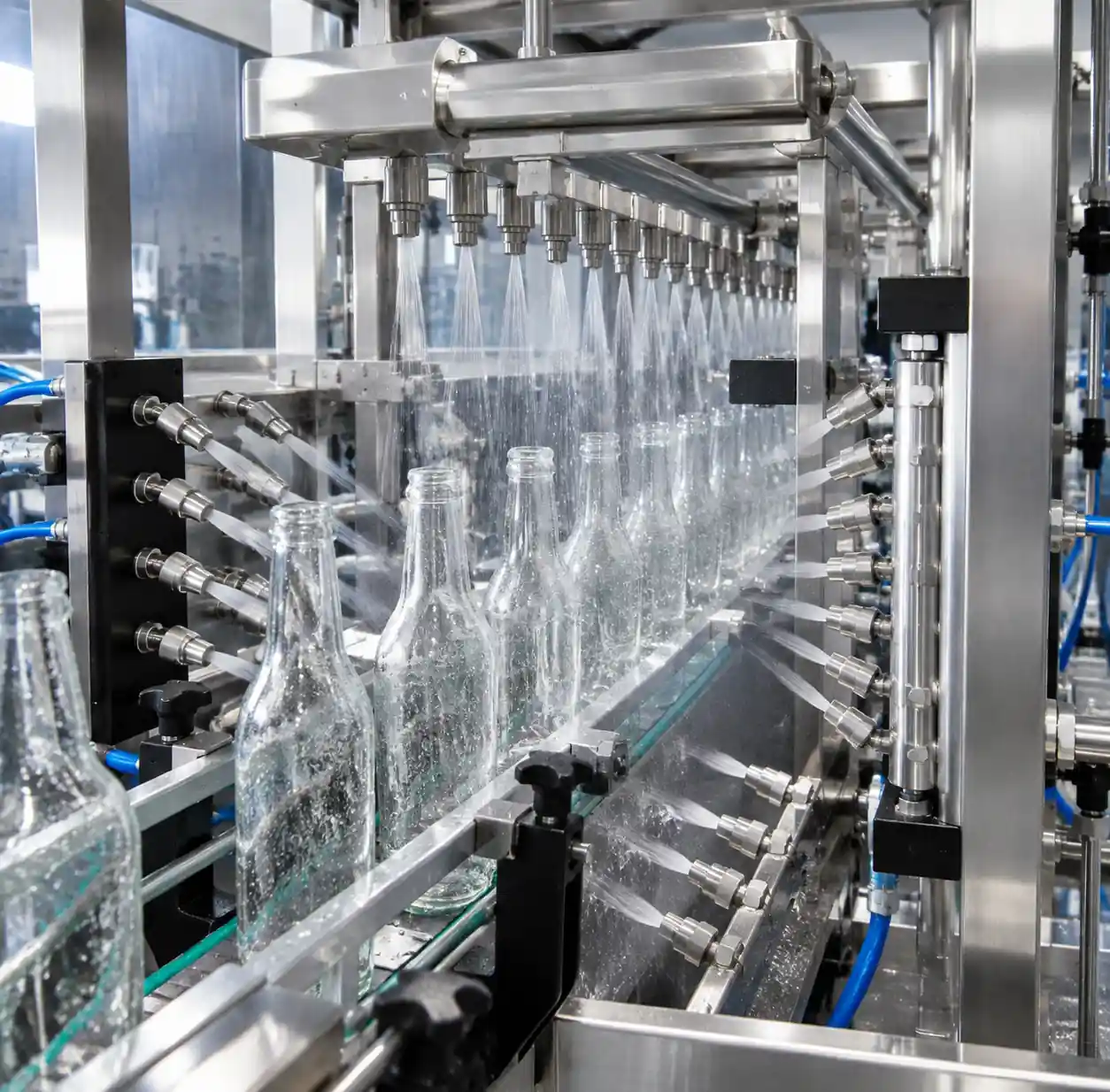 Bottle washing system showing internal and external cleaning nozzle positions
Foam removal is a specific external cleaning challenge. Standard liquid nozzles push foam around without collapsing it. Air knife nozzles that combine high-velocity air sheets with minimal water effectively strip foam and promote rapid drying before bottles enter filling zones.
Water Recirculation and Efficiency
Multi-stage washing systems recirculate water from cleaner stages back to dirtier stages, progressively concentrating contaminants in the pre-rinse while using freshwater only for final rinse. Nozzle selection affects recirculation viability—designs prone to clogging can't handle high-turbidity recirculated water. Full cone nozzles with free-passage vane designs tolerate particle loading better than fine-orifice hollow cone nozzles.
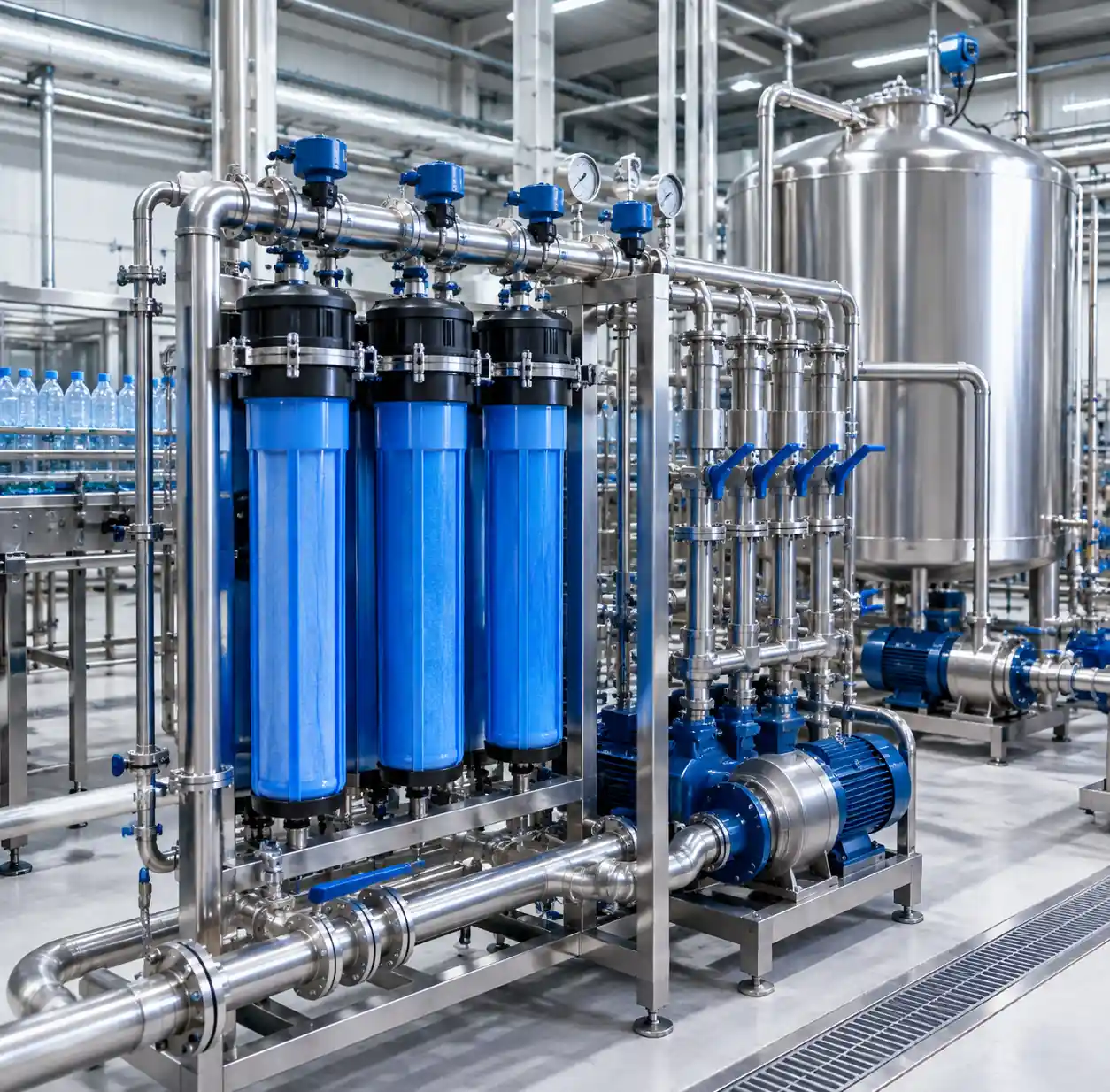 Water recirculation and filtration system for bottle washing line
Filtration requirements scale with nozzle orifice size. A 0.125-inch orifice tolerates particles up to about 1/4 that diameter (0.030 inch) before clogging risk increases sharply. If your recirculation system uses 50-mesh filtration (0.0117-inch openings), you need nozzles with orifices sized accordingly—usually 0.187 inch minimum. Undersizing creates frequent cleaning shutdowns that eliminate the water savings you intended to achieve.
Water recovery percentage determines ROI on recirculation systems. Facilities achieving 70%+ recovery typically use three or more washing stages with progressively cleaner water. The nozzles in each stage must maintain performance despite varying water quality—turbidity, dissolved solids, and temperature all shift as water cycles through the system.
Line Speed Optimization
Washing throughput depends on dwell time—how long each bottle remains in the spray zone. Conveyor speed and nozzle coverage area must align to ensure minimum residence time for effective cleaning. A bottle moving at 200 feet per minute through a 2-foot wash tunnel experiences only 0.6 seconds of spray contact. If your contamination requires 2 seconds minimum contact time, you either slow the line to 60 feet per minute or extend the tunnel length to 6.7 feet.
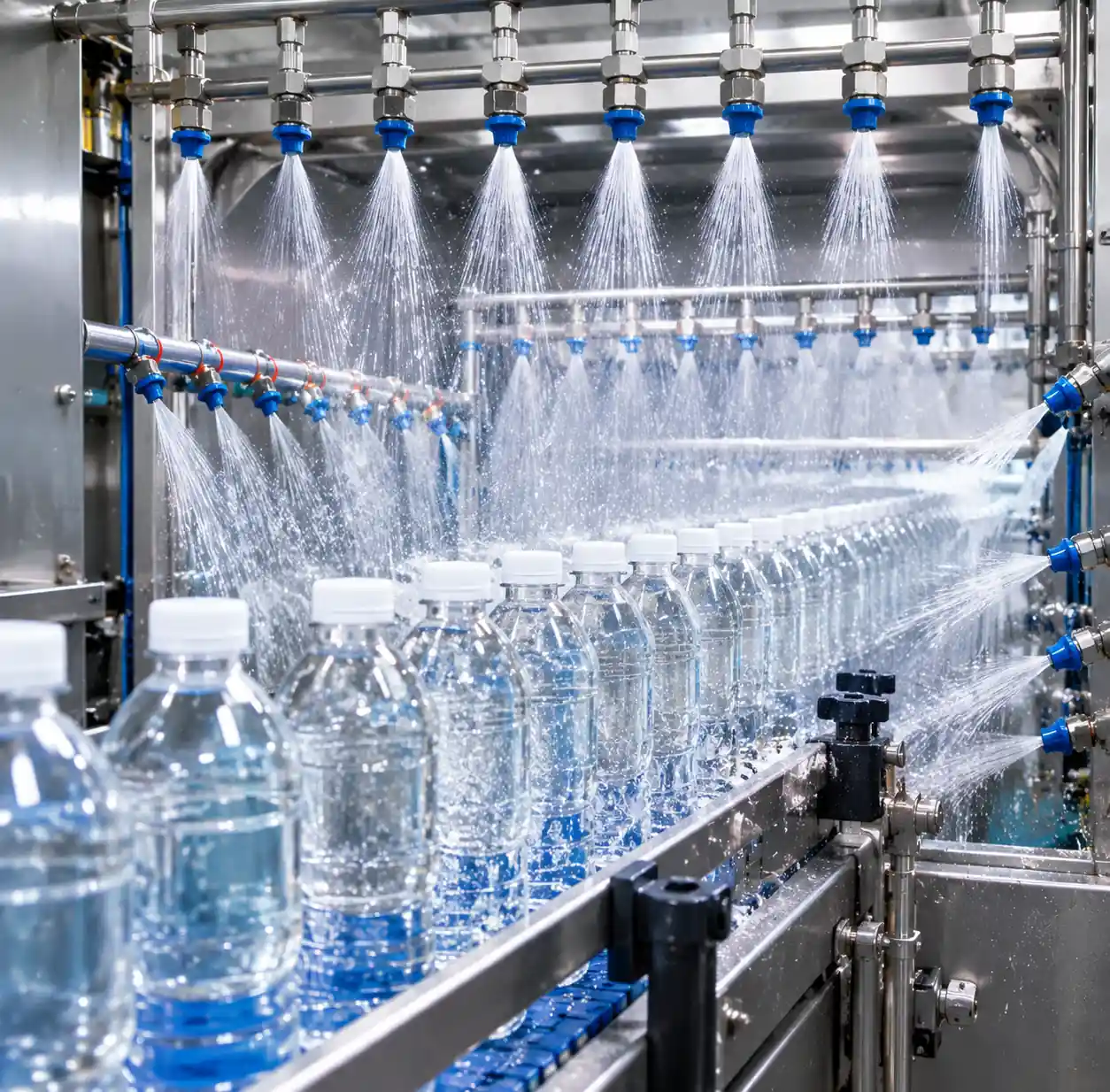 High-speed bottle conveyor moving through multi-row nozzle washing tunnel
Multiple nozzle rows increase effective dwell time without extending tunnel length. Staggered nozzle positioning prevents spray shadowing where one nozzle's impact zone blocks another's coverage. I've optimized lines where adding a third row of offset nozzles allowed 40% speed increase without reducing cleaning effectiveness—the capital cost of additional nozzles and plumbing paid back in under four months through increased production.
Indexing systems (stop-and-spray) versus continuous motion washing represent different optimization strategies. Indexing allows longer dwell time and more aggressive cleaning cycles but limits maximum line speed. Continuous systems support higher speeds but require more sophisticated nozzle arrays to maintain adequate coverage. The decision point typically falls around 150-200 containers per minute—below that, indexing often makes economic sense; above that, continuous motion becomes necessary.
Integration with Existing Systems
Retrofitting new nozzles into existing wash tunnels requires verifying available water pressure and flow capacity. Adding rotary impact nozzles that consume 8 GPM each when your current system delivers 40 GPM total means you can only operate five nozzles simultaneously—potentially inadequate for full coverage. Measure actual operating pressure at the manifold, not just the supply pump rating, because pressure drop through distribution piping reduces what reaches the nozzles.
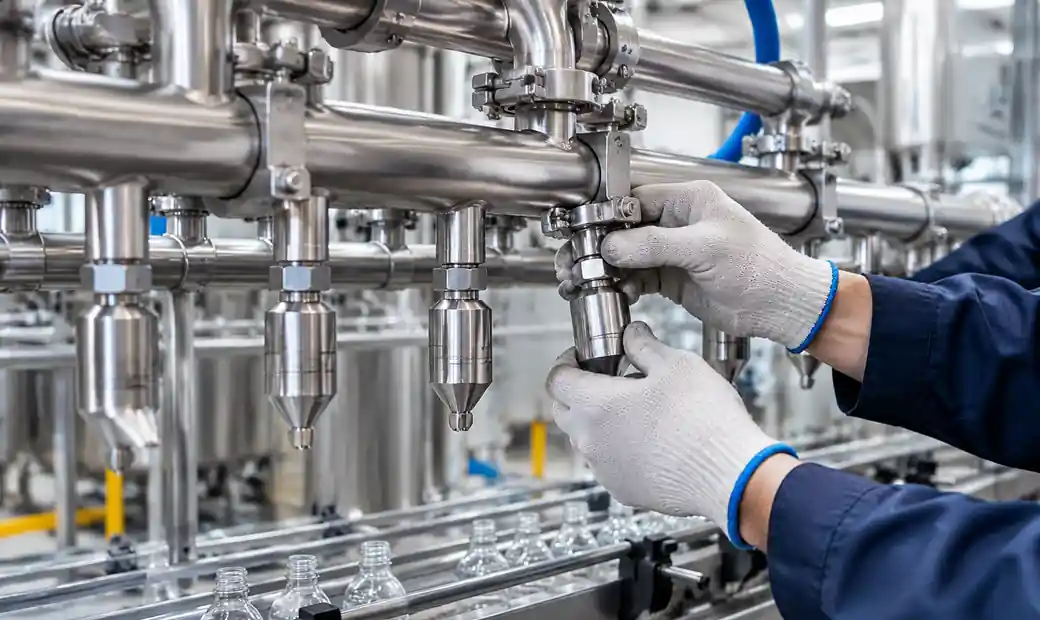 Spray nozzle retrofit installation on existing bottle washing manifold
Mounting compatibility seems straightforward but creates problems when overlooked. NPT threaded connections common in older systems seal via thread interference, while newer sanitary designs use clamp connections with gasket seals. Mixing connection types requires adapters that introduce potential leak points and crevices contrary to sanitary design principles. When possible, standardize on one connection type throughout the system during retrofits.
Control system integration affects nozzle selection when you're implementing automated wash cycle adjustments. Pneumatically actuated nozzles that turn on/off or adjust spray angle allow different wash recipes for different bottle types without manual intervention. But adding control valves and actuators increases system complexity—you're trading operational flexibility for maintenance burden. Simple always-on nozzles require less oversight and have fewer failure modes.
FAQ
What minimum pressure do I need for effective bottle washing?
Most beverage bottle washing requires 30-40 psi minimum at the nozzle for adequate impact force. Sugar-based residues typically need 40+ psi, while protein contamination may require 60+ psi. Verify pressure at the nozzle, not just at the pump—system losses reduce available pressure by 20-30% in typical installations.
How do I prevent nozzle clogging in recirculated wash water?
Use nozzles with free-passage designs where the minimum orifice diameter is at least 4x your filtration mesh size. For 50-mesh (0.0117-inch) filtration, specify nozzles with 0.187-inch or larger orifices. Consider self-cleaning rotary nozzles for heavily contaminated water streams.
Can I mix different nozzle types in the same wash tunnel?
Yes—multi-stage washing benefits from pattern combinations. Use flat fan or hollow cone for pre-rinse debris removal, full cone for main wash coverage, and hollow cone again for final rinse. Ensure each stage's pressure and flow requirements match your available supply.
What's the difference between food-grade and NSF-certified nozzles?
Food-grade typically means suitable materials (stainless steel, FDA-compliant plastics) but lacks third-party verification. NSF/ANSI 51 certification requires standardized testing of materials, surface finish, and design to confirm no product contamination risk. Auditors recognize NSF certification; "food-grade" claims without certification carry less weight.
How often should I replace spray nozzles?
Inspect quarterly for wear indicators: spray pattern distortion, flow rate decline, or visible orifice erosion. Stainless steel nozzles in clean water service last 2-3 years typically. Replace sooner if you see pattern asymmetry or if measured flow drops 10%+ below specification at standard pressure.
Do rotary nozzles require more maintenance than static spray nozzles?
Rotary designs have moving parts (bearings, seals) that need periodic inspection and lubrication. Expect maintenance every 6-12 months versus essentially zero maintenance for static nozzles. The trade-off is 2-3x better cleaning performance in difficult applications—if you need that capability, the maintenance burden is worthwhile.
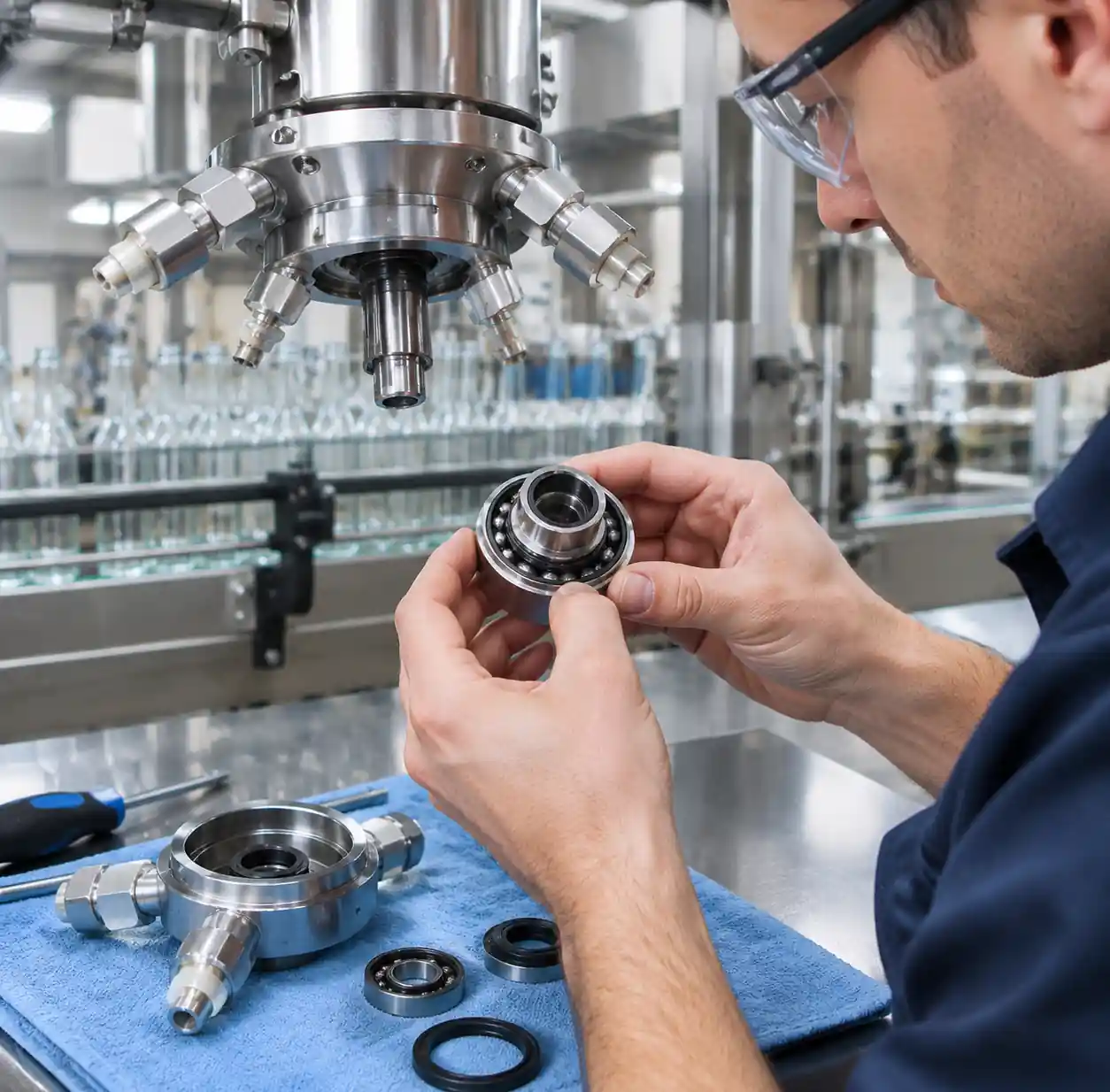 Technician performing maintenance inspection on rotary washing nozzle
Conclusion
Bottle washing nozzle selection directly impacts your beverage operation's efficiency, compliance posture, and production capacity. The right combination of spray pattern, material specification, and performance characteristics reduces water consumption, accelerates line speed, and ensures consistent hygiene standards. Start by documenting your bottle geometry, contamination type, and current system constraints—pressure, flow, and space limitations. Match nozzle types to specific washing stages rather than seeking one universal solution, and verify NSF certification for any food-contact components.
Don't overlook integration complexity when upgrading nozzles. The highest-performing nozzle fails if your existing water supply can't deliver required pressure and flow, or if mounting hardware creates sanitary design violations. Test candidate nozzles in actual production conditions before committing to full tunnel retrofits—spray pattern claims in catalog data don't always translate to effective cleaning of your specific contamination under your water chemistry conditions. Focus on verified performance in your application, not theoretical specifications.