



How Rotary Tank Cleaning Nozzles Work: Mechanism Explained
Industrial tank cleaning has evolved from manual labor to automated systems. At its heart lies the rotary tank cleaning nozzle—a precision device delivering thorough cleaning without human entry into confined spaces.
Table of Contents
- 1. What Is a Rotary Tank Cleaning Nozzle?
- 2. The Core Working Principle
- 3. Types of Drive Mechanisms
- 4. Understanding Cleaning Patterns and Coverage
- 4.1. 3D Coverage Principles
- 4.2. Indexing vs. Continuous Rotation
- 4.3. Coverage Factors
- 5. Key Components and Their Functions
- 6. Pressure and Flow Requirements
- 7. Rotary Jet Heads vs. Rotary Spray Balls
- 7.1. Rotary Jet Heads
- 7.2. Rotary Spray Balls
- 8. Maintenance Requirements and Best Practices
- 9. Common Issues and Troubleshooting
- 10. FAQ
- 11. Conclusion
What Is a Rotary Tank Cleaning Nozzle?
A self-rotating spray device for cleaning tank interiors without manual entry. Unlike static spray balls with fixed orifices, rotary nozzles use high-velocity jets rotating in programmed patterns for complete 3D coverage.
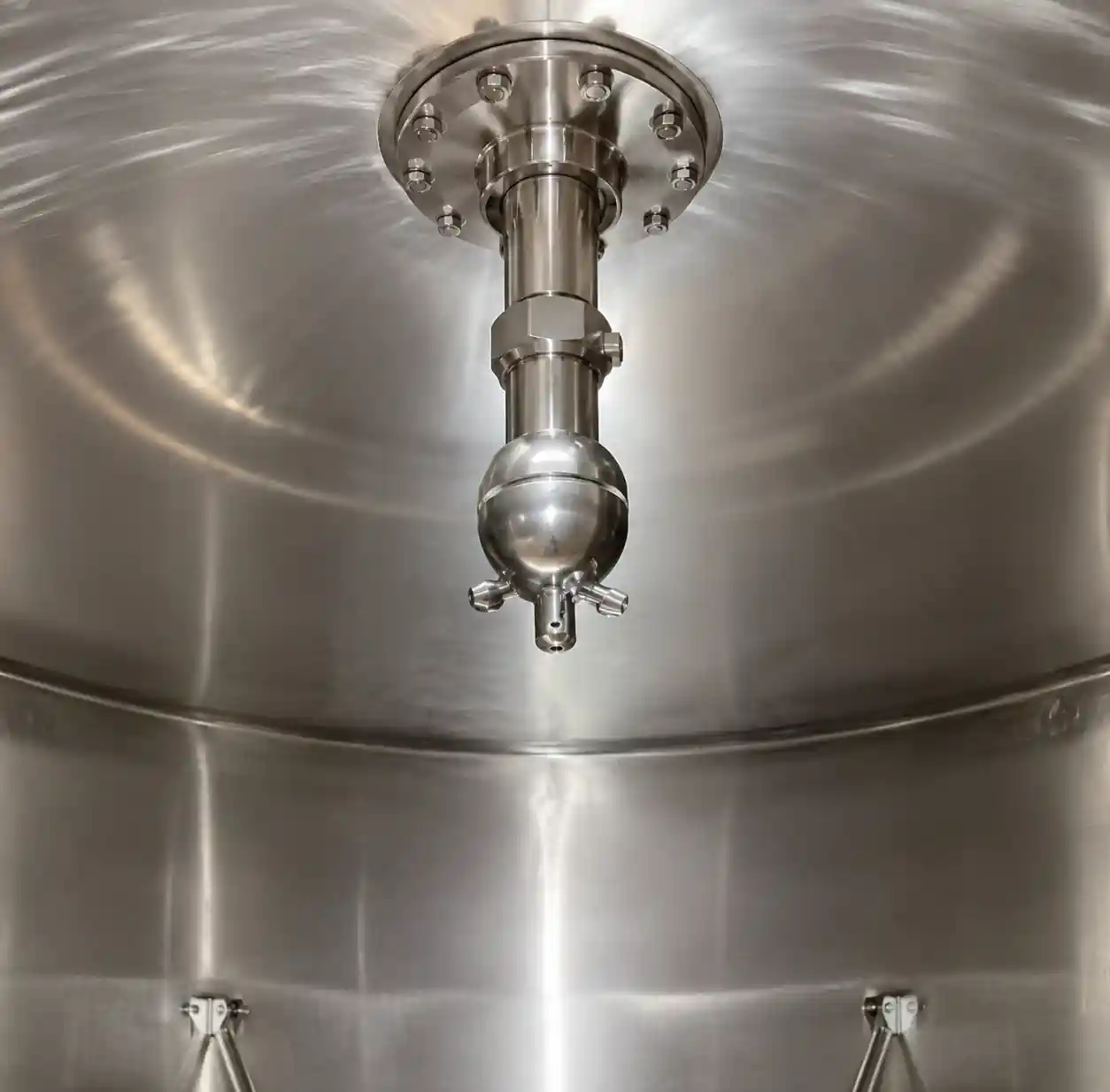 Industrial rotary tank cleaning nozzle mounted inside stainless steel tank
Integral to CIP systems in food, beverage, pharmaceutical, and chemical industries. They reach walls, domes, agitators, and baffles while using less water and chemicals than traditional methods. YuechenPrecision Technology manufactures precision gear-driven models for demanding applications.
Industrial rotary tank cleaning nozzle mounted inside stainless steel tank
Integral to CIP systems in food, beverage, pharmaceutical, and chemical industries. They reach walls, domes, agitators, and baffles while using less water and chemicals than traditional methods. YuechenPrecision Technology manufactures precision gear-driven models for demanding applications.
The Core Working Principle
Convert fluid pressure into mechanical rotation while maintaining high-impact jets. Pressurized cleaning fluid enters, flows through internal channels that both drive rotation and create cleaning jets. No external motors required.
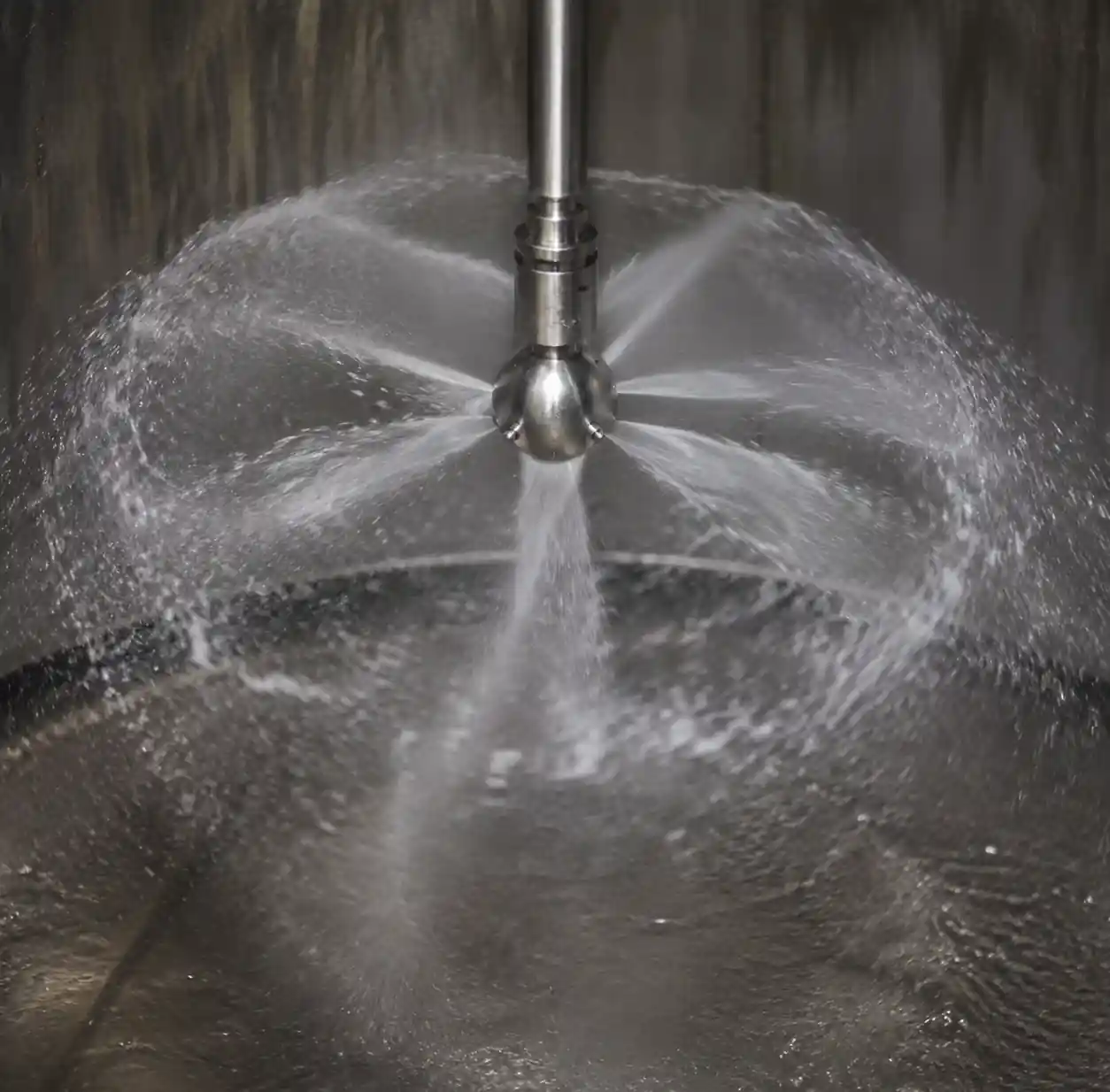 Rotary nozzle creating rotating spray pattern during cleaning cycle
The fluid engages a turbine, gear train, or reaction mechanism to convert hydraulic energy into rotation.Simultaneously, fluid exits through angled jets that impact tank surfaces. Rotating jets follow 360° horizontal movement with indexed vertical positioning, creating spherical coverage. Indexing ensures repeatable patterns, eliminating random gaps.
Rotary nozzle creating rotating spray pattern during cleaning cycle
The fluid engages a turbine, gear train, or reaction mechanism to convert hydraulic energy into rotation.Simultaneously, fluid exits through angled jets that impact tank surfaces. Rotating jets follow 360° horizontal movement with indexed vertical positioning, creating spherical coverage. Indexing ensures repeatable patterns, eliminating random gaps.
Types of Drive Mechanisms
Gear-Driven: Precision gear trains powered by fluid flow. A turbine drives a reduction gearbox controlling speed and indexing. Most precise, ideal for repeatable cleaning cycles. Sealed gears resist abrasive wear.
Hydraulic Turbine: Fluid directly drives a vaned rotor. Continuous rotation, speed proportional to flow/pressure. Fewer parts, higher particle tolerance. Suitable for moderate soiling.
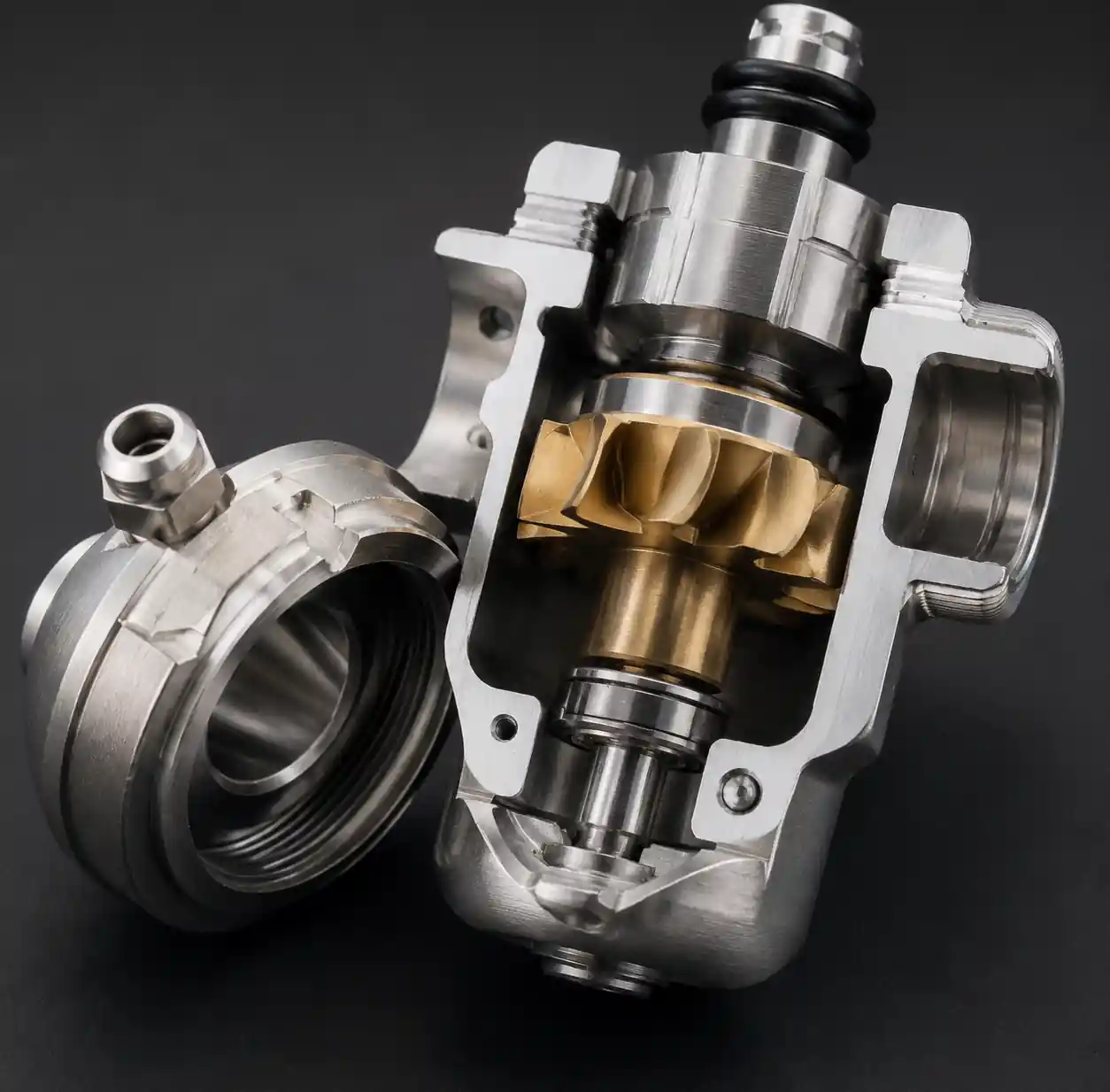 Close-up view of hydraulic turbine mechanism inside rotary nozzle
Reaction-Driven: Operates on Newton's third law—exit force rotates the nozzle. Simplest design, continuous random rotation. Used for rinsing, not critical hygiene.
Close-up view of hydraulic turbine mechanism inside rotary nozzle
Reaction-Driven: Operates on Newton's third law—exit force rotates the nozzle. Simplest design, continuous random rotation. Used for rinsing, not critical hygiene.
Understanding Cleaning Patterns and Coverage
3D Coverage Principles
Rotary nozzles create spherical coverage. Horizontal rotation combined with jets at multiple vertical angles (e.g., 30°, 60°, 90°) covers walls, shoulders, and domes. Overlapping circles ensure full coverage.
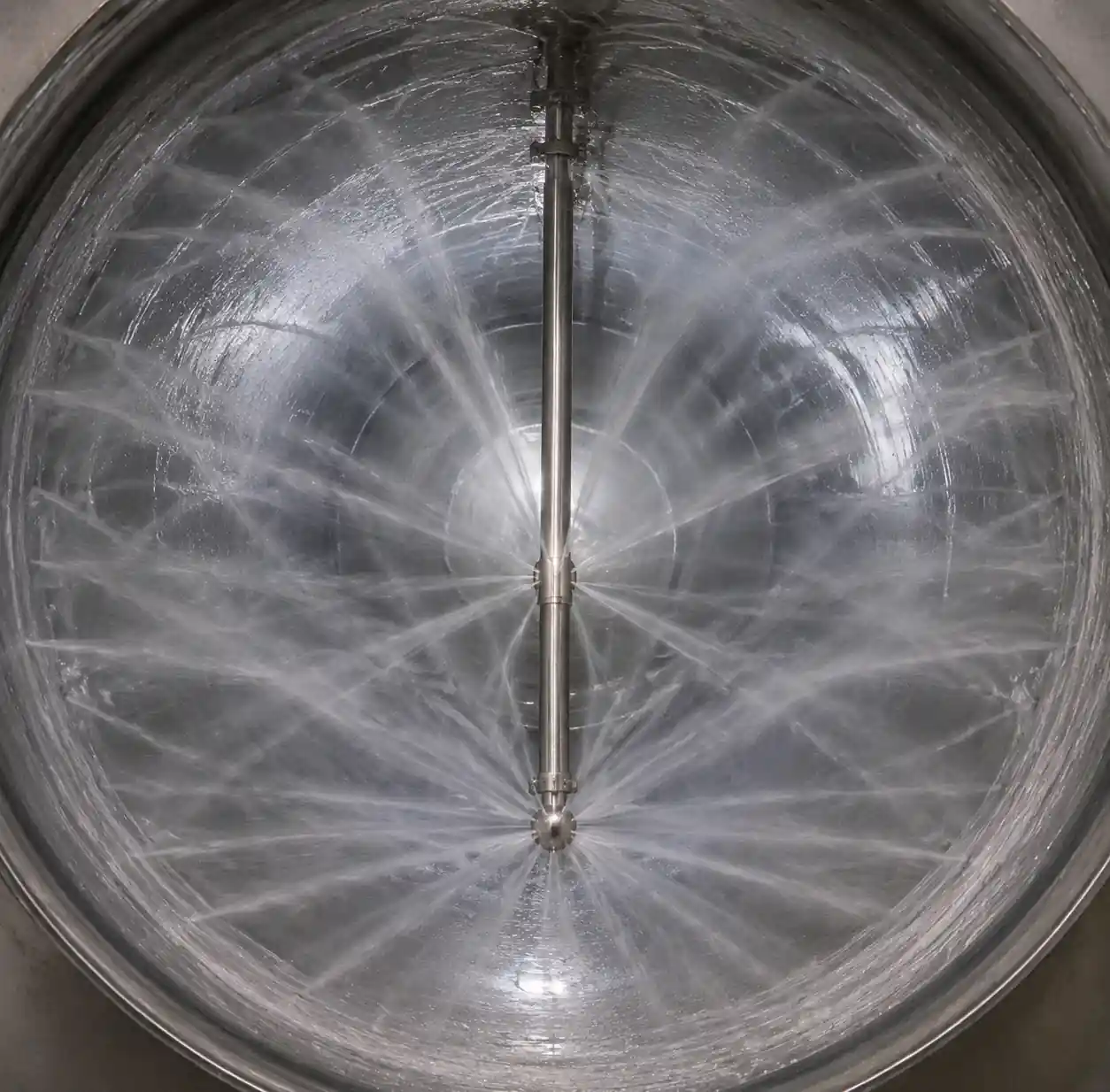 Demonstration of 3D spherical coverage pattern from rotary nozzle
Indexing vs. Continuous Rotation
Indexed: Precise angle rotation with brief pauses—repeatable, validated patterns. Required for hygiene-critical applications.
Continuous: Steady spinning—smooth but harder to validate. Needs longer cycles for sufficient overlap.
Coverage Factors
Impact angle (45-90° optimal), standoff distance, spray overlap (15-30%), rotation speed, and internal obstructions (baffles, agitators) all affect efficiency.
Key Components and Their Functions
| Component | Function | Material |
|---|---|---|
| Nozzle Body | Houses mechanism, mounting interface | 316L SS (304 for less demanding) |
| Turbine/Gear Assembly | Converts flow to rotation, controls speed/indexing | Hardened SS or ceramic |
| Spray Jets/Orifices | Creates high-velocity streams | Precision-drilled, ceramic inserts for abrasives |
| Seals & Bearings | Prevents leaks, enables smooth rotation | PTFE, EPDM, Viton per chemical compatibility |
| Indexing Mechanism | Controls rotational positioning | Gear train or cam system |
| Mounting Flange | Secures nozzle, fluid connection | Tri-clamp, NPT, or flanged |
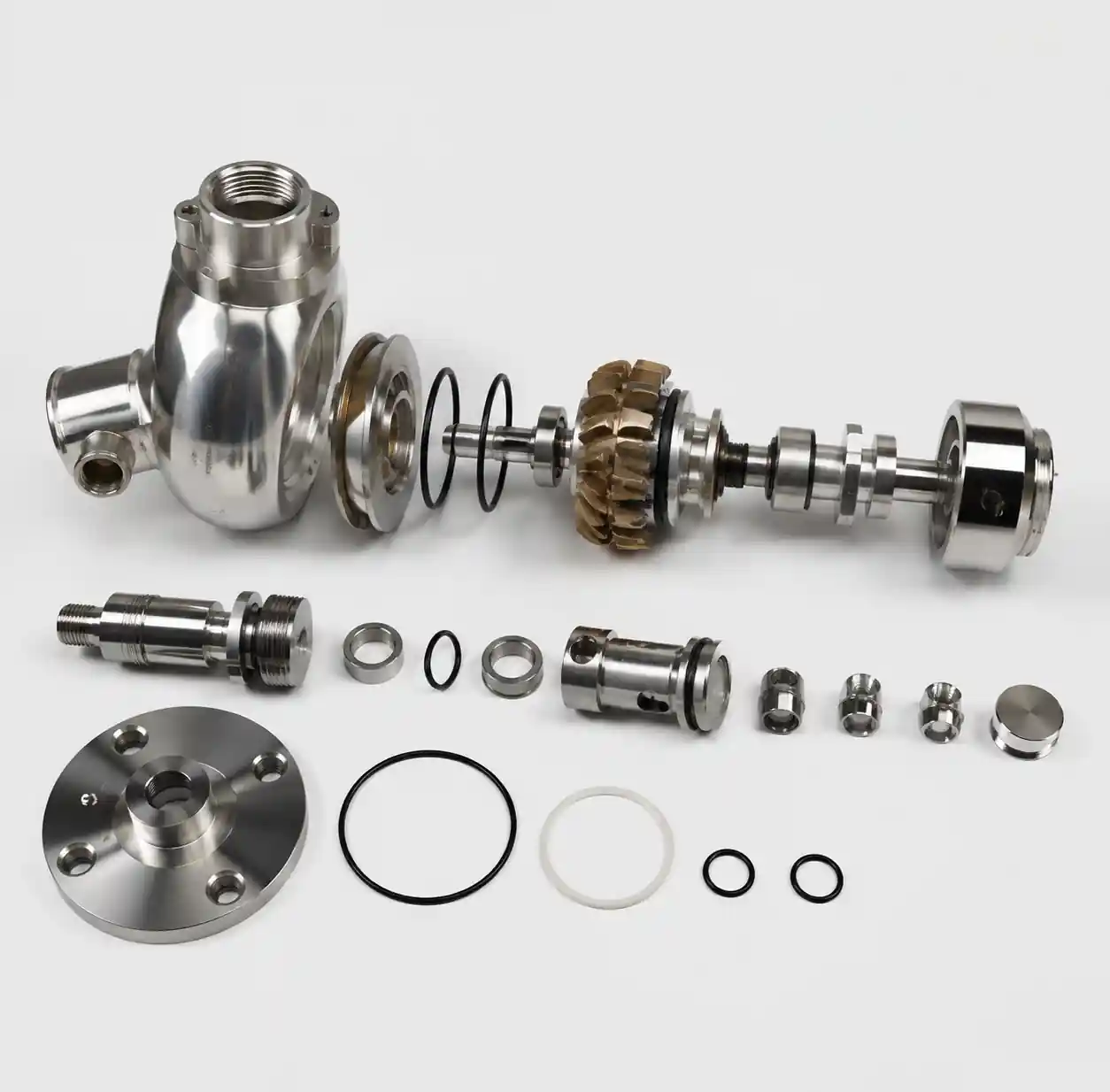 Exploded view showing all components of rotary tank cleaning nozzle
Worn jets, damaged seals, or corroded gears degrade performance. Regular inspection maintains optimal function.
Exploded view showing all components of rotary tank cleaning nozzle
Worn jets, damaged seals, or corroded gears degrade performance. Regular inspection maintains optimal function.
Pressure and Flow Requirements
Minimum Pressure: 15-30 PSI (1-2 bar). Below this, rotation and jet velocity are insufficient.
Optimal Range: 40-80 PSI (3-5.5 bar) for standard units—consistent speed, effective impact, economical water use, normal wear.
Flow Rate Guideline: 0.5-1.5 GPM per m³ of tank volume.
| Tank Volume | Flow Rate | Pressure | Cycle Time |
|---|---|---|---|
| 1-5 m³ | 3-8 GPM | 40-60 PSI | 3-8 min |
| 5-20 m³ | 8-20 GPM | 45-70 PSI | 5-12 min |
| 20-100 m³ | 20-50 GPM | 50-80 PSI | 8-20 min |
| 100-500 m³ | 50-150 GPM | 60-90 PSI | 15-40 min |
Actual values vary by soil type, chemistry, temperature, and standards.
Rotary Jet Heads vs. Rotary Spray Balls
Rotary Jet Heads
High-velocity jets in programmed patterns. Superior against baked-on residues and biofilms.
Pros: High impact, 50-90% less water, faster cycles, better complex geometry coverage, lower chemical use, validated patterns.
Cons: Higher cost, moving parts need maintenance, particle-sensitive, requires minimum pressure.
Preferred for food, pharma, biotech. See tank cleaning nozzles.
Rotary Spray Balls
Multiple fixed orifices, 360° spray as ball rotates. Relies on chemical action and dwell time.
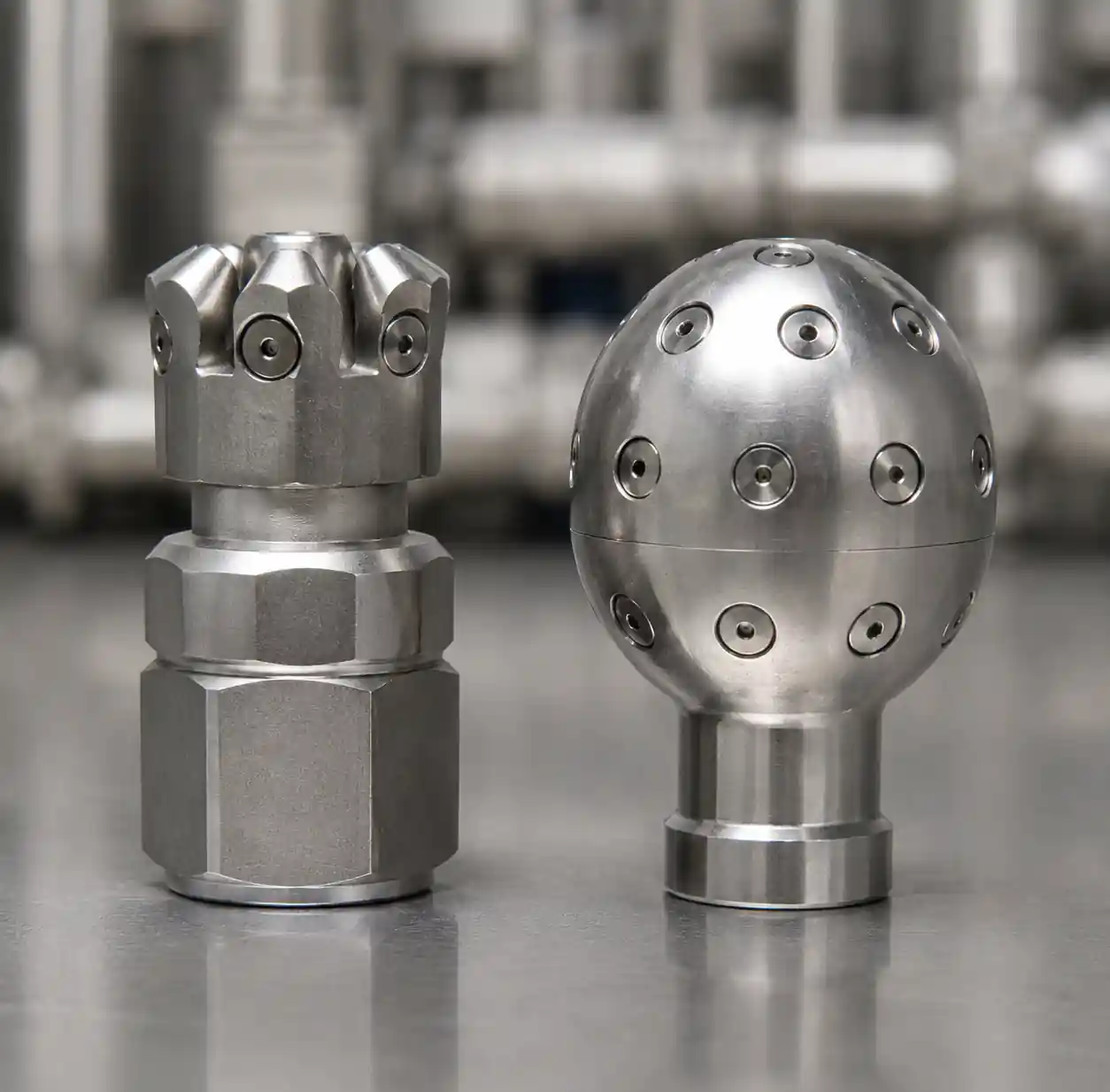 Side-by-side comparison of rotary jet head and rotary spray ball
Pros: Lower cost, simple, minimal maintenance, works at low pressure, gentle.
Side-by-side comparison of rotary jet head and rotary spray ball
Pros: Lower cost, simple, minimal maintenance, works at low pressure, gentle.
Cons: Higher water/chemical use, longer cycles, less effective on stubborn soils, random patterns hard to validate, limited in complex geometries.
Choose Jet Heads when validation, water conservation, heavy soiling, cycle speed, or complex geometry matters. Choose Spray Balls for light duty, rinsing, budget constraints, or simple tanks. Jet heads typically pay back in 12-24 months via operational savings.
Maintenance Requirements and Best Practices
Daily: Visual inspection, verify rotation, check spray pattern, monitor pressure/flow.
Weekly: Inspect/clean jets, clean filters, check mounting, document changes.
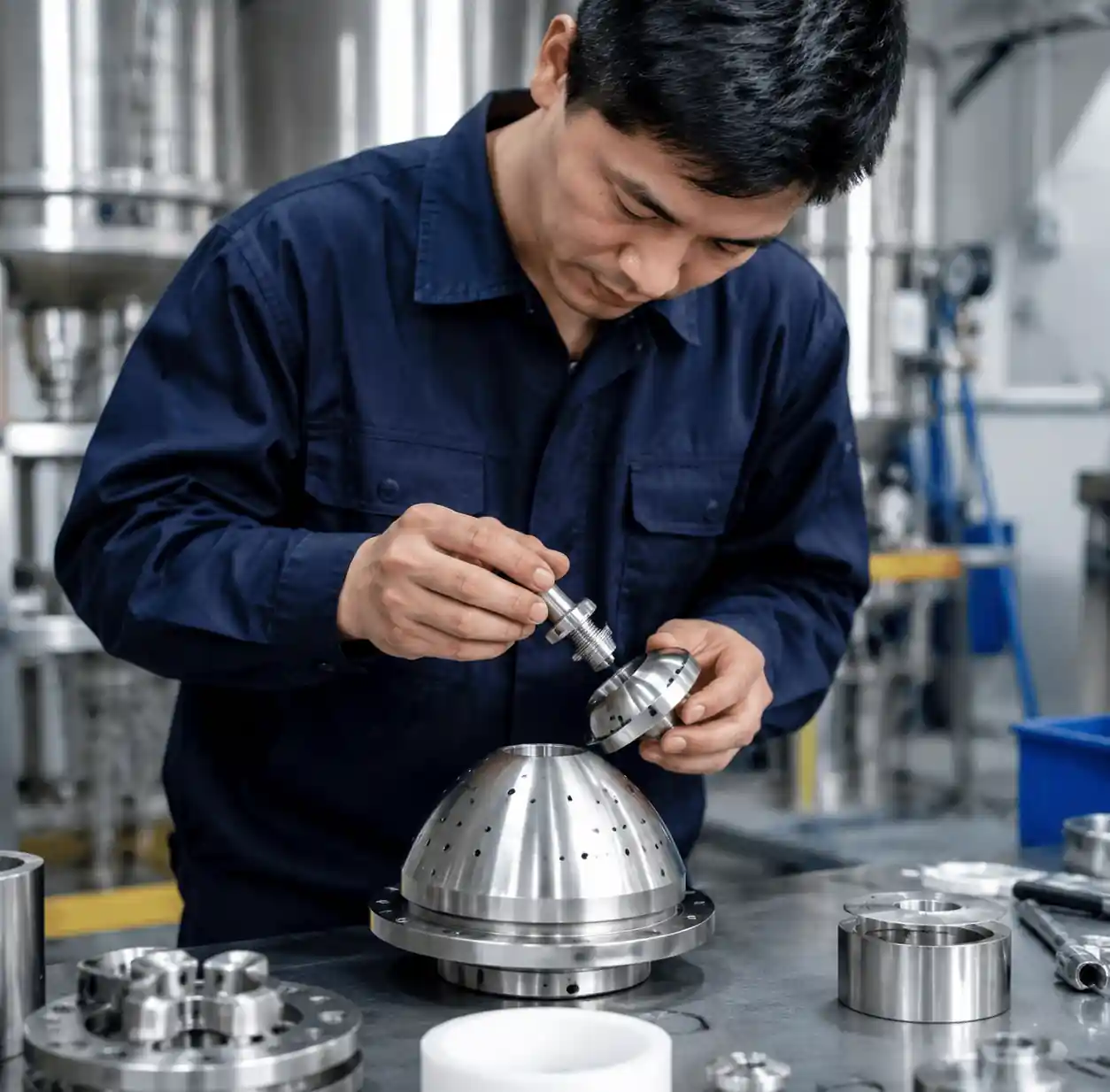 Technician performing maintenance inspection on rotary nozzle
Monthly: Disassemble, inspect gears/bearings/seals, measure orifice erosion, lubricate, test speed/indexing.
Technician performing maintenance inspection on rotary nozzle
Monthly: Disassemble, inspect gears/bearings/seals, measure orifice erosion, lubricate, test speed/indexing.
Quarterly: Replace seals/wear parts, validation tests, calibrate, update records.
Key Tasks:
- Jet Cleaning: Soak in appropriate solution, use soft brushes only.
- Seal Replacement: Replace at first leak, use compatible materials.
- Bearing Maintenance: Inspect for corrosion/galling; lubricate per spec.
- Gear Inspection: Check for tooth wear/chipping; replace damaged gears.
Best Practices: Install 100-200 mesh filters, operate within specs, use compatible chemicals, never dry-run, store clean/dry, keep maintenance records.
Our accessories support comprehensive programs.
Common Issues and Troubleshooting
Nozzle Won't Rotate: Check pressure/flow first. If adequate, disassemble and inspect for obstructions, corrosion, or damage.
Slow/Inconsistent Rotation: Clean filters, check for air leaks, inspect gears/turbine blades, verify seals aren't over-tightened.
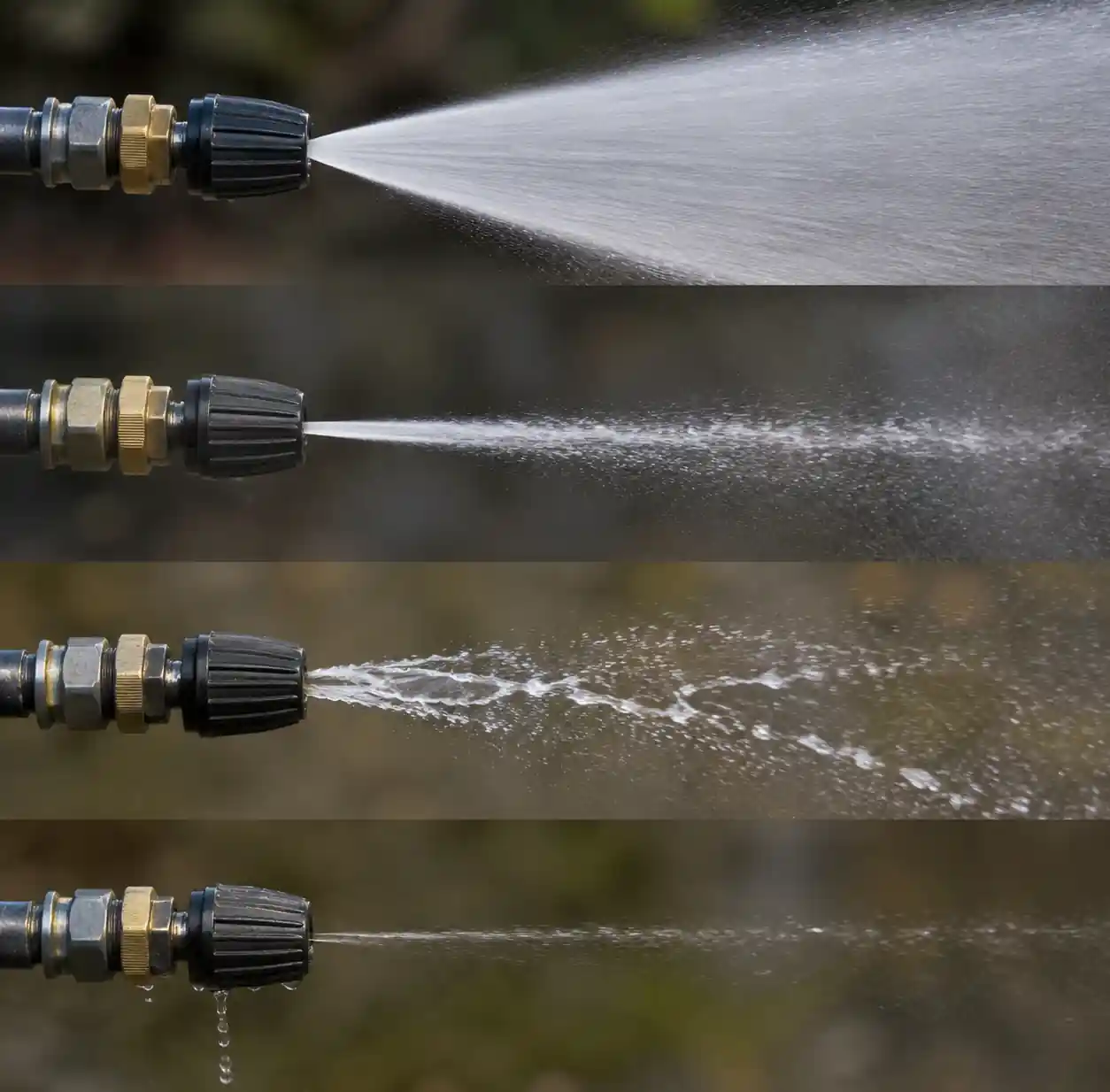 Comparison showing normal versus problematic spray patterns
Weak/Uneven Spray: Clean or replace jets, verify pressure, confirm jet size is correct for application.
Comparison showing normal versus problematic spray patterns
Weak/Uneven Spray: Clean or replace jets, verify pressure, confirm jet size is correct for application.
Leaking Seals: Replace with compatible materials, check sealing surfaces, verify torque.
Incomplete Coverage: Verify nozzle position, map spray pattern, adjust pressure/flow for speed, consider multiple nozzles or repositioning obstructions.
FAQ
How long does a rotary nozzle last? 3-5 years typical with maintenance; 1-2 years in high-wear; 10+ years in gentle applications.
Can it handle hot solutions? Yes, up to 80-95°C standard, 150°C for high-temp models. Verify material compatibility.
CIP vs. manual cleaning? CIP with rotary nozzles is more consistent, reaches inaccessible areas, eliminates operator variability and human entry.
How to size a nozzle? Use manufacturer charts. For standard tanks (L/D 1:1-3:1), use 0.7-1.2 GPM per m³. Complex tanks may need multiple units.
Chemical compatibility? Works with most aqueous solutions but verify materials against your specific chemicals, concentrations, and temperatures.
Water savings vs. spray balls? 50-90% less water—a spray ball may use 200 gal/cycle vs. 30-50 gal for a rotary jet head.
Minimum pressure? 15-30 PSI to start; optimal 40-80 PSI; heavy-duty up to 150 PSI. Below minimum = poor rotation; above max = accelerated wear.
Retrofit existing spray balls? Usually yes if mounting is compatible. Verify pump can deliver required pressure/flow; update PLC timing. Payback typically within first year.
Conclusion
Rotary tank cleaning nozzles convert fluid pressure into programmed rotational patterns for thorough, repeatable cleaning without confined-space entry. Understanding gear-driven indexing, 3D coverage, and pressure/flow requirements enables optimal selection and maintenance.
Choosing between jet heads and spray balls affects cost and efficiency—jet heads save water and time, justifying higher initial investment in demanding applications. Regular maintenance extends life and validates cleaning effectiveness.
Explore our industrial spray nozzles and tank cleaning solutions to optimize your operations.