



Hose Reel Selection Guide for Industrial Facilities
Industrial facilities rely on efficient fluid handling systems to maintain productivity, safety, and operational excellence. Hose reels play a critical role in organizing air, water, chemical, and hydraulic hose systems across manufacturing plants, warehouses, food processing facilities, and chemical plants. Studies show that poorly managed hose systems can reduce equipment lifespan by up to 40% while creating significant safety hazards through trip risks and equipment damage. Selecting the right hose reel configuration based on application requirements, pressure ratings, hose diameter, and environmental conditions directly impacts facility safety, maintenance costs, and operational efficiency.
Table of Contents
- 1. What Are Industrial Hose Reels?
- 2. Hose Reel Types According to Retraction Mechanism
- 2.1. Spring-Driven Retractable Reels
- 2.2. Motor-Driven Power Rewind Reels
- 2.3. Manual Hand-Crank Reels
- 3. Hose Reel Types According to Mounting Configuration
- 3.1. Wall-Mount Fixed Reels
- 3.2. Ceiling-Mount Suspended Reels
- 3.3. Portable Cart-Mount Reels
- 3.4. Truck/Vehicle-Mount Reels
- 4. Critical Selection Criteria for Industrial Hose Reels
- 4.1. Hose Diameter and Length Capacity
- 4.2. Pressure Rating Requirements
- 4.3. Material Construction and Corrosion Resistance
- 4.4. Swivel Joint Configuration
- 5. Application-Specific Hose Reel Solutions
- 5.1. Food Processing and Washdown Applications
- 5.2. Chemical Transfer and Processing
- 5.3. Compressed Air Distribution Systems
- 5.4. High-Pressure Hydraulic Systems
- 6. Installation and Safety Considerations
- 6.1. Mounting and Structural Requirements
- 6.2. Proper Hose Selection and Connection
- 6.3. Maintenance and Inspection Protocols
- 7. Selecting the Right Hose Reel for Your Facility
- 8. Frequently Asked Questions
- 8.1. What pressure rating do I need for my industrial hose reel?
- 8.2. How do I determine the correct hose length capacity?
- 8.3. What material should I choose for chemical applications?
- 8.4. Can I mount a hose reel outdoors?
- 8.5. How often should I replace industrial hoses on reels?
- 8.6. What clearance do I need around a wall-mount reel?
- 9. Conclusion
What Are Industrial Hose Reels?
Industrial hose reels are mechanical devices designed to store, protect, and dispense hoses for air, water, hydraulic fluid, chemicals, and other industrial fluids. A hose reel consists of a drum or spool mounted on a frame with a retraction mechanism—either spring-driven, motor-driven, or hand-crank operated. The reel keeps hoses organized, prevents kinking and tangling, protects hoses from environmental damage, and extends service life by minimizing abrasion and UV exposure.
You can specify hose reels for compressed air distribution, washdown operations, chemical transfer, hydraulic systems, lubrication applications, and pressure washing. Industrial-grade reels are built with heavy-duty steel or stainless steel construction to withstand harsh environments, high pressures up to 5000 PSI, and extreme temperatures from -40°F to 300°F.
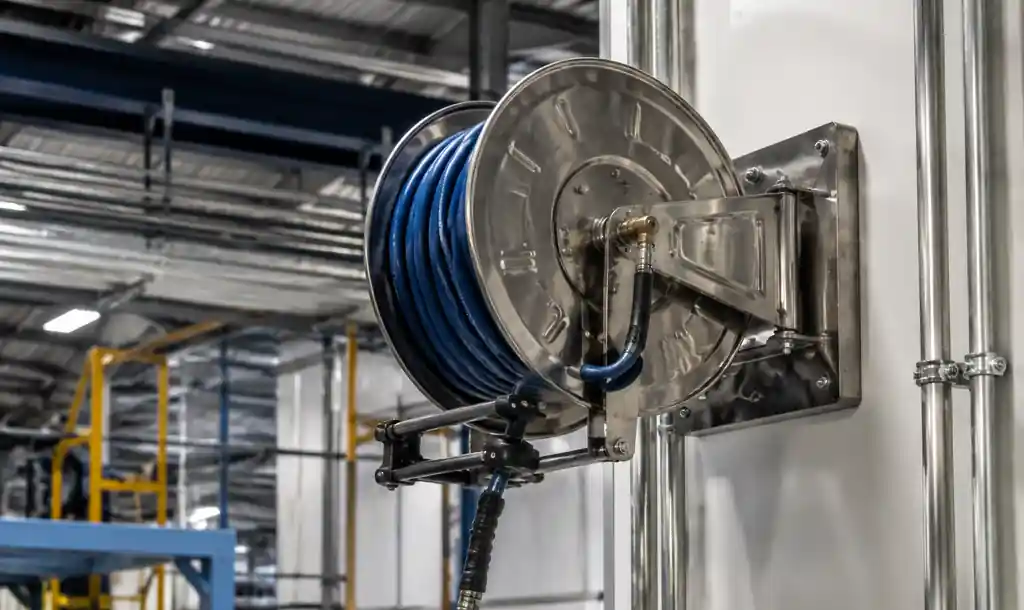 Industrial hose reel mounted on factory wall with organized hose storage
Hose Reel Types According to Retraction Mechanism
Spring-Driven Retractable Reels
Spring-driven reels use a constant-force spring mechanism to automatically retract the hose after use. The spring provides smooth, controlled retraction at speeds typically ranging from 3 to 8 feet per second. This mechanism eliminates manual winding, reduces labor time, and ensures consistent hose storage. Spring-driven reels are rated for hoses up to 100 feet in length and diameters from 1/4" to 1" depending on the reel capacity.
You should specify spring-driven reels for applications requiring frequent hose deployment and retraction, such as washdown stations, compressed air tools, and lubrication systems. The automatic retraction improves workplace safety by eliminating loose hoses on floors and reduces hose damage from dragging or improper coiling.
 Spring-driven retractable hose reel being used in industrial washdown application
Motor-Driven Power Rewind Reels
Motor-driven reels incorporate electric or pneumatic motors to retract heavy, long-length hoses that exceed spring-reel capacity. These reels handle hoses up to 400 feet long and diameters up to 2 inches, with retraction speeds controlled electronically for smooth operation under load. Motor-driven systems prevent slack accumulation and maintain proper hose tension during retraction.
Specify motor-driven reels for heavy-duty applications including high-pressure washdown (3000+ PSI), chemical transfer lines, hydraulic systems in industrial equipment, and any application where hose weight or length makes spring retraction impractical. These reels typically operate on 115V AC, 230V AC, or compressed air at 80-100 PSI.
Manual Hand-Crank Reels
Manual hand-crank reels use a simple mechanical crank handle to wind and unwind hoses. These reels are the most economical option and provide precise control over hose deployment speed. They require no power source and feature robust construction with minimal moving parts for long-term reliability.
You can use hand-crank reels for applications with infrequent hose deployment, static installations where hoses remain extended for long periods, or environments where automatic retraction is not required. Common applications include seasonal irrigation systems, infrequent chemical transfer operations, and backup washdown systems.
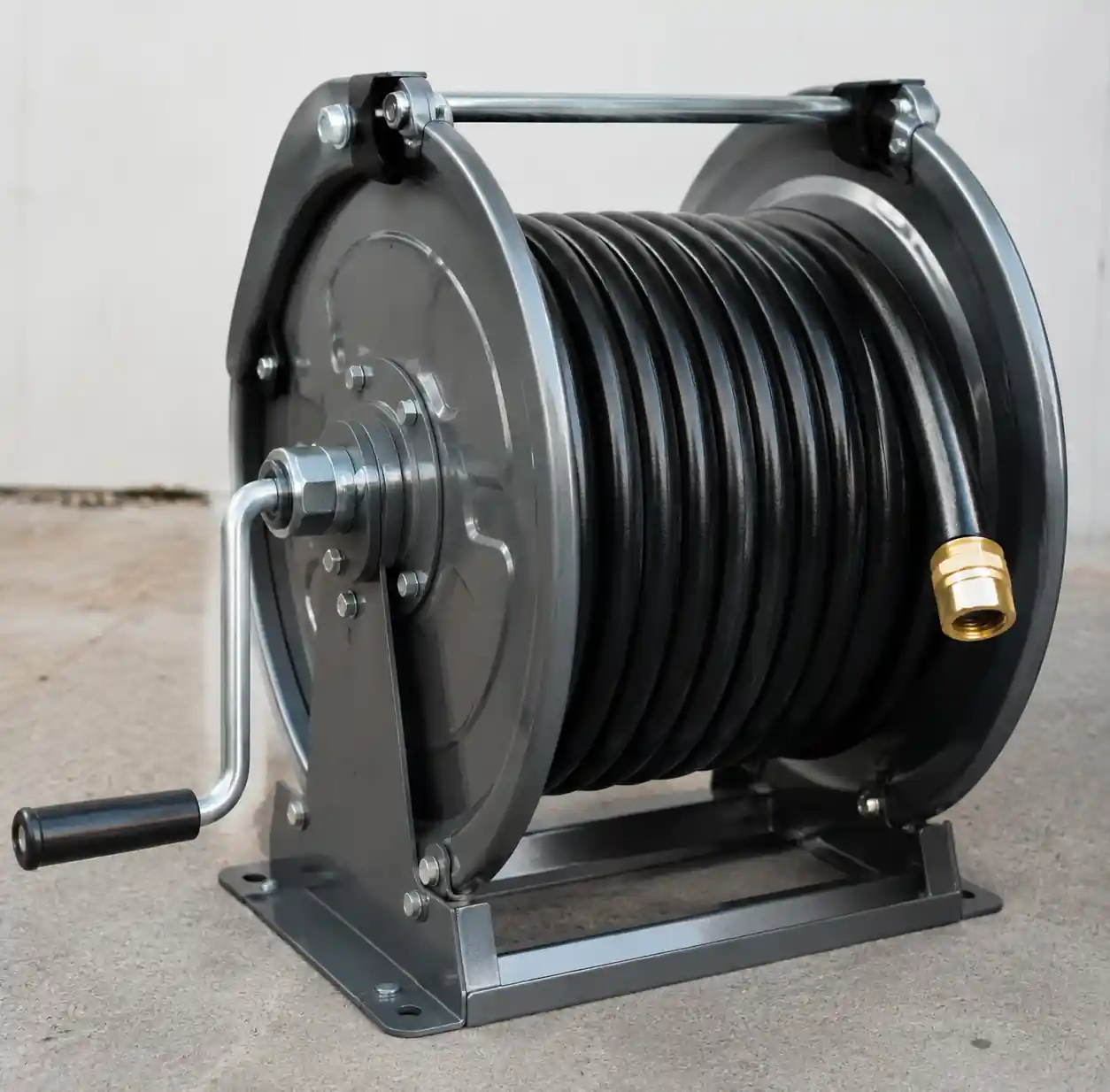 Manual hand-crank industrial hose reel with crank handle mechanism
Hose Reel Types According to Mounting Configuration
Wall-Mount Fixed Reels
Wall-mount reels bolt directly to walls or structural supports, providing a permanent, space-saving installation. These reels typically swivel 180° to 270° horizontally, allowing operators to access multiple work areas from a single fixed position. Wall-mount configurations work best for stationary applications with defined work zones.
Specify wall-mount reels for washdown stations in food processing plants, compressed air distribution in manufacturing cells, lubrication systems at fixed equipment locations, and chemical transfer points at tank farms. Mounting height should position the reel between 4 to 8 feet above floor level for ergonomic hose access.
Ceiling-Mount Suspended Reels
Ceiling-mount reels suspend from overhead structures, keeping hoses completely off the floor and maximizing available work space. These reels typically incorporate 360° swivel capabilities and adjustable drop lengths to serve large work areas. The suspended configuration prevents trip hazards and protects hoses from floor traffic and equipment movement.
You should use ceiling-mount reels in warehouses, automotive service bays, aircraft maintenance hangars, and any facility where floor space is at a premium. The reel must mount to structural members capable of supporting the combined weight of the reel, hose, and working loads—typically 200 to 600 pounds depending on hose size.
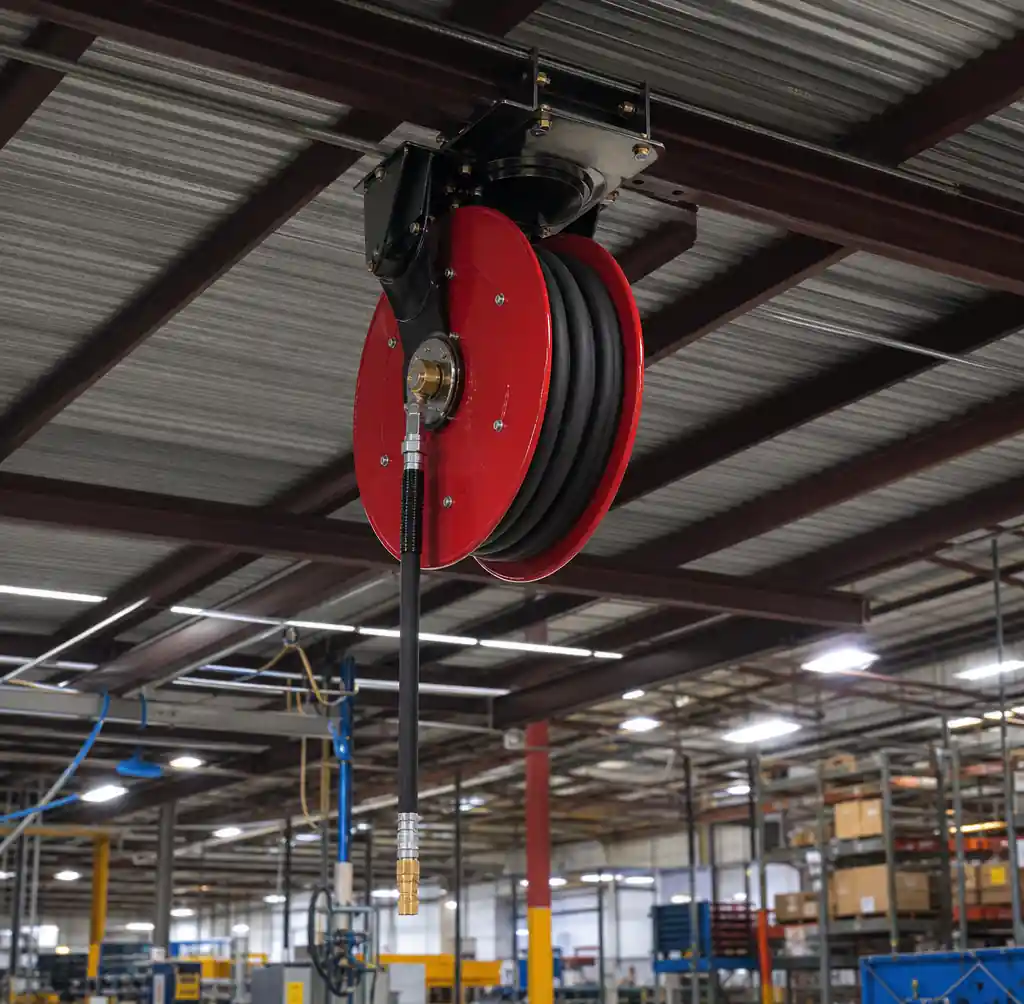 Ceiling-mounted suspended hose reel installation in warehouse facility
Portable Cart-Mount Reels
Portable reels mount on wheeled carts or trailers, providing mobility for applications requiring hose deployment at multiple locations. These reels feature robust frames with pneumatic or solid rubber tires and often include storage compartments for accessories. The cart design allows one operator to transport the complete hose system between work areas.
Specify portable cart-mount reels for facility maintenance operations, pressure washing services, chemical spraying in agriculture, and any application requiring hose deployment across large areas or multiple buildings. Ensure cart reels include locking mechanisms to prevent movement during operation.
Truck/Vehicle-Mount Reels
Truck-mount reels install on service vehicles, utility trucks, and mobile equipment for industrial service operations. These reels feature reinforced mounting brackets designed to withstand vehicle vibration, shock loading, and weather exposure. Many truck-mount reels include powered rewind operated from the vehicle's electrical or hydraulic system.
You can use truck-mount reels for mobile pressure washing services, field service vehicles, agricultural spraying equipment, and industrial maintenance trucks. Mount location must provide adequate clearance for hose deployment while maintaining vehicle stability and weight distribution.
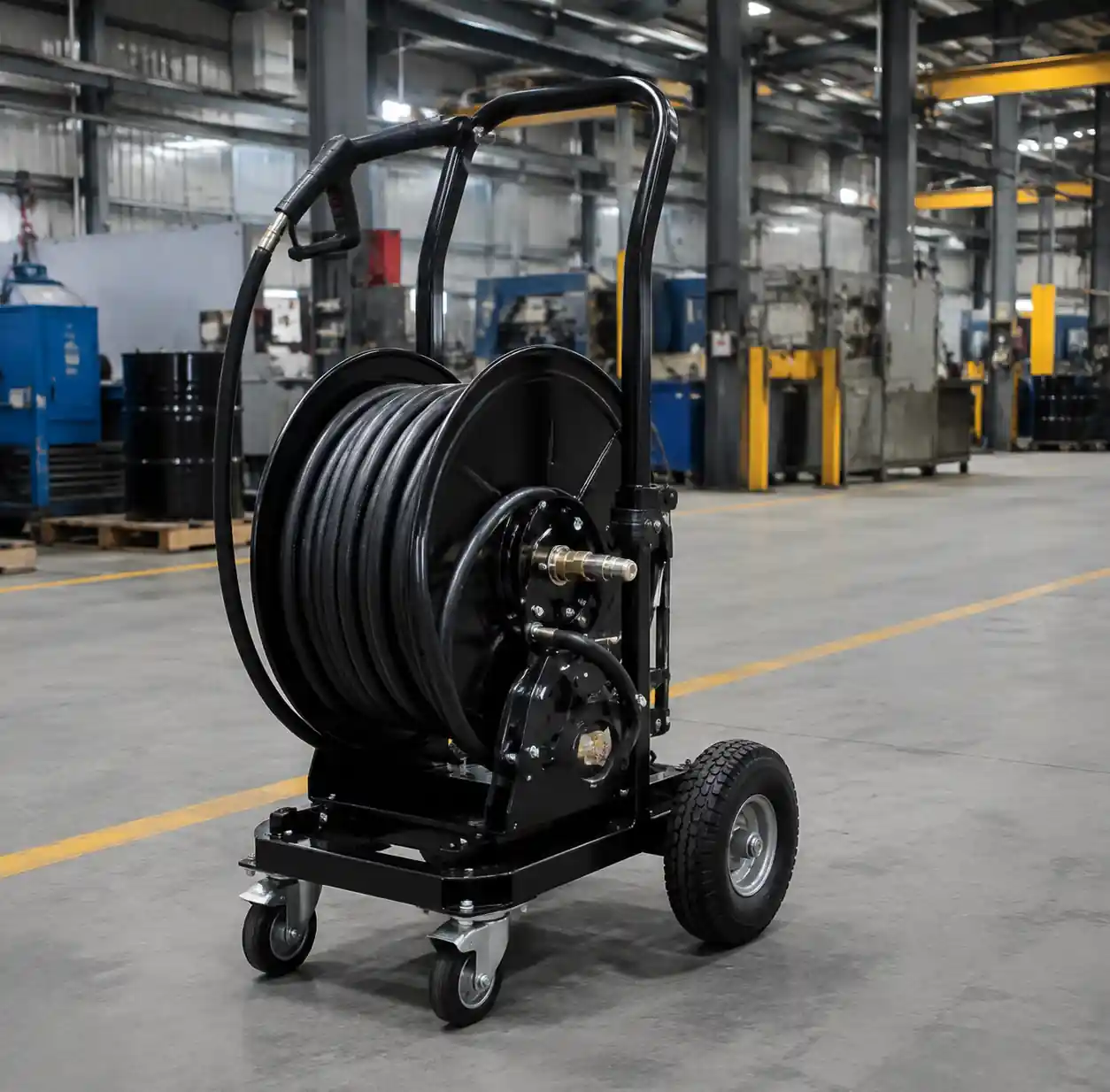 Portable cart-mounted hose reel on wheels for mobile applications
Critical Selection Criteria for Industrial Hose Reels
Hose Diameter and Length Capacity
Reel capacity must match your hose specifications precisely. Undersized reels cause hose binding, while oversized reels waste space and increase costs. Standard industrial reels accommodate hose diameters from 1/4" to 2" and lengths from 25 to 400 feet.
| Hose Diameter | Maximum Length (Spring Reel) | Maximum Length (Motor Reel) | Typical Applications |
|---|---|---|---|
| 1/4" | 75-100 ft | 150-200 ft | Air tools, lubrication |
| 3/8" | 50-75 ft | 100-150 ft | Air tools, light washdown |
| 1/2" | 35-50 ft | 75-125 ft | Water, compressed air |
| 5/8" | 25-35 ft | 50-100 ft | Washdown, pressure washing |
| 3/4" | 20-30 ft | 40-75 ft | Heavy washdown, hydraulics |
| 1" | 15-25 ft | 30-60 ft | Chemical transfer, hydraulics |
Pressure Rating Requirements
Reel pressure ratings must exceed your system's maximum operating pressure with appropriate safety factors. Industrial reels are rated from 300 PSI for low-pressure water applications to 5000 PSI for high-pressure hydraulic and pressure washing systems.
You should verify that both the reel body and the swivel joint meet pressure requirements. The swivel joint is typically the limiting component and must maintain seal integrity under continuous pressure cycling. For pressure washing applications operating at 3000-4000 PSI, specify reels rated for 5000 PSI working pressure to ensure reliability.
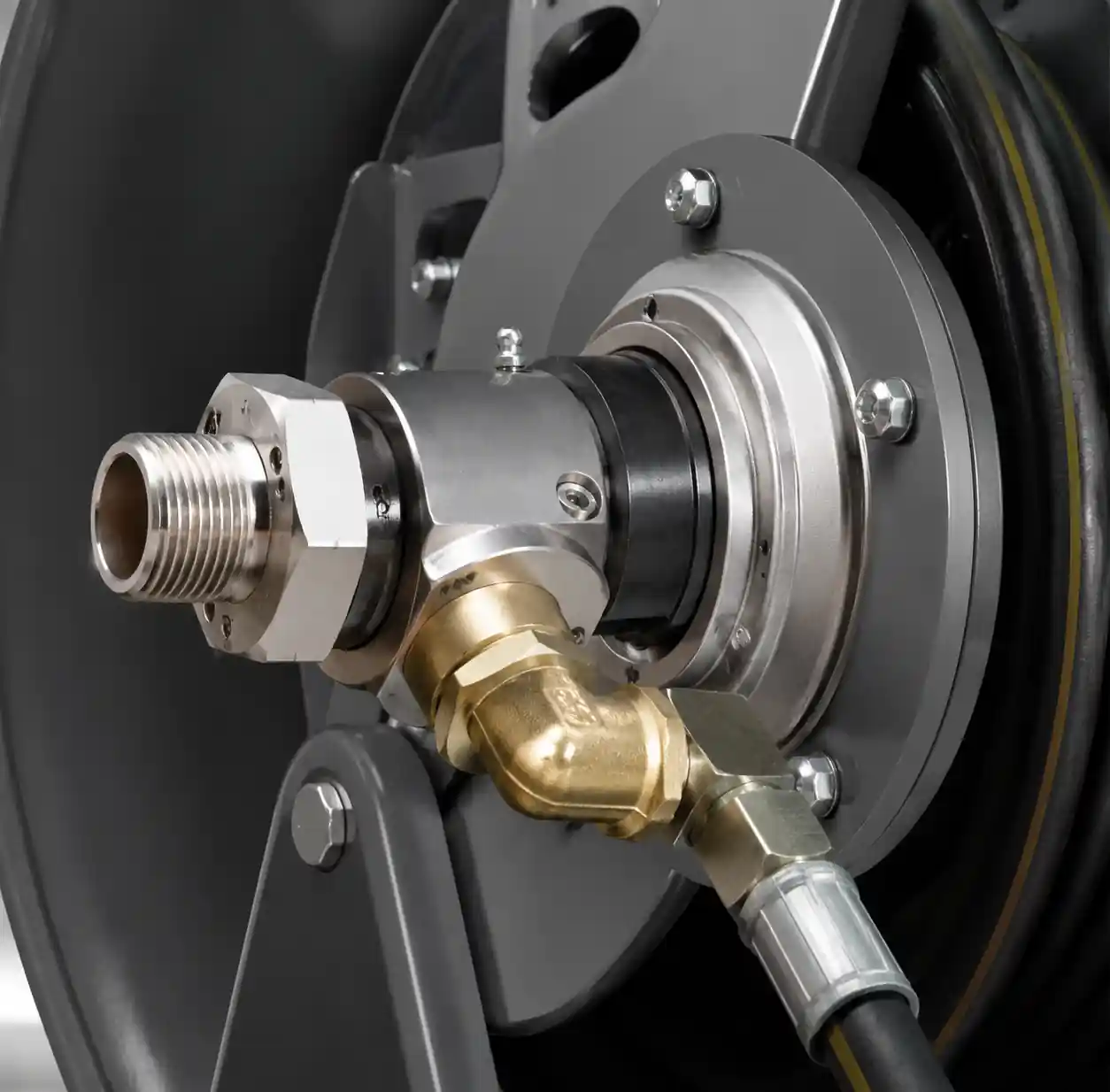 Close-up of high-pressure hose reel swivel joint and connection fittings
Material Construction and Corrosion Resistance
Material selection depends on your operating environment and fluid compatibility. Carbon steel reels with powder-coat or epoxy finishes work well for general industrial environments with low corrosion exposure. Stainless steel 304 or 316 construction is required for food processing, pharmaceuticals, chemical plants, coastal facilities, and washdown applications.
| Material | Corrosion Resistance | Temperature Range | Typical Applications | Cost Factor |
|---|---|---|---|---|
| Carbon Steel (Painted) | Moderate | -20°F to 200°F | Dry environments, compressed air | 1.0x |
| Powder-Coated Steel | Good | -20°F to 250°F | General industrial, light chemicals | 1.2x |
| Stainless Steel 304 | Excellent | -40°F to 300°F | Food processing, washdown | 2.0x |
| Stainless Steel 316 | Superior | -40°F to 400°F | Chemical, marine, pharmaceutical | 2.5x |
| Aluminum | Good | -40°F to 250°F | Portable applications, weight-critical | 1.8x |
Swivel Joint Configuration
The swivel joint connects the hose to the reel inlet and allows rotation during hose deployment and retraction. Industrial swivel joints use sealed ball bearing or roller bearing designs with multiple O-ring seals to prevent leakage. Dual-swivel configurations provide 360° rotation without twisting the supply line.
Specify swivel joints with at least two seal stages for chemical and hydraulic applications. For food-grade and pharmaceutical applications, use stainless steel swivels with FDA-approved seals. High-pressure applications (2000+ PSI) require hardened steel swivels with reinforced seal glands.
Application-Specific Hose Reel Solutions
Food Processing and Washdown Applications
Food processing facilities require reels that meet FDA sanitary standards with stainless steel 304 or 316 construction. Washdown reels must handle hot water up to 180°F, cleaning chemicals, and frequent high-pressure use (500-1500 PSI). Smooth surfaces without crevices prevent bacterial growth and facilitate cleaning.
You should position washdown reels every 50-75 feet to provide complete facility coverage. Mount reels 5-6 feet above floor level to keep hoses above splash zones. Specify reels with open drum designs that allow complete drainage and prevent water accumulation.
Chemical Transfer and Processing
Chemical transfer reels must provide compatibility with corrosive, flammable, and toxic fluids. Stainless steel 316 construction with PTFE or Viton seals ensures chemical resistance across a broad range of compounds. Bonding and grounding provisions prevent static electricity buildup during fluid transfer.
Specify closed drum designs to contain spills and protect operators from chemical exposure. Include secondary containment trays under reel mounting locations. For flammable chemicals, use explosion-proof motors and electrically grounded components meeting NEC Class I Division 1 or 2 requirements.
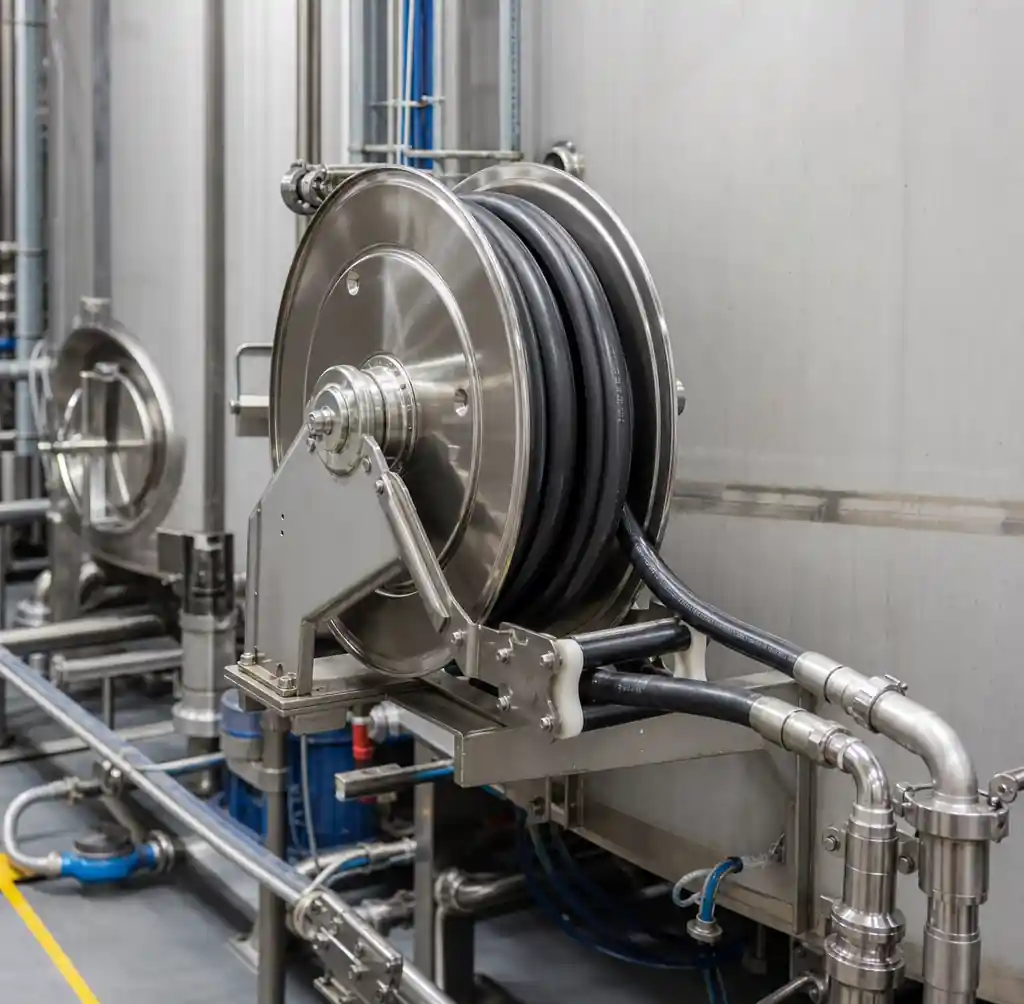 Stainless steel hose reel for chemical transfer applications in processing plant
Compressed Air Distribution Systems
Compressed air reels distribute pneumatic power to tools, equipment, and process systems. These reels handle pressures from 90 to 300 PSI with hose diameters of 1/4" to 1/2". Spring-driven retraction provides quick tool changes and maintains organized hose storage.
You can install multiple air reels throughout a facility to eliminate dragging long air hoses across work areas. Position reels within 25-35 feet of typical tool use locations. Include inline pressure regulators and moisture filters at each reel to protect pneumatic tools and maintain consistent air quality.
High-Pressure Hydraulic Systems
Hydraulic reels serve mobile equipment, industrial machinery, and power units operating at 2000-5000 PSI. These heavy-duty reels feature reinforced drums, high-pressure swivels with multiple seal stages, and robust mounting brackets to handle hydraulic loads and shock.
Specify motor-driven retraction for hydraulic hoses exceeding 50 feet or 3/4" diameter. Mount reels to structural steel with vibration-isolating hardware. Include pressure relief provisions in the hydraulic circuit to protect the reel and hose during pressure spikes.
Installation and Safety Considerations
Mounting and Structural Requirements
Reel mounting must support the combined weight of the reel, hose, and working loads. Wall-mount reels require backing plates or mounting to structural members—never mount to drywall or thin sheet metal. Use minimum 3/8" mounting bolts with lock washers and verify that mounting surfaces can support dynamic loads during hose deployment.
You should position reels to minimize hose travel distance while avoiding interference with doors, equipment, and traffic patterns. Maintain clearance around reels for hose deployment—typically 3-4 feet minimum. Ensure supply line connections include shut-off valves within reach of operators for emergency isolation.
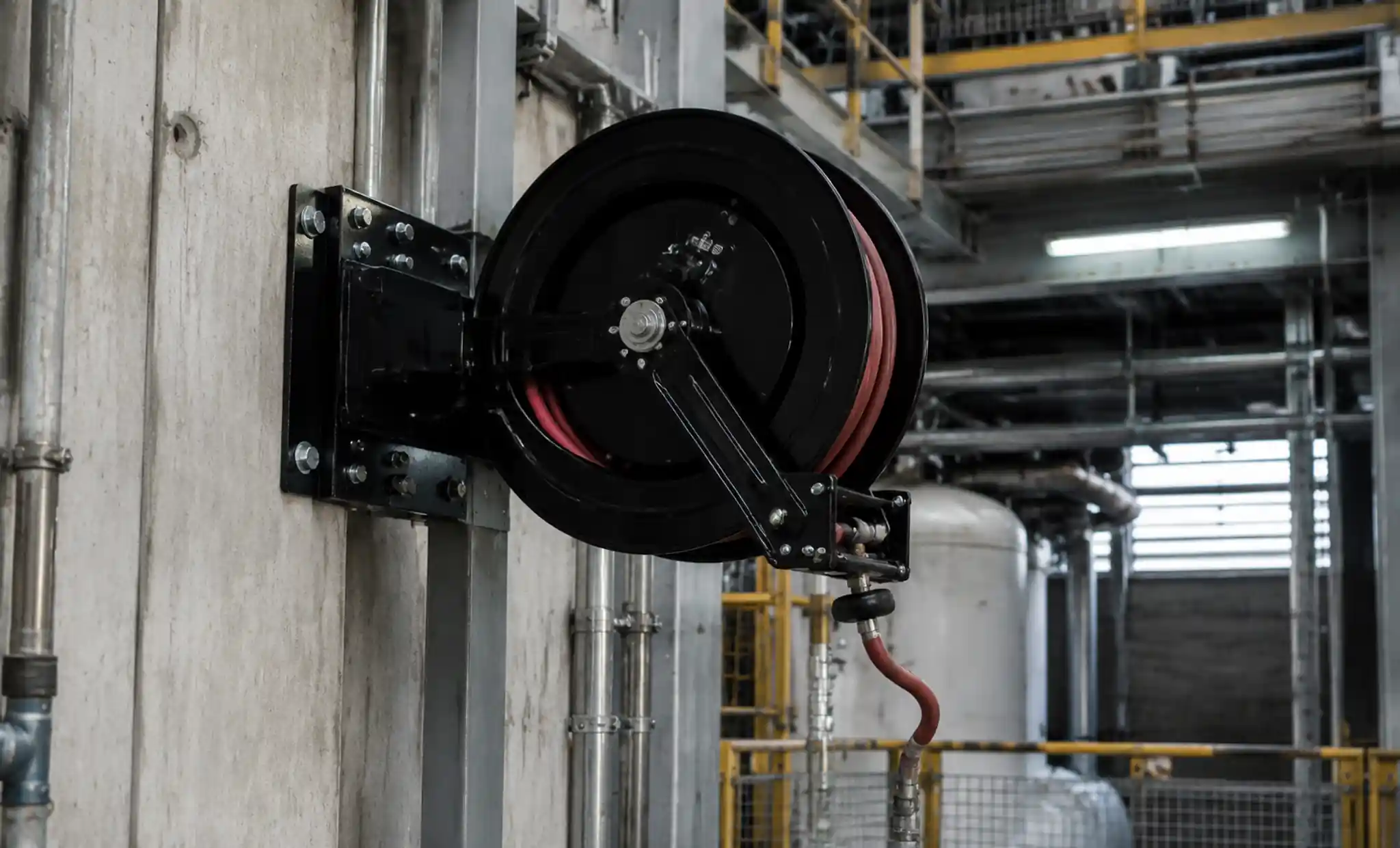 Proper hose reel wall mounting installation showing structural support and brackets
Proper Hose Selection and Connection
Match hose specifications to both the reel capacity and application requirements. Use hoses rated for 2-4 times the normal operating pressure to account for pressure spikes. Include proper strain relief at both the reel connection and tool end to prevent premature failure.
Verify that hose fittings match the reel inlet and outlet connections—common threads include NPT, BSPT, and JIC hydraulic fittings. Use thread sealant compatible with the fluid being conveyed. For chemical applications, verify that the hose inner tube, reinforcement, and cover all provide chemical compatibility.
Maintenance and Inspection Protocols
Establish routine inspection schedules to verify reel operation, check for leaks, and assess hose condition. Monthly inspections should include testing the retraction mechanism, checking swivel joint for leakage, inspecting hose for abrasion or cracking, and verifying mounting bolts remain tight.
You should replace hoses showing any signs of degradation including surface cracking, soft spots, exposed reinforcement, or end fitting damage. Lubricate swivel joints quarterly using food-grade lubricants for food processing applications and standard bearing grease for industrial applications. Maintain manufacturer-recommended spring tension and motor operation per service manuals.
Selecting the Right Hose Reel for Your Facility
Start by documenting your application requirements including fluid type, pressure, flow rate, hose diameter, required length, and deployment frequency. Assess your mounting options based on available space, structural support, and work area layout. Determine environmental factors such as temperature extremes, chemical exposure, and sanitation requirements.
Compare reel specifications from established manufacturers known for industrial-grade construction and parts availability. Evaluate total cost of ownership including initial purchase price, installation costs, expected service life, and maintenance requirements. Consider reels with modular designs that allow component replacement rather than complete reel replacement at end of life.
Verify that selected reels meet applicable industry standards such as ASME B30.35 for safety, NFPA standards for chemical applications, and FDA requirements for food contact surfaces. Request documentation including pressure test certificates, material certifications, and dimensional drawings for installation planning.
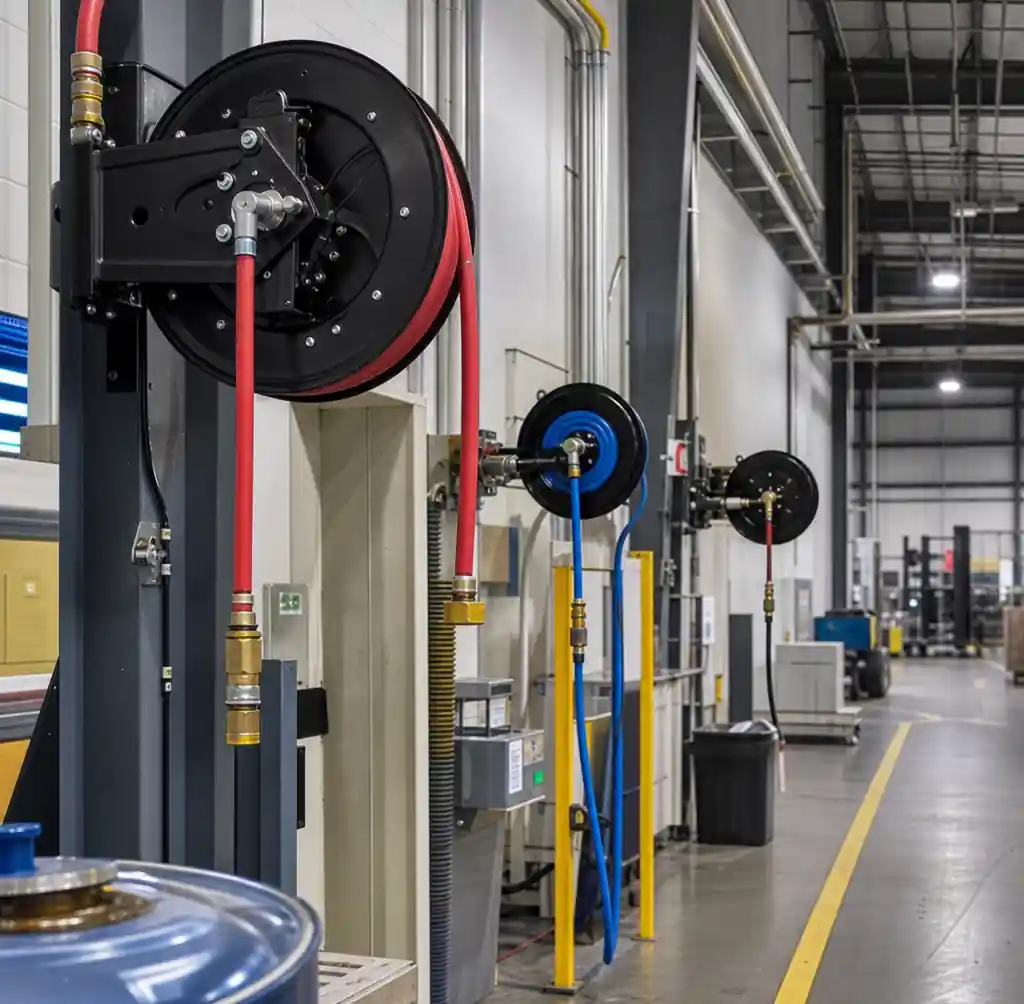 Multiple industrial hose reels organized along facility wall for efficient operations
Frequently Asked Questions
What pressure rating do I need for my industrial hose reel?
Select a reel rated for at least 150% of your maximum system operating pressure. For example, if your washdown system operates at 1200 PSI, specify a reel rated for 1800-2000 PSI minimum. High-pressure applications above 2500 PSI should use reels rated for 5000 PSI to ensure long-term seal integrity and safety.
How do I determine the correct hose length capacity?
Measure the maximum distance from the reel mounting location to the farthest work point, then add 15-20 feet for hose handling and connection slack. Account for vertical drops if the reel mounts above work level. Avoid excessive hose length which adds weight, increases pressure drop, and makes handling more difficult.
What material should I choose for chemical applications?
Stainless steel 316 provides the broadest chemical compatibility for acidic and caustic solutions. Verify that all wetted components including swivel seals, bearings, and fasteners are also chemically compatible. For specific chemicals, consult a chemical compatibility chart matching your exact compound to reel materials.
Can I mount a hose reel outdoors?
Yes, but specify reels designed for outdoor service with weather-resistant finishes, sealed bearings, and UV-resistant components. Stainless steel construction performs best in outdoor environments. Provide protection from direct weather exposure when possible. Cold climates may require heated enclosures to prevent freezing.
How often should I replace industrial hoses on reels?
Inspect hoses monthly and replace when showing surface cracking, abrasion through the cover layer, soft or hard spots, or any fitting damage. Typical service life ranges from 1-3 years for high-use applications to 5+ years for occasional-use applications. Maintain replacement records to identify problematic applications.
What clearance do I need around a wall-mount reel?
Maintain 3-4 feet of clearance in front of the reel for hose deployment and operator access. Provide 6-12 inches of side clearance on each side. Verify that the hose has adequate space to deploy without contacting nearby equipment, corners, or doorways. Check manufacturer specifications for specific models.
Conclusion
Selecting the right industrial hose reel requires careful analysis of your application requirements, operating environment, and safety considerations. Proper reel selection based on hose diameter, pressure rating, mounting configuration, and material construction ensures reliable operation, extended equipment life, and improved workplace safety. Understanding the differences between spring-driven, motor-driven, and manual reels helps you match the technology to your deployment frequency and hose specifications.
If you need high-quality hose reel systems and spray nozzle solutions for your industrial facility, YuechenPrecision Technology offers comprehensive fluid handling products engineered for demanding industrial applications. Our extensive product range covers compressed air distribution, washdown systems, chemical transfer, and hydraulic applications with proven performance across food processing, manufacturing, chemical plants, and warehouse operations. We provide technical support for system design, product selection, and custom configurations to meet your specific requirements.
Contact us today for expert guidance on hose reel selection, technical specifications, and engineered solutions for your industrial fluid handling systems.