



Dry Fog Humidifier Systems: Benefits for Textile and Printing Industries
Table of Contents
- 1. Introduction
- 2. What Is a Dry Fog Humidifier?
- 3. Why Textile Mills Need Precise Humidity Control
- 3.1. Recommended RH Levels by Process
- 4. How Dry Fog Improves Printing Quality
- 4.1. Static Elimination
- 4.2. Ink Performance
- 4.3. Substrate Dimensional Stability
- 5. Energy Efficiency and Cost Savings
- 5.1. Maintenance Cost Comparison (Annualised)
- 6. Installation and Maintenance Best Practices
- 7. Case Studies from the Industry
- 7.1. Case 1: Pakistani Cotton Weaving Mill
- 7.2. Case 2: German Digital Textile Printer
- 7.3. Case 3: Indian Flexo Packaging Plant
- 8. Frequently Asked Questions
- 9. Conclusion
Introduction
Maintaining optimal relative humidity (RH) is one of the most overlooked yet critical factors in textile and printing production. Too little moisture, and you face static electricity, fibre breakage, and misaligned prints. Too much, and you risk product defects and equipment corrosion.
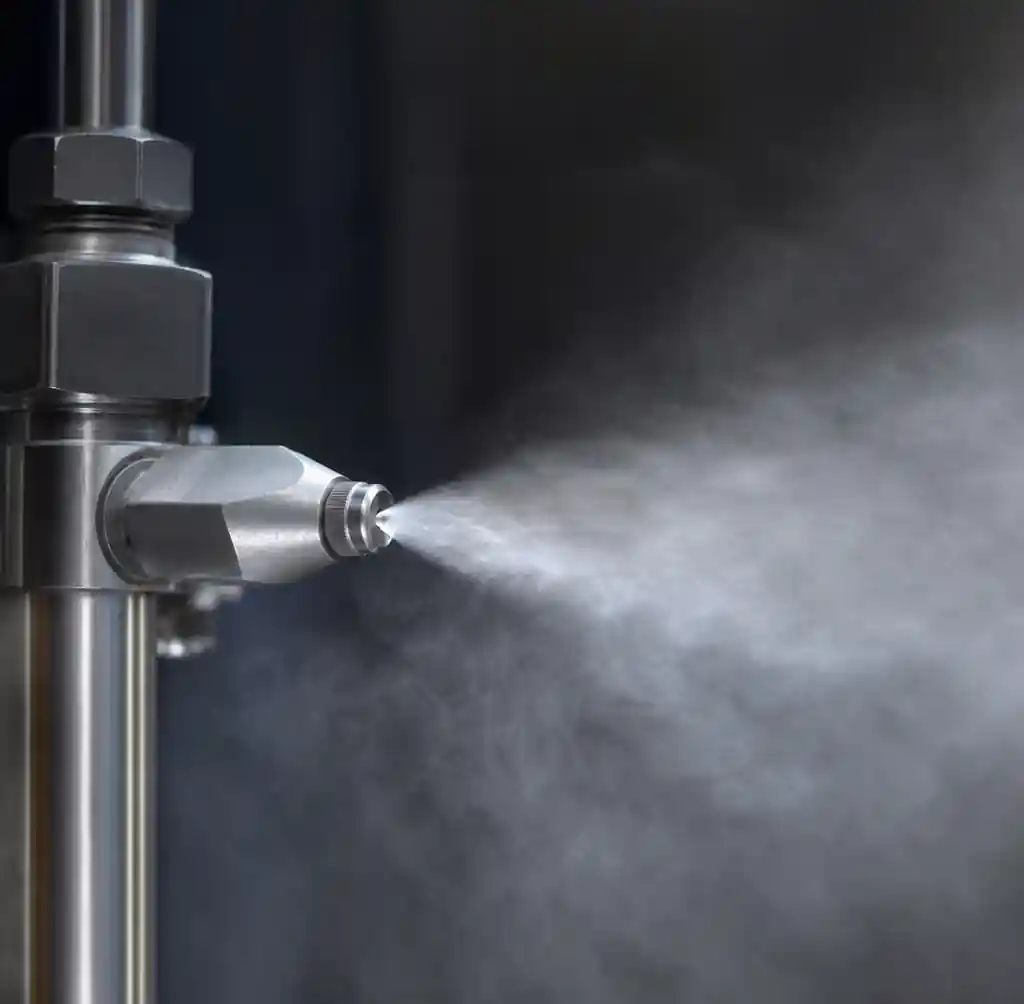 Dry fog nozzle producing ultra-fine water droplets under 10 microns
Traditional humidification systems—such as compressed-air spray or centrifugal atomisers—often over-wet surfaces, leave puddles, or consume excessive energy. Dry fog humidifier systems solve these problems by delivering microscopic water droplets (under 10 microns) that evaporate instantly, adding moisture without wetting machinery or finished goods.
For plant managers and quality engineers, this technology translates into fewer rejects, lower energy bills, and compliance with international quality standards. In this guide, we explore the measurable benefits of dry fog technology specifically for textile and printing environments, backed by real-world data and industry case studies.
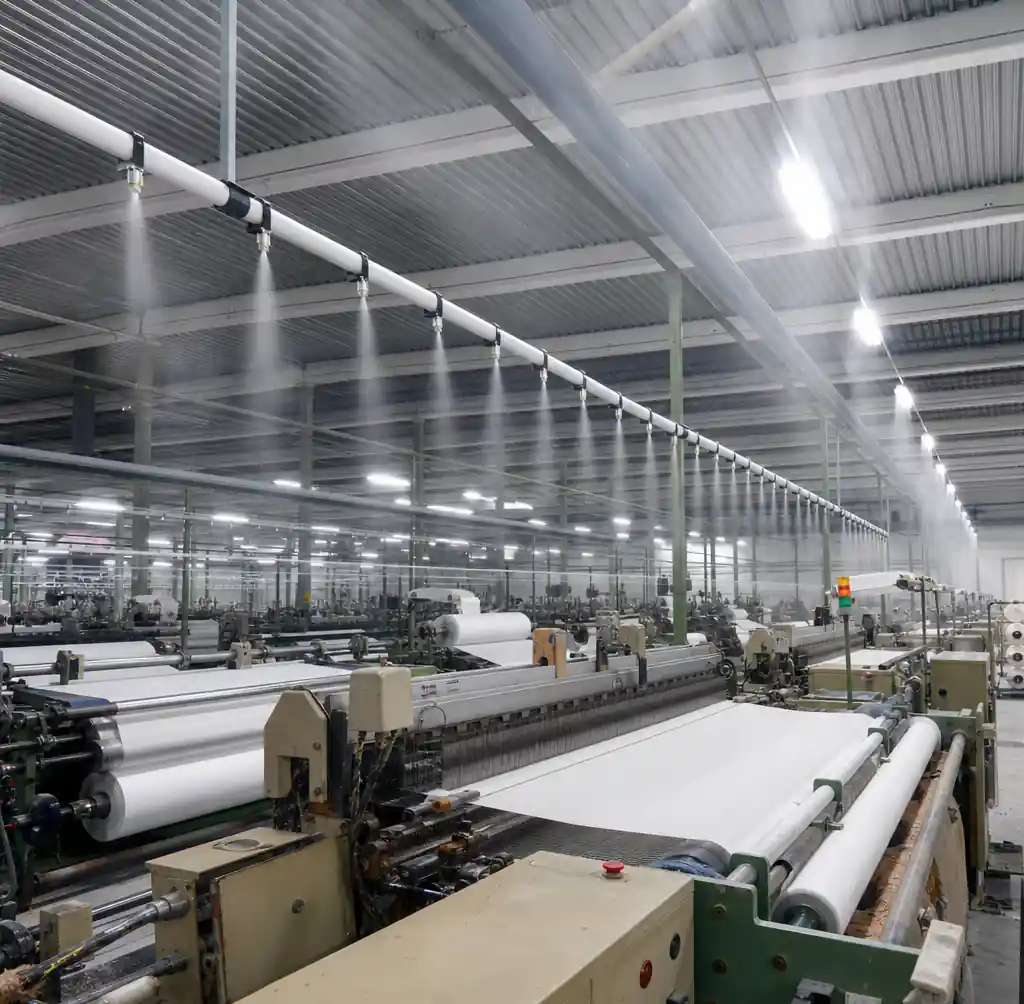 Textile mill production floor with proper humidity control system
What Is a Dry Fog Humidifier?
A dry fog humidifier generates ultra-fine water particles—typically 1–10 microns in diameter—using high-pressure pumps (70–100 bar) and specialised stainless-steel nozzles. Unlike steam systems that add heat or ultrasonic units that require demineralised water, dry fog uses plain tap or softened water and operates at ambient temperature.
The key differentiator is "dryness": because droplets are smaller than 10 microns, they remain airborne until fully evaporated. No dripping, no wet floors, no bacterial growth on saturated surfaces. This makes dry fog ideal for environments where product contact with liquid water must be avoided.
Common components include:
- High-pressure plunger pump
- Filtration and reverse-osmosis (RO) pre-treatment
- Stainless-steel distribution piping
- Precision misting nozzles with anti-drip valves
- Humidity sensors and PLC-based controllers
Compared to traditional systems:
| Feature | Dry Fog | Centrifugal Spray | Steam Injection |
|---|---|---|---|
| Droplet size | 1–10 μm | 50–200 μm | Vapour |
| Wetting risk | None | Moderate | Low (but hot) |
| Energy use | 15 W per nozzle | 500 W+ per fan | 2.5 kW+ per boiler |
| Water quality | Softened/RO | Tap water | Demineralised |
| Maintenance | Annual nozzle cleaning | Weekly filter changes | Descaling every 3 months |
Why Textile Mills Need Precise Humidity Control
Textile fibres are hygroscopic—they absorb and release moisture based on ambient RH. According to ISO 139:2005, standard testing conditions require 65% RH at 20°C. Deviations cause:
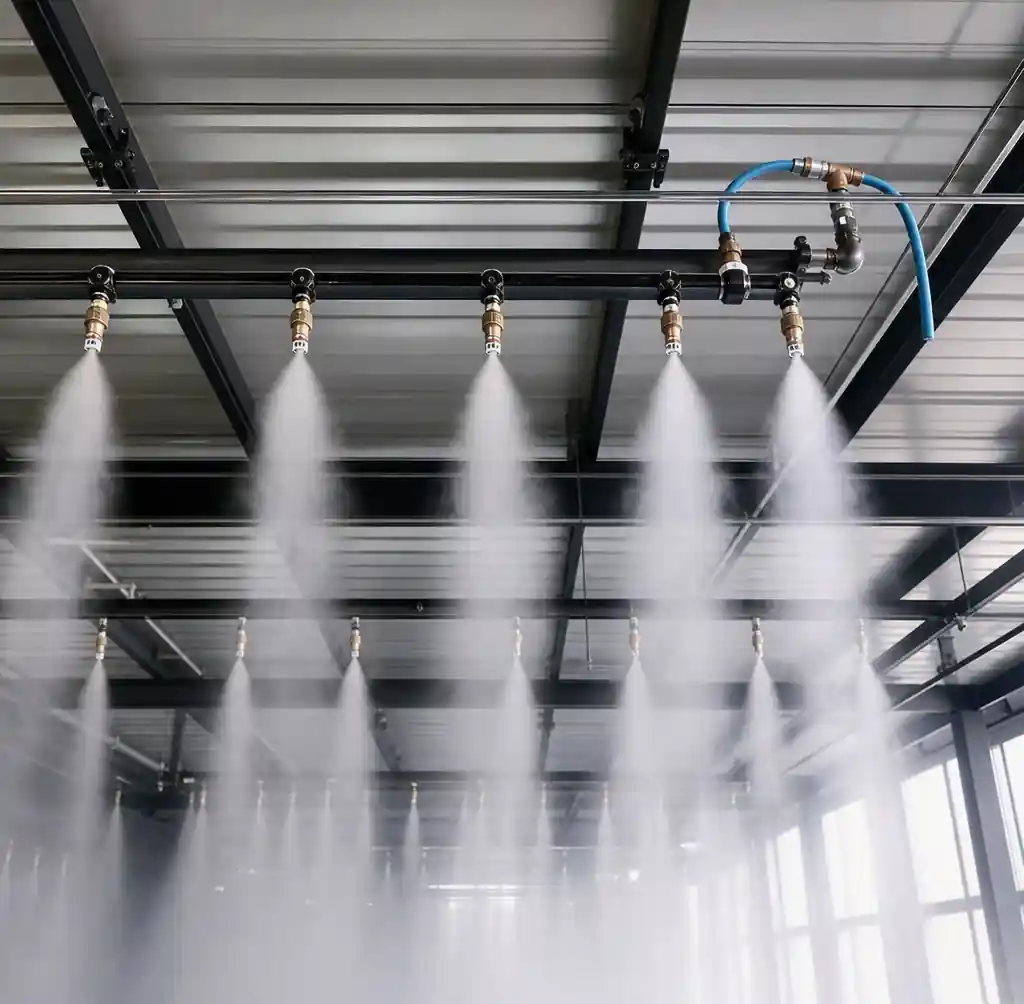 Dry fog humidification nozzles installed in industrial facility ceiling
- Yarn tension variations: Low RH (below 50%) increases static, causing threads to snap or tangle.
- Fibre breakage: Cotton and wool become brittle below 45% RH, raising breakage rates by up to 30%.
- Loom efficiency loss: In weaving, warp yarns need 75–80% RH to maintain extensibility. Dry conditions reduce loom speeds by 10–15%.
- Dimensional instability: Fabrics shrink or stretch after finishing if humidity fluctuates during production.
Recommended RH Levels by Process
| Process | Optimal RH (%) | Why It Matters |
|---|---|---|
| Blow room / Carding | 50–60 | Prevents fly waste and static |
| Drawing / Roving | 55–65 | Maintains silver uniformity |
| Ring spinning | 50–55 | Reduces end breaks |
| Weaving (cotton) | 75–80 | Increases warp elasticity |
| Knitting | 60–65 | Avoids needle chatter |
| Finishing / Stentering | 65–70 | Controls shrinkage |
Dry fog systems maintain these levels within ±2% RH accuracy, even in large open sheds, without over-saturating the product.
How Dry Fog Improves Printing Quality
In flexographic, gravure, and digital textile printing, humidity control is non-negotiable for colour consistency and registration accuracy.
Static Elimination
Low humidity causes static charges on substrates (paper, film, or fabric), attracting dust and repelling ink droplets. Dry fog adds conductive moisture to the air, grounding static electricity naturally—no need for expensive ionising bars.
Ink Performance
Water-based inks rely on controlled evaporation. If RH drops below 40%, ink dries on the anilox roller before transfer, causing skipping and pinholes. At 55–60% RH, ink stays open longer, transferring cleanly and evenly.
Substrate Dimensional Stability
Paper and films expand/contract with humidity changes. In multi-colour printing, even 0.5% stretch can misregister colours by 0.5 mm—unacceptable for high-end packaging or apparel labels. Dry fog keeps substrates stable throughout the press run.
"We reduced print waste from 8% to under 2% after installing dry fog in our gravure hall." — Production Manager, Indian packaging converter.
 Side-by-side comparison of steam humidifier and dry fog system components
Energy Efficiency and Cost Savings
This is where dry fog outperforms all alternatives. Consider a 10,000 m² textile hall requiring 65% RH.
- Steam system: 3,000 kW boiler + 500 kW distribution pumps → ~35,000 kWh/month.
- Dry fog system: 150 high-pressure nozzles × 15 W = 2.25 kW + 7.5 kW pump → under 10,000 kWh/month.
That is a 70% reduction in energy consumption. Annual savings at $0.12/kWh exceed $36,000. Additionally, dry fog uses no compressed air (unlike air-atomising nozzles), eliminating the costly compressor energy—typically 30–40% of a plant's electricity bill.
Maintenance Cost Comparison (Annualised)
| Item | Steam | Centrifugal | Dry Fog |
|---|---|---|---|
| Electricity | $42,000 | $18,000 | $10,800 |
| Water treatment | $8,000 | $3,000 | $1,500 (RO membrane) |
| Spare parts / labour | $12,000 | $8,000 | $2,500 |
| Total | $62,000 | $29,000 | $14,800 |
Payback period for retrofitting dry fog: typically 8–14 months based on energy and maintenance savings alone, not including quality improvement gains.
Installation and Maintenance Best Practices
To maximise lifespan and performance, follow these engineering guidelines:
- Water quality: Use softened water (≤50 ppm hardness) or RO permeate. Hard water scales nozzles rapidly, increasing droplet size and reducing efficiency.
- Nozzle placement: Position nozzles 2.5–3 m above floor level, spaced every 4–6 m for even coverage. Avoid aiming directly at machinery or product.
- Humidity sensors: Install at product level (1.5 m high) in multiple zones. Connect to PLC for zone-specific control.
- Winter operation: Use pre-heated water (15–20°C) to avoid chilling the space, which can affect worker comfort.
- Maintenance schedule:
- Monthly: Inspect filters and strainers.
- Quarterly: Clean nozzles with citric acid soak (if scaling observed).
- Annually: Replace pump seals and check pressure calibration.
Pro tip: Install a drip tray under each nozzle manifold during initial commissioning—even though dry fog doesn't drip, it helps catch any condensation from cold pipes in humid climates.
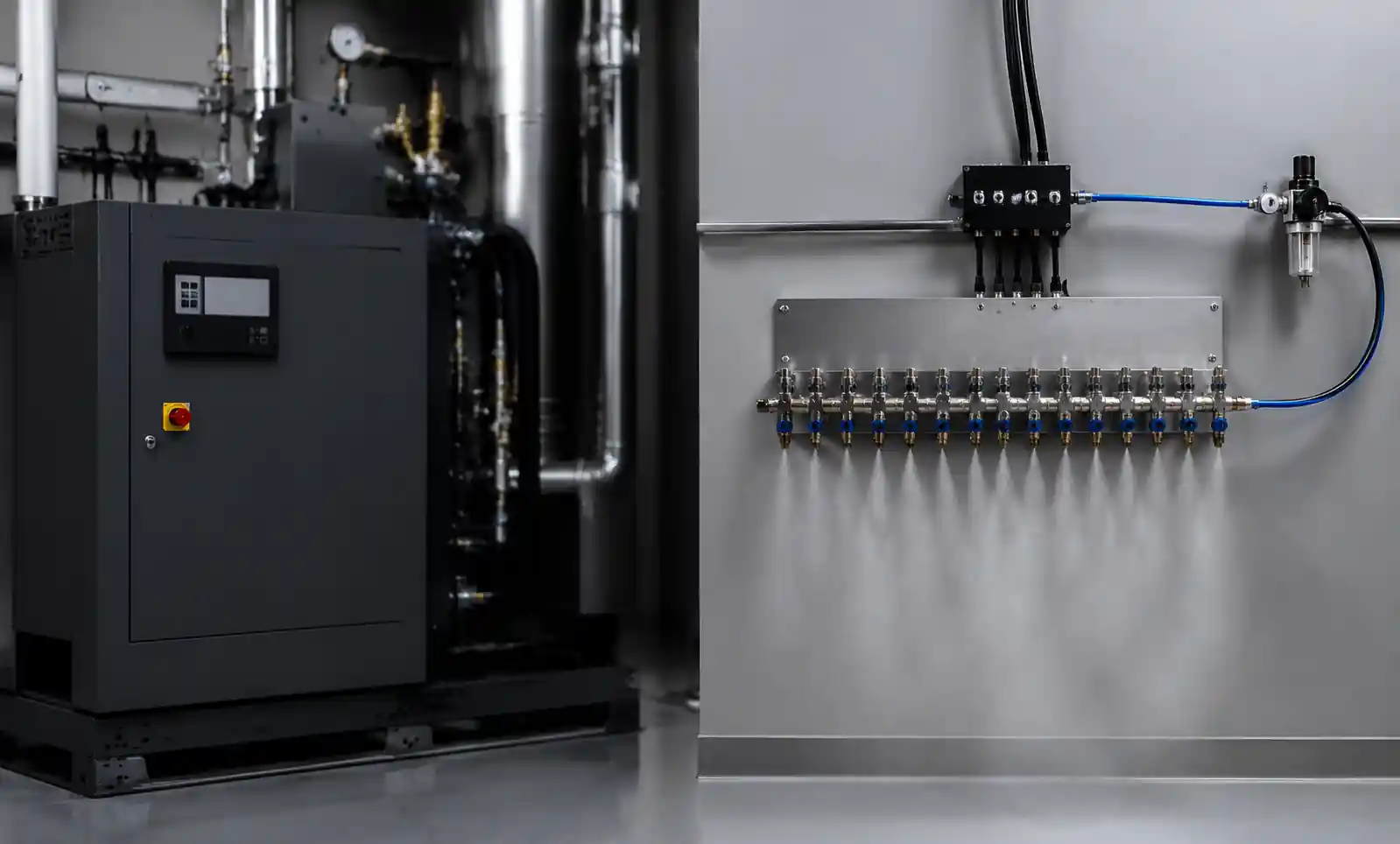
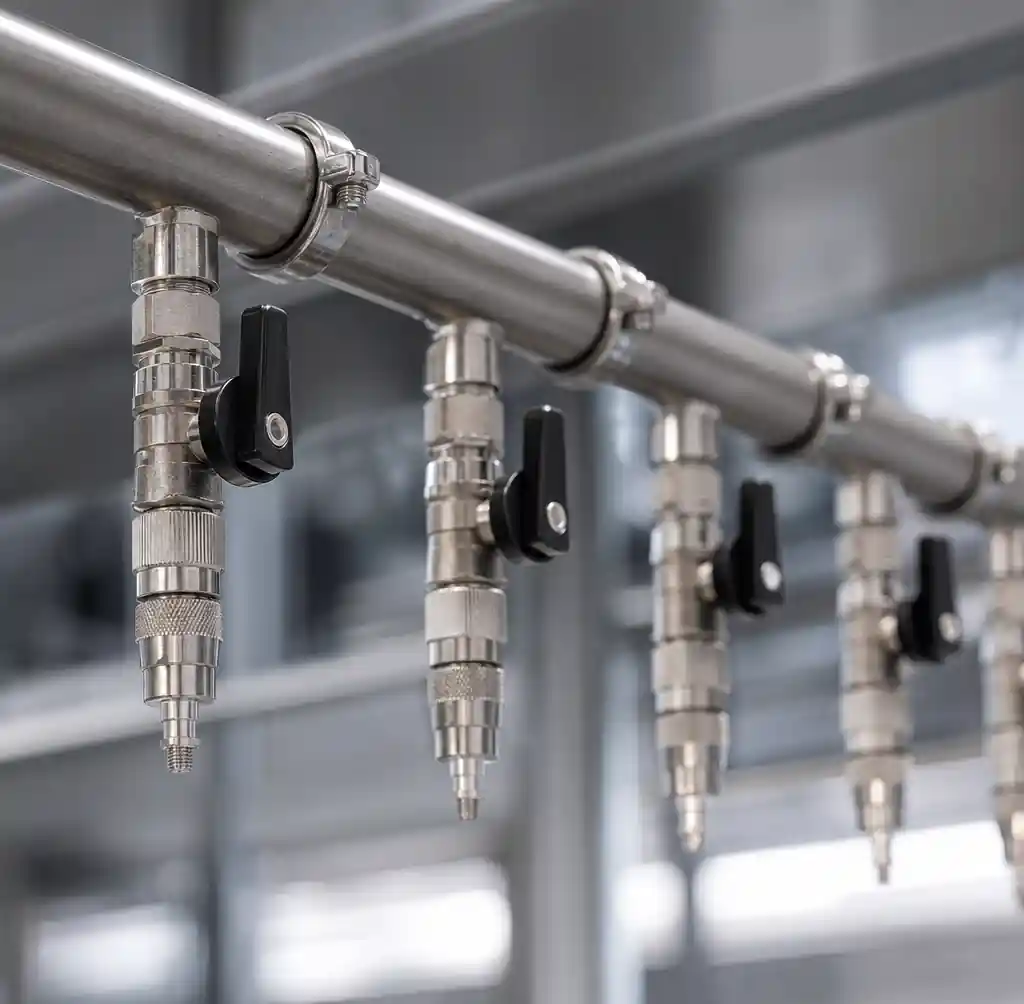 Dry fog nozzle manifold with multiple distribution points
Case Studies from the Industry
Case 1: Pakistani Cotton Weaving Mill
- Size: 25,000 m², 400 looms
- Problem: Frequent warp breakage below 70% RH; loom efficiency at 78%.
- Solution: 180 dry fog nozzles with RO pretreatment.
- Results (after 6 months):
- RH stabilised at 78% ±1.5%
- Loom efficiency increased to 91%
- Yarn breakage reduced by 42%
- Annual energy cost dropped from $58,000 to $19,000.
- ROI: 514% over 3 years; payback in 10 months.
Case 2: German Digital Textile Printer
- Size: 2,500 m², 4 single-pass printers
- Problem: Inkjet nozzle clogging and colour drift due to 35–45% RH fluctuations.
- Solution: 30 dry fog nozzles with zone control.
- Results:
- RH maintained at 55% ±1%
- Ink waste reduced by 65%
- Printer downtime dropped from 12 hours/week to under 2 hours.
- Consistent Delta-E (colour difference) below 1.0 across all batches.
Case 3: Indian Flexo Packaging Plant
- Size: 8,000 m², 6 CI flexo presses
- Problem: Static caused film jams and print misregistration.
- Solution: 80 dry fog nozzles focused on press corridors.
- Results:
- Static voltage dropped from 15 kV to under 0.5 kV.
- Waste film reduced by 300 kg per day.
- Achieved G7 colour certification within 3 months.
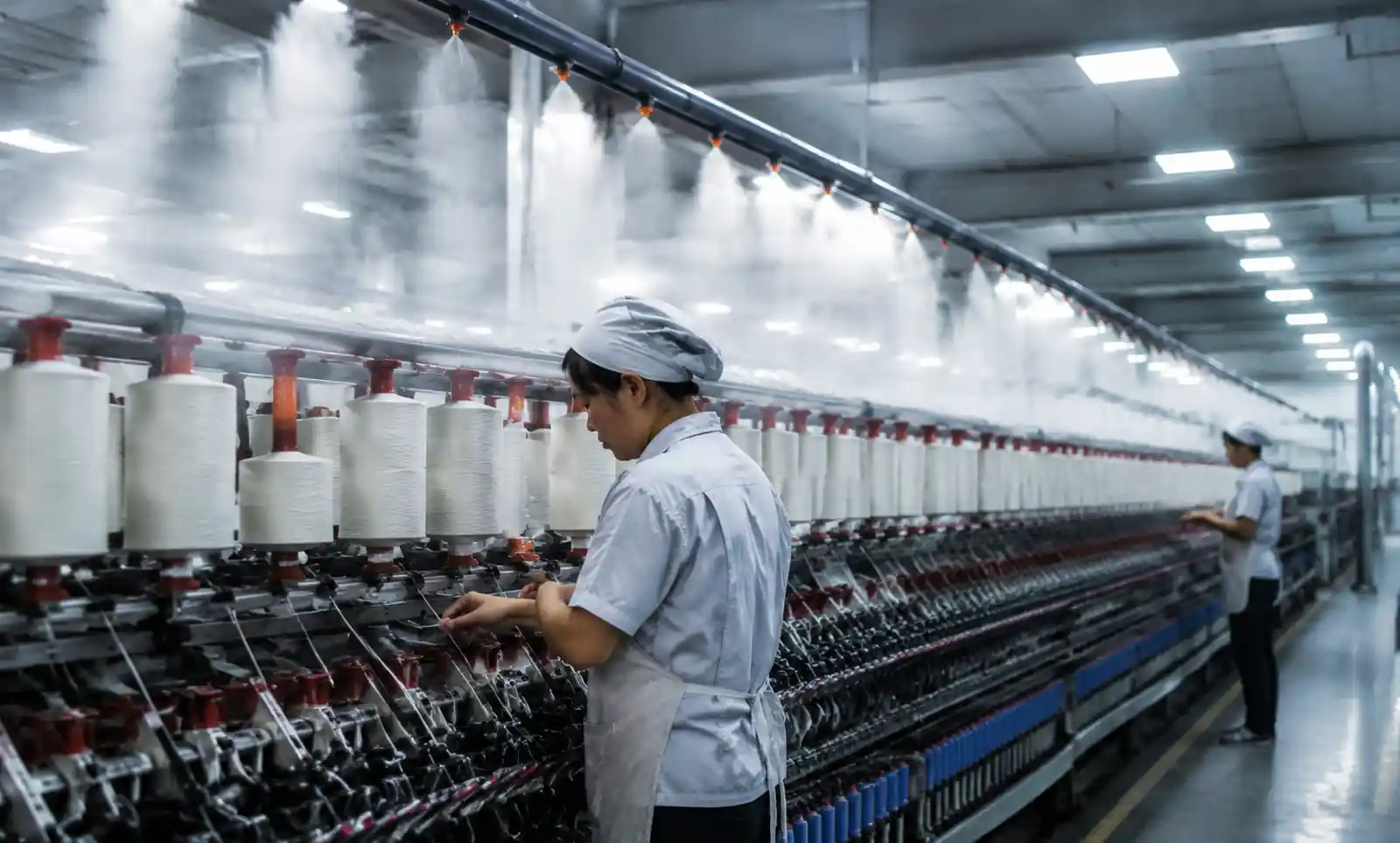 Yarn spinning or weaving operation in humidity-controlled environment
Frequently Asked Questions
-
Is dry fog safe for electronic equipment?
Yes. Because droplets evaporate before settling, there is no risk of condensation on circuit boards. Install nozzles at least 1 m away from control panels. -
What water pressure is required?
Most systems operate at 70–100 bar. A high-pressure plunger pump is included in the package. -
Can dry fog be used in cold climates?
Absolutely. Use heated water (via a mixing valve) to prevent temperature drop in the workspace. -
How often do nozzles need replacing?
With proper filtration, nozzles last 5–8 years. Only O-rings and seals need annual replacement. -
Does dry fog remove dust from the air?
Partially. The fine mist agglomerates dust particles, causing them to settle. However, it is not a substitute for a dedicated dust extraction system. -
What is the typical coverage per nozzle?
One nozzle covers 20–30 m² at 3 m height, depending on airflow and RH target. -
Can I retrofit dry fog into an existing steam-humidified plant?
Yes. Most retrofits take 2–3 days per zone, with minimal production interruption. -
Is demineralised water mandatory?
No. Softened water (≤50 ppm) is sufficient. RO is recommended for very high-pressure systems (≥100 bar).
Conclusion
Dry fog humidifier systems deliver a compelling combination of energy efficiency, product quality improvement, and operational reliability for textile and printing industries. By maintaining precise RH with ultra-fine droplets that never wet surfaces, they eliminate static, reduce yarn/fibre breakage, stabilise colour registration, and cut energy and maintenance costs by 70% or more.
With payback periods under one year and documented waste reductions of 40–65%, dry fog is no longer a premium option—it is the new baseline for competitive production. For plant managers focused on lean manufacturing and sustainable operations, investing in dry fog humidification is one of the highest-ROI decisions available.
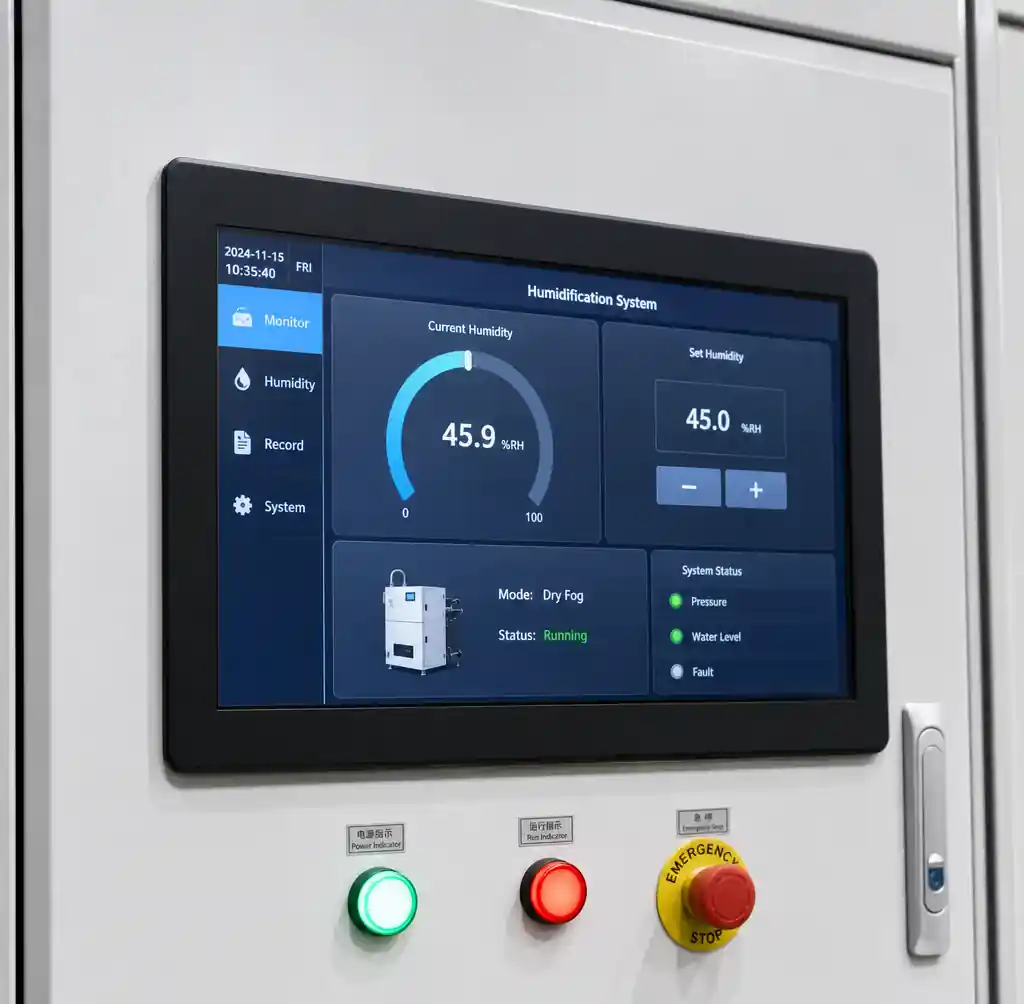 Dry fog humidification system control panel and monitoring display
For more technical specifications and system sizing assistance, browse our industrial humidification nozzles or contact our engineering support team.