



CIP Systems in Food Processing: Optimizing Cleaning Efficiency
Clean-in-Place (CIP) systems account for up to 20% of total water and chemical consumption in food processing facilities. Studies show that optimized CIP nozzle systems can reduce cleaning time by 50%, cut water usage by 40%, and improve hygiene compliance while lowering operational costs.
If you want to maximize CIP system efficiency in your food processing operation, then you will need to understand spray nozzle selection, flow dynamics, coverage patterns, chemical distribution, and cleaning validation protocols. This comprehensive guide explains how to optimize CIP cleaning efficiency through proper nozzle configuration and system design.
Table of Contents
- 1. What Are CIP Systems in Food Processing?
- 2. CIP Spray Nozzle Types and Selection
- 2.1. Rotary Spray Heads
- 2.2. Static Spray Balls
- 3. CIP System Design Parameters
- 3.1. Flow Rate Requirements
- 3.2. Pressure and Impact Force
- 3.3. Chemical Compatibility and Materials
- 4. Optimizing CIP Cleaning Cycles
- 4.1. Pre-Rinse Phase
- 4.2. Caustic Wash Phase
- 4.3. Acid Rinse Phase
- 4.4. Final Rinse and Sanitization
- 5. Coverage Verification and Validation
- 5.1. Spray Pattern Analysis
- 5.2. Flow and Pressure Monitoring
- 6. Common CIP Problems and Solutions
- 6.1. Incomplete Coverage
- 6.2. Nozzle Clogging
- 6.3. Excessive Water and Chemical Consumption
- 7. FAQ
- 7.1. What flow rate do I need for tank cleaning?
- 7.2. How often should I replace CIP nozzles?
- 7.3. Can I use one nozzle type for all cleaning phases?
- 7.4. What causes CIP nozzle rotation to stop?
- 7.5. How do I verify CIP cleaning effectiveness?
- 7.6. What pressure should CIP systems operate at?
- 8. Conclusion
What Are CIP Systems in Food Processing?
CIP systems are automated cleaning solutions that sanitize process equipment, tanks, pipelines, and vessels without disassembly. The system circulates cleaning solutions through specialized spray nozzles that mechanically remove residues, biofilms, and contaminants from all interior surfaces.
A complete CIP system consists of supply tanks for water and chemicals, pumps to generate pressure and flow, automated valves for solution routing, heat exchangers for temperature control, and precisely engineered spray nozzles for optimal coverage. The nozzles deliver cleaning solutions at controlled flow rates, pressures, and spray patterns to achieve complete surface contact and mechanical action.
You can implement CIP systems in dairy processing, beverage production, brewery operations, pharmaceutical manufacturing, and any food facility where hygiene standards require frequent sanitation without equipment disassembly. FDA and 3-A sanitary standards mandate CIP-compatible equipment design for most food contact surfaces.
CIP Spray Nozzle Types and Selection
Rotary Spray Heads
Rotary spray heads use fluid pressure to drive internal gear mechanisms that rotate jet streams in 360-degree patterns. These nozzles deliver high-impact cleaning through concentrated jet streams that sweep across tank surfaces, providing mechanical scrubbing action essential for removing baked-on residues and biofilms.
The rotation speed ranges from 0.5 to 3 RPM depending on flow rate and pressure. At 40-80 psi operating pressure, rotary heads deliver flow rates from 10 to 150 GPM with impact forces sufficient to remove stubborn deposits. You should specify rotary spray heads for large tanks over 500 gallons where complete surface coverage and high mechanical impact are required.
Static Spray Balls
Static spray balls produce fixed spray patterns through multiple drilled orifices arranged around a spherical or cylindrical body. These nozzles create overlapping spray patterns that provide uniform chemical distribution without moving parts, making them ideal for CIP applications where simplicity and reliability are priorities.
Static spray balls operate at lower pressures (20-60 psi) and deliver gentle, uniform coverage for rinse cycles and chemical application. The absence of moving parts eliminates wear and maintenance, but the fixed spray pattern means coverage quality depends entirely on proper nozzle sizing and positioning. You can use static spray balls for smaller vessels, rinse applications, and equipment where mechanical impact is less critical than chemical contact.
CIP System Design Parameters
Flow Rate Requirements
Flow rate directly impacts cleaning effectiveness through both mechanical action and chemical delivery. The minimum flow rate must achieve complete surface wetting and provide sufficient turbulence to dislodge residues. For tank cleaning applications, calculate 1.5 to 3 gallons per minute per square foot of surface area as a baseline.
| Tank Volume | Minimum Flow Rate | Recommended Flow Rate | Typical Nozzle Type |
|---|---|---|---|
| 100-500 gal | 15-25 GPM | 25-40 GPM | Static spray ball |
| 500-2000 gal | 30-60 GPM | 60-100 GPM | Rotary spray head |
| 2000-5000 gal | 80-120 GPM | 120-180 GPM | High-flow rotary head |
| 5000+ gal | 150-300 GPM | 200-400 GPM | Multiple rotary heads |
Higher flow rates improve cleaning speed and effectiveness, but you must balance this against pump capacity, energy costs, and water consumption. Testing per ASTM spray coverage standards helps determine the optimal flow rate for your specific application and soil load.
Pressure and Impact Force
Operating pressure generates the impact force that mechanically removes residues from surfaces. For CIP applications, pressure requirements range from 20 psi for gentle rinse cycles to 100 psi for heavy soil removal. The relationship between pressure and cleaning effectiveness is not linear—doubling pressure does not double cleaning speed.
Rotary spray heads typically operate at 40-80 psi to generate sufficient torque for rotation while maintaining impact force. Static spray balls work effectively at 20-40 psi for chemical distribution and 30-60 psi for final rinse cycles. You should verify that your pump system can maintain consistent pressure throughout the cleaning cycle, as pressure drops reduce both coverage and mechanical action.
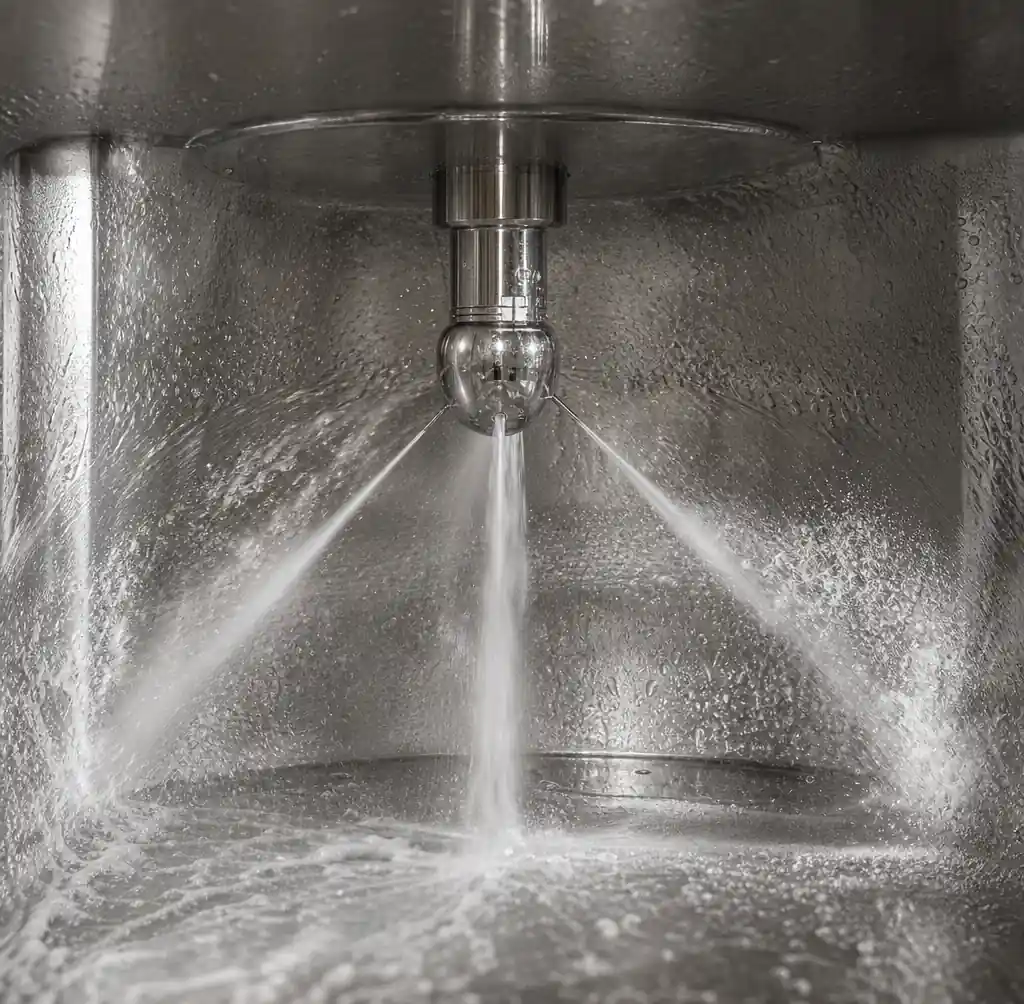 High-pressure spray impact removing residues from tank surface
Chemical Compatibility and Materials
CIP cleaning solutions include alkaline cleaners (sodium hydroxide, potassium hydroxide), acid cleaners (phosphoric acid, nitric acid), and sanitizers (chlorine, peracetic acid, quaternary ammonium compounds). Nozzle materials must resist chemical attack and maintain spray performance throughout the service life.
| Material | Chemical Resistance | Temperature Range | Applications |
|---|---|---|---|
| 316 Stainless Steel | Excellent for most CIP chemicals | -20°C to 200°C | General food processing, dairy, beverage |
| 316L Stainless Steel | Superior acid resistance | -20°C to 200°C | High-acid environments, pharmaceutical |
| PTFE/PVDF | Excellent for aggressive chemicals | -20°C to 150°C | Specialized chemical applications |
| Hastelloy C276 | Maximum chemical resistance | -20°C to 250°C | Extreme chemical environments |
Stainless steel 316 and 316L meet FDA food-grade requirements and provide excellent durability for most CIP applications. You should specify 316L for facilities using strong acids regularly, as the lower carbon content improves resistance to intergranular corrosion. All nozzle surfaces must have sanitary finish (Ra ≤ 0.8 μm) to prevent bacterial adhesion and meet 3-A sanitary standards.
Optimizing CIP Cleaning Cycles
Pre-Rinse Phase
The pre-rinse removes gross soil and residues before chemical cleaning. This phase uses ambient temperature water at moderate flow rates to flush away sugars, proteins, and loose debris. Effective pre-rinsing reduces chemical consumption by 20-30% and shortens overall cycle time.
You should run pre-rinse for 3-5 minutes at 50-70% of maximum flow rate. The spray pattern should achieve complete surface contact without excessive turbulence that could bake residues onto surfaces. Temperature should remain below 60°C to prevent protein denaturation, which makes subsequent cleaning more difficult.
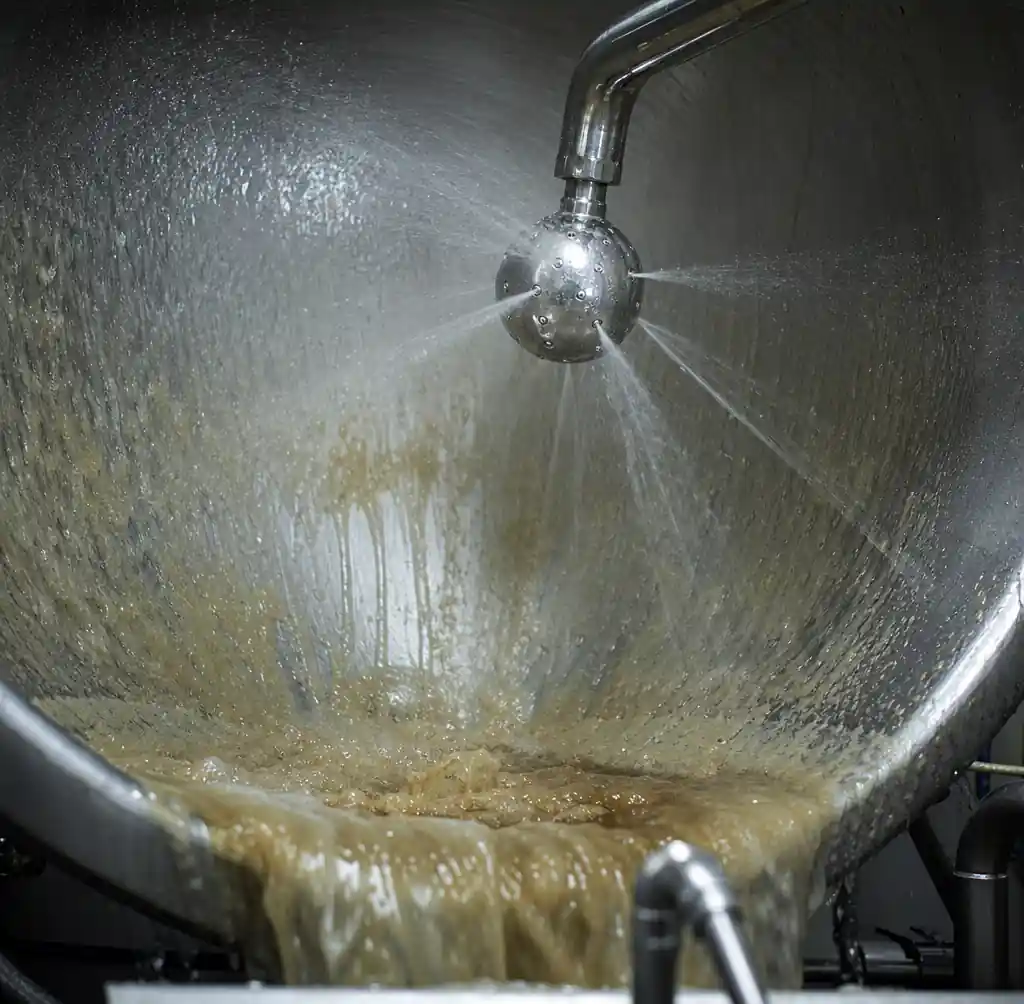 Pre-rinse phase in CIP cleaning cycle
Caustic Wash Phase
The caustic wash phase uses hot alkaline solutions (1-3% sodium hydroxide at 65-85°C) to break down proteins, fats, and organic residues. This phase requires the highest mechanical impact and most complete surface coverage. Operating time ranges from 10-30 minutes depending on soil load and cleaning validation requirements.
Maintain consistent temperature and concentration throughout the wash phase for optimal cleaning chemistry. The combination of chemical action, thermal energy, and mechanical impact from the spray nozzles provides the scrubbing force needed to remove stubborn residues. Flow rate should be at maximum to ensure turbulent flow and complete surface contact.
Acid Rinse Phase
The acid rinse removes mineral deposits, scale, and alkaline residues left from the caustic wash. Most food processing operations use phosphoric acid or nitric acid at 0.5-2% concentration at 60-75°C. This phase typically runs for 5-15 minutes with moderate flow rates and impact.
Acid cleaning is essential for hard water areas where calcium and magnesium deposits accumulate. You should schedule acid rinses based on water hardness and visible scale formation—typically every 3-7 cleaning cycles for most food processing applications.
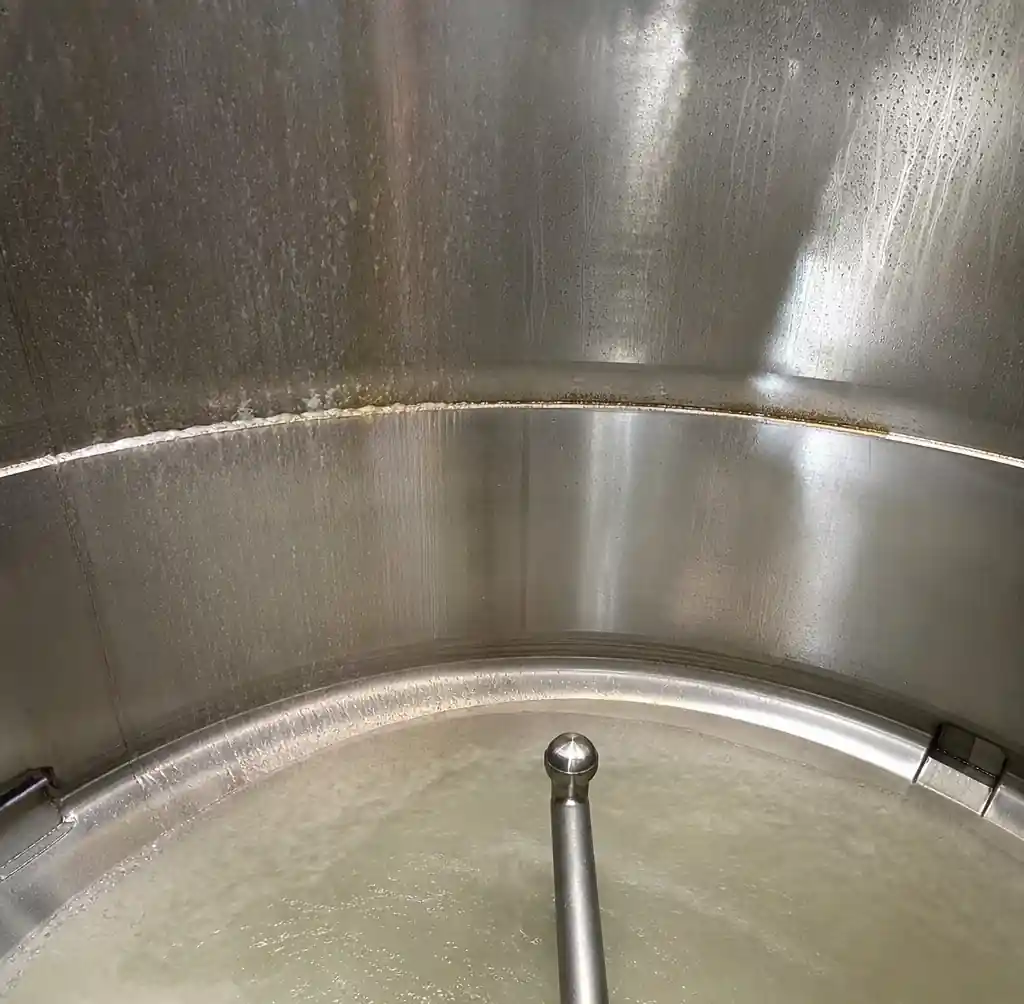 Acid rinse phase removing mineral deposits and scale
Final Rinse and Sanitization
The final rinse uses potable water to remove all chemical residues before sanitizer application. Rinse water should meet drinking water standards and achieve conductivity below 200 μS/cm to verify complete chemical removal. Rinse time varies from 3-10 minutes depending on tank volume and drainage efficiency.
Sanitization uses approved chemical sanitizers (chlorine 50-200 ppm, peracetic acid 100-200 ppm, or quaternary ammonium compounds per manufacturer specifications) at ambient temperature. Contact time must meet regulatory requirements—typically 1-5 minutes depending on sanitizer type and concentration. You must verify sanitizer concentration and contact time through regular validation testing.
Coverage Verification and Validation
Spray Pattern Analysis
Spray pattern verification ensures that nozzles deliver complete coverage to all interior surfaces. You can verify coverage through riboflavin testing, where UV-reactive tracer added to cleaning solution reveals areas of inadequate spray contact. This testing should be performed during commissioning and whenever nozzle performance changes.
For rotary spray heads, verify that rotation speed allows sufficient dwell time on each surface area. Calculate coverage time by dividing 360 degrees by rotation speed in degrees per second—most applications require 30-60 seconds minimum dwell time per surface zone. Static spray balls require careful positioning to ensure overlapping spray patterns cover all surfaces without dead zones.
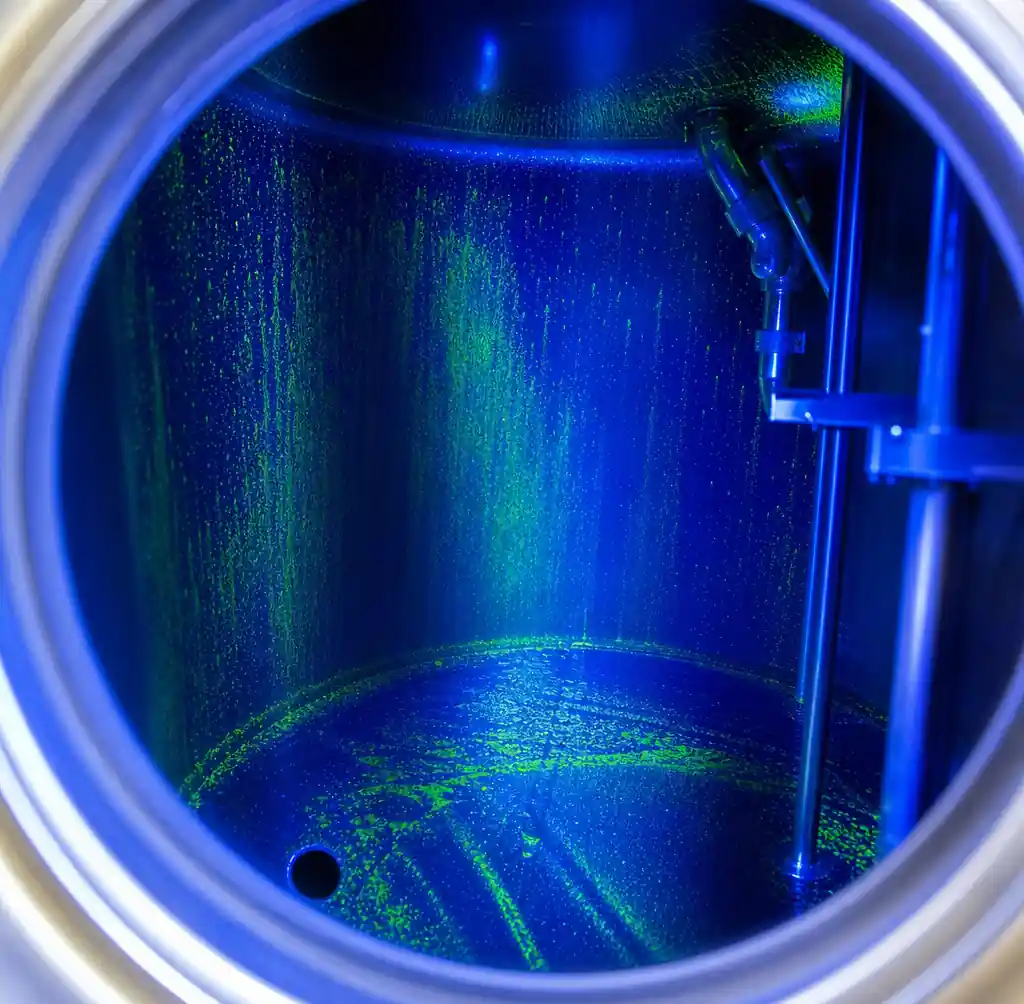 UV riboflavin testing verifying CIP spray coverage
Flow and Pressure Monitoring
Install flow meters and pressure gauges to monitor CIP system performance in real-time. Flow rate below specification indicates clogged nozzles, pump issues, or valve problems. Pressure variations signal system leaks or flow path restrictions. You should establish acceptance ranges for each cleaning phase and configure alarms for out-of-spec conditions.
Regular monitoring data helps optimize cleaning cycles and predict maintenance needs. Trending analysis reveals gradual performance degradation before complete failure occurs. Most food facilities log flow and pressure data electronically for GMP documentation and troubleshooting.
Common CIP Problems and Solutions
Incomplete Coverage
Incomplete coverage leaves residues in dead zones that become harbors for bacterial growth. This problem typically results from undersized nozzles, insufficient flow rate, incorrect nozzle positioning, or worn spray orifices that alter spray patterns.
You should conduct coverage verification testing when installing new nozzles or troubleshooting cleaning failures. Riboflavin testing with UV inspection reveals uncovered areas. Solutions include upgrading to higher-flow nozzles, repositioning spray heads, or adding secondary nozzles for complex geometries. Tank design modifications may be necessary if nozzle placement options cannot achieve complete coverage.
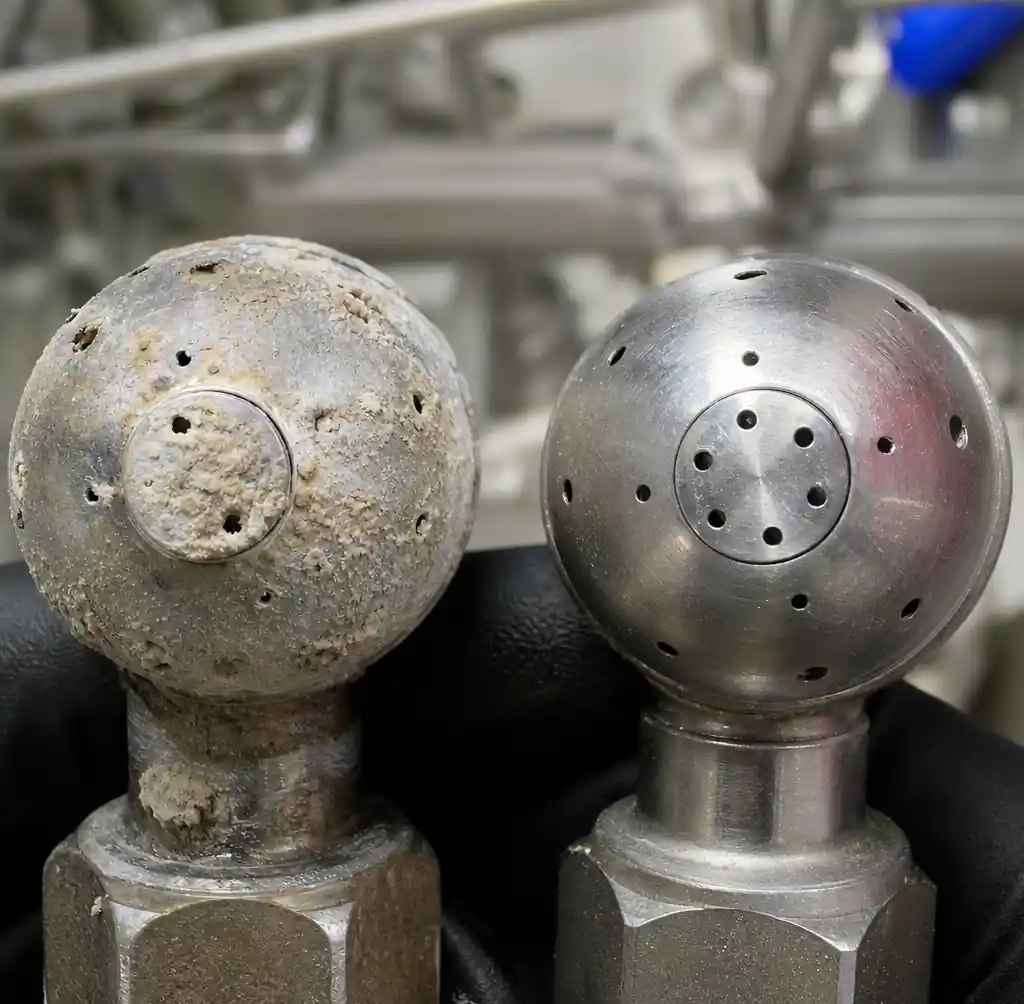 Comparison of clogged and clean CIP nozzle orifices
Nozzle Clogging
Nozzle clogging reduces flow rate and distorts spray patterns, leading to cleaning failures. Clogging occurs when suspended solids, mineral deposits, or undissolved chemicals block orifices. Food facilities should install inline strainers (100-200 mesh) upstream of all CIP nozzles to capture debris.
Regular inspection and cleaning prevents clogging. Remove and inspect nozzles monthly in normal operations, weekly in high-soil applications. Soak clogged nozzles in acid cleaner to dissolve mineral deposits, then flush with high-pressure water. Replace nozzles showing wear, erosion, or damage to spray holes.
Excessive Water and Chemical Consumption
Inefficient CIP systems waste thousands of gallons of water and hundreds of pounds of chemicals annually. Overcleaning, excessive flow rates, and prolonged cycle times drive up costs without improving hygiene. You can optimize consumption through precise cycle programming, flow rate reduction testing, and recovery system implementation.
Conduct cleaning validation studies to determine minimum effective parameters for each phase. Test reduced flow rates, shorter cycle times, and lower chemical concentrations while verifying cleaning effectiveness through ATP testing and microbial swabbing. Most facilities can reduce consumption by 20-40% through systematic optimization.
FAQ
What flow rate do I need for tank cleaning?
Calculate 1.5 to 3 GPM per square foot of tank surface area as a baseline. A 1000-gallon tank with approximately 150 square feet of surface area requires 60-90 GPM minimum flow rate for effective cleaning.
How often should I replace CIP nozzles?
Inspect nozzles every 3-6 months and replace when spray holes show wear, flow rate drops below specification, or spray patterns become distorted. In abrasive or high-temperature applications, expect 1-2 year service life.
Can I use one nozzle type for all cleaning phases?
Yes, most CIP systems use the same nozzle throughout all phases. Rotary spray heads work for all phases when properly sized. You may use static spray balls for final rinse if separate rinse spray points are installed.
What causes CIP nozzle rotation to stop?
Insufficient flow rate, clogged spray holes, worn bearings, or debris jamming the rotation mechanism stops rotary head movement. Verify flow rate meets minimum specifications and inspect for mechanical damage or buildup.
How do I verify CIP cleaning effectiveness?
Use ATP bioluminescence testing for rapid results, combine with periodic microbial swabbing for complete validation. Conduct riboflavin tracer testing to verify spray coverage reaches all surfaces.
What pressure should CIP systems operate at?
Rotary spray heads typically operate at 40-80 psi. Static spray balls work at 20-60 psi. Higher pressures improve mechanical action but increase energy costs and wear rates.
Conclusion
Optimizing CIP system efficiency requires careful attention to nozzle selection, flow dynamics, coverage verification, and cycle programming. Proper spray nozzle configuration combined with validated cleaning parameters reduces water consumption, chemical usage, and cycle time while maintaining strict hygiene standards required in food processing.
If you need high-performance CIP spray nozzles for your food processing facility, YuechenPrecision Technology offers comprehensive solutions including rotary spray heads, static spray balls, and sanitary spray devices. Our FDA-compliant and 3-A certified products deliver reliable cleaning performance across dairy, beverage, brewery, and pharmaceutical applications.
Contact us today for custom CIP nozzle solutions, technical specifications, and application engineering support.