



Chemical Resistant Nozzles: Material Selection Guide
Selecting the wrong nozzle material for chemical handling applications costs facilities tens of thousands in unplanned downtime, contamination incidents, and premature equipment replacement. After 15 years manufacturing precision spray systems for semiconductor fabs, pharmaceutical plants, and chemical processing facilities, we've seen how material incompatibility failures cascade through entire production lines.
This guide walks through proven material selection criteria based on chemical compatibility, temperature limits, mechanical requirements, and total cost of ownership—the same framework YuechenPrecision Technology engineers use when specifying nozzles for corrosive service.
Table of Contents
- 1. Why Material Selection Determines Nozzle Lifespan
- 2. Metallic Materials: When Strength Meets Chemistry
- 2.1. 316/316L Stainless Steel
- 2.2. Hastelloy C-276
- 2.3. 904L and Alloy 20
- 3. Fluoropolymers: Chemical Inertness at Limited Temperatures
- 3.1. PVDF (Polyvinylidene Fluoride)
- 3.2. PTFE (Polytetrafluoroethylene) and PFA
- 3.3. ETFE and ECTFE
- 4. Specialized Materials for Extreme Conditions
- 4.1. Silicon Carbide and Alumina Ceramics
- 4.2. PEEK (Polyetheretherketone)
- 5. Material Selection Decision Framework
- 5.1. Primary Chemical Compatibility
- 5.2. Operating Temperature Considerations
- 5.3. Pressure and Flow Requirements
- 5.4. Contamination Tolerance
- 5.5. Total Cost of Ownership Analysis
- 6. Installation and Maintenance Factors Affecting Material Performance
- 6.1. Thread Compatibility and Galling Prevention
- 6.2. Material-Specific Inspection Protocols
- 6.3. Chemical Changeover Considerations
- 7. Frequently Asked Questions
- 7.1. Can I use 316 stainless steel nozzles with sodium hypochlorite bleach solutions?
- 7.2. How do I determine if a fluoropolymer nozzle has reached end of life?
- 7.3. What causes ceramic nozzles to fail if they're chemically inert?
- 7.4. Why do my PVDF nozzles crack after only 6 months when compatibility charts show excellent resistance?
- 7.5. Is it worth paying 10× more for Hastelloy instead of stainless steel?
- 7.6. Can I mix nozzle materials in the same spray header?
- 8. Conclusion
Why Material Selection Determines Nozzle Lifespan
Chemical attack manifests differently depending on material type. Metals corrode through electrochemical reactions, polymers degrade via chain scission or plasticization, and ceramics fail through grain boundary attack. The visible failure—a cracked nozzle body or eroded orifice—results from months of molecular-level degradation you never see until the spray pattern collapses.
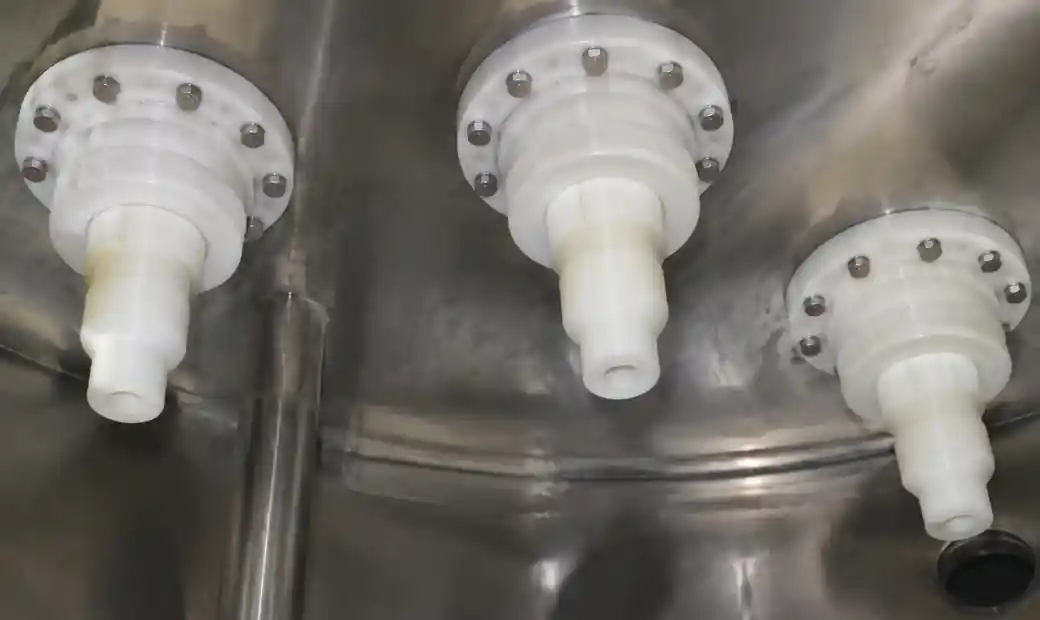 Chemical resistant nozzles installed in industrial processing tank
Temperature accelerates every degradation mechanism. A PVDF nozzle handling 20% sulfuric acid at 60°C might last five years, but raise the temperature to 100°C and you're replacing it in six months. Concentration matters equally—316 stainless steel resists dilute nitric acid admirably but fails rapidly above 65% concentration even at room temperature.
Pressure compounds mechanical stress with chemical exposure. Nozzles operating above 100 psi experience higher localized stress at the orifice, where flow velocity peaks and material thickness reaches its minimum. This stress-corrosion cracking mechanism explains why the same material performs differently in low-pressure tank washing versus high-pressure cleaning.
Metallic Materials: When Strength Meets Chemistry
316/316L Stainless Steel
The workhorse of chemical nozzles, 316 stainless steel dominates applications involving moderate acids, alkaline solutions, and most organic solvents. Its 2-3% molybdenum content provides superior pitting resistance compared to 304 stainless, particularly in chloride environments up to 500 ppm.
Real-world performance: In municipal water treatment chlorination systems (up to 200 ppm free chlorine, pH 6.5-7.5, 25°C), 316 stainless nozzles routinely exceed 8-year service life. The same material fails within 18 months in seawater desalination brine concentrate (35,000 ppm chloride, 45°C) due to crevice corrosion at threaded connections.
Temperature ceiling sits at 425°C in oxidizing environments, though prolonged exposure above 315°C causes carbide precipitation in standard 316 grade. The low-carbon 316L variant prevents sensitization for welded assemblies or extended high-temperature service.
Avoid 316 stainless with: concentrated halogen acids (hydrochloric, hydrobromic above 5%), hot sulfuric acid above 65% concentration, and any solution containing fluoride ions above trace levels.
Hastelloy C-276
When 316 stainless proves insufficient, Hastelloy C-276 handles the most aggressive chemical environments outside of fluorine compounds. This nickel-molybdenum-chromium alloy resists oxidizing acids, reducing acids, chlorine, and hypochlorite across broad temperature and concentration ranges.
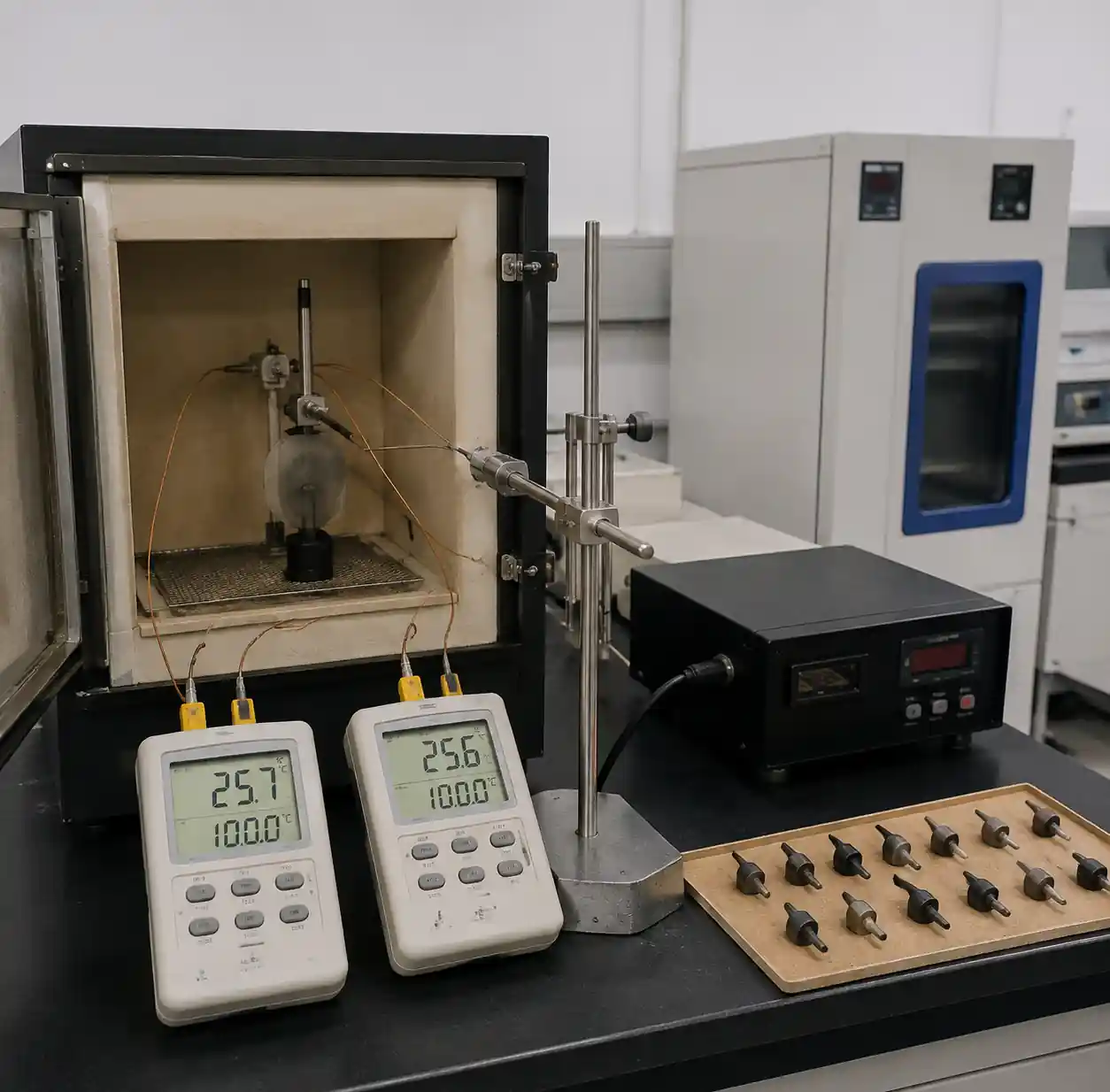 Temperature testing equipment for chemical resistant nozzle materials
Measured performance data: In a pharmaceutical API manufacturing facility spraying 37% hydrochloric acid at 65°C for reactor cleaning, C-276 nozzles show less than 0.05 mm orifice diameter growth after 3 years continuous operation. Under identical conditions, 316 stainless nozzles required replacement every 4 months due to severe pitting.
Cost runs 8-12× higher than 316 stainless, but lifespan advantages in severe service deliver 3-5 year payback when factoring downtime costs. Maximum service temperature reaches 650°C in most chemical environments.
Compatibility table for common acids:
| Chemical | Concentration | Temperature | 316 SS Rating | Hastelloy C-276 Rating |
|---|---|---|---|---|
| Hydrochloric Acid | 37% | 65°C | Poor (< 6 months) | Excellent (> 5 years) |
| Sulfuric Acid | 98% | 80°C | Poor (< 3 months) | Excellent (> 5 years) |
| Nitric Acid | 70% | 50°C | Poor (< 1 year) | Excellent (> 5 years) |
| Phosphoric Acid | 85% | 95°C | Fair (1-2 years) | Excellent (> 5 years) |
| Hydrofluoric Acid | 40% | 35°C | Unusable | Poor (< 1 year) |
| Sodium Hypochlorite | 12% | 40°C | Fair (1-2 years) | Excellent (> 5 years) |
904L and Alloy 20
These molybdenum-enhanced austenitic alloys occupy the middle ground between 316 stainless and Hastelloy. 904L (20Cr-25Ni-4.5Mo-1.5Cu) excels in sulfuric acid across all concentrations and temperatures where 316 fails. Alloy 20 (33Ni-20Cr-2.5Mo-3Cu) was specifically developed for sulfuric acid service and provides excellent resistance to stress-corrosion cracking.
Cost premium runs 3-4× compared to 316 stainless—substantially less than Hastelloy while addressing specific problem chemicals. We specify 904L for concentrated sulfuric acid tank mixing nozzles and Alloy 20 for sulfuric acid spray dryer applications.
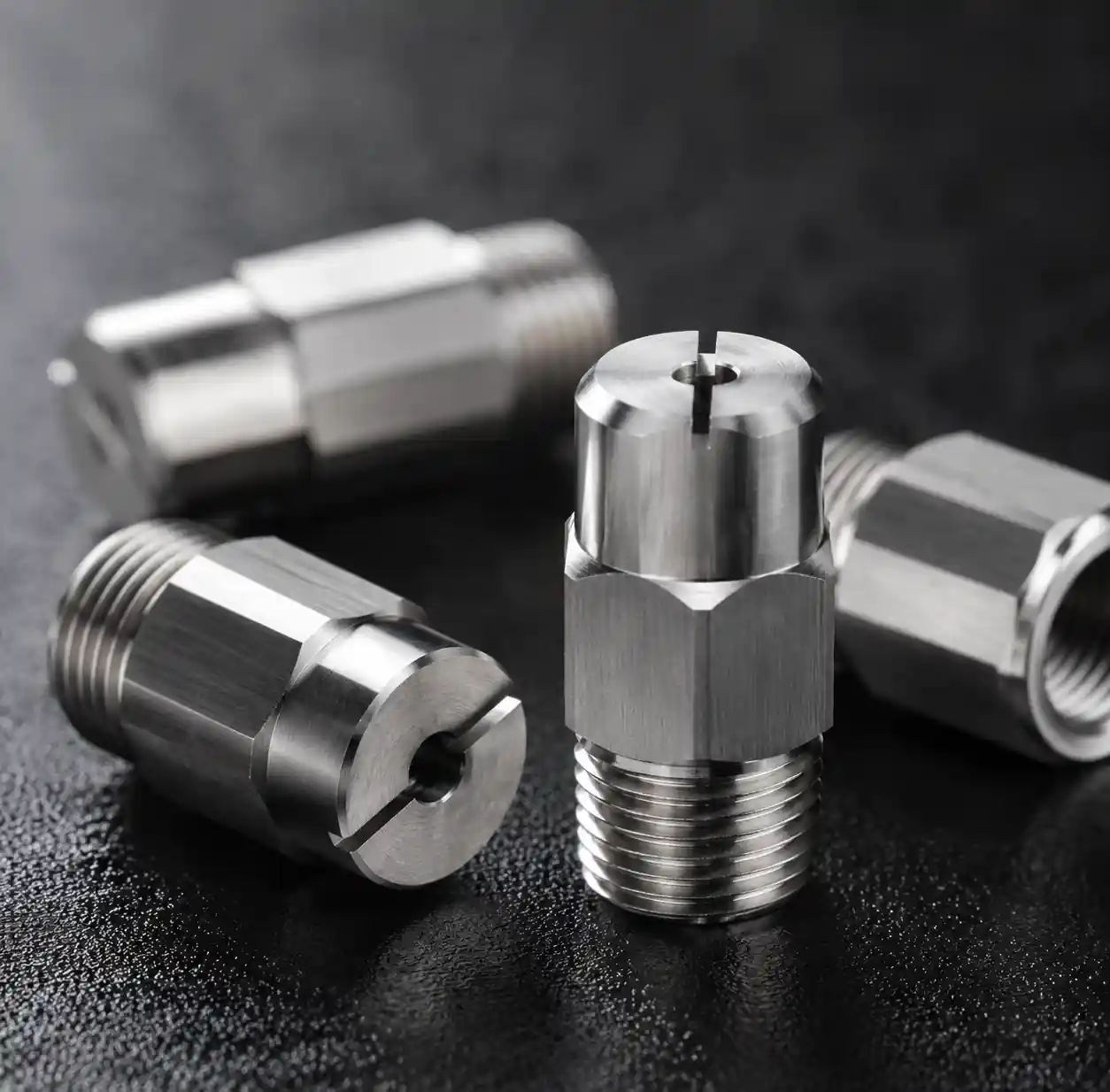 Close-up view of 316 stainless steel spray nozzles
Fluoropolymers: Chemical Inertness at Limited Temperatures
PVDF (Polyvinylidene Fluoride)
PVDF nozzles dominate semiconductor wet processing, electroplating, and pharmaceutical applications where metal ion contamination cannot be tolerated. Chemical resistance encompasses most acids, bases, solvents, and oxidizers with few exceptions (concentrated sulfuric above 60°C, fuming acids, strong alkalis above pH 13 at elevated temperature).
Temperature-pressure performance: Maximum continuous service temperature of 135°C drops to 100°C when operating above 60 psi. At 150°C, PVDF loses 60% of its room-temperature tensile strength and begins creeping under load. For high-temperature chemical service above 120°C, PTFE becomes necessary despite its mechanical limitations.
Measured pressure test results:
| Temperature | Burst Pressure (1/4" nozzle) | Recommended Max Operating Pressure |
|---|---|---|
| 20°C | 145 psi | 60 psi |
| 60°C | 120 psi | 50 psi |
| 100°C | 85 psi | 35 psi |
| 120°C | 65 psi | 25 psi |
UV resistance gives PVDF outdoor durability that other fluoropolymers lack. In outdoor chemical storage tank applications, natural PVDF nozzles show minimal degradation after 10 years of direct sunlight exposure.
Manufacturing advantage: PVDF machines easily with standard tooling, enabling complex internal geometries and tight tolerances. YuechenPrecision Technology produces PVDF nozzles with orifice tolerances to ±0.025 mm—precision matching machined metal components.
PTFE (Polytetrafluoroethylene) and PFA
Pure PTFE offers broader chemical resistance than PVDF, including concentrated sulfuric acid, strong bases, and chlorinated solvents at elevated temperatures. Service temperature extends to 260°C continuously. The critical limitation: PTFE's low tensile strength (20-35 MPa) and tendency to cold-flow under pressure restrict it to low-pressure applications below 30 psi.
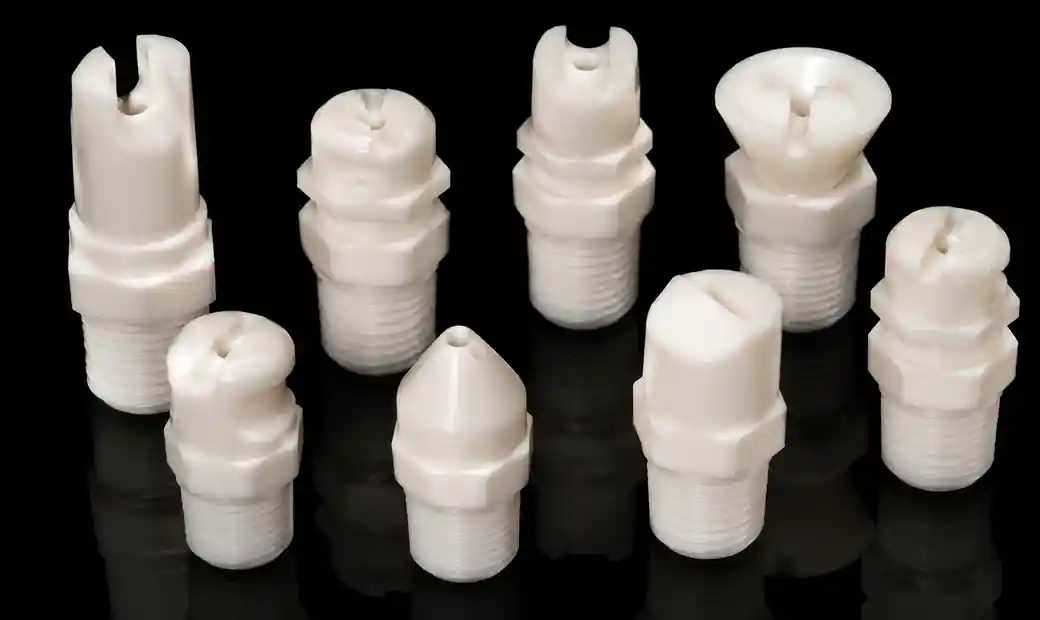 PVDF fluoropolymer spray nozzles for chemical applications
PFA (perfluoroalkoxy) provides PTFE-level chemical resistance with improved mechanical properties and melt-processability. Maximum pressure capability reaches 50 psi at room temperature, double PTFE's limit. We specify PFA for chemical injection nozzles in semiconductor ultrapure water systems where 260°C steam sterilization cycles occur weekly.
Cost comparison: PTFE nozzles run 2-3× the cost of PVDF equivalents; PFA runs 4-5× PVDF cost. The price difference reflects raw material costs and more challenging manufacturing processes.
ETFE and ECTFE
These partially fluorinated polymers sacrifice some chemical resistance for enhanced mechanical strength. ETFE (ethylene tetrafluoroethylene) withstands most acids and bases while offering impact resistance far exceeding PVDF. Maximum service temperature of 150°C suits moderately elevated temperature applications.
ECTFE (ethylene chlorotrifluoroethylene) provides exceptional hydrochloric acid resistance across all concentrations to 175°C—performance rivaling Hastelloy at a fraction of the cost for low-pressure applications. We deploy ECTFE nozzles in steel pickling operations where hot hydrochloric acid vapor previously destroyed PVDF nozzles in weeks.
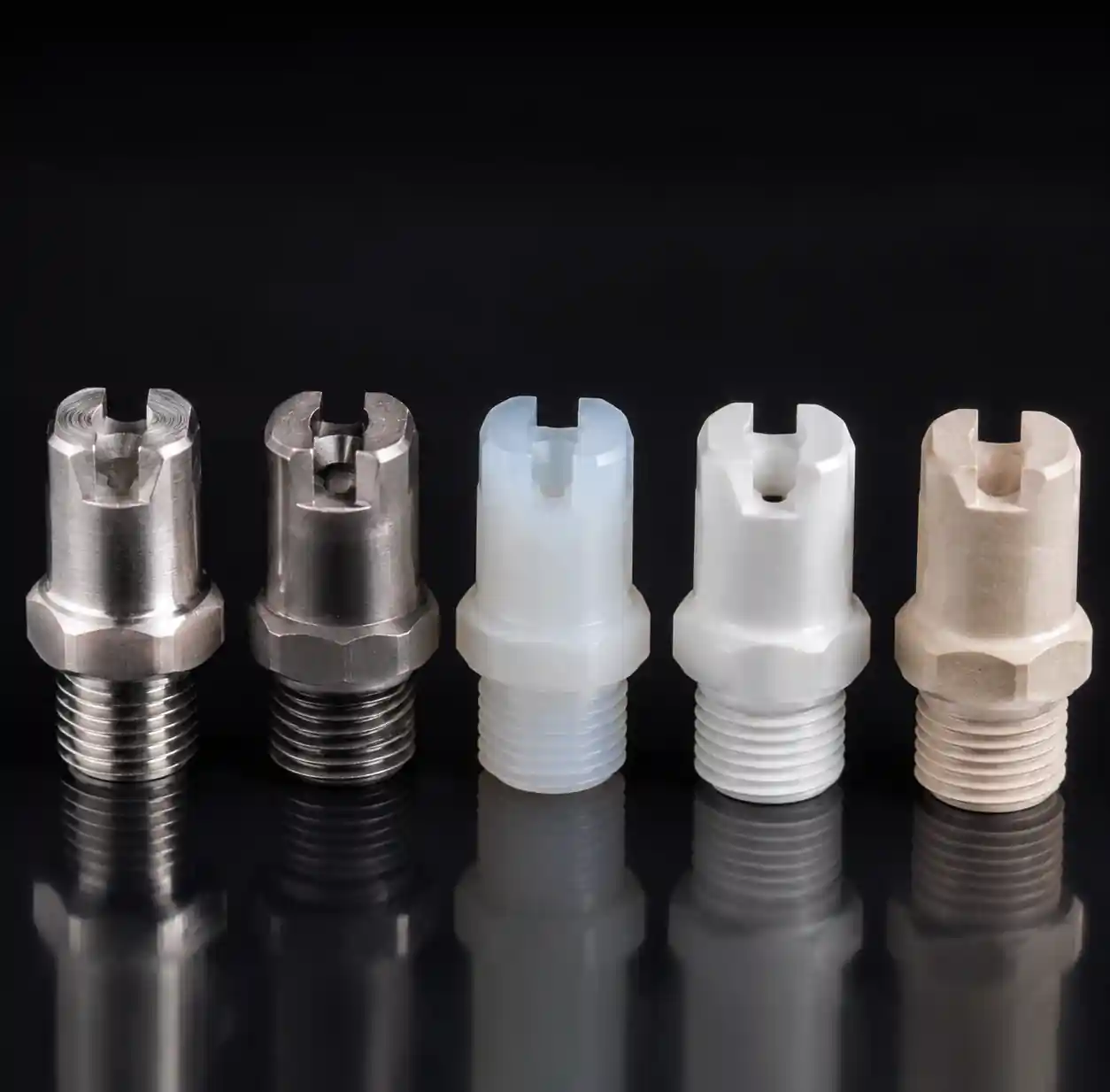 Comparison of different chemical resistant nozzle materials side by side
Specialized Materials for Extreme Conditions
Silicon Carbide and Alumina Ceramics
Ceramic nozzles address two specific failure modes: abrasive erosion and extreme temperature chemical service. Silicon carbide (SiC) hardness of 2500-3000 HV (compared to 200 HV for 316 stainless) delivers 50-100× longer life in slurry spraying applications. In semiconductor CMP (chemical mechanical planarization) systems spraying silica slurries, SiC nozzles last 5+ years versus 3-6 months for stainless steel.
Temperature capability: Reaction-bonded silicon carbide withstands continuous 1400°C operation in oxidizing atmospheres. We've installed SiC nozzles in waste incineration scrubber systems handling 200°C flue gas saturated with sulfuric and hydrochloric acid condensate—conditions that destroy metal nozzles in weeks.
Brittleness remains the primary limitation. Ceramic nozzles require careful installation procedures and cannot tolerate impact or thermal shock. Cost runs 5-8× higher than 316 stainless for equivalent sizes.
PEEK (Polyetheretherketone)
This high-performance thermoplastic bridges the gap between fluoropolymers and metals for clean applications requiring moderate chemical resistance with exceptional mechanical properties. Tensile strength of 90-100 MPa (3× higher than PVDF) enables operating pressures to 145 psi at room temperature.
Chemical resistance covers most acids and bases below 80°C, though strong oxidizers, concentrated sulfuric acid, and chlorinated solvents at elevated temperature cause degradation. Maximum continuous service temperature of 240°C makes PEEK viable for applications beyond PVDF's capability.
Application insight: Semiconductor manufacturers specify PEEK nozzles for heated chemical distribution systems (90-120°C) where PVDF's pressure-temperature limits prove insufficient and metal components risk particle generation. Cost sits between PVDF and PFA.
Material Selection Decision Framework
Primary Chemical Compatibility
Start with the most aggressive chemical in your process at its maximum concentration and temperature. Nozzle materials must resist every chemical contacting them—occasional exposure to aggressive chemicals requires the same material resistance as continuous service.
Reference detailed chemical compatibility charts from nozzle manufacturers rather than generic polymer guides. Real-world spray applications introduce variables that laboratory immersion tests don't capture: spray impact forces, vapor-phase exposure, and concentration fluctuations during batch processes.
Common specification errors we've observed:
- Selecting materials based on room-temperature compatibility when process temperatures reach 70-90°C
- Ignoring pH shifts during batch reactions that briefly expose nozzles to extreme conditions
- Overlooking cleaning chemicals used during CIP cycles that prove more aggressive than process fluids
- Failing to account for oxidizer accumulation in recirculating systems
Operating Temperature Considerations
List every temperature the nozzle experiences: normal operating temperature, startup/shutdown transients, cleaning cycles, and upset conditions. The highest temperature drives material selection even if it occurs infrequently.
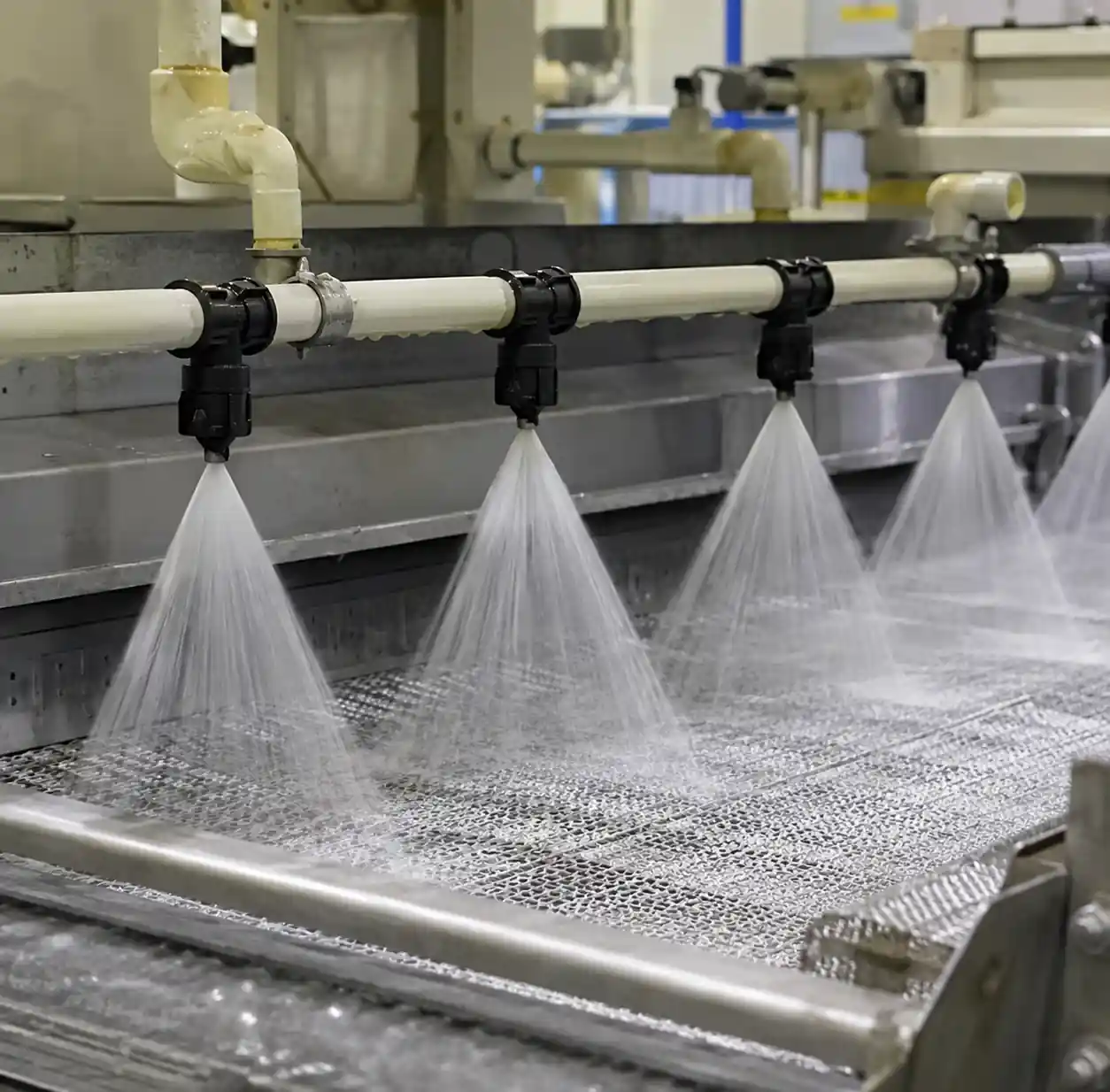 Chemical resistant nozzles operating in spray washing system
Temperature cycling effects: Repeated thermal cycling between room temperature and elevated operating temperature accelerates polymer aging through expansion-contraction fatigue. In pharmaceutical lyophilizer loading systems alternating between -40°C product freezing and 120°C steam sterilization, we specify 316L stainless despite PVDF's apparent compatibility—thermal cycling causes PVDF stress cracking within 200 cycles.
Pressure and Flow Requirements
Operating pressure affects material selection through stress-corrosion cracking susceptibility in metals and creep deformation in polymers. For pressures above 100 psi with corrosive chemicals, metallic materials generally prove more reliable than polymers despite superior chemical resistance of fluoropolymers.
Flow rate precision requirements: Processes requiring ±5% flow consistency over time need materials resisting erosion and corrosion at the orifice. A 0.1 mm orifice diameter increase from wear changes flow rate by approximately 10%—exceeding most process specifications. This drives ceramic or Hastelloy specifications for precision spray applications even when less expensive materials appear chemically adequate.
Contamination Tolerance
Metal ion contamination destroys semiconductor manufacturing yields, pharmaceutical product purity, and food safety. When total metal contamination must stay below 10 ppb, fluoropolymer nozzles become mandatory regardless of chemical resistance advantages offered by stainless steel or Hastelloy.
Material ranking by contamination risk:
| Material Type | Typical Metal Ion Leaching (ppb) | Particle Generation Risk |
|---|---|---|
| PTFE/PFA | < 1 | Very Low |
| PVDF | < 5 | Very Low |
| PEEK | < 10 | Low |
| 316L Stainless (electropolished) | 20-100 | Low to Moderate |
| Hastelloy C-276 | 50-200 | Low to Moderate |
| Ceramic (SiC) | < 5 | Moderate (fracture risk) |
Total Cost of Ownership Analysis
Purchase price represents 15-30% of true nozzle cost over a 5-year period for critical applications. Factor in:
Replacement frequency and labor costs: A $45 PVDF nozzle requiring annual replacement with 2 hours technician time at $85/hour costs $215/year. A $450 Hastelloy nozzle lasting 7+ years costs $64/year even before considering downtime savings.
Downtime impact: Calculate actual production loss during nozzle failure and replacement. For a pharmaceutical batch reactor where failed spray nozzles cost 8 hours downtime at $12,000/hour production value, spending an extra $800 for Hastelloy versus stainless steel pays back in the first failure avoided.
Process quality risks: Gradual nozzle degradation causes spray pattern deterioration before visible failure. In coating applications, this creates product quality variation weeks before operators notice the failing nozzle. Specify materials with known multi-year life rather than replacing marginally adequate materials annually.
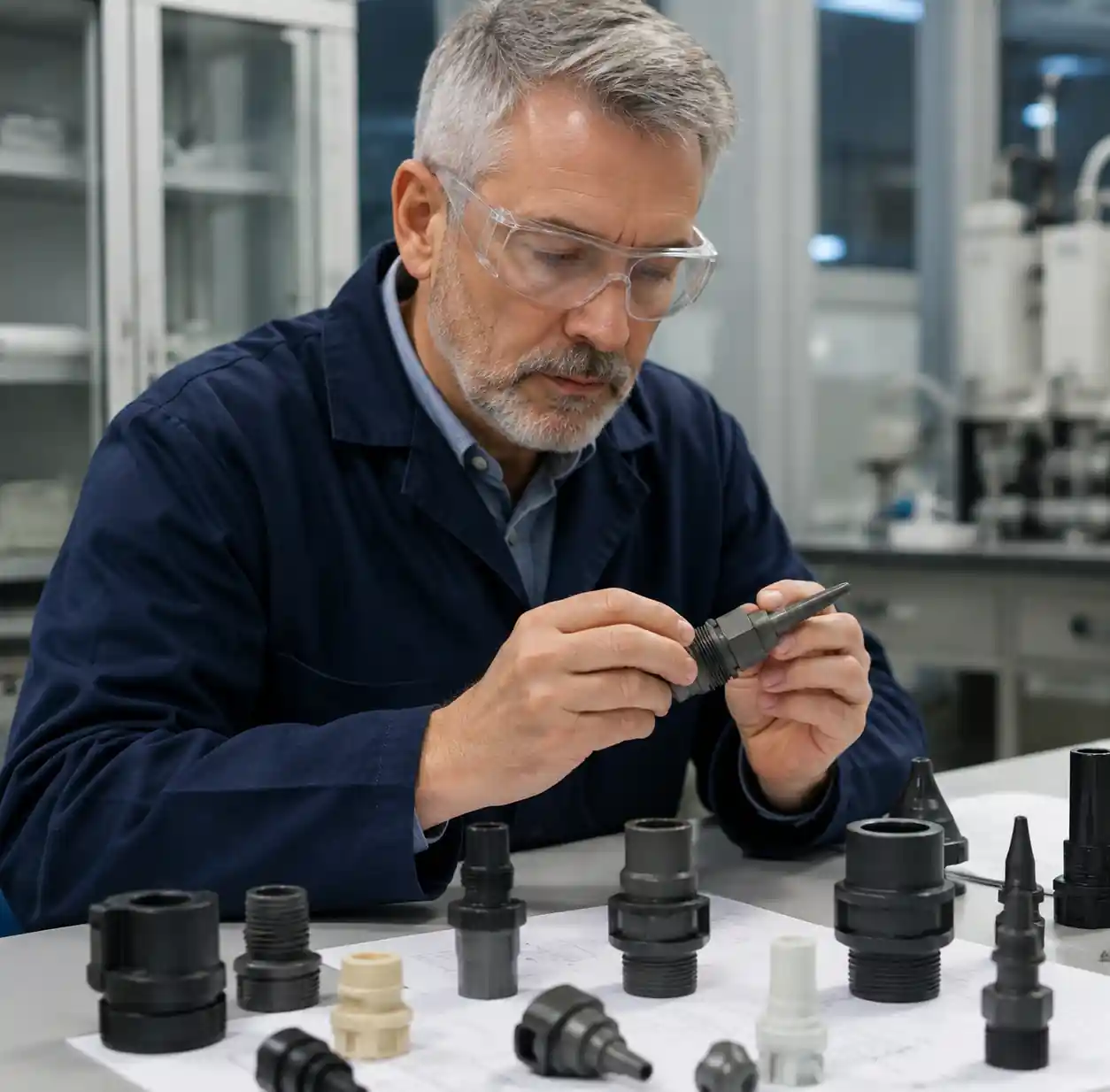 Industrial engineer evaluating chemical resistant nozzle materials
Installation and Maintenance Factors Affecting Material Performance
Thread Compatibility and Galling Prevention
Stainless steel nozzles threaded into stainless steel housings gall during installation and removal without proper lubrication. The cold-welding effect welds threads together, requiring destructive removal. Always apply food-grade anti-seize compound or PTFE tape even in sanitary applications.
Fluoropolymer nozzles require controlled torque—over-tightening crushes threads and causes stress cracking. Hand-tight plus 1/4 turn typically seals PVDF connections adequately. We've analyzed dozens of "premature failure" PVDF nozzles that actually failed from installation over-torque creating stress concentration points.
Material-Specific Inspection Protocols
Metals: Monthly visual inspection for discoloration, pitting, or crystalline deposits indicating localized corrosion. Annual flow testing detects orifice enlargement before spray patterns degrade noticeably.
Fluoropolymers: Quarterly inspection for stress cracking (fine surface cracks perpendicular to stress lines), discoloration (yellowing or browning indicates chemical attack or thermal degradation), and dimensional changes (swelling suggests chemical absorption). Replace immediately upon detecting stress cracks—catastrophic failure typically follows within days to weeks.
Ceramics: Pre-installation dye penetrant inspection to detect microcracks from handling. Periodic tap testing (gentle metallic tap produces clear ring when intact, dull thud when cracked) during maintenance intervals.
Chemical Changeover Considerations
Process changes introducing new chemicals require compatibility re-verification even when both chemicals individually rate as compatible. We've documented cases where nozzles handling sulfuric acid for years failed within weeks after changing to hydrochloric acid—both chemicals individually showed "excellent" compatibility ratings for the material, but the changeover left residual sulfates that created localized acid concentration cells with the hydrochloric acid.
Flush with neutralizing solution, rinse thoroughly with deionized water, and allow complete drying before introducing new chemicals. For critical applications, consider replacing nozzles rather than relying on cleaning when changing chemical services.
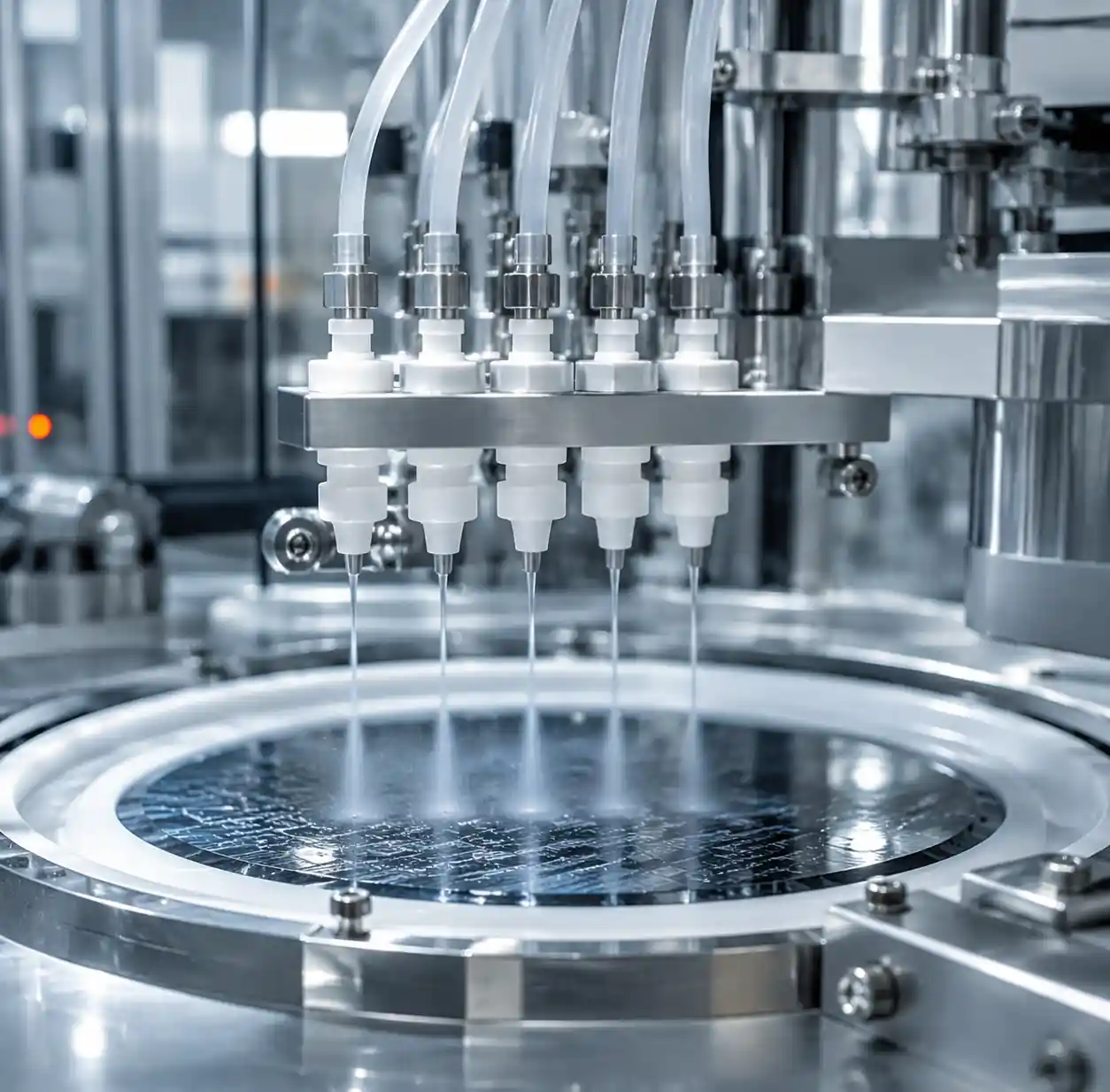 Chemical spray nozzles in semiconductor manufacturing cleanroom
Frequently Asked Questions
Can I use 316 stainless steel nozzles with sodium hypochlorite bleach solutions?
Yes, but with significant limitations. At concentrations below 3% and temperatures under 35°C, 316 stainless provides acceptable service life (2-3 years typical). Above 5% concentration or 40°C temperature, expect severe pitting corrosion within 6-12 months. For bleach concentrations above 5%, Hastelloy C-276, titanium, or PVDF (below 60°C) prove more reliable. The chloride content and pH matter as much as hypochlorite concentration—acidic bleach (pH < 7) accelerates stainless steel attack significantly.
How do I determine if a fluoropolymer nozzle has reached end of life?
Four indicators signal replacement: stress cracks visible on external surfaces (fine lines perpendicular to mechanical stress), spray pattern degradation (uneven distribution, increased drop size, reduced angle), dimensional changes exceeding 2% (measure threaded OD with calipers), or discoloration (yellowing, browning, or opacity changes). Flow rate increase above 10% from baseline indicates orifice erosion or corrosion. Don't wait for catastrophic failure—fluoropolymers crack suddenly once stress-crack propagation begins.
What causes ceramic nozzles to fail if they're chemically inert?
Thermal shock and mechanical impact cause 95% of ceramic nozzle failures. Rapid temperature changes above 100°C/minute create internal stress gradients that exceed fracture toughness. We recommend 30-minute heating/cooling ramps when starting or stopping processes above 150°C. Installation torque must follow manufacturer specifications exactly—over-tightening creates compression stress concentrations. Drop impact during handling creates invisible internal cracks that propagate during pressure cycles.
Why do my PVDF nozzles crack after only 6 months when compatibility charts show excellent resistance?
Three common causes beyond chemical incompatibility: over-torque installation (most common—requires only hand-tight plus 1/4 turn), operating above pressure-temperature limits (creep deformation leads to stress cracking), and UV exposure for outdoor installations (use UV-stabilized PVDF grades). Temperature cycling through PVDF's glass transition range (around -40°C) accelerates fatigue. Also verify your compatibility chart addresses your actual concentration and temperature—many charts list only room temperature data.
Is it worth paying 10× more for Hastelloy instead of stainless steel?
Calculate your true replacement cost including labor, downtime, and quality risk. A chemical reactor producing $50,000 product per batch cannot afford nozzle failures during critical process steps—Hastelloy's 5-7 year life versus stainless steel's 6-12 months makes the premium immaterial. For non-critical tank washing where failures cause minimal disruption, stainless steel's lower cost may prove optimal even with annual replacement. The decision inflection point typically occurs when downtime costs exceed $1,000 per incident or replacement frequency exceeds twice yearly.
Can I mix nozzle materials in the same spray header?
Yes, provided each nozzle material suits its specific chemical exposure and all materials tolerate any common chemicals. We've installed PVDF nozzles alongside 316 stainless nozzles in multi-header systems where some headers spray aggressive acids (PVDF) while others spray caustic solutions (stainless adequate). Ensure galvanic coupling doesn't occur between dissimilar metals sharing common electrolyte—isolate Hastelloy and stainless steel nozzles with non-conductive washers or use separate headers. Never mix materials within a single spray circuit if any nozzle failure creates cross-contamination risk.
Conclusion
Material selection determines whether your chemical spray nozzles last weeks or years. The framework comes down to chemical compatibility at maximum process temperature, pressure capabilities matching your operating conditions, and contamination requirements for your product quality standards.
Start with the harshest chemical at peak concentration and temperature. Verify pressure ratings account for polymer strength degradation at operating temperature. Calculate total ownership cost including replacement labor and downtime—initial price differences rarely exceed a single failure's cost.
When specification seems borderline, choose the more resistant material. The cost difference between adequate and superior materials typically represents 2-3 months of production value, while premature failures consume weeks of troubleshooting and create quality risks that cascade through your operation. YuechenPrecision Technology engineers specify materials conservatively for exactly this reason—process conditions shift, chemicals concentrate beyond design values, and maintenance intervals stretch longer than planned.
Review installed nozzle materials annually as processes evolve. That reactor cleaning procedure that changed from 10% to 15% acid concentration may have pushed your stainless steel nozzles past their reliable service threshold. Material upgrades implemented proactively cost far less than emergency replacements during unplanned outages.