



Agricultural Spray Nozzles: Complete Guide for Southeast Asian Farmers
After two decades consulting across Southeast Asia, I've watched countless farmers lose 20-40% of their pesticides to drift, poor coverage, and wrong nozzle selection. In Thailand's rice paddies, Malaysia's palm plantations, and Vietnam's vegetable farms, the same mistakes repeat: using temperate-climate recommendations that fail in tropical conditions.
Southeast Asian agriculture faces unique challenges—85% humidity year-round, narrow spray windows before monsoon rains, small plots (0.5-2 hectares), and diverse cropping systems. Standard nozzle advice from North America or Europe doesn't account for these realities. This guide explains what actually works in your conditions.
Table of Contents
- 1. Why Tropical Farming Demands Different Nozzle Strategies
- 2. Four Essential Nozzle Types for Tropical Agriculture
- 2.1. Flat Fan Nozzles: Field Crop Foundation
- 2.2. Hollow Cone Nozzles: Dense Canopy Penetration
- 2.3. Air Atomizing Nozzles: Precision Applications
- 3. Critical Selection Parameters
- 3.1. Water Quality: The Silent Performance Killer
- 3.2. Pressure Consistency Matters
- 4. Crop-Specific Applications
- 4.1. Rice: Coverage Without Drift
- 4.2. Palm Oil: Tackling Vertical Challenges
- 4.3. Vegetables: Flexible System Approach
- 5. Maintenance and Calibration
- 6. Common Costly Mistakes
- 7. FAQ
- 7.1. Q: Can I use cheaper plastic nozzles if I replace them more frequently?
- 7.2. Q: How do I reduce drift when spraying near fish ponds or neighbor's crops?
- 7.3. Q: My sprayer pressure fluctuates—do I need expensive pressure-regulating nozzles?
- 7.4. Q: Can I use one nozzle type for all my crops to simplify inventory?
- 7.5. Q: How often should I replace nozzles?
- 7.6. Q: Are expensive nozzles from international brands really better than local options?
- 8. Conclusion
Why Tropical Farming Demands Different Nozzle Strategies
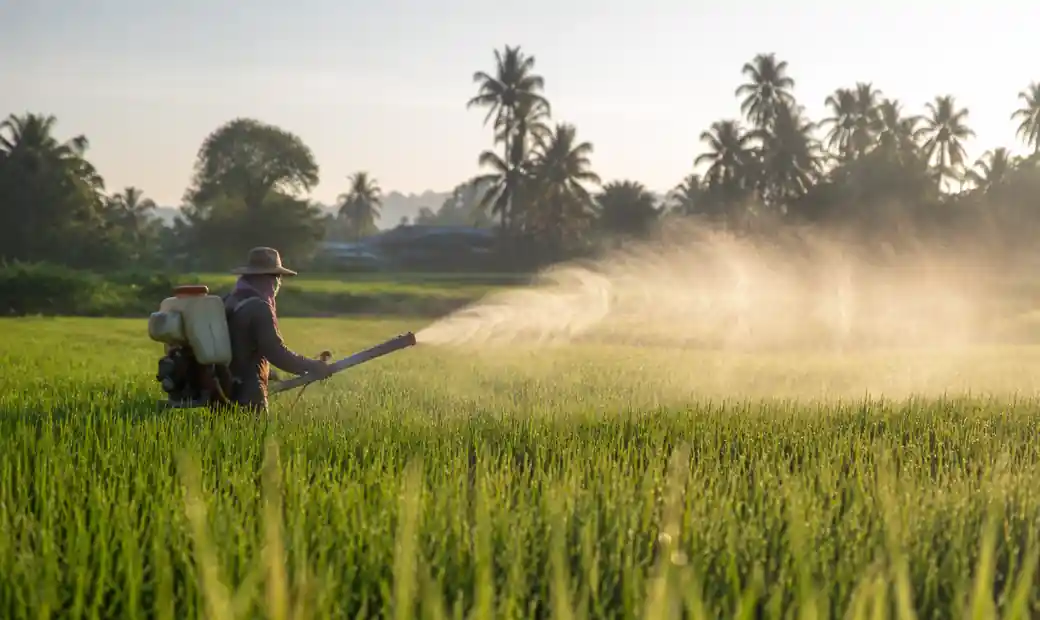 Pesticide drift demonstration in high humidity Southeast Asian rice field
In monsoonal climates, you're spraying in 85% humidity with rain forecasted within 6-8 hours. Your application window is narrow, and re-treatment isn't always an option. This fundamentally changes droplet size selection, spray pressure, and nozzle type requirements compared to temperate regions.
Canopy architecture matters equally. Thai rice at maximum tillering differs entirely from temperate row crops. Palm fronds create unique turbulence patterns. Dense tropical canopies require penetration strategies that don't translate from Western agricultural systems.
Four Essential Nozzle Types for Tropical Agriculture
Flat Fan Nozzles: Field Crop Foundation
For rice, soybeans, and vegetable rows, flat fan nozzles remain the workhorse. But performance varies dramatically in high humidity.
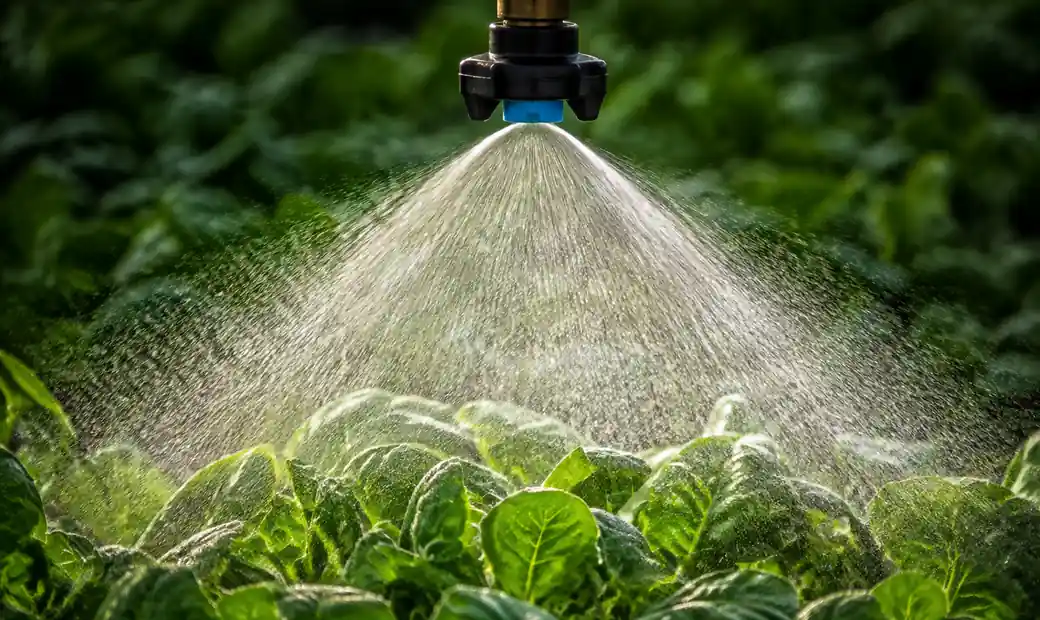 Flat fan spray nozzle pattern demonstration on vegetable crop
Standard vs. Air-Induction Comparison
| Feature | Standard Flat Fan | Air-Induction Flat Fan |
|---|---|---|
| Droplet size (VMD) | 150-250 µm | 300-450 µm |
| Drift reduction | Moderate (up to 50%) | Excellent (75-90%) |
| Coverage uniformity | Good at correct overlap | Excellent across wider range |
| Clogging resistance | Moderate | High (larger orifices) |
| Humid climate performance | Prone to droplet coalescence | Maintains size distribution |
| Cost per nozzle | $3-8 USD | $12-22 USD |
Research confirms that air-induction nozzles reduce drift by 75-90% in rice applications—critical near fish ponds or residential areas. Coarser droplets resist evaporation better; at 35°C a 400 µm droplet arrives with 60% more mass than a 200 µm droplet. When selective herbicides cost $25-40 per liter, this efficiency pays for the premium within two applications.
Hollow Cone Nozzles: Dense Canopy Penetration
Fruit orchards, oil palm, and dense vegetables need spray that penetrates deep. Hollow cone nozzles produce ring-shaped patterns with higher kinetic energy.
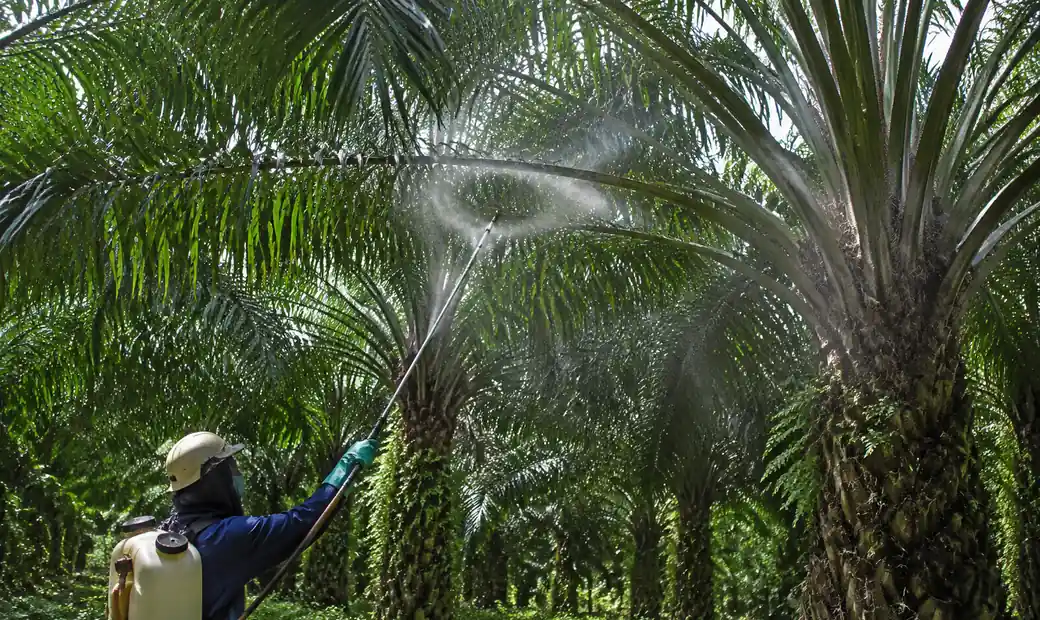 Hollow cone nozzle application in oil palm plantation canopy
For palm weevil control, hollow cones deliver 40-60% better coverage on inner frond bases versus fan nozzles. But pressure matters—you need minimum 3 bar, optimally 4-6 bar. Below that, you get weak patterns that waste chemical.
Air Atomizing Nozzles: Precision Applications
For greenhouses and high-value crops requiring ultra-fine droplets, air atomizing nozzles create 10-150 µm droplets perfect for complete fungicide coverage.
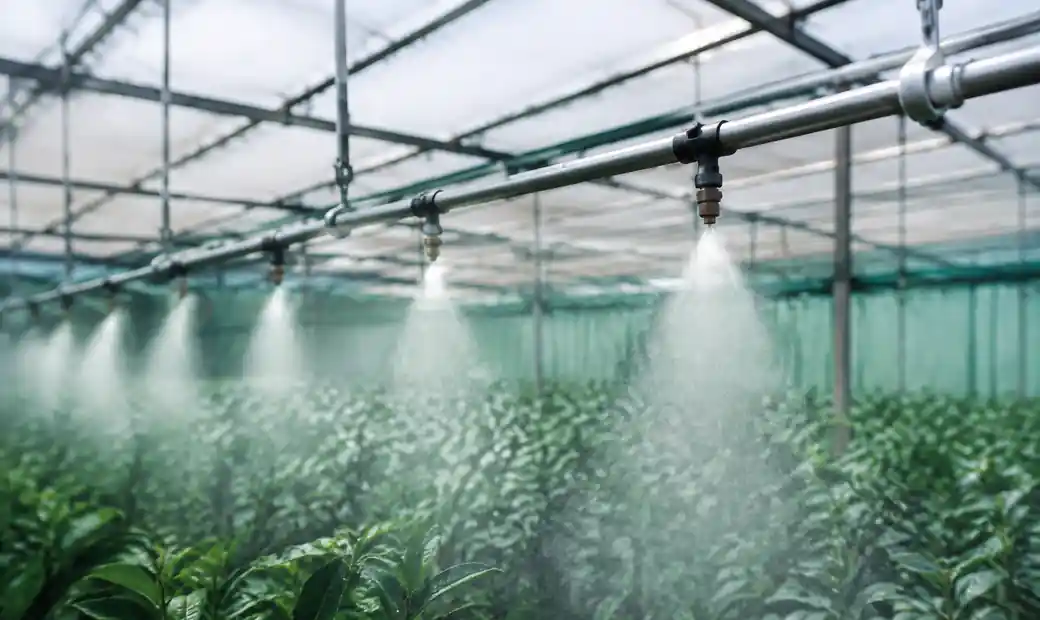 Air atomizing nozzle creating fine mist in protected cultivation greenhouse
They require compressor systems (4-6 bar, 20-40 CFM), making them suitable for operations above $10,000/hectare annually. Emerging use in dry fog humidification for mushroom houses prevents surface wetting while maintaining optimal humidity.
Critical Selection Parameters
Water Quality: The Silent Performance Killer
Southeast Asian water sources carry 100-500 ppm suspended solids versus <50 ppm in municipal systems.
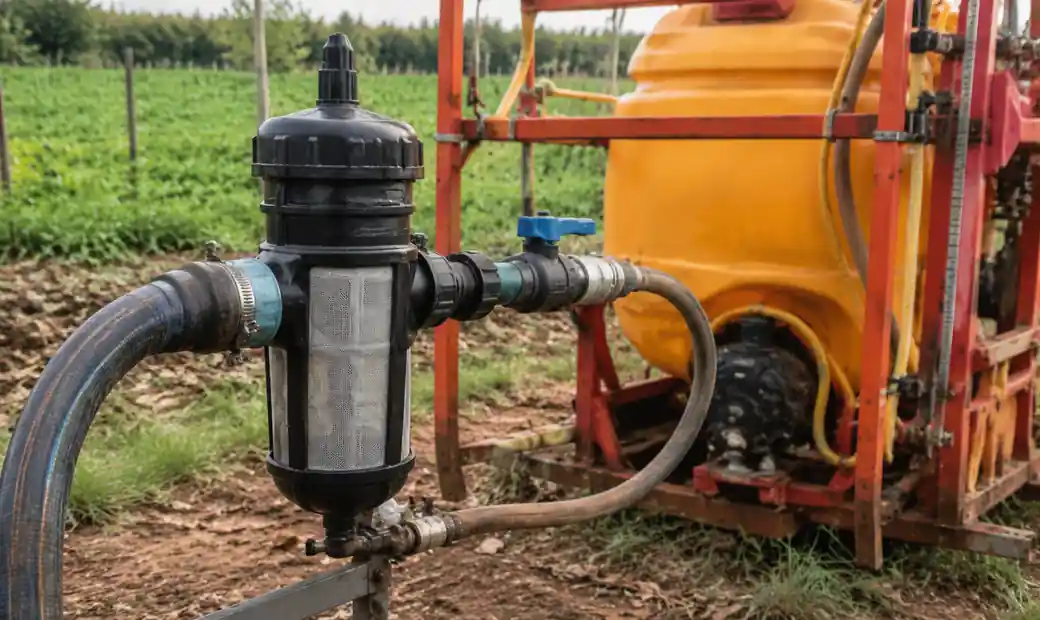 Agricultural spray system with inline filtration equipment for sediment removal
Nozzle Material Selection by Water Quality
| Water Source | Suspended Solids | Material Recommendation | Expected Lifespan |
|---|---|---|---|
| Municipal supply | <50 ppm | Plastic acceptable | 3-4 seasons |
| Deep well | 50-150 ppm | Brass or stainless steel | 2-3 seasons |
| Irrigation canal | 150-500 ppm | Stainless steel only | 1-2 seasons |
| Pond/reservoir | 500+ ppm | Stainless steel + 50-mesh filter | 1 season |
A plastic nozzle on silty water increases orifice size 15-20% after 40 hours—that's 20% more chemical applied or 20% less pressure (wrong droplet size). Invest in 50-mesh screen filters ($15-30) and clean between every tank fill.
Pressure Consistency Matters
Knapsack and motorized sprayers struggle maintaining stable pressure. As temperature rises 28°C to 38°C, output changes. Manual pumping varies with operator fatigue.
A flat fan rated for 3 bar produces 260 µm droplets. At 2 bar (common with fatigue), droplet size jumps to 340 µm while flow drops 18%. Use pressure-regulating nozzles or mount gauges where operators see them continuously.
Crop-Specific Applications
Rice: Coverage Without Drift
Rice dominates Southeast Asian farming, yet nozzle selection remains poor. Most use whatever came with the sprayer.
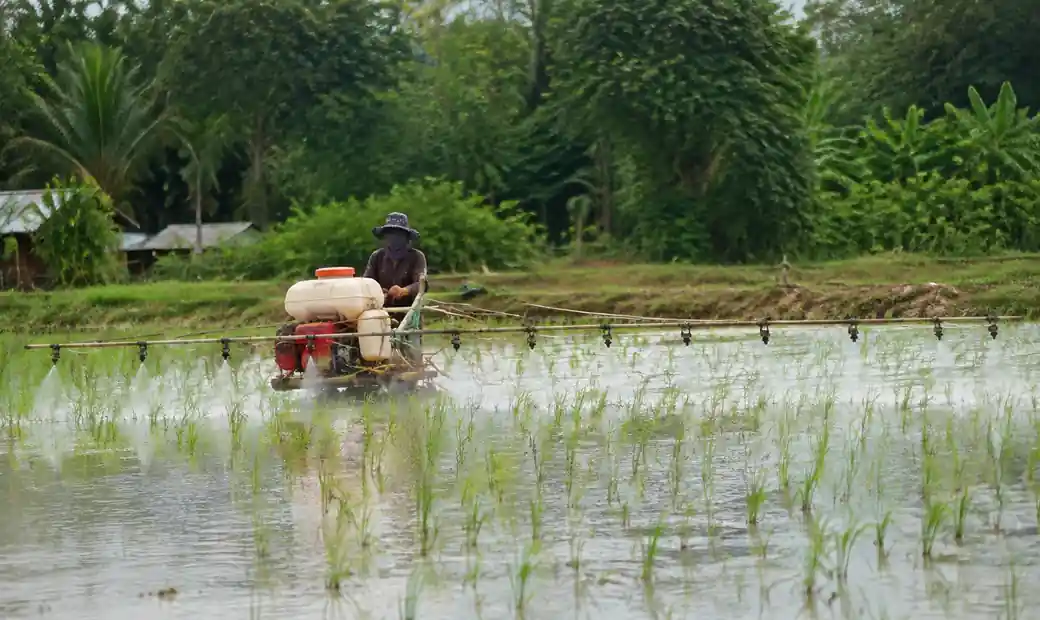 Farmer operating boom sprayer with proper nozzle spacing in flooded rice field
For herbicides in flooded rice, use 250-350 µm droplets from 110° flat fans spaced at 50 cm. Research shows ultra-fine nozzles can reduce water usage 41% and pesticides 43% while maintaining efficacy.
For fungicides at booting or heading stage, shift to 200-250 µm for adequate canopy coverage. Spray early morning (6:00-8:30 AM) when humidity aids adhesion before convective currents increase drift. Never use droplets below 150 µm—they bounce off waxy leaves or evaporate before deposition.
Palm Oil: Tackling Vertical Challenges
Oil palm requires treating 8-12 meter trees with dense, water-shedding fronds. Use hollow cone nozzles producing 300-400 µm droplets at 4-6 bar on mist blowers. Direct spray upward at 45-60° targeting frond bases and crowns where pests concentrate.
Electrostatic systems charging droplets improve deposition 40-70%. Initial costs run $8,000-15,000 but deliver 18-24 month payback on operations above 100 hectares.
Vegetables: Flexible System Approach
Southeast Asian vegetable farmers grow 4-8 crops simultaneously on small plots. Invest in quality booms with quick-coupling connections for rapid nozzle changes.
Keep three types: 80° flat fans for low crops (lettuce, bok choy), 110° for medium height (tomatoes, eggplant), and hollow cones for dense canopies (bitter gourd). This $150-200 investment eliminates compromises causing poor results.
Maintenance and Calibration
A worn nozzle invisibly steals chemical efficacy and wastes money.
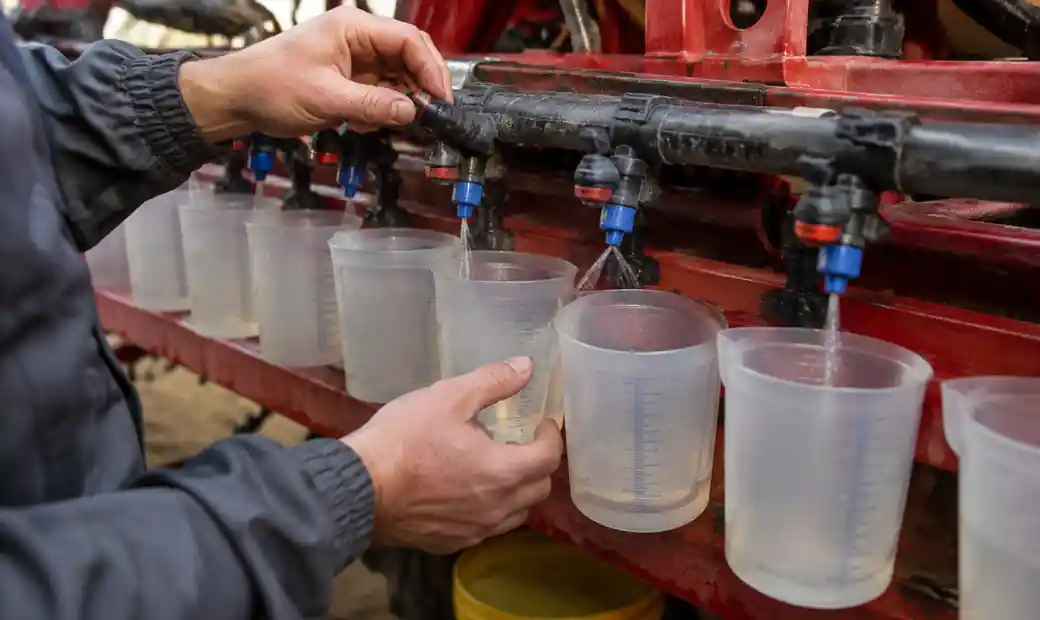 Farmer testing and comparing flow rates from multiple spray nozzles
Check flow rates monthly during active season. Catch output for 30 seconds at operating pressure, measure volume, compare to specs. Replace any nozzle flowing >10% above original rate immediately—worn nozzles apply incorrect amounts and produce wrong droplet sizes.
Clean after every use. Southeast Asia's humidity combined with pesticide residues creates perfect conditions for deposits. Use soft brushes, never metal wires. Sonic cleaners ($40-80) work excellently for multiple nozzles. Store in protective cases with desiccant during wet season.
For proper coverage, space flat fan nozzles using: optimal spacing = spray height × 0.75 for 110° nozzles. At 50 cm boom height, space 37.5 cm apart. Five-centimeter errors create visible striping.
Verify pressure with calibrated gauges at the boom, not just the pump. Pressure drop along supply lines reaches 0.5-1.5 bar. For contact herbicides in rice, target 200-300 L/ha. Systemic products need 150-200 L/ha. Below 100 L/ha compromises coverage; above wastes time.
Common Costly Mistakes
Buying on price alone: A $5 plastic nozzle wears out in 20-30 sprays, increasing flow 15-25% and costing $40-80 in wasted pesticides. A $20 stainless steel nozzle maintains specs for 200+ hours, saving money overall.
Wrong spray angle: Using 65° aircraft nozzles on 50 cm booms creates stripes and gaps. Match spray angle to boom height and spacing.
Skipping calibration: Professional applicators calibrate before each tank; many farmers never calibrate. As nozzles wear and pressure changes, application rates drift. Weekly 15-minute calibration delivers the highest return of any farming activity.
FAQ
Q: Can I use cheaper plastic nozzles if I replace them more frequently?
Yes, but calculate the total cost. Plastic nozzles at $4 each replaced every 20 hours (typical lifespan in Asian field conditions) cost $12 per 60-hour season. Stainless steel at $18 lasting 200+ hours costs $5.40 per 60 hours. Plus plastic nozzles degrade gradually—you're applying incorrect amounts for weeks before failure is obvious. For commercial operations, stainless steel is actually more economical.
Q: How do I reduce drift when spraying near fish ponds or neighbor's crops?
Switch to air-induction nozzles which cut drift 75-90%, increase boom height to 40-50 cm (higher booms despite seeming worse actually reduce drift by moving spray out of ground-level turbulence), apply during stable atmospheric conditions (6:00-9:00 AM or 6:00-8:00 PM), and reduce boom pressure to the minimum that maintains pattern quality. Research confirms that coarser droplets from proper nozzle selection are the single most effective drift control method.
Q: My sprayer pressure fluctuates—do I need expensive pressure-regulating nozzles?
If your pressure varies by more than 0.5 bar during operation, yes. Alternatively, fix the pressure source: repair pump, replace worn check valves, or upgrade to a constant-pressure sprayer system. Pressure-regulating nozzles cost 40-60% more but maintain performance across 2-5 bar input range. For operations spraying 5+ hectares weekly, they're worth the investment.
Q: Can I use one nozzle type for all my crops to simplify inventory?
Not if you want optimal results. 110° flat fans handle maybe 60% of situations adequately but perform poorly in dense canopies or when extreme drift control is needed. Maintain at least two nozzle types—a flat fan for field crops and a hollow cone for dense canopy applications. The cost difference is minimal ($40-60 total) while application quality improves dramatically.
Q: How often should I replace nozzles?
Test them, don't guess. Check flow rates monthly during active season. Replace when any nozzle flows 10% above original specification. In typical Southeast Asian conditions with proper filtration, quality brass nozzles last 80-120 hours, stainless steel 200-300 hours, and plastic 20-40 hours. Without filtration, divide these numbers by three.
Q: Are expensive nozzles from international brands really better than local options?
Quality matters more than brand origin. YuechenPrecision Technology manufactures nozzles to international specifications at regional prices. The key is precision—orifice tolerances should be within ±5%, spray angles within ±3°. Cheap nozzles vary 15-25% between supposedly identical units. This variance makes calibration meaningless and wastes inputs. Request test certificates showing your specific nozzle's measured specifications, not just manufacturer typical values.
Conclusion
Nozzle selection represents one of farming's highest-leverage decisions. The right combination saves 20-40% on chemical costs, improves pest control, reduces environmental impact, and cuts labor time.
For Southeast Asian conditions, ignore temperate-climate advice. Focus on high humidity performance, diverse cropping flexibility, and challenging water quality. Invest in filtration, maintain pressure consistency, match nozzles to crops, and replace worn components before they cost money.
Start by testing current nozzle flow rates, measuring actual pressure, and checking spray patterns. The gaps guide your improvements. Quality systems from YuechenPrecision Technology deliver measurable first-season returns while lasting multiple years with proper maintenance. Your crops, budget, and environment all benefit from this fundamental detail done right.