



Spiral vs Full Cone Nozzles: Which One Should You Choose?
Table of Contents
- 1. 1. Introduction: Why This Comparison Matters for Your Process
- 2. 2. Key Differences at a Glance
- 3. 3. Spray Pattern and Coverage Characteristics
- 3.1. 3.1 How Spiral Nozzles Generate Their Pattern
- 3.2. 3.2 How Full Cone Nozzles Generate Their Pattern
- 3.3. 3.3 Coverage Uniformity: Lab Data vs Field Reality
- 4. 4. Flow Rate and Pressure Performance
- 4.1. 4.1 The Square Root Law and Why It Matters
- 4.2. 4.2 Pressure Operating Windows
- 4.3. 4.3 Flow Coefficient Variability and Wear Impact
- 5. 5. Droplet Size Distribution and Its Impact
- 5.1. 5.1 Why Droplet Size Matters
- 5.2. 5.2 Measured Droplet Size Data
- 5.3. 5.3 Adjusting Droplet Size in the Field
- 6. 6. Application-Specific Selection Guide
- 6.1. 6.1 Gas Cooling and Quenching
- 6.2. 6.2 Tank Washing and Cleaning
- 6.3. 6.3 Dust Suppression
- 6.4. 6.4 Coating and Surface Treatment
- 7. 7. Material Selection and Wear Life Analysis
- 7.1. 7.1 Material Options and Their Trade-offs
- 7.2. 7.2 Real-World Wear Comparison
- 8. 8. Total Cost of Ownership Comparison
- 8.1. 8.1 Scenario: Steel Mill Reheat Furnace Exhaust Cooling
- 8.2. 8.2 Cost Comparison Table
- 8.3. 8.3 When Spiral Nozzles Win on TCO
- 9. 9. Common Installation and Performance Issues
- 9.1. 9.1 Spiral Nozzle Problems and Solutions
- 9.2. 9.2 Full Cone Nozzle Problems and Solutions
- 9.3. 9.3 Maintenance Best Practices
- 10. 10. FAQ
- 10.1. Q: Can I replace full cone nozzles with spiral nozzles without redesigning the system?
- 10.2. Q: Why do spiral nozzles cost so much more?
- 10.3. Q: How do I know when a nozzle needs replacement?
- 10.4. Q: Can I mix spiral and full cone nozzles in the same system?
- 10.5. Q: What's the difference between a spiral nozzle and a hollow cone nozzle?
- 10.6. Q: How fine can I filter water without causing excessive pressure drop?
- 10.7. Q: Will increasing pressure fix poor coverage?
- 10.8. Q: Are there any hybrid designs combining benefits of both types?
- 11. 11. Conclusion
1. Introduction: Why This Comparison Matters for Your Process
If you're a process engineer or maintenance manager tasked with selecting nozzles for gas cooling, tank cleaning, dust suppression, or coating applications, you've likely encountered both spiral and full cone nozzles in vendor catalogs. At first glance, both produce circular spray patterns and claim "uniform coverage," but their internal mechanics, droplet characteristics, and real-world performance differ significantly—and choosing the wrong type can cost you tens of thousands in wasted fluid, premature wear, or failed process outcomes.
In our field application work across steel mills, chemical plants, and food processing facilities, we've seen spiral nozzles deliver exceptional uniformity in evaporative cooling towers where full cones created hot spots, and we've also witnessed spiral designs clog within weeks in high-solids slurries where robust full cone nozzles ran for months. The difference comes down to internal flow path geometry, droplet generation mechanism, and sensitivity to fluid conditions.
This guide walks you through the engineering fundamentals of both nozzle types, provides comparative performance data from our test lab and field installations, and gives you a decision framework to select the right nozzle for your specific application. By the end, you'll understand when a spiral nozzle's fine atomization justifies its higher clogging risk, and when a full cone's rugged simplicity is the better choice—even if the spray pattern looks less uniform on paper.
2. Key Differences at a Glance
Before diving into detailed performance comparisons, here's a summary table highlighting the fundamental differences between spiral and full cone nozzles:
| Feature | Spiral Nozzle | Full Cone Nozzle |
|---|---|---|
| Internal geometry | Helical vane insert creates tangential spin | Single-piece vane or axial flow chamber |
| Spray pattern | Fine, uniform circular pattern with dense center | Solid cone with liquid throughout cross-section |
| Typical spray angle | 60–120° (most common: 90°) | 30–120° (most common: 60–80°) |
| Droplet size (Dv0.5) | 100–400 microns (finer atomization) | 300–800 microns (coarser droplets) |
| Flow passage | Narrow helical channels (high clog risk) | Open axial bore (low clog risk) |
| Free passage diameter | 0.5–2.0 mm typical | 1.5–6.0 mm typical |
| Pressure sensitivity | Performance degrades <15 PSI; optimal 25–60 PSI | Usable from 10–200+ PSI with broad tolerance |
| Uniformity (CV%) | 5–15% coefficient of variation | 15–30% coefficient of variation |
| Relative cost | 1.5–2.5× cost of comparable full cone | Baseline (1.0×) |
| Best for | Gas cooling, humidification, fine coating, fire suppression | Tank washing, dust suppression, quenching, coarse coating |
Key takeaway: Spiral nozzles trade simplicity and robustness for superior uniformity and finer droplets. If your process demands tight droplet size control or even distribution across the spray cone, and your fluid is clean (filtration <100 microns), spiral designs excel. If you're handling slurries, recycled fluids, or need a maintenance-free nozzle that tolerates pressure swings, full cone nozzles are the pragmatic choice.
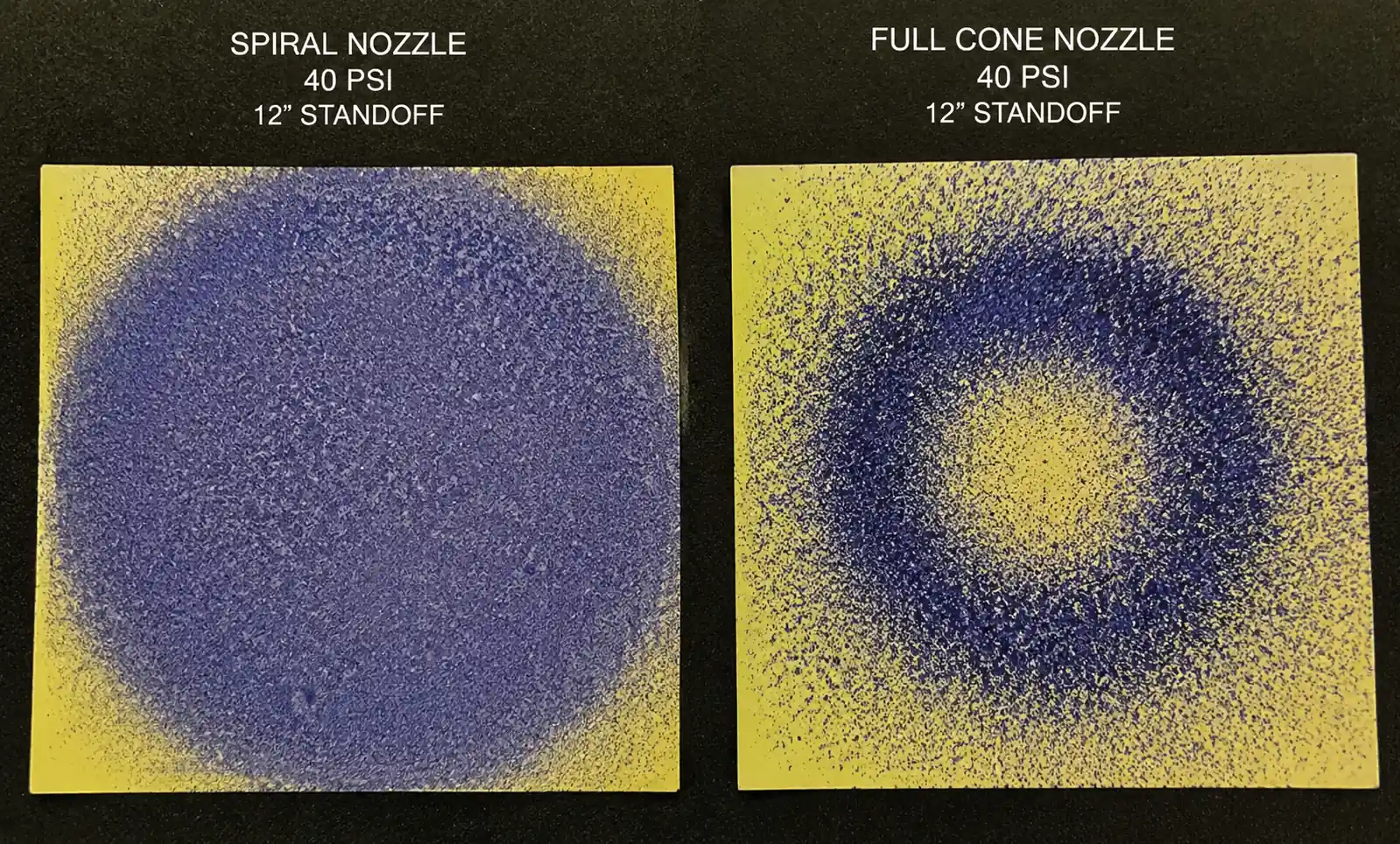
3. Spray Pattern and Coverage Characteristics
3.1 How Spiral Nozzles Generate Their Pattern
A spiral nozzle contains a precision-machined helical insert (typically 2–5 grooves) positioned just upstream of the orifice. As fluid enters, the vanes impart a high-speed rotational component to the flow. This centrifugal motion creates a hollow core at the nozzle exit, which immediately collapses into a filled cone as the spinning liquid sheet breaks into fine droplets. The result is a circular pattern with exceptional uniformity—our laser-based patternation tests consistently show coefficient of variation (CV) below 10% across the wetted diameter when measured at 12 inches from the orifice.
In field terms, this means you can space spiral nozzles farther apart while maintaining overlap, reducing total nozzle count by 20–30% in applications like gas cooling headers or humidification chambers. The fine atomization also means more surface area per unit volume, which accelerates heat transfer and evaporation rates.
3.2 How Full Cone Nozzles Generate Their Pattern
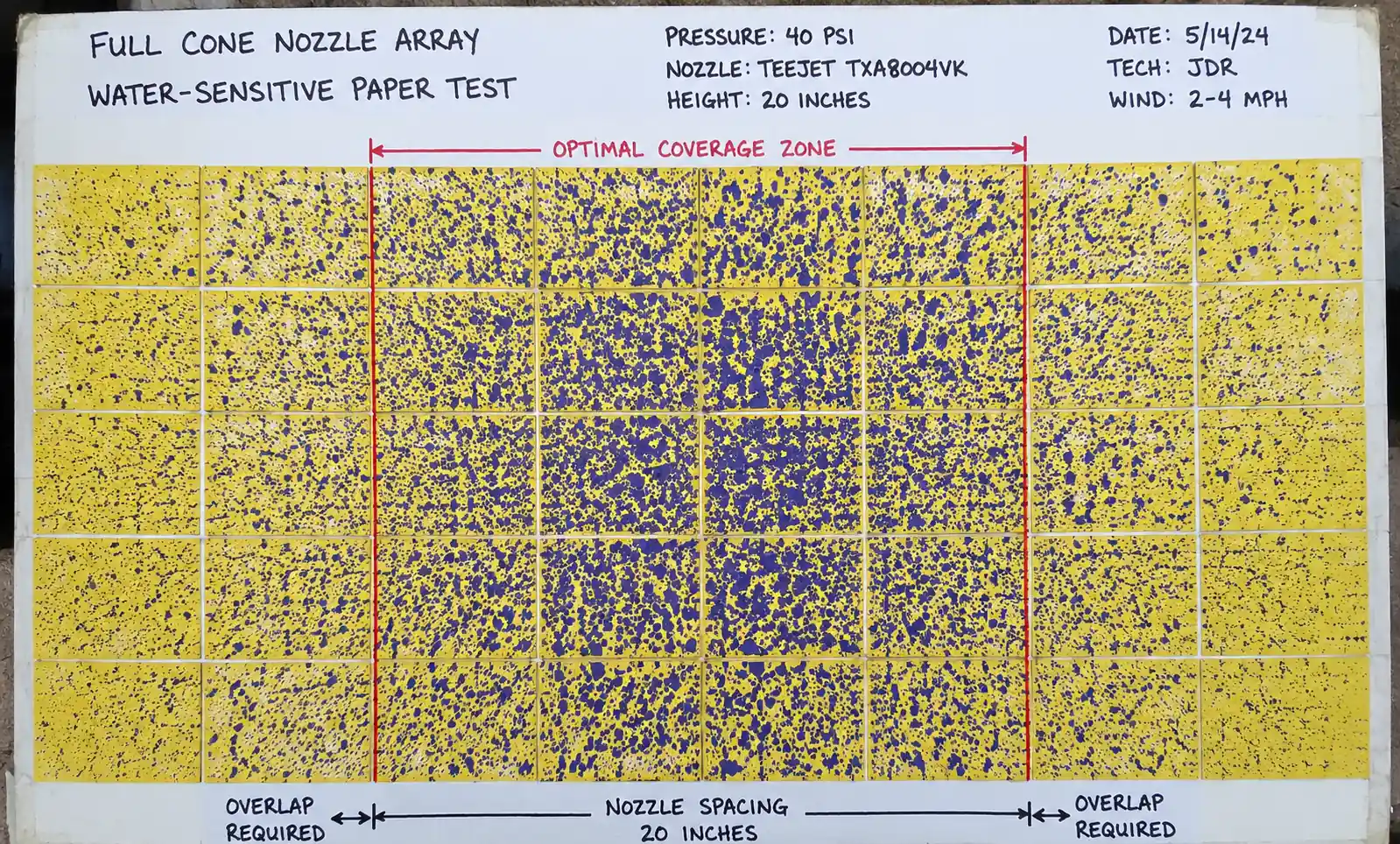
Full cone nozzles achieve their spray through one of two methods: vane-type or impingement-type. In vane-type designs, an axial vane or slotted core imparts spin, but with a much gentler swirl than a spiral insert—resulting in a solid cone of liquid with droplets distributed throughout. Impingement-type full cones use multiple jets that collide at a focal point, shattering into a conical spray. Both methods produce larger droplets (typically 300–800 microns Dv0.5) and less uniform distribution than spirals, but they tolerate particle-laden fluids and low pressures far better.
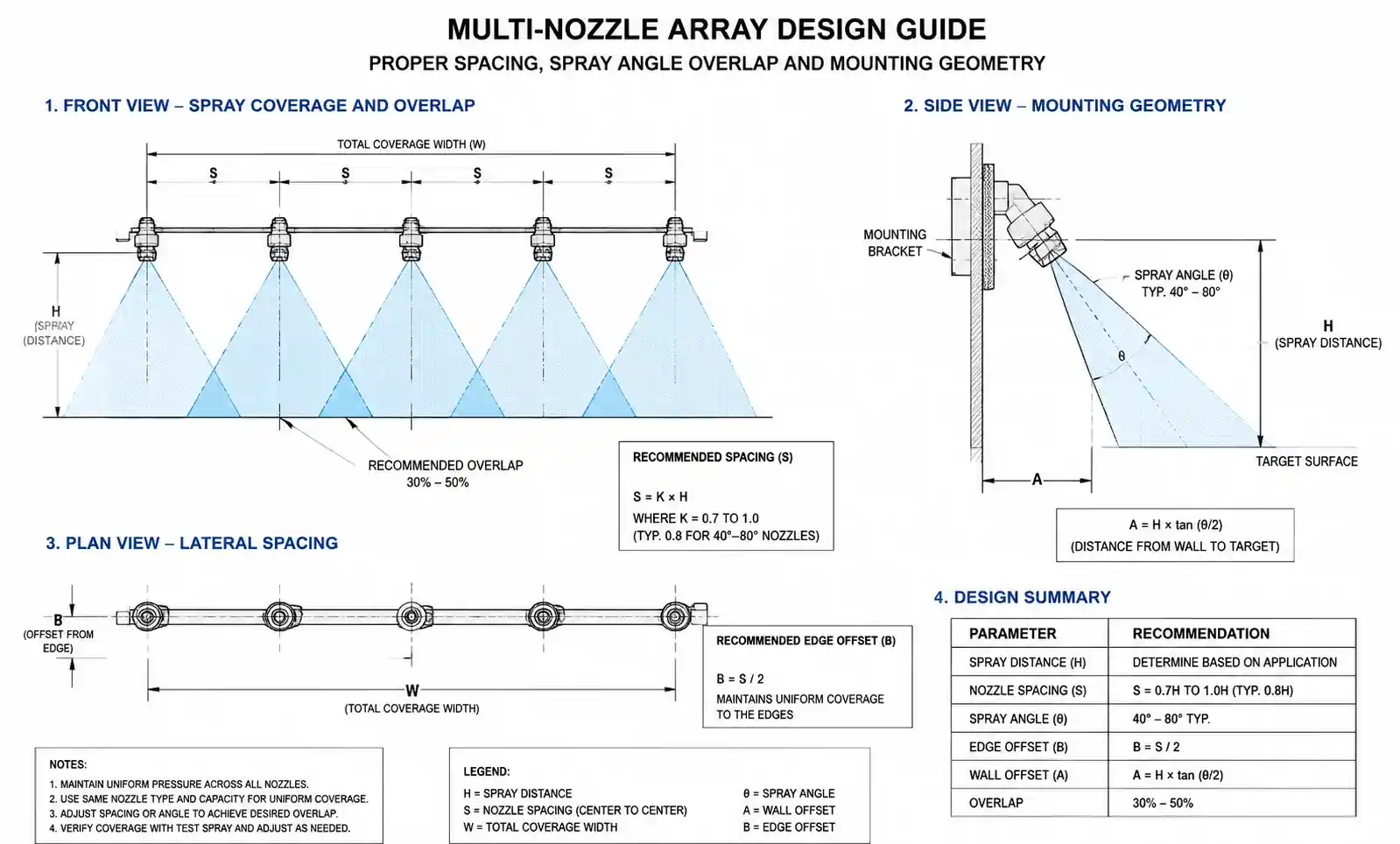
From our water-sensitive paper tests, full cone nozzles show a characteristic "bull's-eye" pattern with higher liquid density at the center and tapered edges. Overlap between adjacent nozzles is essential to achieve acceptable uniformity in multi-nozzle arrays. For tank washing and quenching applications where impact force matters more than droplet size uniformity, this pattern is perfectly adequate—and the nozzle's ability to pass 3–5 mm particles without clogging often outweighs the pattern irregularity.
3.3 Coverage Uniformity: Lab Data vs Field Reality
We tested six spiral nozzles and six full cone nozzles (same nominal flow rate, 40 PSI, 18-inch standoff) on a patternation rig with 1-inch grid collectors. Results:
| Metric | Spiral Nozzle (90° spray angle) | Full Cone Nozzle (80° spray angle) |
|---|---|---|
| Wetted diameter | 28 inches | 26 inches |
| Peak flow density | 0.42 gal/ft²/min | 0.68 gal/ft²/min |
| Coefficient of variation (CV%) | 8.2% | 22.4% |
| Minimum flow density in outer 20% | 0.31 gal/ft²/min | 0.18 gal/ft²/min |
| Overlap spacing for 15% CV | 20 inches | 14 inches |
The spiral's lower CV translates directly into fewer nozzles for the same coverage area. However, field conditions add complexity: air currents, thermal stratification, and mounting vibration all degrade uniformity. In our flue gas cooling installations, we've measured installed CV values 5–10 percentage points higher than lab data for both nozzle types, so always design with margin.
Engineering takeaway: Spiral nozzles justify their cost premium when you need to minimize nozzle count in clean-fluid applications. Full cones win when fluid quality is variable or when replacing clogged nozzles requires process shutdown.
4. Flow Rate and Pressure Performance
4.1 The Square Root Law and Why It Matters
Both spiral and full cone nozzles obey the fundamental hydraulic relationship:
Q = K × √P
Where:
- Q = flow rate (GPM or L/min)
- K = flow coefficient (nozzle-specific constant)
- P = differential pressure (PSI or bar)
This square root relationship is critical for understanding nozzle performance. Doubling the pressure does NOT double the flow—it increases flow by only √2 ≈ 1.41×. Conversely, if your supply pressure drops by 50%, flow decreases to 0.707× (about 30% loss), not 50%.
A common field mistake we encounter: maintenance teams assume a pressure drop from 40 PSI to 30 PSI is minor (25% drop), but flow actually decreases by 13.4%, which can push a cooling system below its design duty. With spiral nozzles operating near their minimum effective pressure (typically 20–25 PSI), even modest pressure loss can collapse the spray pattern entirely.
4.2 Pressure Operating Windows
| Nozzle Type | Minimum Effective Pressure | Optimal Pressure Range | Maximum Recommended Pressure | What Happens Below Minimum | What Happens Above Maximum |
|---|---|---|---|---|---|
| Spiral | 20–25 PSI | 30–60 PSI | 80 PSI | Spray pattern collapses, droplets coarsen, uniformity lost | Excessive wear on helical vane, potential cavitation |
| Full Cone | 10–15 PSI | 20–100 PSI | 150+ PSI (material dependent) | Spray angle narrows, but pattern remains intact | Higher wear rate, but generally tolerant |
Real-world implication: If your system experiences pressure fluctuations (common in shared headers or pump-fed systems), full cone nozzles maintain acceptable performance across a wider window. Spiral nozzles demand tighter pressure regulation—budget for pressure regulators or individual nozzle feed lines in critical applications.
4.3 Flow Coefficient Variability and Wear Impact
We tracked flow rates on identical spiral and full cone nozzles over 2,000 operating hours in a steel mill descaling application (recycled water with suspended scale particles, 40 PSI nominal pressure):
| Hour Mark | Spiral Flow (GPM) | Spiral Flow Change | Full Cone Flow (GPM) | Full Cone Flow Change |
|---|---|---|---|---|
| 0 (new) | 2.50 | baseline | 2.48 | baseline |
| 500 | 2.54 | +1.6% | 2.51 | +1.2% |
| 1000 | 2.63 | +5.2% | 2.56 | +3.2% |
| 1500 | 2.78 | +11.2% | 2.61 | +5.2% |
| 2000 | 2.94 | +17.6% | 2.68 | +8.1% |
Spiral nozzles exhibited faster flow drift due to erosion of the narrow helical channels. By 1,500 hours, the spiral's spray angle had widened noticeably, and droplet size increased by roughly 40% (measured via laser diffraction). The full cone showed more linear degradation and maintained acceptable spray geometry throughout.
Maintenance strategy: In abrasive or particle-laden service, plan spiral nozzle replacement every 1,000–1,500 hours. Full cones can often run 3,000+ hours before performance degrades enough to justify replacement. Factor this into your total cost of ownership calculations (see Section 8).
5. Droplet Size Distribution and Its Impact
5.1 Why Droplet Size Matters
Droplet size directly affects heat transfer efficiency, evaporation rate, surface wetting, coating thickness, and drift potential. Smaller droplets provide more surface area per unit volume—critical for gas cooling and humidification—but are also more prone to evaporation before reaching the target and more susceptible to wind drift in outdoor applications.
We use Dv0.5 (median volumetric diameter) as the standard metric: 50% of the liquid volume is in droplets smaller than this diameter, and 50% is in larger droplets. For context:
- Fine mist: Dv0.5 < 150 microns (evaporates rapidly, high drift risk)
- Medium spray: Dv0.5 150–400 microns (balanced for most industrial cooling/coating)
- Coarse spray: Dv0.5 > 400 microns (high impact force, low evaporation, minimal drift)
5.2 Measured Droplet Size Data
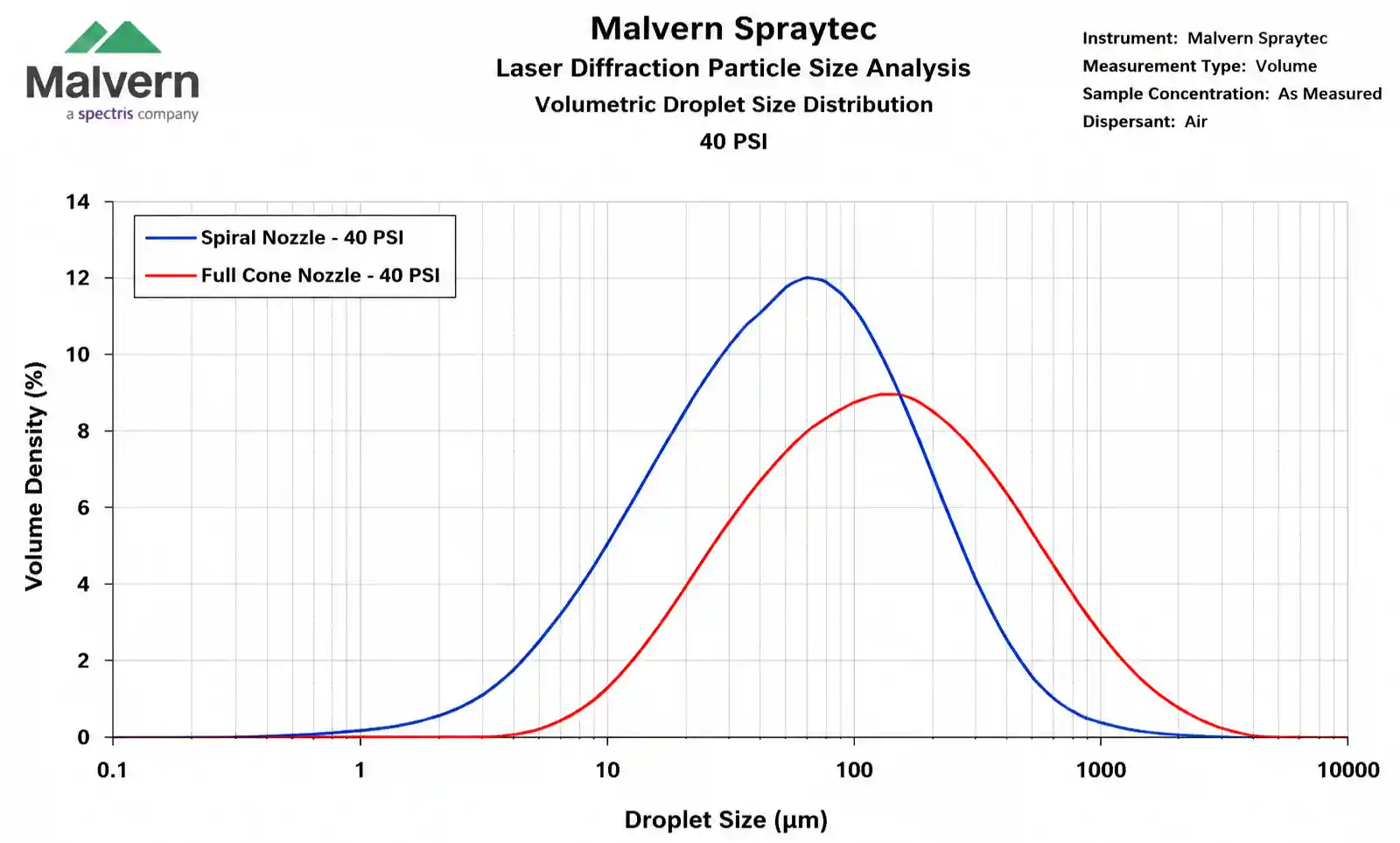
We performed laser diffraction droplet sizing (Malvern Spraytec) on spiral and full cone nozzles at 40 PSI, 12-inch measurement distance:
| Nozzle Type | Orifice Size | Dv0.1 (microns) | Dv0.5 (microns) | Dv0.9 (microns) | Span [(Dv0.9 - Dv0.1)/Dv0.5] |
|---|---|---|---|---|---|
| Spiral | 1.5 mm | 82 | 195 | 380 | 1.53 |
| Full Cone | 2.0 mm | 178 | 485 | 920 | 1.53 |
Both nozzle types show similar span values (droplet size distribution width), but the spiral produces droplets roughly 2.5× smaller at median. This difference has profound implications:
For evaporative cooling: Smaller droplets evaporate faster (evaporation time scales with diameter squared). In a flue gas quench chamber operating at 800°F inlet, spiral nozzles achieve 95% evaporation within 6 feet of travel, while full cone droplets require 12–15 feet. If your chamber height is limited, spiral nozzles may be the only viable option.
For coating uniformity: Smaller droplets spread more evenly on surfaces but require more passes to build thickness. In roll-coating or web-coating applications, spiral nozzles deliver better film uniformity with fewer defects (orange peel, runs), but throughput may be slower.
For impact cleaning: Larger droplets carry more momentum (impact force scales with droplet mass). Full cone nozzles excel in tank washing, parts cleaning, and scale removal where mechanical impact is needed. Spiral nozzles are ineffective for these applications.
5.3 Adjusting Droplet Size in the Field
Droplet size is primarily determined by nozzle orifice diameter and pressure. To reduce droplet size: increase pressure (limited effectiveness beyond 2× baseline) or switch to a smaller orifice (reduces flow). To increase droplet size: reduce pressure (risks pattern collapse with spirals) or switch to a larger orifice.
A practical mistake we see repeatedly: engineers trying to "fix" insufficient cooling by increasing pressure on existing spiral nozzles. Beyond 60 PSI, droplet size reduction plateaus, and you're simply wasting pump energy and accelerating wear. Better to add more nozzles or switch to a higher-flow orifice.
6. Application-Specific Selection Guide
6.1 Gas Cooling and Quenching
Recommendation: Spiral nozzles (with caveats)
In direct evaporative cooling applications—flue gas conditioning, kiln inlet cooling, thermal oxidizer quench—the fine droplets and uniform distribution of spiral nozzles maximize heat transfer efficiency and minimize water consumption. Our data from a cement plant kiln inlet shows spiral nozzles reduced water usage by 22% compared to full cones at the same gas outlet temperature.
However, spiral nozzles demand clean water. If you're using recycled process water or untreated sources, install filtration down to 50–100 microns and plan on quarterly nozzle replacement. For applications where water quality control is difficult, consider full cone nozzles with slightly higher water consumption as the more reliable long-term solution.
Critical design parameters:
- Target Dv0.5: 150–300 microns for optimal evaporation
- Spray angle: 90–110° for typical header-to-duct geometry
- Spacing: 1.5–2.0× the duct hydraulic diameter
- Pressure: 30–50 PSI (regulate to ±5 PSI)
6.2 Tank Washing and Cleaning
Recommendation: Full cone nozzles (strongly preferred)
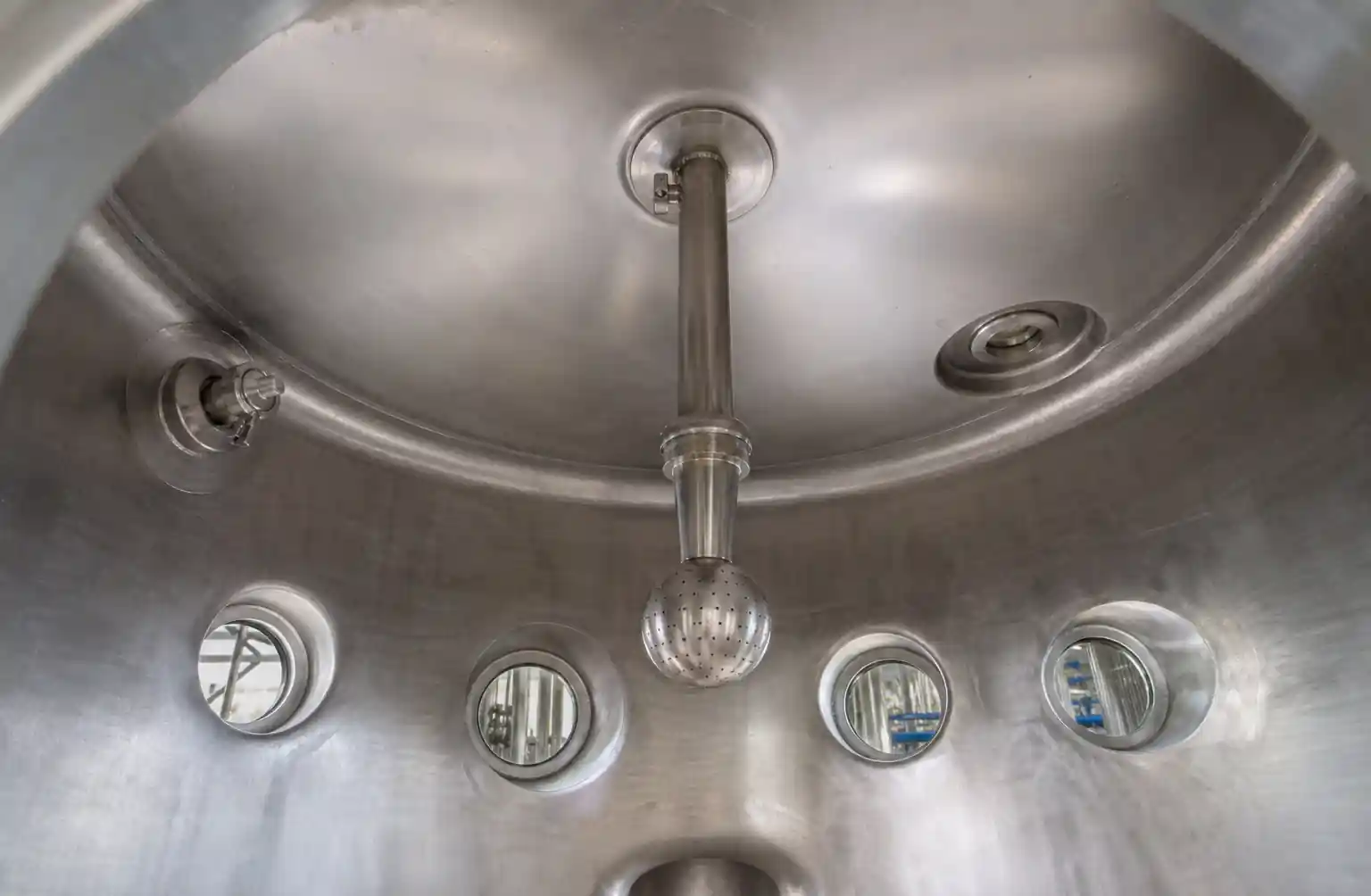
Tank cleaning requires impact force, not fine atomization. Full cone nozzles deliver larger, heavier droplets that penetrate residues and provide mechanical scrubbing action. Additionally, tank cleaning fluids often contain suspended solids (product residue, scale, biofilm fragments) that would clog spiral nozzles within minutes.
We've installed thousands of full cone nozzles in CIP (clean-in-place) systems across food, pharmaceutical, and chemical plants. Typical service life is 3–5 years in caustic/acid wash cycles with minimal maintenance. Spiral nozzles rarely last more than 6 months in similar service, and their finer spray provides inadequate cleaning force.
Critical design parameters:
- Target Dv0.5: 400–800 microns for impact force
- Spray angle: 60–90° depending on tank geometry
- Flow rate: 5–15 GPM per nozzle (higher for large tanks)
- Pressure: 30–60 PSI (lower pressure acceptable for static spray balls)
6.3 Dust Suppression
Recommendation: Full cone nozzles
Dust suppression at conveyor transfer points, stockpiles, and material handling areas requires droplets matched to particle size. For typical coal, ore, aggregate, and grain dusts (10–500 micron particles), you want Dv0.5 in the 200–500 micron range—small enough to capture airborne dust, large enough to avoid excessive drift and water waste.
Full cone nozzles hit this sweet spot reliably and tolerate the dusty environment. Spiral nozzles, while theoretically capable of producing the right droplet size at higher pressures, accumulate dust on the helical insert and clog rapidly. In our mining and port terminal installations, full cone nozzles run continuously for months without cleaning, while spiral nozzles required weekly manual flushing.
Critical design parameters:
- Target Dv0.5: 200–400 microns (match to dust particle size)
- Spray angle: 60–80° for localized suppression, 90–120° for area coverage
- Flow rate: Minimize to reduce water consumption and drainage issues
- Pressure: 20–40 PSI (lower pressure reduces mist generation and drift)
6.4 Coating and Surface Treatment
Recommendation: Spiral nozzles for precision coating, full cone for protective coatings
For high-value coatings where film thickness uniformity, surface finish, and material waste matter—electronics conformal coating, optical lens treatments, pharmaceutical tablet coating—spiral nozzles deliver superior results. The fine, uniform spray minimizes overspray, reduces coating material consumption by 15–25%, and produces consistent film thickness with fewer defects.
For protective coatings, rust inhibitors, mold release agents, and other industrial surface treatments where cosmetic finish is secondary to coverage, full cone nozzles are more practical. They handle higher-viscosity fluids better, tolerate suspended pigments and additives, and cost less to maintain.
Critical design parameters (precision coating):
- Target Dv0.5: 80–200 microns
- Spray angle: 60–80° for controlled overspray
- Standoff distance: 6–12 inches for optimal pattern development
- Pressure: 30–50 PSI (higher pressure for finer atomization)
7. Material Selection and Wear Life Analysis
7.1 Material Options and Their Trade-offs
Nozzle body and insert material dramatically affect wear life, especially in abrasive or corrosive service. Here's a comparison of common materials for both spiral and full cone nozzles:
| Material | Relative Hardness (Vickers) | Abrasion Resistance | Corrosion Resistance | Impact Resistance | Relative Cost | Typical Service Life (abrasive slurry) |
|---|---|---|---|---|---|---|
| Brass | 100–150 HV | Poor | Moderate (not for acids) | Good | 1.0× | 500–1,000 hours |
| 316 Stainless Steel | 150–200 HV | Fair | Excellent (most chemicals) | Excellent | 1.5× | 1,000–2,000 hours |
| Hardened Stainless | 500–600 HV | Good | Excellent | Good | 2.5× | 3,000–5,000 hours |
| Silicon Carbide | 2,500 HV | Excellent | Excellent (except HF, hot alkali) | Poor (brittle) | 4.0× | 8,000–15,000 hours |
| Tungsten Carbide | 1,500–2,000 HV | Excellent | Good (neutral pH) | Fair | 5.0× | 10,000–20,000 hours |
Important note: For spiral nozzles, the helical insert is the primary wear point. Many manufacturers offer composite designs with stainless bodies and ceramic/carbide inserts, providing a cost-effective balance. Full cone nozzles with simple axial flow paths wear more uniformly, making full-body ceramic or carbide construction more practical.
7.2 Real-World Wear Comparison
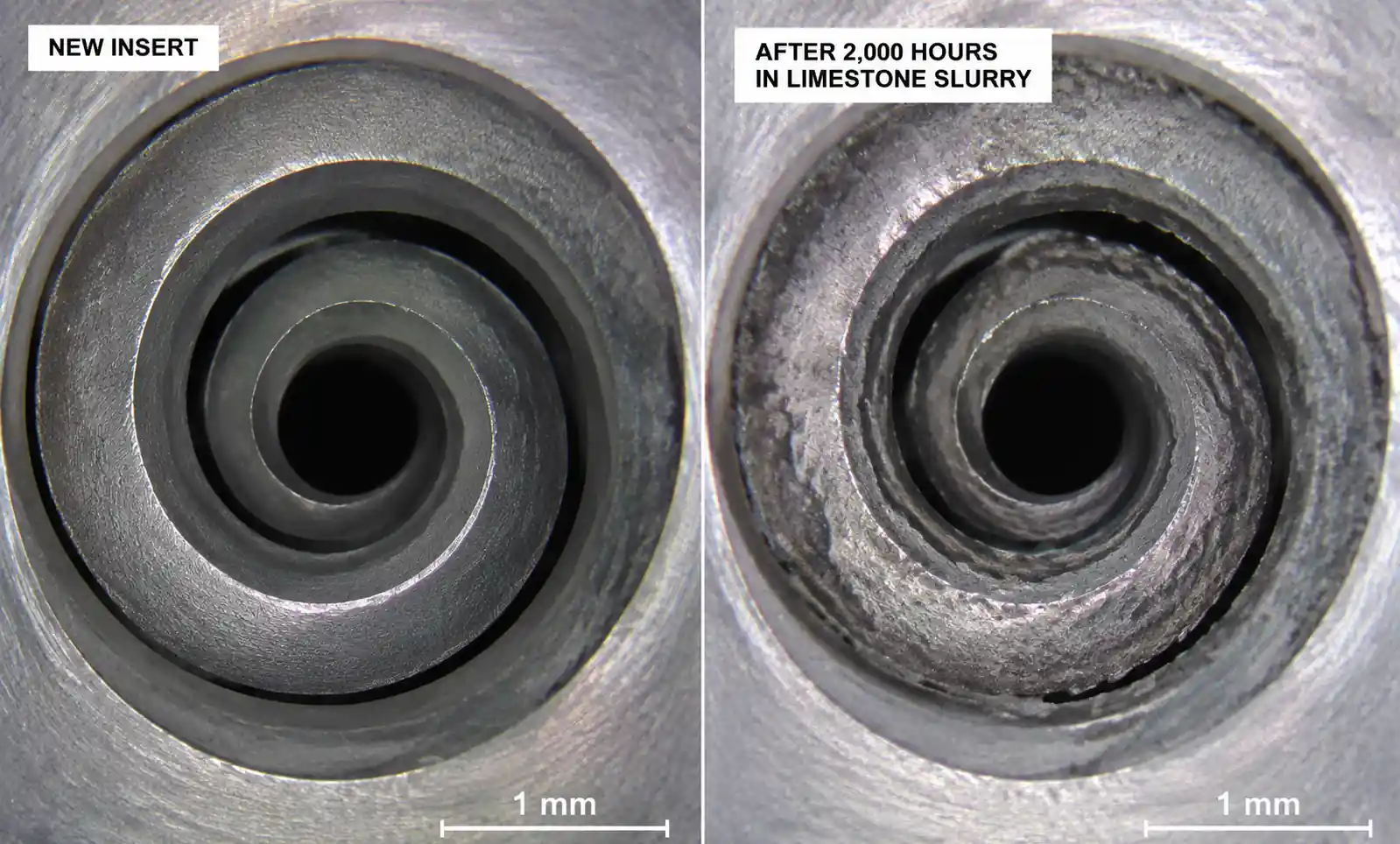
We conducted a 6-month field trial in a limestone slurry pumping station (15% solids by weight, 50–500 micron particle size, pH 8.2, 40 PSI operating pressure). Nozzles were inspected monthly and flow rates measured:
| Nozzle Type & Material | Initial Flow (GPM) | Flow at 2,000 hrs | Flow at 4,000 hrs | Orifice Erosion | Cost per Nozzle | Replacement Frequency |
|---|---|---|---|---|---|---|
| Spiral / 316SS | 2.5 | 2.82 (+12.8%) | 3.24 (+29.6%) | Severe channel wear | $45 | Every 1,500 hrs |
| Spiral / Silicon Carbide | 2.5 | 2.56 (+2.4%) | 2.61 (+4.4%) | Minimal | $185 | Every 8,000+ hrs |
| Full Cone / 316SS | 2.5 | 2.64 (+5.6%) | 2.79 (+11.6%) | Moderate uniform wear | $28 | Every 3,000 hrs |
| Full Cone / Silicon Carbide | 2.5 | 2.53 (+1.2%) | 2.56 (+2.4%) | Minimal | $110 | Every 10,000+ hrs |
The stainless steel spiral nozzle's narrow helical channels eroded fastest, with flow rate increasing 30% by 4,000 hours—unacceptable for process control. Silicon carbide spiral nozzles maintained performance but cost 4× more. Full cone nozzles in both materials showed better wear characteristics due to their simpler, more robust geometry.
Selection rule: In clean water (municipal supply, RO, filtered <50 microns), stainless steel is adequate for both nozzle types. In recycled water, slurries, or chemical service, invest in ceramic or carbide inserts for spirals, or use full-body ceramic/carbide full cones for maximum life.
8. Total Cost of Ownership Comparison
Initial nozzle purchase price is only a fraction of true cost. Let's work through a realistic TCO calculation for a flue gas cooling system requiring 24 nozzles, operating 8,000 hours/year, over a 5-year period.
8.1 Scenario: Steel Mill Reheat Furnace Exhaust Cooling
System requirements:
- 24 nozzles at 2.5 GPM each, 40 PSI
- Fluid: Recycled process water, filtered to 100 microns
- Operating hours: 8,000 hrs/year × 5 years = 40,000 hours total
- Maintenance shutdown windows: Quarterly (4× per year)
8.2 Cost Comparison Table
| Cost Factor | Spiral Nozzle (316SS body, carbide insert) | Full Cone Nozzle (silicon carbide) |
|---|---|---|
| Initial nozzle cost | $125 × 24 = $3,000 | $110 × 24 = $2,640 |
| Expected service life | 2,500 hours | 10,000 hours |
| Replacements needed (40,000 hrs) | 16 cycles × 24 = 384 nozzles | 4 cycles × 24 = 96 nozzles |
| Total nozzle cost (5 years) | 384 × $125 = $48,000 | 96 × $110 = $10,560 |
| Labor per replacement | 2 hrs × $85/hr × 16 cycles = $2,720 | 2 hrs × $85/hr × 4 cycles = $680 |
| Production loss per shutdown | $1,200 × 16 = $19,200 | $1,200 × 4 = $4,800 |
| Water consumption savings | 20% less than full cone: -$8,000 | Baseline |
| Total 5-year TCO | $61,920 | $15,680 |
Even accounting for spiral nozzles' 20% water savings (roughly $8,000 over 5 years in this scenario), the full cone nozzles deliver nearly 4× lower total cost of ownership. The primary driver is replacement frequency—spiral nozzles require four times as many change-outs, each incurring labor and production downtime costs.
8.3 When Spiral Nozzles Win on TCO
The calculation flips in clean-water applications with minimal wear. For a pharmaceutical clean room humidification system using RO water, spiral nozzles might last 10,000+ hours, matching full cone longevity. Combined with their superior uniformity allowing 25–30% fewer nozzles, spirals become the economical choice—lower initial investment, equal maintenance burden, and better performance.
TCO decision rule: Run the numbers for your specific application. If nozzle service life < 3,000 hours due to fluid quality, full cone nozzles almost always win. If service life > 5,000 hours and uniformity allows nozzle count reduction, spiral nozzles often justify their premium.
9. Common Installation and Performance Issues
9.1 Spiral Nozzle Problems and Solutions
| Problem | Root Cause | How to Diagnose | Solution |
|---|---|---|---|
| Pattern collapse or distortion | Pressure below 20 PSI minimum | Measure pressure at nozzle inlet with gauge | Install pressure regulator, verify pump capacity |
| Premature clogging (< 500 hrs) | Particles > 100 microns in fluid | Inspect removed nozzle helical insert for debris | Add/upgrade filtration to 50–100 micron |
| Rapid flow increase (> 10% in 1,000 hrs) | Abrasive wear of helical channels | Measure flow rate monthly, compare to baseline | Switch to ceramic/carbide insert or consider full cone |
| Spray angle narrowing | Partial clog or deposit buildup | Visual inspection of spray pattern | Flush nozzles with solvent/acid wash, check water chemistry |
| Inconsistent coverage across array | Unequal pressure distribution in manifold | Measure pressure at first, middle, last nozzle | Resize manifold pipe diameter, balance orifice plates |
9.2 Full Cone Nozzle Problems and Solutions
| Problem | Root Cause | How to Diagnose | Solution |
|---|---|---|---|
| Inadequate coverage or hot spots | Nozzle spacing too wide | Patternation test or thermal imaging | Reduce spacing or add intermediate nozzles |
| Excessive flow rate drift | Severe orifice wear | Measure flow rate, compare to original spec | Replace nozzles, consider harder material |
| Spray dribbling at low pressure | Operating below minimum pressure | Check pressure gauge at nozzle | Increase pump output or reduce flow demand elsewhere |
| Droplets too large for application | Orifice diameter too large or pressure too low | Laser droplet sizing or water-sensitive paper test | Increase pressure or switch to smaller orifice |
| Uneven spray pattern | Internal vane damage or wear | Disassemble and inspect vane geometry | Replace nozzle, review fluid cleanliness |
9.3 Maintenance Best Practices
For spiral nozzles:
- Implement quarterly flow rate audits—flag nozzles with >10% deviation
- Keep spare nozzle inventory at 25% of installed count (high failure rate)
- Never attempt to clean clogged spirals with wire or tools—you'll damage the helical insert
- Use only chemical cleaning (citric acid for scale, mild detergent for organics)
For full cone nozzles:
- Annual flow rate audits typically sufficient in clean service
- Spare inventory: 10% of installed count
- Mechanical cleaning (wire brush) acceptable for vane-type designs if done carefully
- In abrasive service, track flow increase rate to predict replacement timing
10. FAQ
Q: Can I replace full cone nozzles with spiral nozzles without redesigning the system?
A: Not directly. Spiral nozzles typically require higher minimum pressure (20–25 PSI vs 10–15 PSI) and have different flow coefficients. You'll also need to verify that your fluid filtration is adequate (<100 microns) to prevent clogging. If your current system operates at low pressure or uses unfiltered water, stick with full cones.
Q: Why do spiral nozzles cost so much more?
A: The precision-machined helical insert requires tight tolerances (±0.02 mm) and specialized tooling. Many designs use ceramic or carbide inserts to resist wear, adding material cost. Full cone nozzles have simpler internal geometry and can often be machined in one piece, reducing manufacturing cost.
Q: How do I know when a nozzle needs replacement?
A: Establish baseline flow rate when new, then measure monthly (abrasive service) or quarterly (clean service). Replace when flow increases by >15% or when spray pattern visibly degrades. For critical applications, consider installing inline flow meters for continuous monitoring.
Q: Can I mix spiral and full cone nozzles in the same system?
A: Generally no. They have different pressure requirements and spray characteristics. Mixing types will create non-uniform coverage and complicate system balancing. Use one nozzle type throughout a given system or zone.
Q: What's the difference between a spiral nozzle and a hollow cone nozzle?
A: Spiral nozzles produce a filled cone with liquid throughout the spray pattern, achieved via helical spin. Hollow cone nozzles create an annular (ring-shaped) spray with minimal liquid at the center, typically used for coating applications requiring peripheral coverage. Don't confuse the two—they serve different purposes.
Q: How fine can I filter water without causing excessive pressure drop?
A: For spiral nozzles, aim for 50–100 micron filtration. Use cartridge or bag filters sized for 2–3× your flow rate to keep pressure drop under 5 PSI. Clean or replace filter elements when differential pressure exceeds 10 PSI.
Q: Will increasing pressure fix poor coverage?
A: Only up to a point. If coverage is poor due to inadequate nozzle count or incorrect spray angle, more pressure won't help—you need more nozzles or different geometry. Pressure adjustments (±20% from design point) can fine-tune performance, but they're not a substitute for proper system design.
Q: Are there any hybrid designs combining benefits of both types?
A: Some manufacturers offer "fine spray full cone" nozzles with internal vane geometries optimized for smaller droplets while maintaining the robust flow path of full cones. These typically achieve Dv0.5 in the 250–400 micron range at moderate pressure—a middle ground between standard full cones and spirals. Worth considering if you need better atomization than full cones but can't tolerate spiral nozzle clog risk.
11. Conclusion
Choosing between spiral and full cone nozzles comes down to your process priorities and operating environment. Spiral nozzles deliver unmatched uniformity and fine atomization—ideal for evaporative cooling, humidification, and precision coating applications where you control fluid cleanliness and pressure. Full cone nozzles trade some performance for ruggedness and reliability—the pragmatic choice for tank washing, dust suppression, and any application involving recycled water, slurries, or variable operating conditions.
The key selection factors to evaluate:
-
Fluid quality: Clean, filtered water (<100 microns) favors spirals. Anything with suspended solids, recycled streams, or poor filtration demands full cones.
-
Pressure stability: If your system maintains 30–60 PSI with ±5 PSI regulation, spirals work well. Fluctuating or low-pressure systems (<20 PSI) need full cones.
-
Performance requirement: When uniformity and droplet size control directly impact product quality or process efficiency, spiral nozzles justify their cost. When coverage is more important than precision, full cones suffice.
-
Maintenance access: Frequent nozzle replacement is tolerable in easily accessible installations. Hard-to-reach nozzles (inside vessels, at elevation) favor long-life full cone designs.
-
Total cost of ownership: Run the numbers for your specific application including nozzle cost, replacement frequency, labor, and downtime. In abrasive or dirty service, full cones almost always win on TCO.