



Flat Fan Nozzles: Applications in Agriculture and Crop Spraying
Agricultural operations worldwide face increasing pressure to maximize crop yields while minimizing input costs and environmental impact. Studies show that improper nozzle selection can result in up to 40% reduction in chemical efficacy and significant spray drift, leading to crop damage and regulatory compliance issues.
If you want to optimize your crop spraying operations, then you need to understand flat fan nozzle technology, spray patterns, droplet size control, and selection criteria. This guide provides practical insights to help you improve coverage uniformity, reduce drift potential, and lower chemical costs per acre.
Table of Contents
- 1. What Are Flat Fan Nozzles?
- 2. Flat Fan Nozzle Types for Agricultural Applications
- 2.1. Standard Flat Fan Nozzles
- 2.2. Even Flat Fan Nozzles
- 2.3. Low-Drift Flat Fan Nozzles
- 2.4. Extended Range Flat Fan Nozzles
- 3. Spray Pattern and Coverage Optimization
- 3.1. Nozzle Spacing and Boom Height Calculations
- 3.2. Pattern Uniformity Testing
- 4. Droplet Size Control and Drift Management
- 5. Agricultural Application Scenarios
- 5.1. Pre-Emergence Herbicide Application
- 5.2. Post-Emergence Crop Protection
- 5.3. Variable Rate Application
- 6. Nozzle Selection Guidelines
- 6.1. Flow Rate Calculation
- 6.2. Material Selection and Wear
- 7. Maintenance and Troubleshooting
- 8. Frequently Asked Questions
- 8.1. What spray angle should I use for broadcast applications?
- 8.2. How often should I replace spray nozzles?
- 8.3. Can I mix different nozzle types on the same boom?
- 8.4. What is the optimal pressure for drift reduction nozzles?
- 8.5. What causes nozzle clogging during operation?
- 9. Conclusion
What Are Flat Fan Nozzles?
Flat fan nozzles are precision spray devices that produce an elliptical spray pattern with uniform liquid distribution. The nozzle uses a machined orifice and internal vane to shape pressurized liquid into a flat, fan-shaped pattern, typically 80° to 110° spray angles.
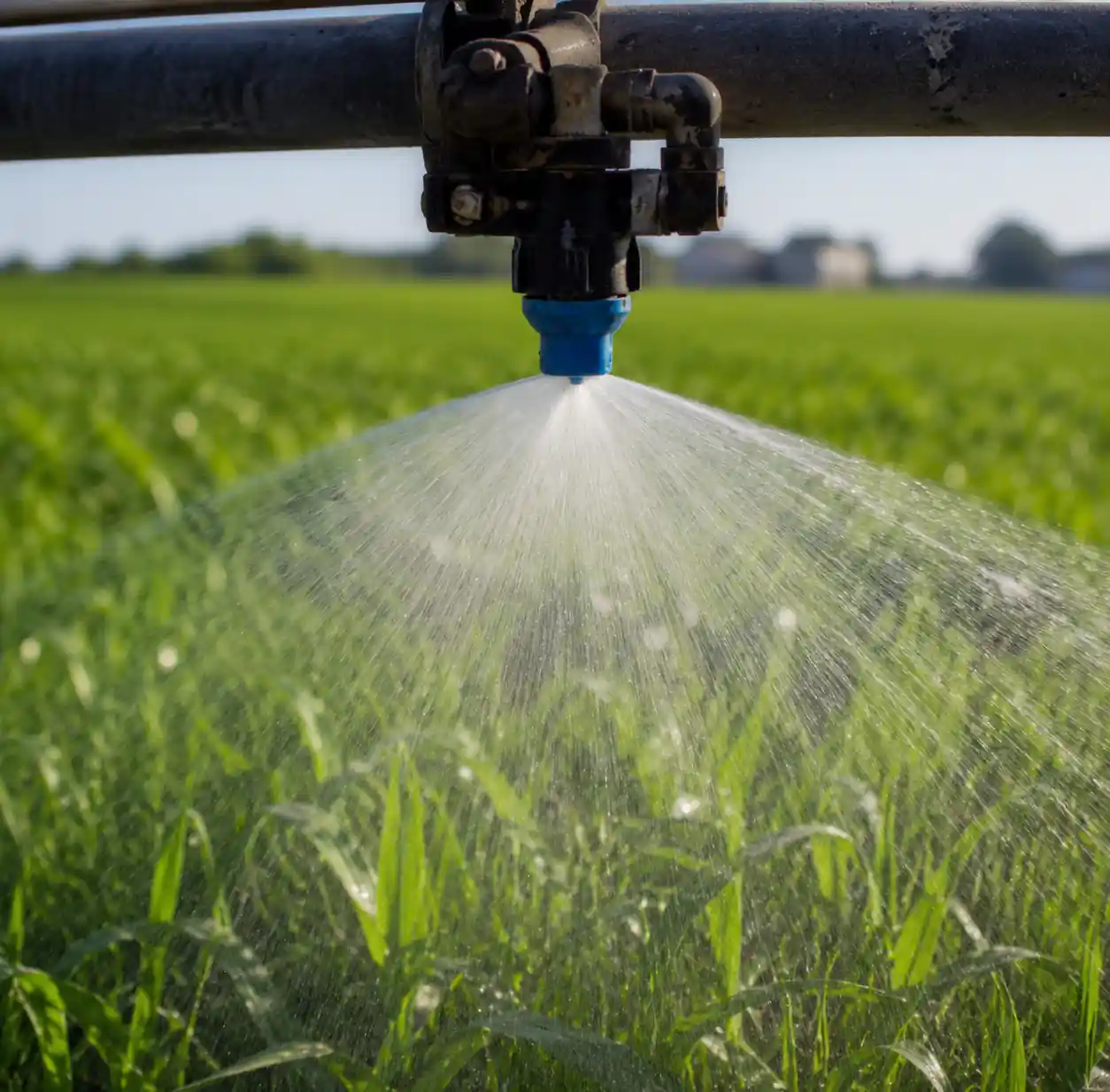 Flat fan nozzle producing elliptical spray pattern in agricultural field
You can achieve optimal spray overlap by positioning nozzles at the correct boom height and spacing intervals, ensuring uniform chemical deposition. This makes flat fan nozzles the standard choice for broadcast spraying of herbicides, fungicides, insecticides, and liquid fertilizers in row crop production.
Flat Fan Nozzle Types for Agricultural Applications
Standard Flat Fan Nozzles
Standard flat fan nozzles produce a tapered spray pattern with finer droplets at the edges and coarser droplets in the center. Spray angles typically range from 65° to 110° depending on orifice size. These work best for soil-applied herbicides where drift is not a primary concern.
You should operate standard flat fans at 30-60 psi (2-4 bar) for optimal pattern formation. Higher pressures produce finer droplets but increase drift potential.
Even Flat Fan Nozzles
Even flat fan nozzles deliver uniform droplet size across the entire spray width. This design features a pre-orifice chamber that equalizes liquid pressure before spray formation, producing consistent droplet sizes from edge to edge.
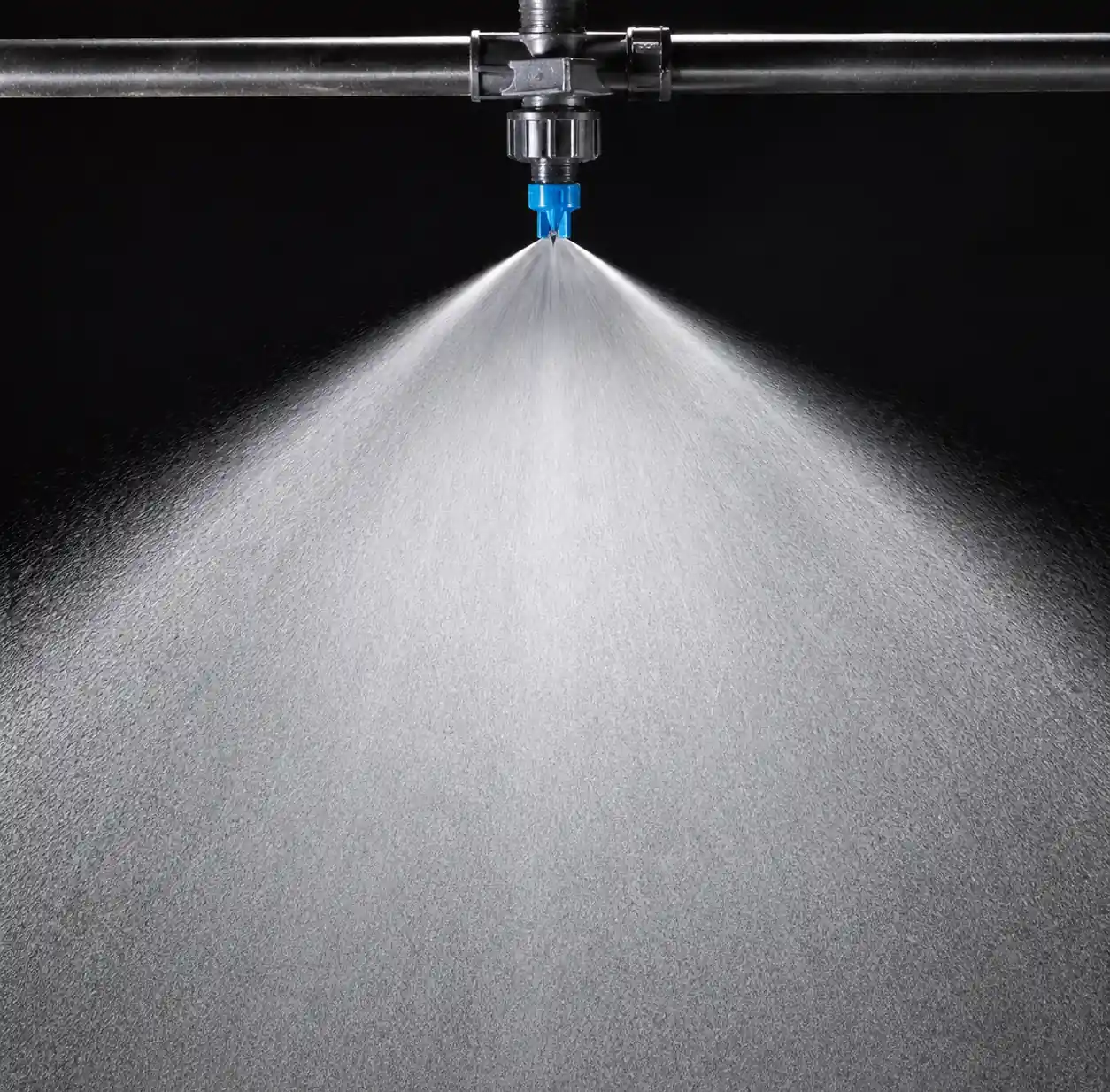 Even flat fan nozzle showing uniform droplet distribution across spray width
You can use even flat fans for post-emergence herbicides, fungicides, and any situation requiring precise droplet control. Operating pressure typically ranges from 20-40 psi (1.4-2.8 bar).
Low-Drift Flat Fan Nozzles
Low-drift flat fan nozzles incorporate air induction technology to produce larger, air-filled droplets that resist wind drift. These nozzles draw air into the liquid stream through internal ports, creating air-filled droplets in the Very Coarse to Extremely Coarse size categories.
The air-filled droplets reduce drift potential by 50-90% compared to standard flat fans at equivalent flow rates. You should specify low-drift nozzles for applications near sensitive crops, moderate wind conditions (up to 10 mph), and drift reduction compliance.
Operating pressure ranges from 30-60 psi (2-4 bar), with optimal performance at 40 psi (2.8 bar).
Extended Range Flat Fan Nozzles
Extended range nozzles maintain consistent droplet size across wider pressure ranges, typically 15-90 psi (1-6 bar). This flexibility allows you to adjust application rates by changing pressure without altering droplet characteristics.
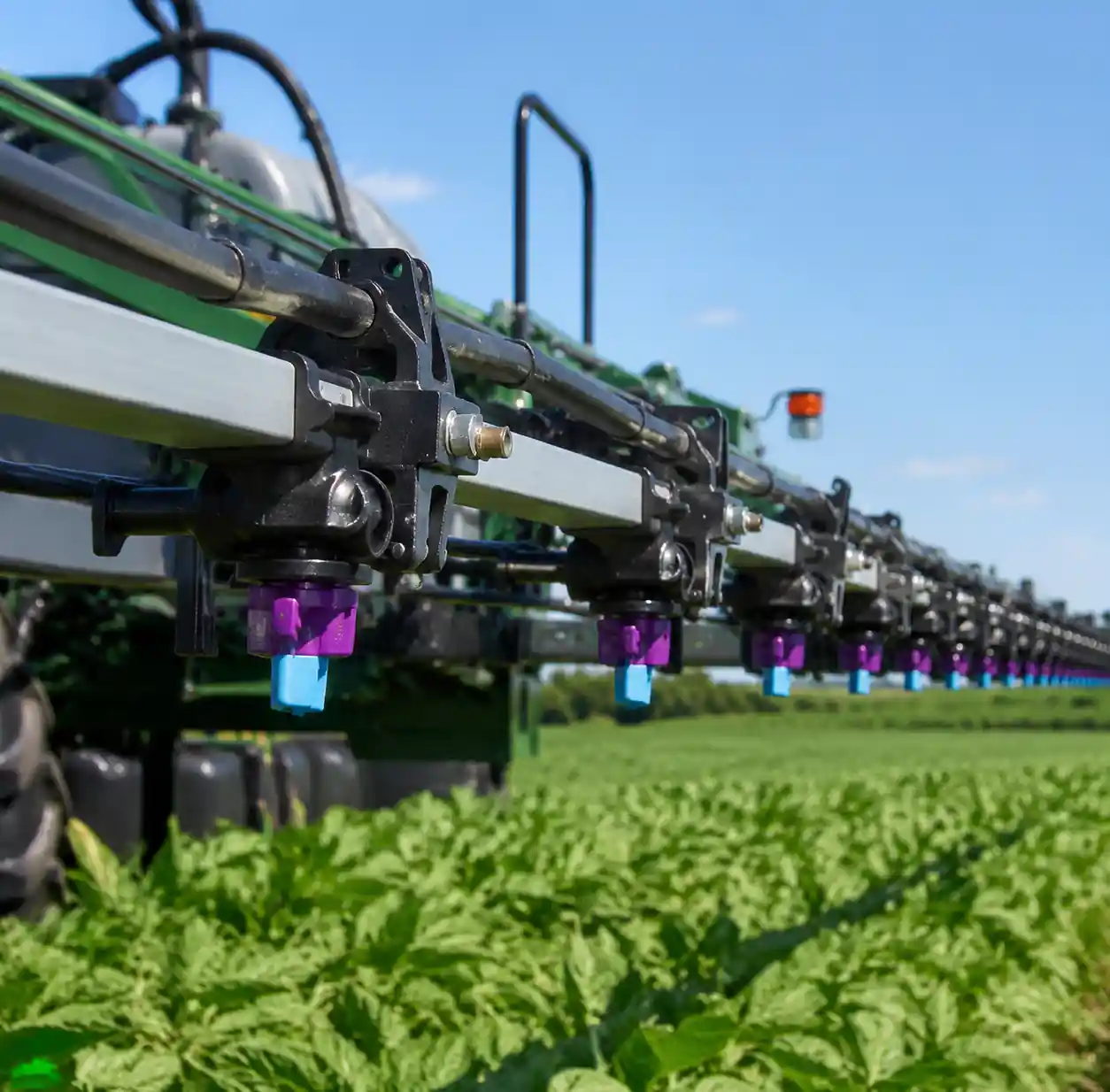 Extended range flat fan nozzles installed on agricultural spray boom
You can use extended range nozzles in variable-rate systems and when field speeds vary. The extended operating range provides greater flexibility for mixing different chemical products on the same boom.
Spray Pattern and Coverage Optimization
Nozzle Spacing and Boom Height Calculations
Spray pattern overlap creates uniform coverage when adjacent spray fans intersect at the correct height. For flat fan nozzles, maintain boom height at 30-50% of nozzle spacing for 80° angles and 40-60% for 110° angles.
| Spray Angle | Nozzle Spacing | Recommended Boom Height | Overlap Percentage |
|---|---|---|---|
| 80° | 20 inches (50 cm) | 15-20 inches (38-50 cm) | 100% |
| 110° | 20 inches (50 cm) | 18-24 inches (46-61 cm) | 100% |
| 80° | 15 inches (38 cm) | 12-15 inches (30-38 cm) | 100% |
| 110° | 15 inches (38 cm) | 14-18 inches (36-46 cm) | 100% |
Calculate boom height using: Boom Height = (Nozzle Spacing / 2) × tan(Spray Angle / 2). For example, 20-inch spacing with 110° nozzles requires approximately 19 inches boom height.
Pattern Uniformity Testing
You can verify spray distribution uniformity using a patternator with collection tubes spaced at regular intervals. Coefficient of variation (CV) should remain below 10% for acceptable uniformity.
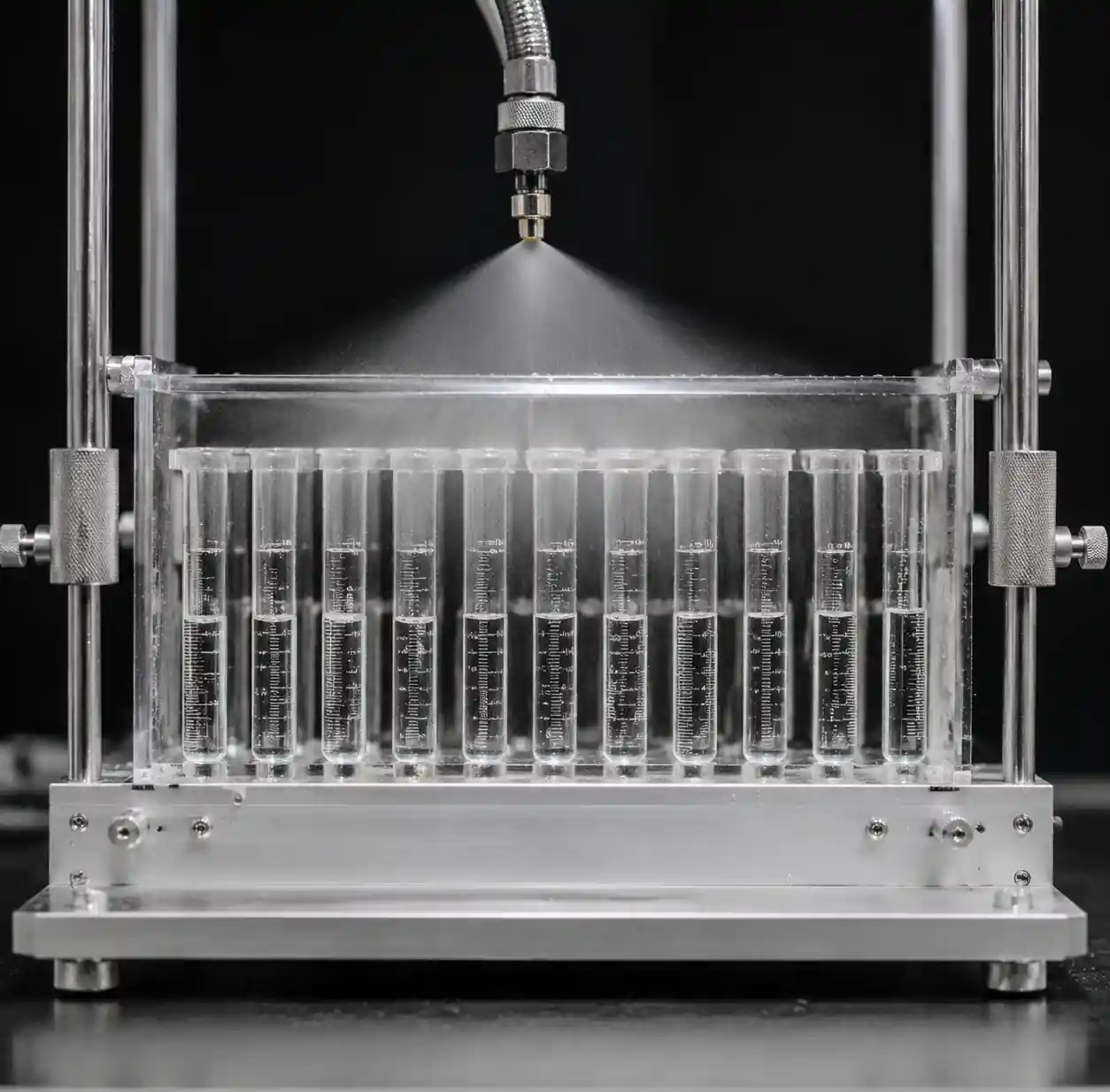 Patternator spray pattern testing equipment for nozzle uniformity verification
Test pattern uniformity at season start, after nozzle replacement, and when you observe uneven coverage. Worn nozzles and incorrect settings will show as elevated CV values.
Droplet Size Control and Drift Management
Droplet size classification follows ASABE S572.3 standard categories, with each affecting coverage, drift potential, and chemical efficacy differently.
| Droplet Size Category | Volume Median Diameter (VMD) | Drift Potential | Best Applications |
|---|---|---|---|
| Fine | 136-177 microns | Very High | Contact herbicides, dense canopy penetration |
| Medium | 177-218 microns | High | Systemic herbicides, post-emergence |
| Coarse | 218-349 microns | Moderate | Pre-emergence herbicides, granular insecticides |
| Very Coarse | 349-428 microns | Low | Drift-sensitive areas, windy conditions |
| Extremely Coarse | 428-622 microns | Very Low | Maximum drift reduction, near sensitive crops |
You should match droplet size to target pest, chemical mode of action, and weather conditions. Contact herbicides require Medium to Fine droplets for leaf coverage, while systemic products perform well with Coarse to Very Coarse droplets.
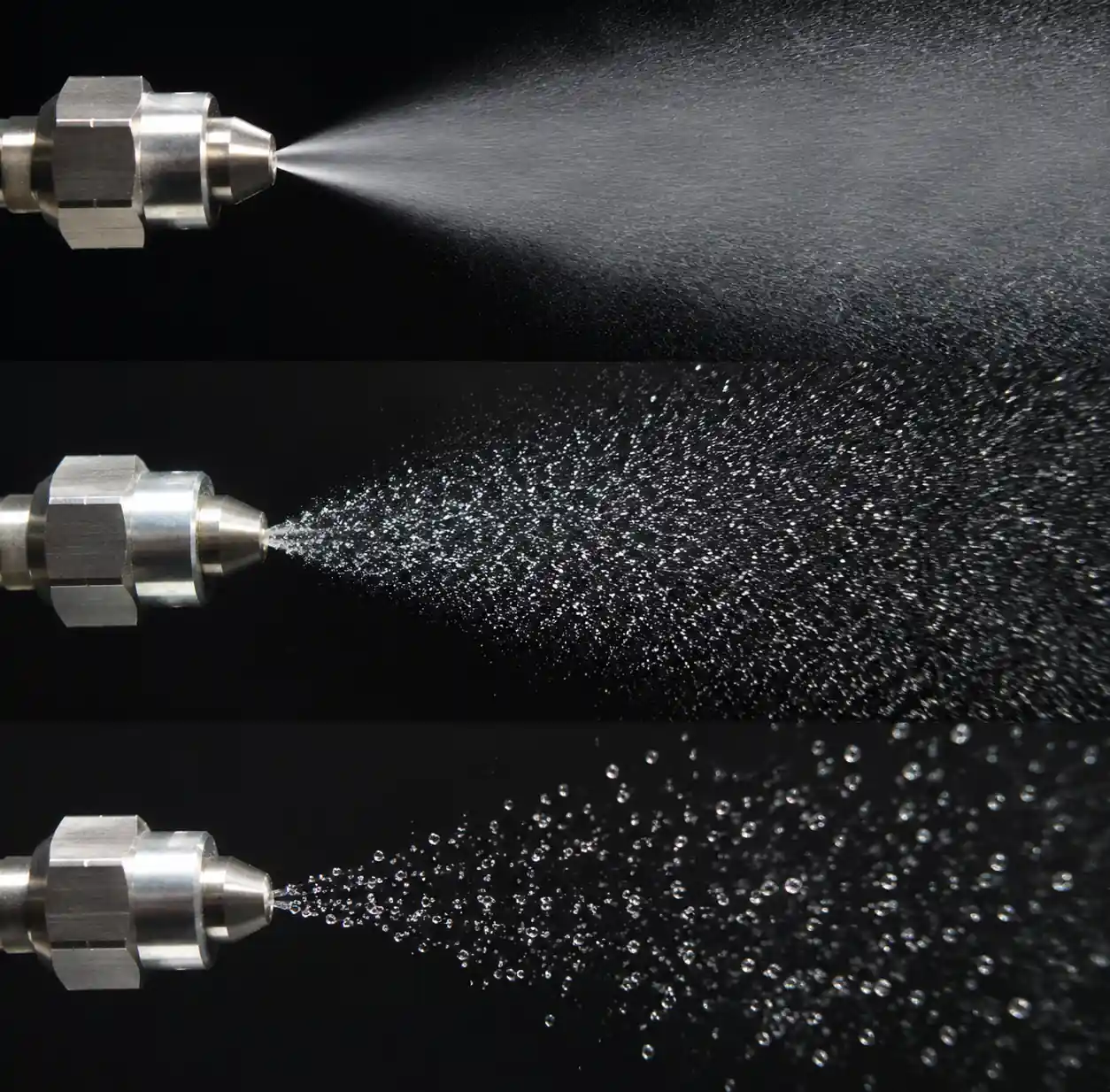 Spray droplet size comparison showing pressure effects on flat fan nozzle output
Operating pressure directly controls droplet size. Increasing pressure from 30 to 60 psi reduces average droplet size by 30-40% for standard flat fans. You can reduce drift by lowering pressure to produce coarser droplets, but excessive reduction (below 20 psi) compromises pattern uniformity.
Agricultural Application Scenarios
Pre-Emergence Herbicide Application
Pre-emergence herbicides require uniform soil surface coverage. Use standard or even flat fan nozzles with Coarse to Very Coarse droplets at 30-40 psi (2-2.8 bar). Flow rates range from 15-30 GPA (140-280 L/ha).
Maintain boom height at 18-24 inches (45-60 cm) above soil for 110° nozzles spaced at 20 inches (50 cm). This ensures uniform deposition with minimal drift.
Post-Emergence Crop Protection
Post-emergence applications target existing weeds and pests. Specify low-drift flat fan nozzles producing Very Coarse droplets at 40 psi (2.8 bar) for optimal air induction performance.
 Low-drift flat fan nozzles applying post-emergence herbicide in crop field
Water volumes range from 10-20 GPA (93-187 L/ha) for systemic products and 15-30 GPA (140-280 L/ha) for contact herbicides. Adjuvants affect spray characteristics, so verify droplet size when adding them.
Variable Rate Application
Variable rate systems adjust chemical rates based on GPS-mapped field zones. Extended range flat fan nozzles maintain consistent droplet characteristics across pressure variations, allowing rate changes through pressure modulation.
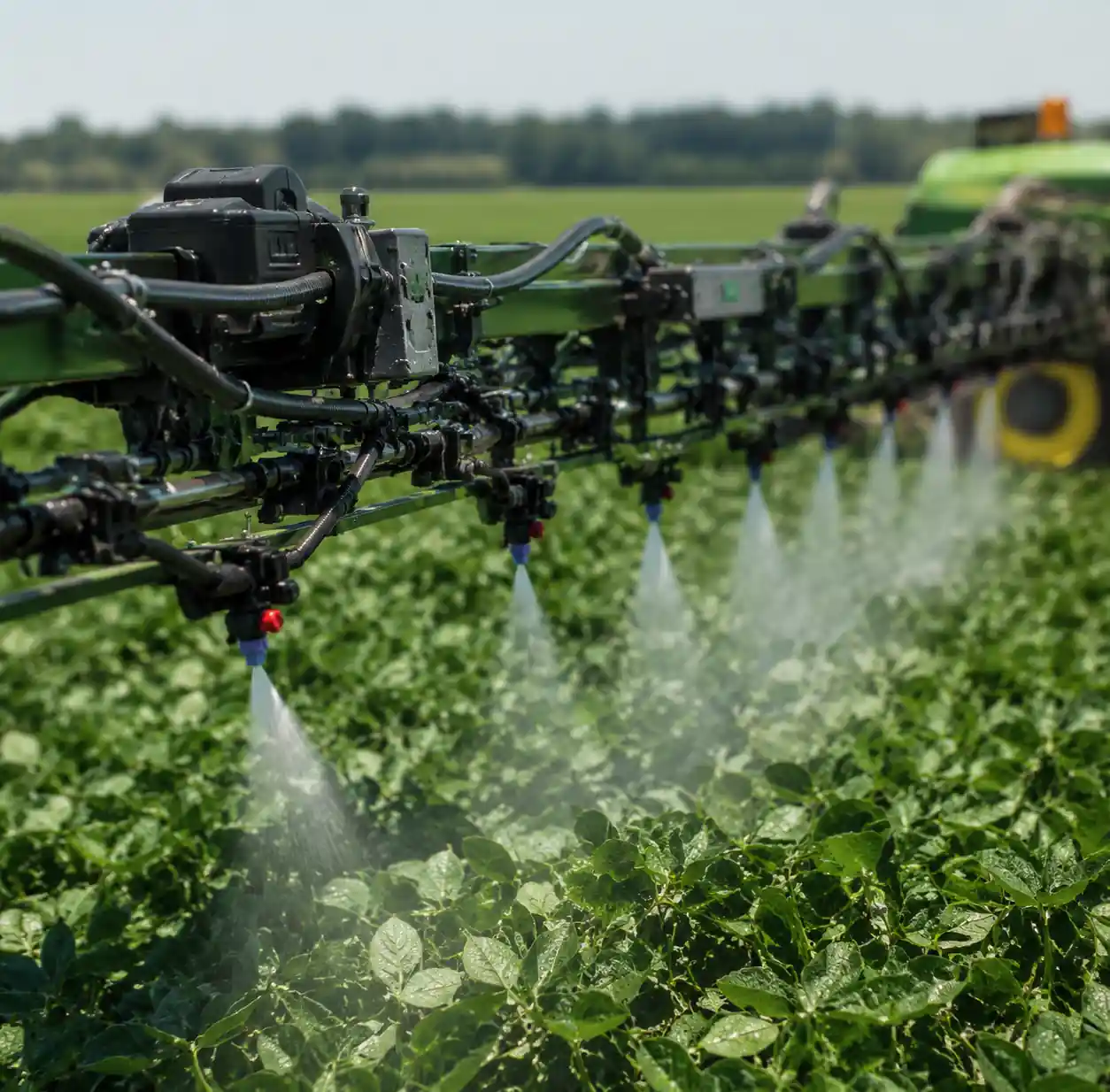 Variable rate spray application system with extended range flat fan nozzles and GPS control
Achieve 3:1 to 6:1 rate variation by varying pressure from 15 to 90 psi, eliminating the need for pulse-width modulation systems.
Nozzle Selection Guidelines
Flow Rate Calculation
Calculate required nozzle flow rate: GPM per nozzle = (GPA × MPH × W) / 5,940
Where GPM = gallons per minute, GPA = gallons per acre, MPH = ground speed, W = nozzle spacing in inches.
Example: applying 20 GPA at 10 MPH with 20-inch spacing requires 0.67 GPM per nozzle.
Material Selection and Wear
- Polymer (plastic): Low cost, good chemical resistance, 1-2 seasons wear life
- Stainless steel: Excellent wear resistance (3-5 seasons), broad compatibility
- Ceramic: Superior wear resistance (5-10 seasons), best for abrasive products
Check nozzle wear regularly by comparing flow rate to specifications. Replace when flow exceeds ±10% of rated capacity.
Maintenance and Troubleshooting
Inspect nozzles before each operation for damage, wear, and debris. Clean clogged nozzles using soft brushes and water pressure—never use metal tools that damage orifices. Replace strainers when pressure gauges show elevated system pressure. Use 100-mesh (149 micron) screens for most flat fan nozzles.
| Problem | Probable Cause | Solution |
|---|---|---|
| Streaked spray pattern | Worn orifice, incorrect pressure | Flow test, replace if >10% wear |
| Heavy drift | Fine droplets, excessive pressure | Select coarser nozzle, reduce pressure |
| Poor coverage | Incorrect boom height | Measure and adjust boom height |
| Uneven application | Flow variation between nozzles | Flow test all, replace worn units |
| Excessive foaming | Pressure too low | Increase to minimum recommended |
Frequently Asked Questions
What spray angle should I use for broadcast applications?
Use 110° flat fan nozzles with 20-inch (50 cm) spacing and 18-24 inch (45-60 cm) boom height. The wider angle provides better overlap and uniformity.
How often should I replace spray nozzles?
Flow test every 50 hours or at season start. Replace when flow exceeds ±10% of specifications or pattern shows distortion. Typical wear life ranges from 200-500 hours.
Can I mix different nozzle types on the same boom?
No. All nozzles should be the same model, orifice size, and spray angle to maintain uniform application.
What is the optimal pressure for drift reduction nozzles?
Most air induction nozzles perform best at 40 psi (2.8 bar). Below 30 psi reduces air induction effectiveness.
What causes nozzle clogging during operation?
Inadequate filtration, incompatible chemical mixing, or dried residues. Install 50-100 mesh filters and clean systems thoroughly after each use.
Conclusion
Flat fan nozzles remain the primary spray technology for agricultural crop protection due to their proven performance, wide selection range, and cost-effectiveness. Proper selection requires matching spray pattern, droplet size, and flow capacity to your crop, chemical product, and application conditions. Low-drift designs significantly reduce off-target movement while maintaining efficacy. Regular inspection, flow testing, and timely replacement preserve application accuracy and chemical performance.
YuechenPrecision Technology offers a comprehensive range of agricultural flat fan nozzles engineered for demanding field conditions. Our product line includes standard flat fans, even spray patterns, air induction drift reduction designs, and extended range models suitable for variable rate systems. We provide technical support for nozzle selection, boom configuration, and spray system optimization across all major crop types.
Contact us today for agricultural spray nozzle selection assistance, flow rate calculations, and custom spray system solutions designed for your specific crop protection requirements.