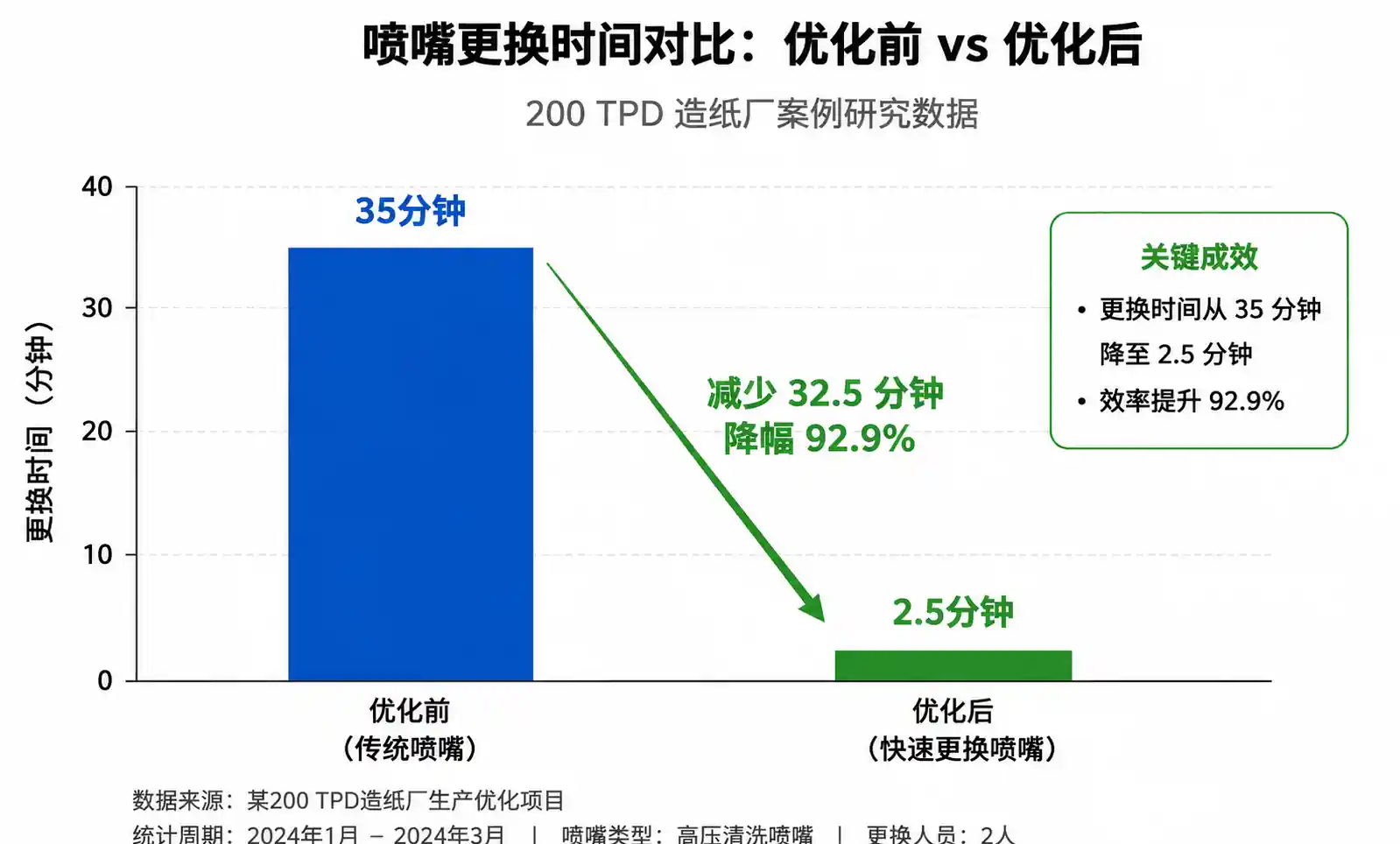



ROI (Return on Investment) Analysis of Quick-Disconnect Nozzles in Paper Machine Maintenance
Table of Contents
- 1. 1. Introduction: The Hidden Cost of Traditional Nozzle Systems
- 2. 2. Critical Parameters Affecting Paper Machine Spray Systems
- 2.1. 2.1 Wear Rate Drivers
- 2.2. 2.2 Maintenance Access Constraints
- 2.3. 2.3 Performance Degradation Impact
- 3. 3. Quick-Disconnect vs. Threaded Nozzle Systems: Performance and Cost Comparison
- 3.1. 3.1 Design Differences
- 3.2. 3.2 Performance Comparison Table
- 3.3. 3.3 When Quick-Disconnect Systems Make Sense
- 4. 4. Calculating the True ROI: A Step-by-Step Framework
- 4.1. 4.1 Data Collection Requirements
- 4.2. 4.2 ROI Calculation Formula
- 4.3. 4.3 Labor Savings Calculation
- 4.4. 4.4 Downtime Savings Calculation
- 4.5. 4.5 Material Cost Consideration
- 4.6. 4.6 Worked Example: Complete ROI Calculation
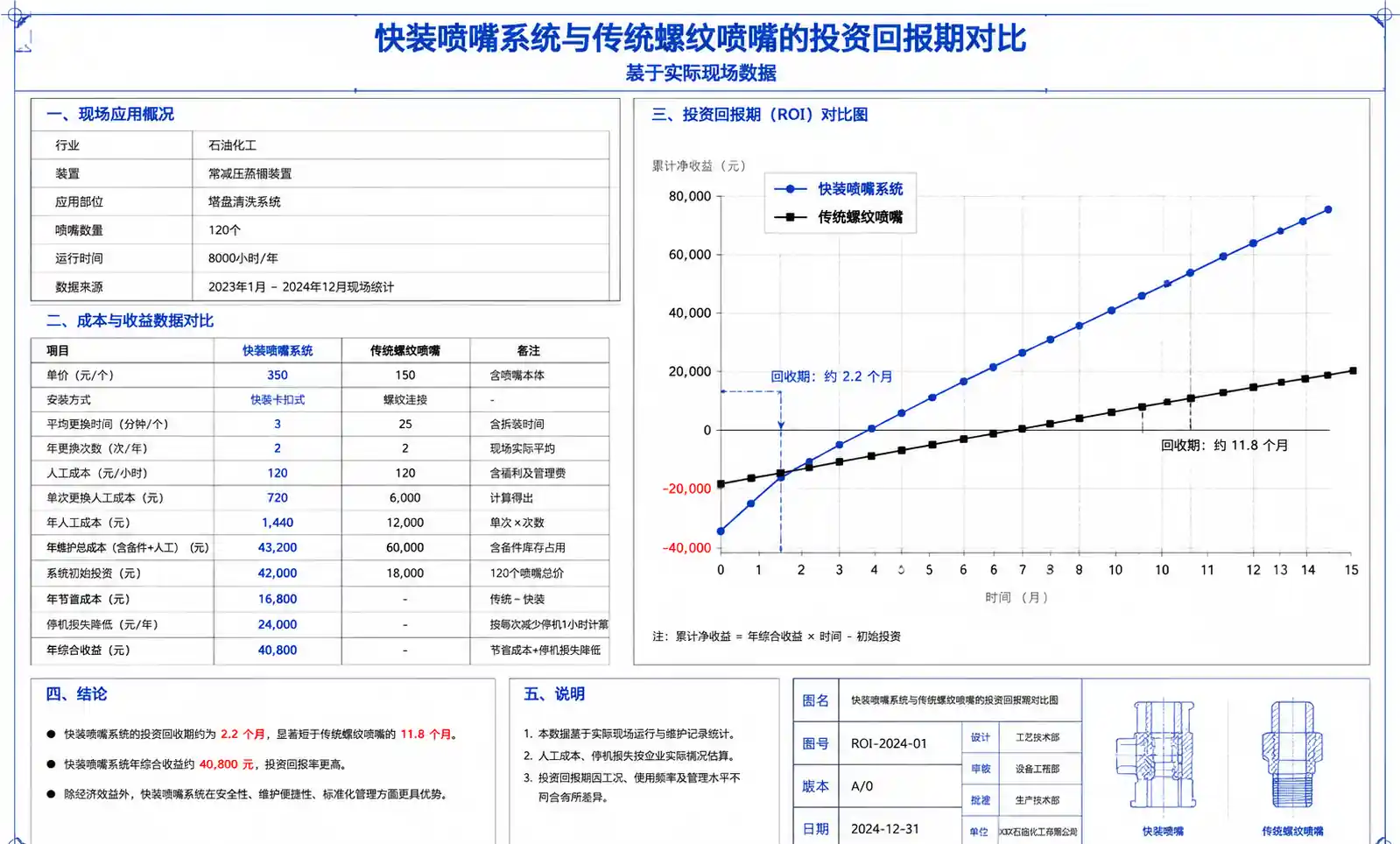
- 5. 5. Real-World Case Study: 200 TPD Paper Mill Implementation
- 5.1. 5.1 Background
- 5.2. 5.2 Implementation
- 5.3. 5.3 Results After 12 Months
- 6. 6. Material Selection and Total Cost of Ownership
- 6.1. 6.1 Material Comparison for Paper Machine Service
- 6.2. 6.2 Total Cost of Ownership Example
- 7. 7. Common Implementation Mistakes That Erode ROI
- 7.1. 7.1 Wrong Application Selection
- 7.2. 7.2 Undersizing the Adapter Material
- 7.3. 7.3 Ignoring Seal Replacement Protocols
- 7.4. 7.4 Inadequate Spray Pattern Documentation
- 7.5. 7.5 Installation Torque Errors
- 8. 8. FAQ
- 8.1. Q: Can I retrofit quick-disconnect adapters into existing threaded nozzle pipe headers without welding?
- 8.2. Q: Do quick-disconnect systems have higher leak risk than threaded nozzles?
- 8.3. Q: What happens if an insert falls out during operation?
- 8.4. Q: Can I use quick-disconnect systems in high-temperature applications like Yankee dryer showers?
- 8.5. Q: How do I justify the higher upfront cost to management if our mill operates with tight capital budgets?
- 8.6. Q: Should I retrofit the entire machine at once or pilot a high-wear section first?
- 8.7. Q: Are there any paper grades or machine speeds where quick-disconnect systems don't work well?
- 9. 9. Conclusion and Action Steps
- 9.1. Recommended Next Steps:
1. Introduction: The Hidden Cost of Traditional Nozzle Systems
In paper machine maintenance, every minute of unplanned downtime costs between $500 and $2,000 depending on production capacity. Traditional threaded nozzle systems require 15–45 minutes per nozzle replacement, involving pipe draining, wrench access in confined spaces, thread cleaning, and system refilling. Over a typical year, a medium-sized paper mill replaces 80–150 spray nozzles across shower systems, steam boxes, and coating applicators.
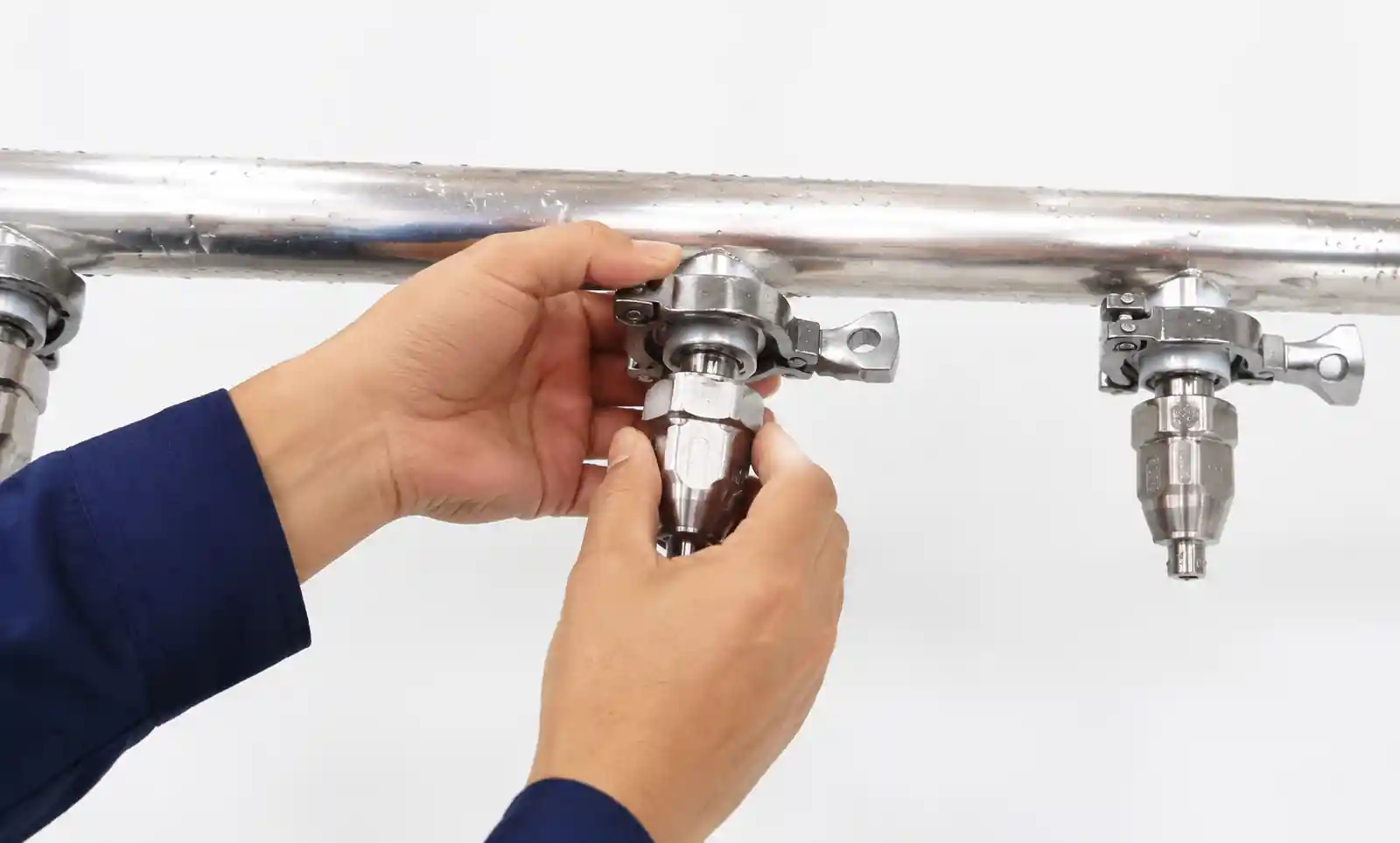
Quick-disconnect nozzle systems reduce replacement time to under 2 minutes per nozzle without shutting down adjacent sections. This guide provides a comprehensive ROI framework based on field data from tissue mills, containerboard operations, and specialty paper producers. You will learn how to quantify maintenance labor savings, production uptime gains, and material cost optimization—and when the investment does not make financial sense.
From our application engineering experience across 40+ paper mill installations, quick-disconnect systems typically achieve payback within 6–18 months in high-wear applications (recycled fiber, high-consistency stock) but may not justify the capital cost in clean furnish operations with infrequent nozzle changes.
2. Critical Parameters Affecting Paper Machine Spray Systems
Before calculating ROI, you need to understand the operational parameters that drive nozzle replacement frequency and maintenance complexity in paper production environments.
2.1 Wear Rate Drivers
Paper machine spray nozzles experience accelerated wear due to several factors. Stock consistency directly correlates with abrasive wear—nozzles in 3–6% consistency chest showers wear 3–5 times faster than clear water shower nozzles. Recycled fiber operations with residual silica, titanium dioxide pigment particles, and calcium carbonate filler increase orifice erosion rates by 40–70% compared to virgin fiber systems.
Operating pressure ranges between 30–120 psi for most fabric showers and dilution systems. At higher pressures, the same abrasive slurry causes disproportionately faster wear—doubling pressure typically increases wear rate by 1.7–2.1x, not linearly. Water chemistry also matters: low pH white water (pH 4.5–5.5) accelerates corrosion in stainless steel nozzles, while high calcium hardness (>200 ppm) leads to deposit buildup that narrows spray angles and reduces flow rates.
2.2 Maintenance Access Constraints
Paper machine spray systems present unique access challenges. Yankee dryer shower pipes operate at 180–220°F, requiring cooldown before maintenance. Forming section showers are often buried behind wire guide rolls with 8–12 inches of clearance. Coating applicator nozzle banks may have 30–50 nozzles in a 6-foot span, making individual nozzle access with pipe wrenches nearly impossible without disturbing adjacent connections.
Traditional threaded nozzles require 6–12 inches of radial wrench clearance. In retrofit situations, maintenance teams often resort to cutting and re-welding pipe sections or installing access panels in machine hoods—adding $3,000–$8,000 per location to the total project cost.
2.3 Performance Degradation Impact
Nozzle wear does not cause sudden failure—it causes gradual performance decay that often goes undetected until product quality issues emerge. A 20% increase in orifice diameter due to wear increases flow rate by approximately 44% (flow scales with area, which scales with diameter squared). This flow increase reduces spray impact force and increases droplet size, degrading fabric cleaning effectiveness or sheet moisture uniformity.
In our field measurements, fabric showers with worn nozzles show 15–30% reduction in cleaning efficiency, leading to increased sheet breaks, reduced drainage, and higher steam consumption in the dryer section. The production losses from degraded spray performance often exceed the direct nozzle replacement cost by 5–10x.
3. Quick-Disconnect vs. Threaded Nozzle Systems: Performance and Cost Comparison
3.1 Design Differences
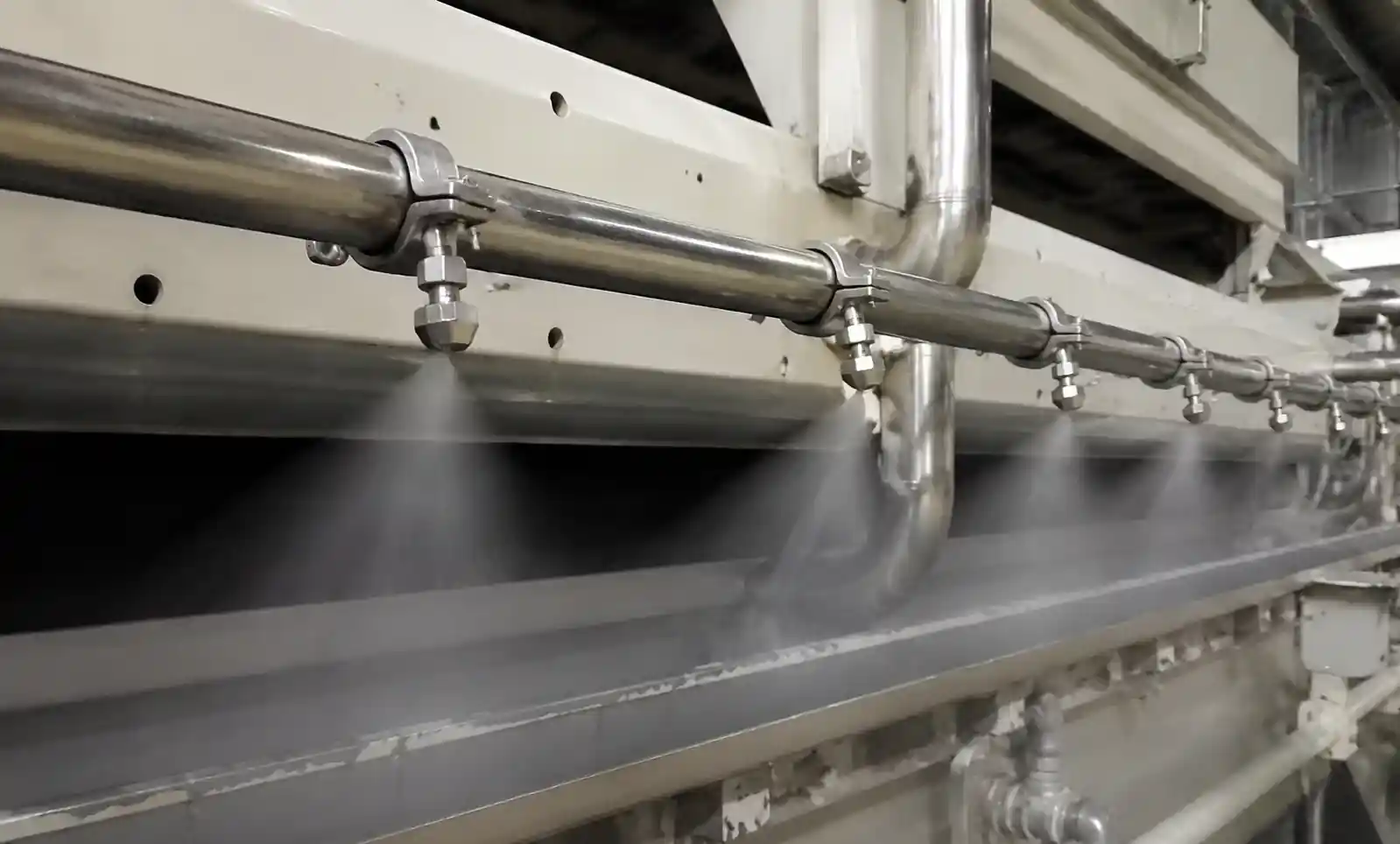
Quick-disconnect nozzle systems use a two-part design: a permanent body adapter welded or threaded into the pipe header, and a removable nozzle insert that locks with a quarter-turn bayonet mechanism, snap-ring retention, or magnetic coupling. The spray orifice and internal vanes are contained entirely in the replaceable insert.
Traditional threaded nozzles integrate the spray element and pipe connection in a single component with 1/8" NPT, 1/4" NPT, or metric ISO 228 threads. Removal requires backing out 8–12 full rotations while supporting the pipe to prevent joint stress.
3.2 Performance Comparison Table
| Parameter | Quick-Disconnect System | Threaded Nozzle System |
|---|---|---|
| Replacement time (per nozzle) | 1.5–3 minutes | 15–45 minutes |
| Tools required | None (hand-operated) | Pipe wrench, thread sealant, cleaning brush |
| System shutdown required | No (if designed with shutoff) | Often yes (for drain-down) |
| Clearance required | 3–4 inches axial | 6–12 inches radial |
| Risk of pipe damage during replacement | Low | Moderate (thread cross-threading, pipe stress) |
| Initial hardware cost (adapter + insert) | $45–$120 per position | $12–$35 per nozzle |
| Replacement insert cost | $18–$55 | $12–$35 (full nozzle) |
| Seal reliability (cycles) | 50–200+ removals | 10–25 removals before thread wear |
| Standardization across machine | High (one adapter fits multiple spray types) | Low (each application needs different thread size) |
The table reveals the core trade-off: higher upfront cost per position versus dramatically reduced maintenance labor and downtime. The economic break-even depends on replacement frequency and production value.
3.3 When Quick-Disconnect Systems Make Sense
Quick-disconnect systems deliver the highest ROI in these scenarios: high-wear applications requiring nozzle replacement every 3–6 months (recycled fiber showers, high-consistency cleaners); restricted-access locations where threaded nozzle removal requires production shutdown or extensive disassembly; operations with frequent nozzle type changes for grade optimization (tissue machines running multiple basis weights); facilities with high maintenance labor costs (>$65/hour fully loaded) or limited skilled labor.
Conversely, threaded systems may be more economical for clean water showers with replacement intervals exceeding 2 years, low-pressure applications with minimal wear (<30 psi), and greenfield installations with designed-in maintenance access.
4. Calculating the True ROI: A Step-by-Step Framework
4.1 Data Collection Requirements
To build an accurate ROI model, gather the following data from your operation over the past 12–18 months:
Nozzle replacement history: Number of nozzles replaced per location (forming section, press section, dryer showers, coating systems), average months between replacements, reason for replacement (wear, clogging, breakage).
Maintenance time tracking: Actual labor hours per nozzle change including preparation, removal, cleaning, installation, and system restart. Separate planned maintenance from emergency repairs—emergency repairs typically take 1.5–2.5x longer due to coordination delays and rush troubleshooting.
Downtime costs: Lost production volume per hour, contribution margin per ton, or if easier, use overall machine downtime cost rate. Distinguish between curtailed production (machine slowed but running) and full shutdown.
Current nozzle costs: Purchase price for current threaded nozzles by type and material.
4.2 ROI Calculation Formula
The payback period formula for quick-disconnect systems is:
Payback (months) = [Initial Investment] / [Monthly Savings]
Where:
Initial Investment = (Number of positions × Quick-disconnect adapter cost) + (Number of initial inserts × Insert cost) + Installation labor
Monthly Savings = [(Labor savings per replacement × Replacements per month) + (Downtime savings per replacement × Replacements per month) + Material cost difference]
Let's break down each component.
4.3 Labor Savings Calculation
Labor savings per replacement = (Threaded nozzle replacement time - Quick-disconnect replacement time) × Fully loaded labor rate
Example: A threaded nozzle replacement averages 25 minutes including pipe access, removal, thread cleaning, sealant application, installation, and verification. A quick-disconnect replacement takes 2 minutes. Fully loaded maintenance labor rate is $72/hour.
Labor savings per replacement = [(25 - 2) / 60] × $72 = 0.383 hours × $72 = $27.60 per nozzle
If you replace 12 nozzles per month on average, monthly labor savings = 12 × $27.60 = $331.20
4.4 Downtime Savings Calculation
This is where ROI becomes substantial in continuous operations. Even if you can replace a threaded nozzle in 25 minutes without a full machine shutdown, adjacent sections often run at reduced speed or quality during maintenance, and there's risk of extended downtime if threads cross-thread or pipe fittings leak during restart.
From our field data, threaded nozzle replacements result in an average of 8–15 minutes of production impact per nozzle (either speed reduction or quality downgrade requiring rewind). Quick-disconnect systems average under 1 minute of impact.
Example: Your machine produces 12 tons per hour of tissue at a contribution margin of $450 per ton. Machine downtime cost = (12 tons/hour × $450/ton) / 60 minutes = $90 per minute.
Conservative estimate: Threaded nozzle replacement causes 10 minutes of production impact; quick-disconnect causes 1 minute.
Downtime savings per replacement = (10 - 1) × $90 = $810 per nozzle
With 12 replacements per month, monthly downtime savings = 12 × $810 = $9,720
4.5 Material Cost Consideration
Quick-disconnect replacement inserts typically cost $18–$55 depending on material and design complexity. Full threaded nozzles cost $12–$35. In many cases, the insert costs slightly more, reducing net savings by $5–$20 per replacement.
However, quick-disconnect systems enable a different material strategy. Because the adapter body stays in place, you can use a corrosion-resistant stainless steel adapter ($85) with lower-cost ceramic inserts ($28) that get replaced frequently. With threaded systems, you'd need to buy the entire nozzle in expensive wear-resistant material every time.
Over a 3-year period, this material optimization can save $15–$40 per position depending on wear rate.
4.6 Worked Example: Complete ROI Calculation
Assumptions:
- 40 nozzle positions to upgrade (press section fabric showers)
- Quick-disconnect adapter cost: $75 per position
- Initial ceramic insert cost: $32 per position
- Installation labor: 15 minutes per position at $72/hour fully loaded
- Current threaded nozzle cost: $28 (stainless steel)
- Replacement frequency: 12 nozzles per month (every position replaced approximately every 3.3 months)
- Labor savings: $27.60 per replacement (calculated above)
- Downtime savings: $810 per replacement (calculated above)
- Material cost difference: $32 insert - $28 threaded = $4 additional cost per replacement
Initial Investment:
- Adapters: 40 × $75 = $3,000
- Initial inserts: 40 × $32 = $1,280
- Installation labor: 40 × (15/60) × $72 = $720
- Total initial investment: $5,000
Monthly Savings:
- Labor savings: 12 × $27.60 = $331
- Downtime savings: 12 × $810 = $9,720
- Material cost penalty: 12 × $4 = -$48
- Total monthly savings: $10,003
Payback period: $5,000 / $10,003 = 0.50 months (15 days)
This example shows why quick-disconnect systems deliver compelling ROI in high-wear, high-production-value environments. The downtime savings overwhelm all other factors.
5. Real-World Case Study: 200 TPD Paper Mill Implementation
5.1 Background
A 200-ton-per-day recycled containerboard mill in the southeastern United States operated a twin-wire former with significant white water recirculation. Stock consistency in the forming section showers ranged from 0.8% to 1.2%, with high filler content (25% calcium carbonate, 8% talc). Nozzles were flat fan, 1/4" NPT threaded, 303 stainless steel.
The maintenance team replaced an average of 18 forming section shower nozzles per month due to orifice erosion and spray angle narrowing. Each replacement required slowing the machine to 70% speed, draining the shower header, accessing nozzles behind wire guide equipment, and verifying spray patterns after restart. Average time per nozzle: 35 minutes labor, 12 minutes of production impact.
5.2 Implementation
The mill retrofitted 65 nozzle positions across three forming section shower banks with quick-disconnect adapters and silicon carbide ceramic inserts. Total project cost: $8,200 including hardware and installation labor during a scheduled maintenance outage.
Post-installation, nozzle replacement time dropped to an average of 2.5 minutes per nozzle with no machine speed reduction required (shower banks included ball valve isolation). Silicon carbide inserts lasted 30% longer than previous stainless steel threaded nozzles due to superior wear resistance.
5.3 Results After 12 Months
- Labor savings: Reduced maintenance time from 35 min to 2.5 min per nozzle × 18 replacements/month × $68/hour labor rate = $663/month
- Downtime savings: Eliminated 12 minutes production impact per replacement × 18 replacements/month × $105/min downtime cost = $22,680/month
- Material cost impact: Silicon carbide inserts cost $48 vs. previous $32 stainless threaded nozzles, but lasted 30% longer. Net material cost increase: approximately $180/month
- Total monthly net savings: $23,163
Payback period: $8,200 / $23,163 = 0.35 months (11 days)
The mill reported two additional non-quantified benefits: reduced risk of pipe damage from repetitive threading cycles, and improved spray pattern consistency because operators could quickly swap nozzles for testing without calling maintenance.
6. Material Selection and Total Cost of Ownership
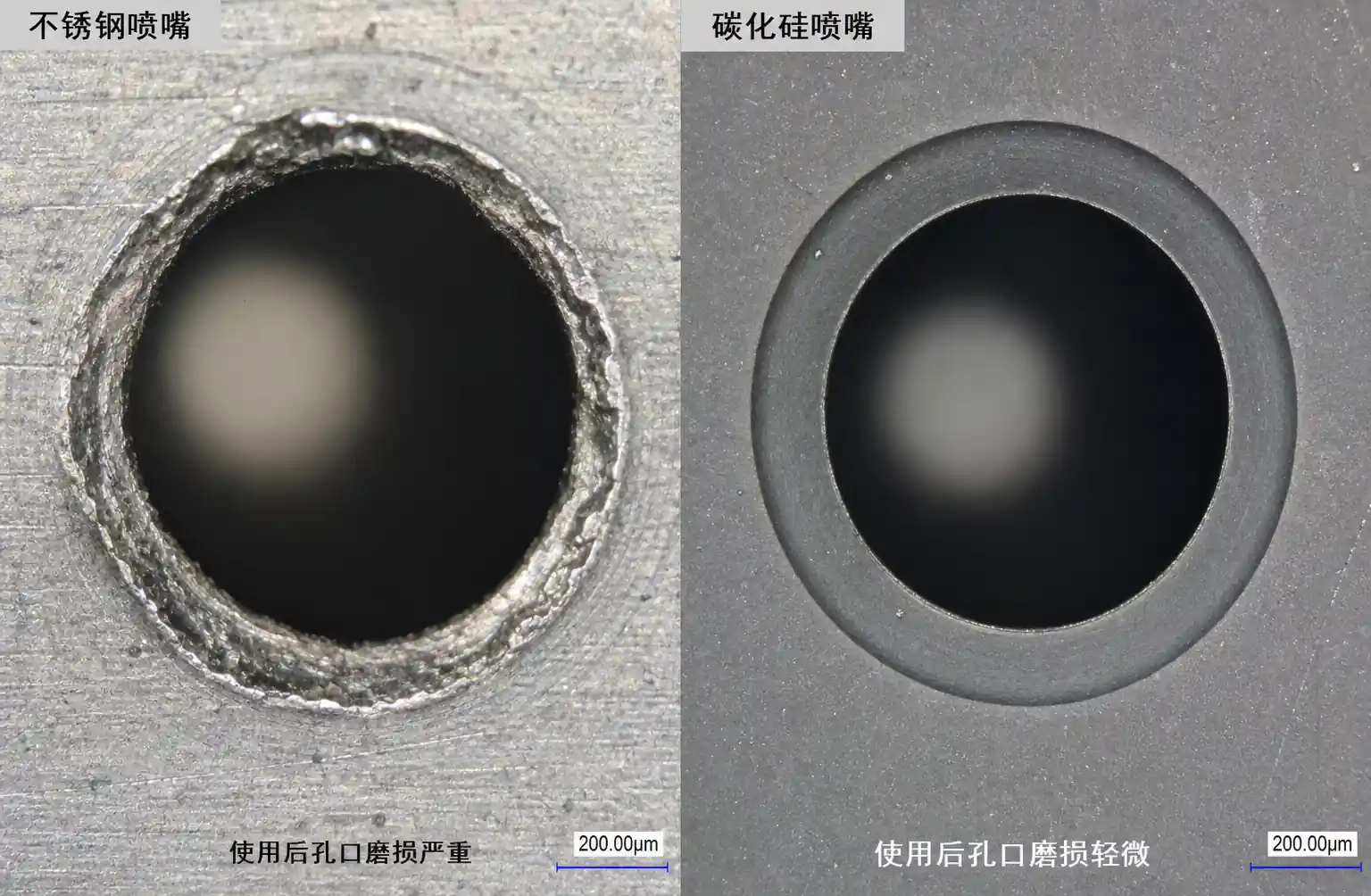
Quick-disconnect systems enable a decoupled material optimization strategy that traditional threaded nozzles cannot match. Because the adapter body remains installed, you can select corrosion-resistant materials for the wetted body and high-wear materials for the replaceable orifice—without paying for expensive materials in both components every time.
6.1 Material Comparison for Paper Machine Service
| Material | Hardness (HRC) | Relative Wear Life | Corrosion Resistance | Cost Multiple | Best Application |
|---|---|---|---|---|---|
| 303/304 Stainless | 15–20 | 1.0× (baseline) | Good (neutral pH) | 1.0× | Clean water, low-consistency clear showers |
| 316 Stainless | 15–20 | 1.0× | Excellent (acidic, chloride) | 1.3× | Acidic white water, coastal environments |
| Hardened 17-4 PH Stainless | 40–45 | 2.5–3.5× | Good | 2.1× | Moderate abrasion, neutral pH |
| Alumina Ceramic (Al₂O₃ 95%) | 80–85 HRA | 8–12× | Excellent (non-HF acids) | 2.8× | High-consistency stock, filler-loaded furnish |
| Silicon Carbide Ceramic | 90+ HRA | 15–25× | Excellent (most chemicals) | 4.5× | Extreme abrasion (recycled fiber, high filler) |
| Tungsten Carbide | 70–75 HRC | 20–35× | Fair (avoid acidic) | 5.2× | Maximum wear resistance, neutral/alkaline only |
In threaded nozzle systems, the entire nozzle must be replaced, so using silicon carbide means paying 4.5× more per replacement. In quick-disconnect systems, you pay for the expensive ceramic insert only, while the stainless adapter remains in service for years.
6.2 Total Cost of Ownership Example
Compare two strategies for a high-wear shower position requiring replacement every 4 months:
Threaded Nozzle Strategy (304 stainless, $28 each):
- Year 1: 3 replacements × $28 = $84
- Year 2: 3 replacements × $28 = $84
- Year 3: 3 replacements × $28 = $84
- 3-year material cost: $252
- Plus: 9 replacements × 35 min labor × $72/hour = $378 labor
- Plus: 9 replacements × 12 min downtime × $90/min = $9,720 downtime cost
- 3-year TCO: $10,350
Quick-Disconnect Strategy (316 SS adapter + silicon carbide insert):
- Initial: $85 adapter + $48 insert = $133
- Year 1: 2 insert replacements (lasts 30% longer) × $48 = $96
- Year 2: 2 insert replacements × $48 = $96
- Year 3: 2 insert replacements × $48 = $96
- 3-year material cost: $421
- Plus: 6 replacements × 2.5 min labor × $72/hour = $18 labor
- Plus: 6 replacements × 1 min downtime × $90/min = $540 downtime cost
- 3-year TCO: $979
The quick-disconnect system saves $9,371 per position over 3 years despite higher material costs, driven primarily by downtime reduction.
7. Common Implementation Mistakes That Erode ROI
7.1 Wrong Application Selection
The most common ROI failure occurs when mills install quick-disconnect systems in low-replacement-frequency locations to "standardize" the facility. If a nozzle position requires replacement only once every 2–3 years, the payback period stretches to 5–8 years—longer than typical equipment depreciation schedules.
Rule of thumb: Quick-disconnect systems make economic sense when replacement frequency exceeds 3–4 times per year in high-production-value operations, or 6+ times per year in lower-value operations.
7.2 Undersizing the Adapter Material
Some mills purchase lower-cost brass or aluminum quick-disconnect adapters to reduce upfront investment. In paper machine white water service (pH 4.5–6.5, chloride from recycled fiber), brass adapters corrode within 12–18 months, requiring complete replacement of the expensive adapter component—destroying the TCO advantage.
From our field failure analysis, 316 stainless steel adapters are the minimum acceptable material for paper machine service. The $15–$25 premium per adapter over brass pays back within the first year by avoiding premature replacement.
7.3 Ignoring Seal Replacement Protocols
Quick-disconnect systems use O-rings or face seals between the adapter and insert. These seals degrade after 50–200 insertion cycles depending on design and operating temperature. Mills that fail to replace seals on schedule experience leaks that require unplanned downtime—erasing the ROI benefit.
Best practice: Replace seals every 40–50 insert changes, or annually, whichever comes first. Seal kits cost $3–$8 but prevent $500–$2,000 leak-related shutdowns.
7.4 Inadequate Spray Pattern Documentation
When you switch from threaded nozzles to quick-disconnect inserts, the spray angle, flow rate, and impact force may shift slightly due to different internal vane designs—even if you specify "equivalent" performance. Some mills install quick-disconnect systems without re-validating spray coverage, leading to fabric cleaning problems or sheet moisture variation.
Always conduct water-sensitive paper spray pattern testing and flow verification after installation. Budget 2–4 hours per shower bank for validation testing.
7.5 Installation Torque Errors
Quick-disconnect adapters threaded into pipe headers require proper installation torque to prevent leaks and seal the tapered pipe thread. Over-torquing cracks ceramic adapters; under-torquing causes leaks that contaminate production or require re-work.
Use a calibrated torque wrench per manufacturer specifications—typically 15–25 ft-lbs for 1/4" NPT adapters, 25–40 ft-lbs for 1/2" NPT. Do not rely on "feel" with standard pipe wrenches.
8. FAQ
Q: Can I retrofit quick-disconnect adapters into existing threaded nozzle pipe headers without welding?
A: Yes, in most cases. Quick-disconnect adapters are available with standard NPT or ISO pipe threads that screw into existing tapped holes. Verify that your current thread size matches available adapter options. If you have non-standard or damaged threads, you may need to re-tap or install weld-in adapters, adding cost and complexity.
Q: Do quick-disconnect systems have higher leak risk than threaded nozzles?
A: When properly maintained, no. Quality quick-disconnect systems use dual O-ring or face seal designs that provide equivalent or better sealing than pipe thread sealant. However, seal degradation over many insertion cycles can cause leaks if you don't follow the seal replacement schedule. Threaded nozzles can also leak if pipe threads wear out after repeated removal cycles.
Q: What happens if an insert falls out during operation?
A: Properly installed quick-disconnect inserts use positive locking mechanisms (bayonet tabs, snap rings, or magnetic retention) that prevent accidental removal under normal operating pressure (up to 150 psi for most designs). We have not observed field failures due to insert ejection in properly specified systems. If operating pressure exceeds the design rating or if the locking mechanism is damaged, inserts can loosen—but this is rare and usually preceded by visible leakage.
Q: Can I use quick-disconnect systems in high-temperature applications like Yankee dryer showers?
A: Yes, but you must specify high-temperature O-ring materials. Standard nitrile (Buna-N) O-rings degrade above 180°F. For Yankee dryer service (up to 220°F), use EPDM, fluorocarbon (Viton), or PTFE seals. Confirm with your supplier that the adapter and insert materials can handle thermal cycling without galling or seizing.
Q: How do I justify the higher upfront cost to management if our mill operates with tight capital budgets?
A: Focus the business case on downtime savings, not labor savings. Labor cost reduction is meaningful but rarely reaches the threshold for capital approval. Use actual production records to calculate machine downtime cost per minute and multiply by the minutes saved per replacement. In most paper operations, downtime savings deliver payback in under 6 months, meeting even conservative capital hurdle rates. If your mill tracks OEE (Overall Equipment Effectiveness), frame the proposal as an OEE improvement project.
Q: Should I retrofit the entire machine at once or pilot a high-wear section first?
A: Pilot first unless you have overwhelming evidence from a sister facility. Install quick-disconnect systems on the highest-wear shower bank (typically forming section or coating applicators with abrasive stock) and track actual labor hours, downtime minutes, and material costs for 6 months. Use that data to build the business case for full-scale rollout. Pilots also reveal any application-specific installation challenges before you commit to facility-wide standardization.
Q: Are there any paper grades or machine speeds where quick-disconnect systems don't work well?
A: Quick-disconnect systems work across all paper grades and machine speeds from tissue to linerboard. The performance limitation is not grade or speed—it's replacement frequency and access difficulty. If your operation has very low nozzle wear (clean virgin fiber, low-consistency showers) and easy maintenance access, the ROI may not justify the investment. The technology itself is grade-agnostic.
9. Conclusion and Action Steps
Quick-disconnect nozzle systems deliver substantial ROI in paper machine maintenance when applied to high-wear, difficult-access applications with frequent replacement cycles. The core value driver is downtime reduction, not labor savings—although labor savings are meaningful in facilities with high maintenance labor costs.
The typical payback period ranges from 2 months to 18 months depending on replacement frequency, machine production value, and labor rates. Mills producing high-value specialty grades or operating with high-cost planned downtime constraints see the fastest payback. Commodity grades with lower contribution margins and less frequent nozzle replacement may require 12–18 months for payback but still achieve strong ROI over a 3–5 year equipment life.
Recommended Next Steps:
Step 1 – Data Collection (1 week): Pull maintenance records for the past 12 months and identify nozzle positions with replacement frequency exceeding 4 times per year. Document actual labor time per replacement including preparation and restart. Obtain machine downtime cost per minute from production or accounting.
Step 2 – Vendor Evaluation (2 weeks): Request samples and engineering specifications from at least two quick-disconnect system manufacturers. Verify that adapter thread sizes match your existing headers. Request material certifications for adapters and inserts compatible with your water chemistry.
Step 3 – ROI Calculation (3 days): Use the framework in Section 4 to calculate payback for your top 3–5 highest-replacement-frequency locations. If payback exceeds 24 months, quick-disconnect systems may not be justified.
Step 4 – Pilot Installation (1–3 months): Install quick-disconnect adapters and inserts on one shower bank during a planned maintenance outage. Train maintenance staff on proper insert removal and installation technique. Track actual replacement time and production impact for 10–15 nozzle changes.
Step 5 – Validation (6 months): Compare pilot section data against baseline performance. Measure labor hours saved, downtime minutes avoided, and any differences in spray performance or product quality. If results meet or exceed projections, proceed with full retrofit.
Step 6 – Scale Deployment: Prioritize remaining locations by ROI. Install highest-value locations first. Budget for seal replacement kits and spare inserts in common spray patterns.
Quick-disconnect nozzle technology is mature and proven across hundreds of paper machine installations worldwide. The question is not whether the technology works—it's whether your specific application justifies the investment. Use the ROI framework in this guide to make that determination with confidence.