



Industrial Nozzle Selection: The 5 Critical Parameters You Cannot Ignore (2026)
Most spray system failures trace back to selection errors. Engineers fixate on flow rate while ignoring pressure, angle, material wear, and droplet size. This guide walks through the five parameters that actually determine nozzle performance—and how they interact. No theory. Just what you need to size a nozzle that works.
Table of Contents
- 1. 1. Flow Rate: The Square Root Law
- 2. 2. Pressure: Balancing Performance and Cost
- 3. 3. Spray Angle: Coverage vs. Impact
- 4. 4. Material Selection: Wear Life and TCO
- 5. 5. Droplet Size: The Hidden Variable
- 6. 6. Selection Methodology
- 7. 7. Common Mistakes and Fixes
- 8. 8. FAQ
- 8.1. Can I use the same nozzle for different fluids?
- 8.2. How do I convert PSI to bar?
- 8.3. What causes spray angle to narrow over time?
- 8.4. Air atomizing vs hydraulic for coating?
- 8.5. How often should I replace nozzles?
- 9. 9. Conclusion
1. Flow Rate: The Square Root Law
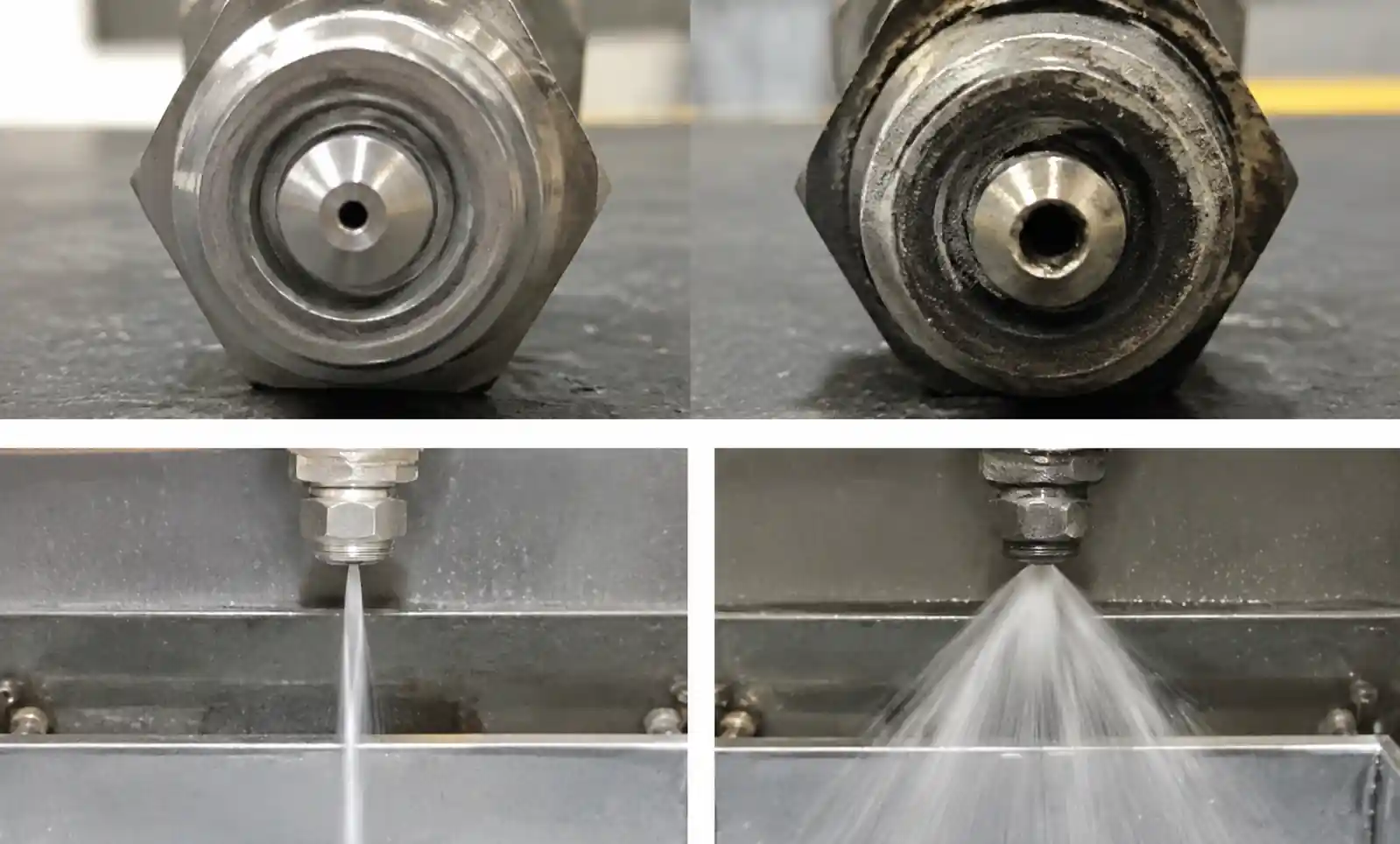
Q = k × √P — flow increases with the square root of pressure. Double pressure, and you only get 1.41× the flow. We've seen operators crank up pressure expecting proportional gains, only to waste energy and accelerate wear.
| Application | Typical Flow Range | Why This Range |
|---|---|---|
| Parts washing | 3–8 GPM per nozzle | Need impact to dislodge chips and coolant residue |
| Gas cooling | 0.5–3 GPM | Fine droplets evaporate quickly; excess flow = carryover |
| Tank cleaning | 15–50 GPM total | High flow needed for wall impact at distance |
| Dust suppression | 0.2–2 GPM | Low flow minimizes mud formation and water consumption |
For tank cleaning applications specifically, flow rate selection must also account for nozzle rotation mechanism—free-spinning vs controlled rotation nozzles have different flow and pressure characteristics that affect coverage consistency. See our Rotary Tank Cleaning Nozzle Selection Guide 2026: Free-Spinning vs Controlled Rotation for a detailed comparison.
Wear monitoring: In abrasive service, flow can increase 15-30% after 500 hours. Establish a replacement trigger at 10-15% above nameplate—don't wait until the process drifts out of spec.
2. Pressure: Balancing Performance and Cost
Pressure controls droplet size, spray angle, impact force, and energy consumption. A 50% pressure hike raises energy consumption by roughly 50%.
| Nozzle Type | Recommended Range | What Happens Outside |
|---|---|---|
| Flat fan | 15–60 PSI | Below 15: collapse. Above 60: excessive atomization |
| Full cone | 25–100 PSI | Below 25: hollow center. Above 100: wear accelerates |
| Hollow cone | 30–150 PSI | Below 30: incomplete cone. Above 150: fine mist |
| Air atomizing | Liquid: 5–30, Air: 40–80 | Low air: coarse. High air: noise and cost |
Field check: Install pressure gauges within 12 inches of the nozzle manifold, not just at the pump. Line friction can drop pressure 15 PSI from inlet to manifold end. We've seen uneven coverage that disappeared once pressure was balanced across the array.
3. Spray Angle: Coverage vs. Impact
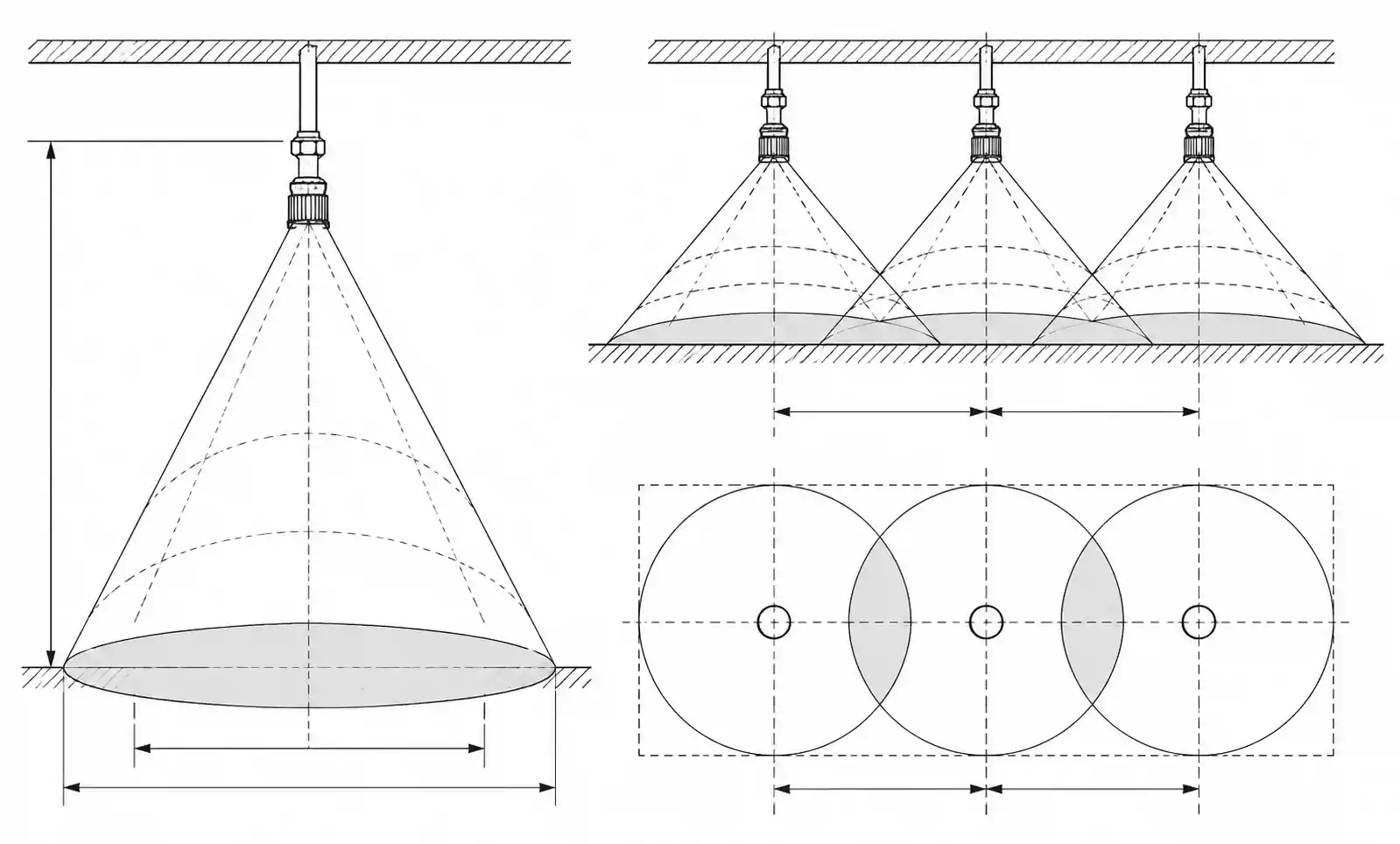
Spray angle determines coverage width at a given distance. A 65° flat fan at 12 inches covers about 15 inches; a 110° covers about 36 inches.
Spacing formula: Overlap spacing = 2 × (H × tan(angle/2)) × overlap factor (0.7–0.85 for uniform coverage)
| Application | Recommended Angle | Reasoning |
|---|---|---|
| Conveyor parts washing | 15–40° flat fan | Narrow, concentrated impact |
| Tank interior cleaning | 90–120° full cone | Reach walls from center mount |
| PCB cleaning | 50–80° flat fan | Balanced coverage and impact |
| Gas cooling | 60–90° hollow cone | Disperse across duct cross-section |
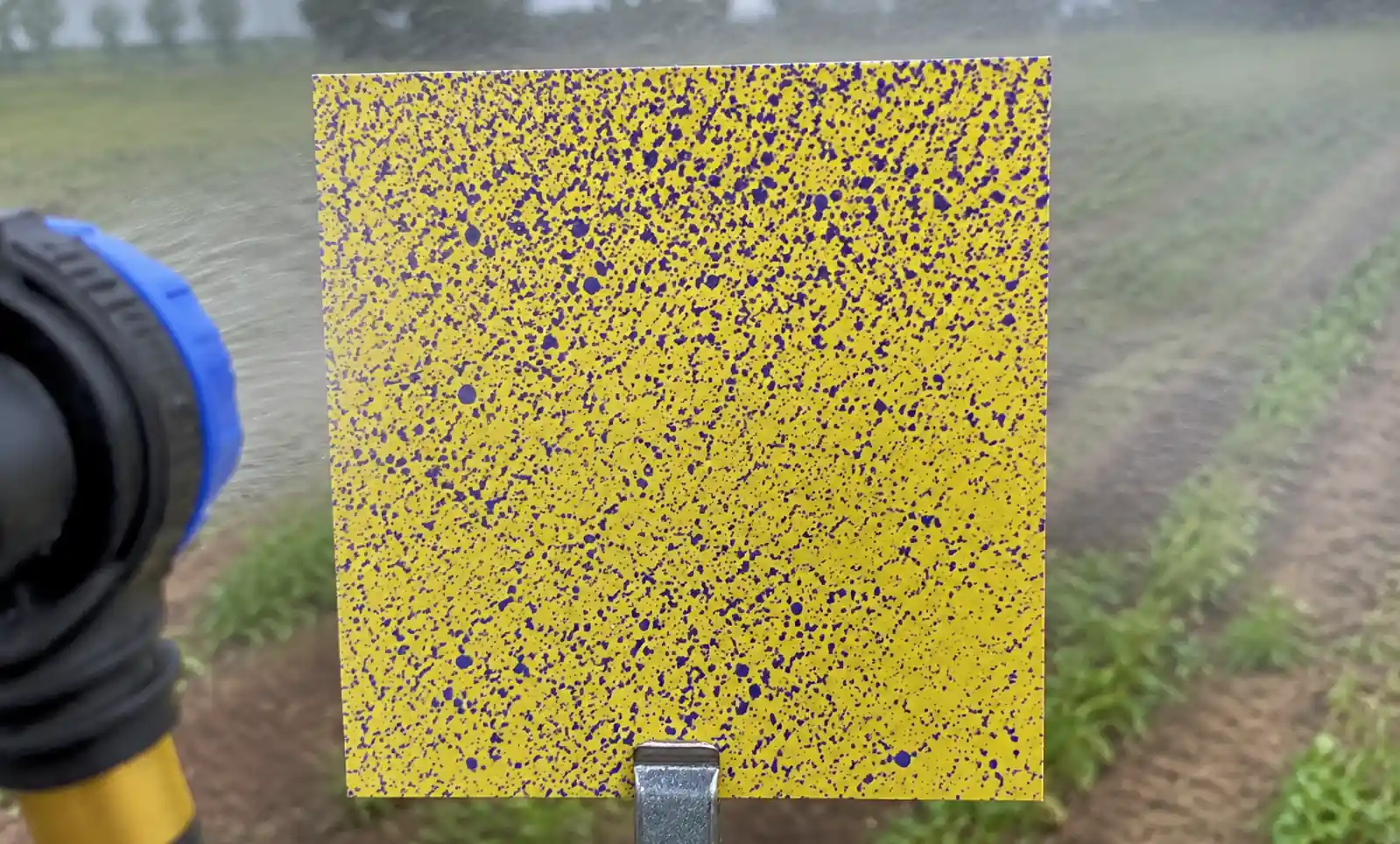
Common mistake: Widest angle to "reduce nozzle count." This reduces impact force and creates uneven center-to-edge coverage. Worn nozzles also narrow angle by 10-15°, creating untreated zones between nozzles. Validate with water-sensitive paper.

4. Material Selection: Wear Life and TCO
| Material | Hardness (HV) | Relative Wear Life | Cost Multiplier | Best For |
|---|---|---|---|---|
| Brass | 60–150 | 1× | 1× | Clean water, short service life acceptable |
| 316 SS | 150–200 | 3–5× | 2–3× | Corrosive chems, food/pharma |
| Hardened steel | 600–800 | 10–15× | 3–4× | Abrasive slurries |
| Ceramic (alumina) | 1200–1500 | 40–60× | 8–12× | High abrasion, acids |
| Silicon carbide | 2400–2800 | 80–120× | 15–25× | Extreme abrasion (fly ash, alumina slurry) |
| Tungsten carbide | 1400–1800 | 50–80× | 12–18× | Heavy abrasion with impact |
TCO calculation: TCO = (Nozzle cost + Labor per change) × (Changes per year)
Example—parts washer with abrasive coolant residue, 2000 hours/year:
- Brass: $12, lasts 200 hours → 10 changes/year → ($12+$50)×10 = $620/year
- Ceramic: $90, lasts 2000 hours → 1 change/year → ($90+$50)×1 = $140/year
The ceramic costs 7.5× more per unit but delivers 4.4× lower TCO. Material selection based solely on unit price is false economy.
Fluid guide:
- Clean water → Brass or 316 SS
- Acids (pH<4) → 316 SS, ceramic, SiC (avoid brass)
- Abrasive slurry (1-5% solids) → Hardened steel, ceramic
- Heavy abrasive (>5% solids) → Ceramic, SiC, tungsten carbide
For high-pressure tank cleaning applications handling baked-on polymers or mineral scale, material selection becomes even more critical—tungsten carbide and silicon carbide inserts can last 15-25× longer than 316 SS in abrasive service. See our High Pressure Tank Cleaning Nozzle Selection Guide 2026: Rotary vs Static vs Orbital for detailed material economics and ROI analysis.
5. Droplet Size: The Hidden Variable
Droplet size is measured as Dv0.5 —the median diameter where half the liquid volume is in smaller droplets. It varies with pressure, orifice size, viscosity, and surface tension.
| Application | Target Dv0.5 | Why |
|---|---|---|
| Evaporative cooling | 50–200 microns | Evaporate before wall impingement |
| Dust suppression | 10–100 microns | Capture airborne particles |
| Parts washing | 200–800 microns | Impact force to dislodge contaminants |
| Spray coating | 30–80 microns | Balance atomization and transfer efficiency |
For dust suppression applications, droplet size matching is particularly critical—the capture effect requires droplets to be comparable in size to airborne particles for effective knockdown. See our Industrial Spray Dust Suppression Systems & Nozzles guide for detailed specifications on 10-200 micron droplet optimization.
Pressure increases produce finer droplets (roughly Dv0.5 ∝ P^-0.3). A 100 PSI nozzle will generate coarser droplets at 40 PSI. For critical applications, request actual drop size distribution curves (ASTM E799) from your supplier at your operating pressure—not generic classifications.
6. Selection Methodology
Step 1: Define requirements — Total flow, target area, coverage uniformity (±10% or ±20%?), impact force, fluid properties (viscosity, temp, abrasiveness).
Step 2: Pick nozzle type — Flat fan (linear coverage, high impact), full cone (circular, uniform), hollow cone (perimeter, fine atomization), air atomizing (finest, high air consumption).
Step 3: Calculate flow per nozzle — Total flow / estimated nozzle count. Verify per-nozzle flow falls within the selected type's recommended range.
Step 4: Determine mounting geometry — Height, target width. Calculate spray angle using the formula. Apply 70-85% overlap.
Step 5: Set operating pressure — Balances droplet size and energy cost. Verify within the nozzle type's recommended range.
Step 6: Select material via TCO — Estimate wear life, calculate changeout frequency and total cost across options.
Step 7: Validate — Install samples with pressure gauges. Measure coverage with water-sensitive paper. Baseline flow for future monitoring.
7. Common Mistakes and Fixes
Mistake 1: Doubling pressure to fix low flow. You only get 1.41× flow—not 2×. Replace with a larger orifice or add nozzles.
Mistake 2: Ignoring viscosity changes with temperature. Winter fluid viscosity doubles? The spray pattern changes. Specify nozzles at worst-case viscosity or heat the fluid.
Mistake 3: Selecting widest angle to minimize nozzle count. Wide angles reduce impact force and create uneven coverage. You lose more in rejects than you save in nozzles.
Mistake 4: Brass in abrasive service. It wears out in weeks. Run the TCO calculation—ceramic or carbide pays back in months.
Mistake 5: No wear monitoring. Worn nozzles increase flow 20-30% before operators notice. Set up flow checks and replacement triggers at 10-15% flow increase.
8. FAQ
Can I use the same nozzle for different fluids?
Only if viscosity, surface tension, and abrasiveness are similar. A water-sized nozzle will deliver 30-50% lower flow with a fluid 5× more viscous. Revalidate with actual process fluid.
How do I convert PSI to bar?
1 bar ≈ 14.5 PSI. European catalogs list pressure in bar; North American catalogs use PSI.
What causes spray angle to narrow over time?
Wear enlarges the orifice while leaving spray-forming surfaces intact, creating a proportionally smaller exit angle. Also check for partial plugging from debris or scale.
Air atomizing vs hydraulic for coating?
Air atomizing gives finer droplets (better finish) but consumes compressed air (5–15 SCFM per nozzle). For high-volume operations, compressed air cost often exceeds finish improvement gains. Run the TCO.
How often should I replace nozzles?
Establish baseline flow after installation. Replace when flow increases 10-15% (wear) or when visual inspection shows orifice damage. Clean water: brass can last years. Abrasive slurry: ceramic may need annual replacement.
9. Conclusion
Industrial nozzle selection comes down to five parameters: flow rate, pressure, spray angle, material, and droplet size. Each one affects the others—wider angle reduces impact force, higher pressure changes droplet size, harder materials cost more upfront but reduce changeouts.
For application-specific guidance, consult field application engineers who can review process conditions, perform coverage mapping, and recommend configurations validated in similar installations.