



High-Pressure Sewer Cleaning Nozzle Spray Dynamics: Field-Tested Selection Guide for Municipal Applications (2026)
Municipal sewer teams often assume higher pressure means better cleaning. Our field testing across hundreds of installations shows otherwise—a 3,000 PSI system with bad nozzle geometry regularly underperforms a well-configured 2,000 PSI setup. Spray dynamics—jet velocity, impact force distribution, and thrust-to-cleaning ratio—determine whether a blockage clears in minutes or requires multiple passes. For municipal crews looking to optimize their entire cleaning operation, industrial cleaning nozzles and spray solutions designed for high-impact residue removal can reduce water consumption by 25-30% while cutting cleaning time in half. This guide covers what we've learned from 4-inch laterals to 36-inch trunk mains.
Table of Contents
1. Critical Spray Parameters in Sewer Jetting
Jet velocity: V = C × √(2 × P / ρ). At 2,500 PSI, theoretical jet velocity hits about 365 ft/s. But velocity decays with distance—a 0.040-inch orifice keeps effective cutting power within 4 inches; a 0.080-inch orifice extends that to 8 inches. Pick your orifice based on how far you need to cut.
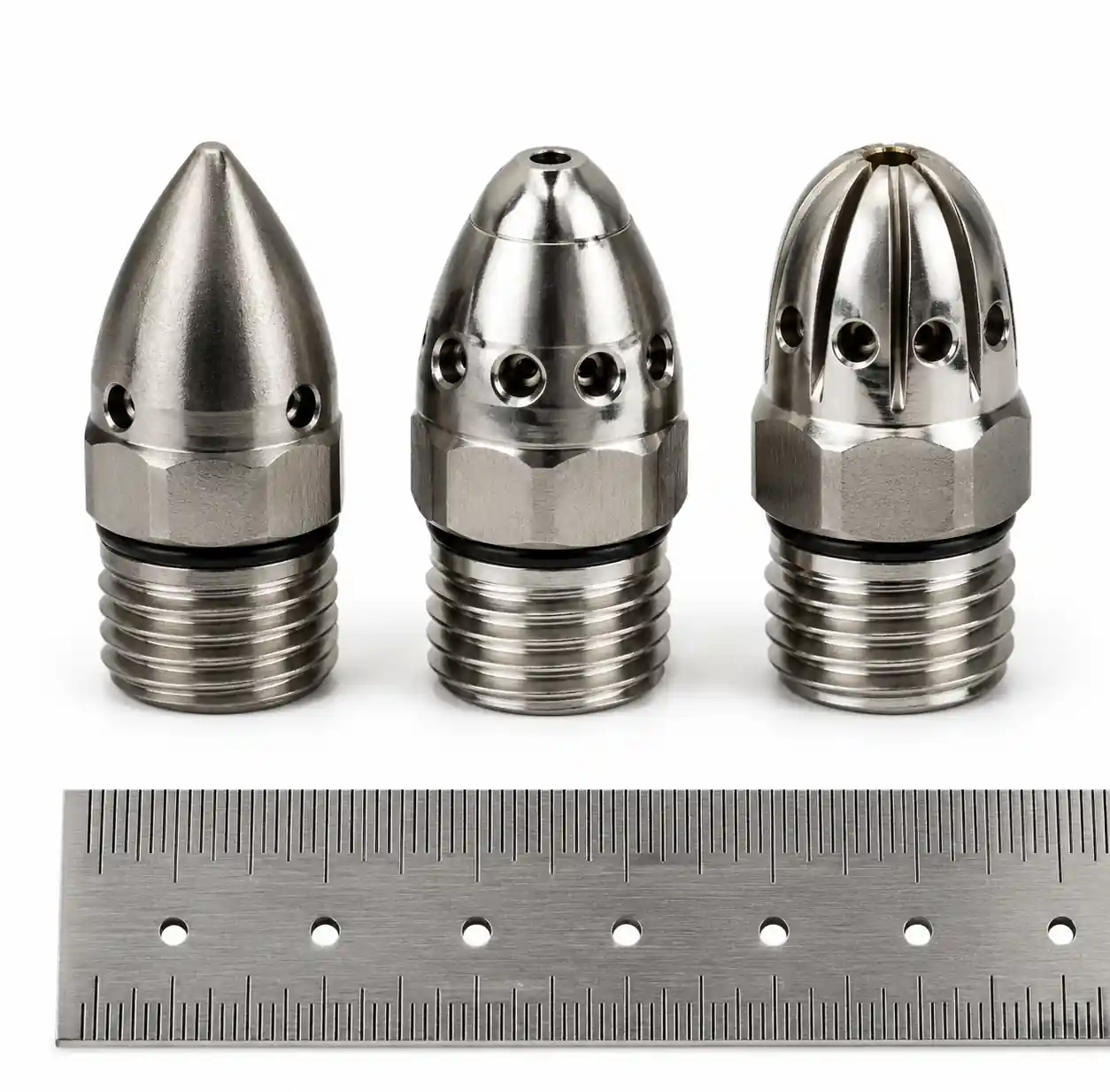
Impact force: F = ρ × Q × V. At 8 GPM and 2,500 PSI through a 0.040-inch orifice, each jet delivers about 4.2 lbf. Penetrator nozzles with 4-6 forward jets give you 17-25 lbf total—enough to break through compacted grease and sediment.
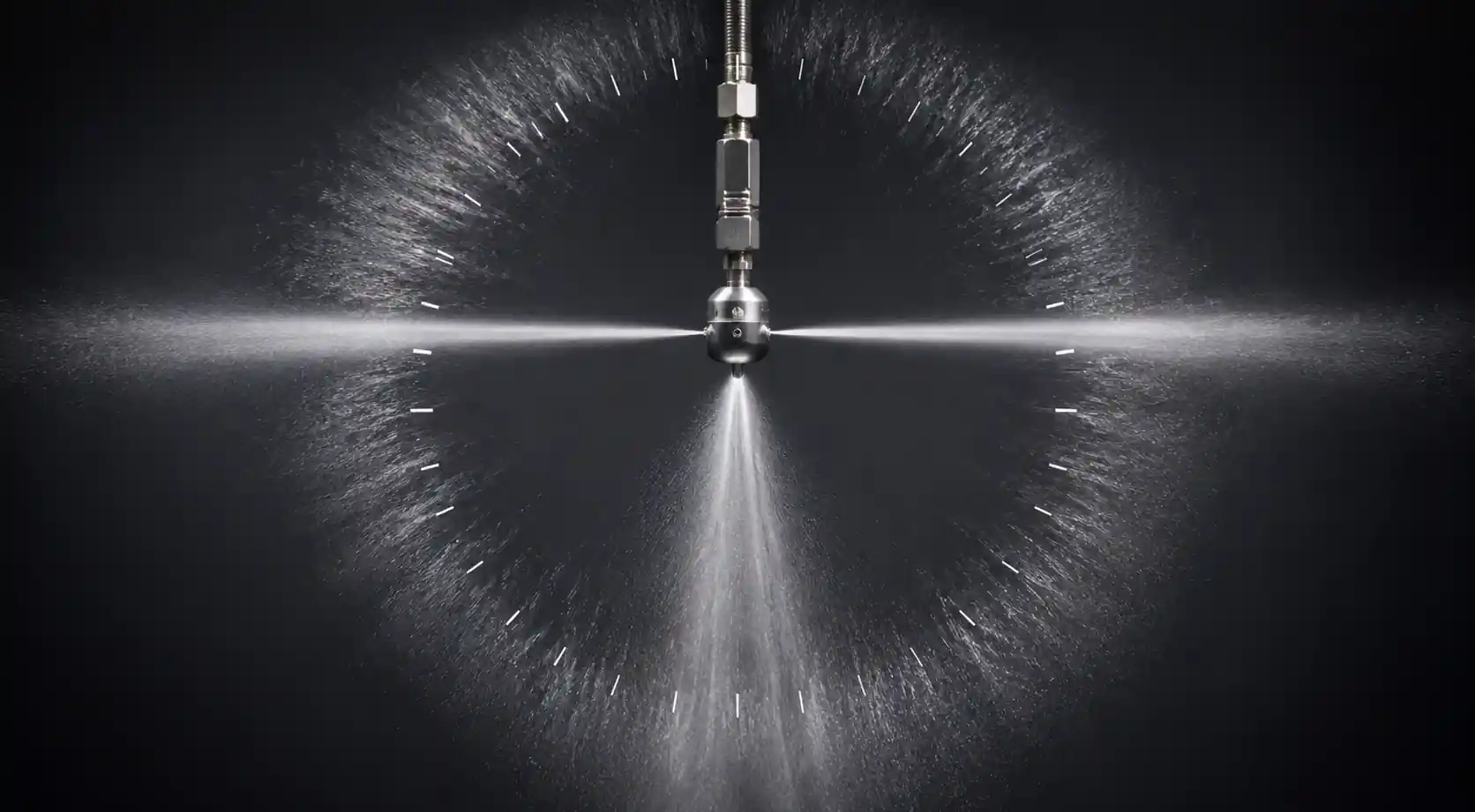
Rear thrust: Thrust = sum of ρ × Q × V over all rear jets. Optimal self-propulsion requires rear thrust ≥ 1.5× (hose drag + forward jet reaction). Too little and the nozzle stalls. Too much and it races through without cleaning or damages pipe walls.
2. Nozzle Type Comparison
| Nozzle Type | Forward Jets | Rear Jets | Forward Force (lbf) | Rear Thrust (lbf) | Best For |
|---|---|---|---|---|---|
| Penetrator | 1–4 (0°) | 3–6 (15–25°) | 15–30 | 20–35 | Compacted grease, hardened scale |
| Rotary | 2–3 (rotating) | 3–4 (30–45°) | 10–20 | 15–25 | Grease film, wall cleaning |
| Flusher | 0 | 6–12 (wide angle) | 0 | 30–50 | Debris transport, final pass |
| Root Cutter | 4–8 (tight angle) | 4–6 (20–30°) | 20–40 | 25–40 | Roots, fibrous blockages |
Penetrator nozzles concentrate flow into 1-4 forward jets. They cut through 12-inch grease accumulations at 15-25 ft/min at 2,500 PSI. Weakness: poor pipe wall cleaning—you'll need a follow-up pass.
Rotary nozzles spin at 300-800 RPM, sweeping forward jets in a circular pattern. In our tests, they remove 85-95% of grease film in a single pass versus 40-60% for static penetrators. Downside: slower advance through heavy blockages; bearings wear.
Flusher nozzles have no forward jets—all flow goes rearward at wide angles. Creates strong turbulent mixing to transport debris downstream. Only works in partially clear lines.
Root cutters use multiple small-diameter forward jets (0.025-0.035") arranged in a circle. At 3,500 PSI, they sever roots up to 2" diameter. High maintenance—small orifices clog easily. Keep your water clean or use inline filtration.
The same principles of nozzle rotation and coverage consistency apply in tank cleaning applications. For a detailed comparison of free-spinning vs controlled rotation nozzles and their impact on cleaning uniformity and maintenance intervals, see our Rotary Tank Cleaning Nozzle Selection Guide 2026: Free-Spinning vs Controlled Rotation.
3. Jet Impact Force and Pipe Wall Safety
Excessive impact force damages aging pipes—especially clay, ceramic, and deteriorated concrete. Here are the safety limits we use:
| Pipe Material | Max Impact (PSI) | Min Standoff (inches) | Safe Pressure |
|---|---|---|---|
| PVC (SDR 35) | 400 | ≥3 | ≤4,000 PSI |
| Vitrified Clay | 250 | ≥4 | ≤3,000 PSI |
| Cast Iron | 800 | ≥2 | ≤5,000 PSI |
| Concrete (good) | 500 | ≥3 | ≤4,000 PSI |
| Concrete (deteriorated) | 200 | ≥5 | ≤2,500 PSI |
| HDPE | 600 | ≥2.5 | ≤4,500 PSI |
Impact pressure at standoff: P_impact = (ρ × V²) / 2 × cos(θ). At the orifice exit (365 ft/s), impact pressure hits ~4,100 PSI—way above the limit for clay and deteriorated concrete. But at 4 inches from a 0.040-inch orifice, velocity drops to ~200 ft/s, impact pressure falls to ~620 PSI—safe for most materials.
Rule of thumb: keep your nozzle at least 3-4 inches from the pipe wall when working with aged or fragile pipe.
For a deeper understanding of how impact force scales with pressure and orifice size across different cleaning applications, see our High Pressure Tank Cleaning Nozzle Selection Guide 2026: Rotary vs Static vs Orbital for detailed material economics and ROI analysis in abrasive service.
[IMG_3]
4. Rear Jet Thrust for Self-Propulsion
Nozzles that stall in the pipe are almost always undersized on rear jets. Hose drag increases with pipe length and roughness. For a typical 300-foot deployment in 8-inch concrete, hose drag runs 25-45 lbf. Add forward jet reaction (15-30 lbf), and total resistance is 40-75 lbf.
For reliable self-propulsion, rear thrust should be 60-110 lbf—1.5-2× resistance. Required rear jet area:
Rear jet area = (1.5 × F_resistance) / (ρ × V × cos(θ))
For a 2,500 PSI system needing 80 lbf thrust with 25° rear jets: required area ≈ 0.0095 in²—about 3 jets at 0.063" each.
Most stock nozzles undersize rear jets to maximize forward cleaning power. We routinely increase rear jet diameter by 0.005-0.010" to fix stalling—small sacrifice in forward impact, big gain in self-propulsion.
5. Material Selection for Abrasive Service
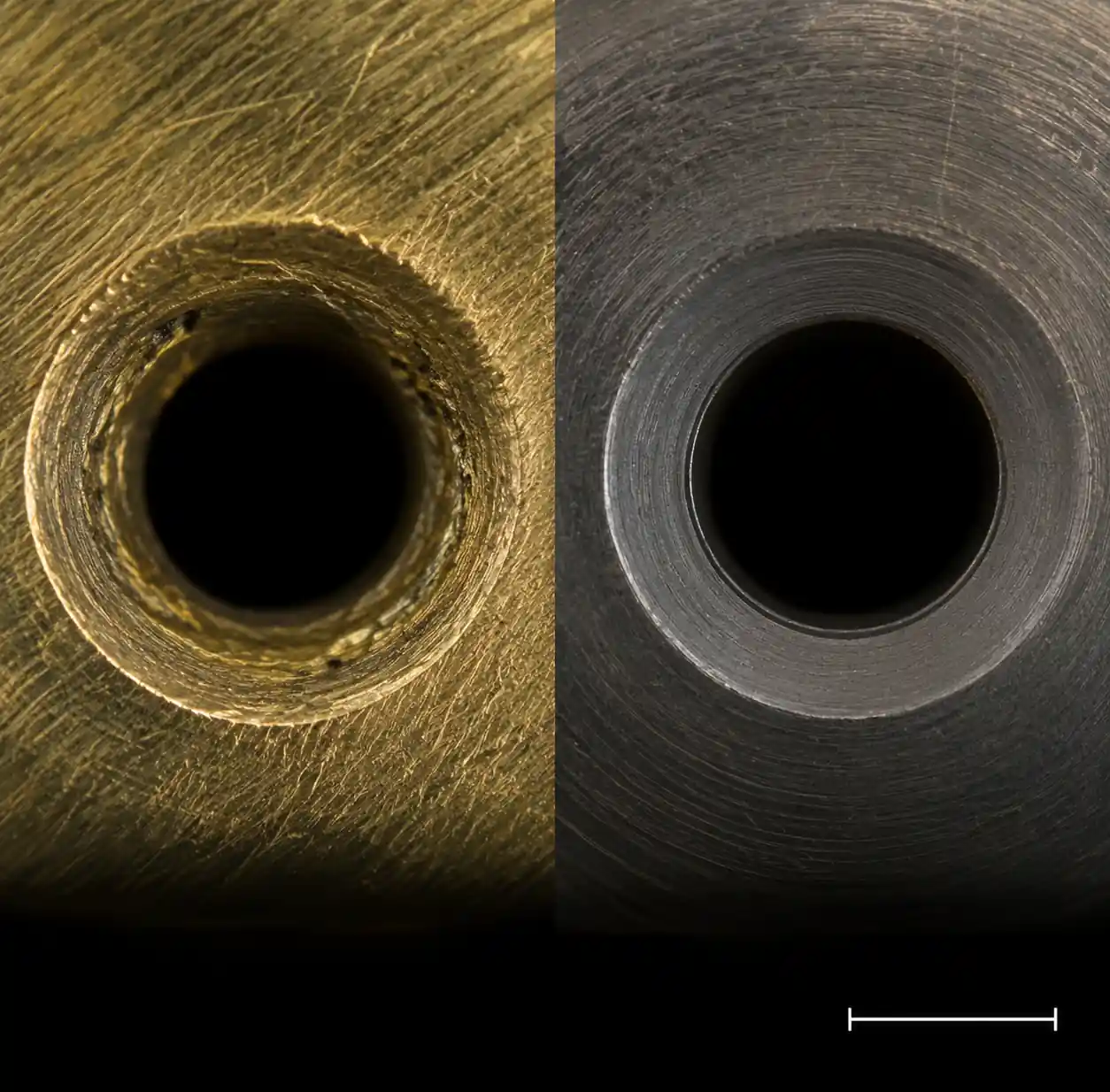
Sewer slurry wears nozzles fast. A 10% increase in orifice diameter drops velocity ~5%, increases flow 21%, and kills cleaning effectiveness.
| Material | Hardness (HRC) | Wear Life (relative) | Cost Multiple | Best For |
|---|---|---|---|---|
| Brass | 60–80 | 1× | 1× | Clean water only |
| Hardened 17-4 SS | 50–55 | 3–5× | 2× | Light grit, residential |
| Tungsten Carbide | 85–92 | 15–25× | 6–8× | Heavy grit, municipal |
| Silicon Carbide | 95–98 | 20–30× | 8–10× | Extreme abrasion, corrosive |
| Ruby Synthetic | 85–90 | 25–35× | 12–15× | Ultra-fine orifices |
For municipal fleets doing 50,000+ feet per month, tungsten carbide nozzles pay back in 3-6 months. They cost 6-8× more than brass but last 15-25× longer, dropping effective cost per operating hour by 50-60%. More importantly, carbide maintains consistent performance throughout its life—no gradual efficiency fade.
6. Common Field Mistakes
Mistake 1: Max pressure = better cleaning. Above optimal pressure, cavitation forms in the nozzle throat, disrupting flow and reducing impact force by 15-25%. Match orifice sizing to your pump's flow capacity—don't just crank it up.
Mistake 2: Ignoring rear jet angle. Steep rear jets (>35°) cause the nozzle to race through blockages without cleaning. Shallow rear jets (<15°) produce insufficient thrust. Use 15-25° for 4-12" lines; 20-30° for 15-36" lines.
Mistake 3: One-pass expectations. Heavily fouled lines need two passes—penetrator to break through, then rotary or flusher for wall cleaning. This two-pass approach is 30-40% faster than single-pass at excessive pressure.
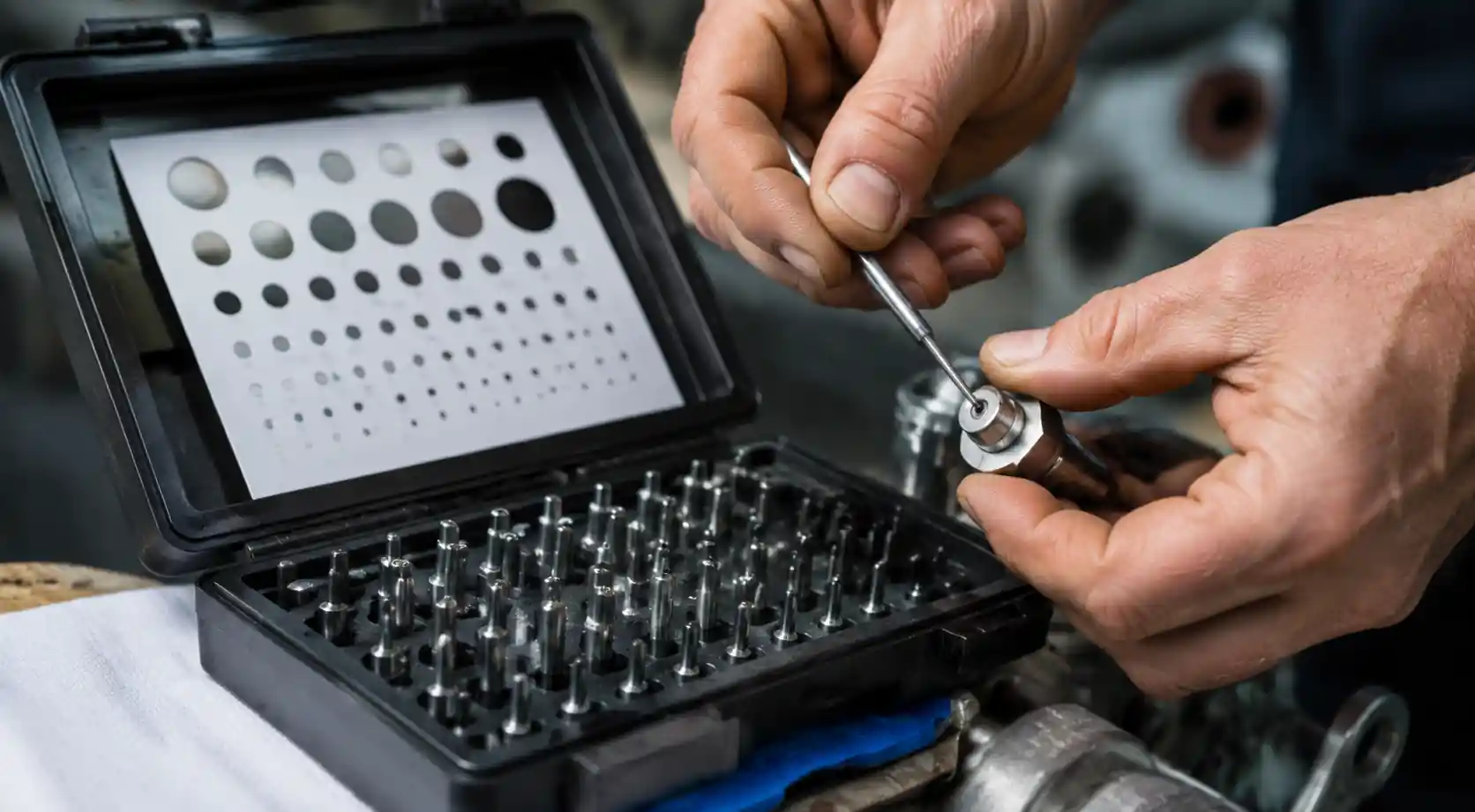
Mistake 4: Not inspecting orifices. A 20% increase in orifice diameter (0.040 to 0.048") increases flow 44% while cutting velocity 17%—massive loss of cleaning power. Pin-gauge orifices weekly, replace when wear exceeds 10%.
Mistake 5: Using the same nozzle for every job. Penetrators for blockages, rotaries for wall cleaning, flushers for transport. One type won't do it all.
7. FAQ
What pressure should I use for residential vs commercial lines?
Residential laterals (4-6"): 1,500-2,500 PSI. Commercial branch (8-12"): 2,000-3,500 PSI. Trunk mains (15+"): 2,500-4,000 PSI. Start low and increase only if cleaning stalls.
How do I select nozzle size for my pipe diameter?
Nozzle body should be 60-75% of pipe inner diameter. Smaller won't reach walls; larger increases drag and reduces maneuverability around bends.
Can I use sewer jetting nozzles in potable water pipes?
Only if the nozzle and hose have never touched wastewater. Most jurisdictions require dedicated equipment for potable water. Check local cross-connection regulations.
What causes nozzle vibration or chatter?
Usually cavitation from excessive pressure or undersized supply hose causing pressure drop. Verify hose is minimum 3/8" ID for up to 10 GPM; 1/2" for 15+ GPM. Reduce pressure 10-15% and retest.
How often should I replace nozzle orifices?
Depends on material and environment: Brass in gritty water: 20-40 hours. Hardened steel: 100-200 hours. Tungsten carbide: 500-1,000 hours. Inspect weekly, replace when orifice diameter increases 10% or more.
8. Conclusion
Effective sewer cleaning comes down to matching nozzle geometry and materials to your actual conditions—not just cranking up pressure. Penetrators for blockages, rotaries for wall cleaning, flushers for debris transport. Use the pressure and impact tables to stay within pipe safety limits. And for municipal fleets, carbide orifices pay back fast.
For nozzle sizing help, send your pipe inventory, typical blockages, and equipment specs to our field application team. We'll run the numbers and recommend optimized configurations.