



Mining Conveyor Belt Dust Cleaning: How to Achieve Full Coverage with Nozzle Placement? (2026)
Mining conveyor dust suppression fails more often from poor coverage than bad nozzles. We routinely audit systems where 20-30% of the belt width gets no water—dry streaks that let dust escape at transfer points. Whether you're designing a new system or troubleshooting an existing one, the right industrial cleaning nozzles and spray solutions can make the difference between full coverage and costly compliance failures. Here's the engineering method we use to design zero-gap coverage for belts from 600mm to 2400mm wide, validated on coal, iron ore, and copper conveyors worldwide.
Table of Contents
- 1. 1. Critical Parameters for Full Coverage
- 2. 2. Nozzle Type Selection
- 3. 3. Coverage Calculation Method
- 4. 4. Installation Layout by Belt Width
- 5. 5. Material Selection for Abrasive Dust
- 6. 6. Field Validation and Troubleshooting
- 7. 7. FAQ
- 7.1. Can I use full cone nozzles instead of flat fans for wider coverage?
- 7.2. How do I calculate water consumption for permit compliance?
- 7.3. What pressure range should I design for?
- 7.4. Do I need different layouts for loaded vs. return belt?
- 7.5. How often should I inspect and clean nozzles?
- 8. 8. Conclusion
1. Critical Parameters for Full Coverage
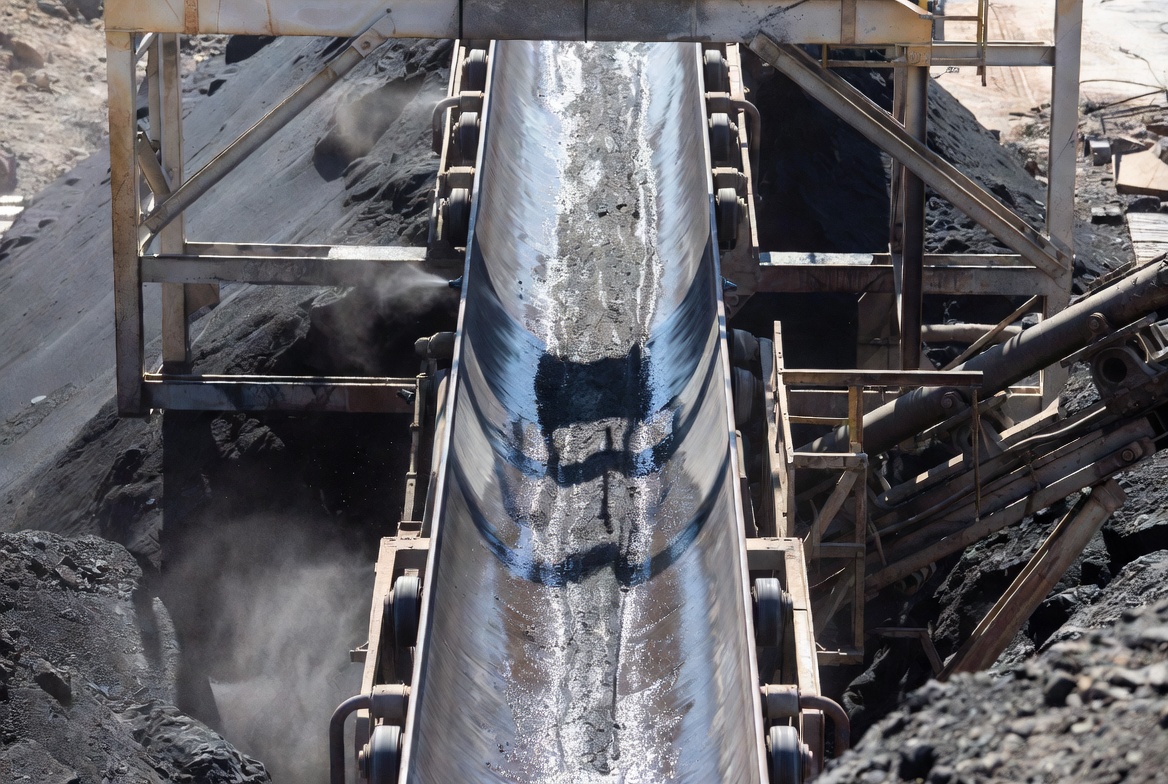
Belt width and speed: Measure under load—belts sag 2-5% when loaded. A nominal 1200mm belt carrying 800 tph may be 1170mm effective. Use loaded width. Speed determines residence time: 3 m/s belt gives only 0.5 seconds of contact over 1.5m spray zone.
Spray angle derating: Catalog angles are measured at ideal conditions. In the field, pressure variation narrows angle 5-8°, orifice wear another 5-10°, and crosswind deflects edges 100-150mm. Effective angle = rated angle − 13° is a safe starting point.
Effective width formula:
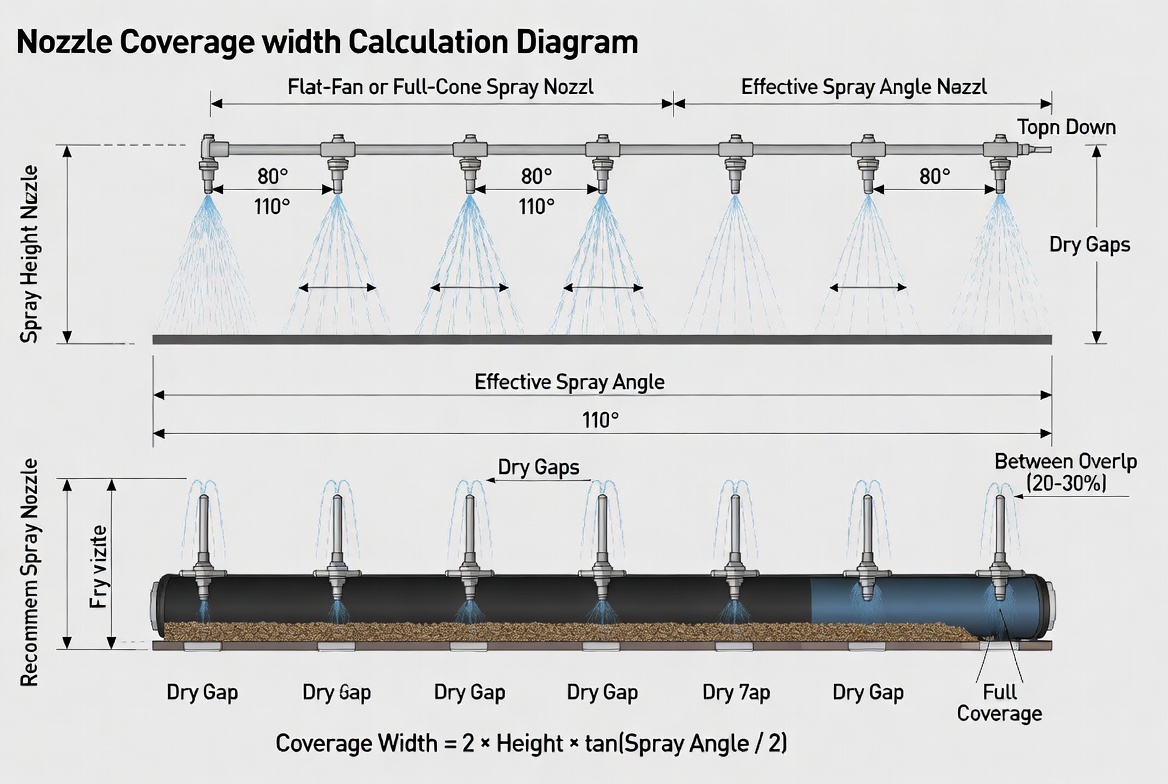
W_eff = 2 × h × tan(θ_eff / 2)
For a 65° flat fan at 1.0m height with 52° effective angle: W_eff = 2 × 1.0 × tan(26°) ≈ 0.98m. This is your single-nozzle footprint.
Structural obstructions: H-beams, cable trays, chute walls create shadow zones. A 150mm H-beam at 0.9m can shadow 200-250mm of belt—map everything in the spray path. Understanding shadow zones is critical to eliminating dry streaks; for a deeper dive into identifying and correcting coverage gaps, see our guide on how to eliminate dead zones in tank cleaning.
Pressure at farthest nozzle: For a 3m manifold feeding 6 nozzles, expect 0.3-0.5 bar drop from first to last with 25mm pipe. Undersized manifolds are the #1 cause of uneven coverage—last nozzles spray 15-20% narrower.
Flow per nozzle: Q = K × √P (K = flow coefficient, typically 0.8-1.5 L/min/√bar for flat fans).
2. Nozzle Type Selection
| Nozzle Type | Droplet Size (Dv50) | Coverage Uniformity | Clogging Resistance | Best Use |
|---|---|---|---|---|
| Flat fan (hydraulic) | 200-600 µm | Excellent (±8%) | Good | Primary belt washing |
| Full cone (hydraulic) | 150-400 µm | Good (±15%) | Moderate | Transfer point suppression |
| Hollow cone | 100-300 µm | Poor (ring pattern) | Good | Perimeter fogging, not belt |
| Air atomizing | 10-100 µm | Excellent | Very poor | Enclosed systems only |
| Spiral | 1000-3000 µm | Poor (pulsing) | Excellent | Heavy material, low dust |
Recommendation: Flat fan hydraulic nozzles (65-80°) give the best belt coverage. The elliptical pattern matches belt geometry, droplet size (300-500 µm) knocks down dust without excessive misting, and they tolerate 10-15% solids in recirculated water. Avoid air atomizing on open conveyors—they clog within 8 hours in high-dust environments.
For belts wider than 1200mm, use staggered rows instead of a single inline array. Two rows offset by 50% spacing eliminate shadow zones from the mounting pipe and provide backup if one nozzle fails.
3. Coverage Calculation Method
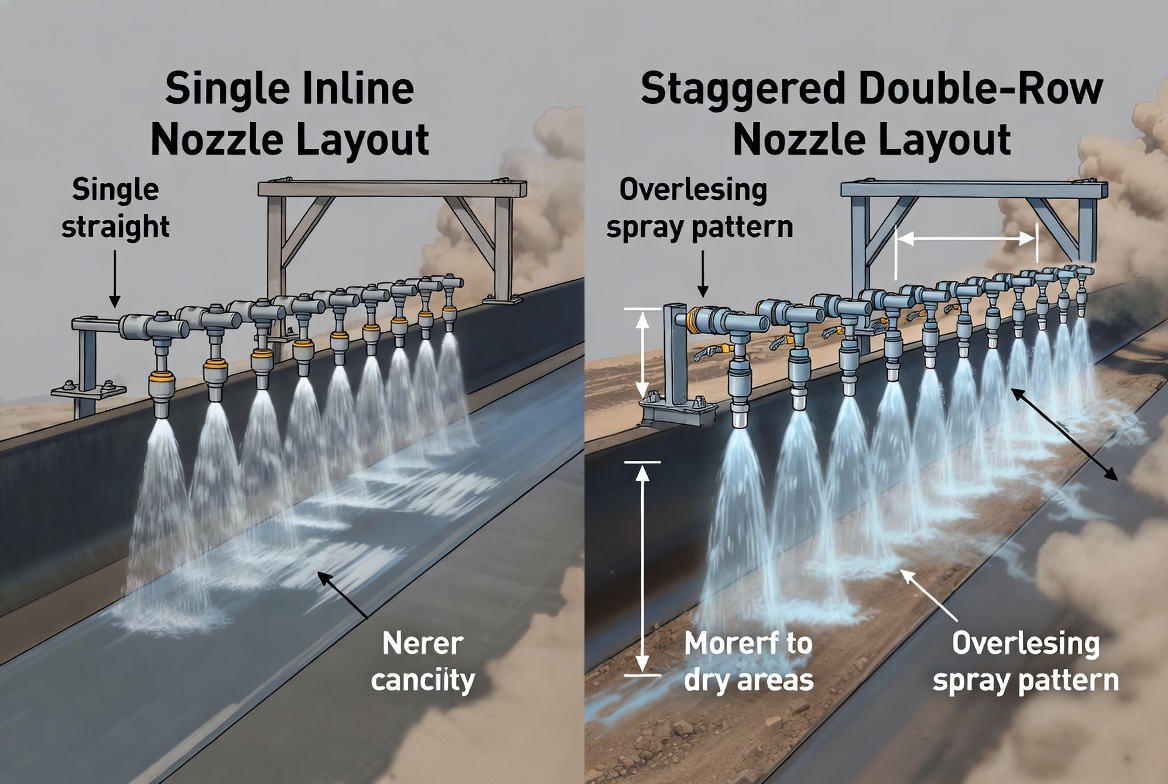
Step 1: Calculate effective width. Use derated angle, not catalog.
Step 2: Set overlap. Design for 15-20% overlap between adjacent nozzles to handle wear and wind.
Spacing = 0.80-0.85 × W_eff
Step 3: Calculate nozzle count.
N = Belt Width / Spacing + 1
Example: 1200mm belt, W_eff = 0.98m, spacing = 0.80m:
- N = 1.20 / 0.80 + 1 = 2.5 → 3 nozzles
Step 4: Verify coverage. 3 nozzles at 0.80m spacing with 0.98m effective width gives 0.18m overlap per side. No dry streaks.
Step 5: Verify flow. Per nozzle flow × count = total demand. Confirm pump and pipe sizing can deliver at required pressure.
4. Installation Layout by Belt Width
| Belt Width | Nozzle Count | Rows | Spacing | Mounting Height | Overlap |
|---|---|---|---|---|---|
| 600-900mm | 2-3 | Single | 0.50-0.60m | 0.8-1.0m | 20-25% |
| 1000-1400mm | 4-6 | Staggered double | 0.70m (offset 0.35m) | 1.0-1.2m | 15-20% |
| 1500-2400mm | 8-12 | Triple or dual side | 0.80-1.00m | 1.2-1.5m | 15-18% |
Narrow belts (600-900mm): Single row, 2-3 nozzles, 70-80° flat fans, 0.8-1.0m height. Angle nozzles 5° forward (belt travel direction) to increase contact time.
Medium belts (1000-1400mm): Staggered double row, 4-6 nozzles, 65-75° flat fans, 1.0-1.2m height. Row 1 at 0.70m spacing, Row 2 offset by 0.35m, 0.30m downstream. If one nozzle clogs, the staggered row covers that zone.
Wide belts (1500-2400mm): Triple staggered or dual side-mounted manifolds. For belts >1800mm, avoid center manifolds—they create shadow. Use dual side manifolds, each covering half the belt.
5. Material Selection for Abrasive Dust
Coal, iron ore, and copper slurry erode brass nozzles in 2-4 weeks. Here's the wear data from field trials.
| Material | Hardness (HV) | Relative Wear Life | Cost Multiple | Best For |
|---|---|---|---|---|
| Brass | 100-150 | 1× | 1× | Clean water, temporary |
| 316 Stainless | 180-220 | 3-4× | 1.5× | Moderate dust |
| Alumina Ceramic | 1400-1800 | 10-15× | 3× | Abrasive dust, slurry |
| Silicon Carbide | 2400-2800 | 15-20× | 4-5× | Severe abrasion, acidic |
| Tungsten Carbide | 1500-2000 | 12-18× | 6× | Extreme service—overkill for most |
Economics (6-nozzle system, 5000 hours/year):
- Brass: Replace every 4 weeks → 60 nozzles/year × $8 = $480 + 60 maintenance trips
- 316 SS: Replace every 10 weeks → 25 nozzles/year × $12 = $300 + 25 trips
- Ceramic: Replace every 50 weeks → 5 nozzles/year × $24 = $120 + 5 trips
For coal and iron ore, ceramic nozzles pay back within 6 months. For clean aggregate, 316 SS is sufficient.
6. Field Validation and Troubleshooting
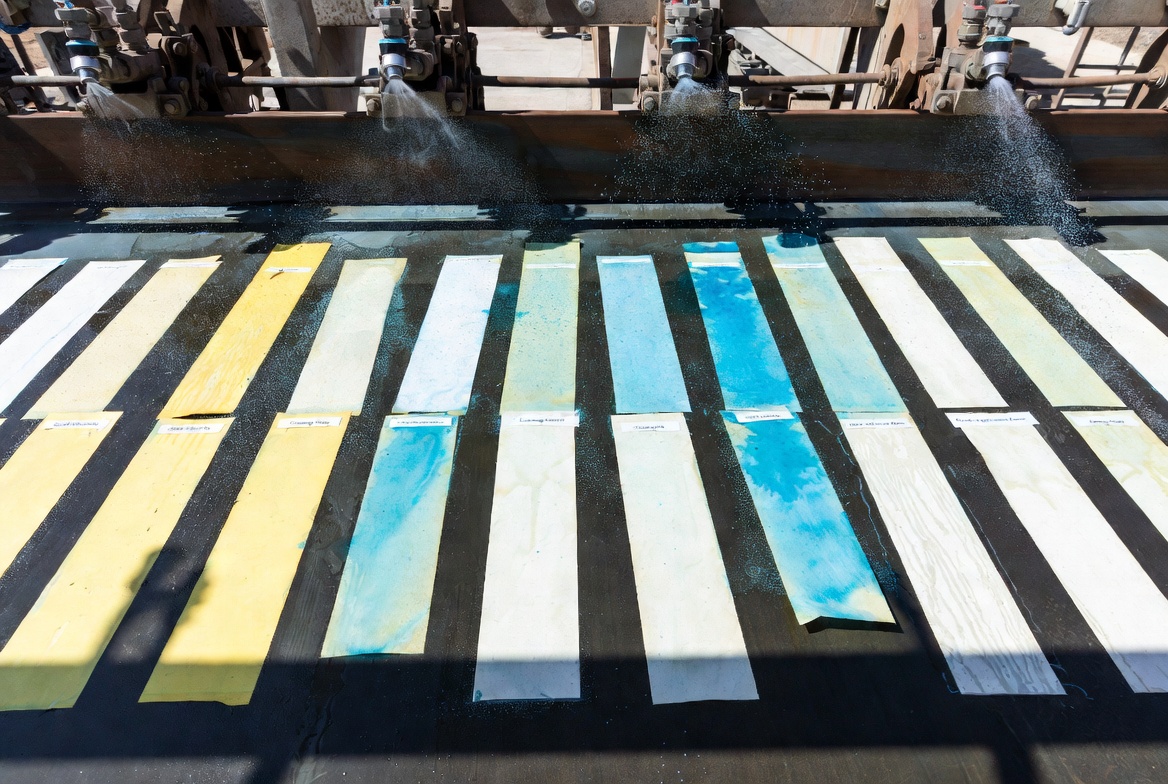
Coverage testing with water-sensitive paper:
- Lay paper strips (50mm × 300mm) across belt at 300mm intervals
- Run spray for 5 seconds at operating pressure
- Measure wetted width—should be ≥95% of belt width with no dry streaks >50mm
- If gaps exist, reduce spacing or raise pressure 0.5-1.0 bar
| Symptom | Root Cause | Fix |
|---|---|---|
| Dry streak down center | Nozzles angled too shallow, edges don't meet | Increase angle or reduce height to 0.8m |
| Dry streaks at edges | Insufficient overlap, edge nozzles spray past belt | Add edge nozzles or rotate nozzles 5° inward |
| Uneven wetting (good start, poor end) | Manifold pressure drop | Increase pipe size to 32mm or use pressure-compensating nozzles |
| Pulsing spray | Air in supply line | Install air release valve at manifold high point |
| Gradual coverage loss | Orifice wear, angle narrowing | Switch to ceramic or reduce spacing 10% |
Monitor flow: Install a flow meter at the manifold inlet. Log daily flow. When total flow increases 15-20% above baseline, nozzles are worn and need replacement.
If your system leaves dry streaks or needs nozzle replacement every 3-4 weeks, it's a design problem, not a product problem. Recalculate using Section 3, check manifold pressure drop, and upgrade materials.
7. FAQ
Can I use full cone nozzles instead of flat fans for wider coverage?
Full cones produce circular patterns—less efficient for rectangular belt coverage. You'll need 25-30% more nozzles for the same uniformity. Use full cones only for transfer points where 360° dust knockdown is needed.
How do I calculate water consumption for permit compliance?
Total flow = nozzle count × Q per nozzle × duty cycle. Six nozzles at 2.5 L/min, 18 hours/day: 6 × 2.5 × 1080 min/day = 16,200 liters/day. For recirculated water, add 5-10% evaporation loss.
What pressure range should I design for?
2.5-4.5 bar (35-65 PSI). Below 2 bar: spray angle collapses, droplets too large. Above 5 bar: excessive mist (<200 µm) blows away rather than wetting the belt.
Do I need different layouts for loaded vs. return belt?
Yes. Loaded belt needs full coverage. Return belt (underside) only needs 50-60% coverage focused on high-dust zones near idlers and scrapers—fewer nozzles, wider spacing.
How often should I inspect and clean nozzles?
Weekly visual inspection for clogging or pattern distortion. Monthly disassembly and ultrasonic cleaning for recirculated water. Quarterly orifice measurement—replace if diameter increases >10%.
8. Conclusion
Full coverage is an engineering calculation, not a guess. Four steps—effective width, overlap ratio, nozzle count, pressure verification—eliminate dry streaks. Key rules:
- Derate spray angle by 10-15° for wear and wind. Use effective angle, not catalog.
- Design for 15-20% overlap—this buffers individual nozzle failure.
- Staggered rows eliminate shadow zones on belts over 1200mm.
- Ceramic nozzles deliver 10-15× wear life in abrasive dust—payback within 6 months.
- Validate with water-sensitive paper before commissioning. Gaps found during testing cost minutes; gaps found during an audit cost thousands.
If your system leaves dry streaks or needs nozzle replacement every 3-4 weeks, it's a design problem, not a product problem. Recalculate using Section 3, check manifold pressure drop, and upgrade materials. For application-specific sizing, contact our technical team with belt width, speed, dust type, and available pressure.