


ROI Analysis: Why High-Performance Silicon Carbide Nozzles Reduce Long-Term Operating Costs (2026)
Most plant engineers pick nozzles by price. That's a mistake. In abrasive service, a $12 stainless nozzle might cost you $45 in labor and downtime every time it fails—which is every two months. Silicon carbide costs 3-5× more upfront but lasts 10-15× longer. For dust suppression applications handling highly abrasive coal or mineral dust, ceramic-lined nozzles can deliver up to 10 times the service life of hardened steel, making the ROI case even stronger—see our Industrial Spray Dust Suppression Systems & Nozzles guide for application-specific data. Run the numbers and you'll see the payback is usually under six months. Here's how to make the case to your procurement team.
Table of Contents
- 1. 1. Total Cost of Ownership for Industrial Nozzles
- 2. 2. Material Performance and Wear Life
- 3. 3. Annual Savings Calculation
- 4. 4. Payback Period Sensitivity
- 5. 5. Application-Specific ROI Examples
- 6. 6. Hidden Costs of Frequent Replacement
- 7. 7. Decision Framework: Is SiC Right for You?
- 8. 8. FAQ
- 8.1. How do I verify claimed wear life for my application?
- 8.2. Can I mix SiC and standard nozzles in the same system?
- 8.3. What happens if a silicon carbide nozzle chips or cracks?
- 8.4. How accurate are the TCO calculations if my labor/downtime costs differ?
- 8.5. Do SiC nozzles need different installation?
- 9. 9. Conclusion
1. Total Cost of Ownership for Industrial Nozzles

Price is just the start. True TCO includes:
Direct costs: Purchase price, replacement parts, inventory carrying, shipping.
Indirect costs (60-75% of TCO): Labor for changeouts (scaffolding, lockout/tagout, system depressurization), production downtime, quality defects from degraded spray, energy waste from flow drift, and compliance risk.
A $12 nozzle that fails every two months with $450 in changeout labor is actually $2,700 per year. The $65 SiC nozzle that lasts two years costs $32.50 per year. The decision isn't close.
2. Material Performance and Wear Life
| Material | Hardness (Knoop) | Relative Wear Life* | Cost Multiplier | Brittleness | Max Temp °C |
|---|---|---|---|---|---|
| Brass | 100-150 | 1.0× | 1.0× | Low | 260 |
| 303 Stainless | 150-200 | 1.2-1.5× | 1.2× | Low | 425 |
| Hardened 17-4PH | 350-400 | 2-3× | 1.8× | Low | 480 |
| Tungsten Carbide | 1,500-1,700 | 8-12× | 4.5-6× | Medium | 540 |
| Silicon Carbide (SiC) | 2,500-3,000 | 10-15× | 3-5× | High | 1,650 |
*20% alumina slurry, 40 PSI, 500 hours baseline. Relative life = hours to 10% orifice enlargement.
The same material economics apply across industrial applications. For high-pressure tank cleaning handling baked-on polymers or mineral scale, tungsten carbide and silicon carbide inserts can deliver 15-25× the service life of 316 SS—see our High Pressure Tank Cleaning Nozzle Selection Guide 2026: Rotary vs Static vs Orbital for detailed material economics and ROI analysis.
Field data from steel mill descaling (1,500-3,000 PSI, scale-laden water):
- Hardened stainless: 800-1,200 hours
- Tungsten carbide: 6,500-9,000 hours
- Silicon carbide: 9,000-14,000 hours
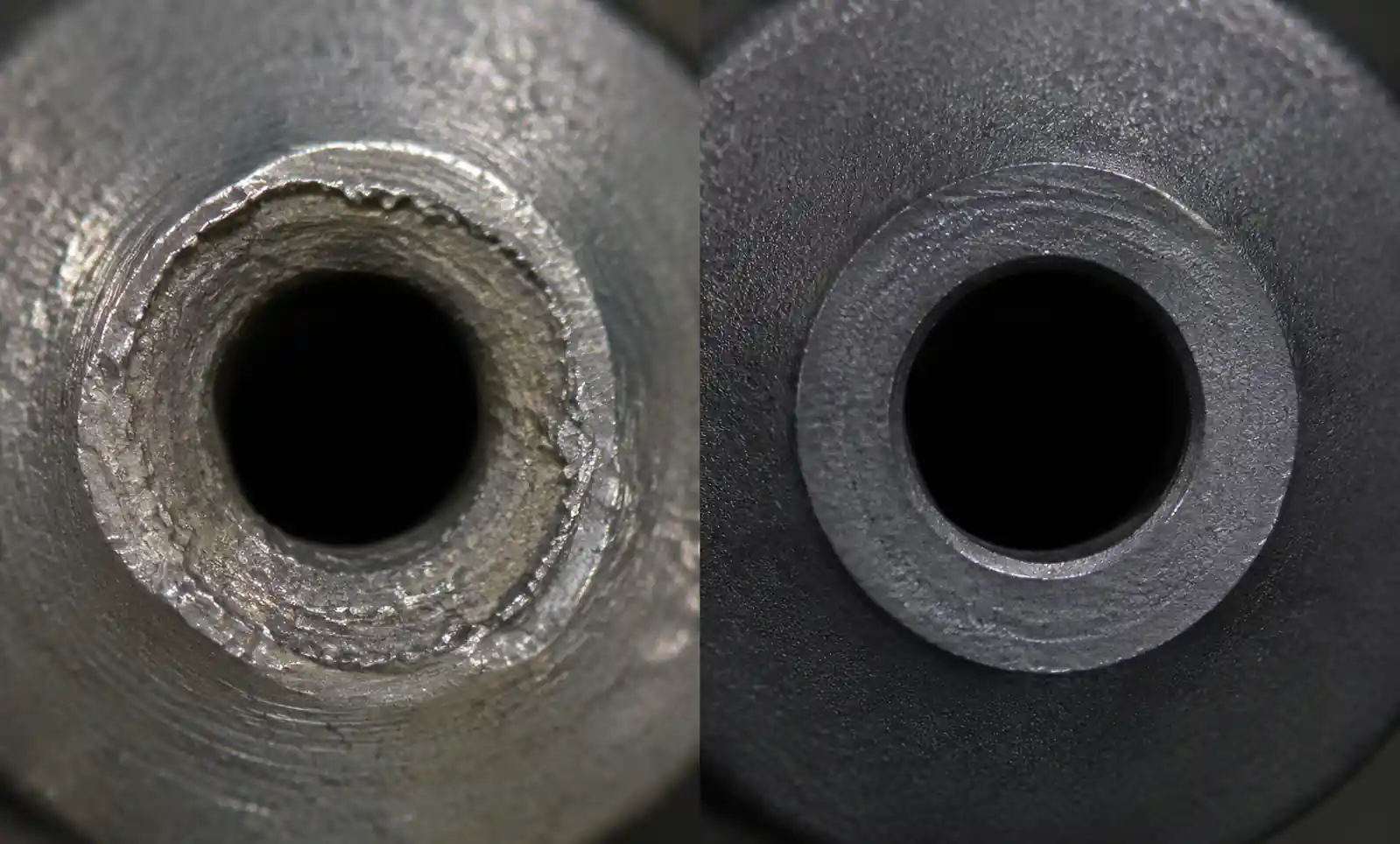
At 8,000 annual operating hours: stainless fails every 1.5-2 months; SiC lasts 13-20 months. That's 30 replacements vs 3-4 over five years.
Caveat: SiC is brittle. If your system has severe pressure transients (>30% spikes) or impact risk during maintenance, tungsten carbide may be the safer TCO choice despite slightly lower wear life.
3. Annual Savings Calculation
Example: Parts washing system with 24 nozzles, 6,500 hours/year
| Cost Component | Hardened Stainless | Silicon Carbide | Annual Savings |
|---|---|---|---|
| Nozzle purchases | $1,728 | $780 | $948 |
| Labor (changeouts × $450)* | $1,800 | $225 | $1,575 |
| Downtime (changeouts × 2h × $850/h) | $6,800 | $850 | $5,950 |
| Total Annual OPEX | $10,328 | $1,855 | $8,473 |
*2 technicians × 3 hours × $75/hr loaded rate.
ROI: Upfront premium = 24 × ($65 - $18) = $1,128. Payback = 1.6 months. Five-year cumulative savings ≈ $42,000.
4. Payback Period Sensitivity
Payback (months) = (SiC cost - baseline cost) ÷ monthly OPEX savings
| Application Severity | Annual Hours | Typical Payback | Recommendation |
|---|---|---|---|
| Mild, clean fluids | <2,000 | 24-36 months | Stainless; SiC optional |
| Mild, clean fluids | >5,000 | 12-18 months | SiC justified |
| Moderate abrasives | <3,000 | 12-18 months | SiC or tungsten carbide |
| Moderate abrasives | >5,000 | 3-8 months | Strongly recommend SiC |
| Severe abrasives | Any | 1-6 months | SiC essentially mandatory |
The tipping point: 3,500-4,000 annual hours in moderate abrasive service. Below that, run the numbers. Above that, SiC pays for itself fast.
5. Application-Specific ROI Examples
Steel mill descaling (1,500-3,000 PSI, scale-laden water): 156 annual replacements eliminated, $187,000 saved annually. Unplanned outages down 78%.
Flue gas conditioning (lime slurry, pH extreme, abrasives): 500 MW coal plant extended nozzle life from 4 months (alumina ceramic) to 18+ months (SiC). Annual nozzle spend dropped from $94,000 to $21,000—$73,000 saved while improving scrubber efficiency.
Food CIP (caustic/acid, 24/7 operation): Reduced replacements from twice/year to once every 3-4 years. Dairy facility achieved 3.2-year payback while simplifying validation documentation.
6. Hidden Costs of Frequent Replacement
Beyond labor and parts, frequent changeouts cost you:
Process quality: 15-25% film thickness variation in coating applications during the last 30% of nozzle life.
Energy waste: 10% orifice wear = 21% higher flow (Q = k√P). Wasted pumping energy, fluid, and treatment capacity.
Inventory: Facilities with short-life nozzles carry 2-3× more safety stock—$4,000-6,000 tied up per 200-nozzle system.
Compliance: Degraded spray in scrubbers or dust suppression can cause permit exceedances. One air quality violation can wipe out your entire annual nozzle budget.
Maintenance disruption: Unplanned failures force reactive maintenance, displacing preventive work and reducing OEE.
Our field data shows hidden costs add 40-60% to direct replacement costs. A $500 changeout carries $200-300 in indirect expense.
7. Decision Framework: Is SiC Right for You?
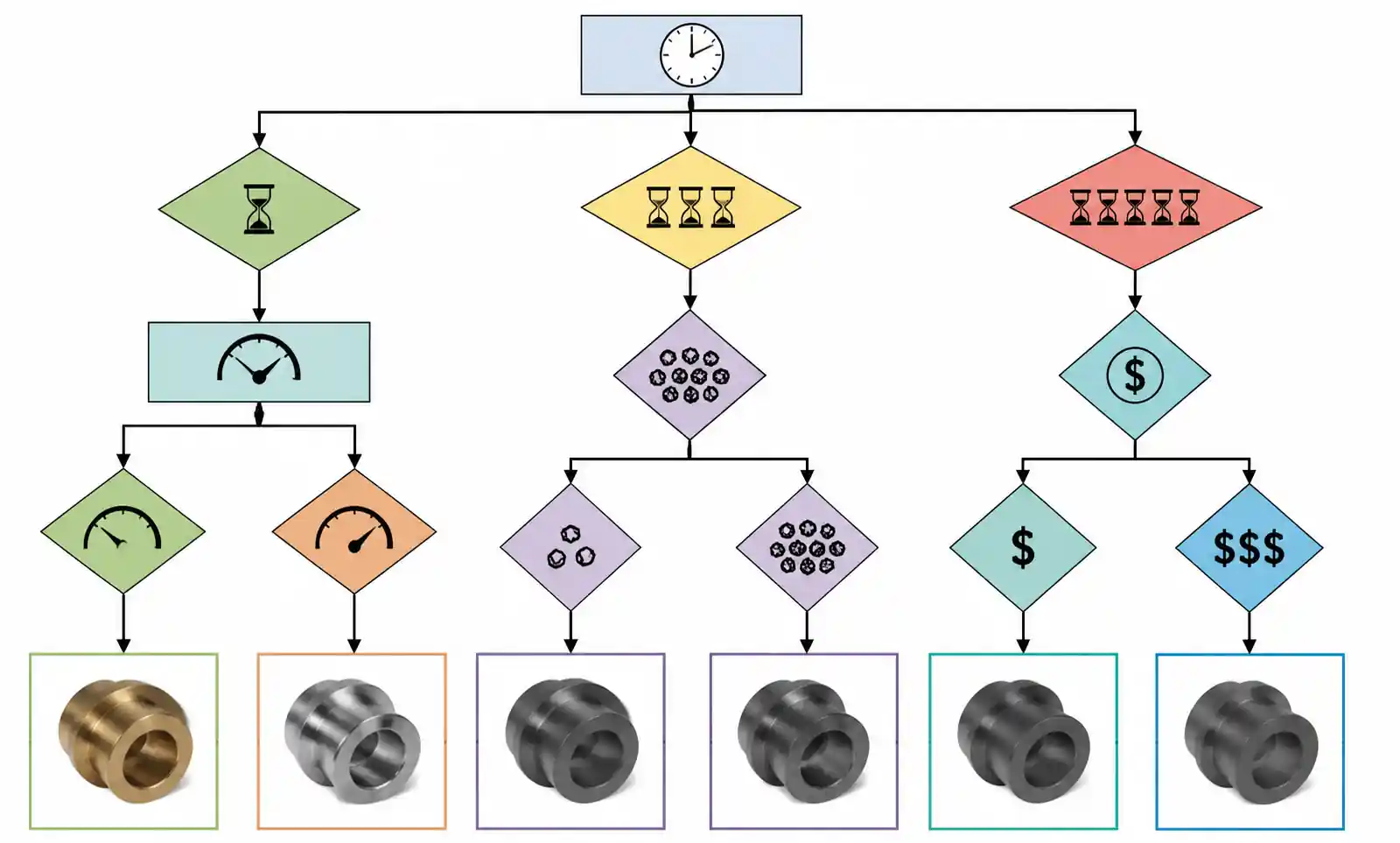
Step 1: Operating >3,500 hours/year in moderate-to-severe abrasive service? → Yes: proceed to Step 2. No: run TCO numbers—SiC may still justify if downtime costs are high.
Step 2: System protected against pressure spikes >30% above max rated? → Yes: SiC is mechanically suitable. No: install pressure relief/dampening, or consider tungsten carbide.
Step 3: Unplanned downtime >$400/hour? → Yes: strong SiC recommendation. No: calculate payback per Section 4.
Step 4: Is spray consistency critical for quality or compliance? → Yes: SiC's stable performance reduces process variation. Recommended.
Alternatives to consider:
- Boron carbide: Only for extreme environments (>5,000 PSI abrasive) where SiC life is inadequate. 8-12× price premium rarely justifies.
- Tungsten carbide: Best for high-impact or uncontrolled transient environments. Slightly lower wear life than SiC, much less brittle.
- Hardened stainless/ceramic: Acceptable for low-severity (<2,000 hours/year, clean fluids) where initial cost matters more than lifecycle.
8. FAQ
How do I verify claimed wear life for my application?
Run a trial with 3-5 nozzles alongside your current baseline. Monitor flow weekly with a calibrated bucket test. Document hours to +10% flow increase. Field data beats datasheet claims every time.
Can I mix SiC and standard nozzles in the same system?
Yes, but not recommended for coverage-critical applications. Mixed wear rates cause non-uniform flow distribution over time. If budget-constrained, prioritize SiC for highest-wear positions and use stainless elsewhere.
What happens if a silicon carbide nozzle chips or cracks?
SiC fails catastrophically rather than gradually. Install flow monitoring to detect sudden failures. In safety-critical systems, consider tungsten carbide for its more ductile failure mode.
How accurate are the TCO calculations if my labor/downtime costs differ?
The formulas are templates—plug in your actual numbers. Sensitivity analysis shows even halving downtime cost estimates, SiC still achieves <6-month payback in severe-duty applications.
Do SiC nozzles need different installation?
Yes. Use torque wrench to manufacturer specs (30-40% lower torque than stainless). Never overtighten. Use thread sealant appropriate for your fluid. Avoid impact during installation.
9. Conclusion
SiC nozzles deliver 10-15× wear life, 3-18 month payback, and 40-75% annual OPEX reduction when full TCO is considered—parts, labor, downtime, energy waste, and quality variation.
They're not universal. Mild-duty, low-utilization applications don't justify the premium. But for continuous operations in erosive, corrosive, or high-temperature service, our field data shows specifying SiC from the start delivers 5-year savings of $8,000-15,000+ per nozzle position.