



Chemical Plant Tank Cleaning: How to Balance Cleaning Agent Usage and Nozzle Pressure (2026)
Tank cleaning is a recurring cost that quietly eats into chemical plant budgets. Too much pressure wastes chemicals and wears out nozzles. Too little pressure and you're running long cycles, burning through solution, and still leaving residue behind. Here's how to find the sweet spot between chemistry and mechanics.
Table of Contents
- 1. The Chemistry vs Mechanics Trade-Off
- 2. Pressure-Flow and Chemical Consumption
- 3. Nozzle Selection for Chemical Efficiency
- 4. Finding Your Optimal Point
- 5. Common Optimization Mistakes
- 6. FAQ
- 6.1. What pressure range should I be running?
- 6.2. How do I know if I'm at optimal pressure?
- 6.3. Can I reduce chemical concentration if I increase pressure?
- 6.4. How often should I inspect tank cleaning nozzles?
- 6.5. What's the most cost-effective nozzle material for alkaline cleaning?
- 7. Conclusion
The Chemistry vs Mechanics Trade-Off
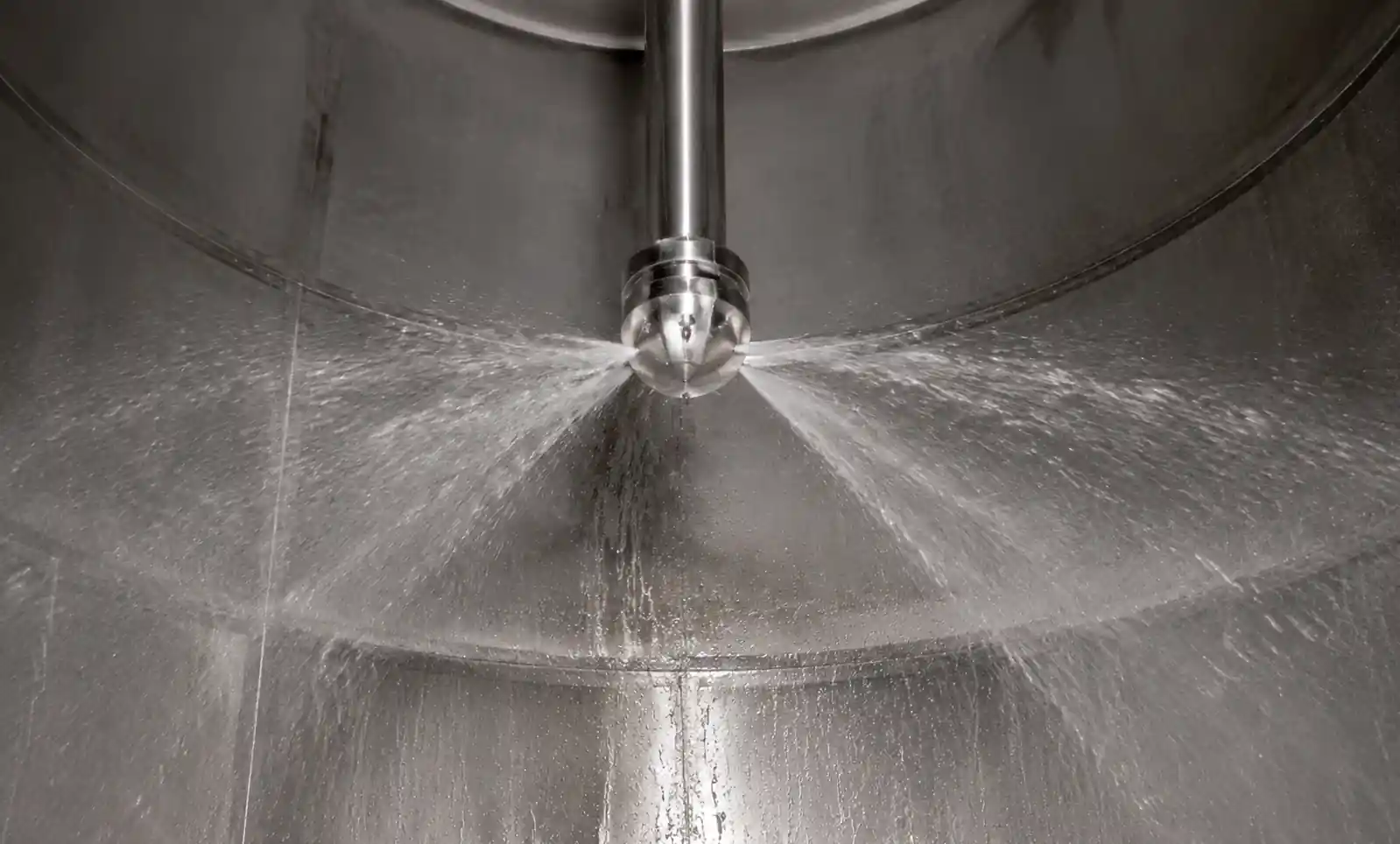
Cleaning effectiveness comes from four factors: chemical action, mechanical impact, temperature, and time. When you change nozzle pressure, you're primarily affecting mechanical action—but it cascades through everything else.
Higher pressure increases impact force at the tank wall. The relationship: Impact Force = ρ × Q × v. Since velocity scales with the square root of pressure (v ∝ √P), doubling pressure only gives you 1.41× the impact force. But higher pressure also accelerates chemical depletion three ways: higher flow rate (more chemical per minute), finer atomization (faster evaporation), and reduced contact time (droplets bounce off instead of dwelling).
In our field data, increasing pressure from 40 to 80 psi cut cleaning time by about 25%, but caustic consumption actually went up 30-40% because the system was using more solution per minute and losing contact time.
The table below shows the optimal pressure ranges we've observed across different soil types:
| Soil Type | Optimal Pressure (psi) | Dominant Mechanism | Typical Chemical Concentration |
|---|---|---|---|
| Light organic residues | 20–40 | Chemical dissolution | 2–5% |
| Heavy polymers | 50–80 | Chemical + impact | 5–10% |
| Inorganic scale | 60–100 | Mechanical + acid | 5–15% acid |
| Particulate solids | 40–70 | Mechanical flushing | Surfactant only |
| Biological fouling | 30–60 | Chemical + contact | Biocide + detergent |
If your current pressure is outside these ranges, you're either wasting chemicals or not cleaning effectively.
Pressure-Flow and Chemical Consumption
Flow rate drives chemical consumption: Q = K × √P. Double the pressure and flow only goes up 1.41×. But the real story is total volume = flow × time. When you increase pressure, flow goes up and time usually comes down—but not proportionally.
Here's real data from rotary spray head trials on polymer residues in 10,000-gallon reactors:
| Pressure (psi) | Flow (gpm) | Time (min) | Total Volume (gal) | Chemical Cost ($) | Efficiency vs Baseline |
|---|---|---|---|---|---|
| 30 | 15 | 45 | 675 | 67.50 | Baseline |
| 45 | 18.4 | 35 | 644 | 64.40 | 95% |
| 60 | 21.2 | 28 | 594 | 59.40 | 88% |
| 80 | 24.5 | 25 | 612 | 61.20 | 91% |
| 100 | 27.4 | 24 | 658 | 65.80 | 97% |
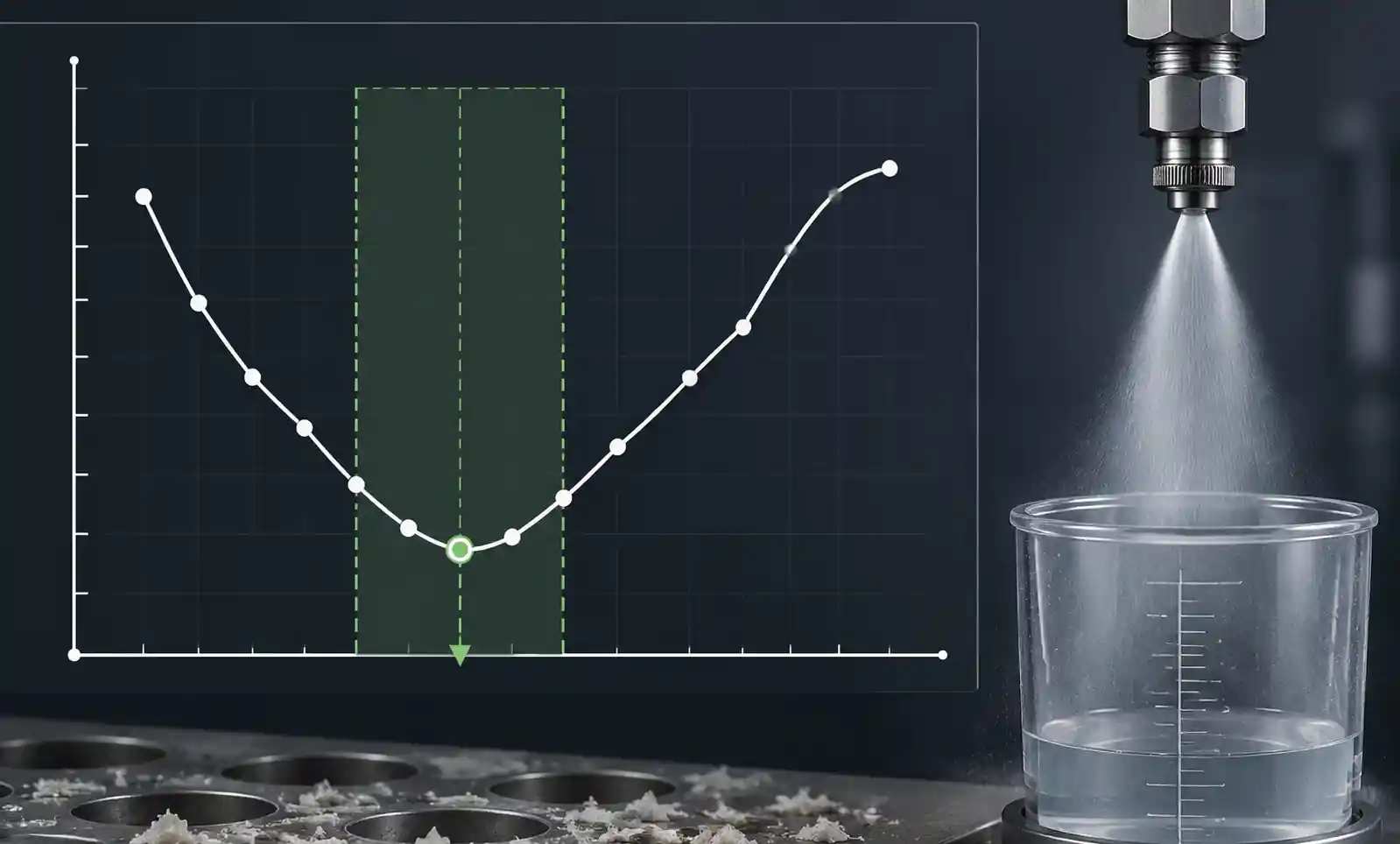
Notice the U-shape. Chemical efficiency improves from 30 to 60 psi (mechanical action helps), then gets worse as pressure keeps climbing (excessive flow and reduced contact time waste solution). That 60 psi sweet spot saved 12% on chemical costs—about $8,000/year for a plant running 100 cycles at $100/cycle in chemicals.
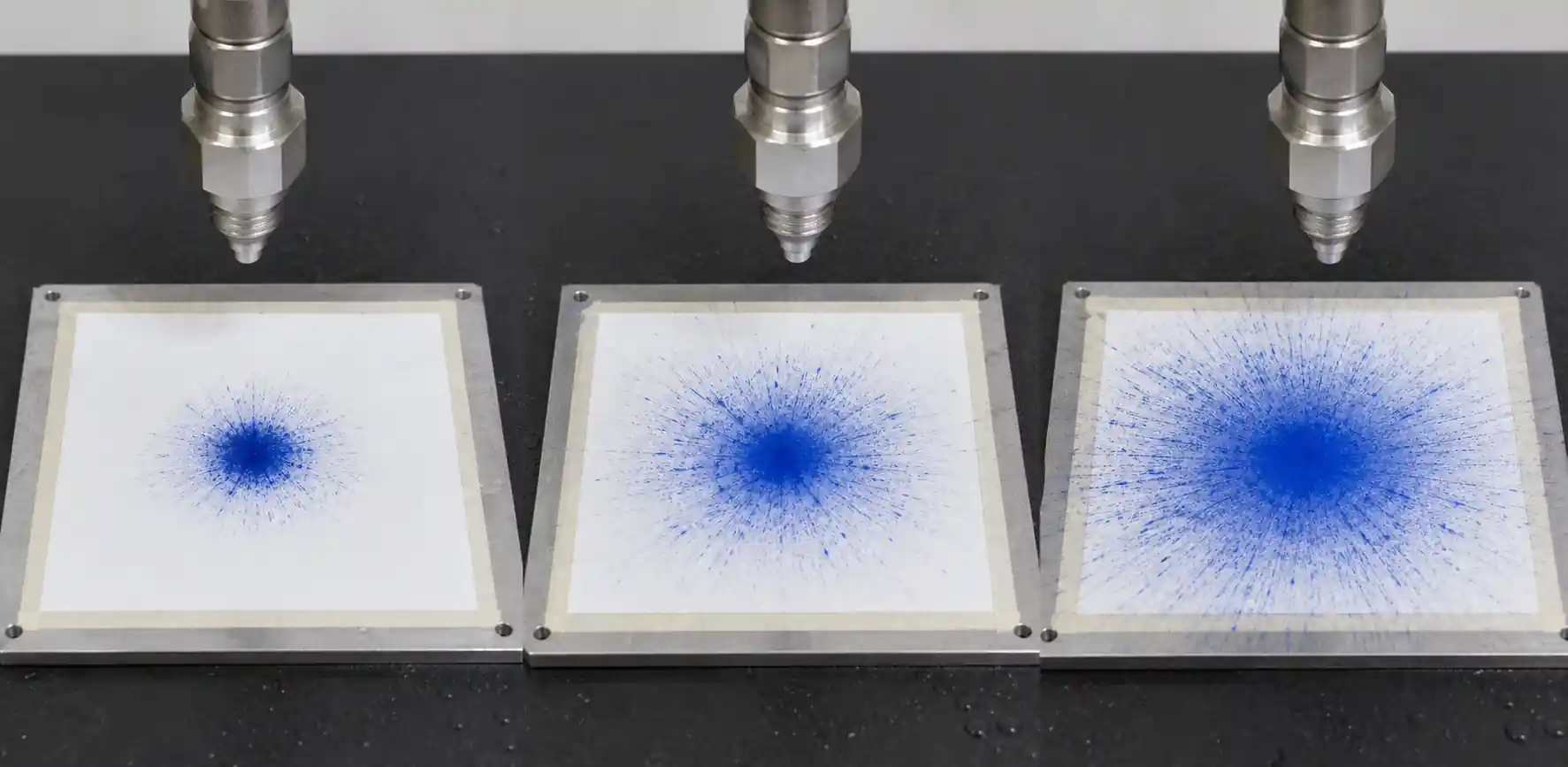
A common mistake: assuming lower pressure always saves chemical because flow decreases. That's only true if cleaning time stays constant. It doesn't. Insufficient pressure extends cycles disproportionately, increasing total consumption.
Nozzle Selection for Chemical Efficiency
Different nozzle types change the pressure-chemical balance significantly:
| Nozzle Type | Impact Force | Droplet Size (µm) | Contact Time | Best Application |
|---|---|---|---|---|
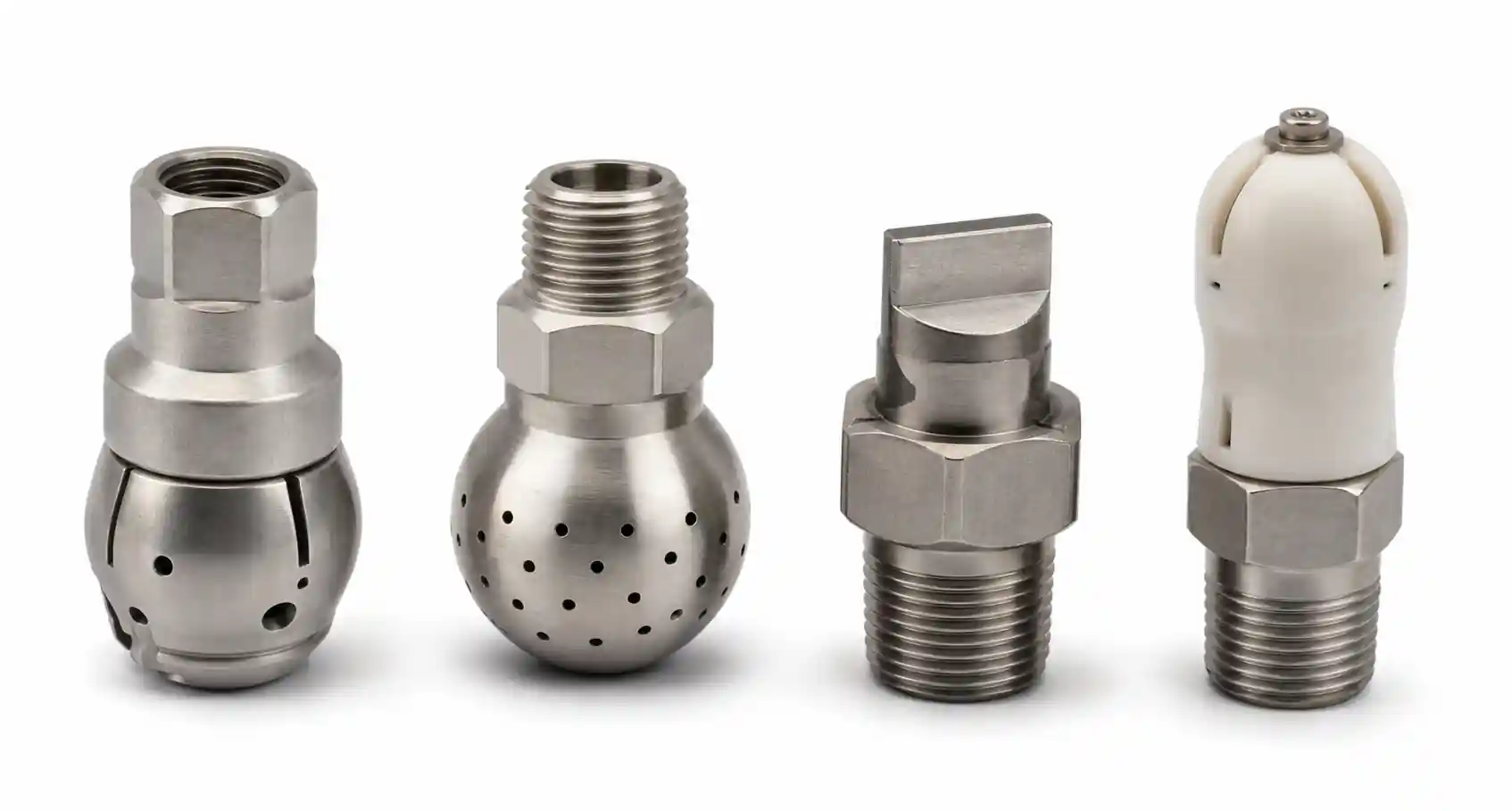
| Rotary spray head | High | 500–2000 | Medium | Large tanks, minimum total volume |
| Fixed spray ball | Low-medium | 300–800 | High | Chemistry-dominant cleaning |
| High-impact flat fan | Very high | 400–1200 | Medium | Rectangular tanks, heavy soils |
| Solid stream | Very high | 1000–3000 | Low | Stubborn deposits, diluted chem |
If your soil needs mechanical energy (polymers, scale), high-impact nozzles let you run lower chemical concentrations by compensating with impact force. If soil responds better to chemistry (light oils, biofilms), hollow cone spray balls minimize total volume through efficient distribution.
Real example: A pharmaceutical facility used fixed spray balls at 40 psi with 8% caustic, consuming 600 liters over 40 minutes. Switching to a rotary spray head at 55 psi let them drop to 5% caustic and 420 liters over 28 minutes—30% chemical cost reduction at higher pressure. The concentrated streams delivered better impact, so the chemical didn't have to work as hard.
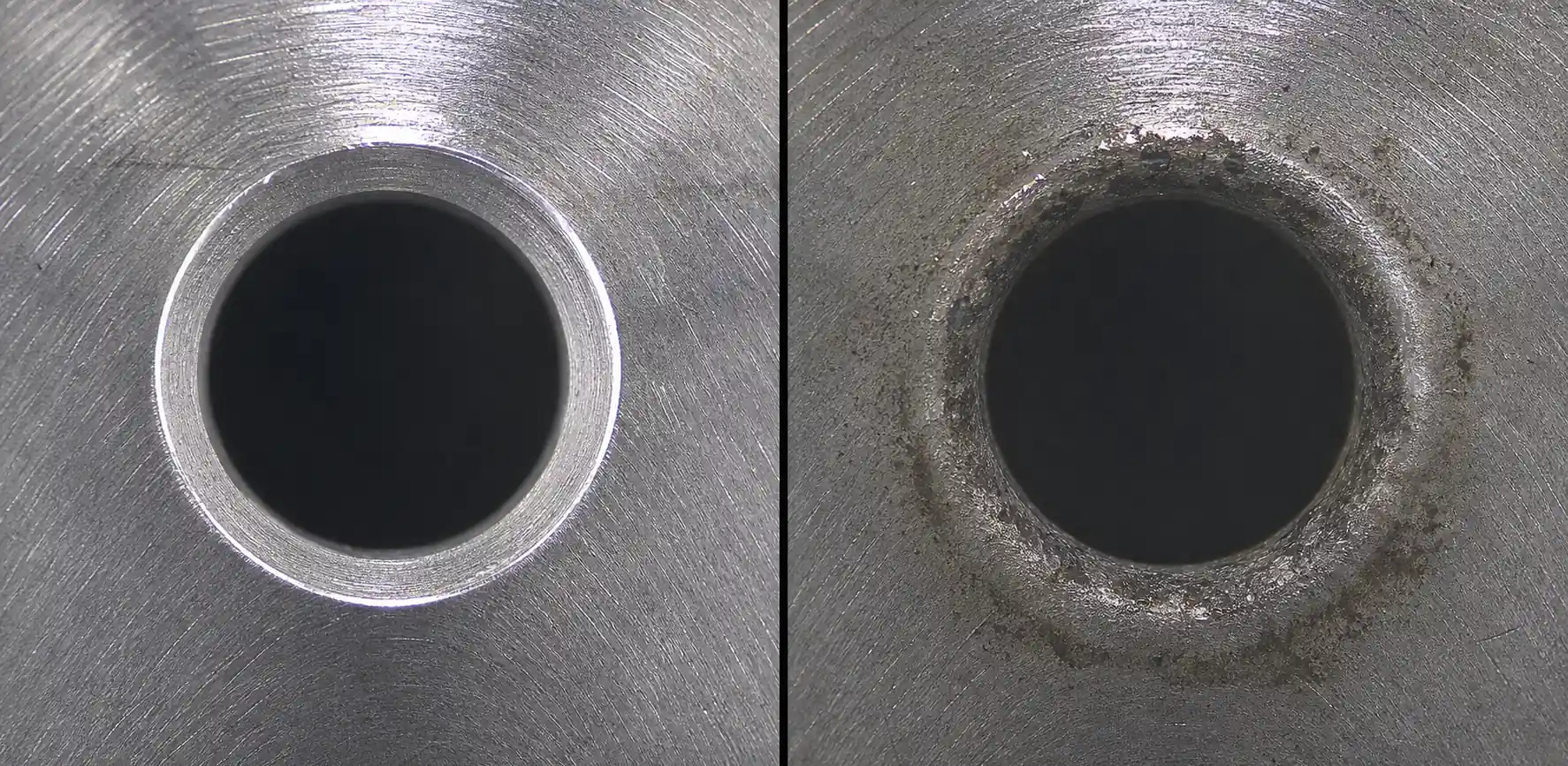
Material selection matters too. Ceramic or carbide inserts maintain consistent orifice size despite abrasive chemicals, while brass or stainless erode 10-20% annually, increasing flow and chemical consumption. Hardened materials pay back within a year in corrosive service.
Finding Your Optimal Point
Here's a systematic way to find your sweet spot.
Baseline example: 15,000-liter horizontal tank, moderate organic residue, fixed spray ball with K = 2.0 (gpm/√psi).
- 50 psi → Q = 2.0 × √50 = 14.1 gpm = 53.4 L/min
- Time = 35 min → Volume = 1,869 L
- 6% chemical concentration at $4/L → Cost = (1,869 × 0.06) × 4 = $448/cycle
Try 35 psi: Time = 50 min → Volume = 2,235 L → Cost = $536
Try 65 psi: Time = 26 min → Volume = 1,586 L → Cost = $381
That's a 15% reduction ($67/cycle). At 80 cycles/year, you save $5,360 annually just by adjusting pressure.
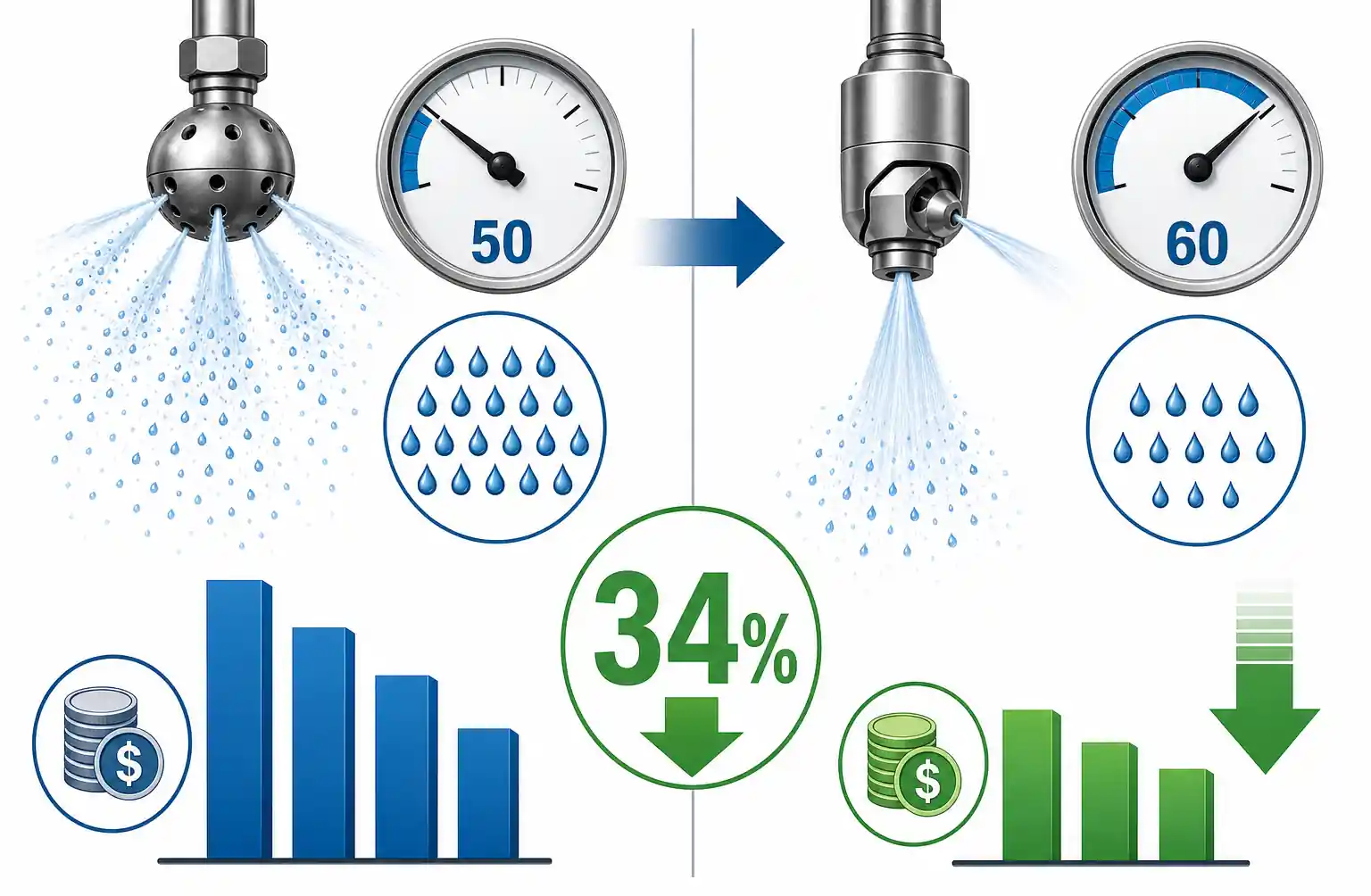
Try a rotary head (K = 1.5) at 60 psi: Flow = 44 L/min, time = 28 min → Volume = 1,232 L → Cost = $296 — a 34% reduction from baseline.
The rotary head costs $800 vs $150 for the fixed ball. Payback = $650 / ($448 - $296) = 4.3 cycles. At 80 cycles/year, that's 20 days.
Common Optimization Mistakes
Mistake #1: Assuming higher pressure always saves chemical. Above a threshold, higher pressure increases total volume because time doesn't drop fast enough. We've seen plants go from 60 to 100 psi and increase chemical consumption 15%.
Mistake #2: Ignoring nozzle wear. Brass and stainless erode in caustic/acid service, increasing orifice diameter 5-10% per year. A nozzle flowing 12 gpm at 50 psi might flow 13.5 gpm after a year—18% more chemical. Specify ceramic or carbide for corrosive service.
Mistake #3: Over-diluting to save cost. Cutting concentration below effectiveness forces longer cycles. One plant dropped caustic from 5% to 3% and saw cleaning time jump from 30 to 55 minutes—total NaOH consumption went up 10%.
Mistake #4: One pressure for everything. Light and heavy soils need different pressures. Running everything at 80 psi wastes chemical on light soils (40 psi would work) and wastes time on heavy soils (100 psi would cut the cycle). Build a cleaning matrix.
Mistake #5: Not measuring flow. Many plants guess from pump curves. Actual flow depends on pressure drop and nozzle condition. Install a flow meter. We found one plant using 40% more chemical than calculated because actual nozzle pressure was 70 psi, not the assumed 50 psi.
Mistake #6: Forgetting temperature. Heating from 50°C to 70°C can halve cleaning time, reducing total chemical volume 30-40%. Evaluate heating cost vs chemical savings—often pays back in weeks.
FAQ
What pressure range should I be running?
Most systems work best between 30-100 psi. Light soils: 30-50 psi. Moderate: 50-80 psi. Heavy: 80-120 psi. Above 120 psi gives diminishing returns and accelerates wear.
How do I know if I'm at optimal pressure?
Run trials at current pressure, then ±20 psi. Measure time and calculate total volume. The optimum minimizes flow × time. If ±20 psi changes total volume by less than 10%, you're near the sweet spot.
Can I reduce chemical concentration if I increase pressure?
If removal is limited by mechanical action (hard deposits, polymers), higher impact allows 20-30% concentration reduction. If limited by chemical reaction rate (dissolving scale, saponifying fats), pressure won't help much—you can't reduce concentration without extending time.
How often should I inspect tank cleaning nozzles?
Corrosive/abrasive service: every 6-12 months. Mild detergents: annually. Replace when flow increases more than 10% from specification or spray pattern distorts.
What's the most cost-effective nozzle material for alkaline cleaning?
For caustic up to 10% below 80°C and 60 psi: 316 stainless works. Higher concentrations, temperatures, or pressures: ceramic (alumina) or PVDF. Ceramic lasts 5-10× longer, paying back the 3-4× higher cost within a year.
Conclusion
Balancing chemical consumption and pressure is an optimization problem with real money on the line. Flow increases with √P, cleaning time decreases with pressure but not linearly, and total chemical consumption follows a U-shaped curve with a sweet spot unique to your soil type and nozzle design.
Most tank cleaning systems run outside their optimal efficiency window. A systematic test—document current pressure, flow, time, and chemical cost, then run trials at ±20 psi—typically reveals 15-35% chemical cost reduction opportunities without compromising cleanliness.