



Pressure, Flow Rate, and Spray Angle: The 3 Critical Variables That Determine Cleaning Efficiency
When it comes to industrial cleaning, surface preparation, or even pressure washing your driveway, understanding how spray nozzles work can mean the difference between a job well done and wasted time, water, and energy. Three fundamental variables control cleaning performance: pressure, flow rate, and spray angle. Master these, and you'll optimize cleaning efficiency while reducing costs and environmental impact.
Table of Contents
- 1. 1. Understanding the Fundamentals of Spray Nozzle Performance
- 1.1. Why These Variables Matter
- 2. 2. Pressure: The Driving Force Behind Cleaning Power
- 2.1. How Pressure Affects Cleaning
- 2.2. Pressure Ranges for Different Applications
- 2.3. The Pressure Paradox
- 3. 3. Flow Rate: Volume Matters More Than You Think
- 3.1. The Role of Flow Rate in Cleaning
- 3.2. Understanding the Pressure-Flow Relationship
- 3.3. Optimizing Flow Rate
- 4. 4. Spray Angle: Coverage vs. Intensity Trade-offs
- 4.1. How Spray Angle Works
- 4.2. The Coverage-Intensity Relationship
- 4.3. Choosing the Right Spray Angle
- 4.4. Distance Matters
- 5. 5. The Interplay: How These Variables Work Together
- 5.1. The Cleaning Power Formula
- 5.2. Practical Interaction Examples
- 5.3. Balancing Act: Finding Your Sweet Spot
- 6. 6. Optimizing for Different Cleaning Applications
- 6.1. Industrial Equipment Cleaning
- 6.2. Surface Preparation for Coating
- 6.3. Food Processing Sanitation
- 6.4. Vehicle and Fleet Washing
- 6.5. Concrete and Masonry Cleaning
- 7. 7. Common Mistakes That Reduce Cleaning Efficiency
- 7.1. Mistake 1: Using Excessive Pressure
- 7.2. Mistake 2: Ignoring Nozzle Wear
- 7.3. Mistake 3: Wrong Spray Angle for the Job
- 7.4. Mistake 4: Incorrect Working Distance
- 7.5. Mistake 5: Inadequate Overlap
- 8. 8. Measuring and Monitoring Nozzle Performance
- 8.1. Key Performance Indicators
- 8.2. Diagnostic Tools
- 8.3. Maintenance Schedule
- 9. 9. Future Trends in Spray Nozzle Technology
- 9.1. Smart Nozzles with Sensors
- 9.2. Variable Spray Angle Nozzles
- 9.3. Advanced Materials
- 9.4. Water Conservation Technologies
- 9.5. AI-Optimized Cleaning Systems
- 10. 10. Practical Tips for Maximizing Cleaning Efficiency
- 10.1. Selection Tips
- 10.2. Operation Tips
- 10.3. Maintenance Tips
- 10.4. Efficiency Tips
- 10.5. Safety Tips
- 11. Conclusion
1. Understanding the Fundamentals of Spray Nozzle Performance
Before diving into each variable, it's essential to understand what "cleaning efficiency" actually means. Cleaning efficiency is the ability to remove contaminants, dirt, coatings, or debris from a surface using the least amount of resources—water, energy, time, and chemical agents.
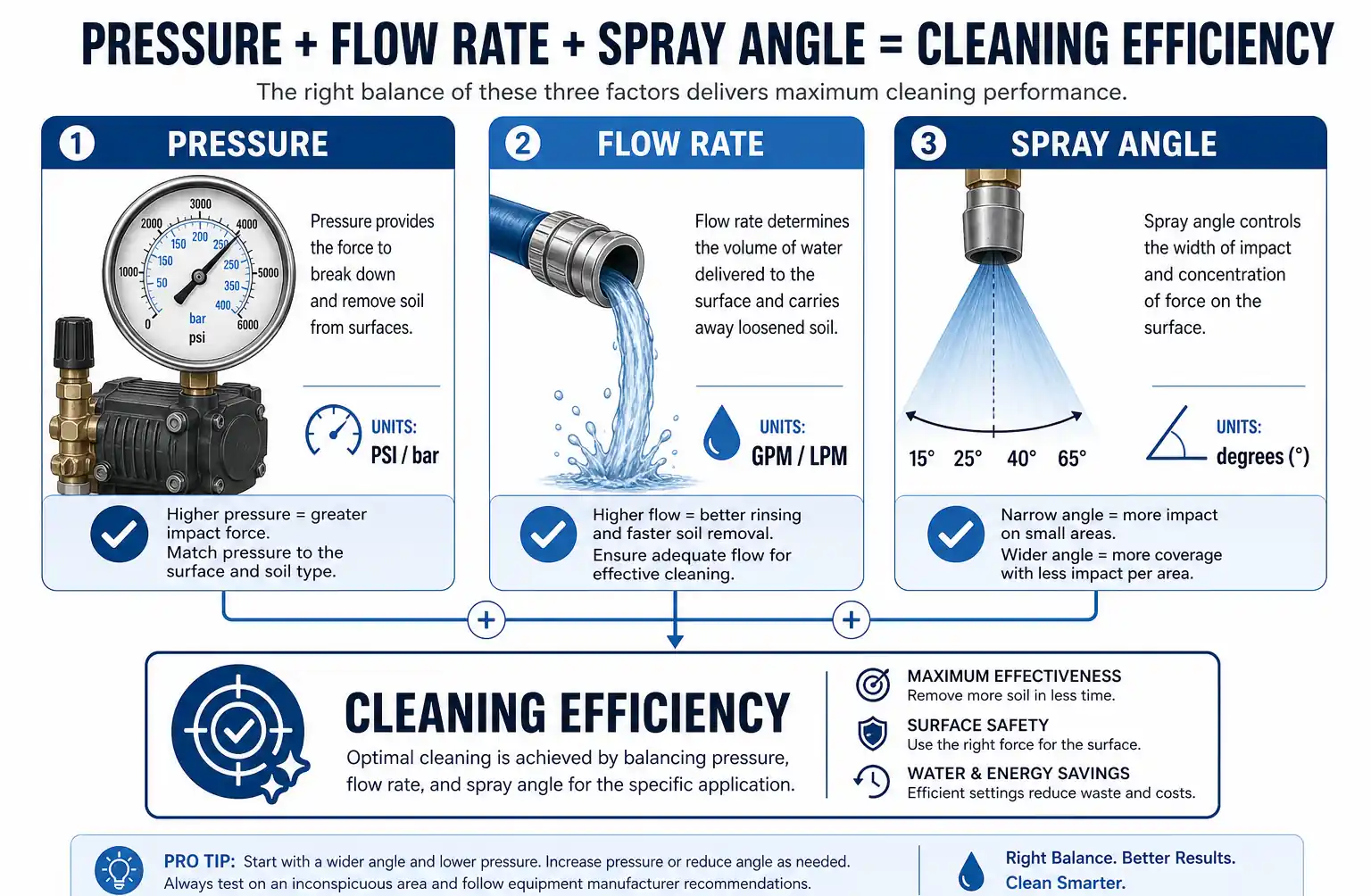
Three primary variables control this efficiency:
- Pressure (PSI/bar): The force at which water or cleaning solution exits the nozzle
- Flow Rate (GPM/LPM): The volume of liquid delivered per unit of time
- Spray Angle (degrees): The width of the spray pattern as it leaves the nozzle
Each variable influences cleaning performance differently, and understanding their individual and combined effects is crucial for selecting the right nozzle for your application.
Why These Variables Matter
In industrial settings, improper nozzle selection can lead to:
- Increased water consumption (up to 40% waste in some cases)
- Higher energy costs from running pumps at suboptimal pressures
- Longer cleaning cycles that reduce productivity
- Incomplete cleaning requiring rework
- Excessive wear on equipment and surfaces
2. Pressure: The Driving Force Behind Cleaning Power
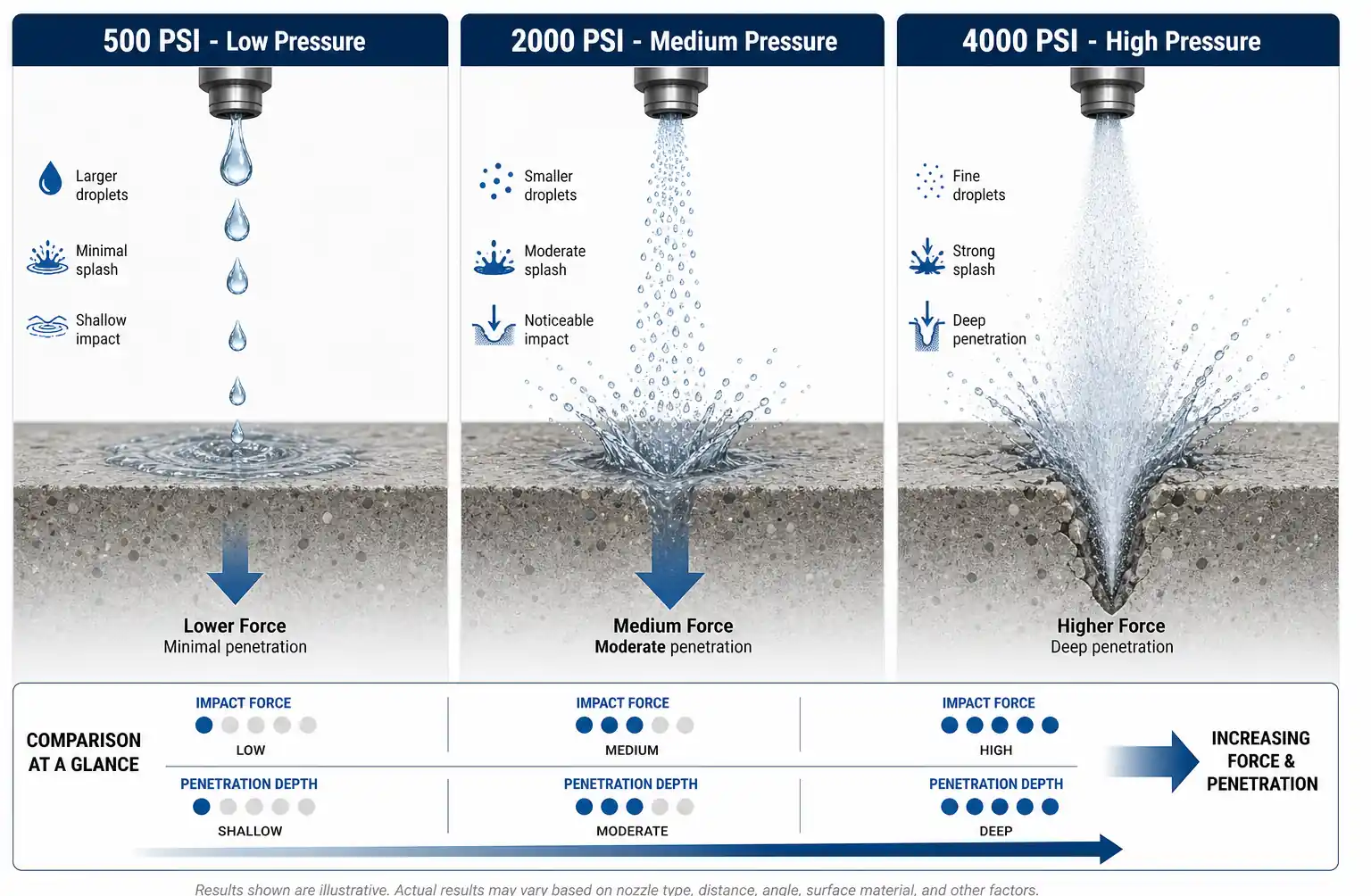
Pressure is often the first variable people think about when considering cleaning power. Higher pressure generally means more impact force, which helps break the bond between contaminants and surfaces.
How Pressure Affects Cleaning
Pressure determines the impact force of water droplets hitting the surface. This impact force is what actually dislodges dirt, grime, and coatings. The relationship follows this principle:
Impact Force = Pressure × Flow Rate × Efficiency Factor
Higher pressure creates:
- Smaller droplet sizes with greater penetration
- Increased kinetic energy upon impact
- Better ability to break through stubborn contaminants
- More effective removal of bonded materials
Pressure Ranges for Different Applications
- Low Pressure (500-1,500 PSI): Delicate surfaces, vehicle washing, light cleaning
- Medium Pressure (1,500-3,000 PSI): General industrial cleaning, surface preparation
- High Pressure (3,000-10,000 PSI): Heavy-duty cleaning, paint removal, concrete preparation
- Ultra-High Pressure (10,000+ PSI): Specialized applications like hydrodemolition, cutting
The Pressure Paradox
More pressure isn't always better. Excessive pressure can:
- Damage sensitive surfaces
- Create excessive mist and overspray
- Increase pump wear and energy consumption
- Reduce nozzle lifespan through accelerated erosion
- Pose safety hazards to operators
The key is finding the minimum effective pressure for your specific application—enough to clean effectively without waste or damage.
3. Flow Rate: Volume Matters More Than You Think
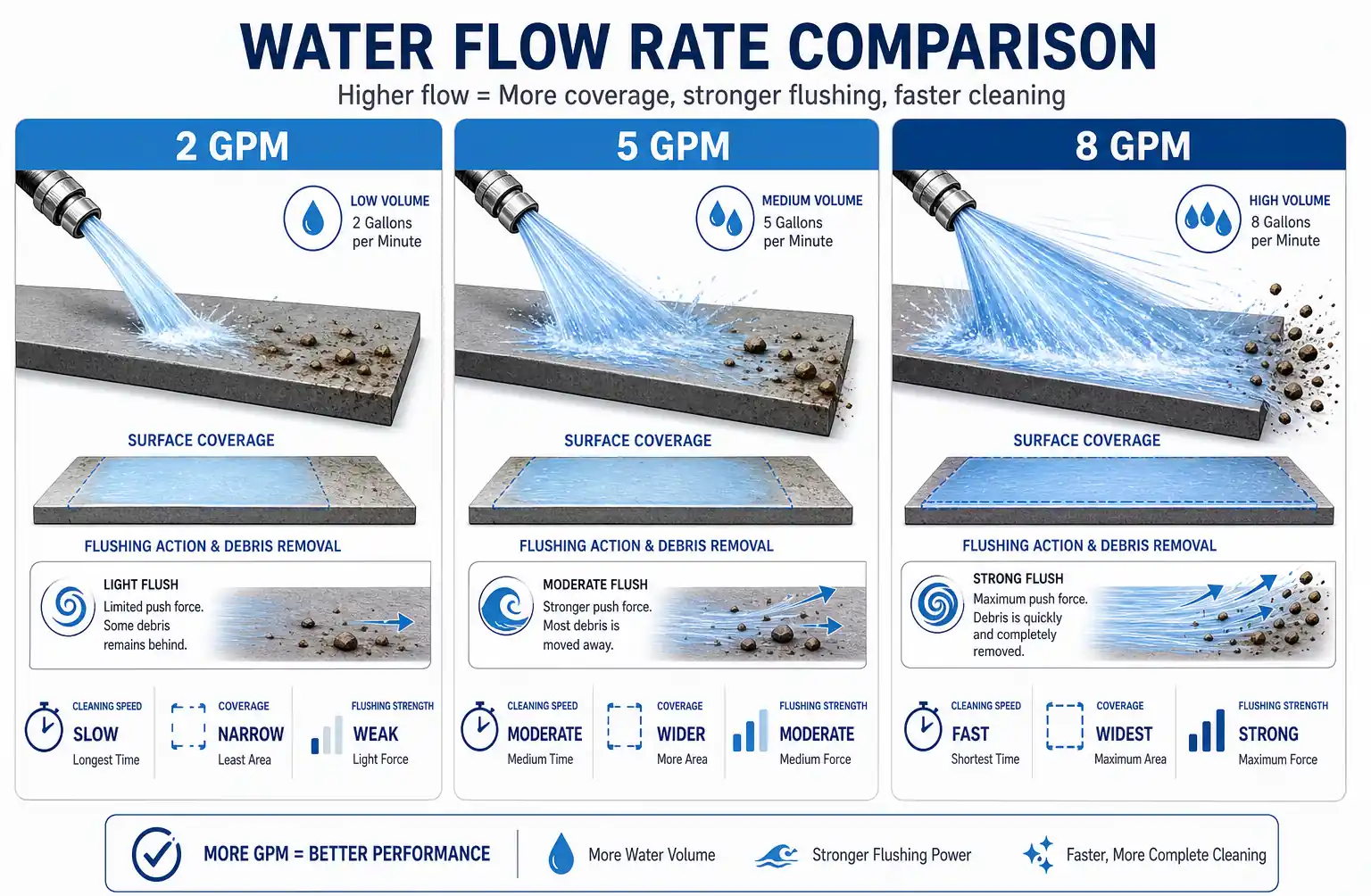
While pressure gets most of the attention, flow rate is equally important and often underestimated. Flow rate determines how much water contacts the surface and how quickly you can cover an area.
The Role of Flow Rate in Cleaning
Flow rate affects cleaning efficiency in several ways:
- Flushing Action: Higher flow rates wash away loosened contaminants more effectively
- Coverage Speed: More volume means you can clean larger areas faster
- Dwell Time: Adequate flow ensures cleaning solution stays on the surface long enough to work
- Heat Transfer: In hot water applications, flow rate affects how much thermal energy reaches the surface
Understanding the Pressure-Flow Relationship
Flow rate and pressure are mathematically related through the nozzle orifice size:
Flow Rate ∝ √Pressure
This means:
- Doubling the pressure increases flow rate by only 41% (√2 = 1.41)
- To double flow rate, you need to quadruple the pressure
- Or, you can increase orifice size to boost flow without raising pressure
Optimizing Flow Rate
The ideal flow rate depends on:
- Surface type: Porous surfaces need more flushing action
- Contaminant type: Heavy soils require more volume to rinse away
- Cleaning method: Stationary vs. moving applications have different needs
- Water availability: Some facilities have flow rate constraints
Many operators focus solely on pressure and overlook flow rate, leading to situations where high pressure creates impact but insufficient flow fails to rinse away debris effectively.
4. Spray Angle: Coverage vs. Intensity Trade-offs
Spray angle is the third critical variable and represents a fundamental trade-off: wider coverage versus concentrated intensity.
How Spray Angle Works
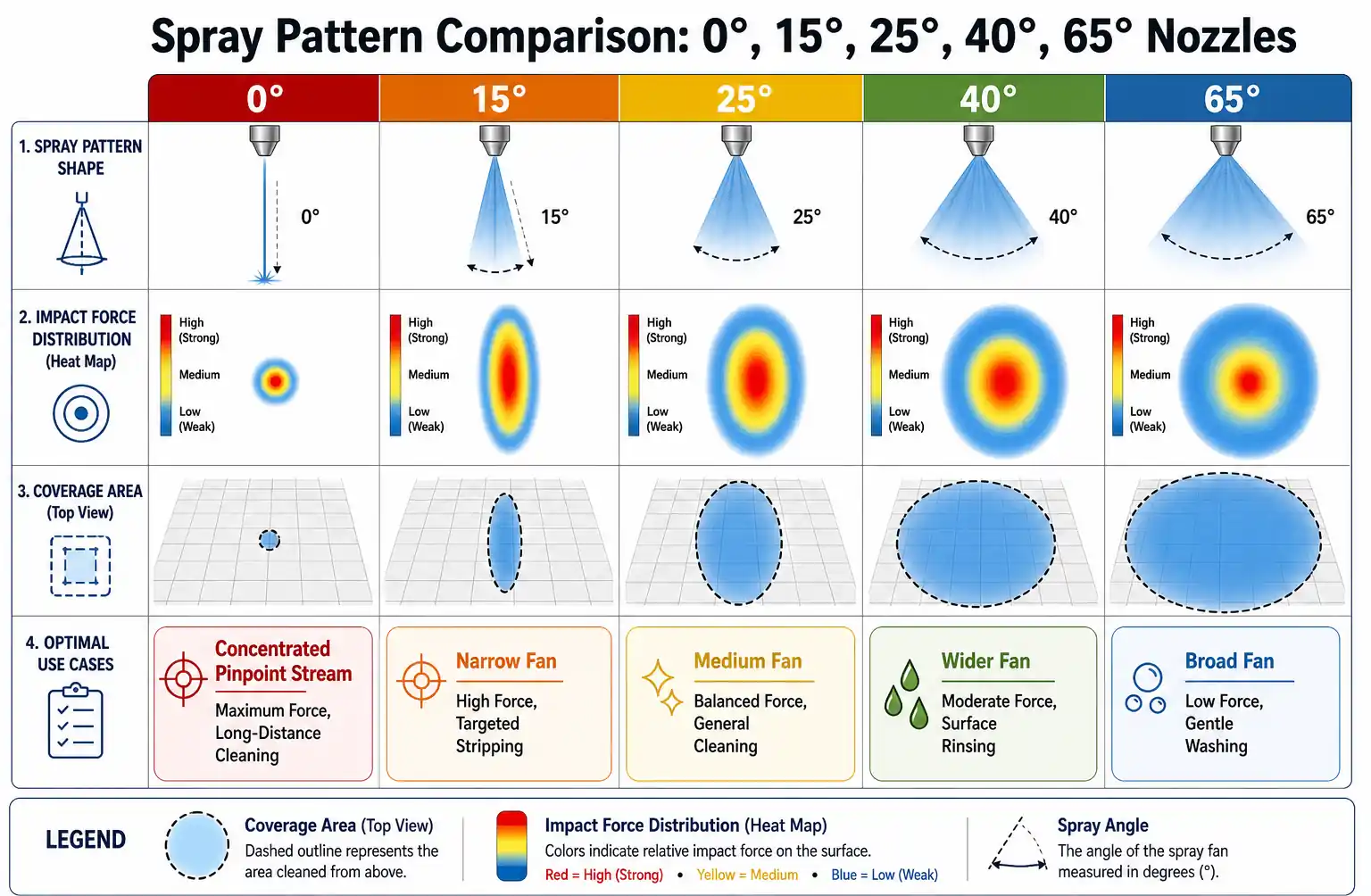
Spray angle is measured in degrees and represents the width of the spray pattern at a given distance from the nozzle. Common angles include:
- 0° (Pinpoint/Jet): Concentrated stream, maximum impact
- 15°: Very narrow fan, high intensity
- 25°: Narrow fan, good for tough spots
- 40°: Medium fan, balanced coverage and power
- 65°: Wide fan, fast coverage, lower intensity
The Coverage-Intensity Relationship
As spray angle increases:
- Coverage area increases proportionally
- Impact force per unit area decreases
- Cleaning speed for large areas improves
- Effectiveness on stubborn contaminants decreases
This creates a fundamental equation:
Impact Force Density = Total Impact Force / Coverage Area
A 0° nozzle concentrates all the force on a tiny spot, while a 65° nozzle spreads the same force over a much larger area.
Choosing the Right Spray Angle
Select spray angle based on:
Narrow angles (0°-25°) for:
- Removing stubborn coatings or deposits
- Cleaning crevices and tight spaces
- Cutting through heavy buildup
- Applications requiring maximum impact
Wide angles (40°-65°) for:
- Large, flat surfaces
- Light to medium soiling
- Faster coverage requirements
- Situations where surface damage is a concern
Distance Matters
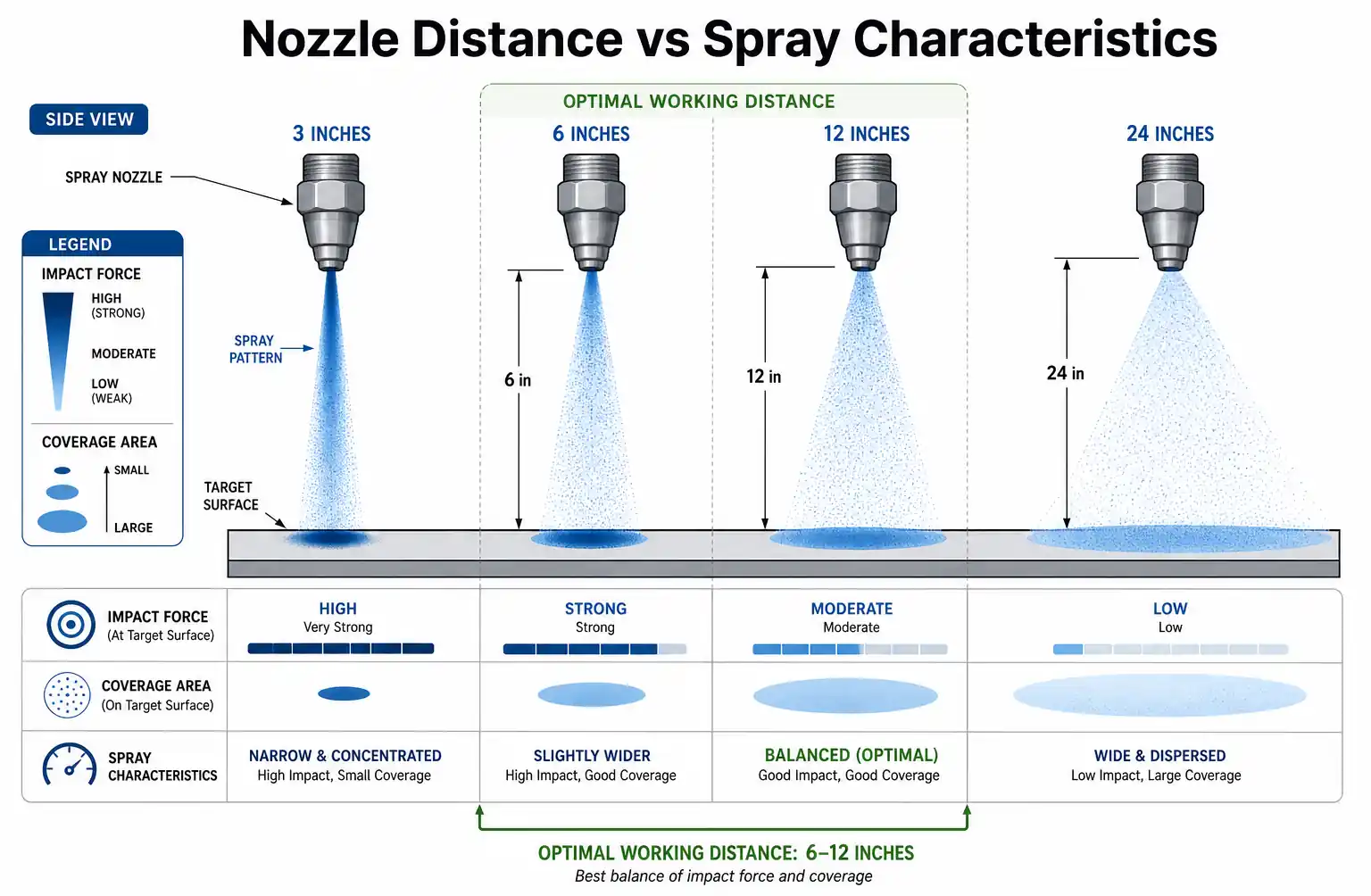
The effective spray angle changes with distance from the surface. As you move the nozzle farther away:
- Coverage area increases
- Impact force decreases
- Spray pattern may become less uniform
- Efficiency drops significantly
Most nozzles have an optimal working distance of 6-12 inches for maximum efficiency.
5. The Interplay: How These Variables Work Together
Understanding each variable individually is important, but real-world cleaning efficiency comes from how they interact. These three variables don't operate in isolation—they form a complex system where changing one affects the others.
The Cleaning Power Formula
While simplified, this formula helps visualize the relationship:
Cleaning Power = (Pressure × Flow Rate × cos(Spray Angle/2)) / Distance²
This shows that:
- Cleaning power increases linearly with pressure and flow rate
- Wider spray angles reduce power density
- Distance has an exponential negative effect
Practical Interaction Examples
Scenario 1: High Pressure + Low Flow + Narrow Angle
- Result: Intense, focused cleaning
- Best for: Removing tough coatings, spot cleaning
- Drawback: Slow coverage, potential surface damage
Scenario 2: Medium Pressure + High Flow + Wide Angle
- Result: Fast, gentle cleaning
- Best for: Large surface areas, light soiling
- Drawback: May not remove stubborn contaminants
Scenario 3: High Pressure + High Flow + Medium Angle
- Result: Balanced, efficient cleaning
- Best for: General industrial applications
- Drawback: Higher water and energy consumption
Balancing Act: Finding Your Sweet Spot
The optimal combination depends on:
- Contaminant type and bonding strength
- Surface material and sensitivity
- Area size and accessibility
- Available water and energy resources
- Time constraints
- Environmental regulations
6. Optimizing for Different Cleaning Applications
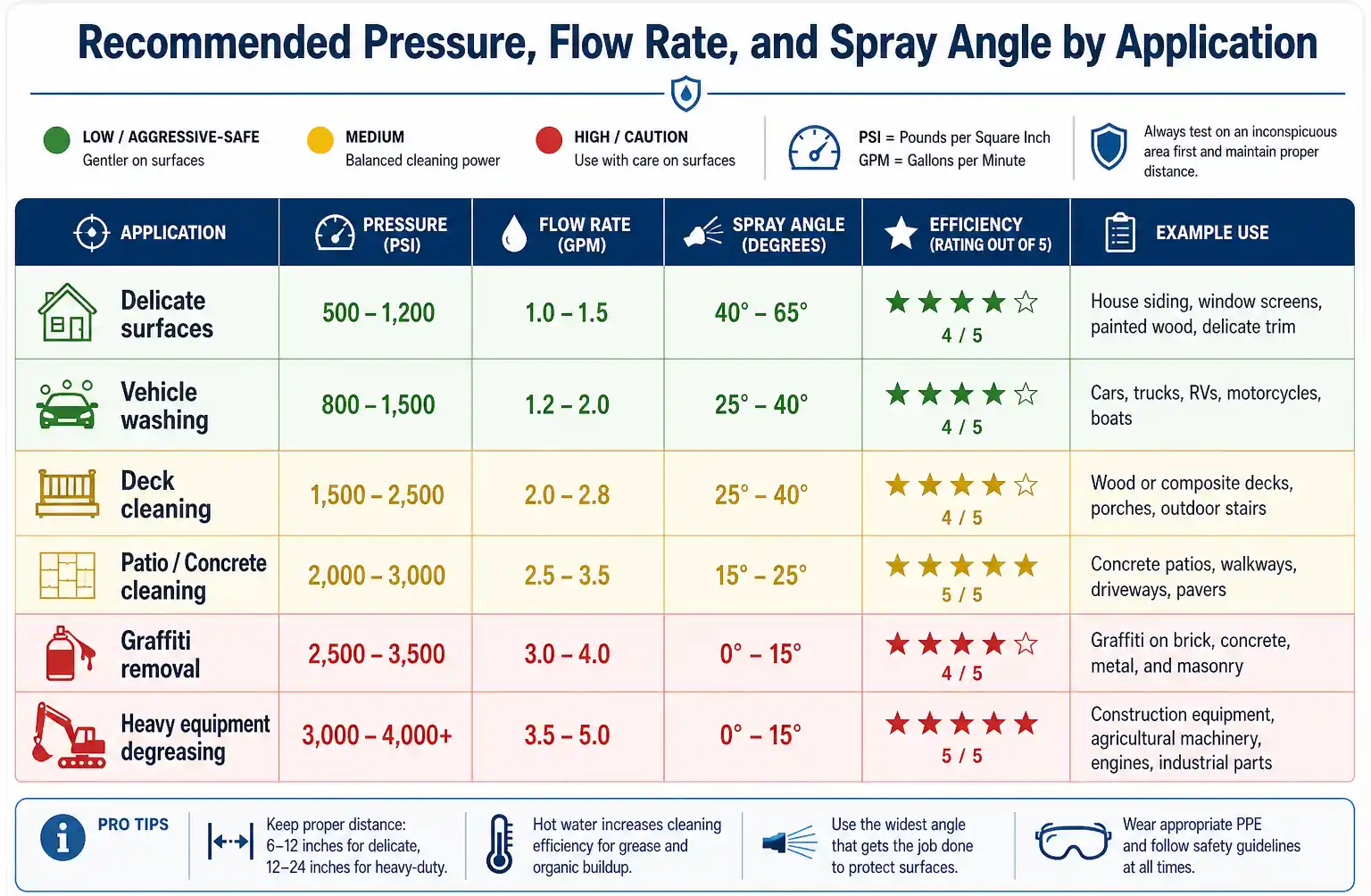
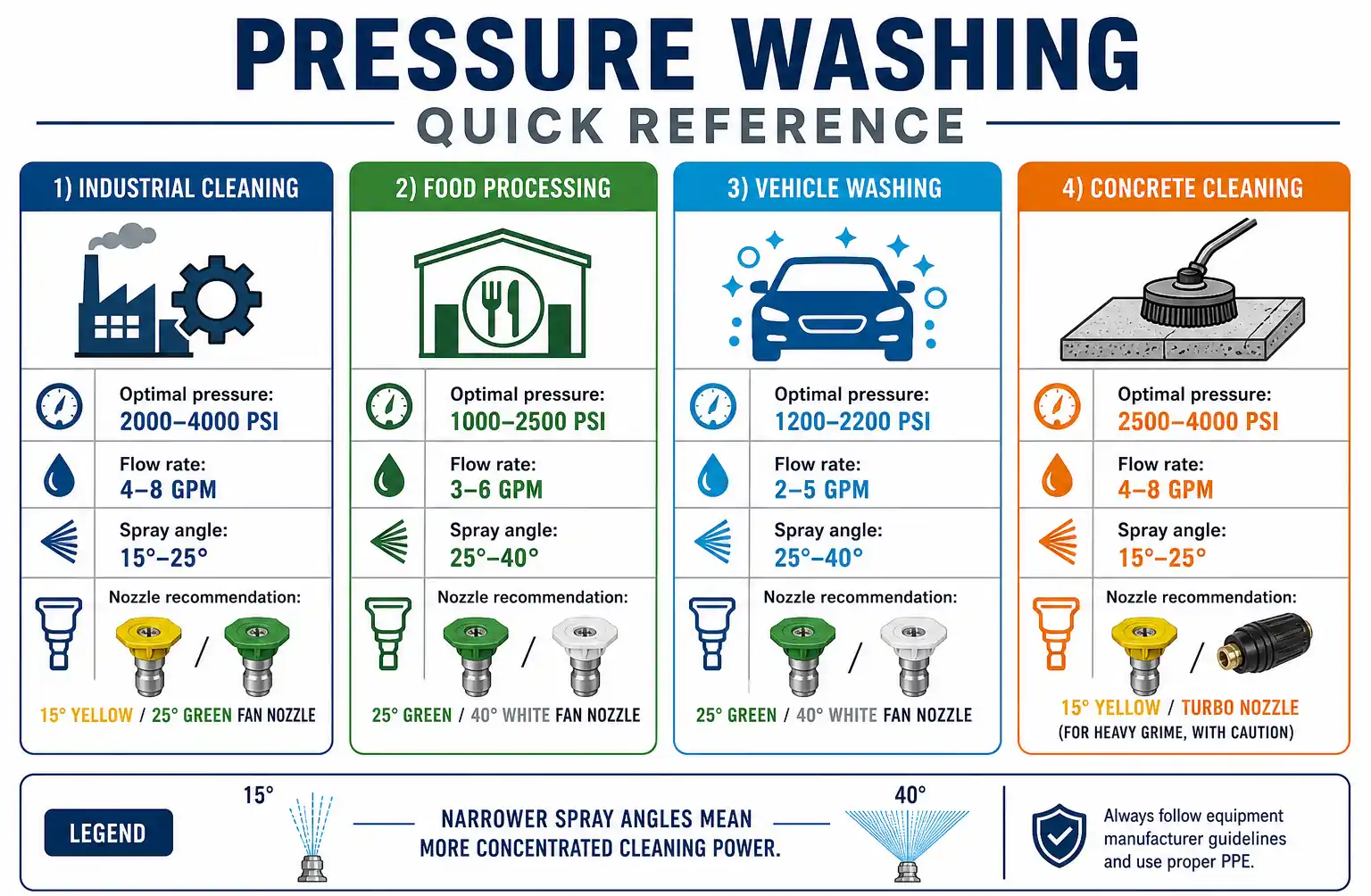
Different industries and applications require different approaches to nozzle selection and parameter optimization.
Industrial Equipment Cleaning
Challenge: Removing grease, oil, and production residues Optimal Setup:
- Pressure: 2,000-4,000 PSI
- Flow Rate: 4-8 GPM
- Spray Angle: 25°-40°
- Additional: Hot water (140-180°F) significantly improves efficiency
Surface Preparation for Coating
Challenge: Achieving proper surface profile without damage Optimal Setup:
- Pressure: 3,000-5,000 PSI
- Flow Rate: 3-6 GPM
- Spray Angle: 15°-25°
- Key: Consistent distance and overlap pattern
Food Processing Sanitation
Challenge: Meeting hygiene standards while protecting equipment Optimal Setup:
- Pressure: 500-1,500 PSI
- Flow Rate: 5-10 GPM
- Spray Angle: 40°-65°
- Critical: Chemical compatibility and complete coverage
Vehicle and Fleet Washing
Challenge: Fast cleaning without paint damage Optimal Setup:
- Pressure: 1,200-2,000 PSI
- Flow Rate: 3-5 GPM
- Spray Angle: 25°-40°
- Tip: Use wider angles for body panels, narrower for wheels
Concrete and Masonry Cleaning
Challenge: Removing stains and buildup from durable surfaces Optimal Setup:
- Pressure: 3,000-4,000 PSI
- Flow Rate: 4-6 GPM
- Spray Angle: 15°-25°
- Note: Adjust based on concrete age and condition
7. Common Mistakes That Reduce Cleaning Efficiency
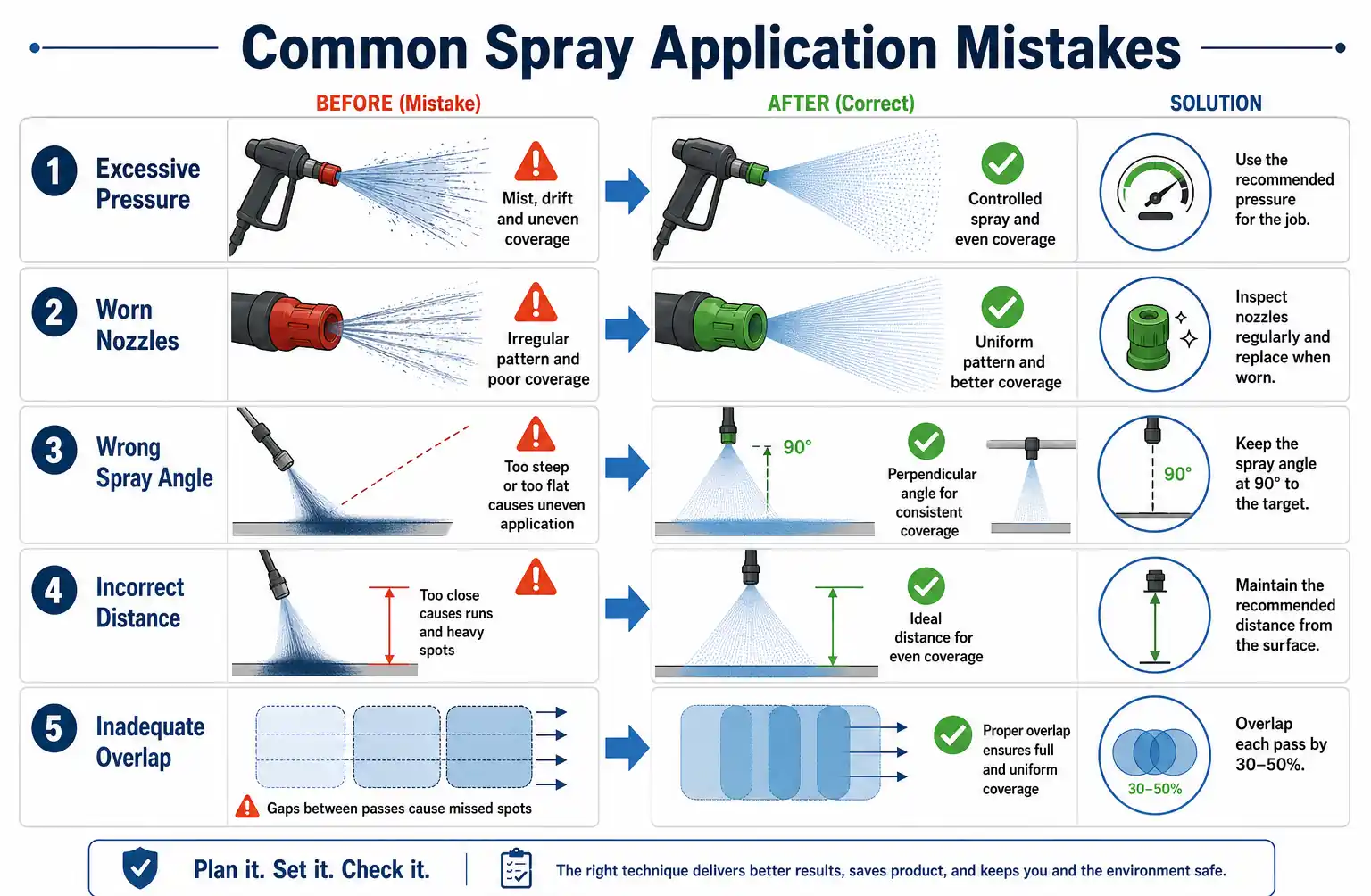
Even with the right equipment, poor practices can significantly reduce cleaning efficiency. Here are the most common mistakes and how to avoid them.
Mistake 1: Using Excessive Pressure
Many operators assume "more pressure = better cleaning." This leads to:
- Wasted energy and increased operating costs
- Accelerated nozzle wear and equipment damage
- Surface damage requiring costly repairs
- Safety hazards from increased recoil and overspray
Solution: Start with lower pressure and increase only if needed. Test on a small area first.
Mistake 2: Ignoring Nozzle Wear
Nozzles wear over time, especially at high pressures. A worn nozzle:
- Increases flow rate by 10-25%
- Reduces pressure at the surface
- Creates irregular spray patterns
- Wastes water and reduces cleaning effectiveness
Solution: Inspect nozzles regularly and replace when flow rate increases by more than 10%.
Mistake 3: Wrong Spray Angle for the Job
Using a wide angle for tough cleaning or a narrow angle for large areas wastes time and resources.
Solution: Match spray angle to the task. Keep multiple nozzles on hand for different situations.
Mistake 4: Incorrect Working Distance
Operating too far from the surface dramatically reduces impact force. Operating too close can damage surfaces and create dangerous splashback.
Solution: Maintain the manufacturer's recommended distance, typically 6-12 inches.
Mistake 5: Inadequate Overlap
Skipping areas or insufficient overlap leaves streaks and requires rework.
Solution: Use a consistent pattern with 20-30% overlap between passes.
8. Measuring and Monitoring Nozzle Performance
To maintain optimal cleaning efficiency, you need to measure and monitor your spray system's performance regularly.
Key Performance Indicators
- Flow Rate Measurement
- Use a flow meter or bucket test
- Measure at regular intervals (monthly for high-use applications)
- Compare to manufacturer specifications
- Replace nozzles when flow increases >10%
- Pressure Verification
- Check pressure at the pump and at the nozzle
- Account for pressure loss in hoses and fittings
- Verify pressure gauge accuracy annually
- Spray Pattern Inspection
- Visual inspection for uniformity
- Check for streaking or dead spots
- Look for signs of nozzle damage or clogging
- Cleaning Time Tracking
- Monitor how long tasks take
- Increasing cleaning times indicate declining efficiency
- Compare against baseline performance
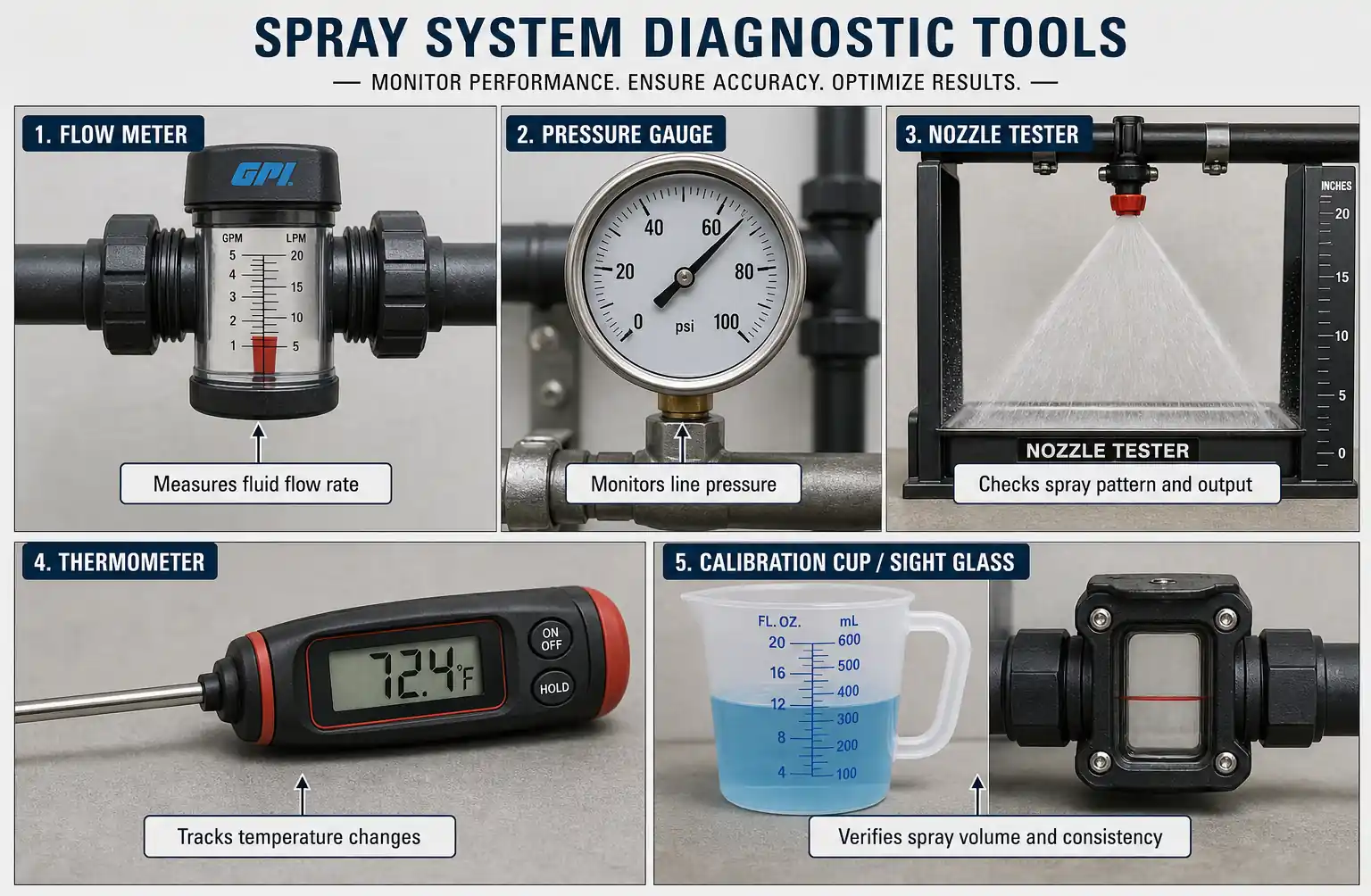
Diagnostic Tools
- Flow meters: Measure actual flow rate
- Pressure gauges: Verify operating pressure
- Nozzle testers: Check spray pattern uniformity
- Thermal imaging: For hot water applications
- Water quality testing: Identify issues causing nozzle wear
Maintenance Schedule
Daily: Visual inspection of spray pattern Weekly: Check for leaks and loose connections Monthly: Measure flow rate and pressure Quarterly: Deep clean or replace filters Annually: Complete system audit and nozzle replacement
9. Future Trends in Spray Nozzle Technology
The spray nozzle industry continues to evolve with new technologies aimed at improving efficiency, reducing waste, and enabling smarter cleaning systems.
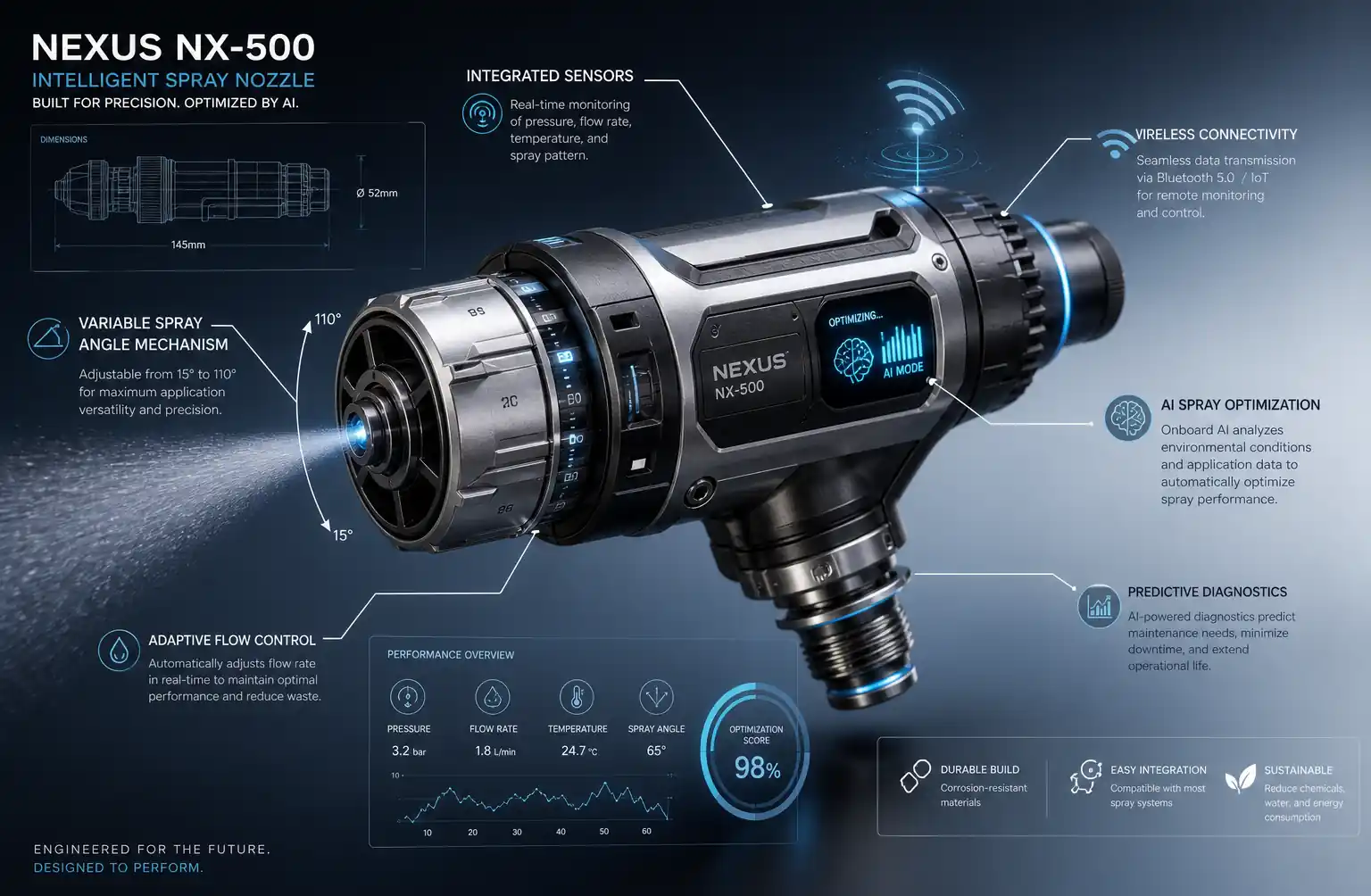
Smart Nozzles with Sensors
Emerging nozzle designs incorporate:
- Pressure and flow sensors for real-time monitoring
- Wireless connectivity for data logging
- Automatic adjustment based on feedback
- Predictive maintenance alerts
Variable Spray Angle Nozzles
New designs allow operators to adjust spray angle on the fly:
- Eliminates need for multiple nozzles
- Optimizes for changing conditions
- Reduces downtime for nozzle changes
- Improves operator flexibility
Advanced Materials
Nozzle manufacturers are developing:
- Ceramic and carbide inserts for extended wear life
- Composite materials resistant to chemical attack
- Self-cleaning designs that resist clogging
- Coatings that reduce friction and improve efficiency
Water Conservation Technologies
With increasing focus on sustainability:
- Ultra-low flow nozzles that maintain cleaning power
- Pulsating spray patterns that reduce water use
- Recirculation systems with advanced filtration
- Fog and mist reduction technologies
AI-Optimized Cleaning Systems
Future systems may include:
- Machine learning algorithms that optimize parameters
- Computer vision for surface assessment
- Automated adjustment based on contaminant type
- Integration with facility management systems
10. Practical Tips for Maximizing Cleaning Efficiency
Here are actionable tips you can implement immediately to improve your cleaning efficiency.
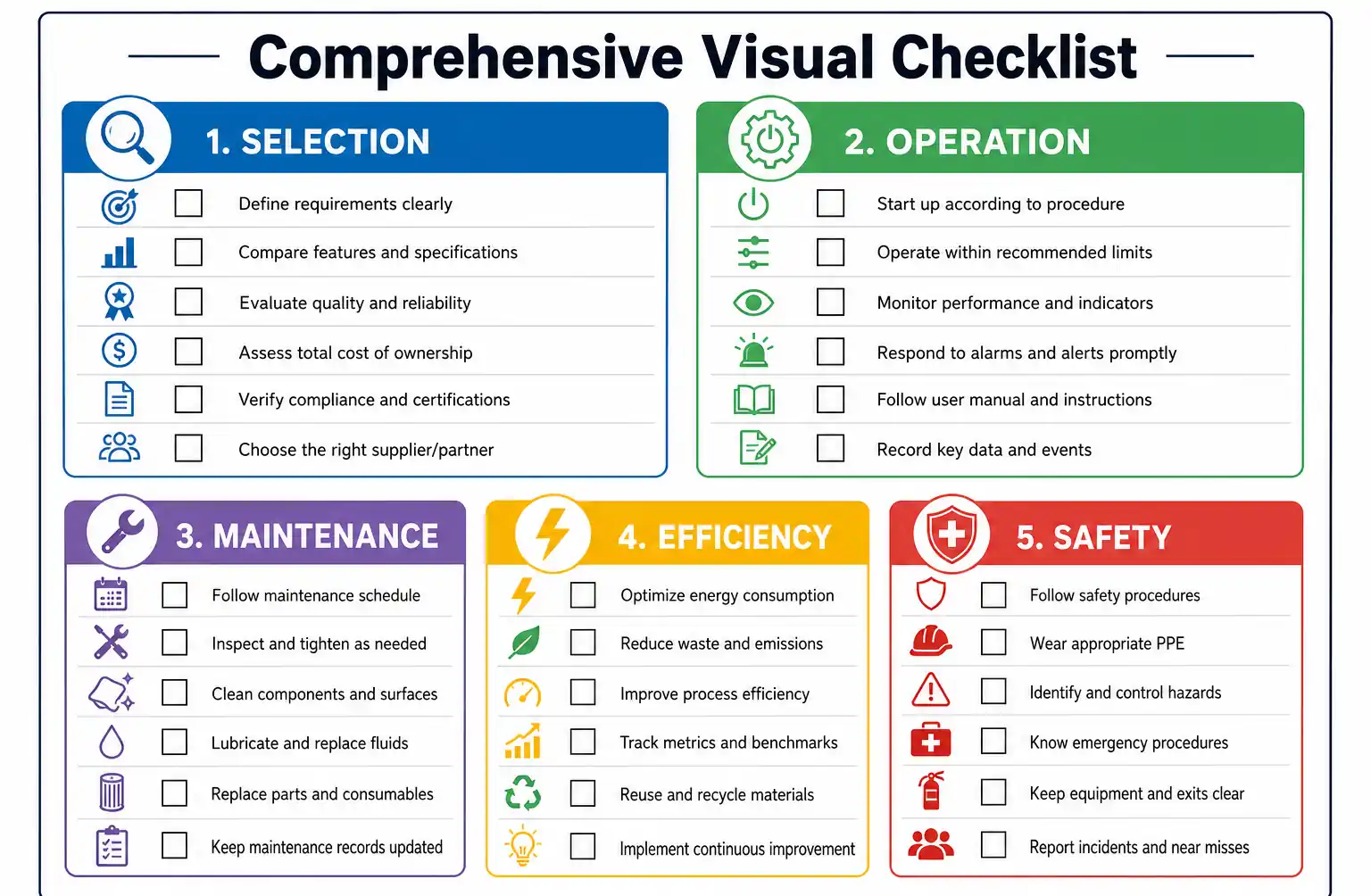
Selection Tips
- Match the nozzle to the task: Don't use a one-size-fits-all approach
- Consider total cost of ownership: Cheaper nozzles may cost more long-term
- Buy quality: Premium nozzles last longer and maintain performance better
- Keep a variety on hand: Different jobs need different nozzles
Operation Tips
- Start low, go slow: Begin with lower pressure and increase as needed
- Maintain consistent distance: Use a guide or practice to maintain optimal spacing
- Use proper technique: Overlap passes by 20-30% for complete coverage
- Pre-treat when possible: Chemical pre-treatment reduces required pressure and time
Maintenance Tips
- Inspect before each use: Catch problems before they affect performance
- Clean nozzles regularly: Remove mineral deposits and debris
- Replace worn nozzles promptly: Don't wait until performance is severely degraded
- Use filtered water: Reduces wear and clogging
Efficiency Tips
- Optimize water temperature: Hot water cleans better at lower pressure
- Use appropriate chemicals: Right detergent reduces mechanical cleaning needs
- Train operators properly: Technique matters as much as equipment
- Document what works: Keep records of successful parameter combinations
Safety Tips
- Wear appropriate PPE: Eye protection, gloves, and protective clothing
- Never point at people or animals: High-pressure water can cause serious injury
- Be aware of electrical hazards: Water and electricity don't mix
- Secure hoses and equipment: Prevent trip hazards and equipment damage
Conclusion
Pressure, flow rate, and spray angle are the three fundamental variables that determine cleaning efficiency. While each plays a distinct role, their interaction creates the actual cleaning performance you experience.
Understanding these variables allows you to:
- Select the right nozzle for each application
- Optimize water and energy consumption
- Reduce cleaning time and labor costs
- Achieve better cleaning results
- Extend equipment life
- Improve workplace safety
The key is finding the right balance for your specific application. Start with manufacturer recommendations, test different combinations, and monitor performance over time. With proper selection, operation, and maintenance, you can maximize cleaning efficiency while minimizing resource consumption.
Remember: the most expensive nozzle isn't always the best, and the highest pressure isn't always the most effective. Smart optimization of all three variables—pressure, flow rate, and spray angle—is what delivers superior cleaning efficiency.