



2026 Industrial Humidification Nozzle Purchasing Checklist: 5 Core Parameters to Focus On
When specifying industrial humidification nozzles for applications like manufacturing climate control, textile processing, or data center cooling, engineers tend to lock in on flow rate and spray angle and call it done. Out in the field, we keep seeing the same fallout: uneven RH distribution (15–20% swings across one zone), nozzles that clog monthly despite water treatment, and expensive retrofits that could have been avoided. This guide cuts through the datasheet noise and walks through five parameters that actually matter, based on real commissioning data from North American and European plants.
This checklist assumes hydraulic systems running 60–1000 PSI with water as the medium. If you're dealing with compressed air atomization, additives, or sanitary specs, you'll have extra layers to consider—but these five still anchor the job.
Table of Contents
- 1. 1. Droplet Size Distribution & Evaporation Efficiency
- 2. 2. Flow Rate vs. Pressure Relationship
- 3. 3. Spray Pattern Coverage & Overlap Design
- 4. 4. Material Compatibility with Water Quality
- 5. 5. Clog Resistance & Maintenance Accessibility
- 6. 6. Application-Specific Selection Matrix
- 7. 7. Common Purchasing Mistakes to Avoid
- 8. 8. FAQ
- 8.1. Can I mix nozzle brands on the same manifold if they have the same flow rating?
- 8.2. How often should humidification nozzles be replaced?
- 8.3. What's the real-world turndown ratio for hydraulic nozzles?
- 8.4. Do pneumatic (two-fluid) nozzles justify the added complexity for humidification?
- 8.5. How do I verify droplet size without expensive laser diffraction gear?
- 9. 9. Conclusion
1. Droplet Size Distribution & Evaporation Efficiency
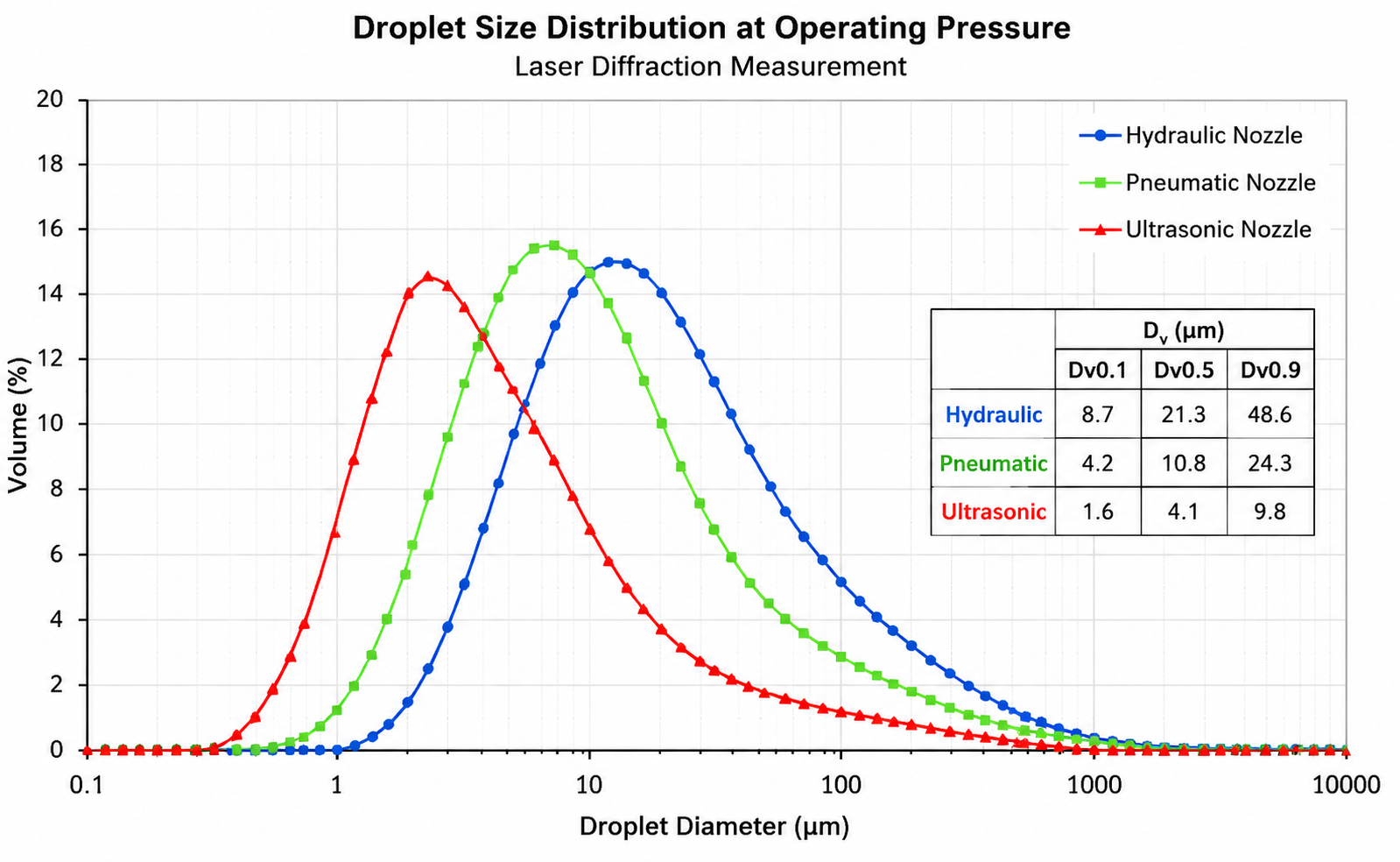
Droplet size decides whether water flashes off in the air or ends up on the floor. For most HVAC humidification, the sweet spot is 10–50 microns (Dv0.5). Anything above 80 microns only works in high-velocity ducts where there's enough hang time. But here's the catch: a nozzle with Dv0.5 = 20 microns might still push 15% of its volume above 50 microns. That fraction will wet things out. Always request laser diffraction data (ASTM E799 or ISO 9276) showing Dv0.1, Dv0.5, and Dv0.9 at your operating pressure. Tighter distribution spans directly reduce wetting risk.
From what we've measured across job sites:
| Nozzle Type | Typical Dv0.5 (microns) | Distribution Span | Evaporation Distance (ft) | Best Application |
|---|---|---|---|---|
| Single-fluid hydraulic (1000 PSI) | 15–25 | 1.5–2.0 | 6–10 | In-duct humidification |
| Two-fluid pneumatic (60 PSI air) | 10–18 | 1.2–1.6 | 4–8 | Clean room, precision control |
| Ultrasonic atomizer | 5–10 | <1.0 | 3–5 | Pharmaceutical, tight RH band |
| Hydraulic (250 PSI) | 30–50 | 2.0–2.5 | 10–15 | Industrial warehouse |
One rule of thumb: doubling pressure only cuts droplet size by about 30%, not 50%. If you're at 40 microns on 500 PSI, cranking to 1000 PSI gets you roughly 28 microns. If you truly need finer mist, switch nozzle types instead of chasing pressure.
Quick evaporation estimate: Evaporation time (sec) ≈ (droplet diameter in microns)² / (4000 × ΔRH) where ΔRH is the humidity deficit (e.g., 0.4 for 30%→70% RH at 70°F). Multiply by air velocity to get minimum distance.
2. Flow Rate vs. Pressure Relationship
Load changes with outdoor conditions and production schedules. A lot of engineers assume they can just dial pressure up and down to throttle flow. Problem is, hydraulic nozzles follow Q = K × √P—cut pressure in half and you're still pushing 71% of max flow. Fine modulation through pressure alone is a losing game.
If you need turndown above 2:1, stage multiple nozzle banks with on/off control rather than wrestling one manifold across a wide pressure band. For a load swinging from 50 to 200 lbs/hr, set up four 50 lbs/hr banks. You'll keep atomization quality and save your pump from short-cycling.
Always ask for flow vs. pressure curves measured at your actual water temperature. Viscosity effects are minor for water, but check the K-factor tolerance: quality nozzles hold ±5%, budget ones can drift ±15%, which throws off distribution across a manifold. Also watch out for pressure drop along long headers—first and last nozzles see different pressures. Keep manifold drop under 5% of nozzle pressure, or add balancing orifices if it exceeds 10 PSI.
3. Spray Pattern Coverage & Overlap Design
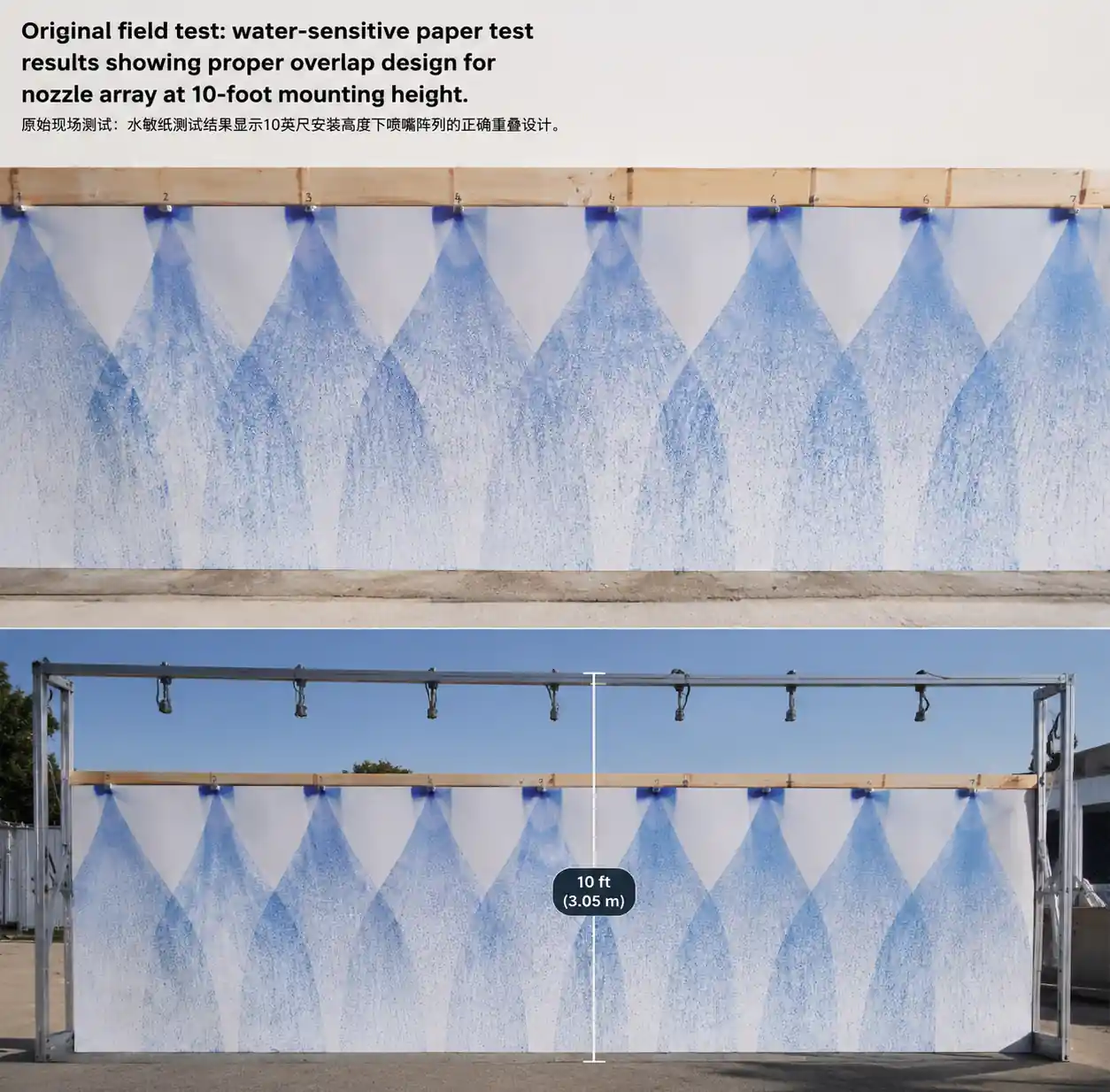
Spray cones aren't uniform—density peaks in the center and tapers at the edges. To get even humidity, you need overlap. Too little leaves dry streaks; too much just wastes nozzles and money. Specify spray angle at your operating pressure (angles narrow as pressure drops) and ask for the coverage uniformity coefficient. Good industrial nozzles hold ±10% uniformity across 80% of rated spray width with proper overlap.
For array layout, we use these field-verified spacing guidelines:
| Mounting Height (ft) | Spray Angle (degrees) | Overlap Factor | Nozzle Spacing (ft) |
|---|---|---|---|
| 8 | 60 | 1.3 | 6.5 |
| 10 | 70 | 1.4 | 8.0 |
| 12 | 80 | 1.5 | 9.5 |
| 15 | 90 | 1.6 | 11.5 |
Spacing calculation: (Mounting height × tan(spray angle/2) × 2) / Overlap factor
Before locking in your array, run a water-sensitive paper test. Tape paper at the target plane, fire the system for 10 seconds at pressure. Uniform purple over 90% of the area means you're set; white spots mean gaps.
Watch the definition trap: some manufacturers quote "full angle" (total cone), others quote "half angle" (centerline to edge). A 60° full-angle nozzle only covers 30° from center—check which standard they're using.
4. Material Compatibility with Water Quality
Municipal water—even softened—carries dissolved minerals, chlorides, and grit that chew up orifices. 316 stainless is the default, but it's not bulletproof. We've seen 316SS pit in under 18 months at coastal plants with chlorides above 150 ppm. Brass nozzles, which still show up in "budget" bids, fail within six months on moderately hard water.
Match material to your actual water report—TDS, hardness, chlorides, pH, iron. Then cross-reference corrosion tables. Here's a practical starting point:
| Water Condition | TDS (ppm) | Chlorides (ppm) | Recommended Material | Cost Multiple | Expected Life (hours) |
|---|---|---|---|---|---|
| RO or DI water | <50 | <10 | 316 SS | 1.0× | 15,000+ |
| Softened municipal | 150–300 | 30–80 | 316 SS with electro-polish | 1.3× | 10,000–12,000 |
| Hard municipal | 300–600 | 80–200 | 316L SS or Hastelloy C-276 | 3–5× | 8,000–15,000 |
| Industrial reclaim | 600+ | >200 | Hastelloy C-276 or ceramic (alumina) | 5–8× | 10,000–20,000 |
Ceramic nozzles cost 5–8× more than 316SS but last 2–3× longer in abrasive or hard water. Run the total cost of ownership—purchase plus labor plus downtime. For a 100-nozzle system with 4-hour changeouts at $150/hr, ceramic breaks even around 18 months if you're swapping stainless twice a year. Avoid mixing metals in the same circuit—brass fittings with stainless nozzles invite galvanic corrosion.
5. Clog Resistance & Maintenance Accessibility
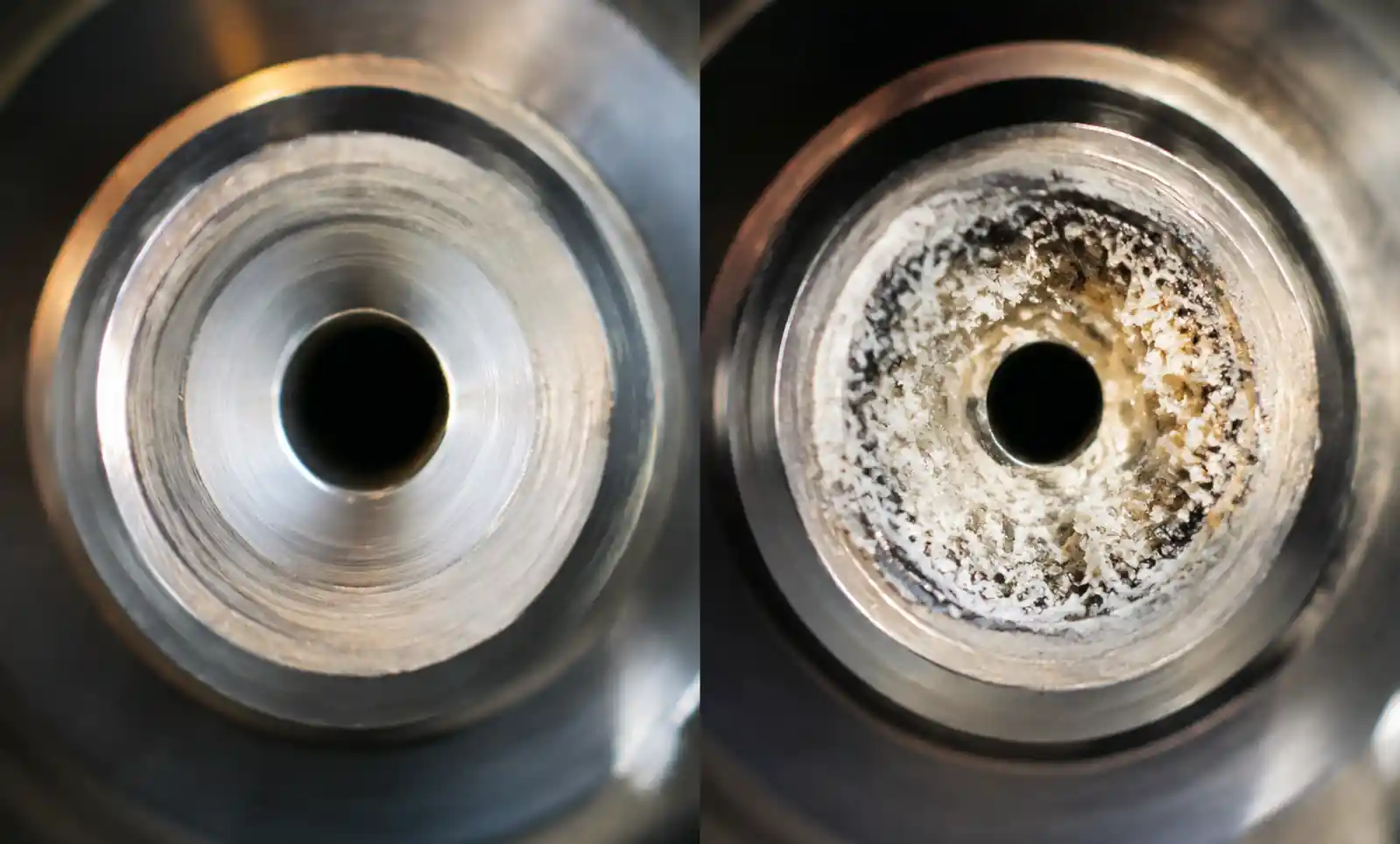
Orifices can be as small as 0.008 inches (200 microns). Any particle above 20% of that diameter starts clogging. Even with 40-micron filtration, mineral precipitation at the orifice—where pressure drop causes localized supersaturation—gradually restricts flow. If you can't inspect or clean nozzles without scaffolding, they'll stay clogged until someone notices water on the floor or RH drifting.
Specify removable tips or cartridges for in-place cleaning. Quick-disconnect bodies (1/8" NPT with knurled cap) let you pull a nozzle in under 30 seconds with no tools. For ceiling arrays above 12 feet, that single feature cuts maintenance downtime by roughly 80% compared to fixed-orifice designs that require manifold disassembly.
Filtration should catch particles at 1/5 of the smallest orifice diameter—so 50-micron filters for 0.010" orifices. Put Y-strainers with blow-down valves on each manifold, not just one at the pump. That localizes debris and speeds troubleshooting.
Maintenance checklist:
- Can you remove each nozzle without draining the manifold?
- Is there a zone isolation valve?
- Can you visually inspect from a ladder without moving ceiling tiles?
- Do you keep three spares per 50 installed for immediate swap?
Monitor flow per zone, not just at the main supply. A 10% drop in zone flow points to clogged nozzles before RH distribution goes south. Pressure gauges alone won't catch this—pressure stays steady while total flow drops.
6. Application-Specific Selection Matrix
Not every job weights these five parameters the same. Use this to set priorities:
| Application | Critical Parameters (in priority order) | Typical Pressure (PSI) | Notes |
|---|---|---|---|
| Data center precision cooling | Droplet size, clog resistance, flow/pressure | 800–1200 | Zero wetting tolerance; RO water mandatory |
| Textile manufacturing (spinning) | Coverage uniformity, flow/pressure, droplet size | 300–600 | High volume, moderate precision |
| Museum / archive storage | Droplet size, material compatibility, coverage | 600–1000 | Long unattended runs; water quality varies |
| Cold storage humidification | Droplet size, clog resistance, material | 1000+ | Minimize freezing risk; very fine mist |
| Industrial warehouse comfort | Coverage uniformity, clog resistance, flow/pressure | 250–500 | Cost-sensitive; rugged operation |
7. Common Purchasing Mistakes to Avoid
From RFQ reviews and site walkdowns, here are the errors we see most often:
Mistake 1: Spec'ing by flow rate alone. "We need 300 lbs/hr" doesn't constrain droplet size, pressure, or distribution. Two nozzles can both hit 300 lbs/hr—one as a coarse spray at 250 PSI with 60-micron droplets, the other as fine mist at 1000 PSI with 20-micron droplets. Always specify flow, pressure, and droplet distribution together.
Mistake 2: Ignoring turndown. Sizing for peak winter load without considering spring/fall part-load means poor atomization when you back off pressure. Size for the operating range, not just the peak.
Mistake 3: Vague "or equal" specs. Without measurable criteria—flow coefficient tolerance, droplet distribution, spray angle, material grade—"or equal" is meaningless. Define what equal actually means.
Mistake 4: Overlooking orientation. Most hydraulic nozzles are orientation-sensitive. Mount a downward-spray nozzle at 45° and you change the pattern and accelerate internal wear.
Mistake 5: No commissioning plan. If you haven't planned for flow verification, spray pattern inspection, and humidity mapping, you won't know if the system works until the schedule won't allow fixes.
8. FAQ
Can I mix nozzle brands on the same manifold if they have the same flow rating?
Not recommended. Even with identical flow ratings, different brands have different pressure coefficients. As supply pressure fluctuates, distribution goes uneven. If you absolutely must mix, install individual flow-balancing orifices upstream of each nozzle.
How often should humidification nozzles be replaced?
With softened water and 40-micron filtration, figure 8,000–12,000 hours—about 2–3 years of continuous run. Do annual flow testing and replace when measured flow at rated pressure deviates more than 10% from nameplate.
What's the real-world turndown ratio for hydraulic nozzles?
About 2:1 before atomization noticeably degrades. Beyond that, droplet size climbs and spray angle narrows. For wider turndown, go with staged manifolds rather than pressure modulation.
Do pneumatic (two-fluid) nozzles justify the added complexity for humidification?
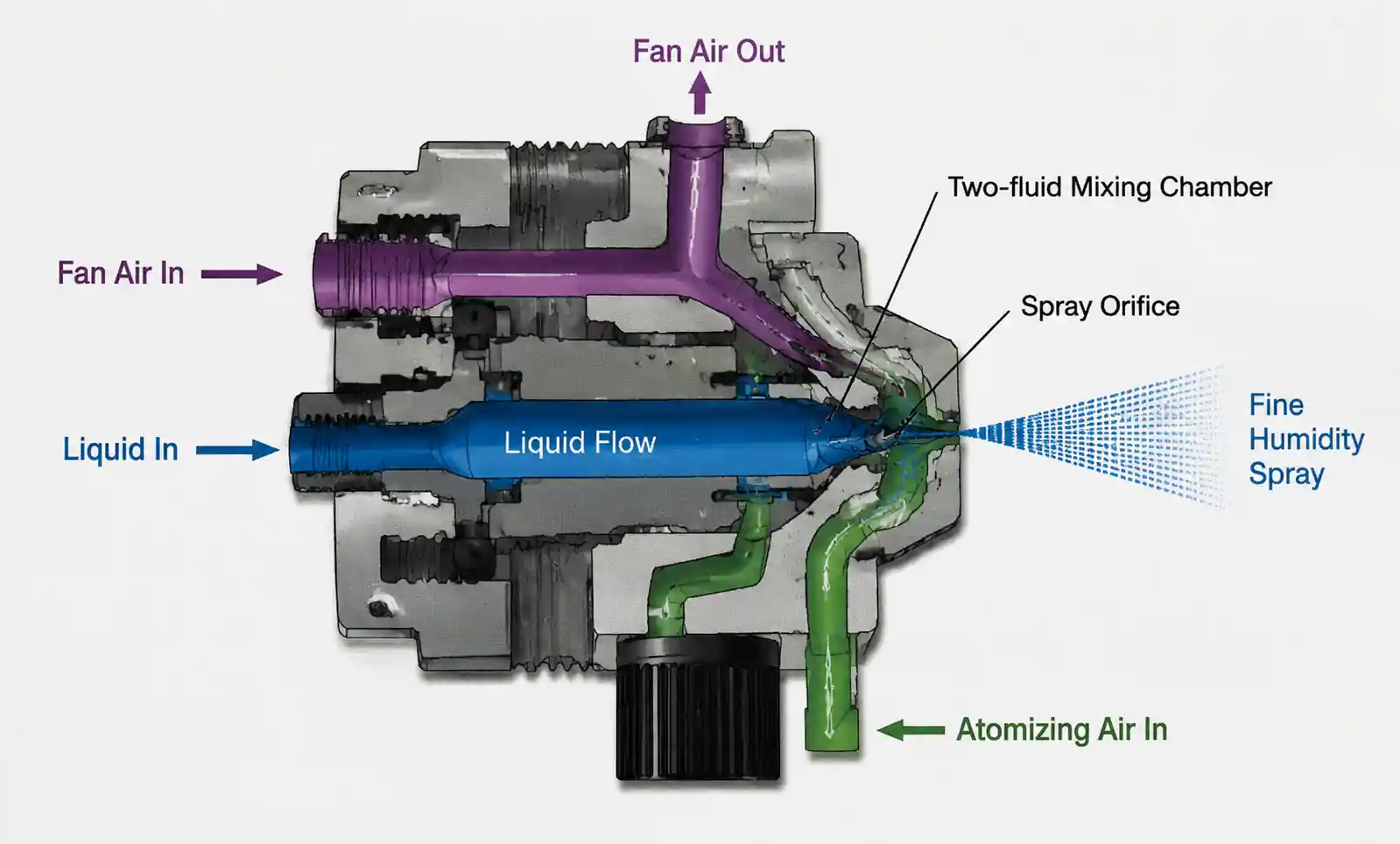
Rarely for standard HVAC work, unless you need droplets below 15 microns or have low water pressure (<100 PSI). Compressed air cost and extra maintenance usually outweigh benefits. We typically spec two-fluid only for cleanrooms or sites with water pressure constraints.
How do I verify droplet size without expensive laser diffraction gear?
You can't measure it precisely in-house, but you can validate performance. Run the system and check for surface wetting at the expected evaporation distance. If surfaces stay dry at that distance, your atomization is adequate. For hard numbers, hire a test lab or request manufacturer certification data at your exact pressure and flow.
9. Conclusion
Good humidification comes down to nozzle selection that balances atomization, water compatibility, maintainability, and lifecycle cost. The five parameters here—droplet distribution, flow/pressure behavior, coverage design, material selection, and clog resistance—give you a spec that actually delivers in the field.
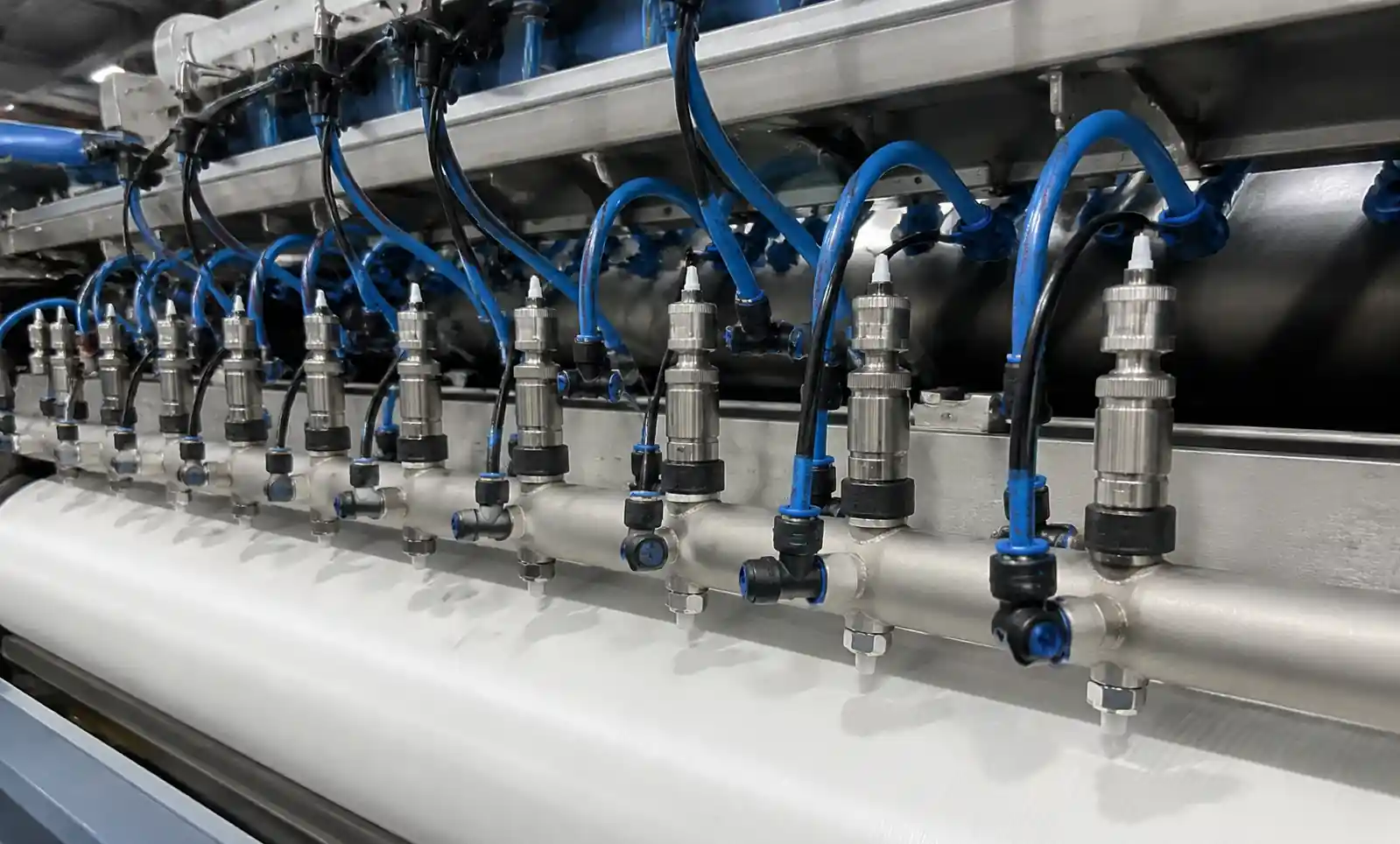
For complex jobs with multiple zones or tight RH control, consider a factory commissioning test with your water sample run through candidate nozzles at real flow and pressure. That test typically runs $1,500–3,000 and pays for itself many times over by avoiding field rework. If you need help sizing an array or interpreting water quality data against material options, reach out to our application engineering team. We offer no-cost preliminary guidance and can arrange field atomization testing for projects above 100 nozzles. For a broader perspective on nozzle selection fundamentals—including flow rate, spray angle, material wear, and droplet size—check out our guide on 5 critical parameters you cannot ignore. And if you're also working with tank cleaning or washdown systems, our guide on how to reduce 30% water consumption offers complementary insights on optimizing flow without sacrificing performance.