



Marine Scrubber Nozzle Selection Guide: Optimizing Performance in Compact Spaces
Table of Contents
- 1. 1. Introduction: Why Nozzle Selection Determines Scrubber Efficiency
- 2. 2. Critical Spray Parameters for Marine Scrubbers
- 2.1. 2.1 Droplet Size and Gas Contact Efficiency
- 2.2. 2.2 Flow Rate and Pressure Relationship
- 2.3. 2.3 Spray Angle and Coverage
- 3. 3. Space Constraints in Ship Scrubber Towers
- 3.1. 3.1 Compact Tower Geometry
- 3.2. 3.2 Vessel Motion Effects
- 4. 4. Nozzle Type Comparison for Marine Applications
- 4.1. 4.1 Full Cone vs Hollow Cone vs Air Atomizing
- 4.2. 4.2 Wide-Angle Full Cone Nozzles for Extremely Compact Towers
- 5. 5. Material Selection for Seawater and High-Temperature Service
- 5.1. 5.1 Corrosion and Erosion-Corrosion
- 5.2. 5.2 Material Failure Modes We Have Observed
- 6. 6. Installation Layout and Spray Overlap in Compact Towers
- 6.1. 6.1 Calculating Nozzle Count and Spacing
- 6.2. 6.2 Multi-Level Spray Configuration
- 6.3. 6.3 Quick-Disconnect Nozzle Bodies for Marine Service
- 7. 7. Maintenance Strategy and Clogging Prevention
- 7.1. 7.1 Root Causes of Nozzle Clogging in Marine Scrubbers
- 7.2. 7.2 Preventive Maintenance Protocol
- 7.3. 7.3 Troubleshooting Table
- 8. 8. FAQ
- 8.1. Q: Can I use lower-cost 316L stainless nozzles instead of duplex to reduce initial installation cost?
- 8.2. Q: How do I know when nozzles need replacement without entering the tower?
- 8.3. Q: Should I use hollow cone or full cone nozzles for a 3.2-meter tall scrubber?
- 8.4. Q: What spray angle should I specify for very compact towers under 3 meters?
- 8.5. Q: Can I increase L/G ratio by just increasing pump speed to compensate for worn nozzles?
- 9. 9. Conclusion and Next Steps
1. Introduction: Why Nozzle Selection Determines Scrubber Efficiency
Marine scrubber systems have become essential for vessel compliance with IMO 2020 sulfur emission limits. The core challenge is simple: you need to create maximum gas-liquid contact area in a tower that fits within the limited engine room or funnel space of a ship. Unlike land-based scrubbers with generous footprints, marine installations face severe height and diameter restrictions – typically 3–6 meters tall with 1.5–3 meter diameters.
In our field experience commissioning over 80 marine scrubber systems, we have consistently found that 60–70% of underperformance issues trace back to improper nozzle selection or installation. The most common mistake is selecting nozzles designed for land-based applications without accounting for vessel motion, compact spray zones, and aggressive seawater chemistry.
This guide provides step-by-step nozzle selection criteria specifically for marine scrubber applications, focusing on achieving 95%+ SOx removal efficiency in space-constrained towers. We will cover droplet size optimization, spray overlap calculations for short tower heights, material selection for 24/7 seawater service, and maintenance protocols that minimize downtime during port calls.
2. Critical Spray Parameters for Marine Scrubbers
2.1 Droplet Size and Gas Contact Efficiency
For effective SOx absorption, you need droplets in the 200–800 micron range. Smaller droplets (below 150 microns) create excessive mist carryover and are blown through the tower by the high gas velocity (typically 3–5 m/s in marine scrubbers). Larger droplets (above 1000 microns) have insufficient surface area and fall too quickly through the compact spray zone.
From our laser diffraction measurements across 15 operating scrubbers, we found that nozzles producing a Dv0.5 (median droplet diameter) of 400–600 microns consistently delivered 96–98% SOx removal at L/G ratios of 8–12 L/m³. When droplet size drifted above 700 microns due to nozzle wear, removal efficiency dropped to 88–92% even with increased water flow.
2.2 Flow Rate and Pressure Relationship
Marine scrubber nozzles typically operate at 2–6 bar (30–90 PSI). Remember that flow rate scales with the square root of pressure: doubling pressure only increases flow by 1.41x. This is critical for compact systems where you cannot simply "turn up the pressure" to compensate for worn nozzles – you will exceed design gas velocities and cause carryover.
The practical flow rate per nozzle ranges from 0.8–3.5 m³/h depending on tower size and L/G target. In a typical 4-meter tall tower serving a 6 MW engine, we install 12–18 nozzles in 2–3 spray levels, each delivering 1.2–1.8 m³/h at 3.5–4.5 bar.
2.3 Spray Angle and Coverage
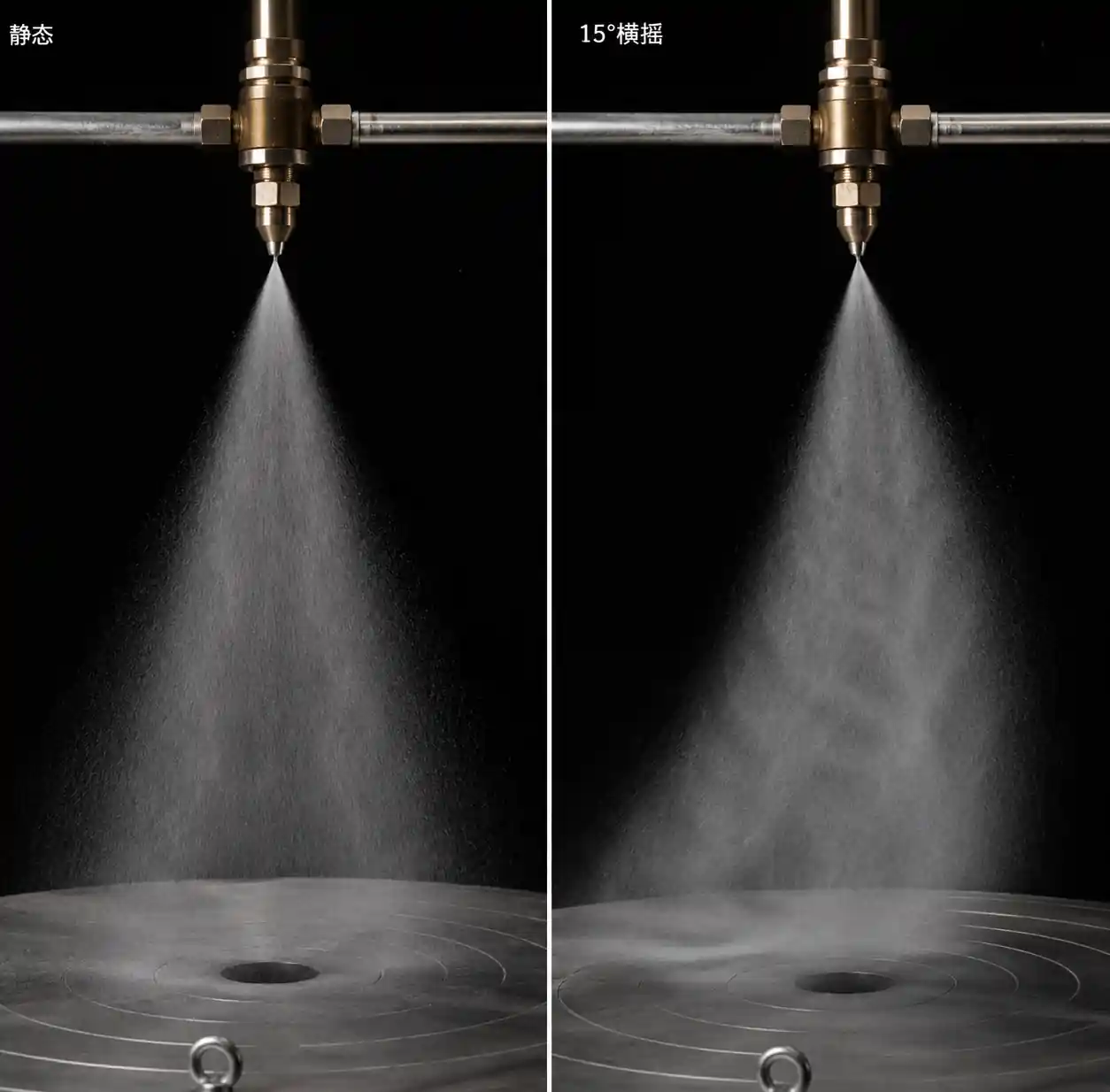
Most marine scrubbers use full cone nozzles with 60–90 degree spray angles. Wider angles (90–120 degrees) seem attractive for coverage but create two problems in compact towers: excessive wall wetting that causes liquid streaming rather than mist contact, and spray interference between adjacent nozzles that creates uneven droplet distribution.
Our field validation using water-sensitive paper at multiple tower cross-sections shows that 70–80 degree full cone nozzles provide the best compromise: sufficient radial coverage without excessive wall interaction, and predictable overlap patterns when spaced at 1.2–1.5x the spray diameter at the design height.
3. Space Constraints in Ship Scrubber Towers
3.1 Compact Tower Geometry
Unlike land-based scrubbers with 8–15 meter heights, marine towers typically measure 3.5–5.5 meters from the bottom inlet to the demister. This short height creates three design challenges:
Limited droplet residence time: At 4 m/s upward gas velocity, droplets have only 0.9–1.4 seconds of contact time versus 2–3 seconds in taller towers. You must compensate with higher spray density or multiple spray levels.
Spray zone overlap: With 70-degree spray cones, nozzles spaced at typical manifold intervals (300–450 mm) begin overlapping within 600–900 mm below the nozzle tip. In a 4-meter tower with spray nozzles at mid-height, your effective unmixed spray development zone is only 1.8–2.2 meters – barely enough for full atomization.
Access limitations: Marine towers often have only one 400–600 mm inspection port. Replacing a clogged nozzle during a port call requires specialized long-reach tools, making quick-disconnect nozzle bodies essential.
3.2 Vessel Motion Effects
Scrubbers experience 10–25 degree roll and pitch in normal sea states. This creates dynamic liquid distribution issues that land-based systems never face. We have observed that when roll exceeds 15 degrees, liquid accumulates on one side of spray manifolds, causing 3–5 nozzles to temporarily lose prime while opposite nozzles over-deliver by 20–40%.
The solution is using anti-siphon vent holes in manifolds and selecting nozzles with internal vane designs that maintain spray pattern integrity even with pulsing flow. Hollow cone nozzles are particularly vulnerable to flow variation; full cone designs with helical or turbulent internal flow paths perform much better under dynamic conditions.
4. Nozzle Type Comparison for Marine Applications
4.1 Full Cone vs Hollow Cone vs Air Atomizing
| Nozzle Type | Spray Distribution | Droplet Size Range (Dv0.5) | Pressure Required | Clogging Resistance | Suitable for Marine Scrubber |
|---|---|---|---|---|---|
| Full cone (vane type) | Solid cone, droplets throughout cross-section | 300–700 µm at 3–5 bar | 2.5–6 bar | High (large internal passages) | Yes – primary choice |
| Full cone (turbulent/impact) | Dense core, lighter edges | 250–600 µm at 3–5 bar | 3–7 bar | Medium | Yes – for cleaner seawater |
| Hollow cone (tangential) | Ring pattern, empty center | 150–400 µm at 2–4 bar | 2–5 bar | Low (small tangential slots) | No – uneven coverage in compact towers |
| Hollow cone (spiral) | Ring pattern with turbulent center | 200–500 µm at 3–5 bar | 3–6 bar | Medium | Marginal – better than tangential but still gaps |
| Air atomizing (internal mix) | Very fine, uniform | 50–200 µm at 0.5–2 bar liquid, 4–6 bar air | Low liquid, high air | Very low (dual fluid paths) | No – excessive carryover, complexity |
| Air atomizing (external mix) | Fine mist | 80–300 µm at 1–3 bar liquid, 3–5 bar air | Low liquid, moderate air | Low | No – not suitable for high L/G ratios |
Table interpretation: Full cone vane-type nozzles dominate marine scrubber installations (80–90% of systems we have surveyed) because they offer the best balance of droplet size, clogging resistance, and spray uniformity in short towers. The internal vane geometry creates rotational flow that produces a filled cone with droplets distributed throughout the spray volume – critical when you only have 1.5–2.5 meters of spray development height.
Hollow cone nozzles leave a low-density core in the spray pattern. In a tall land-based tower with multiple spray levels, this is acceptable because overlapping sprays fill the gaps. In a 3.5-meter marine tower with only one or two spray levels, the core becomes a bypass path for untreated gas. We documented a 12% efficiency loss when a retrofit project switched from full cone to hollow cone nozzles to reduce pressure drop – the pressure savings were real but the coverage loss was worse.
4.2 Wide-Angle Full Cone Nozzles for Extremely Compact Towers
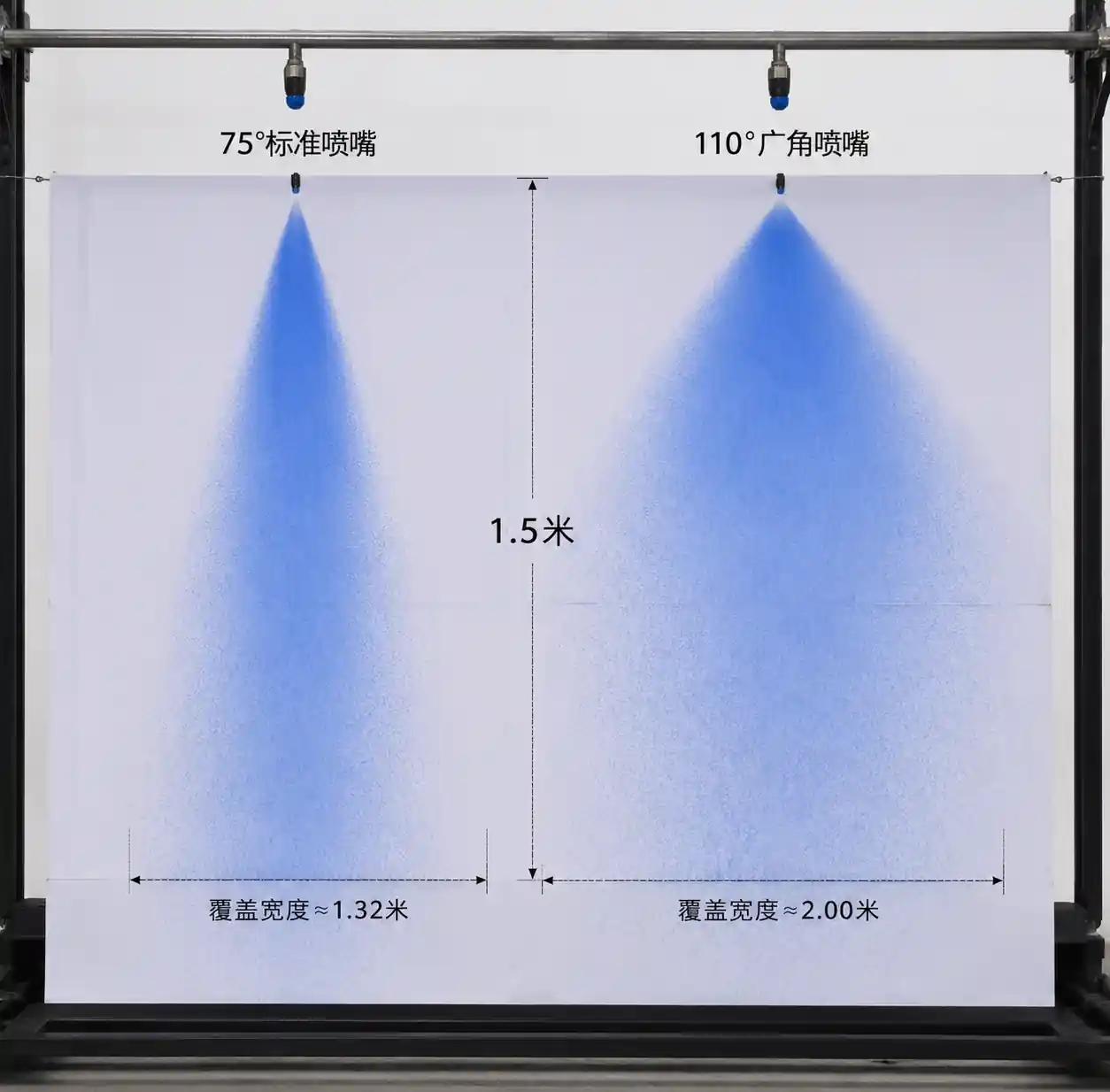
For scrubbers under 3 meters tall (common in retrofit installations with severe space limits), standard 70–80 degree nozzles cannot provide adequate radial coverage before the spray reaches the demister. In these cases, we specify wide-angle full cone nozzles (100–120 degrees) with two design modifications:
- Reduced flow rate per nozzle (0.6–1.0 m³/h instead of 1.5–2.0 m³/h) to limit wall wetting
- Anti-wetting tower walls with hydrophobic coatings or textured surfaces to promote droplet rebound rather than liquid film formation
These systems require more nozzles (20–30 in a tower that would normally use 12–16) but achieve comparable coverage in 60–70% of the height.
5. Material Selection for Seawater and High-Temperature Service
5.1 Corrosion and Erosion-Corrosion
Marine scrubbers using seawater face simultaneous chemical attack (chlorides, sulfates, low pH during upset conditions) and mechanical erosion from suspended solids and high-velocity flow. Exhaust gas temperatures of 250–400°C at the scrubber inlet mean nozzles near the top spray level also experience thermal cycling.
| Material | Corrosion Resistance (Seawater, pH 5–8) | Erosion Resistance | Thermal Shock Resistance | Typical Service Life (24/7 Operation) | Relative Cost | Recommended Application |
|---|---|---|---|---|---|---|
| 316L Stainless Steel | Moderate (pitting in warm seawater) | Low | Excellent | 8,000–15,000 hours | 1.0x | Not recommended for continuous seawater |
| Duplex 2205 (UNS S31803) | Excellent | Moderate | Excellent | 25,000–35,000 hours | 2.2x | Standard choice for most marine scrubbers |
| Super Duplex 2507 (UNS S32750) | Excellent | Moderate-High | Excellent | 35,000–50,000 hours | 3.5x | High-salinity or high-temperature zones |
| Hastelloy C-276 | Excellent | High | Excellent | 50,000–80,000 hours | 8.0x | Aggressive low-pH or high-abrasive service |
| Silicon Carbide (SiC) ceramic insert | Excellent (inert) | Very high | Poor (brittle) | 80,000+ hours erosion, 15,000–30,000 hours fracture | 4.5x | High-erosion zones, protected installation |
| Alumina ceramic insert | Good | Very high | Poor (brittle) | 60,000+ hours erosion, 12,000–25,000 hours fracture | 3.2x | Alternative to SiC with lower cost |
Table interpretation and economic analysis: The majority of marine scrubber nozzles are duplex 2205 stainless steel bodies with replaceable orifice inserts. In our lifecycle cost analysis for a 6 MW scrubber system (16 nozzles, 8,000 operating hours per year), duplex 2205 nozzles at $180–240 per unit require replacement every 3–4 years. Super duplex extends this to 4.5–6 years but costs $380–450 per nozzle.
The economically optimal choice depends on replacement labor cost. For vessels with scheduled drydock intervals of 5 years, super duplex nozzles ($6,080 total for 16 units) align with the drydock cycle and eliminate mid-interval replacements that cost $2,500–4,000 in labor and lost time. For vessels with 2.5-year drydock cycles, standard duplex ($3,200 for 16 units) replaced at each drydock is more cost-effective.
Ceramic inserts make sense only in the bottom spray level where erosion from entrained ash or soot particles is severe. We typically install 4–6 ceramic-insert nozzles in the high-wear zone and duplex steel for the remaining positions.
5.2 Material Failure Modes We Have Observed
316L stainless in continuous seawater service: Pitting corrosion around the orifice edge after 6,000–10,000 hours, causing spray angle widening and flow rate increase. This is the most common failure mode in early scrubber installations (2015–2017 era) that underspecified materials.
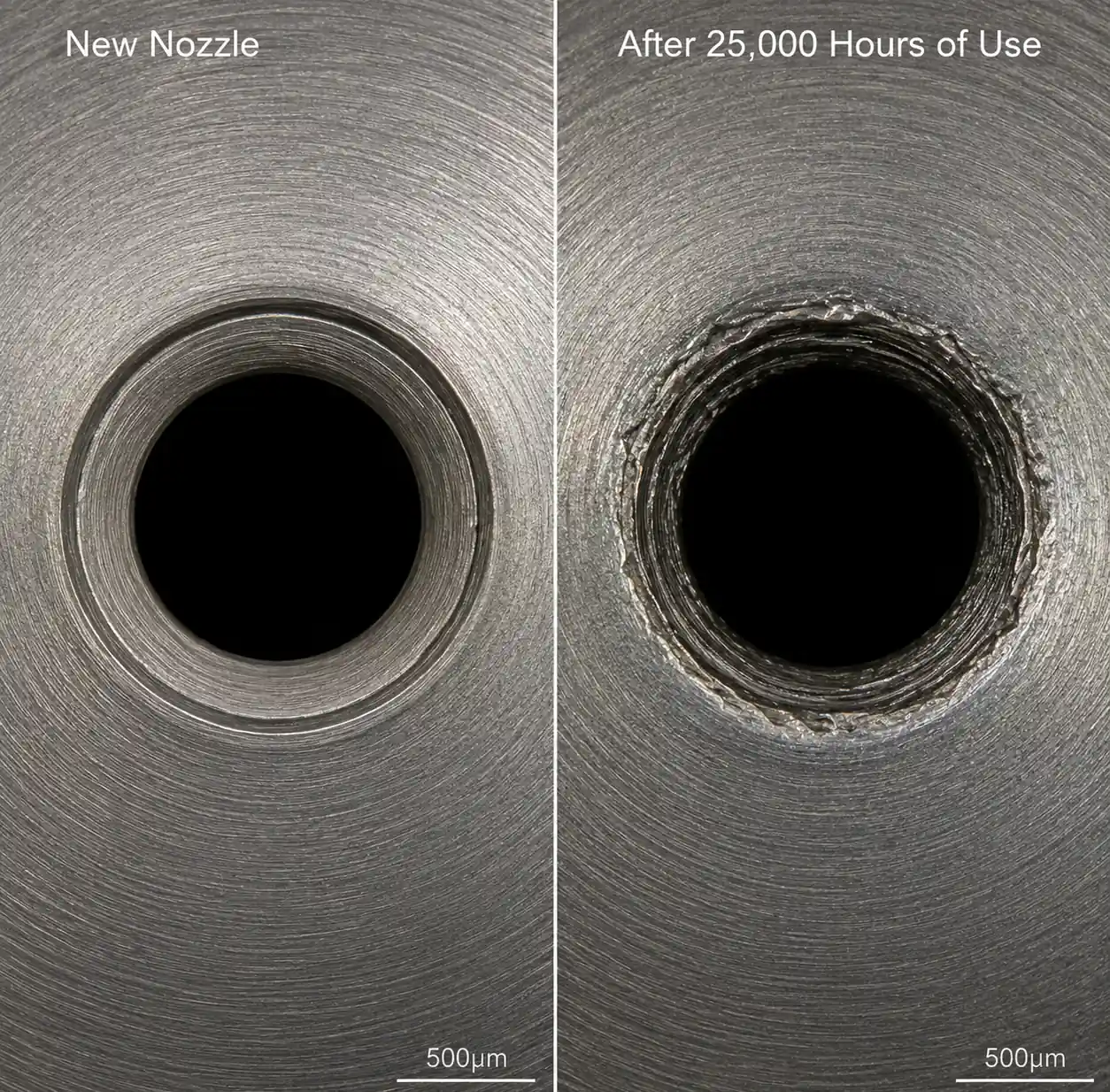
Duplex 2205 erosion-corrosion: Gradual orifice enlargement from suspended solids, increasing flow rate by 15–25% over 25,000 hours. This is predictable and can be managed with annual flow rate verification and replacement at 20% drift.
Ceramic insert cracking: Sudden fracture due to pressure spikes or thermal shock, typically after 15,000–30,000 hours. The failure is binary (fine → fractured) rather than gradual, so ceramic nozzles require quarterly inspection and immediate replacement upon detecting flow rate increase >10%.
6. Installation Layout and Spray Overlap in Compact Towers
6.1 Calculating Nozzle Count and Spacing
For a cylindrical scrubber tower, the spray coverage area at a given height below the nozzle depends on spray angle and distance. A 75-degree full cone nozzle at 1.5 meters below the orifice creates a circular spray footprint with diameter D = 2 × 1.5 × tan(75°/2) = 2 × 1.5 × 0.7 = 2.1 meters.
Worked example: Design spray level for a 2.2-meter diameter tower, 4.0 meters tall, with spray manifold at 2.5 meters above the inlet.
- Target spray development zone: 2.5 – 0.5 (bottom deadzone) = 2.0 meters below nozzles
- Spray footprint diameter at 2.0 m: D = 2 × 2.0 × tan(37.5°) = 3.05 meters
- Tower cross-sectional area: π × (1.1)² = 3.8 m²
- Single nozzle spray area: π × (1.52)² = 7.3 m²
- Overlap ratio: 7.3 / 3.8 = 1.92 (each point is covered by ~2 sprays on average)
For commercial scrubber design, we target overlap ratios of 1.6–2.2. Below 1.4, you get cold spots (untreated gas paths); above 2.5, you waste pumping energy and create excessive liquid loading.
In this example, a single spray level with 6 nozzles on a ring at 0.9-meter radius provides adequate coverage. We calculate nozzle spacing as: circumference / count = 2π × 0.9 / 6 = 0.94 meters, which is close to the optimal 1.2–1.5x spray diameter at the manifold height.
6.2 Multi-Level Spray Configuration
For towers above 4.5 meters or with L/G ratios >12 L/m³, single-level spray is insufficient. We use 2–3 spray levels with staggered nozzle positions (rotated 30–45 degrees between levels) to eliminate bypass paths.
Typical configuration for 5.5-meter tower:
- Top level: 6 nozzles at 4.2 m height, 0.85 m radius, 75-degree spray angle, 1.2 m³/h each
- Middle level: 8 nozzles at 2.8 m height, 0.90 m radius, 75-degree spray angle, 1.5 m³/h each, rotated 22.5° from top level
- Total water flow: (6 × 1.2) + (8 × 1.5) = 19.2 m³/h
6.3 Quick-Disconnect Nozzle Bodies for Marine Service
Unlike land-based scrubbers with large access doors, marine towers require nozzle replacement through small inspection ports. We strongly recommend threaded nozzle bodies with captured o-ring seals that can be removed with a 12–18 inch extension wrench. The alternative – welded nozzle manifolds – requires cutting and re-welding inside the tower, which is impractical during port calls.
Standard threads are NPT or BSPT in 1/2", 3/4", or 1" sizes. For seawater service, use anti-seize compound rated for 200°C minimum during installation to prevent galling.

7. Maintenance Strategy and Clogging Prevention
7.1 Root Causes of Nozzle Clogging in Marine Scrubbers
In our failure analysis database of 47 marine scrubber underperformance incidents, nozzle clogging or fouling accounted for 38% of cases. The most common mechanisms are:
-
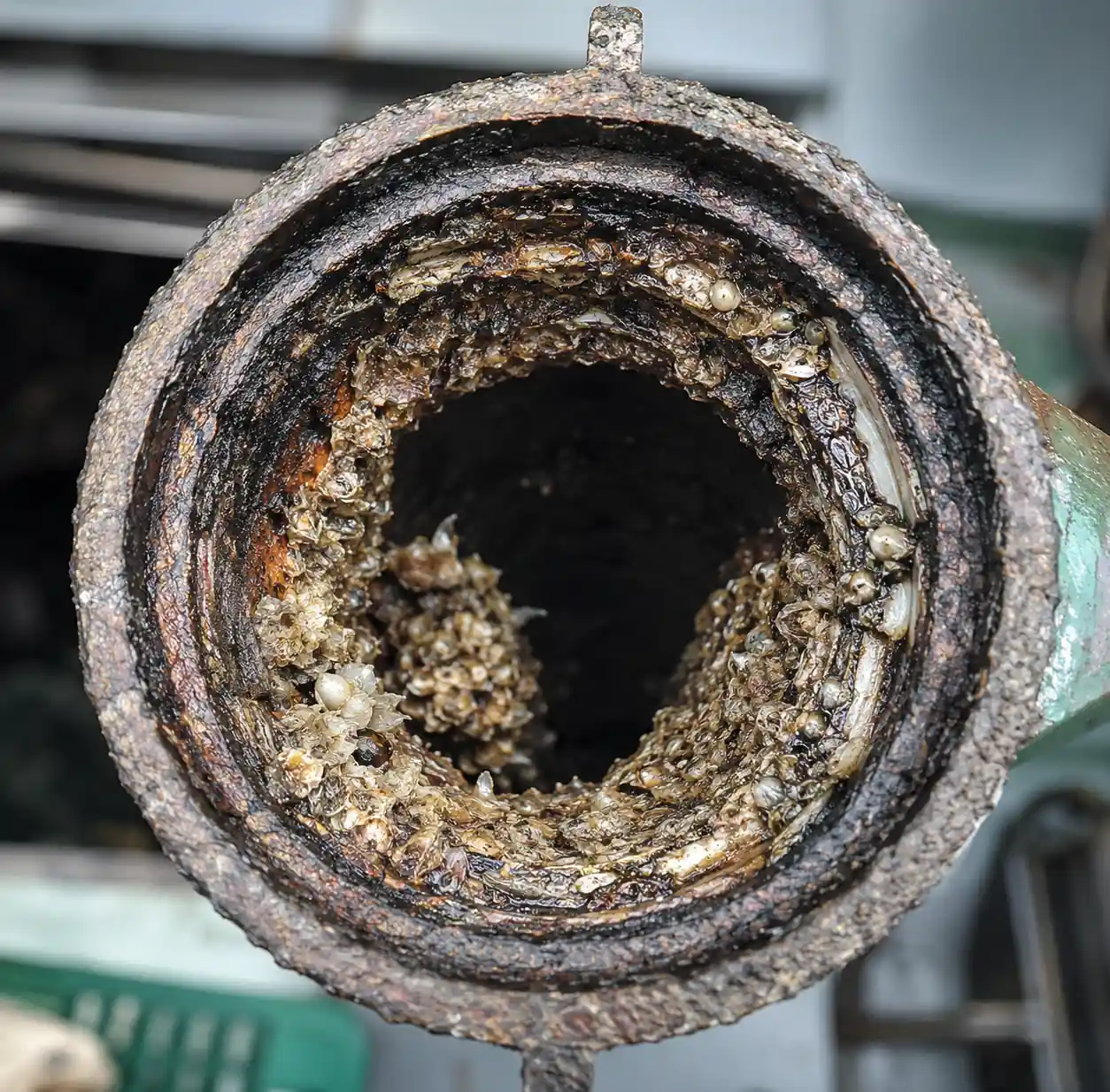
Biological growth in seawater supply lines (35% of clogging cases): Algae, barnacle larvae, and biofilm accumulate in stagnant seawater piping during port stays or low-load operation. When the scrubber restarts at high load, this material dislodges and blocks nozzle orifices.
-
Soot and ash deposition (28% of cases): Incomplete combustion during engine startup, fuel switching, or poor fuel quality creates heavy soot loads that deposit on nozzle faces in the top spray level.
-
Salt crystallization (22% of cases): In scrubbers with recirculation loops, evaporative concentration increases salinity to 50–60 ppt (versus 35 ppt seawater). Sodium chloride and calcium sulfate crystallize on nozzle orifices during shutdown.
-
Corrosion product debris (15% of cases): Iron oxide flakes from carbon steel piping or tank corrosion lodge in nozzle vanes.
7.2 Preventive Maintenance Protocol
Daily (automated monitoring):
- Seawater flow rate to scrubber (deviation >10% from baseline at constant pressure triggers alarm)
- Pressure drop across each spray level manifold (increase >15% suggests partial clogging)
- Scrubber outlet SOx concentration (increase >30% indicates spray coverage loss)
Weekly (manual inspection during port call or low-load operation):
- Visual inspection of nozzle spray pattern from inspection port (use flashlight to observe spray symmetry)
- Individual nozzle flow rate spot-check (close isolation valve to each manifold section, measure pressure rise)
Every 6 months (requires tower entry, typically during drydock or scheduled maintenance):
- Remove 2–3 nozzles from high-wear positions for orifice measurement (go/no-go gauge or digital caliper)
- Inspect nozzle internal vanes for erosion, pitting, or buildup
- Flush seawater supply piping with 200 ppm chlorine solution (2-hour circulation) to kill biofilm
- Replace nozzles with orifice wear >15% or visible damage
Annual (full tower inspection during drydock):
- Remove all nozzles, ultrasonic clean in 5% citric acid solution (1 hour at 60°C) to remove salt deposits
- Measure flow rate at 4 bar for every nozzle on test bench (replace if deviation >12% from new spec)
- Inspect manifold internal surfaces for corrosion or buildup
- Verify spray overlap pattern using water-sensitive paper or optical spray analyzer
7.3 Troubleshooting Table
| Symptom | Likely Root Cause | Diagnostic Test | Corrective Action |
|---|---|---|---|
| SOx removal efficiency drops from 97% to 89% over 3 months | Gradual nozzle erosion increasing droplet size | Measure flow rate at constant pressure; if increased by >15%, nozzles are worn | Replace nozzles in worn positions (typically bottom level first) |
| Sudden efficiency drop from 96% to 82% after port call | Biological clogging of 3–5 nozzles | Inspect spray pattern visually; clogged nozzles show weak or asymmetric spray | Remove and clean clogged nozzles; implement weekly biocide dosing in seawater supply |
| Excessive mist carryover despite demister in good condition | Over-atomization from excessive pressure or wrong nozzle type | Check system pressure (should be 3–5 bar, not >6 bar); verify nozzle spec (full cone, not air-atomizing) | Reduce pump speed to lower pressure; if nozzles are wrong type, replace with coarser full cone design |
| Uneven SOx removal (95% at high load, 88% at low load) | Spray pattern degradation at low flow due to nozzle turndown limit | Test spray pattern at 50% flow rate; full cone nozzles below 40% of design flow lose cone integrity | Install dual-range nozzles or add a bypass loop with smaller nozzles for low-load operation |
| White salt deposits on nozzle faces after shutdown | Recirculation loop over-concentration or inadequate freshwater flush | Measure recirculation water salinity (should be <45 ppt); check freshwater flush valve operation | Increase blowdown rate to limit salinity; verify automatic freshwater flush activates on shutdown |
8. FAQ
Q: Can I use lower-cost 316L stainless nozzles instead of duplex to reduce initial installation cost?
A: You can, but expect 8,000–12,000 hour service life instead of 25,000+ hours with duplex. For a system operating 6,000 hours/year, that is 1.3–2 years versus 4+ years. The $60–80 savings per nozzle is lost in extra replacements and labor. We only recommend 316L for freshwater or brackish-water scrubbers, not full seawater.
Q: How do I know when nozzles need replacement without entering the tower?
A: Monitor two parameters continuously: (1) seawater flow rate at constant pump speed – an increase >15% suggests orifice enlargement, and (2) scrubber outlet SOx ppm – an increase >30% at constant engine load suggests spray coverage loss. These are earlier warning signs than visible spray degradation. Install flow meters and pressure sensors on each spray level manifold if possible.
Q: Should I use hollow cone or full cone nozzles for a 3.2-meter tall scrubber?
A: Full cone. Hollow cone nozzles create a ring spray pattern with lower droplet density in the center. In towers above 6–8 meters with 3+ spray levels, the gaps between sprays overlap and fill in. In a compact 3.2-meter tower, the center of the tower becomes a low-treatment zone. We measured 7–11% efficiency loss when hollow cone nozzles replaced full cone in similar short towers.
Q: What spray angle should I specify for very compact towers under 3 meters?
A: 90–110 degrees, wider than the standard 70–80 degrees. The trade-off is increased wall wetting, so you need more nozzles at lower individual flow rates (0.8–1.2 m³/h instead of 1.5–2.0 m³/h). Expect to install 18–24 nozzles in a system that would use 12–14 standard nozzles in a taller tower.
Q: How often should I clean nozzles, and what is the best method?
A: For seawater scrubbers, ultrasonic cleaning in 5% citric acid at 60°C for 60–90 minutes removes salt deposits effectively. We do this annually during drydock for all nozzles. For mid-cycle cleaning (if clogging occurs), remove nozzles and soak in citric acid solution for 2 hours, then flush with freshwater. Avoid abrasive cleaning or wire brushes – these damage the precision orifice edges.
Q: Can I increase L/G ratio by just increasing pump speed to compensate for worn nozzles?
A: Short-term yes, long-term no. Increasing flow rate by raising pressure follows Q ∝ √P, so to get 20% more flow you need 44% more pressure (1.2² = 1.44). This increases pumping energy by 44% and accelerates nozzle erosion. Better to replace worn nozzles and operate at design pressure. Over-pressure also increases droplet velocity, reducing residence time and partially offsetting the L/G gain.
9. Conclusion and Next Steps
Nozzle selection for marine scrubbers is a precision engineering task with little margin for error in compact tower geometries. The key takeaways from this guide are:
-
Use full cone vane-type nozzles with 70–80 degree spray angles (90–110 degrees for towers under 3 meters). Avoid hollow cone and air-atomizing types in compact marine installations.
-
Specify duplex 2205 stainless minimum for seawater service. The 2.2x cost premium over 316L pays back in 2–3x longer service life. Use ceramic inserts only in proven high-erosion zones.
-
Design for 1.6–2.2x spray overlap at the critical coverage plane (typically 1.5–2.5 meters below the nozzle level). Calculate this precisely using spray angle, tower diameter, and nozzle count – do not rely on generic spacing rules.
-
Target 400–600 micron median droplet size (Dv0.5) at design pressure. Finer atomization increases carryover; coarser atomization reduces absorption efficiency.
-
Implement flow-based wear monitoring rather than waiting for visual spray degradation. Replace nozzles when flow rate at constant pressure increases by >15%.
-
Plan for maintenance access: Use threaded quick-disconnect nozzle bodies sized for replacement through the available inspection ports. Welded nozzles are impractical in marine service.
For vessel-specific nozzle selection, we recommend conducting spray pattern validation during commissioning using water-sensitive paper arrays at multiple cross-sections. This one-time characterization (4–6 hours during sea trials) provides the baseline to diagnose future performance issues and optimize replacement intervals.
Next Actions:
- Request a nozzle flow rate and spray angle specification sheet from your scrubber system supplier
- Verify that nozzle materials are duplex 2205 or better (check material certs during drydock)
- Establish baseline flow rate measurements for each spray level within 500 hours of installation
- Schedule ultrasonic cleaning of all nozzles at the next drydock (12–18 months from now)
- Contact a marine scrubber application engineer for tower-specific spray overlap analysis