


Manual vs Automated Tank Cleaning: Which Is Better
When production managers search for manual vs automated tank cleaning, they are rarely looking for a theoretical debate—they need a cost-engineered answer. Every hour a vessel sits offline for cleaning bleeds revenue. Every confined-space entry risks an OSHA incident. And every inconsistent rinse cycle jeopardizes batch integrity. In our experience advising over 500 industrial facilities across food, pharmaceutical, and chemical sectors, the facilities that transition from manual scrubbing to automated tank cleaning nozzles achieve 80–85% reduction in cleaning cycle times and 30–50% savings on water and chemical costs within the first quarter. This guide breaks down the real economics, safety data, and performance benchmarks so you can make a decision grounded in operational reality—not vendor promises.
Quick Answer: Automated tank cleaning outperforms manual methods in speed, safety, and cost efficiency for nearly all mid-to-large scale industrial operations. Manual cleaning remains viable only for small vessels, light residues, or facilities with minimal throughput requirements.
Table of Contents
- 1. The Hidden Costs of Manual Tank Cleaning
- 2. How Automated Tank Cleaning Nozzles Work
- 3. Manual vs Automated: Head-to-Head Comparison
- 4. ROI Analysis: Breaking Down the Numbers
- 5. Industry Case Studies: Three Real-World Scenarios
- 5.1. Case 1: Dairy Processing — Eliminating Cross-Contamination
- 5.2. Case 2: Chemical Manufacturing — Surviving Aggressive Media
- 5.3. Case 3: Pharmaceutical Production — Validating for FDA Compliance
- 6. How to Select the Right Approach for Your Operation
- 7. When Manual Cleaning Still Makes Sense
- 8. People Also Ask: Common Questions Answered
- 8.1. How much water can automated tank cleaning really save?
- 8.2. Is automated tank cleaning safe for all vessel types?
- 8.3. How long does it take to install an automated CIP system?
- 8.4. Can automated nozzles handle heavy sludge and baked-on residues?
- 8.5. What is the typical payback period for automated tank cleaning equipment?
- 8.6. Do automated systems require extensive maintenance?
- 9. Conclusion: Making the Right Choice for Your Operation
The Hidden Costs of Manual Tank Cleaning
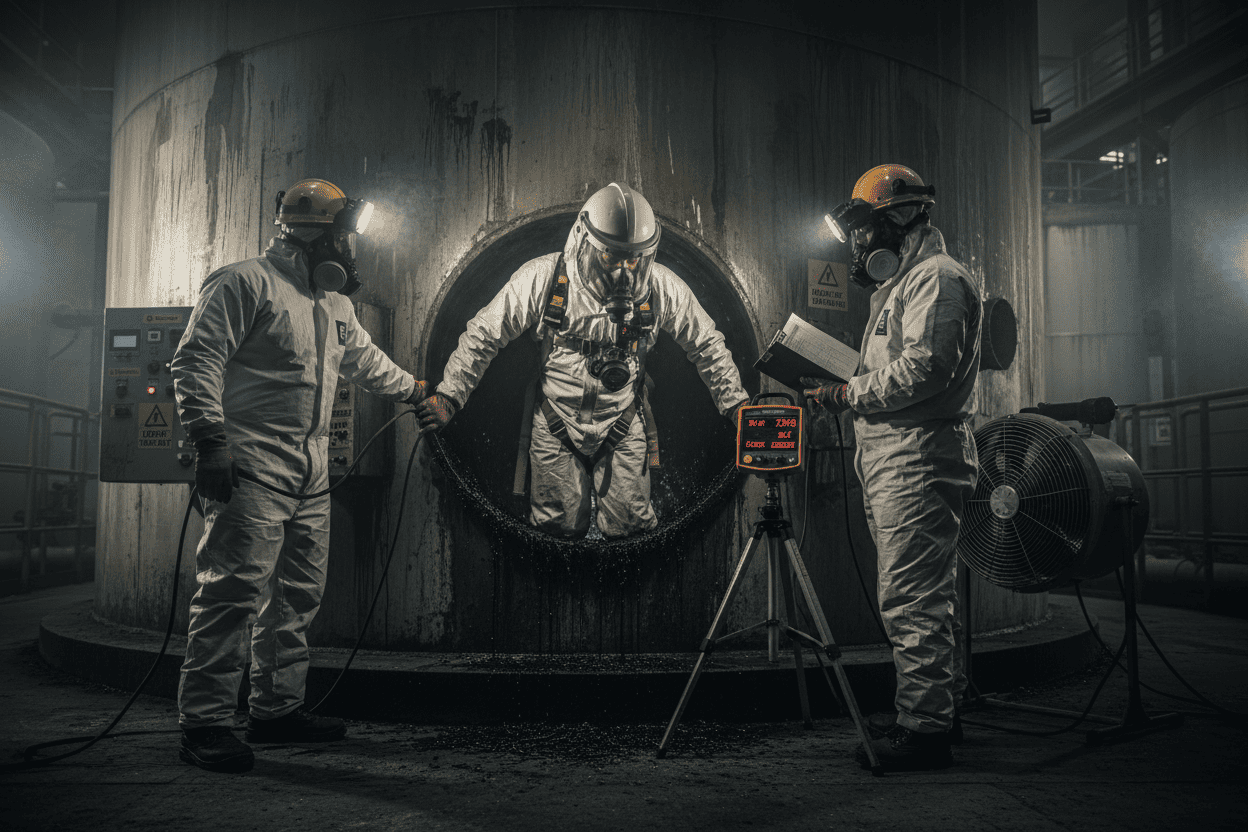
Manual tank cleaning is deceptively expensive. On paper, it requires no capital investment—just labor. Beneath the surface, however, the cost structure unravels into three critical damage dimensions.
Capital Efficiency Loss
Manual scrubbing averages 4 to 8 hours per cleaning cycle. For a mid-scale dairy facility running six batches daily, switching to automated protocols recovers one additional production batch per day—directly increasing revenue without adding equipment. Water and chemical waste from inefficient manual rinsing drives utility costs upward by 200–400% compared to optimized fluid dynamics. In our field assessments, we consistently observe that facilities underestimate true manual cleaning costs by 40–60% because labor allocation is often distributed across maintenance budgets rather than tracked per cleaning event.
Key cost drivers often overlooked:
- Overtime premiums for weekend or night-shift cleaning cycles
- PPE replenishment and respiratory equipment certification
- Standby safety teams required for confined-space entry compliance
- Production schedule disruption and expedited shipping costs to compensate for delays
Regulatory and Safety Exposure
Confined space entry remains one of the leading causes of industrial fatalities. OSHA data indicates tank-related incidents account for approximately 12% of all confined-space deaths in processing industries. Beyond human risk, manual cleaning creates product contamination vulnerabilities that can result in batch losses exceeding $50,000 per incident in pharmaceutical applications.
Product Integrity Degradation
Biofilms and polymerized residues evade casual visual inspection. Cross-contamination between product changeovers in shared vessels leads to rejection rates of 3–8% in regulated industries—an unacceptable margin when product margins are already under pressure.
"The transition from manual cleaning to engineered nozzle systems represents the single most impactful operational upgrade for facilities seeking both safety enhancement and cost reduction." — Industrial Hygiene Engineering Consortium, 2025 Process Equipment Report
How Automated Tank Cleaning Nozzles Work
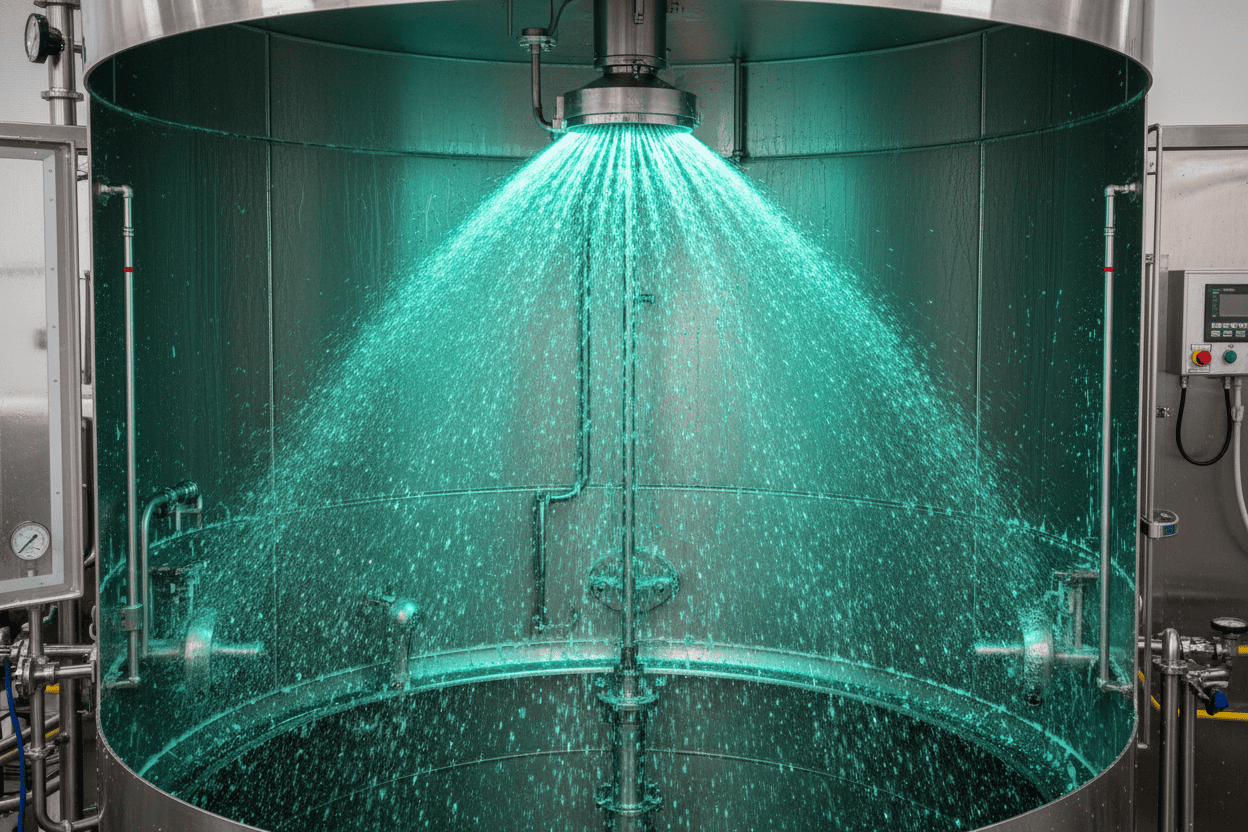
Automated tank cleaning replaces human scrubbing with precision-engineered spray devices that convert fluid pressure into kinetic energy. These systems deliver controlled turbulence and impact force to vessel interiors without manual entry. To understand the mechanical principles behind these devices—including fluid dynamics, spray pattern engineering, and nozzle architecture—see our detailed guide on what tank cleaning nozzles are and how they work.
Three Core Technologies Compared:
- Static Spray Balls — Fixed orifice patterns for light rinsing in small vessels (≤3 m). Zero moving parts. Low impact force (15–30 PSI equivalent).
- Free-Spinning Rotary Nozzles — Fluid-driven rotation increasing impact force by 300–500% over static alternatives. Ideal for general CIP systems and medium residues in vessels up to 10 m diameter.
- Controlled Rotary Jet Heads — Gear-driven indexing delivering 100–300 PSI impact force. Eliminates shadow areas in large tanks up to 40 m. Best for heavy sludge and biofilm removal.
Modern tank cleaning nozzles for industrial applications are crafted from 316L stainless steel, PTFE, PEEK, or tungsten carbide to withstand aggressive chemicals and high temperatures up to 250°C. Material specification significantly affects longevity—facilities specifying the correct alloy grade based on cleaning media pH extend service life from 12–18 months to 5–7 years in aggressive environments. In our production practice, we have observed that 316L stainless steel remains the gold standard for food-grade and pharmaceutical CIP cycles due to its superior corrosion resistance and minimal carbon precipitation during welding. For environments involving concentrated acids or chloride-rich media, PTFE and PEEK polymer options provide near-universal chemical resistance at roughly 60% of the weight of all-metal counterparts.
"Material compatibility failures account for 35% of premature nozzle replacements in chemical processing facilities. Specifying the correct alloy grade extends service life fivefold." — Chemical Processing Equipment Standards Committee, Materials Selection Guidelines
Manual vs Automated: Head-to-Head Comparison
The performance gap between manual scrubbing and automated CIP systems is not incremental—it is transformational. The following data is compiled from cross-industry operational audits conducted between 2023 and 2025.
| Parameter | Manual Cleaning | Static Spray Balls | Rotary Tank Cleaning Nozzles |
|---|---|---|---|
| Cycle Time | 4–8 hours | 45–90 minutes | 15–30 minutes |
| Water / Chemical Use | Very High (uncontrolled) | High (compensatory flow) | Low (optimized trajectory) |
| Coverage Uniformity | Inconsistent (human dependent) | Moderate (shadow zones likely) | 360° with minimal blind spots |
| Impact Force | Variable | 15–30 PSI equivalent | 100–300 PSI equivalent |
| Worker Safety Risk | High (confined entry required) | Low | Low |
| Validation & Documentation | Manual logs (error-prone) | Basic | Automated, repeatable, auditor-friendly |
| Upfront Capital Cost | $0 (labor-only) | $200–$800 per nozzle | $500–$3,500 per nozzle |
| Annual Operating Cost (Medium Facility) | $45,000–$85,000 | $25,000–$40,000 | $12,000–$22,000 |
Key Insight: While automated systems require upfront capital investment, facilities typically achieve full ROI within 4 to 8 months through combined savings in labor, utilities, and reduced batch rejection. For a deeper exploration of why vessel hygiene directly affects your bottom line and compliance posture, read our analysis on why tank cleaning is critical in industrial operations.
ROI Analysis: Breaking Down the Numbers
Understanding the full financial picture requires looking beyond sticker price to total cost of ownership (TCO). Here is how the numbers stack up for a typical mid-scale processing facility running 250 cleaning cycles annually.
| Cost Category | Manual Cleaning | Automated (Rotary Nozzles) | Annual Savings |
|---|---|---|---|
| Labor (2 operators/cycle) | $28,000 | $4,200 | $23,800 |
| Water Consumption | $8,500 | $3,400 | $5,100 |
| Chemical / Detergent | $12,000 | $5,400 | $6,600 |
| Wastewater Treatment | $6,200 | $2,800 | $3,400 |
| Batch Rejection / Rework | $15,000 | $2,500 | $12,500 |
| Equipment (Amortized) | $0 | $3,600 | -$3,600 |
| Total Annual Cost | $69,700 | $21,900 | $47,800 (69% reduction) |
Critical Observation: The largest savings driver is not utility reduction—it is recovered production capacity. Every hour saved in cleaning is an hour gained in revenue-generating output. For a facility generating $5,000 per production batch, recovering one batch per day translates to $125,000 in additional annual revenue.
"Facilities that view tank cleaning as a cost center miss the strategic opportunity. Optimized CIP systems are revenue enablers—every minute of downtime eliminated flows directly to the bottom line." — Processing Magazine, 2024 Operational Excellence Report
Industry Case Studies: Three Real-World Scenarios
Case 1: Dairy Processing — Eliminating Cross-Contamination
Application: A mid-scale dairy cooperative in Wisconsin operated shared CIP systems across 12 processing vessels handling fluid milk, yogurt base, and whey protein concentrate. Manual changeover cleaning averaged 6 hours per vessel, with frequent flavor cross-contamination events.
Solution Implemented: Upgraded to controlled rotary jet heads (360-A series) operating at 10–15 bar with 316L stainless steel construction for FDA compliance.
Results:
- Cleaning cycle reduced from 6 hours to 22 minutes
- Cross-contamination incidents dropped from 8 per month to zero
- Water consumption reduced by 42% (saving 1.2 million gallons annually)
- Facility gained capacity for +2 production batches daily
Case 2: Chemical Manufacturing — Surviving Aggressive Media
Application: A specialty chemical producer in Texas processed polymerized resins in 15-meter reaction vessels. Manual entry required full PPE, air-supplied respirators, and 4-hour safety standby teams. Residue buildup caused inconsistent batch quality with 5.2% rejection rate.
Solution Implemented: Installed PTFE-coated rotary tank cleaning nozzles with tungsten carbide inserts rated for pH 1–14 environments and temperatures up to 180°C.
Results:
- Eliminated 100% of confined-space entries for routine cleaning
- Batch rejection rate fell from 5.2% to 0.8%
- Nozzle service life extended to 6.5 years in aggressive chemical environment
- Annual savings in labor and rework exceeded $180,000
Case 3: Pharmaceutical Production — Validating for FDA Compliance
Application: A generic pharmaceutical manufacturer in New Jersey required validated, repeatable cleaning protocols for API (Active Pharmaceutical Ingredient) reactors. Manual cleaning produced inconsistent documentation that triggered FDA 483 observations during two consecutive inspections.
Solution Implemented: Deployed high-impact rotary jet nozzles with automated CIP skids featuring conductivity sensors and cycle data logging for full batch record integration.
Results:
- Cleaning validation passed FDA inspection with zero observations
- Cycle time reduced from 4.5 hours to 18 minutes
- Documentation compliance automated—100% traceability
- Prevented estimated $2.3M in potential product recall liability
How to Select the Right Approach for Your Operation
Choosing between manual and automated tank cleaning is not a binary decision—it is a function of five critical variables that every operations manager should systematically evaluate before committing capital.
| Selection Factor | Manual Cleaning Favored | Automated Cleaning Favored |
|---|---|---|
| Vessel Diameter | Under 1.5 meters | Over 2 meters (mandatory for 5 m+) |
| Cleaning Cycles / Year | Fewer than 50 cycles | More than 100 cycles |
| Residue Type | Light, water-soluble soils | Viscous oils, polymers, biofilms |
| Regulatory Environment | Non-regulated, non-food applications | FDA, USDA, EHEDG, or 3-A compliant operations |
| Existing Infrastructure | No CIP piping or pump capacity available | Existing CIP skids or compatible pump systems |
"The most expensive tank cleaning decision is not choosing the wrong technology—it is delaying the evaluation while competitors gain operational advantage." — Food Engineering Magazine, 2024 Capital Equipment Survey
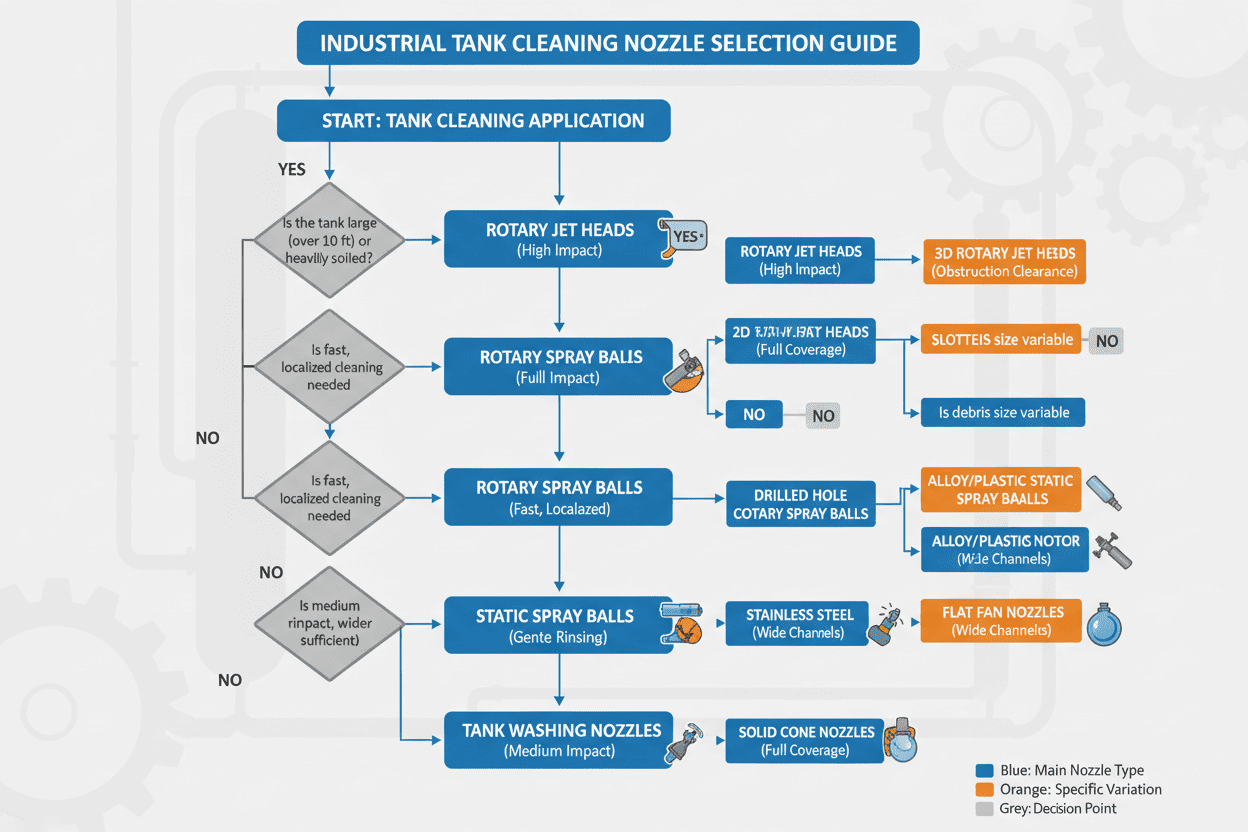
When Manual Cleaning Still Makes Sense
Despite overwhelming advantages of automated systems, manual cleaning retains a niche in specific operational contexts. An honest assessment demands acknowledging these scenarios:
- Small vessel volumes — Tanks under 1 meter diameter where nozzle installation costs exceed labor costs
- Light, water-soluble residues — Simple rinse applications with no biofilm or polymerized buildup
- Extremely low throughput — Facilities running fewer than 20 cleaning cycles annually
- Interim / backup protocols — When automated systems require maintenance or during emergency shutdowns
- Regulatory specificity — Certain legacy facilities with validated manual SOPs that cannot be changed without extensive re-validation costs
Our assessment: These scenarios represent less than 15% of industrial tank cleaning applications. For the remaining 85%, automated tank cleaning delivers superior economics, safety, and compliance outcomes.
People Also Ask: Common Questions Answered
How much water can automated tank cleaning really save?
Automated systems with optimized rotary nozzles typically reduce water consumption by 30–50% compared to manual cleaning, and by 20–35% compared to static spray balls. The savings come from precision-engineered spray trajectories that eliminate compensatory flow. A single facility processing 10 vessels daily can save 500,000 to 1.5 million gallons annually, with corresponding reductions in wastewater treatment costs.
Is automated tank cleaning safe for all vessel types?
Yes—with proper specification. Automated tank cleaning nozzles for industrial applications are engineered for vessels ranging from 50-liter drums to 40-meter reactors. Key selection factors include tank diameter, internal obstructions (agitators, baffles), residue type, and required impact force. Our engineering team provides complimentary nozzle specification audits to ensure optimal matching.
How long does it take to install an automated CIP system?
For retrofits, most installations complete within 1 to 3 days per vessel with minimal production disruption. Greenfield installations integrate seamlessly during construction. The critical path is not hardware installation—it is CIP validation documentation, which typically requires 2 to 4 weeks for FDA-regulated facilities and 3 to 5 days for non-regulated operations. In our deployment experience, facilities that conduct pre-installation vessel audits and nozzle specification reviews reduce commissioning time by 30–40% compared to those that skip the planning phase.
Can automated nozzles handle heavy sludge and baked-on residues?
Absolutely. Controlled rotary jet heads deliver impact forces of 100–300 PSI equivalent—sufficient to remove polymerized resins, baked-on food proteins, and established biofilms. For extremely tenacious residues, operating pressure can be increased to 200+ bar with specialized high-pressure rotary nozzles. The key is matching mechanical energy to soil adhesion characteristics.
What is the typical payback period for automated tank cleaning equipment?
Based on our cross-industry data, facilities achieve full ROI within 4 to 8 months. The fastest paybacks occur in high-throughput operations (daily cleaning cycles) and regulated industries where batch rejection costs are highest. When factoring in recovered production capacity, some facilities report positive ROI within 6 weeks.
Do automated systems require extensive maintenance?
No. Static spray balls have zero moving parts and require only annual inspection. Rotary nozzles need quarterly inspection of bearings and seals—approximately 15 minutes per unit. Compared to the labor burden of manual cleaning (4–8 hours per cycle), maintenance overhead is negligible. Proper material specification extends service life to 5–7 years in standard applications.
Conclusion: Making the Right Choice for Your Operation
The evidence is unequivocal: for the vast majority of industrial operations, automated tank cleaning outperforms manual methods across every metric that matters—speed, safety, cost efficiency, compliance, and product integrity. The only scenarios where manual cleaning remains viable involve small vessels, minimal throughput, or regulatory constraints that prevent system upgrades.
The real question is not whether to automate, but how quickly you can transition without disrupting production schedules. With full ROI achievable in 4–8 months and safety risks essentially eliminated, delaying the decision carries its own costs—every day of manual cleaning is a day of unnecessary expense and exposure.
At Nozzle-Intellect, we specialize in precision-engineered tank cleaning nozzles for industrial applications, from hygienic static spray balls to high-impact controlled rotary jets rated for the world's most demanding CIP environments. Our application engineering team provides complimentary vessel audits, nozzle specification recommendations, and validation support.
Ready to eliminate manual cleaning from your operation? Contact our engineering team for a free nozzle specification audit and ROI analysis tailored to your facility.