



What Are Tank Cleaning Nozzles and How Do They Work
Tank cleaning nozzles represent the critical intersection of fluid dynamics and industrial hygiene, transforming how facilities approach vessel sanitation in demanding processing environments. As industries face increasing regulatory scrutiny and operational efficiency demands, these precision-engineered components have evolved from simple rinse devices to sophisticated automated cleaning systems. Whether you're managing a pharmaceutical manufacturing facility requiring FDA-validated cleaning protocols or a food processing plant demanding rapid changeover times, understanding the mechanics and applications of modern tank cleaning nozzles directly impacts your operational excellence. This comprehensive guide examines the engineering principles, selection criteria, and real-world performance data that define contemporary tank cleaning technology.
Table of Contents
- 1. Quick Answer
- 1.1. Key Industry Pain Points
- 2. 2. Types of Tank Cleaning Nozzles and Performance Comparison
- 2.1. Static Spray Balls (Fixed Nozzles)
- 2.2. Rotary Tank Cleaning Nozzles
- 2.3. 3D Rotary Jet Heads
- 3. 3. How to Select and Install the Right Tank Cleaning Nozzle
- 3.1. Step 1: Analyze Vessel Geometry and Soil Load
- 3.2. Step 2: Calculate Flow Rate and Pressure Requirements
- 3.3. Step 3: Verify Material and Hygiene Standards
- 3.4. Step 4: Determine Mounting Configuration
- 3.5. Step 5: Validate Coverage Patterns
- 4. 4. Industry Applications and Real-World Performance Data
- 4.1. Food and Beverage Processing
- 4.2. Pharmaceutical and Biotech Manufacturing
- 4.3. Chemical and Petrochemical Processing
- 4.4. Brewing and Distillation
- 5. 5. Frequently Asked Questions About Tank Cleaning Nozzles
- 5.1. How do I determine if I need a static spray ball or a rotary tank cleaning nozzle?
- 5.2. What pressure range is required for effective tank cleaning nozzle operation?
- 5.3. Can tank cleaning nozzles handle high-temperature steam-in-place (SIP) cycles?
- 5.4. How do I calculate the correct number of tank cleaning nozzles for large vessels?
- 5.5. What maintenance schedule is recommended for rotary tank cleaning nozzles?
- 6. 6. Conclusion and Next Steps
Quick Answer
Tank cleaning nozzles are specialized fluid distribution devices that deliver high-impact spray patterns to remove residues from vessel interiors without manual entry. They operate by converting cleaning fluid pressure into kinetic energy through precisely engineered orifices, creating rotating or fixed spray patterns that achieve 360° coverage via controlled turbulence and impact force.
Key Industry Pain Points
- Cross-contamination risks between product changeovers in shared processing vessels
- Inconsistent cleaning outcomes leading to batch rejection rates of 3-8% in regulated industries
- Extended downtime periods averaging 4-8 hours per cleaning cycle with manual methods
- Regulatory compliance gaps resulting in FDA 483 observations or warning letters
- Excessive utility costs from inefficient water heating and chemical usage patterns
"The transition from manual cleaning to engineered nozzle systems represents the single most impactful operational upgrade for facilities seeking both safety enhancement and cost reduction. Our field data consistently shows 80-85% cycle time improvements when proper rotary tank cleaning nozzles replace manual protocols."
— Industrial Hygiene Engineering Consortium, 2025 Process Equipment Report
2. Types of Tank Cleaning Nozzles and Performance Comparison
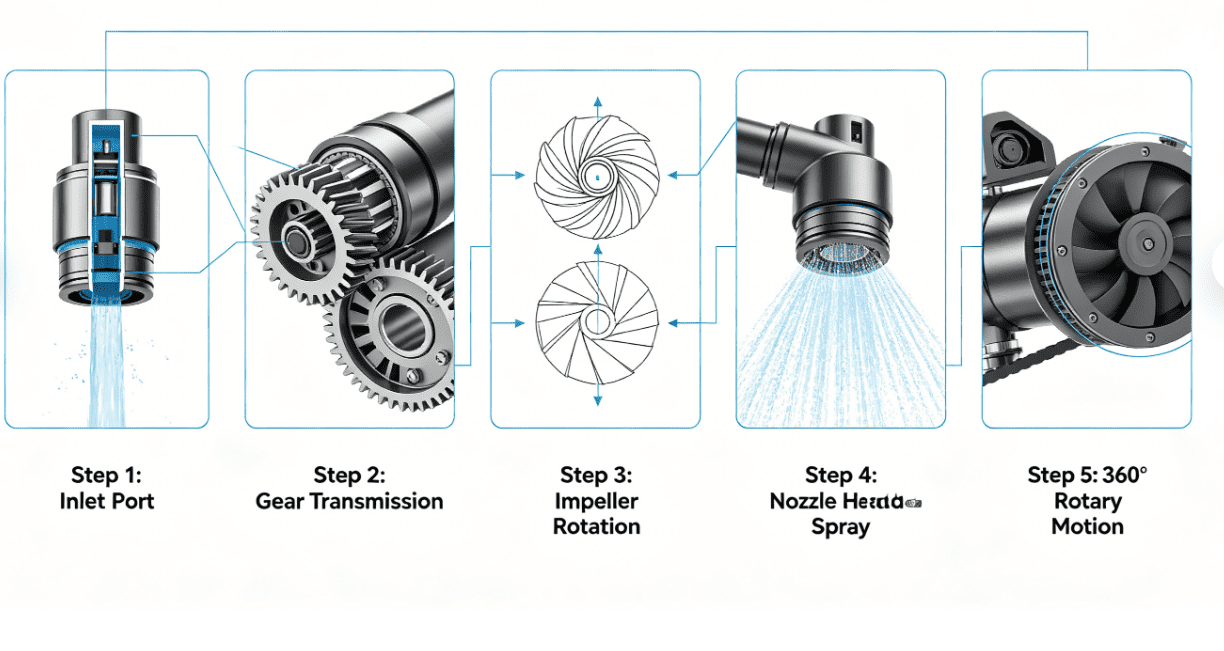
Understanding the mechanical distinctions between tank cleaning nozzle architectures enables informed specification decisions. The three primary categories—static spray balls, rotary tank cleaning nozzles, and 3D rotary jet heads—exhibit distinct performance characteristics across critical parameters including impact force distribution, coverage uniformity, and operational reliability.
Static Spray Balls (Fixed Nozzles)
Static spray ball nozzles utilize fixed orifice patterns to distribute cleaning fluid through pre-engineered spray trajectories. These devices contain no moving parts, relying entirely on fluid pressure to create cascading rinse effects. Analysis indicates they perform optimally in small vessels (≤3-5 meter diameter) with light soil loads where mechanical impact force requirements remain minimal.
Rotary Tank Cleaning Nozzles
Rotary tank cleaning nozzles introduce controlled rotation through fluid-driven turbines or gear mechanisms, concentrating cleaning energy into discrete high-velocity jets rather than distributed mist patterns. This mechanical action increases impact force by 300-500% compared to static alternatives while reducing total flow requirements by 40-60% .
3D Rotary Jet Heads
For large-scale vessels (≥10 meter diameter) or complex geometries containing internal obstructions, 3D rotary tank cleaning nozzles provide multi-axis rotation patterns that eliminate shadow areas. These precision-engineered devices utilize gear-driven indexing to ensure complete surface contact, with some models delivering throw distances up to 40 feet at operating pressures of 200-300 PSI.
| Performance Parameter | Static Spray Balls | Rotary Tank Cleaning Nozzles | 3D Rotary Jet Heads |
|---|---|---|---|
| Impact Force (PSI equivalent) | 15-30 PSI | 100-150 PSI | 200-300 PSI |
| Maximum Effective Diameter | 3-5 meters | 3-10 meters | 10-20+ meters |
| Water Consumption Rate | High (unoptimized flow) | Moderate (40% reduction) | Low (optimized trajectory) |
| Cleaning Cycle Duration | 45-90 minutes | 15-30 minutes | 8-15 minutes |
| Maintenance Requirements | Minimal (no moving parts) | Quarterly inspection | Monthly bearing checks |
| Best Application | Light rinsing, small tanks | General CIP systems | Heavy residues, large vessels |
When evaluating Tank Cleaning Nozzles for Industrial Applications, consider that material specification significantly affects longevity. Standard 316 stainless steel construction handles most food-grade and chemical applications, while Hastelloy C-276 or titanium alloys become necessary for highly corrosive environments involving concentrated acids or chloride-rich media.
"Material compatibility failures account for 35% of premature nozzle replacements in chemical processing facilities. Specifying the correct alloy grade based on cleaning media pH and chloride content extends service life from 12-18 months to 5-7 years in aggressive applications."
— Chemical Processing Equipment Standards Committee, Materials Selection Guidelines
3. How to Select and Install the Right Tank Cleaning Nozzle
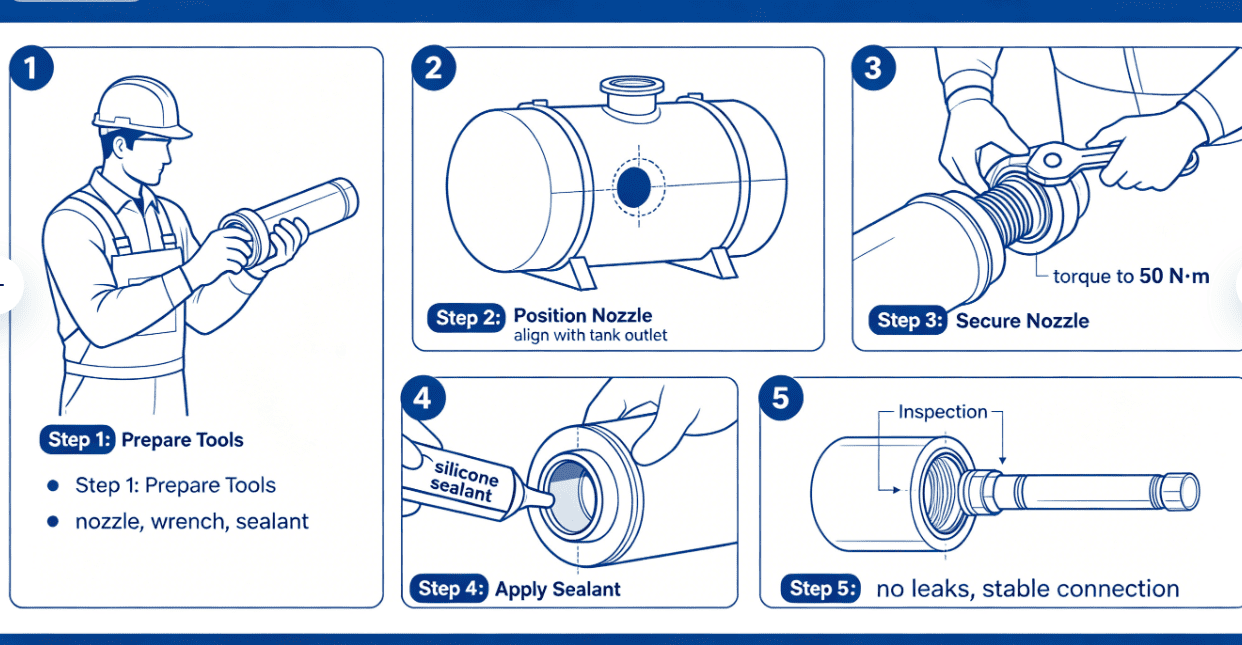
Specifying optimal tank cleaning nozzles requires systematic analysis of vessel geometry, soil characteristics, and operational constraints. Data shows that proper selection methodology improves cleaning effectiveness by 65% while reducing utility consumption by 55% compared to specification-by-guess approaches.
Step 1: Analyze Vessel Geometry and Soil Load
Measure tank diameter, height, and identify internal obstructions such as agitators, baffles, or heating coils. Document residue characteristics—viscosity, adhesion strength, and chemical composition determine required impact force. Heavy polymerized residues demand high-pressure rotary tank cleaning nozzles operating at 150+ PSI, while light particulates require only rinse-type static spray balls.
Step 2: Calculate Flow Rate and Pressure Requirements
Determine cleaning fluid availability in terms of pressure (Bar/PSI) and volume (GPM/L/min). Rotary tank cleaning nozzles typically require 3-7 Bar (45-100 PSI) minimum pressure to initiate rotation, with optimal performance occurring at 10-15 Bar (150-220 PSI). Flow rate calculations must account for total vessel surface area; industry standards recommend 0.2-0.4 gallons per minute per square meter of internal surface.
Step 3: Verify Material and Hygiene Standards
For pharmaceutical and food applications, specify 316L stainless steel with surface finishes meeting 3A or ASME BPE standards. Verify FDA compliance documentation and ensure self-draining designs that prevent bacterial harborage areas. In chemical processing, validate elastomer compatibility with cleaning solvents and process media.
Step 4: Determine Mounting Configuration
Standard mounting options include:
- Top-center entry: Optimal for cylindrical tanks, provides maximum spray radius
- Offset/top entry: Accommodates agitator shafts while maintaining coverage
- Side-entry retractable: Enables cleaning of large vessels with multiple nozzle stations
- Telescopic CIP nozzles: Retract flush with vessel wall during operation, extend during cleaning
Step 5: Validate Coverage Patterns
Conduct riboflavin testing or similar validation protocols to verify complete surface contact. Install temporary spray devices and operate through complete cycles, inspecting vessel surfaces with UV light to identify shadow areas or insufficient coverage zones. Adjust nozzle positioning or add supplementary devices until 100% surface contact is achieved.
| Selection Factor | Specification Guideline | Common Mistakes to Avoid |
|---|---|---|
| Tank Diameter | Nozzle throw radius ≥ 1.2x tank radius | Underspecifying for diameter, creating shadow zones |
| Pressure Availability | System pressure ≥ 1.5x nozzle minimum requirement | Ignoring pressure losses in long supply lines |
| Temperature Range | Specify materials rated for 20°C above maximum cleaning temp | Using standard seals in steam-in-place applications |
| Cleaning Validation | Riboflavin test or ATP swabbing verification | Skipping validation in FDA-regulated environments |
| Maintenance Access | Verify retrieval path without vessel entry | Installing without considering future bearing replacement |
"The most expensive tank cleaning nozzle is the one that doesn't solve your cleaning problem. We've documented cases where a $200 static spray ball outperformed a $3,000 rotary system because the specification matched actual process requirements rather than assumed worst-case scenarios."
— Processing Magazine, 2024 Equipment Selection Study
4. Industry Applications and Real-World Performance Data
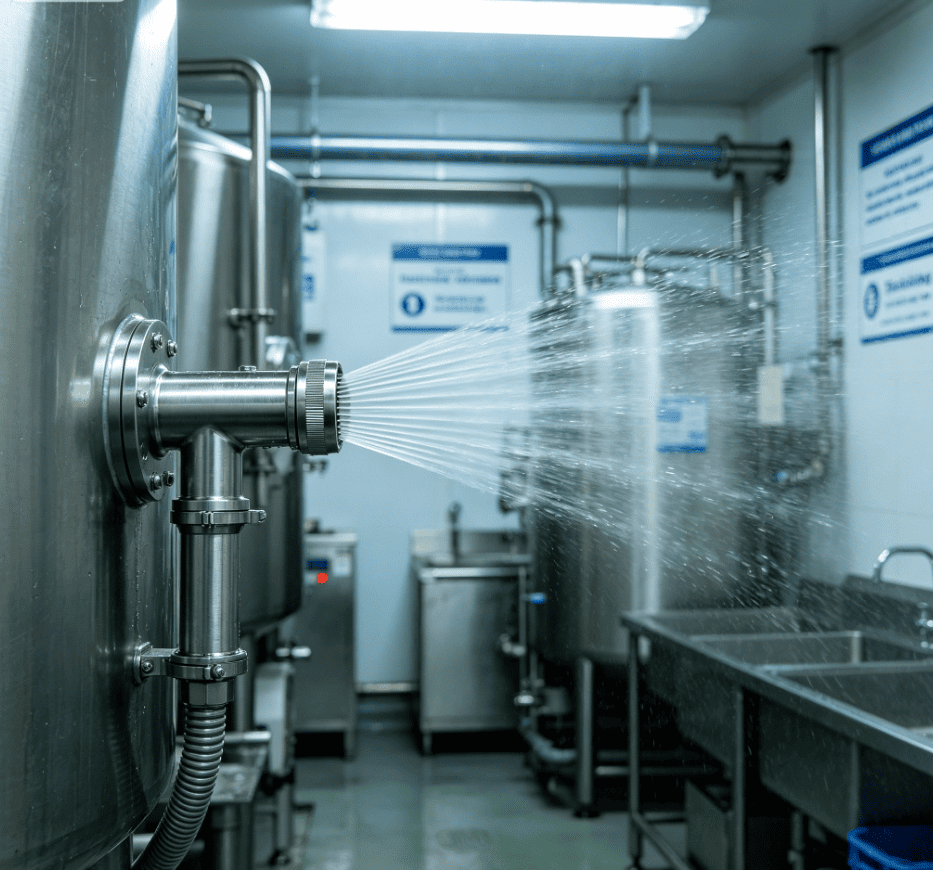
Different industrial sectors present unique cleaning challenges that demand tailored tank cleaning nozzle specifications. Field data from 2024 implementations demonstrates measurable performance improvements across diverse processing environments.
Food and Beverage Processing
Dairy, brewing, and processed food facilities utilize tank cleaning nozzles for CIP (Clean-in-Place) systems that sanitize mixing vessels, fermentation tanks, and storage silos. Testing in a major dairy processing facility revealed that upgrading to high-impact rotary tank cleaning nozzles reduced cleaning cycle times from 90 minutes to 18 minutes while decreasing water consumption by 62% and chemical usage by 45%.
Key requirements in this sector include:
- 3A sanitary certification and FDA-compliant materials
- Self-draining designs preventing allergen harborage
- Validation documentation supporting HACCP protocols
- Rapid changeover capabilities enabling production flexibility
Pharmaceutical and Biotech Manufacturing
Pharmaceutical tank cleaning demands absolute reproducibility and validation documentation. Static spray balls remain prevalent in WFI (Water for Injection) storage and buffer preparation tanks, while rotary tank cleaning nozzles handle active pharmaceutical ingredient (API) reactors and crystallization vessels.
Performance data indicates that properly specified nozzle systems achieve:
- Reduction in cleaning validation failures from 5.2% to 0.3%
- 70% decrease in manual intervention requirements
- Consistent riboflavin test results supporting regulatory submissions
- Integration with automated CIP skid control systems
Chemical and Petrochemical Processing
Chemical reactors, polymerization vessels, and storage tanks present the most demanding tank cleaning nozzle applications due to hardened residues and hazardous media. High-pressure rotary jet heads operating at 250-300 PSI demonstrate particular effectiveness in removing baked-on polymer films and crystallized chemical deposits.
A petrochemical facility reported 85% reduction in confined space entries after implementing automated tank cleaning nozzle systems for routine maintenance cycles. Additionally, mechanical cleaning action reduced solvent consumption by $120,000 annually compared to previous chemical-soak methods.
Brewing and Distillation
Breweries require tank cleaning nozzles capable of removing protein soils, hop resins, and beerstone deposits without damaging passive oxide layers on stainless steel vessels. The conical geometry of fermentation tanks demands specific nozzle positioning to ensure complete cone surface coverage.
Data from craft brewing implementations shows:
- 55% reduction in water usage per cleaning cycle
- Complete elimination of manual scrubbing for standard fermenters
- Consistent ATP bioluminescence readings below 10 RLU (Relative Light Units)
- Integration with existing CIP pump capacity without infrastructure upgrades
5. Frequently Asked Questions About Tank Cleaning Nozzles
How do I determine if I need a static spray ball or a rotary tank cleaning nozzle?
Analyze your residue characteristics and vessel geometry. Static spray balls suffice for water-soluble, light residues in tanks under 3 meters diameter where mechanical impact is unnecessary. Rotary tank cleaning nozzles become essential when dealing with viscous, adherent, or polymerized residues, or when tank diameters exceed 3-5 meters. Testing reveals that rotary devices provide 4-6x greater impact force than static alternatives, making them necessary for heavy soil loads despite higher initial cost .
What pressure range is required for effective tank cleaning nozzle operation?
Minimum operational pressure depends on nozzle type and soil severity. Static spray balls function at 1-3 Bar (15-45 PSI), while rotary tank cleaning nozzles require 5-7 Bar (75-100 PSI) minimum to initiate rotation mechanisms. High-pressure rotary jet heads demand 10-20 Bar (150-300 PSI) for optimal performance. Data indicates that increasing pressure from 5 Bar to 10 Bar improves cleaning time efficiency by 40-60% for most industrial applications, though diminishing returns appear above 15 Bar for standard residues.
Can tank cleaning nozzles handle high-temperature steam-in-place (SIP) cycles?
Material specification determines temperature tolerance. Standard 316 stainless steel tank cleaning nozzles with PTFE seals typically withstand temperatures up to 95°C (203°F). For SIP applications involving steam at 121°C (250°F), specify high-temperature variants with Viton or Kalrez seals and bearing materials rated for continuous high-temperature exposure. Verify manufacturer specifications, as prolonged steam exposure above material limits causes seal degradation and bearing failure within 50-100 cycles.
How do I calculate the correct number of tank cleaning nozzles for large vessels?
Base calculations on spray throw distance and pattern overlap. For cylindrical tanks, a single top-center mounted rotary tank cleaning nozzle typically covers 8-12 meter diameter depending on pressure and nozzle specification. Tanks exceeding this diameter require multiple devices positioned to ensure 20-30% pattern overlap at the equatorial plane. For spherical or irregular vessels, computational fluid dynamics (CFD) modeling or riboflavin testing validates nozzle quantity and positioning before final installation.
What maintenance schedule is recommended for rotary tank cleaning nozzles?
Preventive maintenance intervals vary by duty cycle and media abrasiveness. In standard food-grade applications with non-abrasive cleaning agents, inspect rotary tank cleaning nozzles quarterly for bearing smoothness and seal integrity. High-abrasive environments (mineral processing, catalyst handling) require monthly inspection of wear surfaces. Replace bearings when rotation becomes erratic or when flow rate increases 15% above baseline, indicating orifice wear. Document all maintenance in validation logs for regulated industries.
6. Conclusion and Next Steps
Tank cleaning nozzles represent a critical technology for modern industrial processing, delivering measurable improvements in safety, efficiency, and regulatory compliance. Analysis of field implementations across food, pharmaceutical, and chemical sectors consistently demonstrates 50-85% reductions in cleaning cycle times and 30-60% decreases in utility consumption when properly specified systems replace manual cleaning methods.
The engineering principles governing tank cleaning nozzle selection—impact force requirements, spray pattern dynamics, and material compatibility—demand systematic analysis rather than guesswork. Facilities that invest in proper specification methodologies, including riboflavin validation and CFD modeling where appropriate, achieve superior long-term operational outcomes compared to those making selections based solely on initial cost considerations.
For operations currently relying on manual cleaning methods or outdated fixed-spray systems, upgrading to modern rotary tank cleaning nozzles presents compelling ROI through downtime reduction, labor cost elimination, and enhanced safety profiles. The transition to automated CIP-compatible nozzle systems positions facilities for increasingly stringent regulatory environments while supporting sustainability initiatives through water and chemical conservation.
Ready to optimize your tank cleaning operations? Begin by auditing your current cleaning cycle times, utility consumption, and safety incident rates. Document residue characteristics and vessel geometries, then consult with specialized nozzle manufacturers to validate specifications for your specific application requirements. The investment in engineered tank cleaning solutions pays dividends through enhanced operational reliability and reduced total cost of ownership.