



Industrial Spray Technology in Offshore Applications: Complete Guide to Marine Coating Systems
Offshore environments present some of the harshest conditions for industrial equipment. Salt spray, UV exposure, extreme temperatures, and constant humidity create a perfect storm for corrosion and degradation. Industrial spray technology has emerged as the frontline defense, protecting billions of dollars worth of offshore infrastructure from oil platforms to wind turbines.
This comprehensive guide explores how advanced spray coating systems are revolutionizing offshore asset protection, extending equipment life from years to decades while reducing maintenance costs by up to 70%.
Table of Contents
- 1. 1. Understanding Industrial Spray Technology for Offshore Use
- 2. 2. Types of Spray Coating Technologies
- 2.1. Thermal Spray Technologies
- 2.2. Cold Spray Technology
- 2.3. Electrostatic Spray Application
- 3. 3. Critical Applications in Offshore Environments
- 3.1. Oil and Gas Platform Protection
- 3.2. Offshore Wind Turbine Systems
- 3.3. Subsea Pipeline Coating
- 4. 4. Material Selection and Coating Performance
- 4.1. Metallic Coatings
- 4.2. Organic Coating Systems
- 5. 5. Advanced Application Methods
- 5.1. Automated Spray Systems
- 5.2. Airless Spray Technology
- 5.3. Plural Component Spray
- 5.4. Surface Preparation Integration
- 6. 6. Corrosion Protection Strategies
- 6.1. Barrier Protection
- 6.2. Cathodic Protection
- 6.3. Impressed Current Systems
- 7. 7. Maintenance and Lifecycle Management
- 7.1. Inspection Protocols
- 7.2. Predictive Maintenance
- 7.3. Repair and Restoration
- 8. 8. Industry 4.0 and Future Trends
- 8.1. Smart Coating Technologies
- 8.2. Automated Application Systems
- 8.3. Sustainable Technologies
- 9. 9. Best Practices and Implementation
- 9.1. Environmental Control
- 9.2. Quality Assurance
- 9.3. Specification Compliance
- 9.4. Training and Certification
- 10. Conclusion
1. Understanding Industrial Spray Technology for Offshore Use
Industrial spray technology has transformed from basic paint application to sophisticated coating systems that protect offshore assets worth billions. The offshore sector encompasses oil and gas platforms, wind turbines, marine vessels, subsea pipelines, and floating production facilities—all operating in environments that accelerate material degradation.
The core challenge in offshore applications is the combination of corrosive agents. Salt-laden wind carries chloride ions that penetrate protective barriers, UV radiation breaks down polymer chains in coatings, temperature fluctuations cause expansion and contraction stress, and humidity promotes electrochemical corrosion. Traditional protective methods often fail within 4-6 years, but modern spray technologies now deliver 25+ years of protection.
The economic impact is substantial. According to industry research, the thermal spray processing services market reached $10.77 billion in 2025 and is projected to grow to $16.01 billion by 2032, driven primarily by offshore infrastructure protection needs. For offshore wind foundations alone, the coating market is expected to expand from $1.72 billion in 2025 to $3.37 billion by 2032.
Key performance requirements for offshore spray coatings:
- Corrosion resistance in C5-M high-corrosivity marine environments
- Adhesion strength exceeding 10 MPa under wet conditions
- Flexibility to accommodate structural movement and vibration
- UV stability with minimal color change or chalking
- Abrasion resistance against airborne particles and debris
- Chemical resistance to hydrocarbons, drilling fluids, and cleaning agents
Modern spray technologies achieve these requirements through advanced atomization control, precise particle deposition, and multi-layer coating systems that provide both barrier protection and sacrificial corrosion resistance.
2. Types of Spray Coating Technologies
The offshore industry utilizes several distinct spray coating technologies, each optimized for specific applications and operating conditions.
Thermal Spray Technologies
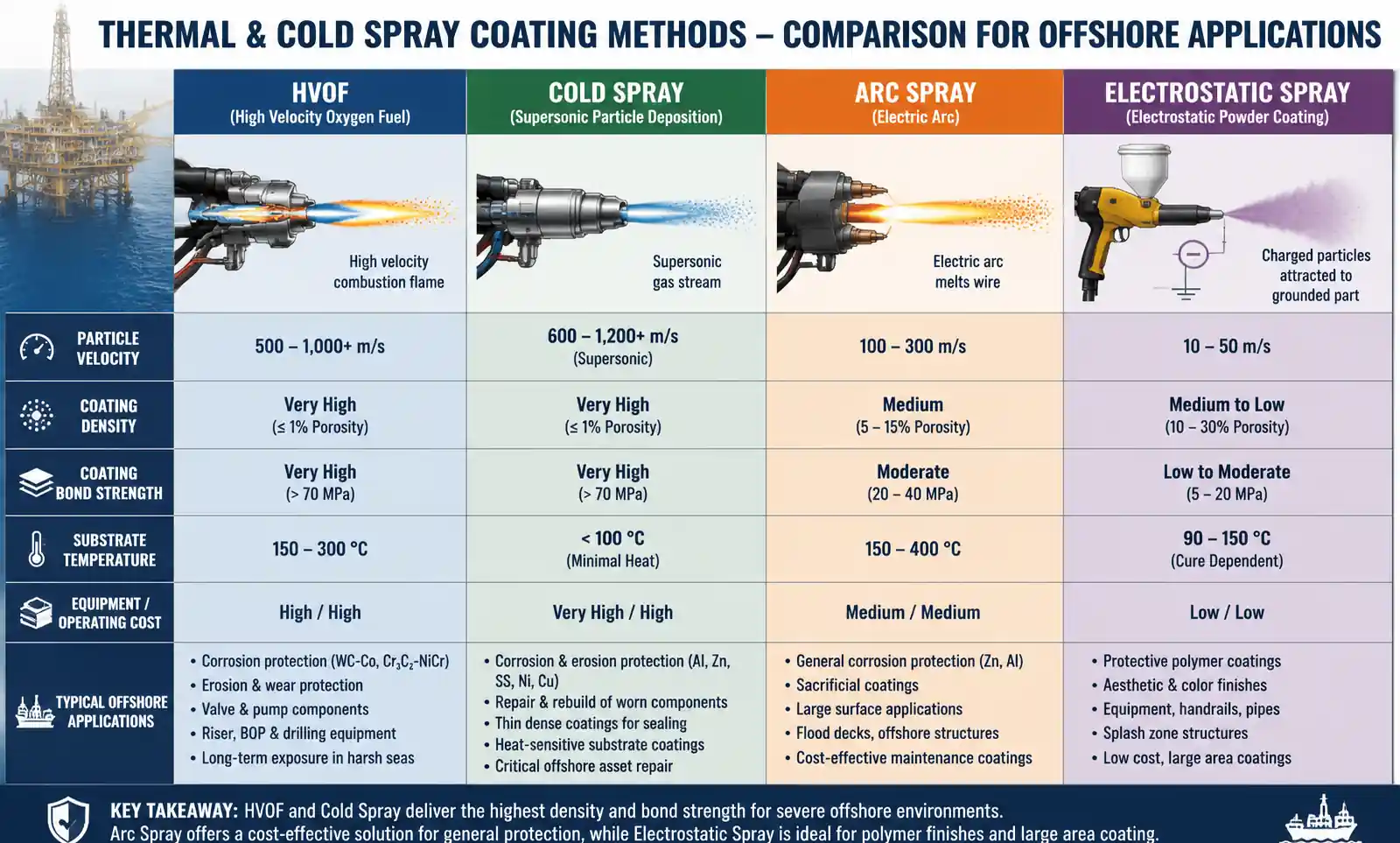
High-Velocity Oxy-Fuel (HVOF) Spraying propels coating particles at supersonic speeds (up to 2000 m/s), creating dense, well-bonded coatings with minimal oxidation. HVOF excels for carbide coatings on pump components and wear-resistant surfaces exposed to abrasive slurries. The high particle velocity produces coatings with porosity below 1% and bond strengths exceeding 70 MPa.
Thermal Sprayed Aluminum (TSA) has become the gold standard for offshore structural protection. Companies like Metallisation use flame spray equipment to apply aluminum coatings that provide cathodic protection to steel substrates. TSA coatings can extend platform life by 30+ years and eliminate the need for frequent repainting cycles. The process melts aluminum wire and propels molten droplets onto prepared steel surfaces, creating a metallurgically bonded protective layer.
Arc Spray Technology uses an electric arc between two consumable wire electrodes to melt coating material. Compressed air atomizes and propels the molten material onto substrates. Arc spray offers high deposition rates (up to 25 kg/hour) and is cost-effective for large structural elements like wind turbine towers and platform legs.
Cold Spray Technology
Cold spray represents a paradigm shift in coating application. Rather than melting materials, it accelerates solid particles to 500-1200 m/s using supersonic gas flow. Upon impact, particles undergo plastic deformation and bond mechanically to the substrate without oxidation or phase changes.
This technology is revolutionizing offshore wind turbine maintenance through projects like CLEERBlade, which uses cold spray to repair leading edge erosion on turbine blades. The process produces coatings with superior bond strength, no thermal stress, and the ability to deposit oxygen-sensitive materials that would oxidize in traditional thermal processes.
Electrostatic Spray Application
Recent innovations from PPG and other coating manufacturers have brought electrostatic spray technology (ESTA) to marine applications. The system negatively charges paint particles at the spray gun nozzle while the steel substrate is grounded, creating electrostatic attraction that draws coating material onto surfaces.
ESTA delivers up to 70% transfer efficiency compared to 40-50% for conventional airless spray, dramatically reducing overspray and VOC emissions. The technology produces more uniform coating thickness and can reach complex geometries that challenge traditional application methods.
3. Critical Applications in Offshore Environments
Spray coating technology serves multiple critical functions across offshore operations, each with unique performance requirements.
Oil and Gas Platform Protection
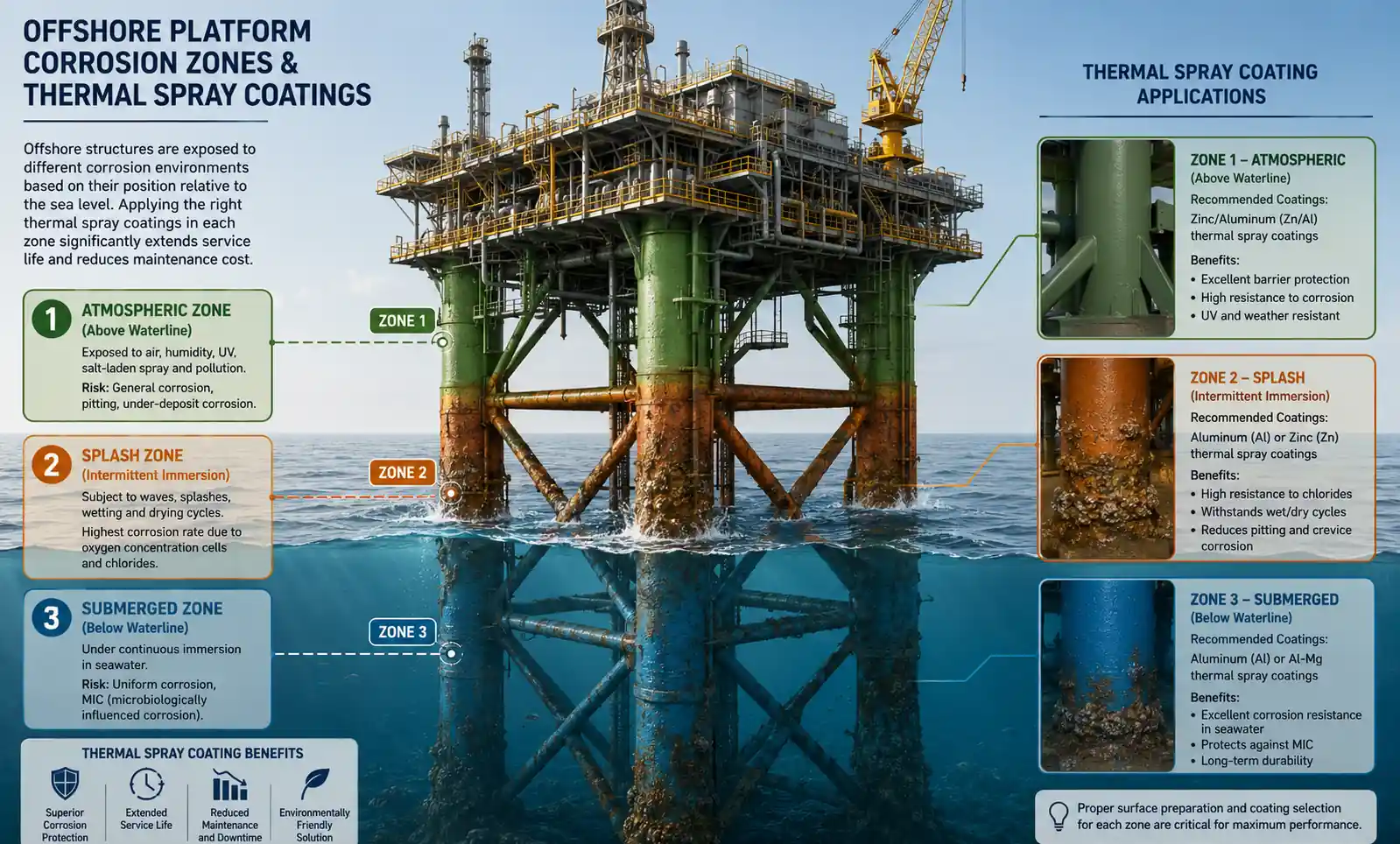
Offshore oil platforms represent some of the most challenging coating environments. Structures experience three distinct corrosion zones: atmospheric (above waterline), splash zone (intermittent immersion), and submerged zone (continuous immersion).
Thermal sprayed aluminum has proven exceptionally effective for atmospheric and splash zone protection. The aluminum coating acts as a sacrificial anode, corroding preferentially to protect the underlying steel. Even when damaged, the coating continues providing galvanic protection to exposed steel areas within its electrical field.
Platform topside equipment—including pipe racks, process vessels, and structural supports—benefits from high-performance epoxy and polyurethane spray coatings that resist hydrocarbon exposure and thermal cycling. Modern spray systems can apply these coatings at controlled film builds of 300-500 microns per coat, ensuring complete coverage of complex geometries.
Offshore Wind Turbine Systems
The offshore wind sector has emerged as a major consumer of advanced spray coating technology. Wind turbine towers, foundations, and transition pieces face constant salt spray and humidity, while turbine blades encounter rain erosion at velocities exceeding 300 km/h.
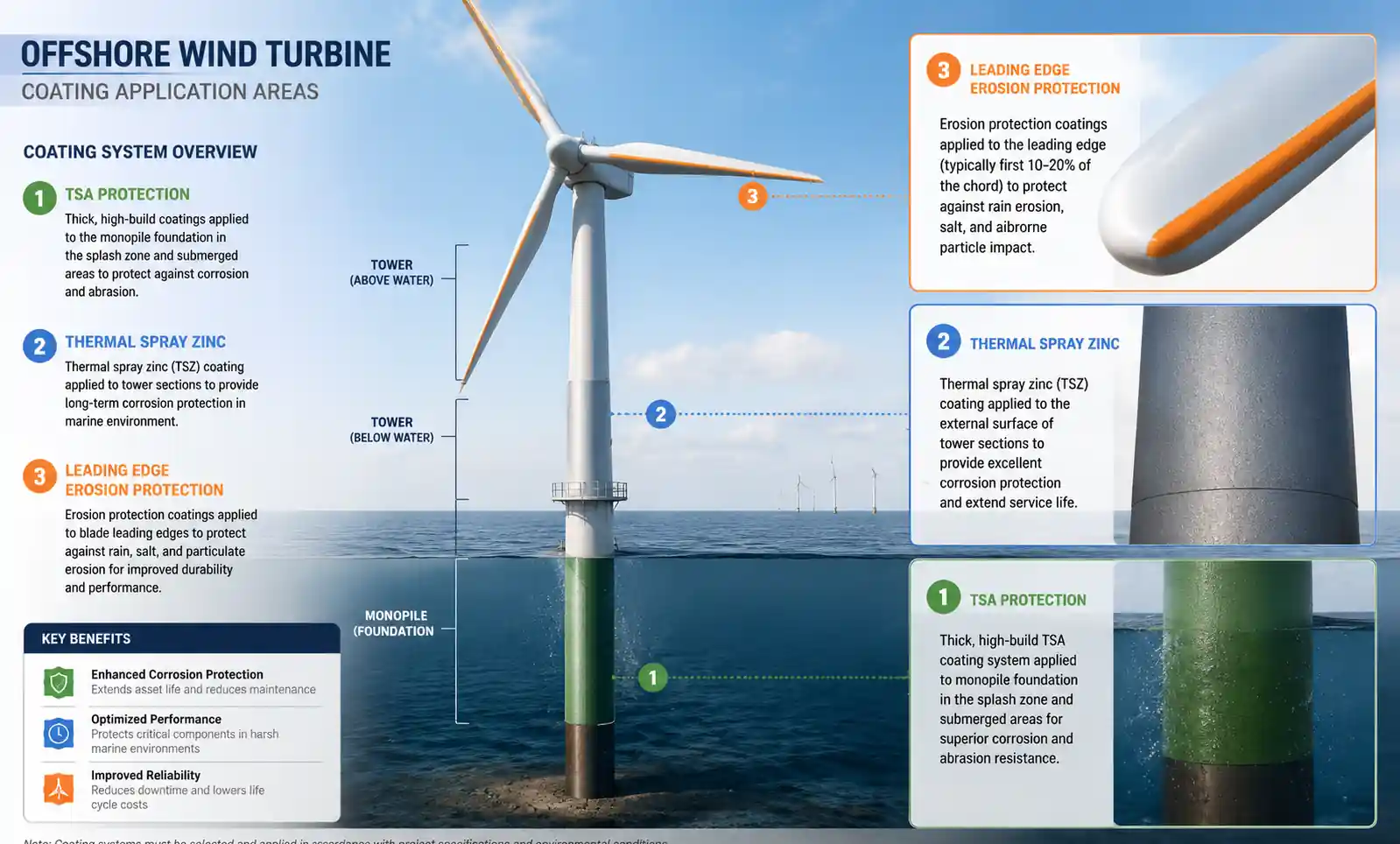
Foundation and Tower Protection: Thermal spray zinc and aluminum coatings provide 25+ years of corrosion protection without maintenance. The HVTS (High-Velocity Thermal Spray) process optimizes coating density and adhesion for these long-service-life applications.
Blade Leading Edge Protection: Rain erosion destroys unprotected blade leading edges within 2-3 years, reducing aerodynamic efficiency and power generation. Smart coating technologies now incorporate self-healing polymers that autonomously restore protective barriers after impact damage. Cold spray repairs can restore eroded leading edges offshore, eliminating the need for blade replacement and reducing maintenance costs by 60%.
Subsea Pipeline Coating
Internal and external pipeline coatings protect subsea infrastructure from corrosion, scale formation, and flow assurance issues. Spray-applied fusion-bonded epoxy (FBE) and three-layer polyethylene systems provide barrier protection, while specialized internal coatings reduce friction and prevent wax deposition.
Recent patent developments describe robotic spray systems that can apply fluorescent anti-corrosion coatings to pipeline weld joints internally, enabling subsequent UV inspection to verify coating integrity without excavation.
4. Material Selection and Coating Performance
Selecting appropriate coating materials determines long-term performance and lifecycle costs in offshore environments.
Metallic Coatings
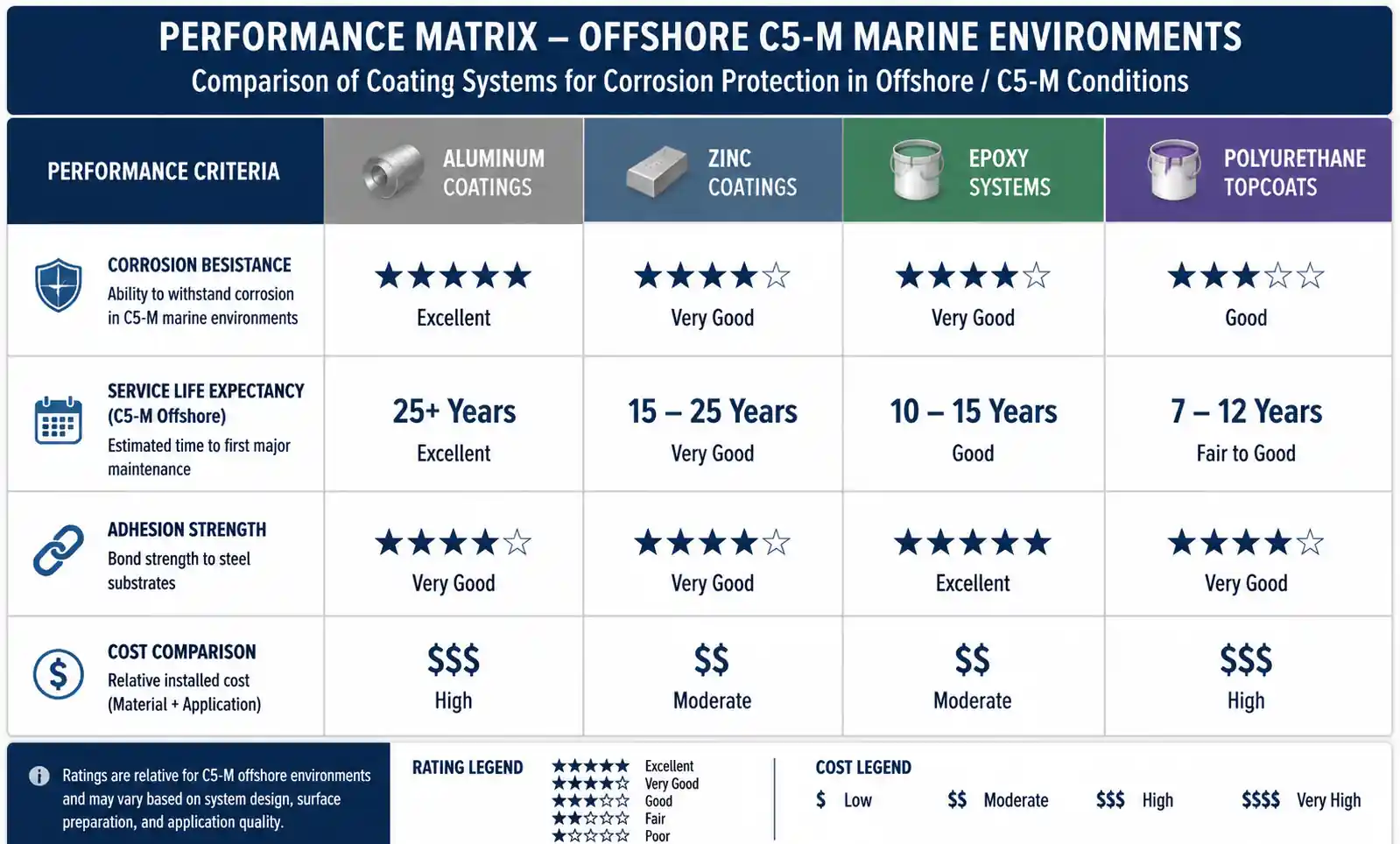
Aluminum and Zinc Coatings provide sacrificial cathodic protection. When properly applied, these coatings corrode at controlled rates, protecting steel substrates for 20-30 years. Aluminum offers superior performance in marine atmospheres due to its stable oxide layer, while zinc performs better in immersed conditions.
Coating thickness directly impacts service life. Thermal spray aluminum at 200 microns typically provides 15-20 years protection, while 300 micron applications extend life to 25+ years. The corrosion rate in marine splash zones averages 3-5 microns per year for aluminum.
Carbide and Ceramic Coatings protect against erosion and wear rather than corrosion. HVOF-sprayed tungsten carbide coatings on pump impellers and valve components extend service life by 5-10x compared to uncoated steel. These coatings maintain hardness values of 1000-1400 HV while bonding strongly to substrates.
Organic Coating Systems
Modern epoxy, polyurethane, and fluoropolymer spray coatings deliver both barrier protection and chemical resistance. High-solids and solvent-free formulations meet increasingly stringent VOC regulations while maintaining performance.
Epoxy Systems excel in chemical and water resistance, making them ideal for tank linings and splash zone protection. Two-component epoxy coatings cure through chemical cross-linking, producing tough, adherent films with excellent substrate wetting.
Polyurethane Topcoats provide UV stability and gloss retention that epoxies cannot match. Aliphatic polyurethane topcoats maintain color and gloss for 10+ years in direct sunlight, protecting underlying epoxy primer layers from UV degradation.
Performance Requirements:
- Adhesion: Minimum 5 MPa per ASTM D4541
- Impact resistance: 50 inch-pounds minimum per ASTM D2794
- Salt spray resistance: 6000+ hours per ASTM B117
- Cathodic disbondment: Less than 6mm per NACE TM0115
5. Advanced Application Methods
Application methodology significantly impacts coating performance and project economics.
Automated Spray Systems
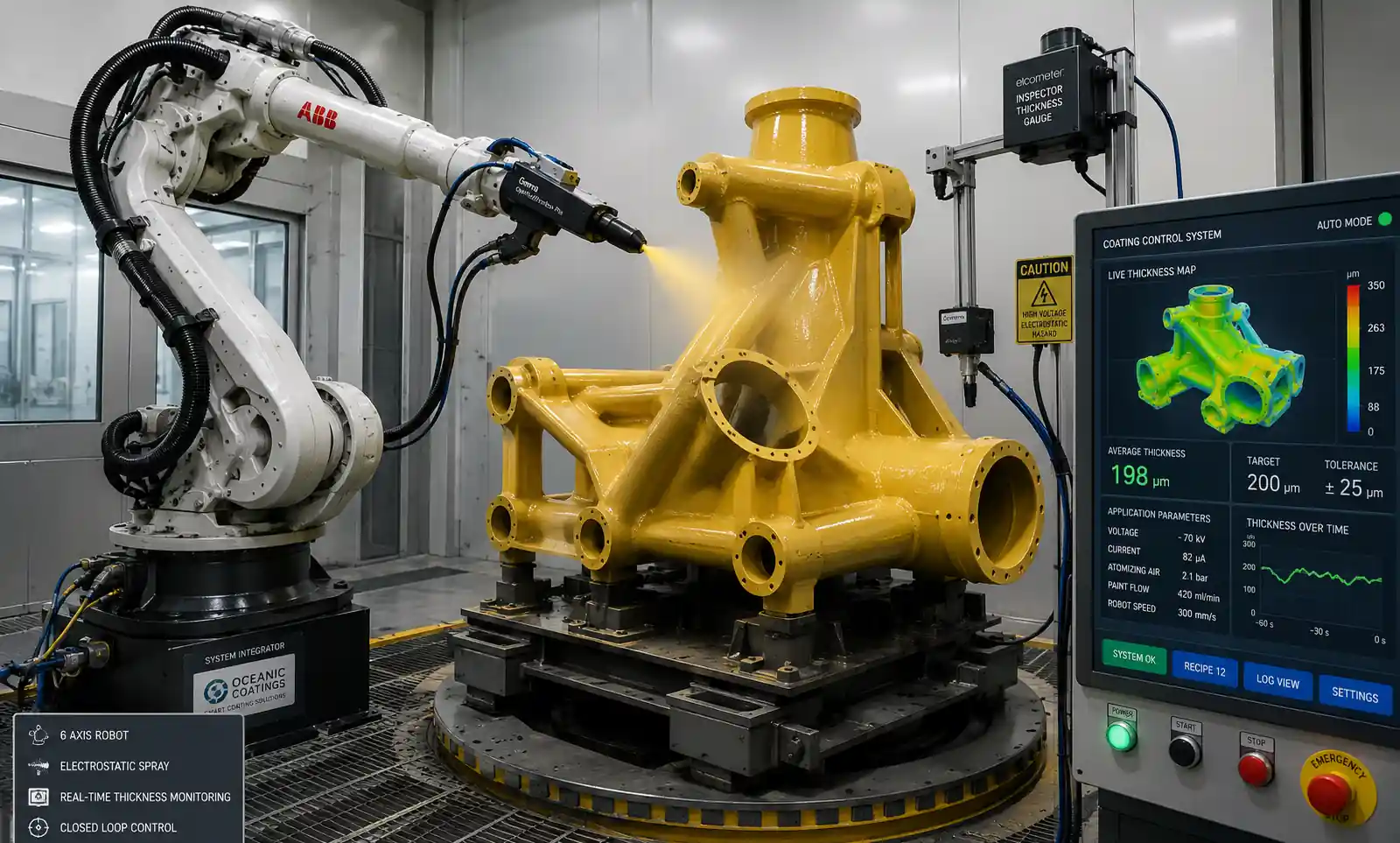
Research into ship section manufacturing demonstrates that automated spray equipment improves efficiency by 300% compared to manual application. Robotic spray systems equipped with ultrasonic thickness gauges maintain precise film builds while reducing coating waste.
These systems integrate six-axis robotic arms with electrostatic or airless spray guns, following programmed paths that ensure uniform coverage of complex geometries. Real-time thickness monitoring adjusts spray parameters automatically, maintaining target film builds of ±25 microns.
Airless Spray Technology
Airless spray remains the workhorse for large offshore structures. The technology pumps coating material at 3000-5000 PSI through a precision nozzle, producing controlled atomization without compressed air. This eliminates overspray from air turbulence and delivers high transfer efficiency in outdoor conditions.
Modern airless systems incorporate pressure feedback control and reversible spray tips that clear blockages without disassembly. Heated airless systems reduce viscosity for thick coatings, improving atomization and flow characteristics.
Plural Component Spray
Two-component coatings like epoxies and polyurethanes require precise mixing at the spray gun. Plural component systems meter and mix reactive components in controlled ratios (typically 2:1 or 4:1 by volume), delivering mixed material directly to the spray gun.
Advanced systems feature automatic mixing ratio verification, in-line solvent flushing, and temperature control to maintain optimal material properties. This technology is essential for large-scale offshore coating projects where hand mixing would be impractical.
Surface Preparation Integration
The offshore coating industry has developed integrated blast and spray systems that prepare surfaces and apply coatings in continuous operations. This approach minimizes the time between surface preparation and coating application—critical in humid marine environments where flash rusting can occur within hours.
Vacuum blast systems recover abrasive media while removing existing coatings and contaminants, achieving cleanliness standards of Sa 2.5 or Sa 3 per ISO 8501. Immediate coating application preserves surface profile and prevents contamination.
6. Corrosion Protection Strategies
Effective corrosion protection in offshore environments requires layered defense strategies that combine multiple protection mechanisms.
Barrier Protection
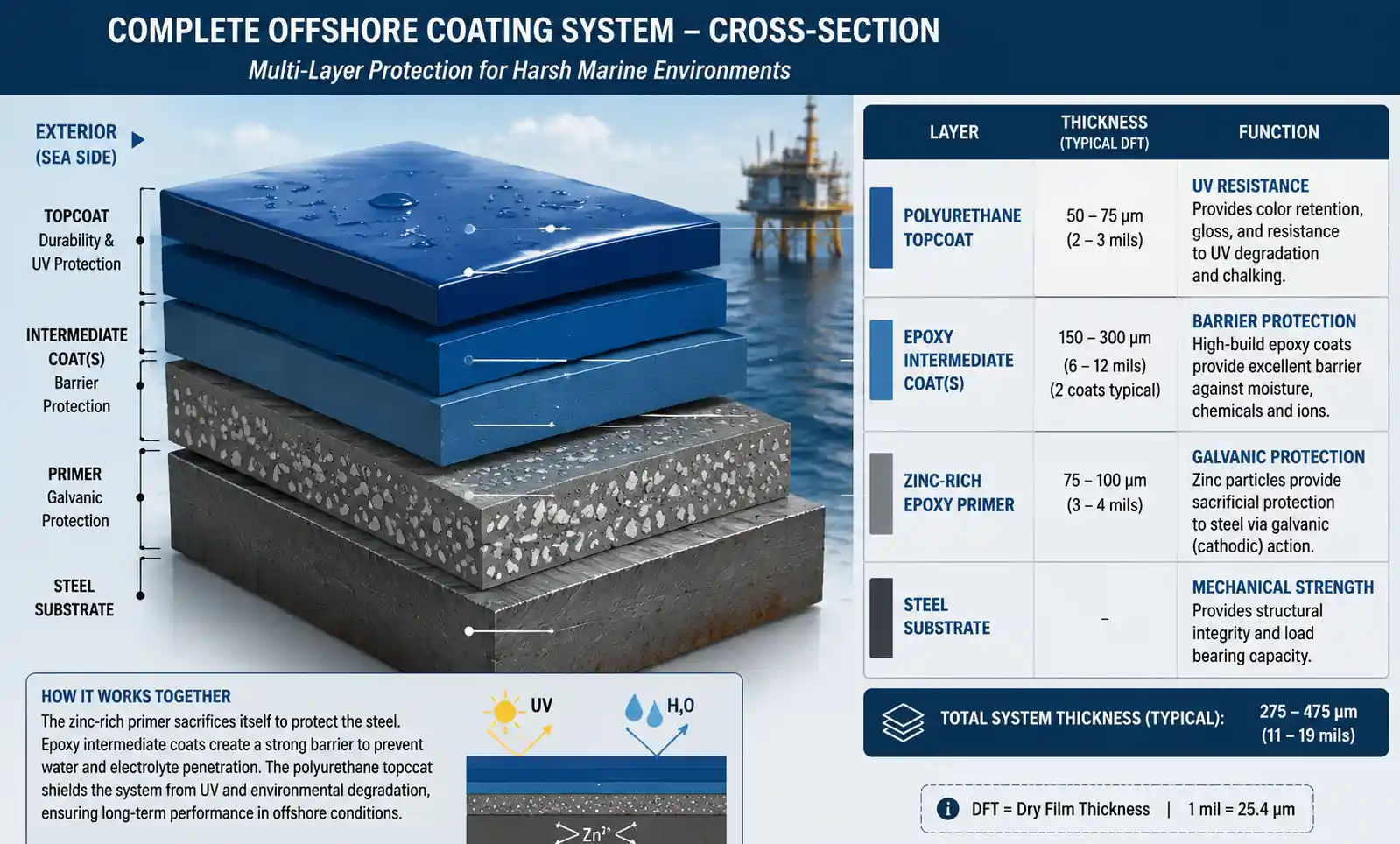
Organic coatings function primarily as barriers, isolating steel from water, oxygen, and chloride ions. Coating film integrity determines protection effectiveness—even microscopic pinholes or holidays can initiate localized corrosion.
Multi-coat systems build redundancy into barrier protection. A typical offshore system includes zinc-rich primer (providing galvanic protection), epoxy intermediate coats (barrier protection), and polyurethane topcoat (UV resistance). Total dry film thickness typically ranges from 300-600 microns depending on corrosivity category.
Cathodic Protection
Sacrificial metallic coatings provide electrochemical protection. When zinc or aluminum coatings are electrically connected to steel, they become anodic in the galvanic series and corrode preferentially. This sacrificial corrosion protects steel even when coating damage exposes the substrate.
The protective current from a thermal spray aluminum coating can protect exposed steel up to 30mm from the coating edge. This "throwing power" provides critical protection at coating defects, weld seams, and mechanical damage points.
Impressed Current Systems
Large offshore structures often combine spray coatings with impressed current cathodic protection (ICCP) systems. ICCP uses external power sources to force protective current onto steel structures, supplementing coating protection in highly corrosive splash zones and submerged areas.
Spray coatings reduce the current demand for ICCP systems by 90% compared to uncoated structures, dramatically reducing operating costs and anode consumption.
7. Maintenance and Lifecycle Management
Proactive maintenance extends coating service life and reduces total cost of ownership.
Inspection Protocols
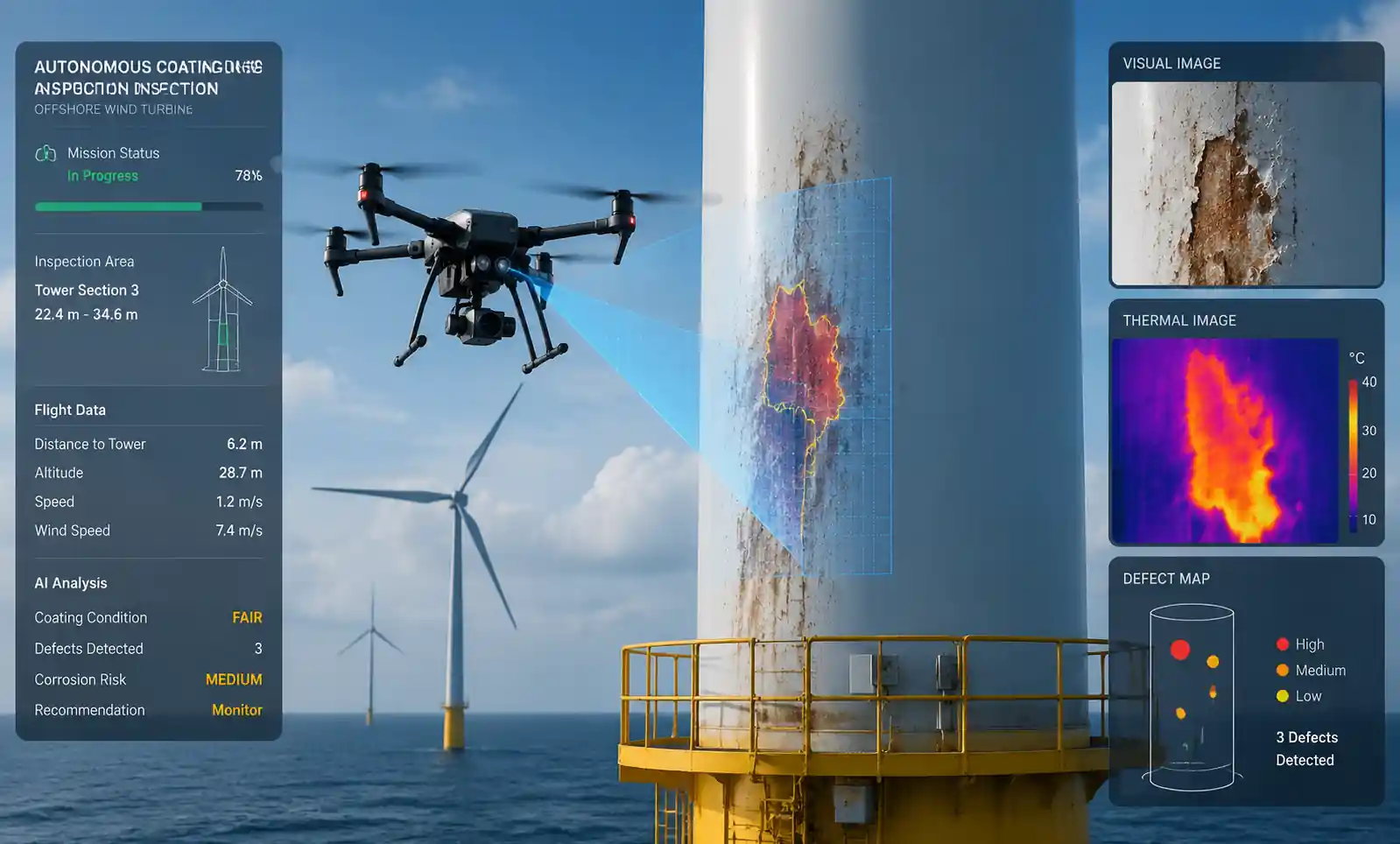
Regular coating inspection identifies degradation before failure occurs. Visual inspection detects chalking, cracking, and color change, while instrumental methods quantify remaining protection.
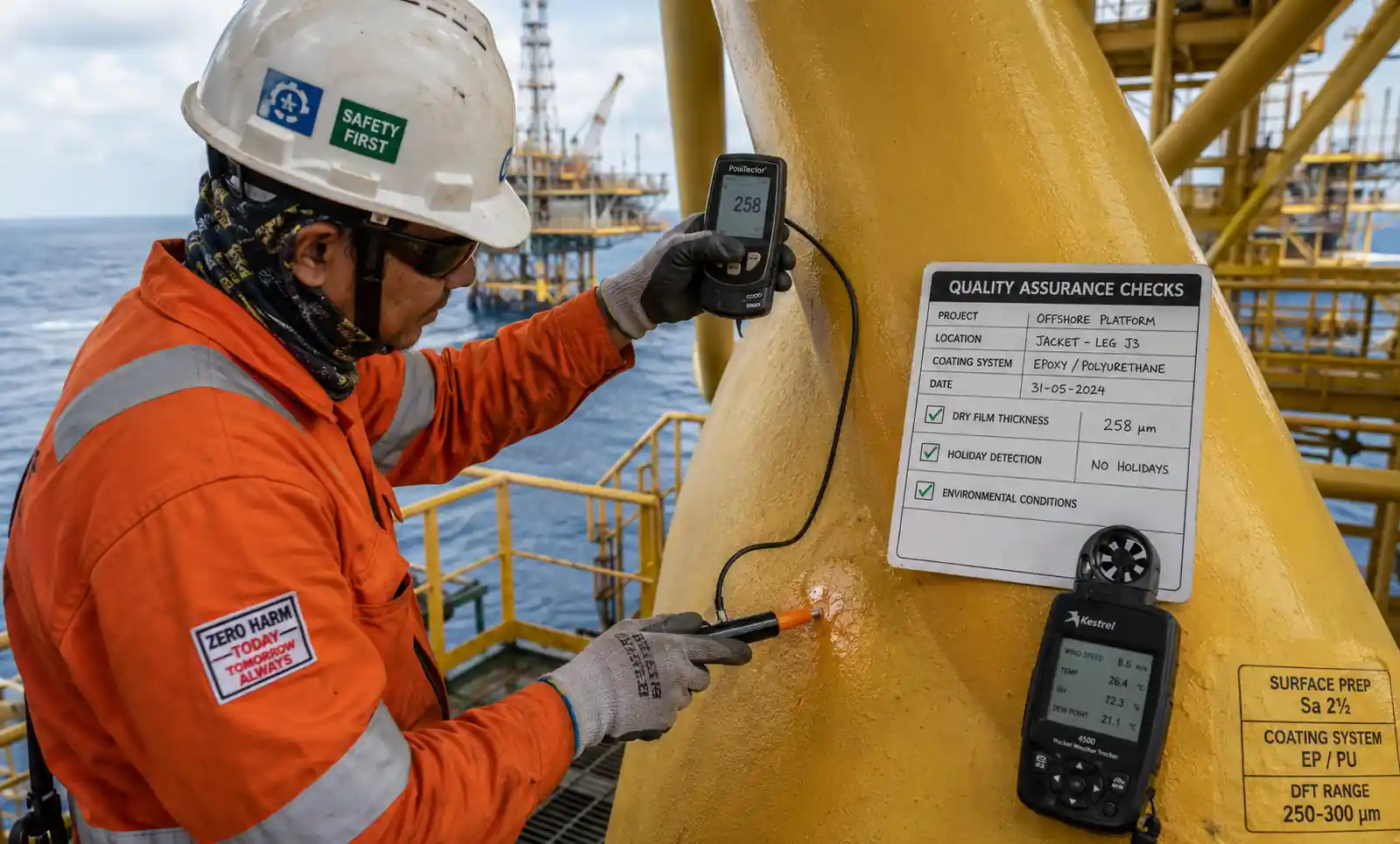
Dry film thickness (DFT) measurement using magnetic or eddy current gauges verifies coating build. Holiday detection using high-voltage pulse testers identifies pinholes and discontinuities. Adhesion testing via pull-off or cross-cut methods assesses bond strength before visible failure.
Offshore wind operators are implementing drone-based inspection systems equipped with high-resolution cameras and infrared sensors to monitor coating condition on towers and nacelles without human access requirements.
Predictive Maintenance
Advanced monitoring systems track coating performance metrics to predict remaining service life. Parameters include color and gloss changes (indicating UV degradation), surface contamination (indicating loss of anti-fouling properties), and localized corrosion (indicating barrier failure).
Machine learning algorithms analyze inspection data to identify degradation patterns and optimize maintenance timing. This shifts maintenance from fixed intervals to condition-based scheduling, reducing unnecessary work while preventing unexpected failures.
Repair and Restoration
Localized coating damage requires prompt repair to prevent corrosion propagation. Cold spray technology enables in-situ repairs without heat-affected zones or extensive surface preparation. For organic coatings, portable plural component spray systems allow offshore touch-up while maintaining proper mixing ratios and film builds.
The key to successful repairs is matching original coating properties—adhesion, flexibility, and corrosion resistance—while ensuring compatibility with aged existing coatings.
8. Industry 4.0 and Future Trends
Digital transformation is revolutionizing how offshore spray coating systems are designed, applied, and monitored.
Smart Coating Technologies
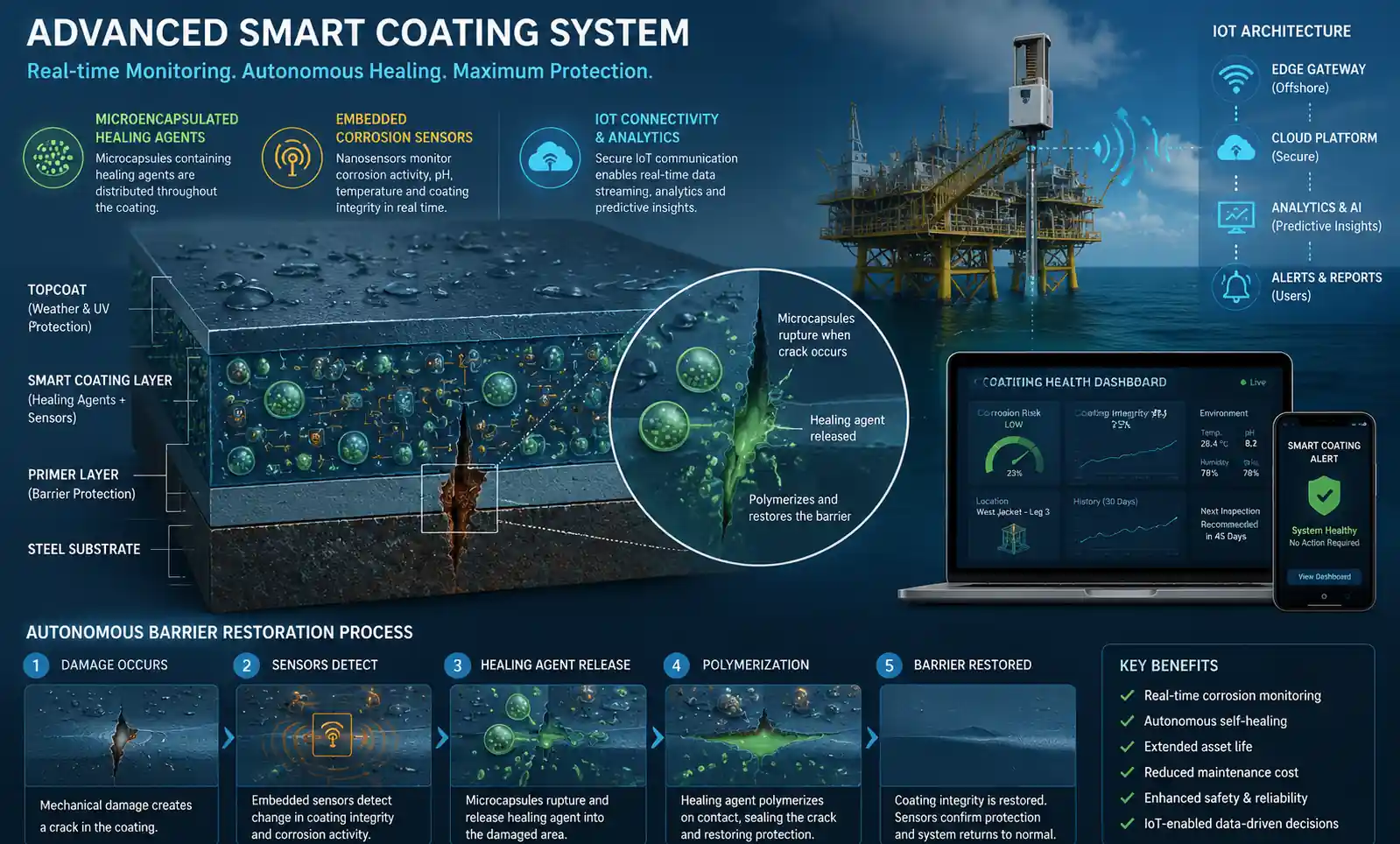
Self-healing coatings represent a paradigm shift from passive to active protection. These systems incorporate microencapsulated healing agents that release when coating damage occurs, autonomously restoring barrier properties. Research published in 2025 demonstrates self-healing polyurethane coatings that recover 85% of original mechanical properties after puncture damage.
Embedded sensors in smart coatings monitor corrosion activity, coating degradation, and environmental exposure in real-time. This data streams to predictive maintenance systems, enabling intervention before visible damage occurs.
Automated Application Systems
Industry 4.0 integration brings adaptive spray systems that adjust parameters in real-time based on environmental conditions and coating performance feedback. These systems incorporate:
- Computer vision for surface defect detection and automated path planning
- IoT sensors monitoring temperature, humidity, and material properties
- AI algorithms optimizing spray patterns for complex geometries
- Digital twins simulating coating application before physical execution
The result is consistent coating quality with minimal operator intervention, particularly valuable for large offshore structures where manual application variability impacts long-term performance.
Sustainable Technologies
Environmental regulations drive development of low-VOC and zero-VOC coating systems. Water-based epoxies and high-solids polyurethanes reduce emissions by 60-80% compared to traditional solvent-borne coatings while maintaining performance standards.
Electrostatic spray application reduces material waste from 50% to 70% transfer efficiency, cutting raw material consumption and disposal costs. Cold spray eliminates thermal energy consumption and oxidation losses associated with traditional thermal spray processes.
The coatings industry is also developing bio-based alternatives to petroleum-derived resins, with some formulations incorporating up to 40% renewable content without compromising marine durability.
9. Best Practices and Implementation
Successful offshore spray coating projects require attention to multiple critical factors beyond equipment selection.
Environmental Control
Offshore coating application faces unique environmental challenges. Wind, humidity, and temperature fluctuations impact coating cure, adhesion, and final properties. Best practices include:
Temperature Management: Apply coatings only when substrate temperature is 3°C above dew point and within material specifications (typically 5-35°C). Use heated spray equipment for low-temperature applications.
Humidity Control: Relative humidity should remain below 85% during application and cure. Temporary enclosures with dehumidification extend application windows in marine environments.
Contamination Prevention: Salt contamination causes adhesion failure even with proper surface preparation. Test surfaces with conductivity meters before coating application, achieving readings below 50 µS/cm per ISO 8502-9.
Quality Assurance
Implementing robust QA programs ensures coating performance meets design specifications:
- Document environmental conditions at application time
- Measure wet and dry film thickness at specified intervals
- Conduct adhesion testing on witness panels
- Perform holiday detection on 100% of critical surfaces
- Photograph completed work for future reference
Third-party inspection during application provides verification that procedures meet industry standards like NACE SP0188 or ISO 12944.
Specification Compliance
Offshore coating specifications typically reference ISO 12944 (corrosivity categories and coating systems) and NACE standards for specific applications. Understanding these requirements prevents costly rework:
- ISO 12944-9 addresses offshore and marine structures specifically
- NACE SP0108 covers subsea pipeline external coatings
- NORSOK M-501 provides Norwegian oil and gas industry standards
- SSPC-PA 2 outlines measurement procedures for coating thickness
Training and Certification
Offshore coating applicators require specialized training beyond standard painting skills. Organizations like NACE International (now AMPP) and FROSIO provide coating inspector certification programs. Thermal spray operators typically need manufacturer-specific training for equipment operation and safety.
Conclusion
Industrial spray technology has evolved from a simple application method to a sophisticated protection system essential for offshore asset longevity. Modern thermal spray, cold spray, and electrostatic application technologies deliver unprecedented corrosion protection, extending service life from single-digit years to multiple decades.
The convergence of advanced materials, automation, and digital monitoring creates coating systems that actively respond to environmental challenges rather than passively resisting them. As offshore energy production expands into harsher environments—deeper waters, stronger currents, more aggressive corrosion—spray coating technology will continue adapting to protect these critical assets.
Success in offshore coating applications requires integrating the right technology with proper surface preparation, environmental control, quality assurance, and lifecycle maintenance planning. Organizations that embrace these comprehensive approaches achieve dramatic reductions in maintenance costs while ensuring safe, reliable offshore operations.