



How to Choose the Right Spray Nozzle for Your Application
Selecting the wrong spray nozzle costs manufacturers thousands in wasted materials, excessive downtime, and poor product quality. After two decades optimizing spray systems across industries, I've seen operations transform simply by matching the right nozzle to their specific requirements. This guide walks you through the critical parameters that actually matter when specifying spray nozzles for industrial applications.
Table of Contents
- 1. Understanding Your Application Requirements First
- 2. Pressure Requirements and Performance Windows
- 3. Spray Angle Selection for Coverage Optimization
- 4. Material Compatibility: Beyond Corrosion Resistance
- 5. Flow Rate Calculation
- 6. Spray Pattern Quality
- 7. Industry-Specific Selection Criteria
- 8. Common Mistakes That Destroy ROI
- 9. Testing and Validation Protocol
- 10. FAQs
- 10.1. How often should I replace spray nozzles?
- 10.2. Can I use the same nozzle for different chemicals?
- 10.3. What causes uneven spray patterns?
- 10.4. How do I calculate the number of nozzles needed?
- 10.5. What's the difference between hollow cone and full cone nozzles?
- 11. Conclusion
Understanding Your Application Requirements First
Before browsing spray nozzle catalogs, define three fundamental parameters: required flow rate, target coverage area, and operational pressure range. Most selection failures stem from skipping this step.
Your flow rate determines nozzle orifice size. Coverage area dictates spray angle and mounting height. Pressure availability constrains which nozzle types will perform reliably. Document these specifications before contacting suppliers—it separates professional procurement from guesswork.
 Industrial engineer documenting spray nozzle application requirements including flow rate and pressure specifications
Pressure Requirements and Performance Windows
Every nozzle type operates within an optimal pressure window. Push below minimum pressure and spray patterns collapse. Exceed maximum ratings and you accelerate wear while wasting energy.
| Nozzle Type | Optimal Pressure Range | Typical Applications | Performance Characteristics |
|---|---|---|---|
| Full Cone Nozzles | 40-100 PSI (2.8-6.9 bar) | Gas scrubbing, quenching, dust control | Uniform droplet distribution across entire cone |
| Hollow Cone Nozzles | 30-150 PSI (2.1-10.3 bar) | Spray drying, cooling, washing | Fine atomization, ring-shaped pattern |
| Flat Fan Nozzles | 20-60 PSI (1.4-4.1 bar) | Coating, rinsing, surface treatment | Controlled width-to-height ratio |
| Air Atomizing Nozzles | 5-30 PSI liquid, 60-100 PSI air | Lubrication, humidification, coating | Ultra-fine droplets (10-50 microns) |
Pressure directly impacts droplet size. For coating applications demanding 20-micron droplets, you need either 100+ PSI hydraulic pressure or air atomization. There's no shortcut. Right-sizing the nozzle type often eliminates the need for pressure upgrades.
Spray Angle Selection for Coverage Optimization
Spray angle determines how far from the target you can mount nozzles while achieving complete coverage. The coverage diameter formula: Coverage Diameter = 2 × (Mounting Height × tan(Spray Angle/2))
Common spray angles and their applications:
-
0-25° (Narrow): Targeted cleaning, specific spot treatment, high-impact washing. Used in tank cleaning systems where concentrated force matters more than coverage.
-
25-65° (Medium): General purpose spraying, coating lines, surface rinsing. Balances coverage with droplet velocity.
-
65-120° (Wide): Humidification, large-area cooling, dust suppression. Sacrifices impact force for coverage breadth.
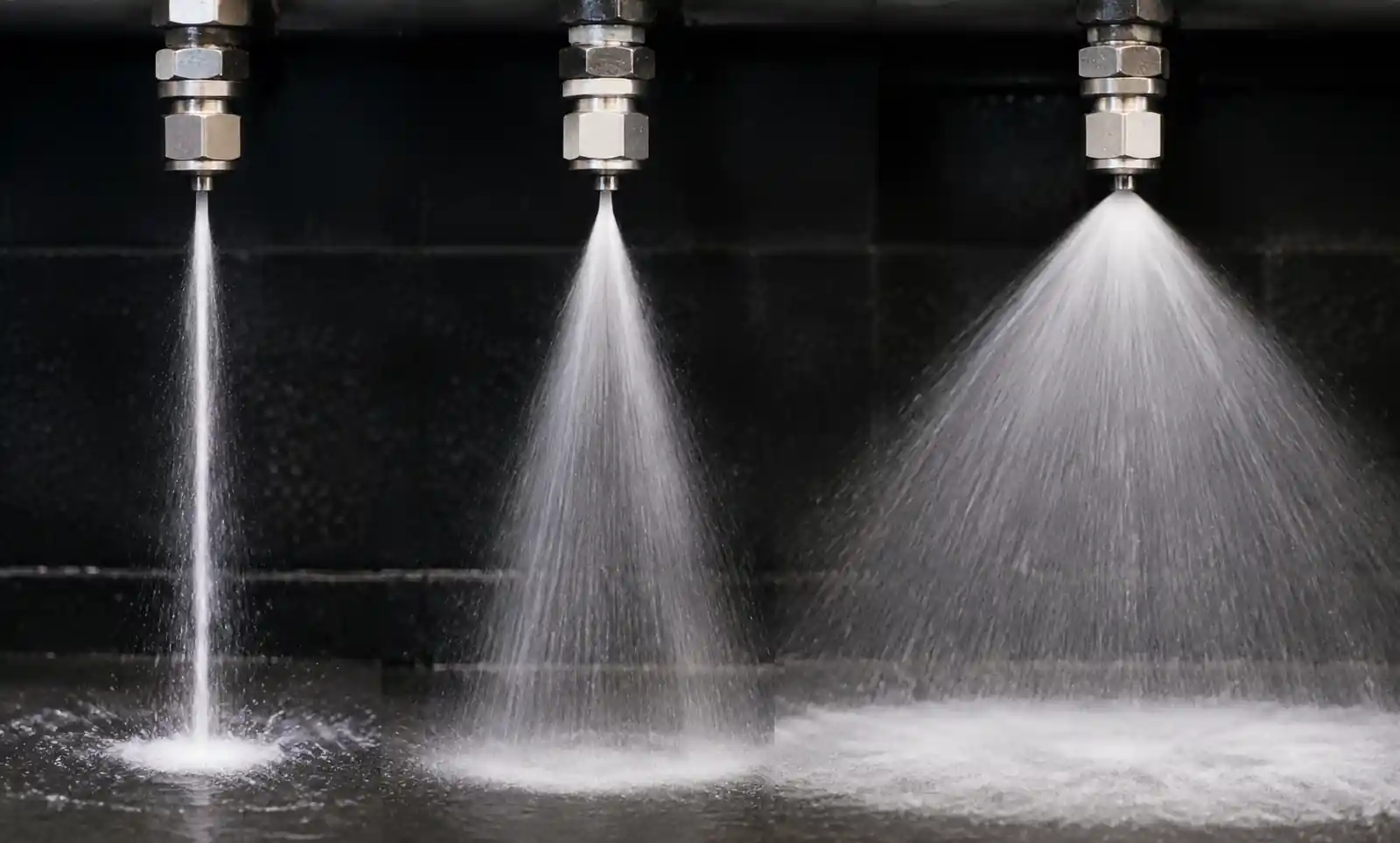 Spray nozzle demonstrating different spray angles and coverage patterns at various mounting heights
When designing systems, overlap adjacent spray patterns by 30-50% to eliminate dry spots. Space nozzles at 60-70% of their coverage diameter. This redundancy costs less than production losses from incomplete coverage.
Material Compatibility: Beyond Corrosion Resistance
Material selection involves more than chemical compatibility charts. Consider abrasion resistance, temperature limits, and cleanability requirements specific to your process.
| Material | Temperature Limit | Best For | Limitations | Relative Cost |
|---|---|---|---|---|
| Brass | 400°F (204°C) | General water service, compressed air | Poor acid resistance, moderate wear life | 1x (baseline) |
| 316 Stainless Steel | 800°F (427°C) | Chemical processing, food-grade, acidic environments | Lower abrasion resistance than hardened steel | 3-4x |
| Hardened Stainless | 600°F (316°C) | Abrasive slurries, high-wear applications | Difficult to machine, limited availability | 5-7x |
| Ceramic (Alumina) | 1800°F (982°C) | Extreme abrasion, high temperatures | Brittle, expensive, limited geometries | 8-12x |
| PTFE/Plastic | 200°F (93°C) | Strong acids/bases, cost-sensitive applications | Low pressure ratings, poor abrasion resistance | 0.5-1x |
In water treatment, 316 stainless steel proves most cost-effective despite higher initial investment. The material resists chlorine and chloramine corrosion that destroys brass nozzles within months. Calculate total cost over 3-5 years, not just purchase price.
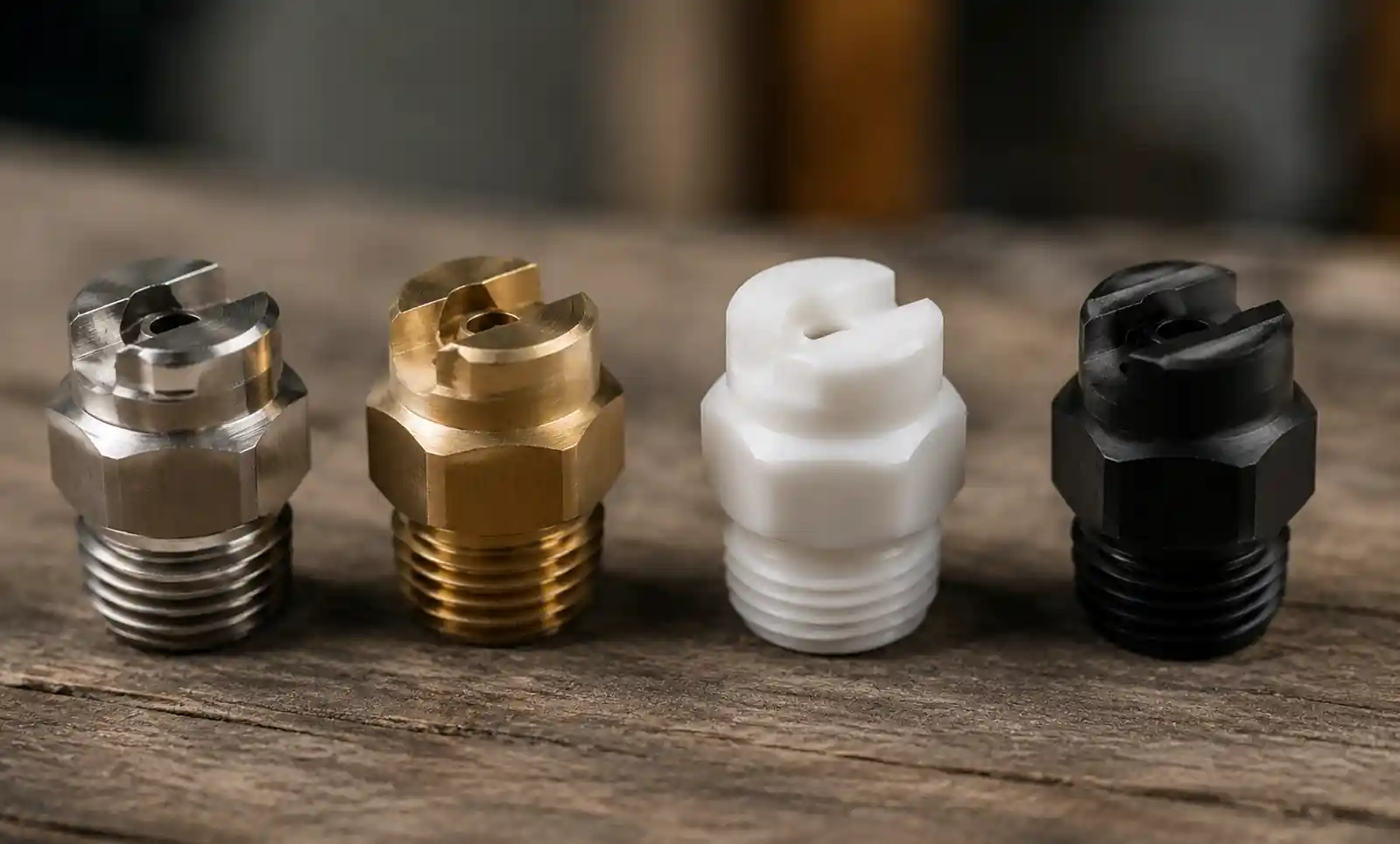 Comparison of spray nozzle materials including stainless steel, brass, and plastic nozzles
Flow Rate Calculation
Flow rate calculations separate functioning systems from expensive failures. Use this fundamental equation:
Q = A × √(2 × P × ΔP / ρ)
In practical terms, most manufacturers provide flow rate charts at standard pressures. For water-based fluids at 40 PSI, a typical full cone nozzle with a 1/4" orifice flows approximately 3-5 GPM depending on design.
Key insight: specified flow rates assume clean water. Viscous fluids, suspended solids, or temperature extremes alter performance significantly. For oils or coating materials above 50 centipoise, consult manufacturers with actual fluid samples.
When sizing systems, calculate total system flow by summing individual nozzle requirements, then add 15-20% overhead for pressure losses through piping, filters, and quick coupling connections.
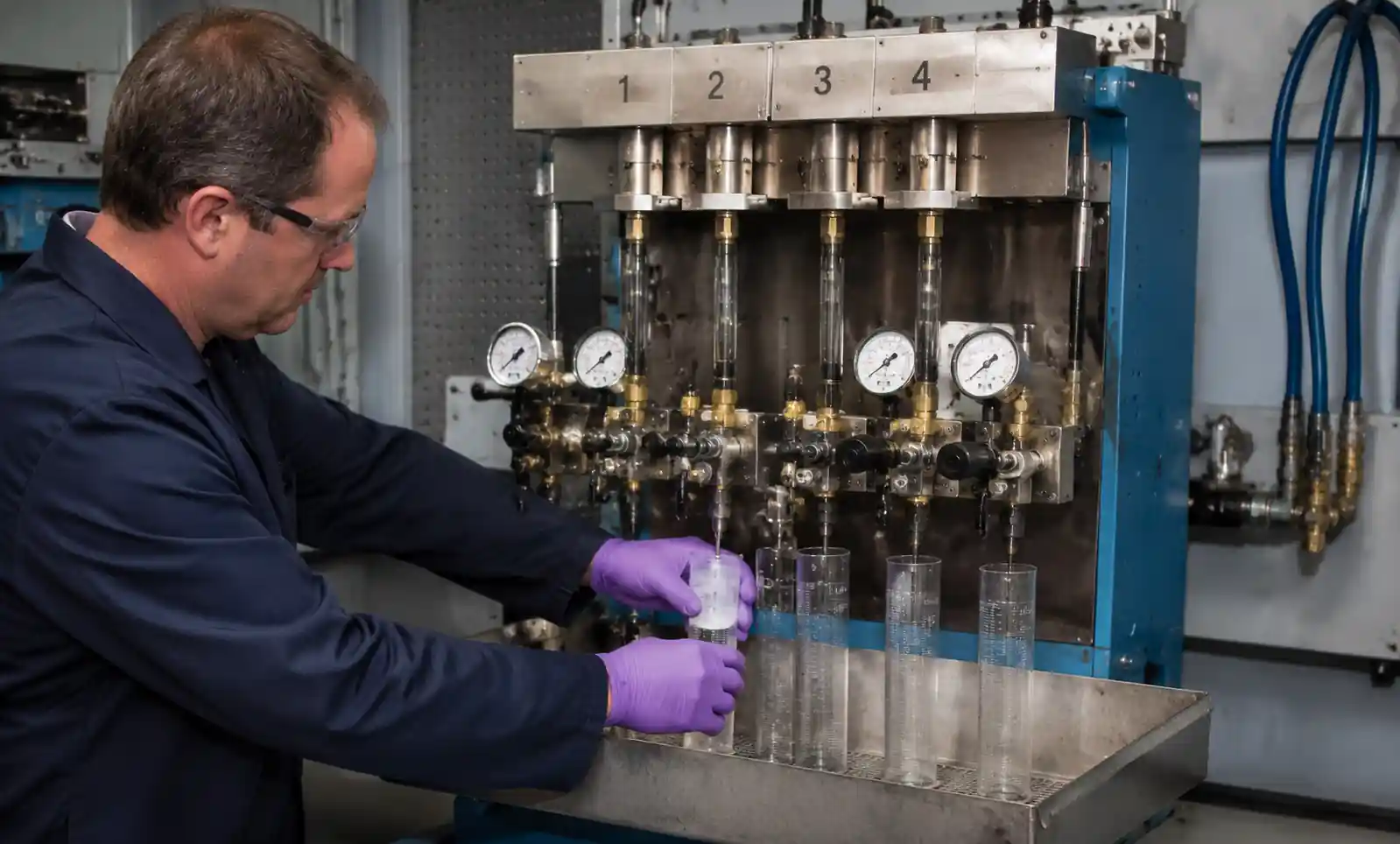 Technician measuring spray nozzle flow rate using calibrated testing equipment and pressure gauges
Spray Pattern Quality
Distribution uniformity measures whether all areas receive equal liquid volume. Coefficient of variation should stay below 10% for critical applications like coating and humidification.
Droplet size consistency impacts atomization applications. Air atomizing systems produce 10-100 micron droplets with narrow size distribution. Hydraulic pressure nozzles create broader ranges (50-500 microns).
Implement quarterly spray pattern checks using pressure-sensitive paper or digital imaging. Catching degradation early prevents quality escapes.
Industry-Specific Selection Criteria
Chemical Processing: Material compatibility trumps all else. Demand compatibility data for your exact compounds.
Food & Beverage: Sanitary design and CIP compatibility are mandatory. Use only 316L stainless with FDA-compliant elastomers and complete drainability.
Automotive Coating: Air atomizing nozzles achieve 65-85% transfer efficiency versus 30-45% for conventional spray.
Agriculture: Low-pressure flat fan nozzles with larger droplets (200-400 microns) minimize wind drift.
Metalworking: Full cone nozzles provide consistent cooling; flat fans excel at chip flushing.
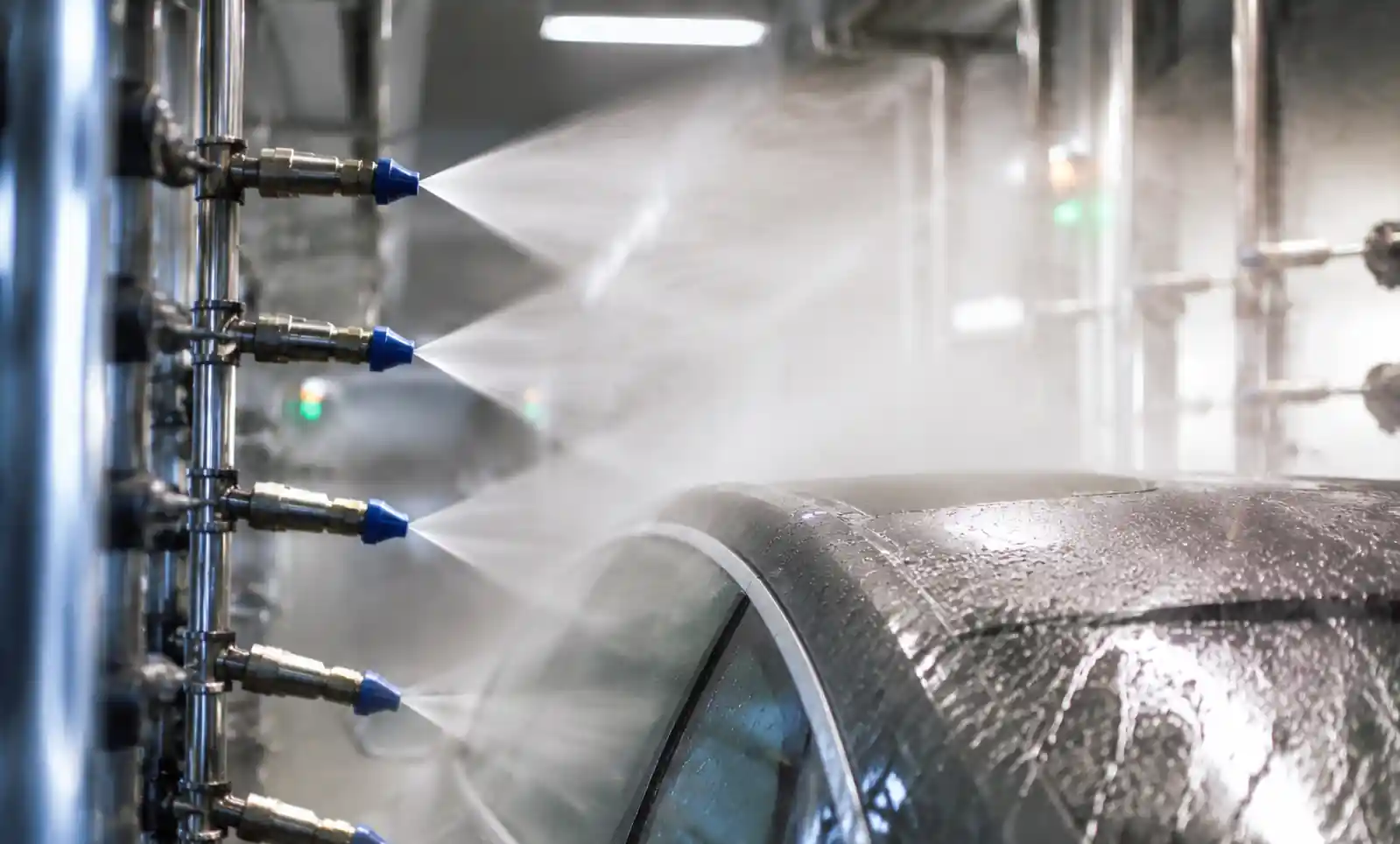 Industrial spray nozzles in operation across different manufacturing sectors including automotive and food processing
Common Mistakes That Destroy ROI
Mistake 1: Selecting based only on price. A $15 brass nozzle lasting three months costs more than a $75 stainless nozzle lasting five years.
Mistake 2: Ignoring filtration requirements. Install appropriate filtration accessories upstream—typically 100-200 mesh (74-150 microns) for fine spray nozzles.
Mistake 3: Over-pressurizing to compensate for poor coverage. Fix the root cause: wrong spray angle or improper spacing.
Mistake 4: Neglecting maintenance schedules. Establish inspection intervals based on operating hours—typically 500-2000 hours for critical applications.
Mistake 5: Mixing incompatible nozzle types in one system. Different types have different flow coefficients, creating pressure imbalances.
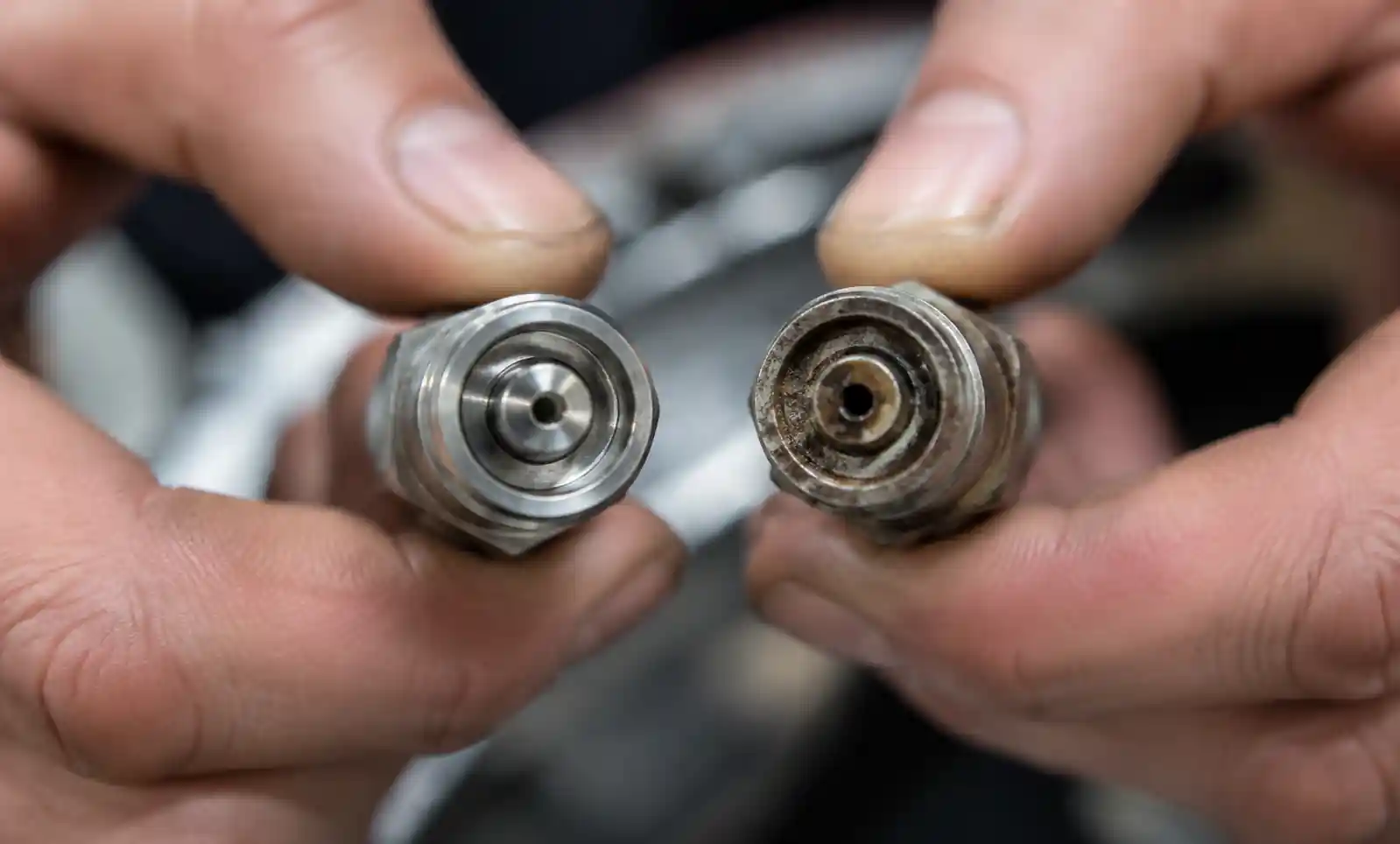 Close-up of spray nozzle inspection showing wear patterns and maintenance evaluation
Testing and Validation Protocol
Never specify nozzles for critical applications without testing. Request sample nozzles and conduct:
- Pattern verification: Spray onto flat surface or collection grid to verify uniformity
- Flow measurement: Confirm actual flow matches specifications at your operating pressure
- Droplet analysis: Use laser diffraction or collection method to measure droplet size distribution
- Wear testing: Run extended tests with actual process fluids to assess longevity
Document results and share with suppliers. Reputable manufacturers use field feedback to improve designs.
System integration essentials: Maintain equal pressure to all nozzles through proper manifold design. Secure nozzles against vibration. Install quick coupling systems for fast changes. Install pressure gauges and regulators at critical spray zones.
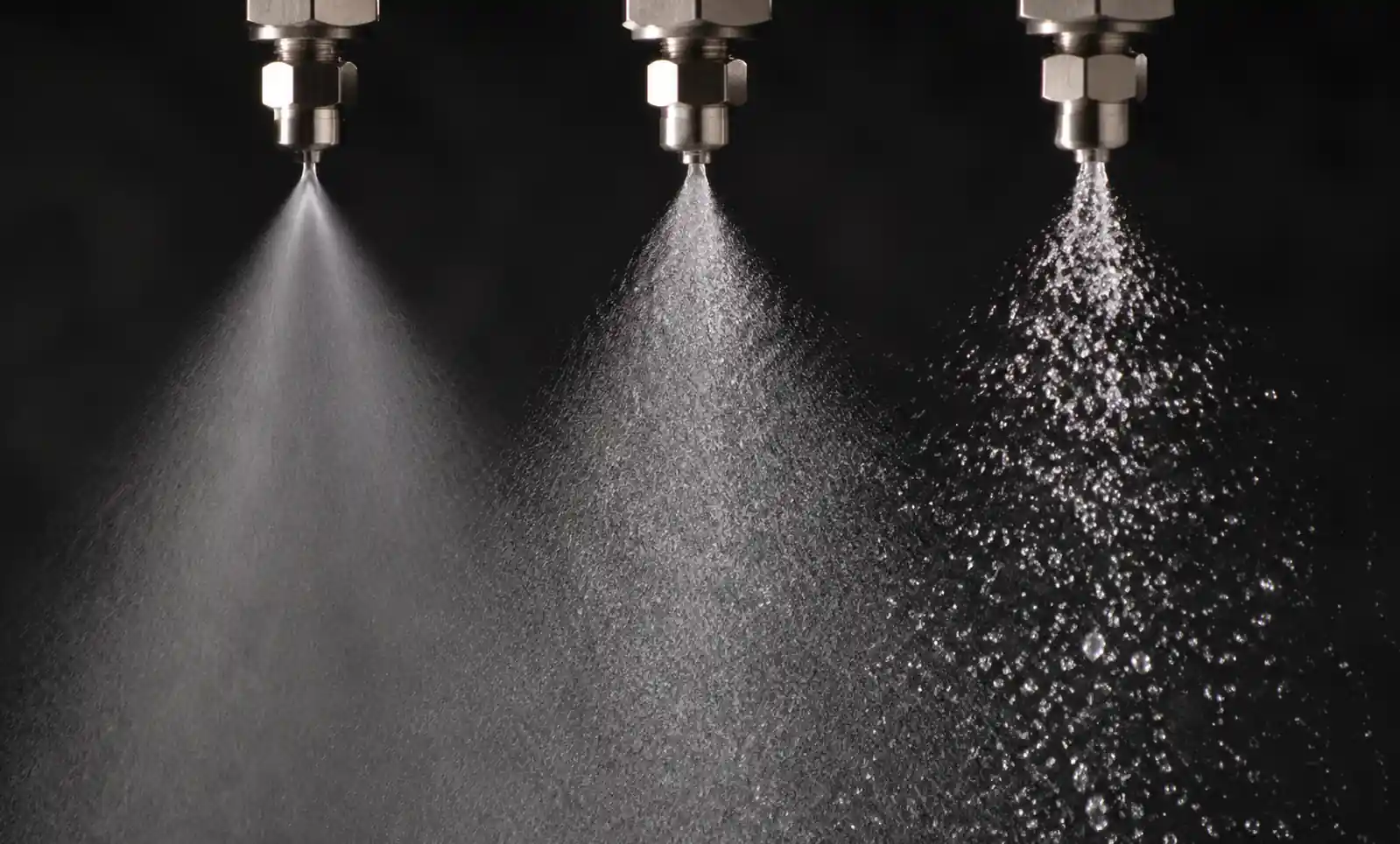 Air atomizing spray nozzle creating fine mist with visible droplet atomization pattern
FAQs
How often should I replace spray nozzles?
Replace when flow rate deviates more than 10% from specifications or when visual inspection reveals orifice wear. In clean water service, quality stainless nozzles last 2-5 years. Abrasive applications may require replacement every 3-12 months.
Can I use the same nozzle for different chemicals?
Only if all chemicals are compatible with the nozzle material. Many plastics resist acids but fail with organic solvents. Stainless steel handles most chemicals but corrodes in high-chloride environments.
What causes uneven spray patterns?
Common causes: worn orifice, partially clogged internal passages, damaged spray vanes, incorrect installation angle, or operating pressure below minimum specifications.
How do I calculate the number of nozzles needed?
Calculate total flow requirement (area × liquid application rate). Divide by individual nozzle capacity at your operating pressure. Verify adequate overlap by calculating coverage diameter and spacing nozzles at 60-70% of coverage diameter.
What's the difference between hollow cone and full cone nozzles?
Hollow cone nozzles create a ring-shaped pattern with minimal center liquid – ideal for maximum atomization and heat transfer. Full cone nozzles distribute uniformly across the entire circular pattern – better for impact washing and dust suppression.
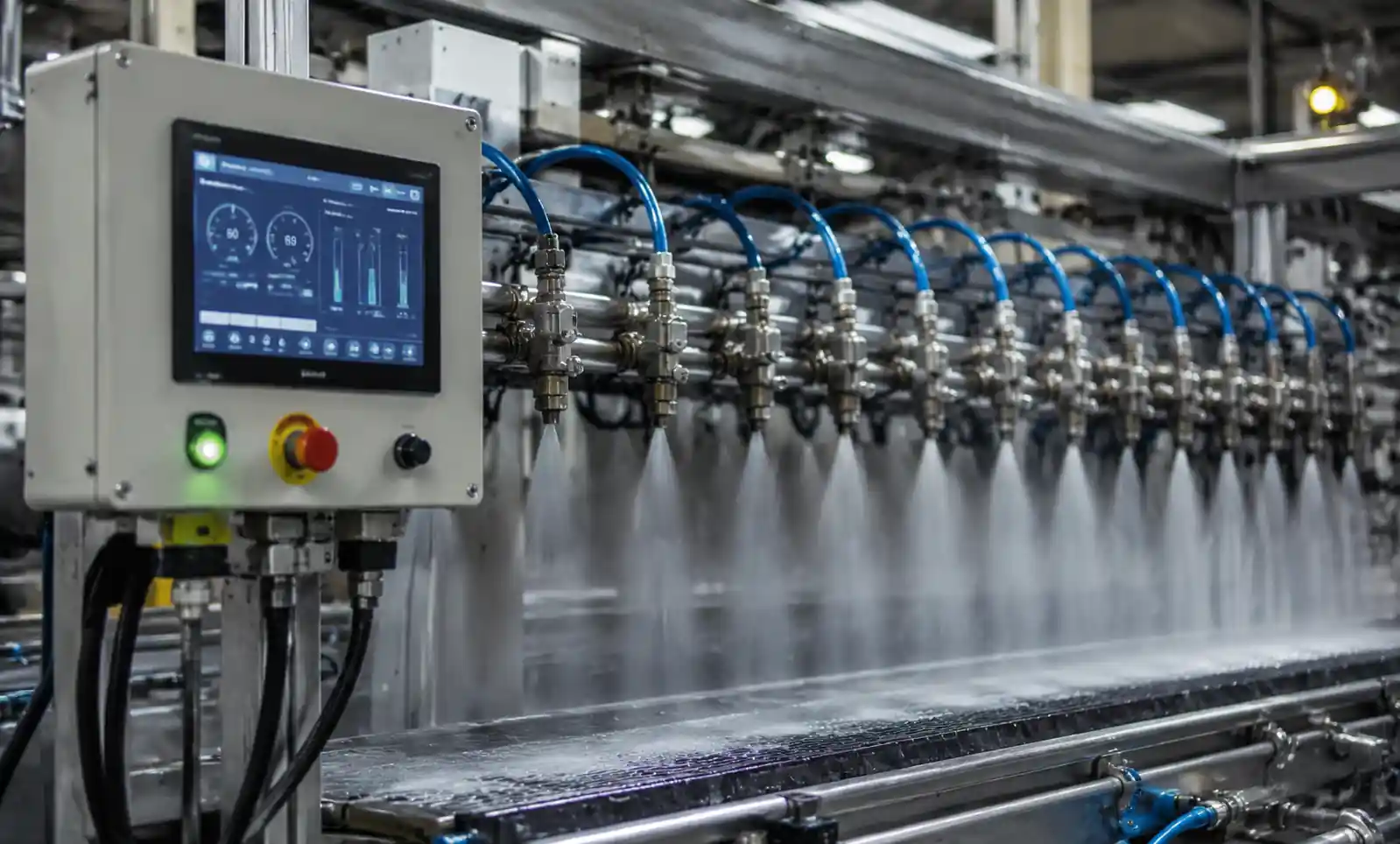 Advanced spray nozzle system with modern monitoring technology and control equipment
Conclusion
Choosing the right spray nozzle means balancing pressure, flow rate, spray angle, and material properties against your actual operating conditions. Document your flow, pressure, coverage, and chemical compatibility before selecting—don't chase price, skip filtration, or mix incompatible types. Test samples with your process fluids, design for proper distribution and easy maintenance, and you'll cut waste, improve quality, and extend service life. For complex applications, work with manufacturers who offer application testing and engineering support—at Yuechen Precision Technology, that's exactly how we help customers get spray systems right.