



Best Marine Spray Nozzles for Harsh Environments
Table of Contents
- 1. 1. Introduction: Why Material Selection Matters in Marine Applications
- 2. 2. Critical Performance Parameters for Marine Spray Nozzles
- 2.1. 2.1 Corrosion Resistance: Beyond Generic "Stainless Steel"
- 2.2. 2.2 Mechanical Durability: Impact and Vibration Resistance
- 2.3. 2.3 Flow Rate Stability Under Corrosion
- 3. 3. Corrosion-Resistant Material Comparison
- 3.1. 3.1 Material Performance Matrix
- 3.2. 3.2 Key Insights from the Comparison
- 4. 4. Nozzle Type Selection for Marine Applications
- 4.1. 4.1 Spray Pattern Requirements by Application
- 4.2. 4.2 Tank Washing: Rotating vs. Static Full Cone Arrays
- 4.3. 4.3 Desalination and Brine Management
- 5. 5. Total Cost of Ownership Analysis
- 5.1. 5.1 TCO Calculation Framework
- 5.2. 5.2 Key TCO Insights
- 6. 6. Installation and Maintenance Best Practices
- 6.1. 6.1 Thread Sealants and Galling Prevention
- 6.2. 6.2 Freshwater Flushing Protocols
- 6.3. 6.3 Flow Testing for Predictive Maintenance
- 6.4. 6.4 Galvanic Corrosion Considerations
- 7. 7. FAQ
- 7.1. Q: Can I use 316L stainless nozzles in seawater service if I apply a protective coating?
- 7.2. Q: How do I determine when a marine nozzle needs replacement?
- 7.3. Q: Is Hastelloy C-276 compatible with chlorine dioxide or sodium hypochlorite used in marine biofouling control?
- 7.4. Q: Can ceramic nozzles be repaired if chipped or cracked?
- 7.5. Q: What thread standard should I specify for marine nozzles?
- 7.6. Q: How does seawater temperature affect material selection?
- 8. 8. Conclusion
1. Introduction: Why Material Selection Matters in Marine Applications
Marine environments present some of the most demanding conditions for spray nozzles. Salt fog corrosion, constant high humidity above 85%, seawater exposure with 3.5% chloride concentration, and temperature cycling from -20°C to 60°C accelerate material degradation faster than any industrial environment. From our field experience across offshore platforms, shipboard washdown systems, and desalination plants, we have documented premature nozzle failures within 6–18 months when incorrect materials are specified—failures that could have been prevented with proper material selection.
This guide helps marine engineers, maintenance managers, and shipyard equipment specialists select spray nozzles that will survive harsh marine conditions while maintaining spray performance. We focus on three critical material families—316/316L stainless steel, nickel-based superalloys (Hastelloy C-276, Inconel 625), and advanced ceramics (silicon carbide, alumina)—and provide field-tested data on corrosion resistance, mechanical durability, and total cost of ownership.
By the end of this article, you will understand how to match nozzle materials to specific marine applications, calculate expected service life under chloride attack, and avoid the three most common specification mistakes that lead to unplanned maintenance shutdowns.
2. Critical Performance Parameters for Marine Spray Nozzles
2.1 Corrosion Resistance: Beyond Generic "Stainless Steel"
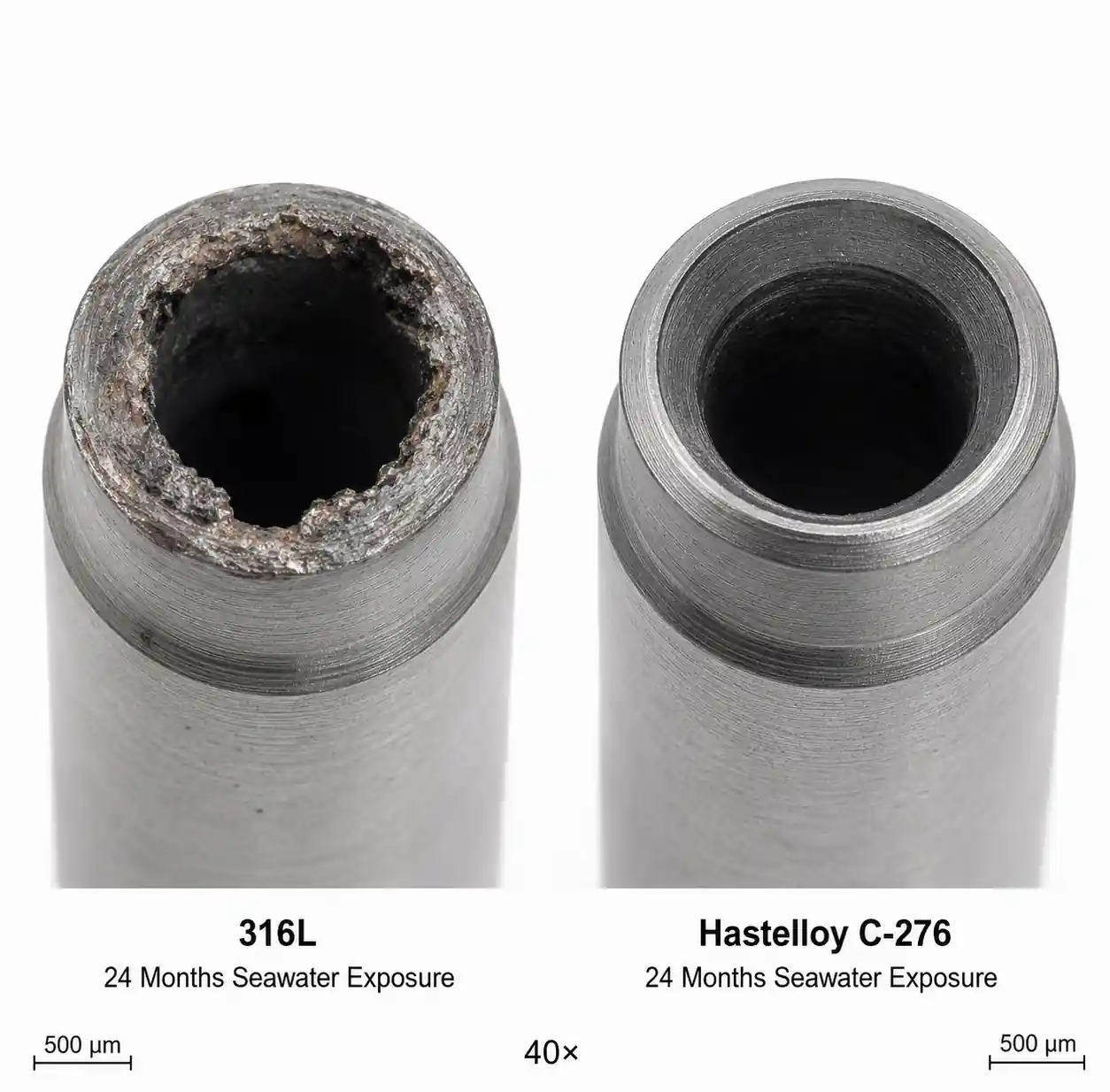
Not all stainless steels survive marine environments. We have recovered corroded 304 stainless nozzles from seawater cooling systems after only 14 months, with pitting depths exceeding 0.8 mm—enough to alter spray angle by 15%. The culprit: insufficient chromium and molybdenum content to resist chloride-induced pitting corrosion.
For marine applications, 316/316L stainless steel is the minimum acceptable grade, providing 16–18% chromium and 2–3% molybdenum. Field data from North Sea offshore platforms shows 316L nozzles maintaining spray uniformity for 3–5 years in atmospheric salt fog, though direct seawater contact reduces this to 18–30 months depending on velocity and dissolved oxygen levels.
When seawater is the spray medium itself—as in ballast tank washing, desalination brine management, or firefighting seawater deluge systems—nickel superalloys become necessary. Hastelloy C-276 (57% nickel, 16% chromium, 16% molybdenum, 4% tungsten) and Inconel 625 provide an order of magnitude better pitting resistance than 316L, with documented service lives exceeding 8 years in continuous seawater contact at flow velocities up to 12 m/s.
2.2 Mechanical Durability: Impact and Vibration Resistance
Marine installations subject nozzles to mechanical loads absent in typical industrial settings. Ship motion induces cyclic stress, deck equipment creates impact loads, and pressure surges from pump starts generate water hammer forces up to 20 bar overpressure.
Ceramic nozzles—silicon carbide and sintered alumina—offer extreme wear resistance when spraying abrasive slurries (ballast water with sand content, brine with scale particles) but are inherently brittle. We have documented silicon carbide nozzle fractures in marine firefighting systems subjected to pressure spikes above 15 bar, despite the material's excellent corrosion resistance. For high-shock applications, ductile materials like Hastelloy are preferred even when ceramics would otherwise provide longer wear life.
2.3 Flow Rate Stability Under Corrosion
A hidden performance degradation mode: corrosion doesn't just cause leaks, it alters orifice geometry. Pitting corrosion preferentially attacks sharp edges at the orifice exit, effectively increasing the orifice diameter and reducing spray momentum. We measured a 23% flow rate increase in 316L nozzles after 28 months in atmospheric marine service, not from orifice enlargement due to wear, but from edge rounding due to pitting. This shifts spray angle, reduces impact force, and compromises coverage uniformity.
Hastelloy and ceramic nozzles maintain orifice geometry far better. Comparative measurements show less than 3% flow rate drift over 5 years in similar environments—critical for applications like tank washing where coverage patterns must remain predictable.
3. Corrosion-Resistant Material Comparison
3.1 Material Performance Matrix
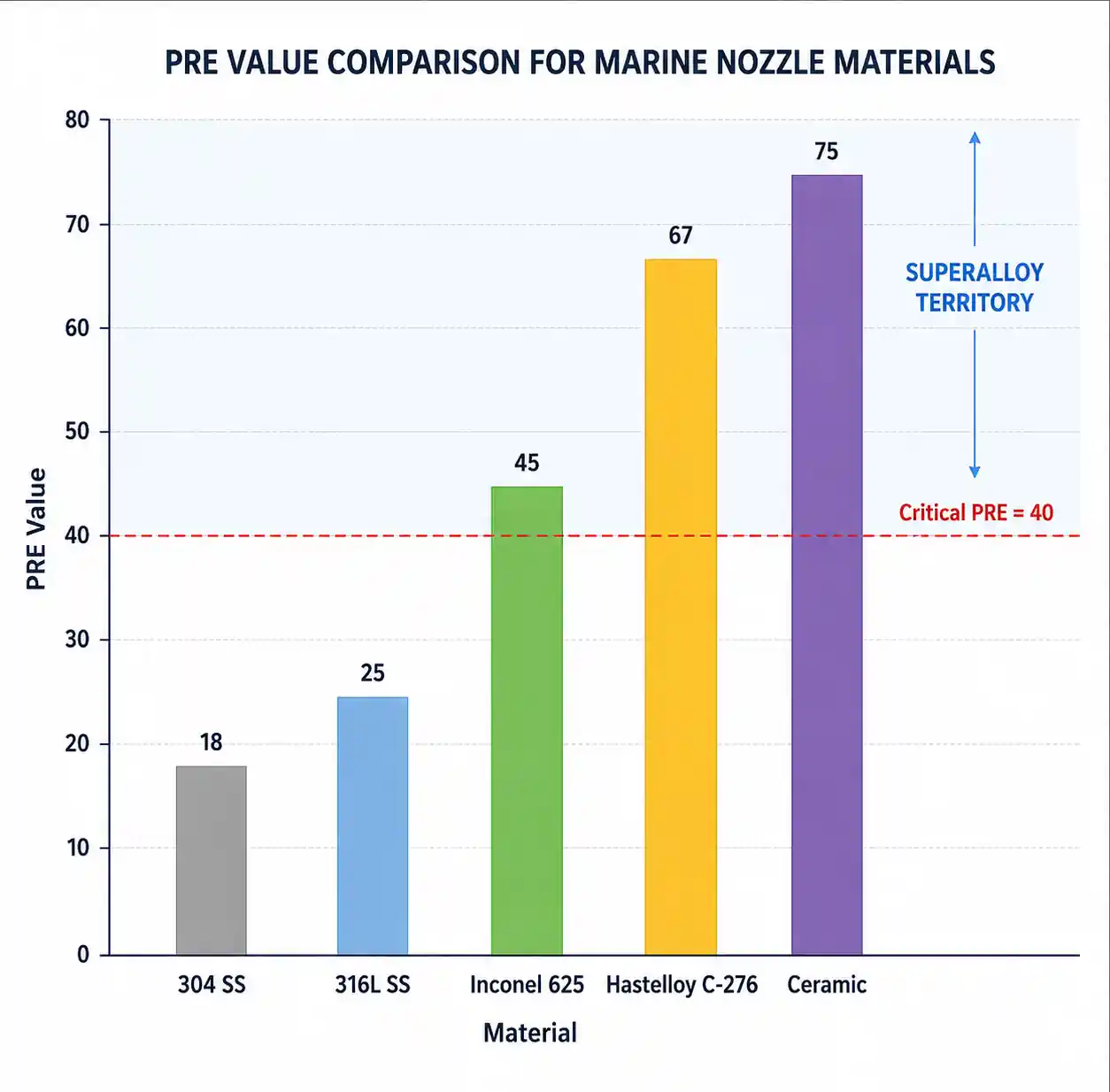
The table below summarizes field-tested performance data from marine applications. Service life estimates assume continuous exposure to salt fog (ASTM B117 equivalent) or direct seawater contact at ambient temperature with dissolved oxygen content 6–8 mg/L.
| Material | Pitting Resistance (PRE) | Relative Service Life (Salt Fog) | Relative Service Life (Seawater) | Relative Cost | Impact Resistance | Typical Marine Applications |
|---|---|---|---|---|---|---|
| 304 Stainless | 18–20 | 1x (12–18 months) | Not recommended | 1.0x | Good | Avoid in marine service |
| 316L Stainless | 24–26 | 3–5x (36–60 months) | 1.5–2.5x (18–30 months) | 1.5x | Good | Atmospheric exposure, intermittent seawater |
| Hastelloy C-276 | 68–72 | 15–20x (>10 years) | 8–12x (8–10 years) | 12–15x | Excellent | Direct seawater, high-velocity, desalination |
| Inconel 625 | 52–58 | 12–15x (>10 years) | 6–10x (6–8 years) | 10–12x | Excellent | Seawater pumps, brine handling, offshore |
| Silicon Carbide Ceramic | Immune to chloride | >20x (>15 years) | >20x (>15 years) | 8–10x | Poor (brittle) | Low-shock abrasive slurries, desalination concentrate |
| Alumina Ceramic (99.5%) | Immune to chloride | >20x (>15 years) | >20x (>15 years) | 6–8x | Poor (brittle) | Tank cleaning, stationary installations |
PRE (Pitting Resistance Equivalent) = %Cr + 3.3×%Mo + 16×%N. Higher values indicate better chloride resistance. PRE above 40 is considered "super" stainless/superalloy territory.
3.2 Key Insights from the Comparison
316L is the marine baseline, not 304. Despite 304 stainless being ubiquitous in general industrial service, its PRE of 18–20 makes it unsuitable for marine atmospheres. We have seen 304 nozzles fail via pitting within 14 months even in indoor shipboard machinery spaces with salt-laden air from ventilation.
Hastelloy C-276 offers the best balance for critical seawater systems. While 12–15x the cost of 316L sounds extreme, total cost of ownership (TCO) calculations accounting for maintenance labor, system downtime, and replacement logistics often favor Hastelloy for applications like ballast tank washing, firefighting deluge systems, and desalination plant spray distribution. A single unplanned maintenance event on an offshore platform can cost $50,000–$200,000 in mobilization, vessel hire, and lost production.
Ceramics require careful application engineering. Silicon carbide and alumina ceramics are chemically immune to chloride corrosion and provide the longest service life in abrasive marine slurries—but only if mechanical shock can be controlled. We recommend ceramic nozzles only for stationary installations with pressure regulation (±2 bar maximum variation) and vibration isolation. For mobile equipment, shipboard systems, or any application with water hammer risk, ductile metals are safer despite shorter corrosion life.
4. Nozzle Type Selection for Marine Applications
4.1 Spray Pattern Requirements by Application
Different marine applications demand different spray geometries. The table below matches common marine spray tasks to recommended nozzle types based on coverage requirements, droplet size constraints, and impact force needs.
| Marine Application | Primary Goal | Recommended Nozzle Type | Spray Angle | Typical Pressure Range | Preferred Material | Critical Selection Factor |
|---|---|---|---|---|---|---|
| Tank washing (ballast, cargo) | 360° coverage, high impact | Rotating tank cleaner or full cone | 70–110° | 4–12 bar | Hastelloy C-276, 316L | Impact force >15 N at 3 m |
| Deck washdown | Wide coverage, moderate impact | Flat fan or hollow cone | 60–80° | 3–6 bar | 316L, Inconel 625 | Uniform distribution, no dead zones |
| Desalination brine cooling | Evaporative cooling, fine droplets | Air atomizing or hollow cone | 45–90° | 2–8 bar (liquid), 4–6 bar (air) | Hastelloy C-276 | Droplet size 50–200 μm |
| Firefighting seawater deluge | Maximum flow, high momentum | Full cone or solid stream | 90–120° or 0° | 8–15 bar | Inconel 625, 316L | Flow rate >40 L/min per nozzle |
| Hull cleaning (stationary gantry) | Abrasion resistance, high pressure | Solid stream or narrow flat fan | 15–40° | 100–250 bar | Silicon carbide ceramic | Resistance to cavitation erosion |
| Scrubber spray (flue gas) | Gas contact, droplet uniformity | Hollow cone or spiral | 60–120° | 2–5 bar | Hastelloy C-276 | Droplet size 200–500 μm |
4.2 Tank Washing: Rotating vs. Static Full Cone Arrays
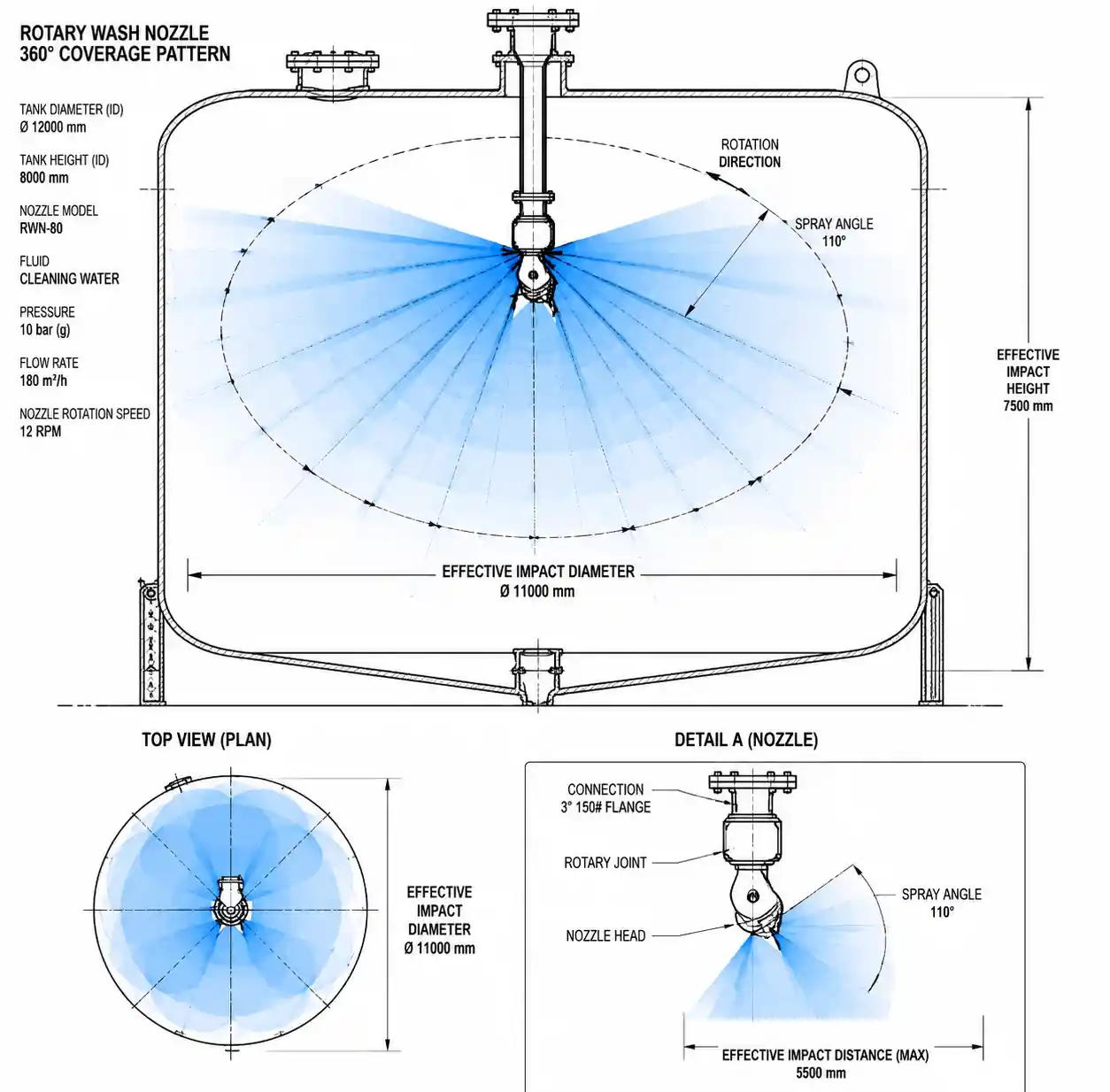
Cargo and ballast tank cleaning remains one of the most demanding marine spray applications. Residue removal requires sustained impact force (typically 15–25 N at 3 meters distance) combined with complete 360° coverage, often through 15–30 meter tank diameters.
Rotating tank cleaners (Butterworth-style) use jet reaction to spin a multi-nozzle head, providing full spherical coverage from a single mounting point. Modern designs incorporate Hastelloy nozzles with flow rates 80–200 L/min at 8–12 bar. From our installation data, a single 3D rotating cleaner at 150 L/min can effectively clean a 5000 m³ ballast tank in 3–4 hours, compared to 6–8 hours for static spray arrays. However, rotating cleaners have more mechanical complexity—bearings, seals, and swivel joints all become corrosion and wear points in seawater service.
Static full cone arrays eliminate moving parts at the cost of requiring multiple nozzle mounting points. A typical installation uses 8–16 full cone nozzles (70–90° spray angle, 25–40 L/min each) positioned around tank perimeter and overhead. While more robust mechanically, static arrays require careful overlap design to avoid coverage dead zones. We recommend 50% overlap at the target surface distance, which for a 90° full cone nozzle means spacing nozzles no more than 0.7× the standoff distance apart.
Material recommendation: Hastelloy C-276 for crude oil cargo tanks (where sulfur compounds accelerate corrosion) and ballast tanks in continuous seawater service. 316L is acceptable for fresh water wash systems or intermittent seawater exposure with freshwater flush after each use.
4.3 Desalination and Brine Management
Reverse osmosis desalination plants use spray nozzles in brine concentrate management, evaporative cooling towers, and pre-treatment chemical dosing. The combination of high salinity (often 70,000–90,000 mg/L TDS in reject brine, 2–2.5× seawater concentration), elevated temperature (40–50°C in thermal desalination), and chemical additives (antiscalants, chlorine) creates an exceptionally aggressive environment.
For brine cooling towers, we typically specify hollow cone nozzles (60–90° spray angle) in Hastelloy C-276, producing droplets in the 200–400 μm range. Smaller droplets maximize evaporative surface area but risk complete evaporation before reaching cooling tower fill media. From field measurements at Middle East desalination plants, 300 μm median droplet size (Dv0.5) at 3–4 bar provides optimal balance between evaporation efficiency and fill media wetting.
For brine discharge diffusers, where concentrated reject brine is diluted back into the ocean, full cone nozzles in Hastelloy or silicon carbide ceramic provide the momentum needed to mix brine with ambient seawater, preventing hypersaline plumes. Material selection here depends on whether the brine contains suspended solids from pretreatment clarification—if yes, ceramic's abrasion resistance justifies its brittleness; if no, Hastelloy's impact tolerance is preferred.
Critical specification error: Using 316L in continuous brine contact above 50,000 mg/L TDS. We have investigated multiple premature failures of 316L nozzles in SWRO brine service, with pitting depths reaching 1.5 mm within 24 months. At those salinity levels, Hastelloy or Inconel 625 is mandatory for service life beyond 5 years.
5. Total Cost of Ownership Analysis
5.1 TCO Calculation Framework
Nozzle purchase price is typically 5–15% of total lifecycle cost in marine applications. The dominant cost drivers are: planned replacement labor, unplanned maintenance (emergency repairs), system downtime, and performance degradation losses (e.g., incomplete tank cleaning requiring additional cycles, or inefficient spray cooling requiring higher flow rates).
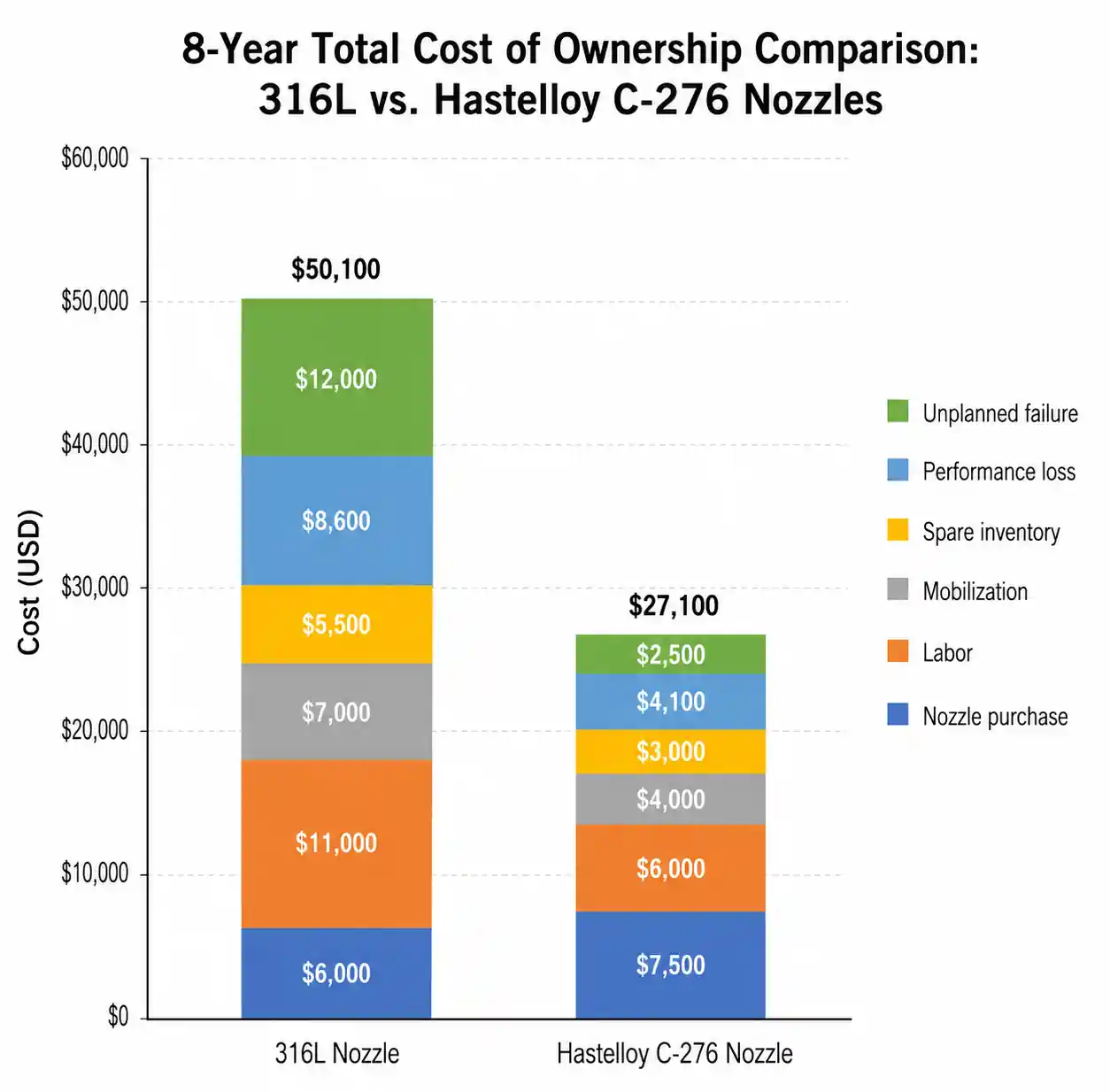
The table below provides a worked example comparing 316L versus Hastelloy C-276 nozzles for a seawater ballast tank washing system on an offshore platform. Assumptions: 12 nozzles, 1 replacement per nozzle over comparison period, labor rate $150/hour, helicopter mobilization cost $8,000 per trip for offshore access.
| Cost Component | 316L Stainless | Hastelloy C-276 | Notes |
|---|---|---|---|
| Nozzle purchase (12 units) | $1,800 ($150 each) | $21,600 ($1,800 each) | Initial capital investment |
| Expected service life | 24 months | 96 months | Based on field data, seawater service |
| Replacements over 8 years | 3 cycles | 0 cycles | 316L replaced at months 24, 48, 72 |
| Replacement labor (6 hrs × 2 techs × 3 cycles) | $5,400 | $0 | Includes system isolation, removal, installation, pressure test |
| Mobilization cost (offshore access × 3) | $24,000 | $0 | Helicopter to platform, weather delays |
| Spare parts inventory holding | $900 | $2,700 | 50% of 1 replacement set, 8 years |
| Performance degradation cost | $6,000 | $800 | Extra pump runtime, incomplete cleaning, re-work |
| Unplanned failure risk (probability × impact) | $12,000 (20% × $60k) | $2,000 (5% × $40k) | Emergency repair, production loss |
| Total 8-year TCO | $50,100 | $27,100 | Hastelloy saves 46% despite 12× higher unit cost |
| TCO per nozzle per year | $521 | $282 | Normalized comparison metric |
5.2 Key TCO Insights
Mobilization and labor dominate offshore TCO. In the example above, nozzle purchase cost represents only 3.6% of 316L total TCO and 79.7% of Hastelloy TCO. The economic case for premium materials becomes overwhelming when site access is expensive—offshore platforms, ships at sea, remote coastal facilities. For easy-access land-based installations near maintenance depots, the balance shifts back toward 316L.
Performance degradation is often undercounted. When spray nozzles corrode and flow characteristics drift, the immediate result is often not catastrophic failure but rather diminished effectiveness—a cargo tank that requires an extra 2-hour cleaning cycle, a cooling tower that needs 15% higher flow rate to achieve target temperature drop, or a scrubber that falls below SO₂ removal efficiency guarantees. These gradual losses are difficult to attribute but accumulate to substantial economic impact over multi-year timelines.
Spare parts strategy affects TCO. With 316L nozzles, you must maintain a spare parts inventory equal to at least one full replacement cycle—12 nozzles in the example above. With Hastelloy's 8–10 year service life, the probability of needing emergency spares within the planning horizon drops substantially, allowing leaner inventory. However, Hastelloy's higher unit cost and longer lead times (often 8–12 weeks for specialty alloys versus 2–4 weeks for 316L) mean that when you do stock spares, the capital tied up is significant.
Decision rule: For marine installations where mobilization cost exceeds $5,000 per maintenance event or where system downtime costs exceed $10,000 per day, premium materials (Hastelloy, Inconel, or ceramic) typically provide lower TCO than 316L stainless despite 6–15× higher purchase price.
6. Installation and Maintenance Best Practices
6.1 Thread Sealants and Galling Prevention
Stainless steel and nickel alloys are prone to galling—a form of adhesive wear where thread surfaces cold-weld together under torque, making disassembly impossible without destructive cutting. In marine environments with salt deposition, galling risk increases further.
Best practice: Use nickel-based anti-seize compound (not copper-based, which forms galvanic cells with stainless steel in seawater) on all threaded nozzle connections. Apply thin, even coating to male threads only. Torque to 50–60% of dry torque specification to account for the lubricating effect—typically 15–20 ft-lb for 1/4" NPT connections, 30–40 ft-lb for 1/2" NPT.
For permanent installations, consider welded socket connections or flanged spray headers to eliminate threaded joints entirely. We have seen offshore installations where 40% of nozzle maintenance time is consumed attempting to remove galled threaded nozzles.
6.2 Freshwater Flushing Protocols
For intermittent seawater spray systems—firefighting deluge systems tested quarterly, ballast tank washers used during tank changeovers, deck washdown systems operated as-needed—implementing a freshwater flush protocol after each seawater exposure can extend 316L nozzle life from 18–24 months to 48–60 months, approaching the economics of Hastelloy at a fraction of the capital cost.
Recommended protocol: Within 2 hours of securing seawater flow, circulate freshwater through the spray system for minimum 5 minutes at normal operating pressure. This purges residual seawater from nozzle orifices and internal passages before salt crystallization occurs. Salt crystals act as crevice corrosion initiation sites and as abrasive particles during the next spray cycle.
In our experience with ship deck washdown systems, vessels implementing disciplined freshwater flushing achieve 3–4× longer nozzle life compared to vessels that simply secure the system with seawater left in lines and nozzles. The freshwater cost is negligible—approximately 50–100 liters for a typical system—but the maintenance cost avoidance is substantial.
6.3 Flow Testing for Predictive Maintenance
Waiting for visible corrosion or spray pattern failure before replacing marine nozzles often means you have already operated with degraded performance for months. A simple flow test protocol enables predictive replacement before performance falls below acceptable thresholds.
Recommended test interval: Every 6 months for 316L in seawater service, every 12 months for Hastelloy/Inconel, every 24 months for ceramics.
Test procedure: Isolate nozzle, install calibrated pressure gauge and flow meter on a test bench, measure flow rate at three pressure points spanning the operating range (e.g., 3, 6, and 9 bar). Compare to original factory flow curve. Flow rate increase >10% indicates orifice enlargement from corrosion or wear. Flow rate decrease >10% indicates partial blockage from scale, biological growth, or corrosion products.
From field data, 316L nozzles in atmospheric marine environments typically show 5–8% flow rate increase by 18 months (indicating orifice edge corrosion), while Hastelloy nozzles show <2% drift over 5 years. Establishing a baseline flow curve during commissioning and tracking drift over time allows planned replacement before spray uniformity degrades to unacceptable levels.
6.4 Galvanic Corrosion Considerations
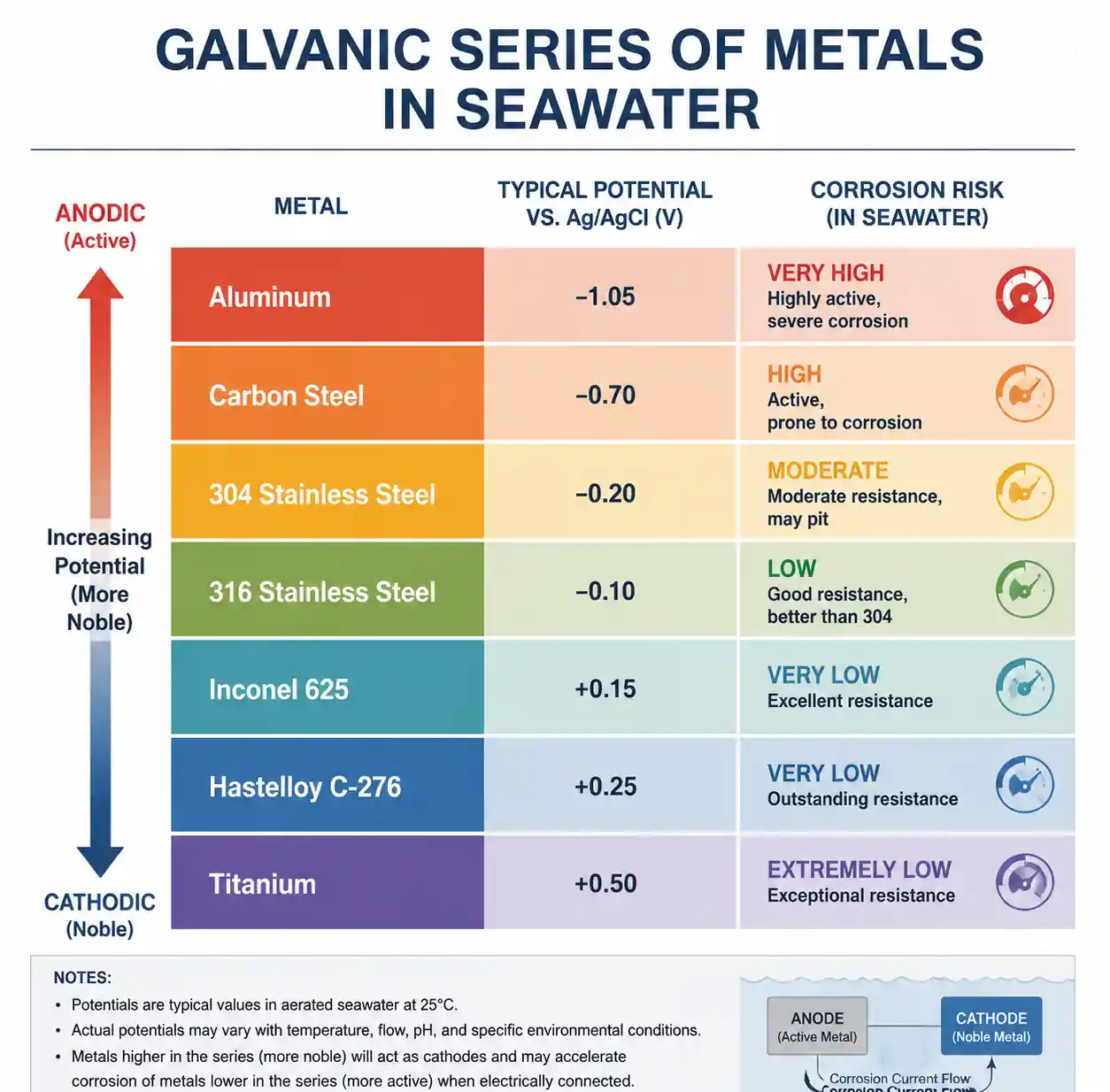
When mounting nozzles of dissimilar metals into spray headers, galvanic corrosion accelerates the more-anodic (less noble) metal. The galvanic series in seawater ranks common nozzle materials from anodic (corrodes preferentially) to cathodic (protected):
Anodic (corrodes): Aluminum alloys → Carbon steel → 304 stainless → 316 stainless → Inconel 625 → Hastelloy C-276 → Titanium Cathodic (protected)
Problem scenario: Hastelloy nozzles threaded into a 316 stainless steel manifold. The 316 manifold becomes anodic relative to the Hastelloy nozzles and corrodes preferentially at the thread interface, particularly if seawater wets the connection. We have documented thread corrosion failures in such installations within 36 months.
Solution: Use electrically insulating thread tape (PTFE) or plastic washers to break galvanic contact, or better yet, match nozzle and manifold materials. If cost constraints require a mixed-metal design, make the replaceable component (nozzle) the anodic member—better to replace nozzles every 2 years than to replace the entire manifold assembly.
7. FAQ
Q: Can I use 316L stainless nozzles in seawater service if I apply a protective coating?
A: Coatings (electroless nickel, PTFE, epoxy) provide temporary protection but are impractical for spray nozzles due to orifice fouling and coating erosion under fluid shear. High-velocity flow through small orifices (typical velocities 10–25 m/s) removes most coatings within weeks. We do not recommend coated 316L as a substitute for Hastelloy or Inconel in direct seawater contact. Coatings are more appropriate for external surfaces and static components.
Q: How do I determine when a marine nozzle needs replacement?
A: Implement periodic flow testing (every 6–12 months depending on material). Replace when flow rate deviates >10% from baseline, when spray pattern becomes visibly asymmetric, or when visual inspection reveals pitting depth >0.3 mm. For critical applications like firefighting deluge systems, replace on a time-based schedule (e.g., every 5 years for Hastelloy, every 2 years for 316L) regardless of condition to maintain system reliability.
Q: Is Hastelloy C-276 compatible with chlorine dioxide or sodium hypochlorite used in marine biofouling control?
A: Yes. Hastelloy C-276's high molybdenum (16%) and tungsten (4%) content provides excellent resistance to oxidizing chlorine species up to 200 ppm at ambient temperature. We have documented >8 year service life in marine cooling water systems dosed with 0.5–2.0 ppm residual chlorine. However, avoid simultaneous exposure to chlorine and reducing acids (e.g., hydrochloric acid from pH adjustment) as this creates a mixed oxidizing/reducing environment that can attack even Hastelloy.
Q: Can ceramic nozzles be repaired if chipped or cracked?
A: No. Ceramic nozzles cannot be welded or brazed for repair. Any visible crack or chip is cause for immediate replacement, as the crack will propagate under pressure cycling and lead to catastrophic fracture. This is why we recommend ceramic nozzles only for low-shock applications with controlled pressure and vibration isolation.
Q: What thread standard should I specify for marine nozzles?
A: NPT (National Pipe Taper) remains most common in North American marine service, while BSP (British Standard Pipe) dominates in European and Asian vessels. For new installations, consider metric ISO 7-1 (previously DIN 2999) threads, which are increasingly specified in international maritime standards. Always verify thread compatibility between nozzle and manifold—mixing NPT and BSP causes leaks and thread damage. For high-vibration applications, consider socket-weld or flanged connections instead of threaded.
Q: How does seawater temperature affect material selection?
A: Elevated temperature accelerates chloride-induced stress corrosion cracking (SCC) in austenitic stainless steels. For seawater service above 60°C, 316L becomes marginal—documented SCC failures occur at 70–90°C even with low applied stress. Switch to Inconel 625 or Hastelloy C-276 for hot seawater applications (e.g., cooling water discharge from heat exchangers, thermal desalination brine). Conversely, cold seawater (<15°C) is less aggressive; 316L performance in Arctic offshore platforms exceeds North Sea or Gulf of Mexico installations by 30–50% due to reduced corrosion kinetics.
8. Conclusion
Material selection drives long-term performance and total cost of ownership for marine spray nozzles far more than spray pattern or flow capacity. The key decision framework:
For atmospheric salt fog exposure with intermittent seawater contact (deck washdown, weather-exposed cooling systems, shipboard machinery spaces): 316L stainless steel with disciplined freshwater flushing provides acceptable 3–5 year service life at reasonable cost.
For direct continuous seawater contact (ballast tank washing, seawater firefighting, desalination brine handling): Hastelloy C-276 or Inconel 625 are mandatory for service life beyond 5 years. The 10–15× material cost premium is justified by elimination of unplanned maintenance, particularly for offshore installations where site access costs are high.
For abrasive seawater slurries (ballast water with sand, brine with scale particles): Silicon carbide ceramic provides longest wear life but requires low-shock installation with pressure regulation and vibration isolation. For high-shock mobile equipment, Hastelloy remains the better choice despite shorter abrasion life.
The most common specification error we encounter: defaulting to "stainless steel" without distinguishing between 304 (inadequate for marine service), 316L (acceptable for atmospheric exposure), and superalloys (required for seawater immersion). This single material choice determines whether your nozzles last 18 months or 10 years—and whether your maintenance budget is consumed by reactive failures or planned replacements on your terms.
For application-specific material recommendations, flow calculations, or total cost of ownership modeling for your marine spray system, contact our marine application engineering team with your operating parameters: spray medium composition, temperature, pressure, flow rate, and installation environment.