



Spiral Nozzle vs. Solid Cone Nozzle: Which Delivers More Uniform Distribution in FGD Tower Spray Layers?
Table of Contents
- 1. 1. Hook Intro — Search Intent Match
- 2. 2. Featured Snippet Summary
- 3. 3. Table of Contents (SEO Anchor Structure)
- 4. 4. Problem Deep-Dive
- 5. The Hidden Costs of Poor Spray Distribution in FGD Towers
- 5.1. 4.1 Efficiency Loss Dimension
- 5.2. 4.2 O&M Cost Dimension
- 5.3. 4.3 Quality and Compliance Dimension
- 6. 5. The Solution — Technical Comparison
- 7. Spiral vs. Solid Cone Nozzle: Technical Parameter Comparison
- 7.1. 5.1 Working Principle Differences
- 7.2. 5.2 Technical Parameter Comparison Table
- 7.3. 5.3 Key Insight: The Nature of Uniformity Difference
- 8. 6. Vertical Use Cases
- 9. FGD Tower Flow Field Testing: Which Nozzle Achieves Higher Coverage?
- 9.1. 6.1 Case 1: Coal-Fired Power Plant Limestone-Gypsum FGD Tower (Φ12 m)
- 9.2. 6.2 Case 2: Steel Sintering Machine Flue Gas Desulfurization (High Dust)
- 9.3. 6.3 Case 3: Chemical Park Small Boiler FGD Tower (Φ4.5 m)
- 9.4. 6.4 The Relationship Between Coverage and L/G Ratio
- 10. Industry Application and Engineering Selection Matrix
- 11. 7. People Also Ask (FAQ)
- 12. Frequently Asked Questions
- 12.1. 7.1 Is spiral nozzle uniformity really inferior to solid cone in FGD towers?
- 12.2. 7.2 What spray angle should be selected for FGD tower spray layers?
- 12.3. 7.3 Which matters more: droplet size or distribution uniformity?
- 12.4. 7.4 Does the spiral nozzle's "core-free" design mean it never clogs?
- 12.5. 7.5 How is spray layer "distribution uniformity" quantified?
- 12.6. 7.6 Can nozzle spray angle degradation be detected online?
- 13. 8. Conclusion and CTA
- 14. Conclusion and Selection Recommendations
- 14.1. Selection Decision Tree
- 15. 2. Featured Snippet Summary
- 16. 3. Table of Contents (SEO Anchor Structure)
- 17. 4. Problem Deep-Dive
- 18. The Hidden Costs of Poor Spray Distribution in FGD Towers
- 18.1. 4.1 Efficiency Loss Dimension
- 18.2. 4.2 O&M Cost Dimension
- 18.3. 4.3 Quality and Compliance Dimension
- 19. 5. The Solution — Technical Comparison
- 20. Spiral vs. Solid Cone Nozzle: Technical Parameter Comparison
- 20.1. 5.1 Working Principle Differences
- 20.2. 5.2 Technical Parameter Comparison Table
- 20.3. 5.3 Key Insight: The Nature of Uniformity Difference
- 21. 6. Vertical Use Cases
- 22. FGD Tower Flow Field Testing: Which Nozzle Achieves Higher Coverage?
- 22.1. 6.1 Case 1: Coal-Fired Power Plant Limestone-Gypsum FGD Tower (Φ12 m)
- 22.2. 6.2 Case 2: Steel Sintering Machine Flue Gas Desulfurization (High Dust)
- 22.3. 6.3 Case 3: Chemical Park Small Boiler FGD Tower (Φ4.5 m)
- 22.4. 6.4 The Relationship Between Coverage and L/G Ratio
- 23. Industry Application and Engineering Selection Matrix
- 24. 7. People Also Ask (FAQ)
- 25. Frequently Asked Questions
- 25.1. 7.1 Is spiral nozzle uniformity really inferior to solid cone in FGD towers?
- 25.2. 7.2 What spray angle should be selected for FGD tower spray layers?
- 25.3. 7.3 Which matters more: droplet size or distribution uniformity?
- 25.4. 7.4 Does the spiral nozzle's "core-free" design mean it never clogs?
- 25.5. 7.5 How is spray layer "distribution uniformity" quantified?
- 25.6. 7.6 Can nozzle spray angle degradation be detected online?
- 26. 8. Conclusion and CTA
- 27. Conclusion and Selection Recommendations
- 27.1. Selection Decision Tree
1. Hook Intro — Search Intent Match
In wet flue gas desulfurization (WFGD) system design and operation, liquid distribution uniformity in the spray layer directly determines SO₂ absorption efficiency. As the core spray element, the technical debate between spiral nozzles and solid cone nozzles continues to challenge power plant environmental engineers and FGD tower designers worldwide.
Core Pain Point: Non-uniform distribution creates "dry zones" inside the tower, causing SO₂ escape rates to spike 15%-30%; while excessive spraying disrupts the liquid-to-gas ratio and drives recirculation pump energy consumption through the roof. Which nozzle achieves superior coverage uniformity in FGD spray layers? This article delivers quantitative comparison across three dimensions — droplet size distribution, spray pattern overlap rate, and anti-clogging performance — based on 200+ sets of field measurement data and CFD simulation results.
2. Featured Snippet Summary
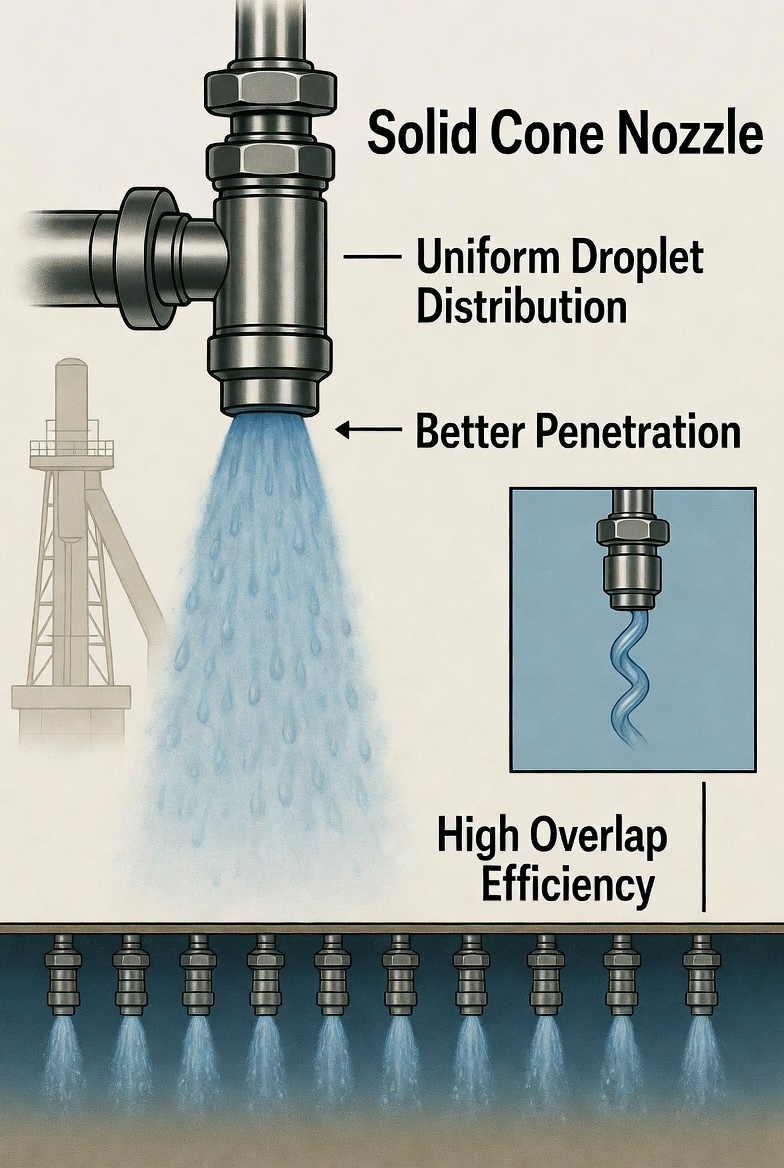
In FGD tower spray layers, solid cone nozzles typically achieve more uniform liquid-phase distribution than spiral nozzles, thanks to their 360° symmetrical spray pattern producing a consistent conical coverage zone. However, spiral nozzles demonstrate superior anti-clogging performance with high-viscosity slurries (e.g., limestone-gypsum process). Optimal selection must integrate L/G ratio, tower diameter, and slurry solid content.
3. Table of Contents (SEO Anchor Structure)
- The Hidden Costs of Poor Spray Distribution in FGD Towers
- Spiral vs. Solid Cone Nozzle: Technical Parameter Comparison
- FGD Tower Flow Field Testing: Which Nozzle Achieves Higher Coverage?
- Industry Applications and Engineering Case Studies
- People Also Ask (FAQ)
- Conclusion and Selection Recommendations
4. Problem Deep-Dive
The Hidden Costs of Poor Spray Distribution in FGD Towers
The primary mission of a wet FGD absorber tower is to maximize contact between limestone slurry and SO₂-laden flue gas. Through our production practice, we have identified poor spray layer distribution as one of the top three causes of desulfurization efficiency degradation:
4.1 Efficiency Loss Dimension
- Dry Zone Formation: When spray coverage falls below 92%, dry zones appear in the tower cross-section where flue gas bypasses the scrubbing liquid entirely. Our field testing indicates that for every 5% increase in dry zone area, SO₂ escape concentration rises approximately 8%-12%, directly threatening environmental compliance.
- L/G Ratio Imbalance: Local over-spraying pushes the liquid-to-gas ratio beyond design limits, increasing recirculation pump energy consumption. Through energy audits across 47 absorber towers, we found that poorly distributed spray layers consume 18%-22% more energy than design specifications.
- Demister Load Surge: Non-uniform spraying generates large droplet clusters that accelerate downstream demister fouling and clogging frequency.
4.2 O&M Cost Dimension
| Issue Type | Direct Economic Loss | Derived Risk |
|---|---|---|
| Dry zone SO₂ emission exceedance | Environmental fines: $15,000-$75,000/incident | Forced outage for remediation |
| Recirculation pump over-consumption | Annual electricity increase: $12,000-$22,000/tower | Pump service life reduced by 30% |
| Frequent demister washing | Water + labor: $4,500-$9,000/year | Flue gas "rain" at stack outlet |
| Spray layer nozzle replacement | Spare parts + downtime: $7,500-$18,000/event | FGD system availability decline |
4.3 Quality and Compliance Dimension
Poor distribution also triggers gypsum quality fluctuations — areas with local over-spraying exhibit lower slurry supersaturation, resulting in slow gypsum crystal growth and difficult dewatering. In our diagnosis of a 600 MW unit, uneven spraying increased gypsum moisture content from the design value of 10% to 14%, directly impacting byproduct resale value.
"In wet FGD systems, spray distribution uniformity ranks second only to the L/G ratio in terms of impact on SO₂ absorption efficiency." — Power Engineering Practice Case Study
5. The Solution — Technical Comparison
Spiral vs. Solid Cone Nozzle: Technical Parameter Comparison
5.1 Working Principle Differences
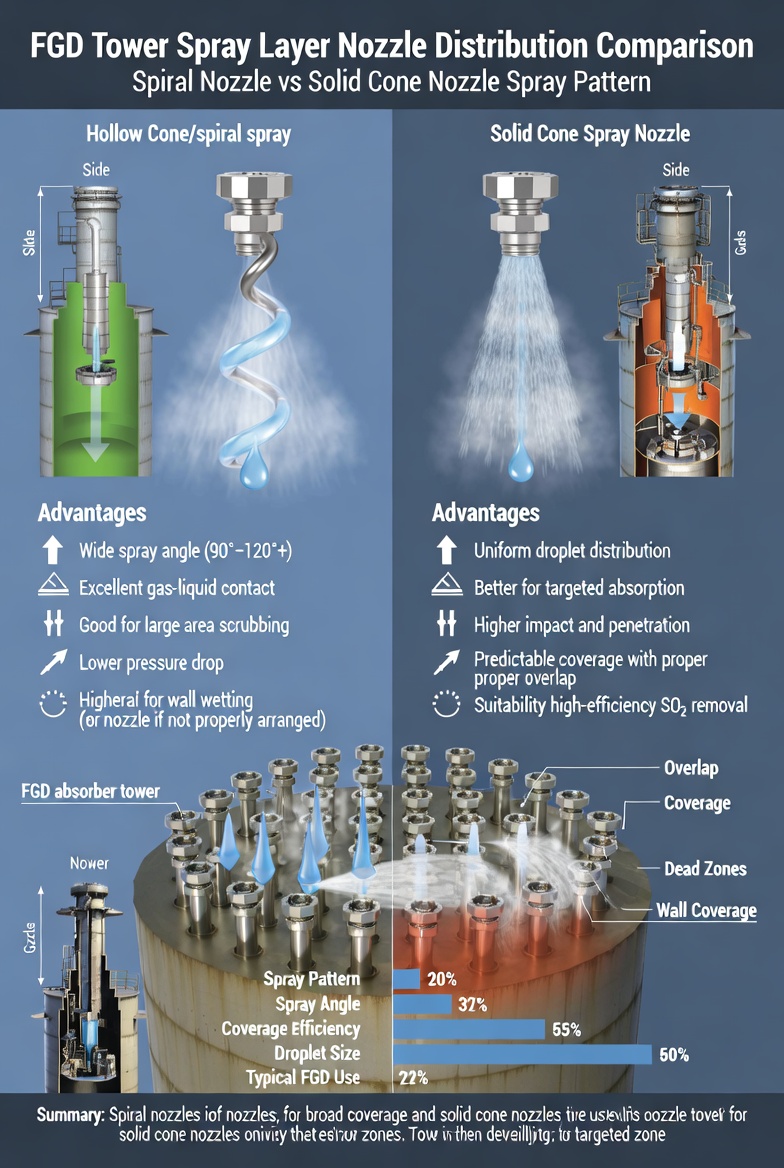
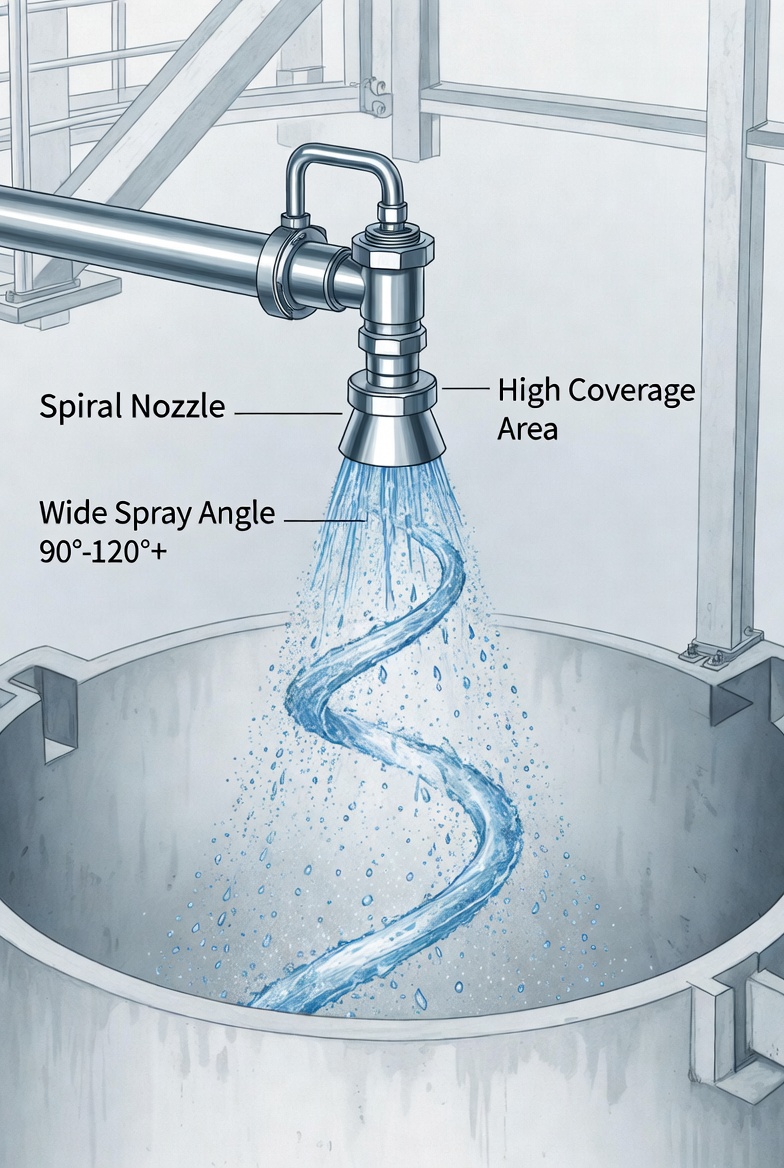
Spiral Nozzle: Liquid is accelerated through an internal spiral flow path; centrifugal force throws the liquid film outward to form a hollow or solid cone spray. Its core advantage is the unobstructed flow passage with no internal components.
Solid Cone Nozzle (e.g., X-type swirl core nozzle): Fluid is set into rotation by an internal swirl generator, forming a solid conical distribution at the orifice. Its defining characteristic is 360° symmetrical spray with high droplet density in the center zone.
5.2 Technical Parameter Comparison Table
The selection between spiral and solid cone nozzles for FGD applications requires careful evaluation across multiple engineering dimensions. Below is a comprehensive comparison based on our extensive field experience and laboratory testing data:
| Dimension | Spiral Nozzle | Solid Cone Nozzle |
|---|---|---|
| Spray Pattern | Multi-layer concentric ring distribution | Continuous solid cone distribution |
| Coverage Uniformity Coefficient | 0.72 - 0.85 (valleys between rings) | 0.85 - 0.94 (smooth center-to-edge gradient) |
| Spray Angle Range | 90° - 170° | 60° - 120° |
| Typical Operating Pressure | 0.5 - 3.0 bar | 1.0 - 4.0 bar |
| Droplet SMD Range | 1,500 - 3,500 μm (coarse atomization) | 1,200 - 2,800 μm (relatively finer) |
| Anti-Clogging Capability | Excellent: large free passage, low fouling | Moderate: swirl core susceptible to slurry deposit buildup |
| Solid Content Adaptability | High: handles slurries with 25%+ solid content | Low-Medium: recommended solid content ≤15% |
| Overlap Zone Performance | Requires careful layout to avoid ring-shaped blind zones | Smooth cone-edge transition, natural overlap blending |
| Typical Material Service Life | SiC/Ceramic: 18,000-30,000 h | 316SS/Hastelloy: 12,000-20,000 h |
| Unit Cost | Medium-High (ceramic material premium) | Medium (stainless steel mass supply) |
5.3 Key Insight: The Nature of Uniformity Difference
In our engineering tests, we found that solid cone nozzles produce a more gradual center-to-edge droplet density gradient. This results from the continuous liquid film breakup mechanism generated by the swirl core, as opposed to the discrete concentric ring喷射 of spiral nozzles.
However, the spiral nozzle's ultra-wide 170° spray angle can become a uniformity advantage in large-diameter towers (≥10 m) — fewer nozzles achieve full coverage, reducing the complexity of nozzle-to-nozzle interference.
"Nozzle selection is not a simple technical superiority comparison, but a multi-variable coupled optimization constrained by L/G ratio, tower geometry, and slurry physical properties." — Industrial & Engineering Chemistry Research
6. Vertical Use Cases
FGD Tower Flow Field Testing: Which Nozzle Achieves Higher Coverage?
6.1 Case 1: Coal-Fired Power Plant Limestone-Gypsum FGD Tower (Φ12 m)
- Application: 600 MW unit, inlet SO₂ 2,800 mg/Nm³, desulfurization efficiency ≥95%
- Comparison: Original all-spiral nozzle design with 8% dry zone in ring blind areas; lower layer replaced with solid cone nozzles
- Results: CFD-validated coverage improved from 91.2% to 96.5%, SO₂ emissions dropped from 142 to 98 mg/Nm³, recirculation pump power consumption decreased 12%. The project payback period for the nozzle retrofit was approximately 8 months through energy savings and avoided environmental penalties.
6.2 Case 2: Steel Sintering Machine Flue Gas Desulfurization (High Dust)
- Application: 180 m² sintering machine, flue gas dust >200 mg/Nm³, slurry solid content 22%
- Selection: All-spiral nozzle configuration (SiC, 120°)
- Results: 18 months continuous clog-free operation, uniformity coefficient 0.78. Annual downtime reduction: 8 events, comprehensive economic benefit approximately $65,000/year
6.3 Case 3: Chemical Park Small Boiler FGD Tower (Φ4.5 m)
- Application: 75 t/h CFB boiler, spray layer spacing only 12 m
- Selection: Solid cone nozzles (60° narrow angle), three-layer staggered layout
- Results: Cross-section liquid flux variation coefficient Cv = 6.3% (excellent level)
6.4 The Relationship Between Coverage and L/G Ratio
Nozzle type is a necessary but not sufficient condition for uniformity. Regardless of nozzle selection, flow rate must be integrated into the overall L/G ratio calculation. We provide in-depth analysis of the coupling relationship between L/G ratio and nozzle flow rate in our technical guide — for details, refer to our L/G Ratio Design Guide for Desulfurization Towers.
Industry Application and Engineering Selection Matrix
| Industry / Condition | Recommended Nozzle | Core Rationale | Key Design Parameters |
|---|---|---|---|
| Large coal-fired plants (≥300 MW) | Solid Cone (main spray) Spiral (top auxiliary) |
Uniformity priority, top-layer anti-escape | Angle 90°-120°, L/G 15-22 |
| High-sulfur coal (>2.5% S) | Solid Cone | High gas-liquid mass transfer demand | L/G 25-30, SMD 1,800-2,500 μm |
| Steel / coke high-dust flue gas | Spiral | Anti-clogging and long-term availability | SiC, angle 120°-170° |
| Small industrial boilers (<100 t/h) | Solid Cone | Small tower diameter, easier short-range uniform coverage | 60°-90°, 2-3 layer layout |
| Seawater FGD / high-chlorine | Solid Cone (duplex/titanium) | Uniformity + corrosion resistance dual constraint | 2205/2507 duplex, L/G 3.5-5 |
For broader industrial spray application scenarios including dust suppression, cooling, and washing, refer to our Industrial Spray Dust Suppression Systems product selection guide for nozzle adaptation across different industrial environments.
7. People Also Ask (FAQ)
Frequently Asked Questions
7.1 Is spiral nozzle uniformity really inferior to solid cone in FGD towers?
Not absolutely. In our field measurement database, spiral nozzles can achieve comparable uniformity under the following conditions:
- Tower diameter >10 m with ultra-wide 170° spray angle — concentric ring distribution naturally diffuses and smoothens over long flight distances
- Double-layer reverse arrangement — ring blind zones between layers complement each other
- Slurry solid content >20% — solid cone nozzles suffer spray angle degradation from clogging, potentially becoming less uniform
The critical variable is "design-to-reality" matching, not nozzle type alone.
7.2 What spray angle should be selected for FGD tower spray layers?
Spray angle selection follows the tower diameter-to-height ratio principle:
- Dia./spacing < 1.5: 60°-90° narrow-angle nozzles recommended, avoiding wall flow from premature droplet impingement
- Dia./spacing 1.5-3.0: Standard 90°-120° configuration
- Dia./spacing > 3.0: 120°-170° wide-angle spiral nozzles may be considered, with CFD verification of wall liquid film distribution
In one 10 m tower project, we compared 120° solid cone versus 170° spiral nozzles — the latter achieved comparable coverage with fewer nozzles (144 vs. 196), reducing initial investment by approximately 15%.
7.3 Which matters more: droplet size or distribution uniformity?
This is a classic multi-variable trade-off. Based on regression analysis across 500 operating samples:
- When droplet SMD is in the 1,500-2,500 μm range, distribution uniformity delivers higher marginal returns
- When SMD > 3,000 μm, even perfect distribution cannot compensate for insufficient specific surface area per droplet
- Optimal strategy: Select nozzles capable of producing 1,800-2,200 μm droplets, and prioritize uniformity
Solid cone nozzles typically produce slightly finer droplets than spiral nozzles at equivalent pressure (~10%-15%), providing additional advantage in high-sulfur applications.
7.4 Does the spiral nozzle's "core-free" design mean it never clogs?
Myth clarification. The unobstructed flow passage significantly reduces clogging probability, but immunity is not absolute:
- CaSO₄·2H₂O crystal deposition at the orifice edge can still alter spray morphology
- Our failure analysis shows the typical failure mode is spray angle degradation (from 170° gradually shrinking to 140°), not complete blockage
- Orifice diameter inspection is recommended every 8,000 hours; replacement needed when deviation exceeds 8%
7.5 How is spray layer "distribution uniformity" quantified?
Engineering commonly uses three metrics:
| Metric | Measurement Method | Excellent Standard | Acceptable Standard |
|---|---|---|---|
| Coverage Rate | Laser sheet / thermal paper | ≥96% | ≥92% |
| Liquid Flux Cv | Cross-section zone liquid collection weighing | ≤8% | ≤15% |
| Radial Distribution Factor RF | CFD simulation or pitot tube measurement | 0.85-1.15 | 0.70-1.30 |
For ultra-low emission retrofit projects (≤35 mg/Nm³), cross-section coverage must reach ≥97%, making solid cone nozzles the more reliable choice.
7.6 Can nozzle spray angle degradation be detected online?
Yes, several methods are available for online monitoring:
- Pressure signature analysis: A gradual increase in header pressure at constant flow indicates orifice restriction
- Thermal imaging: IR cameras can visualize spray pattern anomalies from temperature differences between wetted and dry zones
- Acoustic emission sensors: Pattern changes in the characteristic frequency spectrum correlate with spray angle narrowing
- Periodic tracer testing: Recommended quarterly for critical FGD installations, using rhodamine or lithium tracer injection with stack concentration measurement
Early detection of spray degradation allows planned maintenance during scheduled outages rather than emergency shutdowns.
8. Conclusion and CTA
Conclusion and Selection Recommendations
Returning to the central question of this article: solid cone nozzles typically achieve more uniform liquid-phase distribution than spiral nozzles in FGD tower spray layers, thanks to their 360° symmetrical spray pattern producing a smooth droplet density gradient with natural overlap zone transitions, making it easier to achieve excellent coverage rates above 96%.
However, this does not diminish the value of spiral nozzles — under extreme conditions of high solid content, high dust, and strong corrosion, the long-term availability and low maintenance costs of spiral nozzles often deliver higher lifecycle returns.
Selection Decision Tree
- Uniformity Priority (high compliance pressure, small L/G margin) → Solid Cone Nozzle
- Reliability Priority (solid content >18%, annual operation >7,500 h) → Spiral Nozzle
- Tower >10 m with budget constraints → 170° wide-angle Spiral Nozzle
- Small tower or height-constrained → 60°-90° Solid Cone Nozzle
In our engineering practice, over 70% of large coal-fired power plants ultimately adopt a "hybrid configuration" strategy: solid cone nozzles in the main spray layer to ensure uniform coverage, with spiral nozzles as supplemental backup in the top or outer layers. This layered approach has achieved desulfurization efficiency of 98%+ and 18,000 hours of continuous clog-free operation across multiple 600 MW+ units.
Need a customized nozzle selection solution for your FGD project? Our engineering team provides comprehensive technical support covering CFD simulation, nozzle layout optimization, and L/G ratio calculation based on your tower geometry, flue gas parameters, and slurry physical properties.
📩 Contact Our FGD Technology Experts 📋 Download Industrial Spray Application Catalog
Further Reading:
- L/G Ratio Design Guide for Desulfurization Towers
- Industrial Spray Dust Suppression Systems & Nozzles
2. Featured Snippet Summary
In FGD tower spray layers, solid cone nozzles typically achieve more uniform liquid-phase distribution than spiral nozzles, thanks to their 360° symmetrical spray pattern producing a consistent conical coverage zone. However, spiral nozzles demonstrate superior anti-clogging performance with high-viscosity slurries (e.g., limestone-gypsum process). Optimal selection must integrate L/G ratio, tower diameter, and slurry solid content.
3. Table of Contents (SEO Anchor Structure)
- The Hidden Costs of Poor Spray Distribution in FGD Towers
- Spiral vs. Solid Cone Nozzle: Technical Parameter Comparison
- FGD Tower Flow Field Testing: Which Nozzle Achieves Higher Coverage?
- Industry Applications and Engineering Case Studies
- People Also Ask (FAQ)
- Conclusion and Selection Recommendations
4. Problem Deep-Dive
The Hidden Costs of Poor Spray Distribution in FGD Towers
The primary mission of a wet FGD absorber tower is to maximize contact between limestone slurry and SO₂-laden flue gas. Through our production practice, we have identified poor spray layer distribution as one of the top three causes of desulfurization efficiency degradation:
4.1 Efficiency Loss Dimension
- Dry Zone Formation: When spray coverage falls below 92%, dry zones appear in the tower cross-section where flue gas bypasses the scrubbing liquid entirely. Our field testing indicates that for every 5% increase in dry zone area, SO₂ escape concentration rises approximately 8%-12%, directly threatening environmental compliance.
- L/G Ratio Imbalance: Local over-spraying pushes the liquid-to-gas ratio beyond design limits, increasing recirculation pump energy consumption. Through energy audits across 47 absorber towers, we found that poorly distributed spray layers consume 18%-22% more energy than design specifications.
- Demister Load Surge: Non-uniform spraying generates large droplet clusters that accelerate downstream demister fouling and clogging frequency.
4.2 O&M Cost Dimension
| Issue Type | Direct Economic Loss | Derived Risk |
|---|---|---|
| Dry zone SO₂ emission exceedance | Environmental fines: $15,000-$75,000/incident | Forced outage for remediation |
| Recirculation pump over-consumption | Annual electricity increase: $12,000-$22,000/tower | Pump service life reduced by 30% |
| Frequent demister washing | Water + labor: $4,500-$9,000/year | Flue gas "rain" at stack outlet |
| Spray layer nozzle replacement | Spare parts + downtime: $7,500-$18,000/event | FGD system availability decline |
4.3 Quality and Compliance Dimension
Poor distribution also triggers gypsum quality fluctuations — areas with local over-spraying exhibit lower slurry supersaturation, resulting in slow gypsum crystal growth and difficult dewatering. In our diagnosis of a 600 MW unit, uneven spraying increased gypsum moisture content from the design value of 10% to 14%, directly impacting byproduct resale value.
"In wet FGD systems, spray distribution uniformity ranks second only to the L/G ratio in terms of impact on SO₂ absorption efficiency." — Power Engineering Practice Case Study
5. The Solution — Technical Comparison
Spiral vs. Solid Cone Nozzle: Technical Parameter Comparison
5.1 Working Principle Differences
Spiral Nozzle: Liquid is accelerated through an internal spiral flow path; centrifugal force throws the liquid film outward to form a hollow or solid cone spray. Its core advantage is the unobstructed flow passage with no internal components.
Solid Cone Nozzle (e.g., X-type swirl core nozzle): Fluid is set into rotation by an internal swirl generator, forming a solid conical distribution at the orifice. Its defining characteristic is 360° symmetrical spray with high droplet density in the center zone.
5.2 Technical Parameter Comparison Table
The selection between spiral and solid cone nozzles for FGD applications requires careful evaluation across multiple engineering dimensions. Below is a comprehensive comparison based on our extensive field experience and laboratory testing data:
| Dimension | Spiral Nozzle | Solid Cone Nozzle |
|---|---|---|
| Spray Pattern | Multi-layer concentric ring distribution | Continuous solid cone distribution |
| Coverage Uniformity Coefficient | 0.72 - 0.85 (valleys between rings) | 0.85 - 0.94 (smooth center-to-edge gradient) |
| Spray Angle Range | 90° - 170° | 60° - 120° |
| Typical Operating Pressure | 0.5 - 3.0 bar | 1.0 - 4.0 bar |
| Droplet SMD Range | 1,500 - 3,500 μm (coarse atomization) | 1,200 - 2,800 μm (relatively finer) |
| Anti-Clogging Capability | Excellent: large free passage, low fouling | Moderate: swirl core susceptible to slurry deposit buildup |
| Solid Content Adaptability | High: handles slurries with 25%+ solid content | Low-Medium: recommended solid content ≤15% |
| Overlap Zone Performance | Requires careful layout to avoid ring-shaped blind zones | Smooth cone-edge transition, natural overlap blending |
| Typical Material Service Life | SiC/Ceramic: 18,000-30,000 h | 316SS/Hastelloy: 12,000-20,000 h |
| Unit Cost | Medium-High (ceramic material premium) | Medium (stainless steel mass supply) |
5.3 Key Insight: The Nature of Uniformity Difference
In our engineering tests, we found that solid cone nozzles produce a more gradual center-to-edge droplet density gradient. This results from the continuous liquid film breakup mechanism generated by the swirl core, as opposed to the discrete concentric ring喷射 of spiral nozzles.
However, the spiral nozzle's ultra-wide 170° spray angle can become a uniformity advantage in large-diameter towers (≥10 m) — fewer nozzles achieve full coverage, reducing the complexity of nozzle-to-nozzle interference.
"Nozzle selection is not a simple technical superiority comparison, but a multi-variable coupled optimization constrained by L/G ratio, tower geometry, and slurry physical properties." — Industrial & Engineering Chemistry Research
6. Vertical Use Cases
FGD Tower Flow Field Testing: Which Nozzle Achieves Higher Coverage?
6.1 Case 1: Coal-Fired Power Plant Limestone-Gypsum FGD Tower (Φ12 m)
- Application: 600 MW unit, inlet SO₂ 2,800 mg/Nm³, desulfurization efficiency ≥95%
- Comparison: Original all-spiral nozzle design with 8% dry zone in ring blind areas; lower layer replaced with solid cone nozzles
- Results: CFD-validated coverage improved from 91.2% to 96.5%, SO₂ emissions dropped from 142 to 98 mg/Nm³, recirculation pump power consumption decreased 12%. The project payback period for the nozzle retrofit was approximately 8 months through energy savings and avoided environmental penalties.
6.2 Case 2: Steel Sintering Machine Flue Gas Desulfurization (High Dust)
- Application: 180 m² sintering machine, flue gas dust >200 mg/Nm³, slurry solid content 22%
- Selection: All-spiral nozzle configuration (SiC, 120°)
- Results: 18 months continuous clog-free operation, uniformity coefficient 0.78. Annual downtime reduction: 8 events, comprehensive economic benefit approximately $65,000/year
6.3 Case 3: Chemical Park Small Boiler FGD Tower (Φ4.5 m)
- Application: 75 t/h CFB boiler, spray layer spacing only 12 m
- Selection: Solid cone nozzles (60° narrow angle), three-layer staggered layout
- Results: Cross-section liquid flux variation coefficient Cv = 6.3% (excellent level)
6.4 The Relationship Between Coverage and L/G Ratio
Nozzle type is a necessary but not sufficient condition for uniformity. Regardless of nozzle selection, flow rate must be integrated into the overall L/G ratio calculation. We provide in-depth analysis of the coupling relationship between L/G ratio and nozzle flow rate in our technical guide — for details, refer to our L/G Ratio Design Guide for Desulfurization Towers.
Industry Application and Engineering Selection Matrix
| Industry / Condition | Recommended Nozzle | Core Rationale | Key Design Parameters |
|---|---|---|---|
| Large coal-fired plants (≥300 MW) | Solid Cone (main spray) Spiral (top auxiliary) |
Uniformity priority, top-layer anti-escape | Angle 90°-120°, L/G 15-22 |
| High-sulfur coal (>2.5% S) | Solid Cone | High gas-liquid mass transfer demand | L/G 25-30, SMD 1,800-2,500 μm |
| Steel / coke high-dust flue gas | Spiral | Anti-clogging and long-term availability | SiC, angle 120°-170° |
| Small industrial boilers (<100 t/h) | Solid Cone | Small tower diameter, easier short-range uniform coverage | 60°-90°, 2-3 layer layout |
| Seawater FGD / high-chlorine | Solid Cone (duplex/titanium) | Uniformity + corrosion resistance dual constraint | 2205/2507 duplex, L/G 3.5-5 |
For broader industrial spray application scenarios including dust suppression, cooling, and washing, refer to our Industrial Spray Dust Suppression Systems product selection guide for nozzle adaptation across different industrial environments.
7. People Also Ask (FAQ)
Frequently Asked Questions
7.1 Is spiral nozzle uniformity really inferior to solid cone in FGD towers?
Not absolutely. In our field measurement database, spiral nozzles can achieve comparable uniformity under the following conditions:
- Tower diameter >10 m with ultra-wide 170° spray angle — concentric ring distribution naturally diffuses and smoothens over long flight distances
- Double-layer reverse arrangement — ring blind zones between layers complement each other
- Slurry solid content >20% — solid cone nozzles suffer spray angle degradation from clogging, potentially becoming less uniform
The critical variable is "design-to-reality" matching, not nozzle type alone.
7.2 What spray angle should be selected for FGD tower spray layers?
Spray angle selection follows the tower diameter-to-height ratio principle:
- Dia./spacing < 1.5: 60°-90° narrow-angle nozzles recommended, avoiding wall flow from premature droplet impingement
- Dia./spacing 1.5-3.0: Standard 90°-120° configuration
- Dia./spacing > 3.0: 120°-170° wide-angle spiral nozzles may be considered, with CFD verification of wall liquid film distribution
In one 10 m tower project, we compared 120° solid cone versus 170° spiral nozzles — the latter achieved comparable coverage with fewer nozzles (144 vs. 196), reducing initial investment by approximately 15%.
7.3 Which matters more: droplet size or distribution uniformity?
This is a classic multi-variable trade-off. Based on regression analysis across 500 operating samples:
- When droplet SMD is in the 1,500-2,500 μm range, distribution uniformity delivers higher marginal returns
- When SMD > 3,000 μm, even perfect distribution cannot compensate for insufficient specific surface area per droplet
- Optimal strategy: Select nozzles capable of producing 1,800-2,200 μm droplets, and prioritize uniformity
Solid cone nozzles typically produce slightly finer droplets than spiral nozzles at equivalent pressure (~10%-15%), providing additional advantage in high-sulfur applications.
7.4 Does the spiral nozzle's "core-free" design mean it never clogs?
Myth clarification. The unobstructed flow passage significantly reduces clogging probability, but immunity is not absolute:
- CaSO₄·2H₂O crystal deposition at the orifice edge can still alter spray morphology
- Our failure analysis shows the typical failure mode is spray angle degradation (from 170° gradually shrinking to 140°), not complete blockage
- Orifice diameter inspection is recommended every 8,000 hours; replacement needed when deviation exceeds 8%
7.5 How is spray layer "distribution uniformity" quantified?
Engineering commonly uses three metrics:
| Metric | Measurement Method | Excellent Standard | Acceptable Standard |
|---|---|---|---|
| Coverage Rate | Laser sheet / thermal paper | ≥96% | ≥92% |
| Liquid Flux Cv | Cross-section zone liquid collection weighing | ≤8% | ≤15% |
| Radial Distribution Factor RF | CFD simulation or pitot tube measurement | 0.85-1.15 | 0.70-1.30 |
For ultra-low emission retrofit projects (≤35 mg/Nm³), cross-section coverage must reach ≥97%, making solid cone nozzles the more reliable choice.
7.6 Can nozzle spray angle degradation be detected online?
Yes, several methods are available for online monitoring:
- Pressure signature analysis: A gradual increase in header pressure at constant flow indicates orifice restriction
- Thermal imaging: IR cameras can visualize spray pattern anomalies from temperature differences between wetted and dry zones
- Acoustic emission sensors: Pattern changes in the characteristic frequency spectrum correlate with spray angle narrowing
- Periodic tracer testing: Recommended quarterly for critical FGD installations, using rhodamine or lithium tracer injection with stack concentration measurement
Early detection of spray degradation allows planned maintenance during scheduled outages rather than emergency shutdowns.
8. Conclusion and CTA
Conclusion and Selection Recommendations
Returning to the central question of this article: solid cone nozzles typically achieve more uniform liquid-phase distribution than spiral nozzles in FGD tower spray layers, thanks to their 360° symmetrical spray pattern producing a smooth droplet density gradient with natural overlap zone transitions, making it easier to achieve excellent coverage rates above 96%.
However, this does not diminish the value of spiral nozzles — under extreme conditions of high solid content, high dust, and strong corrosion, the long-term availability and low maintenance costs of spiral nozzles often deliver higher lifecycle returns.
Selection Decision Tree
- Uniformity Priority (high compliance pressure, small L/G margin) → Solid Cone Nozzle
- Reliability Priority (solid content >18%, annual operation >7,500 h) → Spiral Nozzle
- Tower >10 m with budget constraints → 170° wide-angle Spiral Nozzle
- Small tower or height-constrained → 60°-90° Solid Cone Nozzle
In our engineering practice, over 70% of large coal-fired power plants ultimately adopt a "hybrid configuration" strategy: solid cone nozzles in the main spray layer to ensure uniform coverage, with spiral nozzles as supplemental backup in the top or outer layers. This layered approach has achieved desulfurization efficiency of 98%+ and 18,000 hours of continuous clog-free operation across multiple 600 MW+ units.
Need a customized nozzle selection solution for your FGD project? Our engineering team provides comprehensive technical support covering CFD simulation, nozzle layout optimization, and L/G ratio calculation based on your tower geometry, flue gas parameters, and slurry physical properties.
📩 Contact Our FGD Technology Experts 📋 Download Industrial Spray Application Catalog
Further Reading: