



How Venturi Nozzles Improve Cleaning Efficiency Through Air Absorption
Air mixing technology has revolutionized industrial cleaning processes, and at the heart of this innovation lies the Venturi nozzle. This ingenious device harnesses fluid dynamics principles to dramatically enhance cleaning performance across countless applications. Whether you're managing industrial air pollution control, optimizing vacuum systems, or seeking more efficient cleaning solutions, understanding how Venturi nozzles work can unlock significant operational improvements.
Table of Contents
- 1. 1. What is a Venturi Nozzle and How Does It Work?
- 2. 2. The Science Behind Air Absorption and Mixing
- 3. 3. Key Benefits of Venturi Nozzles in Cleaning Applications
- 4. 4. Industrial Applications and Use Cases
- 5. 5. Venturi Scrubbers: High-Efficiency Particulate Removal
- 6. 6. Venturi Vacuum Systems: Suction Without Motors
- 7. 7. Performance Factors and Optimization
- 8. 8. Comparing Venturi Systems to Traditional Cleaning Methods
- 9. 9. Maintenance and Operational Considerations
- 10. Conclusion
1. What is a Venturi Nozzle and How Does It Work?
A Venturi nozzle is a specially designed tube with a constricted section that creates dramatic changes in fluid velocity and pressure. Named after Italian physicist Giovanni Battista Venturi, this device exploits fundamental principles of fluid dynamics to generate powerful cleaning effects.
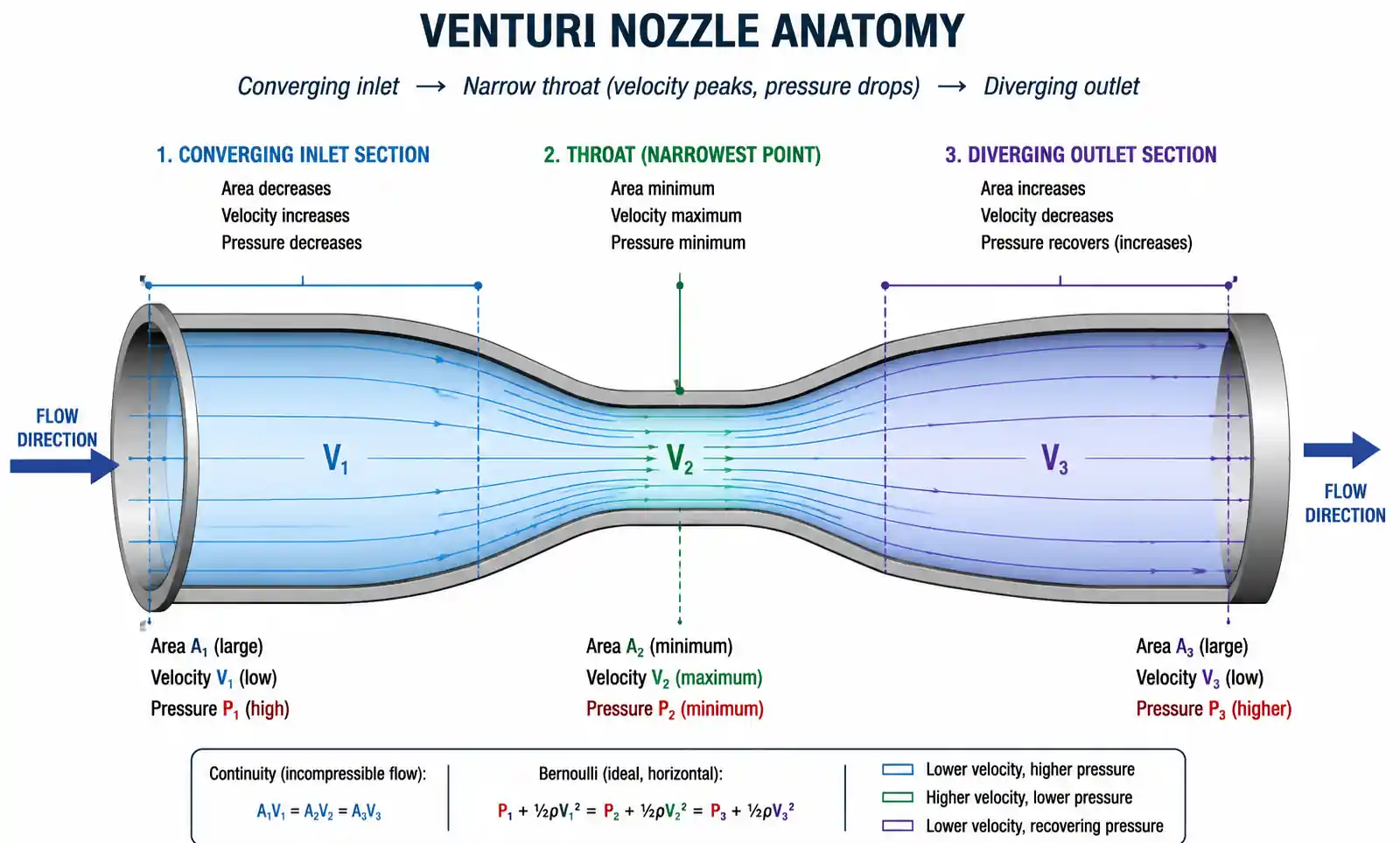
The basic structure consists of three main components:
Converging section: The inlet where fluid (air or liquid) enters and begins to accelerate as the passage narrows.
Throat: The narrowest point where velocity reaches its maximum and pressure drops to its minimum.
Diverging section: The outlet where the passage widens, velocity decreases, and pressure partially recovers.
When compressed air or fluid flows through this configuration, the constriction forces the fluid to accelerate dramatically. According to Bernoulli's principle, this velocity increase creates a corresponding pressure drop at the throat. This low-pressure zone becomes the key to the Venturi effect's cleaning power.
The pressure differential generated can be substantial. In industrial Venturi scrubbers, gas velocities at the throat typically range from 100 to 200 meters per second, with some advanced systems reaching velocities up to 1200 m/s. This creates a powerful vacuum effect that pulls in surrounding air or contaminants.
2. The Science Behind Air Absorption and Mixing
The cleaning effectiveness of Venturi nozzles stems from their exceptional ability to mix fluids and create intense contact between different phases (gas-liquid, gas-solid, or liquid-solid).
Air Entrainment Mechanism
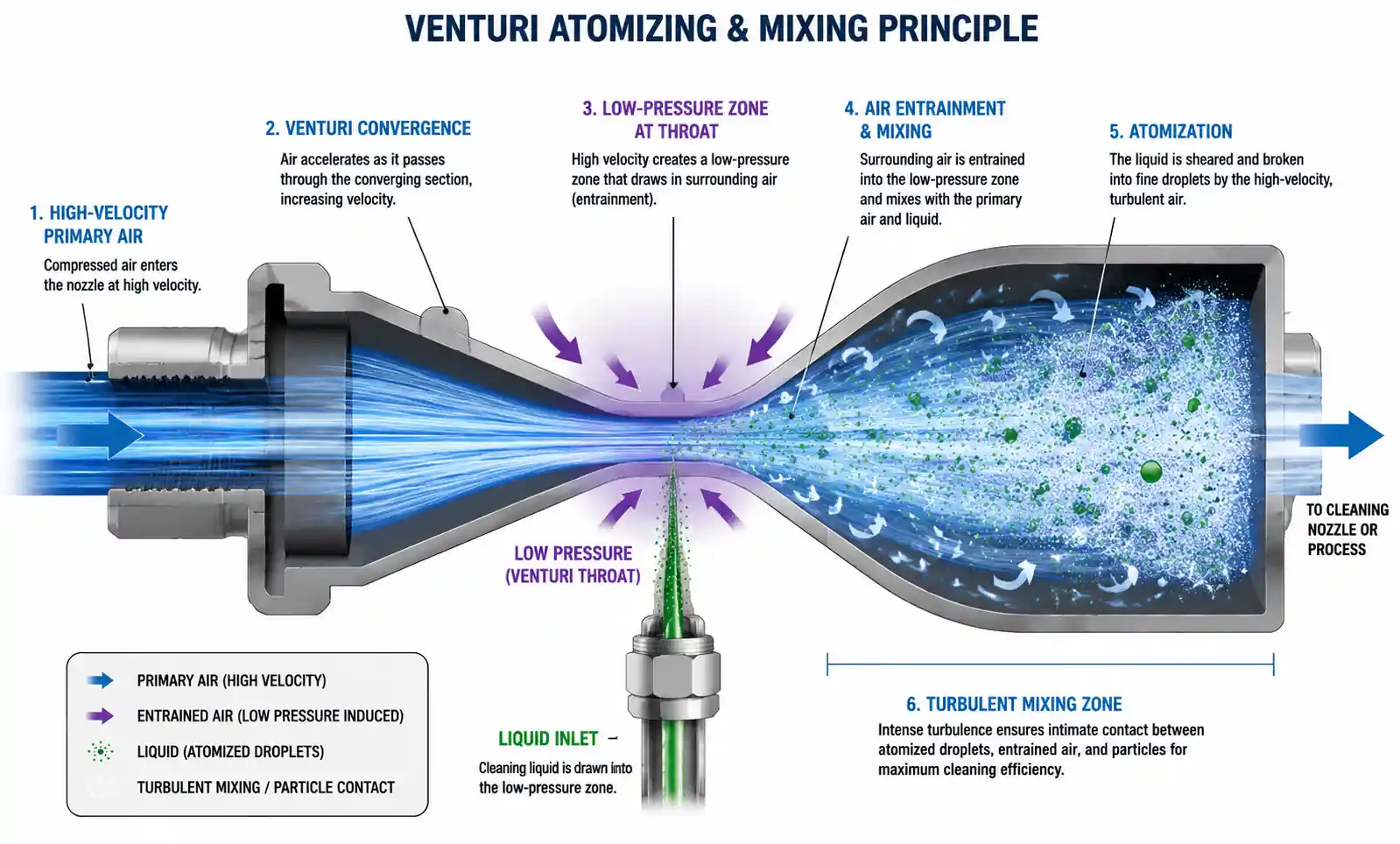
When high-velocity air exits the Venturi throat, it creates a low-pressure zone that "entrains" or sucks in surrounding atmospheric air. This air entrainment phenomenon multiplies the total airflow volume beyond what the compressed air source alone provides. The entrained air mixes turbulently with the primary airstream, creating powerful cleaning action.
Liquid Atomization Process
In wet cleaning applications, liquid introduced at the throat gets shattered into extremely fine droplets by the high-velocity gas stream. This atomization creates millions of tiny droplets with enormous combined surface area. According to research on Venturi scrubber efficiency, this maximized contact area is crucial for capturing particulates and absorbing gaseous pollutants.
The shear forces between the high-speed gas and liquid phases are intense enough to break liquid streams into mist-like droplets often smaller than 10 microns. These microscopic droplets provide exponentially more surface area for pollutants to contact compared to a simple water spray.
Turbulent Mixing Dynamics
The diverging section creates intense turbulence as the fluid decelerates. This turbulent mixing zone ensures thorough contact between contaminants and cleaning media. Particles collide with liquid droplets repeatedly, dramatically increasing capture probability through inertial impaction.
3. Key Benefits of Venturi Nozzles in Cleaning Applications
Venturi technology delivers multiple advantages that make it invaluable across industrial cleaning sectors.
Superior Particulate Capture Efficiency
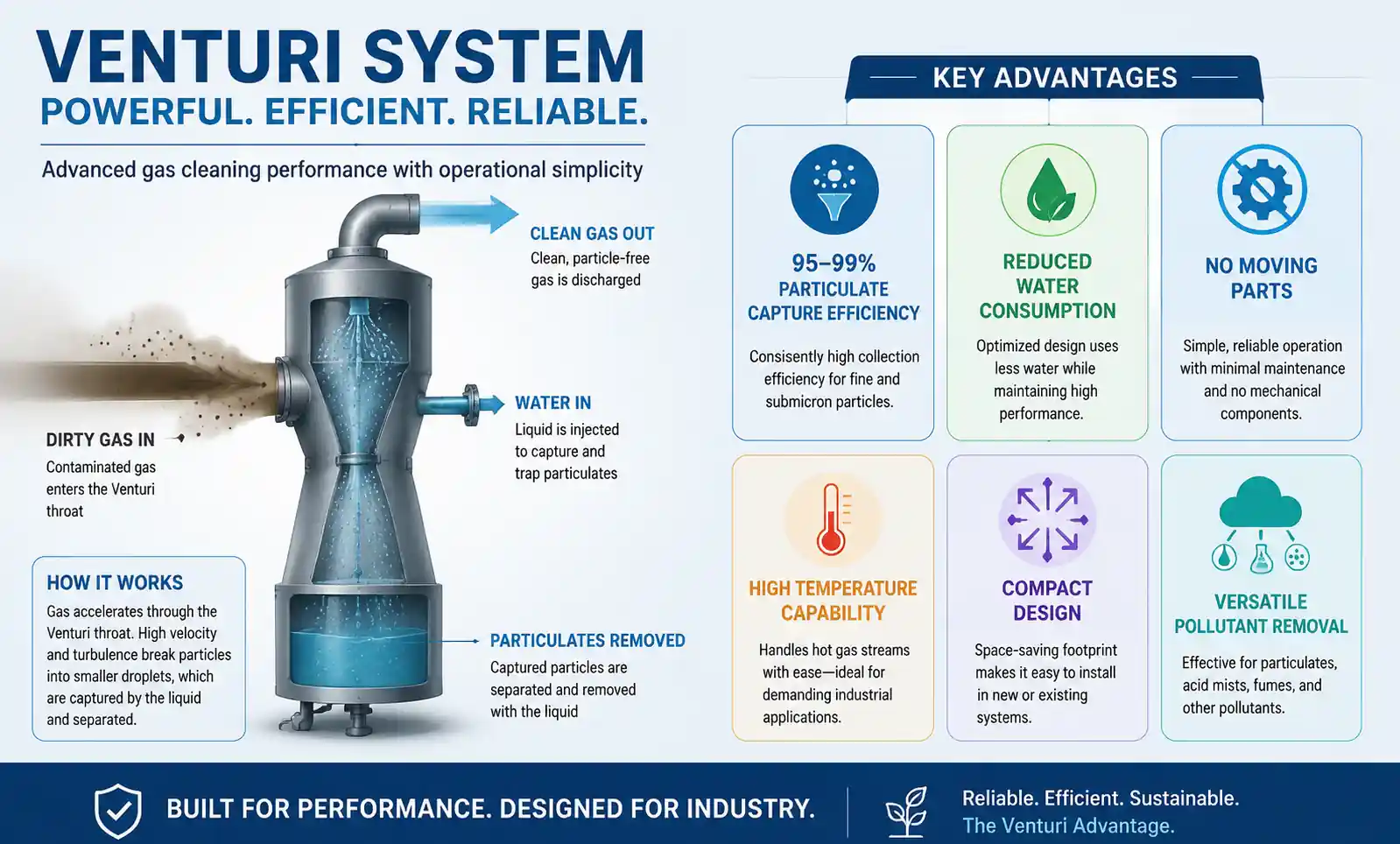
Venturi devices excel at removing fine particulate matter. Modern Venturi scrubbers achieve removal efficiencies ranging from 95% to 99%, even for submicron particles smaller than 1 micron. This performance surpasses many alternative cleaning technologies, especially for challenging fine dust applications.
Reduced Water Consumption
Despite their wet operation, Venturi systems can be remarkably water-efficient. The atomization process creates such fine droplets that relatively small water volumes can treat large gas volumes. The large adsorption ratio compared to water usage enables reduced overall water consumption versus other wet cleaning methods.
No Moving Parts
Unlike mechanical vacuum pumps or fans, Venturi devices have zero moving parts. This simplicity translates to exceptional reliability, minimal maintenance requirements, and extended service life. There are no motors to burn out, no bearings to wear, and no seals to leak.
Handles High Temperatures
Venturi systems can process hot gas streams that would damage conventional equipment. They're commonly used to clean exhaust gases exceeding 500°C, with the liquid injection providing simultaneous cooling.
Compact Footprint
The simple tube design occupies minimal space compared to alternative pollution control equipment. This makes Venturi systems ideal for retrofits and space-constrained installations.
Versatile Pollutant Removal
A single Venturi unit can simultaneously remove both particulate matter and gaseous pollutants, providing dual-action cleaning. This versatility eliminates the need for multiple separate treatment systems.
4. Industrial Applications and Use Cases
Venturi nozzle technology serves diverse industries requiring effective air cleaning and vacuum generation.
Manufacturing and Metalworking
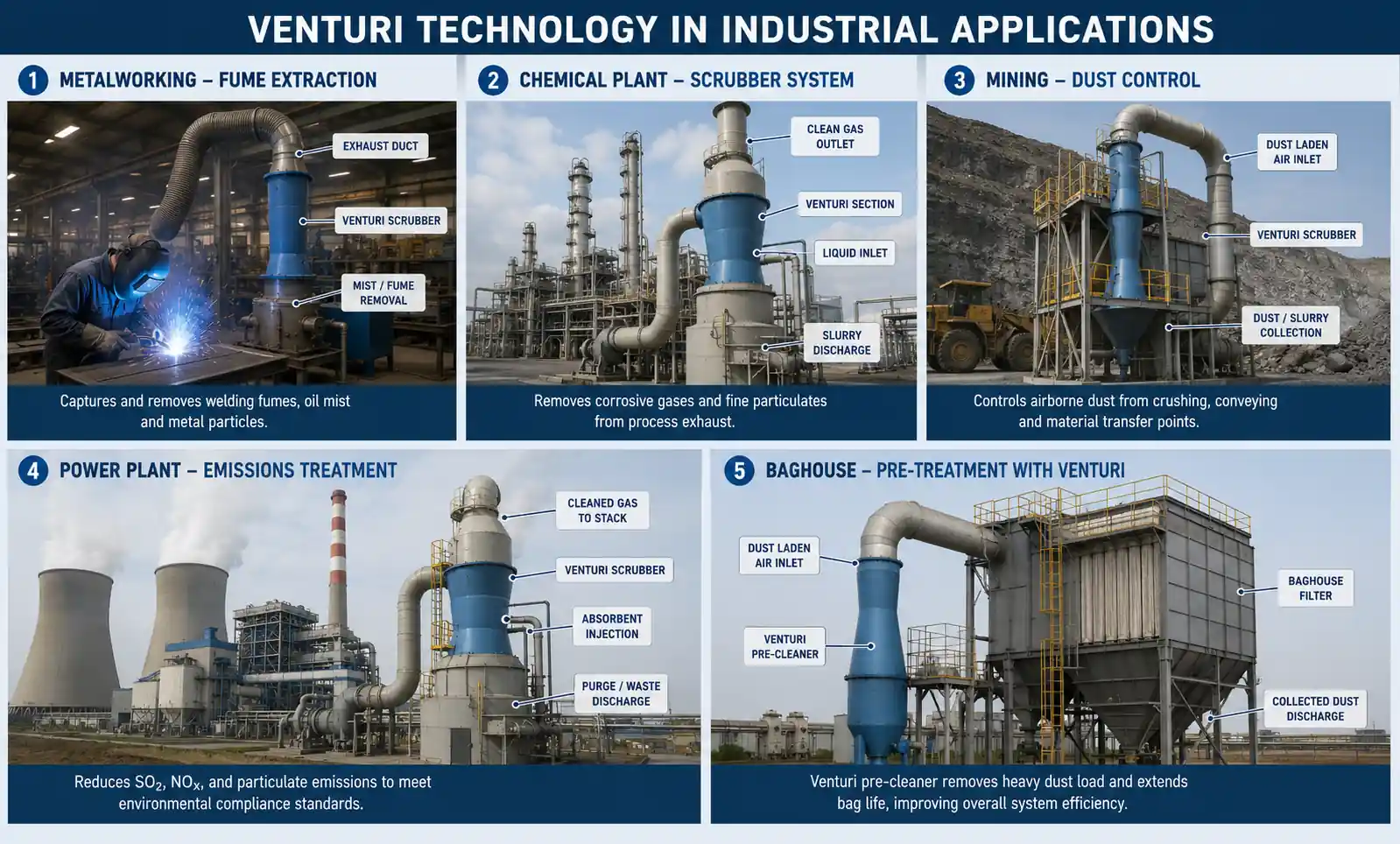
Metal fabrication generates welding fumes, grinding dust, and cutting fluid mists. Venturi scrubbers capture these contaminants before they can harm workers or escape to the environment. Food processing facilities use Venturi vacuum systems for sanitary material handling that meets strict hygiene standards.
Chemical Processing
Chemical plants deal with corrosive gases, toxic vapors, and reactive compounds. Venturi scrubbers effectively remove hazardous materials including HCl, Cl₂, NH₃, SO₂, and various organic vapors. The simple design withstands corrosive environments that would quickly destroy mechanical equipment.
Mining and Cement Production
These dusty industries generate massive quantities of respirable silica dust and other hazardous particulates. Venturi systems provide robust, reliable dust control that operates continuously in harsh conditions.
Power Generation
Coal and biomass-fired power plants use Venturi scrubbers for flue gas desulfurization, removing SO₂ before emissions enter the atmosphere. The systems can handle the enormous gas volumes these facilities produce.
Waste Incineration
Incinerators burning municipal solid waste or hazardous materials produce acidic gases and toxic particulates. Multi-stage Venturi systems provide effective emissions control to meet stringent environmental regulations.
Pulse Jet Baghouses
Research shows that incorporating Venturi structures in baghouse pulse jet cleaning systems improves pressure distribution near filter bag mouths. This extends cleaning cycles, reduces energy consumption, and lowers dust emission concentrations.
5. Venturi Scrubbers: High-Efficiency Particulate Removal
Venturi scrubbers represent the most common industrial application of Venturi air mixing technology for cleaning contaminated gas streams.
Operating Principle
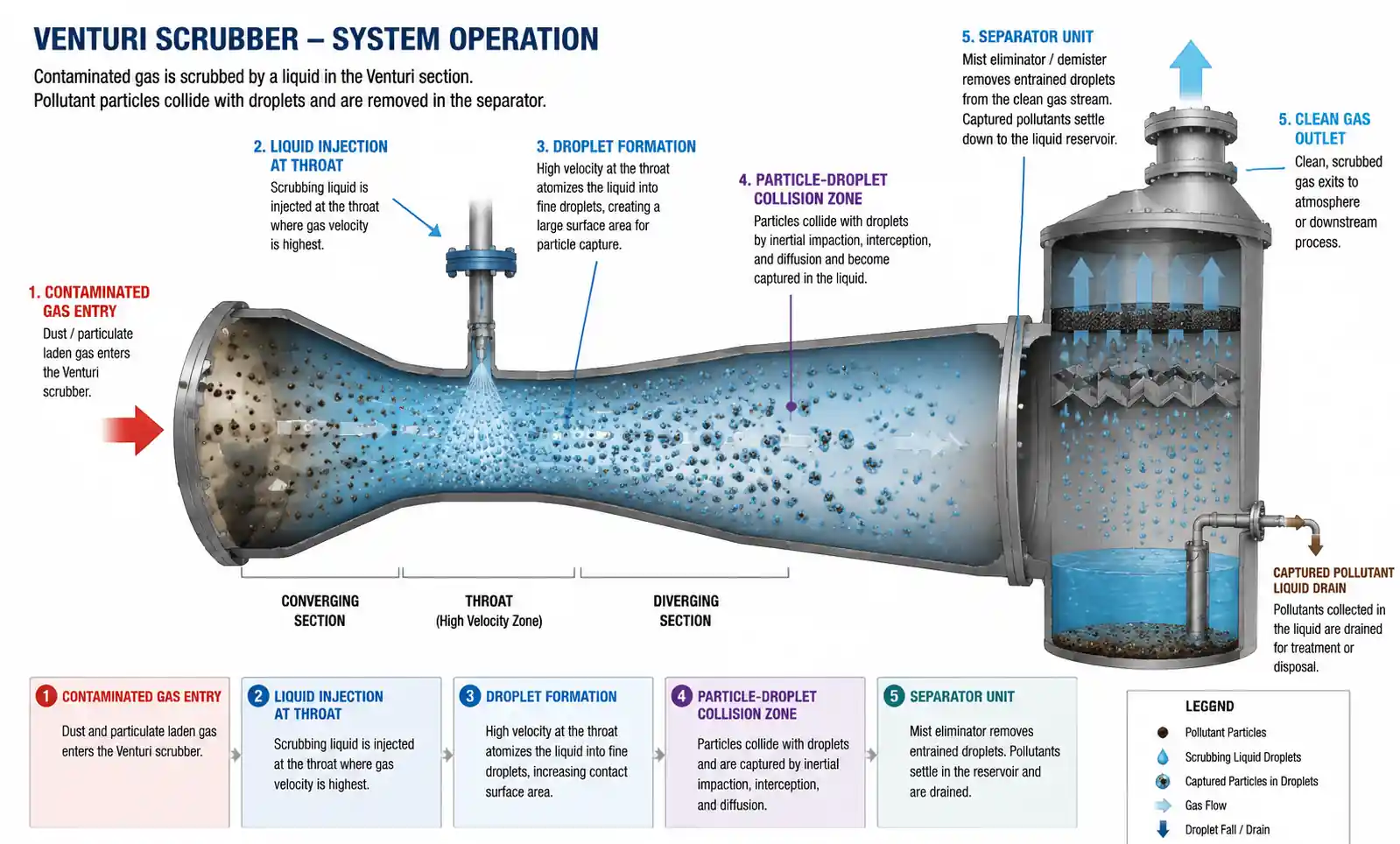
Contaminated gas enters the converging section and accelerates toward the throat. Scrubbing liquid (typically water or chemical solution) is injected around the throat perimeter. The high-velocity gas stream atomizes the liquid into fine droplets. Pollutant particles collide with and adhere to these droplets through inertial impaction. The particle-laden droplets then travel to a separator (typically a cyclonic separator) where they're removed from the cleaned gas stream.
Design Variations
Several Venturi scrubber types optimize performance for different applications:
Fixed throat Venturi scrubbers have a permanently sized throat optimized for specific gas flow rates and pollutant characteristics.
Variable throat Venturi scrubbers feature adjustable throat openings that allow operators to vary pressure drop and cleaning intensity based on changing operating conditions.
Ejector Venturi scrubbers use liquid jets to create the Venturi effect, eliminating the need for separate gas-moving equipment.
Multi-Vane Venturi scrubbers incorporate multiple smaller Venturi passages to improve liquid distribution and reduce overall pressure drop.
Performance Characteristics
According to comprehensive efficiency studies, Venturi scrubbers perform best on particulate matter because particles can be physically trapped through contact. They're somewhat less effective for gaseous pollutants since gases must be chemically absorbed during the relatively brief contact time.
Typical pressure drops range from 12 to 60 inches of water column (3-15 kPa), with higher pressure drops generally correlating to better collection efficiency. The tradeoff is increased energy consumption for moving gas through the system.
6. Venturi Vacuum Systems: Suction Without Motors
Compressed air-powered Venturi vacuum generators provide an elegant alternative to electric vacuum pumps for cleaning and material handling applications.
How Venturi Vacuums Work
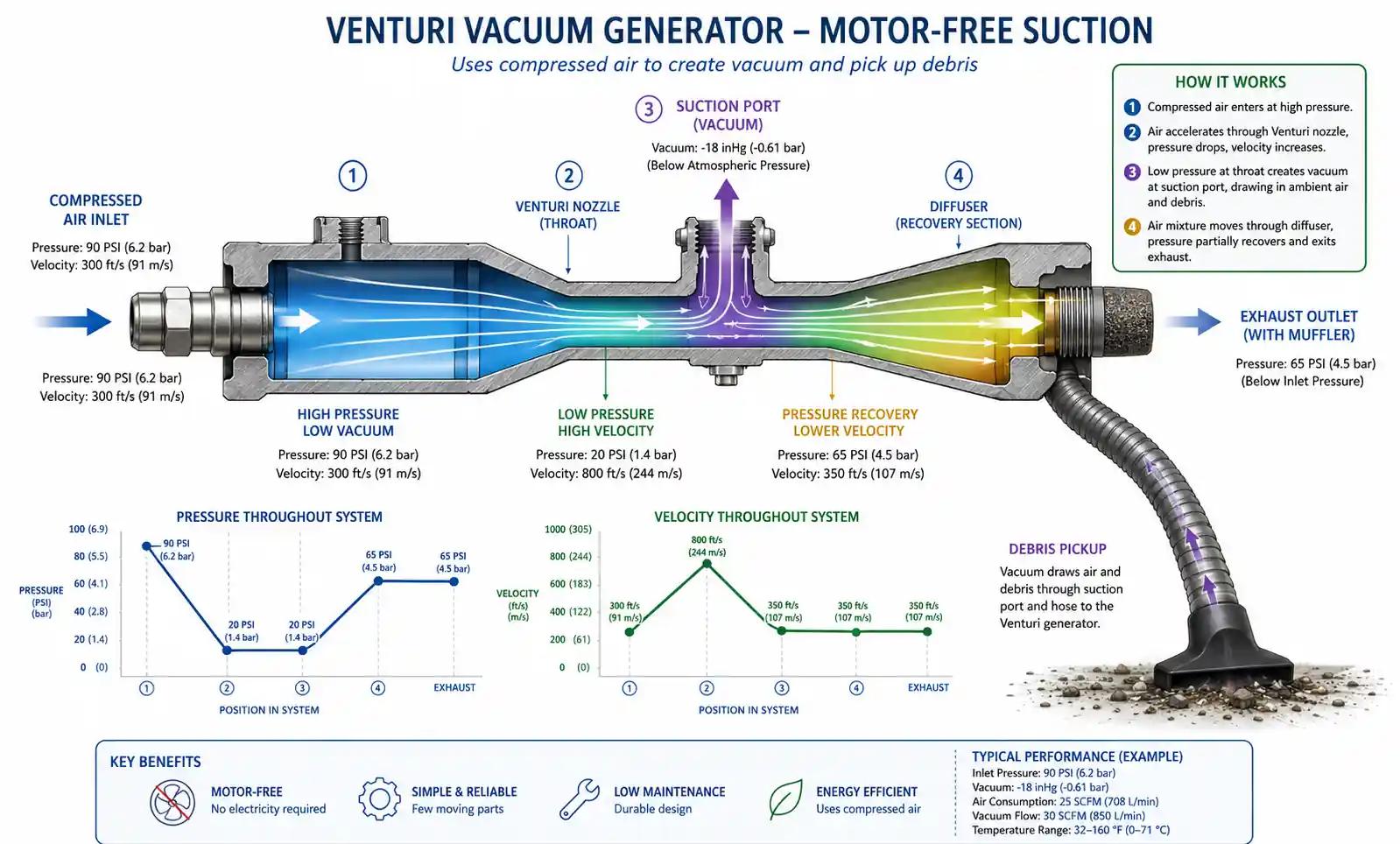
Compressed air vacuum systems operate by feeding compressed air (typically 60-90 psi) through a Venturi nozzle. The high-velocity air exiting the throat creates a vacuum at a suction port. This vacuum can then pick up debris, convey materials, or hold workpieces.
The vacuum generated depends on the nozzle design and compressed air pressure. Industrial Venturi vacuum generators can achieve vacuum levels from 15 to 27 inches of mercury (50-90 kPa below atmospheric pressure).
Advantages for Cleaning Applications
Intrinsically safe: No electrical components means no ignition risk in flammable environments.
Lightweight and portable: Venturi vacuum tools are far lighter than equivalent electric vacuums.
Instant on/off: No motor warmup or cooldown required.
Handles liquids: Unlike electric vacuums, Venturi systems can safely pick up wet materials without damage.
Performance Considerations
The Venturi effect in vacuum applications requires careful design balance. While narrow restrictions create stronger vacuum, excessive constriction can actually reduce effective cleaning power by limiting airflow volume at the pickup point.
For optimal performance on materials like sand, dust, and pet hair, the system needs both adequate vacuum pressure AND sufficient air volume. Overly restrictive nozzles may generate high static vacuum but lack the airflow needed to actually move debris.
7. Performance Factors and Optimization
Several variables determine how effectively a Venturi system cleans in any given application.
Gas Velocity and Pressure Drop
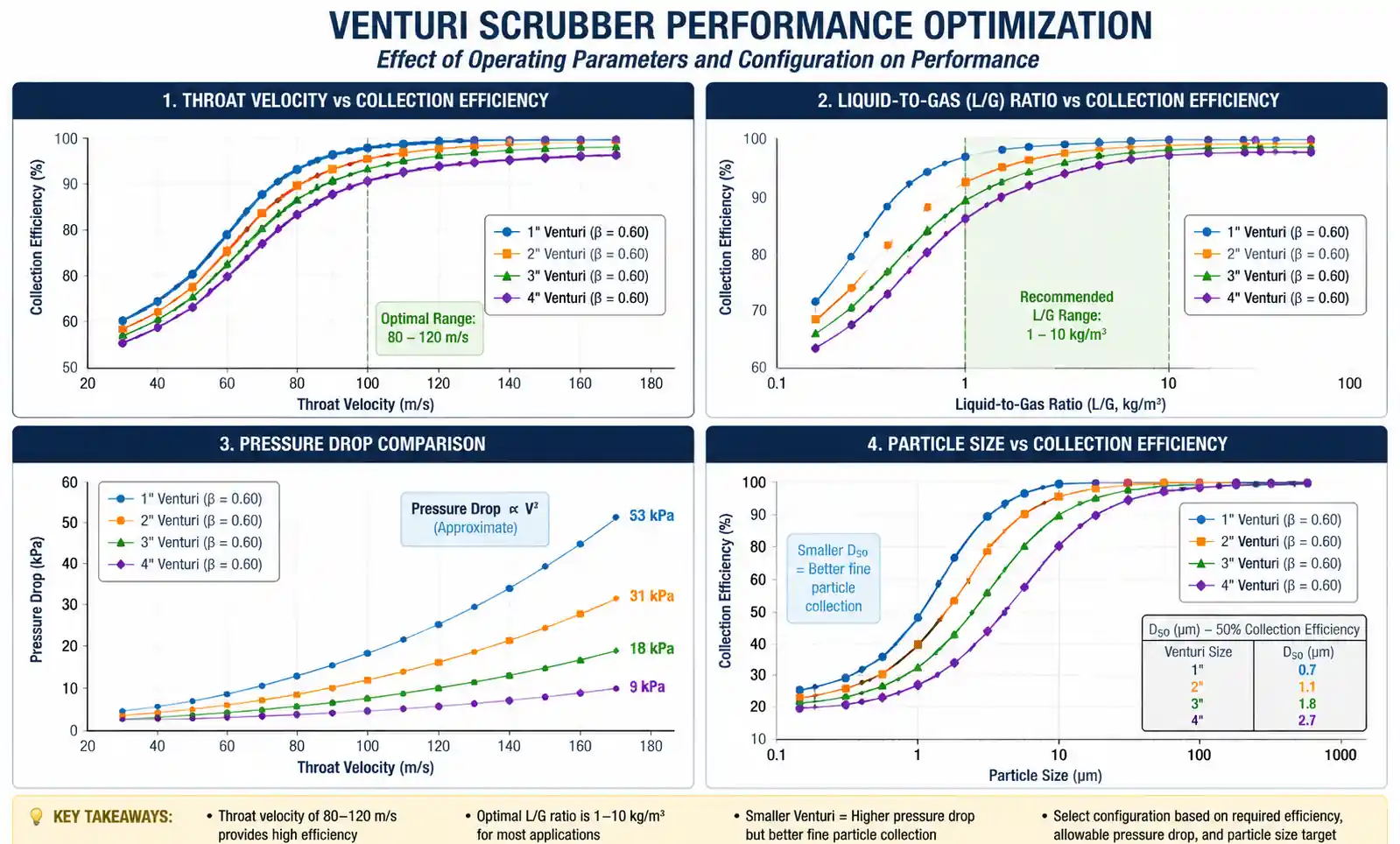
Higher throat velocities generally improve cleaning efficiency by creating finer liquid droplets and more energetic particle-droplet collisions. However, this requires greater pressure drop, which increases energy consumption.Optimizing Venturi scrubber designinvolves balancing efficiency against operating costs.
Liquid-to-Gas Ratio
The volume of scrubbing liquid relative to gas flow significantly impacts performance. Too little liquid provides insufficient collection surface area. Excess liquid wastes water and increases disposal costs without proportional efficiency gains. Optimal L/G ratios typically range from 0.5 to 2.0 liters per cubic meter, depending on the application.
Throat Diameter and Length
Smaller throat diameters create higher velocities but also higher pressure drops. Throat length affects the duration of the high-velocity mixing zone. Longer throats improve efficiency but increase system size and pressure loss.
Liquid Injection Method
How scrubbing liquid enters the system affects atomization quality. Common methods include:
- Radial injection through holes around the throat perimeter
- Upstream flooding where liquid flows down the converging section walls
- Spray nozzles that pre-atomize liquid before the throat
Particle Characteristics
Venturi systems handle particles across a wide size range, but efficiency varies. Larger particles (>5 microns) are captured easily through inertial impaction. Smaller submicron particles require higher velocities and longer contact times for effective collection.
Chemical Enhancement
Adding surfactants or reactive chemicals to scrubbing liquid can dramatically improve performance for specific pollutants. Caustic solutions neutralize acidic gases. Oxidizing agents convert gaseous pollutants to particles that are then captured.
8. Comparing Venturi Systems to Traditional Cleaning Methods
Understanding how Venturi technology stacks up against alternatives helps identify the best solution for specific applications.
Venturi vs. Cyclone Separators
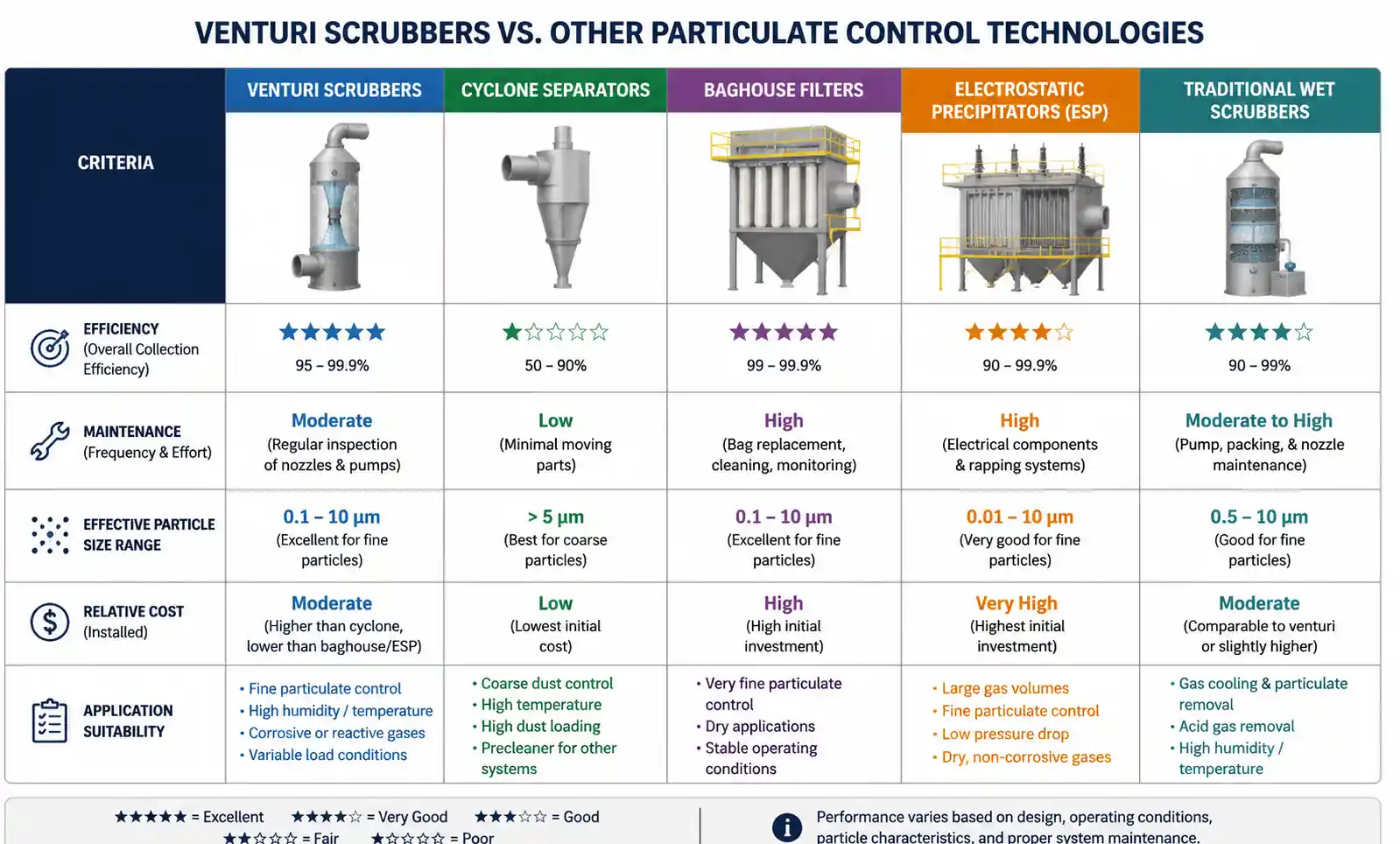
Cyclones use centrifugal force to separate particles from gas streams. They handle larger particles efficiently with low pressure drop and minimal maintenance. However, cyclones struggle with fine particulates below 5 microns where Venturi scrubbers excel. Many systems use cyclones as pre-cleaners upstream of Venturi units, or as droplet separators downstream.
Venturi vs. Baghouse Filters
Fabric filter baghouses provide excellent fine particle collection without water usage. They can't handle sticky or hygroscopic materials that would blind fabric bags. They also can't cool hot gases or remove gaseous pollutants. Venturi scrubbers complement baghouses in two-stage systems - the scrubber cools and conditions the gas stream while removing sticky particles, then the baghouse provides final polishing.
Venturi vs. Electrostatic Precipitators
ESPs use electrical charging to collect particles with very low pressure drop. They require significant capital investment and skilled maintenance. ESPs can struggle with high-resistivity dust or fluctuating gas conditions. Venturi scrubbers are simpler, more robust, and better suited to small-to-medium scale applications or where moisture content would disrupt ESP operation.
Venturi vs. Traditional Wet Scrubbers
Packed bed scrubbers and spray towers operate at lower pressure drops than Venturi units. They generally capture larger particles and absorb gases more effectively due to longer residence times. However, they require more space and have moving parts (pumps, nozzles) requiring maintenance. Venturi scrubbers provide more compact, simpler systems when high particulate capture efficiency is the priority.
9. Maintenance and Operational Considerations
While Venturi systems are low-maintenance, proper care ensures optimal long-term performance.
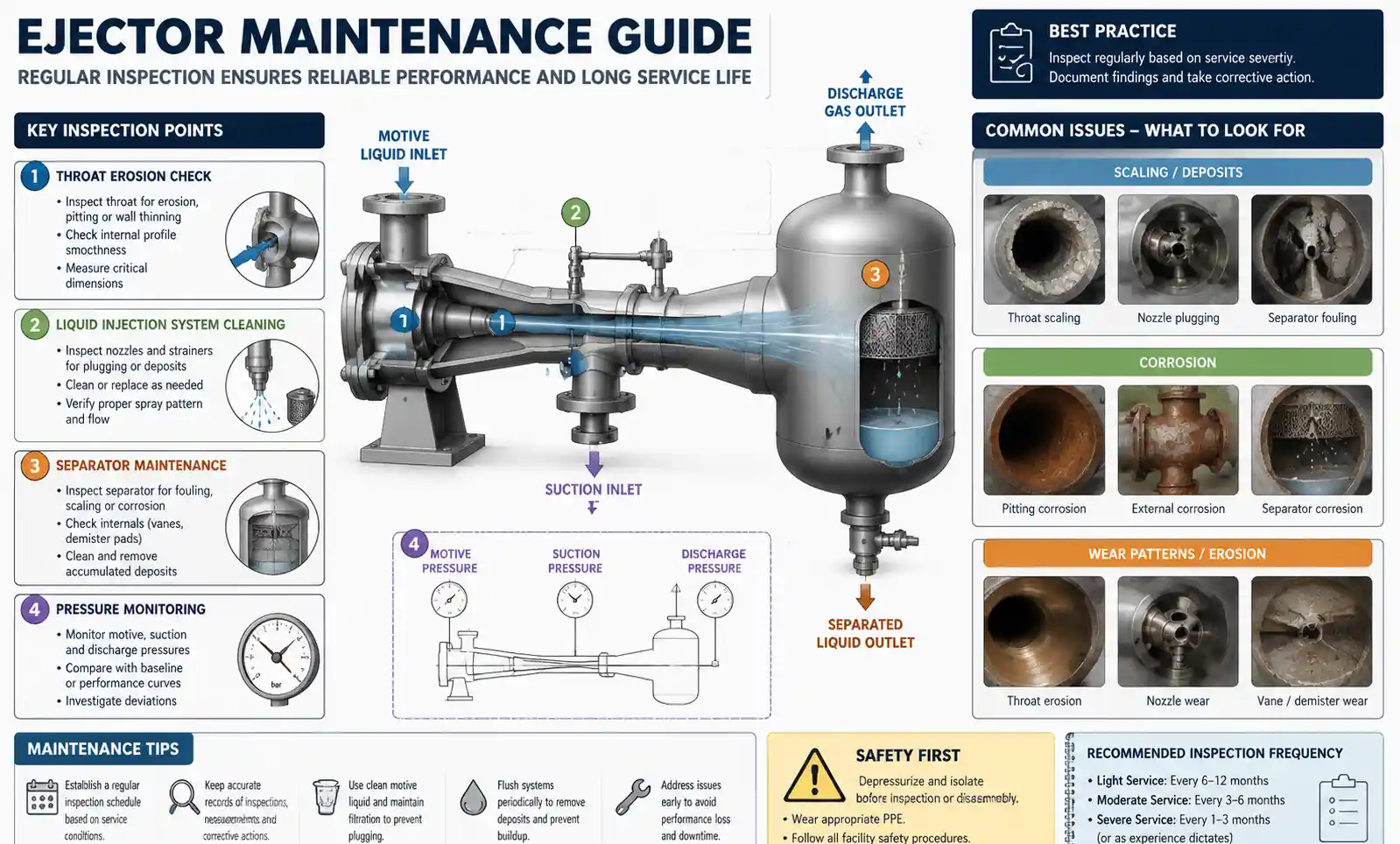
Routine Maintenance Tasks
Throat inspection: Periodically check for erosion, corrosion, or buildup that could alter throat dimensions and reduce efficiency. Abrasive particles can erode throat walls over time, especially at high velocities.
Liquid system maintenance: Clean spray nozzles or injection ports to prevent clogging. Monitor liquid flow rates to ensure proper L/G ratios.
Separator maintenance: Empty droplet separators regularly and check eliminator elements for fouling.
Pressure monitoring: Track pressure drop across the system. Increases may indicate throat restrictions or downstream blockages.
Common Operational Issues
Scaling and deposition: Dissolved minerals in scrubbing water can precipitate and form scale, particularly when cleaning hot gases. Use water treatment or periodic acid washing to control buildup.
Erosion: High-velocity particle-laden streams gradually erode throat walls. Using abrasion-resistant materials like ceramics or carbides extends life in severe applications.
Corrosion: Acidic gases and scrubbing solutions attack metal surfaces. Select appropriate materials of construction (stainless steel, FRP, alloys) based on the specific chemical environment.
Energy Costs
The high pressure drops inherent to Venturi operation translate to significant fan or blower power requirements. Energy typically represents the largest ongoing operational cost. Optimizing throat design, considering variable-throat systems, and integrating energy recovery where possible can reduce power consumption.
Water and Waste Management
Scrubbing liquid becomes laden with captured pollutants and must be treated before discharge or recycling. Factor in water supply costs, wastewater treatment expenses, and any solid waste disposal requirements when evaluating total cost of ownership.
Conclusion
Venturi nozzles harness fundamental fluid dynamics to deliver exceptional cleaning performance through air absorption and mixing. By creating high-velocity flows and low-pressure zones, these elegantly simple devices atomize liquids, entrain air, and generate powerful suction - all without moving parts.
From industrial air pollution control removing submicron particles at 99% efficiency, to portable vacuum systems providing suction in hazardous environments, Venturi technology proves its versatility daily across countless applications. The ability to handle both particulates and gases, operate at extreme temperatures, and maintain reliability in harsh conditions makes Venturi systems indispensable tools for modern industrial cleaning.
While considerations like energy consumption and liquid management require attention, the combination of high efficiency, low maintenance, compact design, and robust operation positions Venturi nozzles as a cornerstone technology for cleaning applications where performance matters most. Understanding how air absorption and mixing drive this effectiveness enables engineers and operators to optimize these systems for maximum benefit in their specific situations.