



Construction Site Dust Control: High-Pressure Misting Systems vs Fog Cannons - A Performance Comparison
Construction sites generate significant dust pollution that threatens worker health, disrupts neighboring communities, and risks regulatory penalties. Choosing the right dust suppression system directly impacts project safety, compliance, and operational efficiency. This comprehensive guide compares high-pressure misting systems and fog cannons to help you select the optimal solution for your construction site.
Table of Contents
- 1. 1. Understanding Construction Site Dust Challenges
- 2. 2. What Are High-Pressure Misting Systems?
- 3. 3. What Are Fog Cannons (Mist Cannons)?
- 4. 4. Key Performance Differences
- 5. 5. Coverage Area and Range Comparison
- 6. 6. Water Efficiency and Consumption
- 7. 7. Installation and Mobility Requirements
- 8. 8. Cost Analysis: Initial Investment vs Operating Expenses
- 9. 9. When to Choose High-Pressure Misting Systems
- 10. 10. When to Choose Fog Cannons
- 11. 11. Regulatory Compliance and Environmental Impact
- 12. 12. Emerging Technologies and 2026 Industry Trends
- 13. Conclusion
1. Understanding Construction Site Dust Challenges
Construction dust contains harmful particulate matter including PM10 and PM2.5 particles—fine enough to penetrate deep into human lungs. These particles originate from excavation, demolition, material handling, and vehicle movement across unpaved surfaces.
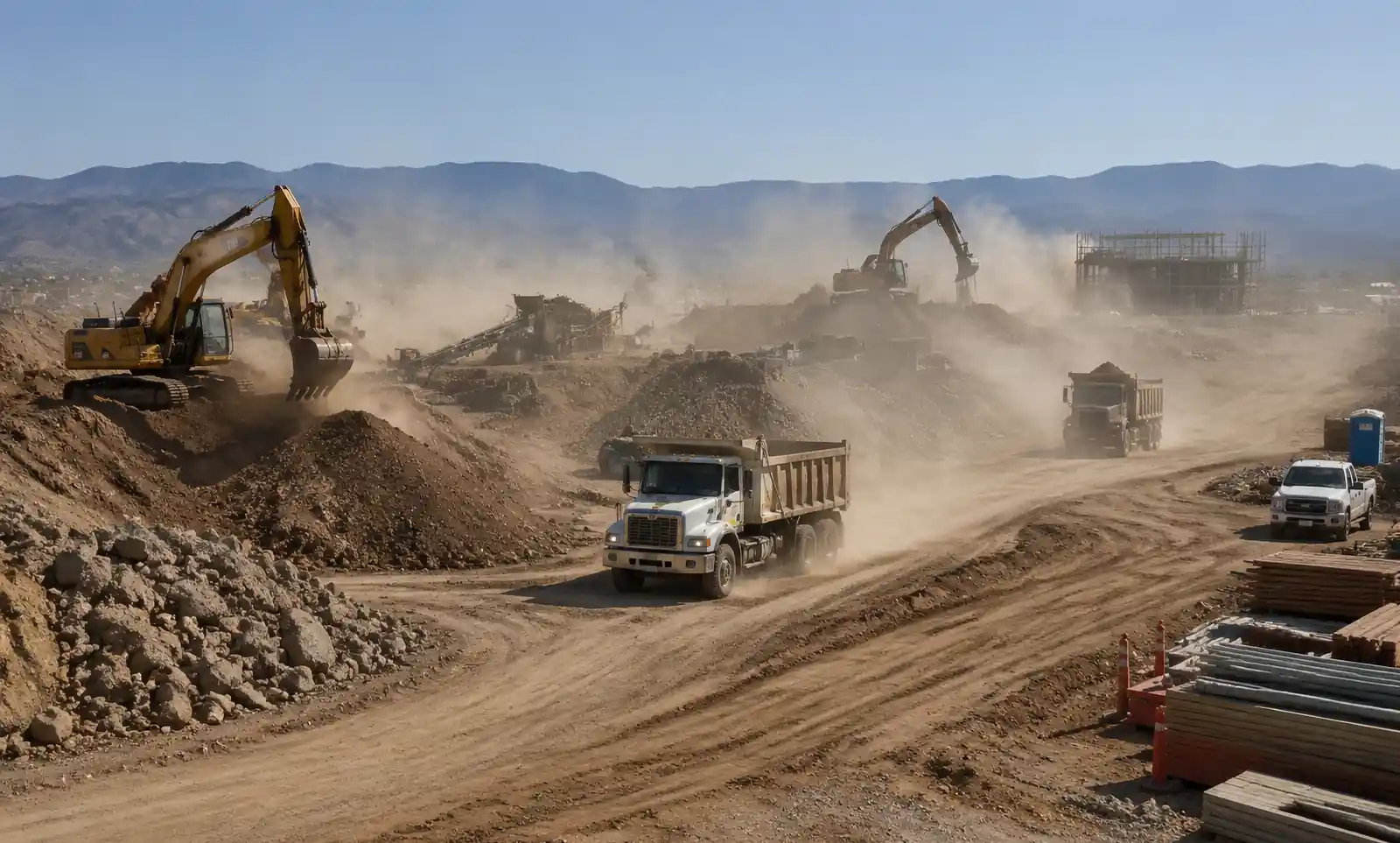
The health consequences are serious. Prolonged exposure causes respiratory diseases, aggravates asthma, and increases cardiovascular risks. Beyond health concerns, uncontrolled dust reduces equipment lifespan through filter clogging and abrasive wear, while also creating visibility hazards.
Regulatory agencies worldwide have tightened dust emission standards. Construction managers face mounting pressure to implement effective suppression systems that protect workers, satisfy compliance requirements, and maintain good community relations.
2. What Are High-Pressure Misting Systems?
High-pressure misting systems pressurize water to approximately 70 bar (1000 PSI), forcing it through specialized nozzles that create ultra-fine droplets measuring 10-50 microns. These microscopic water particles remain suspended in air, binding with dust through collision and coalescence.
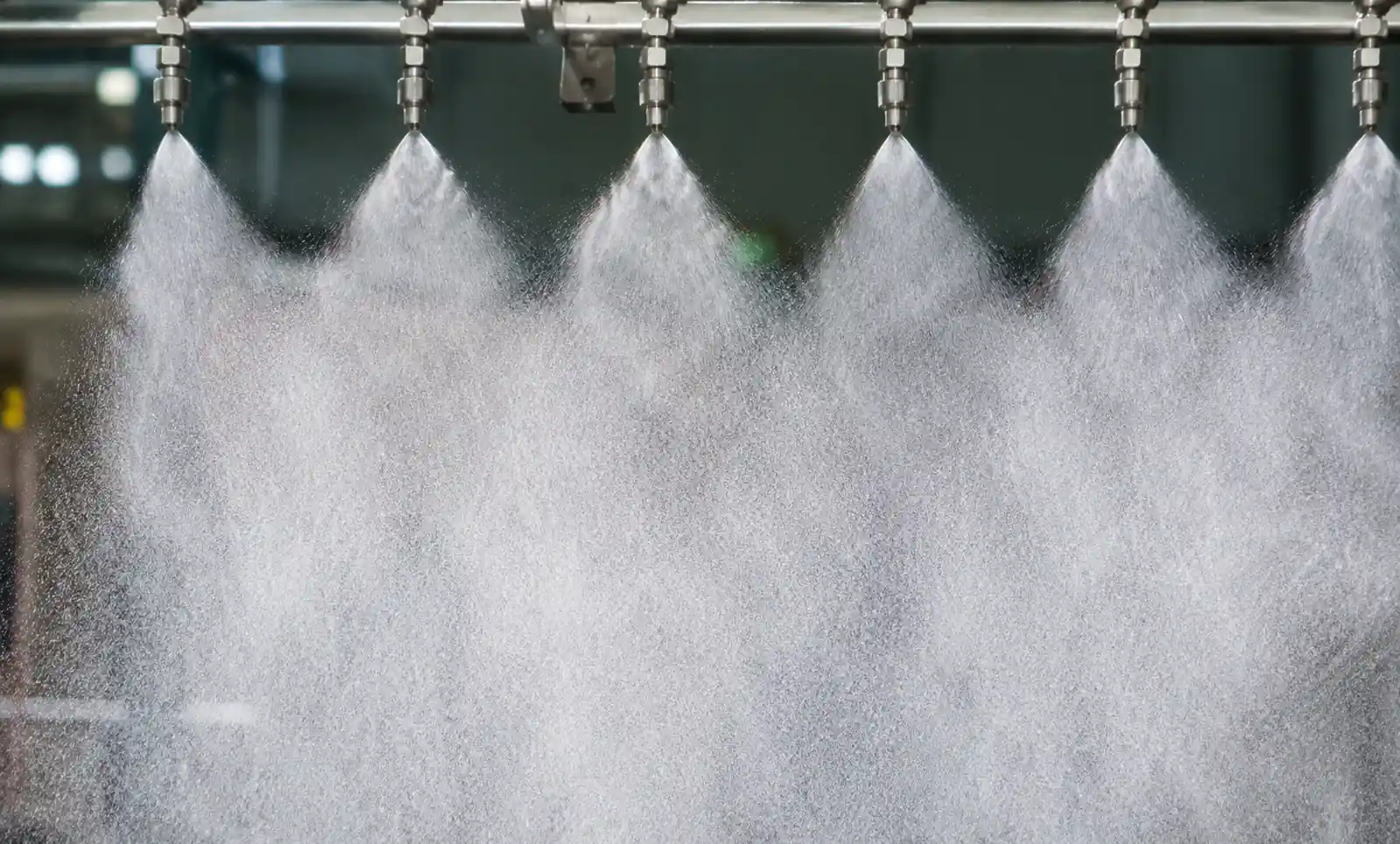
The technology operates through fixed pipelines or portable units positioned around dust generation points. Pumps deliver pressurized water to strategically placed nozzle arrays that generate a fine mist blanket. The system requires continuous water supply and electrical power for pump operation.
These systems excel in controlled environments where precise dust suppression is needed without excessive water application. The ultra-fine droplet size maximizes surface area contact with airborne particles while minimizing ground saturation—a critical advantage for indoor or semi-enclosed construction zones.
3. What Are Fog Cannons (Mist Cannons)?
Fog cannons combine high-pressure nozzles with powerful axial fans to project water droplets across extended distances. The system atomizes water into 50-200 micron droplets, then uses fan-generated airflow to propel this mist up to 100 meters from the cannon location.
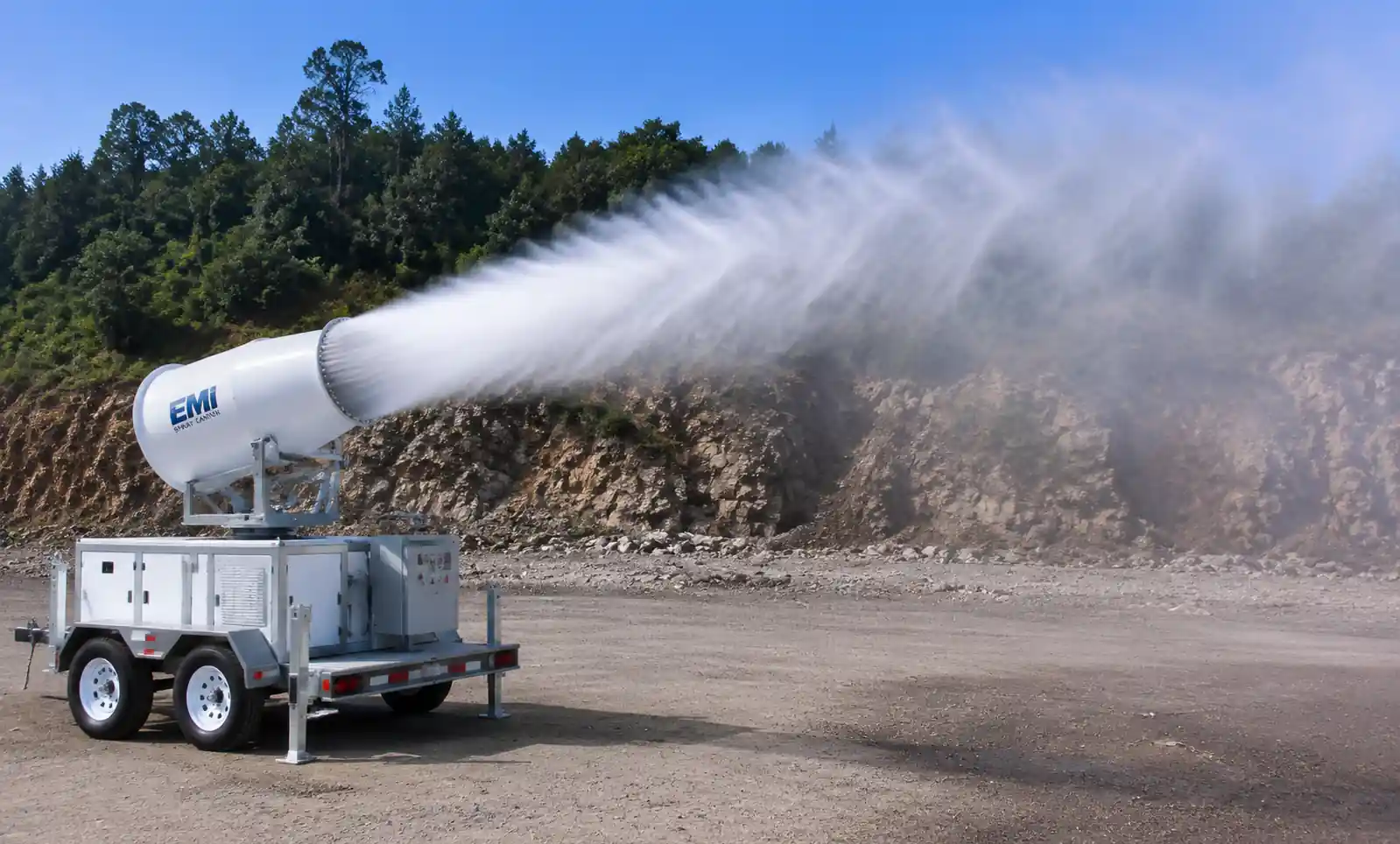
Modern fog cannons feature adjustable spray angles, variable flow rates, and remote operation capabilities. Many units mount on trailers for easy repositioning, while others integrate into fixed installations. The dual-component design—atomization plus air propulsion—enables coverage of large outdoor areas from a single deployment point.
The engineering principle matches water droplet size to target dust particles. When properly calibrated, the mist droplets collide with suspended dust, increase particle mass, and force contaminated droplets to settle harmlessly to the ground. This mid-air interception prevents dust migration beyond construction boundaries.
4. Key Performance Differences
The fundamental distinction lies in application methodology and coverage characteristics. High-pressure misting systems create localized suppression zones through fixed infrastructure, while fog cannons deliver mobile, wide-area coverage through projected mist streams.
Droplet Size and Behavior
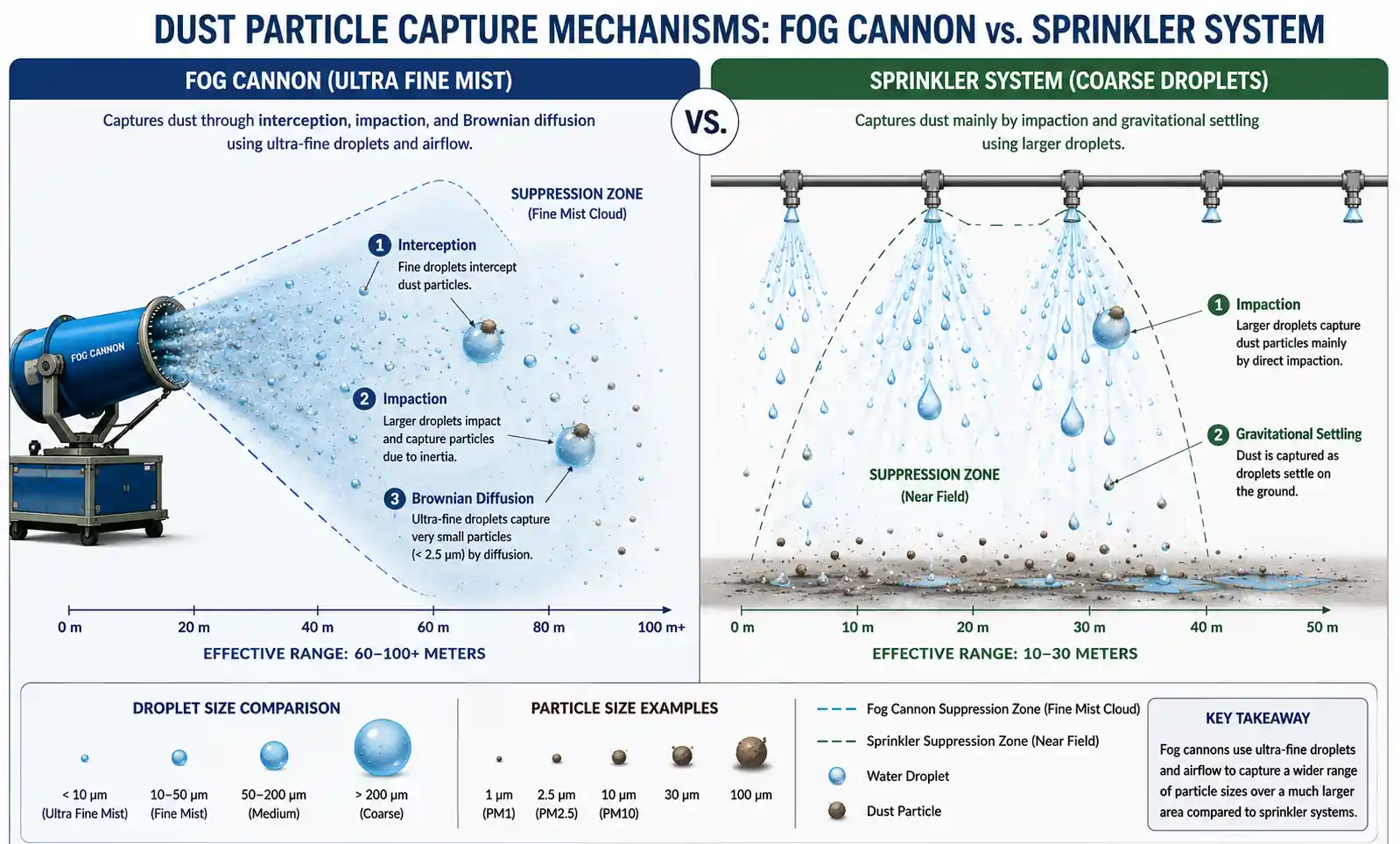
Misting systems produce smaller droplets (10-50 microns) that remain airborne longer, creating persistent dust suppression zones. Fog cannons generate slightly larger droplets (50-200 microns) with greater momentum for extended projection distance.
Dust Capture Efficiency
Both technologies effectively suppress respirable dust when properly deployed. Misting systems achieve higher capture rates in confined spaces where mist concentration remains high. Fog cannons demonstrate superior performance in open areas where wind dispersion would dilute fixed misting systems.
Operational Flexibility
Fog cannons offer rapid redeployment to follow changing dust sources—a significant advantage on dynamic construction sites. Misting systems provide continuous protection for fixed dust generation points like material transfer stations or crushing operations.
5. Coverage Area and Range Comparison
Coverage capability fundamentally differentiates these technologies. High-pressure misting systems typically cover 5-15 meters radius per nozzle array, requiring multiple installation points for large site coverage. System expansion demands additional piping, nozzles, and potentially upgraded pump capacity.
Fog cannons project mist 30-100 meters depending on fan power and nozzle configuration. A single mid-range unit covers approximately 5,000-10,000 square meters under favorable conditions. Wind significantly affects fog cannon performance—strong crosswinds reduce effective range and may disperse mist before dust capture occurs.
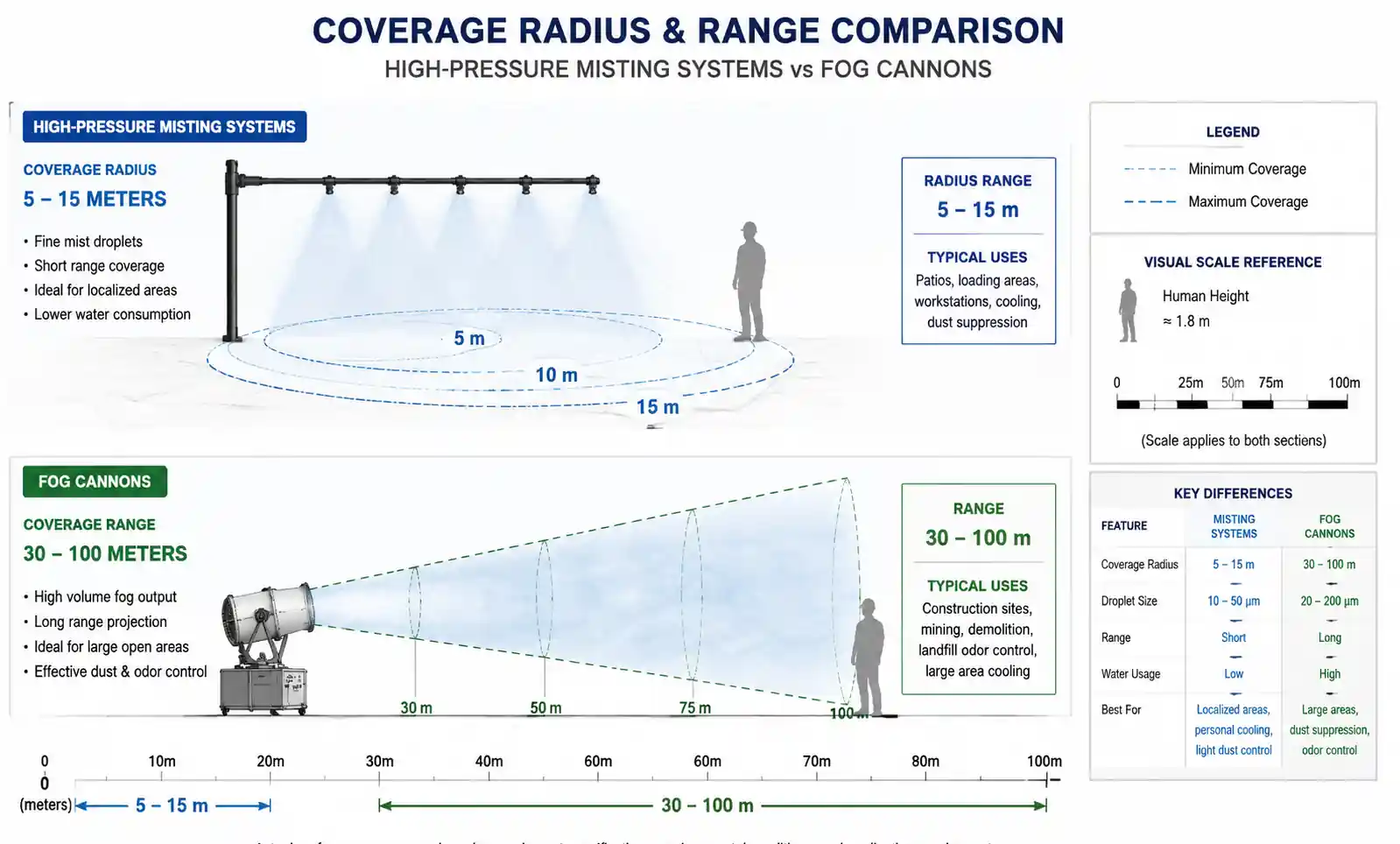
For linear applications like haul roads, fog cannons positioned at strategic intervals provide efficient coverage with minimal infrastructure. Enclosed or partially enclosed spaces favor misting systems, which maintain effective mist concentration despite limited air volume.
Site topography influences system selection. Fog cannons perform poorly when projecting uphill or against prevailing winds. Misting systems maintain consistent performance regardless of terrain since they don't rely on long-distance projection.
6. Water Efficiency and Consumption
Water consumption directly impacts operating costs and environmental sustainability. Both technologies use significantly less water than traditional sprinkler methods, but consumption patterns differ substantially.
High-pressure misting systems typically consume 5-20 liters per minute per nozzle array. A comprehensive site installation might use 50-200 liters per minute depending on coverage requirements. The ultra-fine droplets maximize dust capture per liter consumed.
Fog cannons operate at 20-120 liters per minute based on unit size and power setting. While higher than misting systems, the wide coverage area results in competitive water efficiency per square meter protected. Intermittent operation reduces consumption—many sites run fog cannons only during high dust-generation activities.
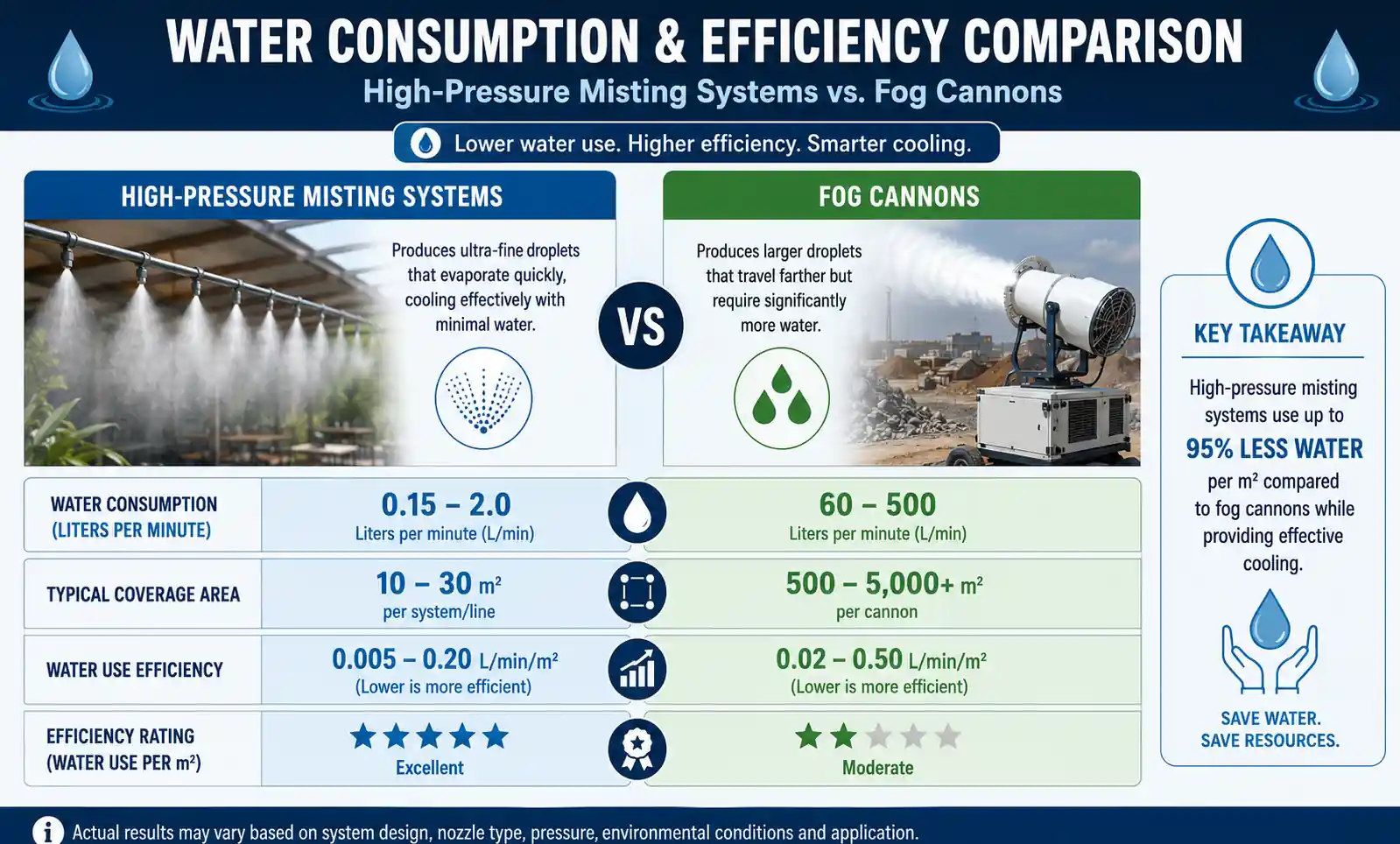
Ground saturation risks differ significantly. Misting systems rarely create muddy conditions since ultra-fine droplets evaporate quickly or bind minimal water to dust particles. Fog cannons may cause localized moisture accumulation if operated continuously in concentrated areas, though proper positioning and duty cycling prevents this issue.
Water quality requirements favor fog cannons, which tolerate higher mineral content and suspended solids. Misting system nozzles clog easily with poor-quality water, necessitating filtration systems that increase installation costs.
7. Installation and Mobility Requirements
Installation complexity and mobility capabilities strongly influence total cost of ownership and operational effectiveness.
High-Pressure Misting Systems Installation
Fixed misting systems require professional installation including water supply piping, high-pressure pump stations, electrical connections, and nozzle mounting infrastructure. Installation typically spans several days for comprehensive site coverage. The permanent infrastructure limits adaptation to changing site layouts.
Portable misting units reduce installation complexity but sacrifice coverage area and require manual repositioning. These compromise solutions suit small sites or temporary applications.
Fog Cannon Deployment
Trailer-mounted fog cannons deploy in under 30 minutes—simply position the unit, connect to water supply, and activate. No specialized installation expertise required. Single operators easily relocate cannons as construction phases progress or dust sources shift.
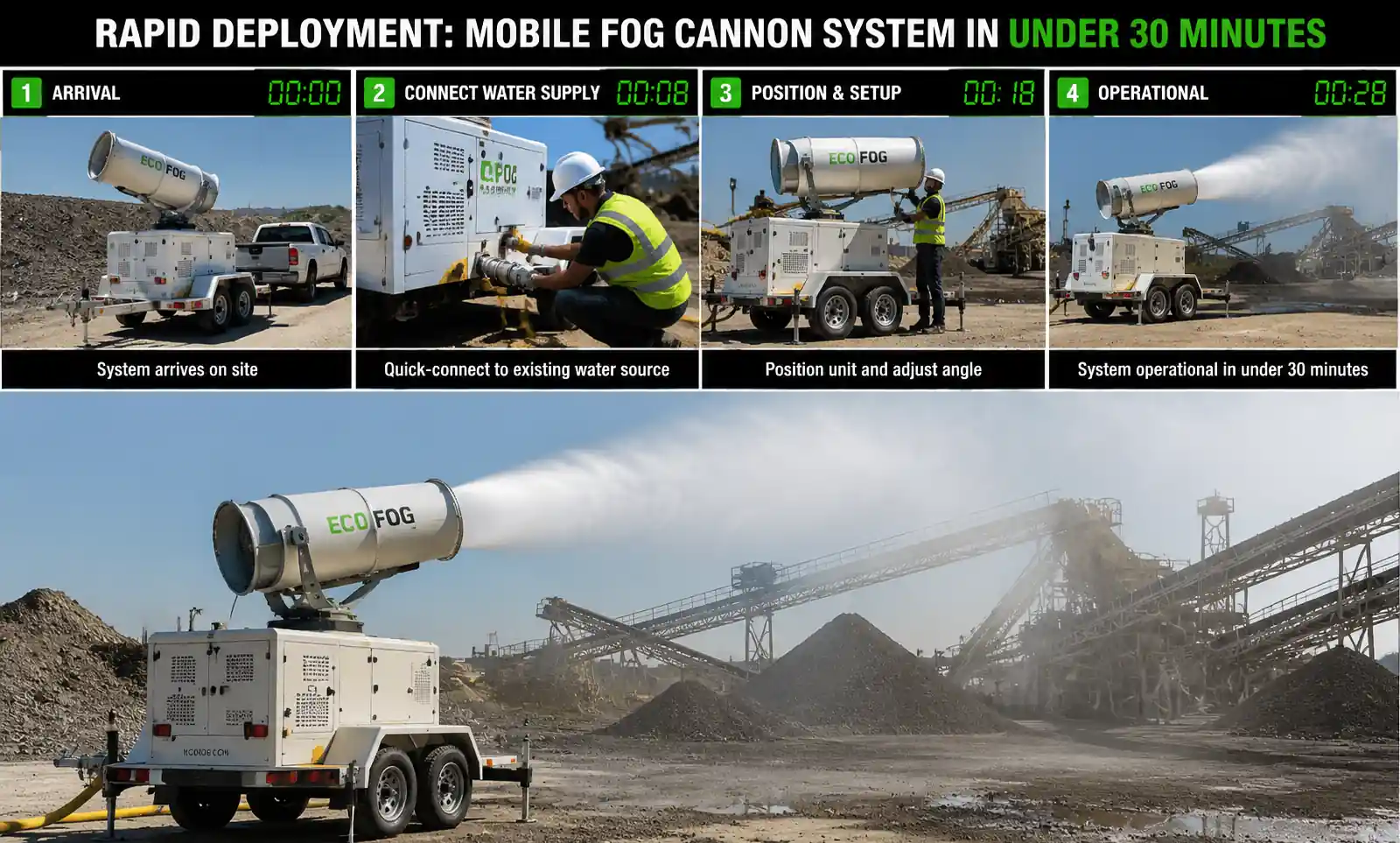
Fixed-mount fog cannons serve permanent dust sources like aggregate processing or material stockpiles. Installation remains simpler than misting systems since fog cannons are self-contained units requiring only water and power connections.
The mobility advantage makes fog cannons ideal for contractors working multiple job sites. A single unit serves sequential projects, distributing capital costs across numerous applications.
8. Cost Analysis: Initial Investment vs Operating Expenses
Understanding total cost of ownership requires examining both upfront investment and ongoing operating expenses over the equipment lifespan.
Initial Investment
High-pressure misting systems for comprehensive site coverage typically cost $15,000-$50,000 including pumps, piping, nozzles, and installation labor. Portable units start around $3,000 but provide limited coverage.
Fog cannons range from $25,000-$80,000 depending on throw distance, fan power, and features like remote control or automated oscillation. Trailer-mounted units include mobilization costs built into pricing.
Operating Costs
Electricity consumption varies significantly. Misting system pumps draw 3-10 kW continuously. Fog cannons consume 5-30 kW during operation but typically run intermittently, reducing actual energy costs.
Water costs correlate with local utility rates and consumption volumes. Neither technology dramatically outperforms the other on water expense—coverage efficiency matters more than raw consumption.
Maintenance requirements favor fog cannons. Misting system nozzles require frequent cleaning or replacement due to mineral buildup. High-pressure pumps need regular servicing. Fog cannons have fewer maintenance touchpoints beyond basic fan and pump upkeep.
Return on Investment
Both technologies deliver ROI through avoided health incidents, regulatory penalties, and equipment protection. Fog cannons typically achieve faster payback on large outdoor sites due to superior coverage efficiency. Misting systems provide better economics for permanent installations with concentrated dust sources.
9. When to Choose High-Pressure Misting Systems
High-pressure misting systems excel in specific construction scenarios where their unique characteristics provide competitive advantages.
Ideal Applications:
- Enclosed or semi-enclosed construction areas where mist containment is feasible
- Material processing operations with fixed dust generation points
- Indoor renovation and demolition projects
- Confined excavations or foundation work
- Scenarios requiring minimal ground moisture
- Projects with established utility infrastructure for easy power and water access
Performance Advantages in These Contexts:
The fine mist creates persistent suppression zones without wind-dependent performance variability. Precise nozzle placement targets specific dust sources efficiently. Minimal water runoff prevents slippery surfaces in pedestrian areas.
Project Examples:
Underground station construction benefits from misting system reliability in enclosed spaces. Industrial facility renovations leverage existing utility infrastructure for cost-effective installation. Aggregate processing plants install permanent misting systems at transfer points generating consistent dust emissions.
10. When to Choose Fog Cannons
Fog cannons represent the industry standard for large outdoor construction sites, mining operations, and demolition projects where their projection capabilities and mobility deliver maximum value.
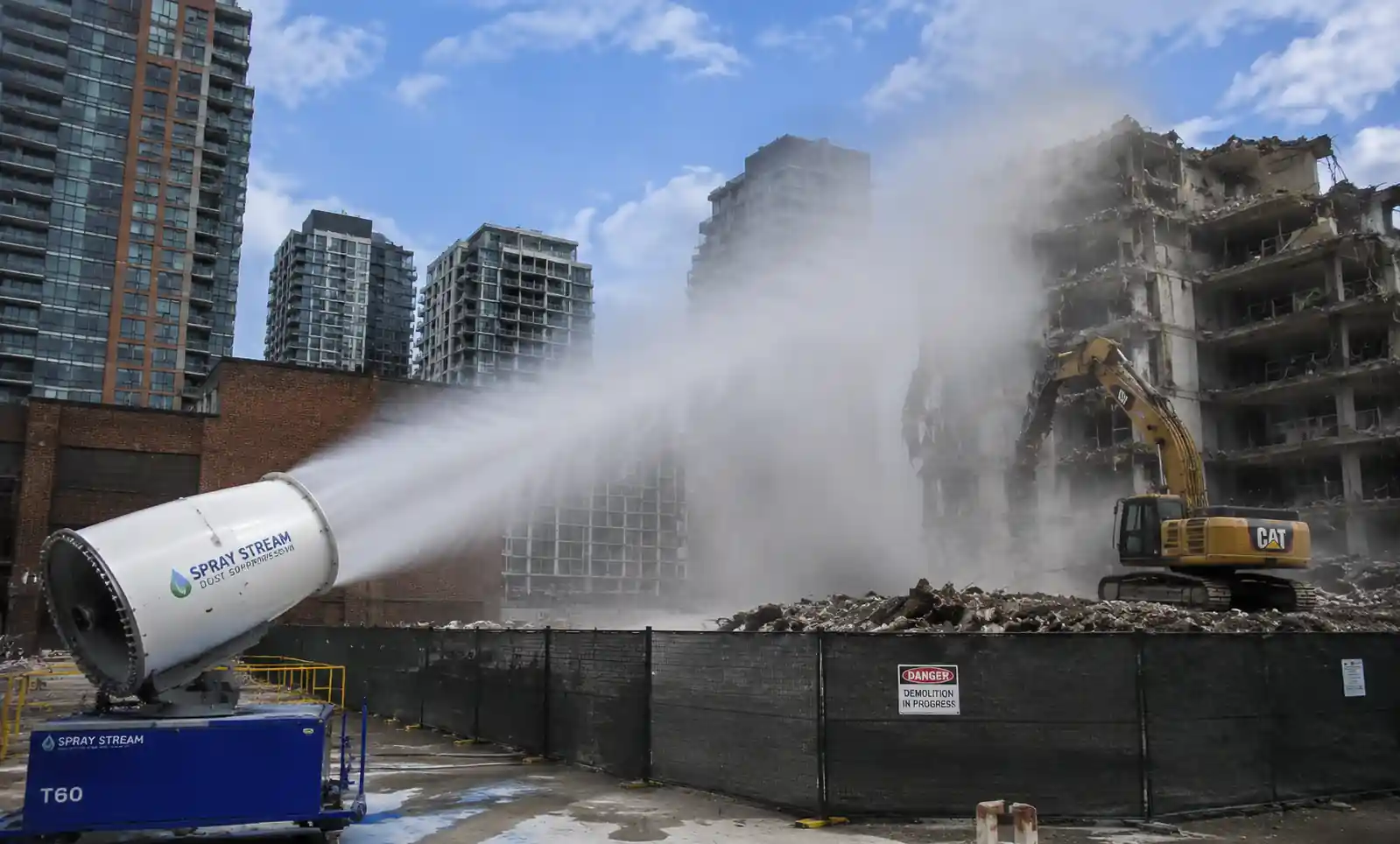
Ideal Applications:
- Open-air construction sites spanning multiple acres
- Demolition and excavation projects with shifting dust sources
- Road construction and paving operations
- Material stockpile management
- Temporary construction projects requiring mobile solutions
- Sites with limited fixed infrastructure
Performance Advantages in These Contexts:
Single units cover vast areas, reducing equipment quantity requirements. Rapid deployment enables responsive dust control as work zones change. No piping infrastructure accelerates site mobilization and demobilization. Trailer mounting facilitates multi-site equipment sharing for contractors managing simultaneous projects.
Project Examples:
Highway construction projects position fog cannons along active paving zones, relocating equipment as work advances. Urban demolition sites use fog cannons to prevent dust migration into adjacent neighborhoods. Mining operations deploy fog cannons on haul roads where vehicle traffic generates fugitive dust emissions.
Recent 2026 industry analysis confirms that progressive construction operations increasingly adopt advanced fog cannon technology as the outdoor dust suppression standard, reflecting the technology's proven performance advantages for large-scale applications.
11. Regulatory Compliance and Environmental Impact
Both technologies help construction sites meet increasingly stringent air quality regulations, though compliance strategies differ based on system selection.
Regulatory Framework
Air quality agencies worldwide regulate construction dust emissions through PM10 and PM2.5 standards. Enforcement includes periodic inspections, complaint investigations, and continuous monitoring requirements for large projects. Non-compliance results in stop-work orders, financial penalties, and reputational damage.
Modern dust suppression systems provide documented proof of compliance efforts. Many jurisdictions require dust control plans specifying equipment types, deployment strategies, and monitoring protocols before issuing construction permits.
Environmental Considerations
Water consumption represents the primary environmental concern. Both technologies use substantially less water than traditional methods while achieving superior dust suppression. Fog cannons' higher consumption rate is offset by broader coverage—total site water use may actually decrease compared to multiple misting installations.
Runoff management matters for sites near sensitive water bodies. Ultra-fine misting produces minimal runoff since droplets evaporate or bind completely with dust particles. Fog cannons require runoff controls if operated at high duty cycles in concentrated areas.
Energy consumption contributes to carbon footprint. Neither technology represents a significant energy burden relative to other construction equipment, though solar-powered options increasingly appear for both system types in remote locations.
Compliance Documentation
Modern systems offer data logging capabilities tracking runtime, water consumption, and operational parameters. This documentation supports regulatory reporting requirements and demonstrates due diligence during inspections or complaint investigations.
12. Emerging Technologies and 2026 Industry Trends
The dust suppression industry continues evolving with technological innovations enhancing performance, efficiency, and automation.
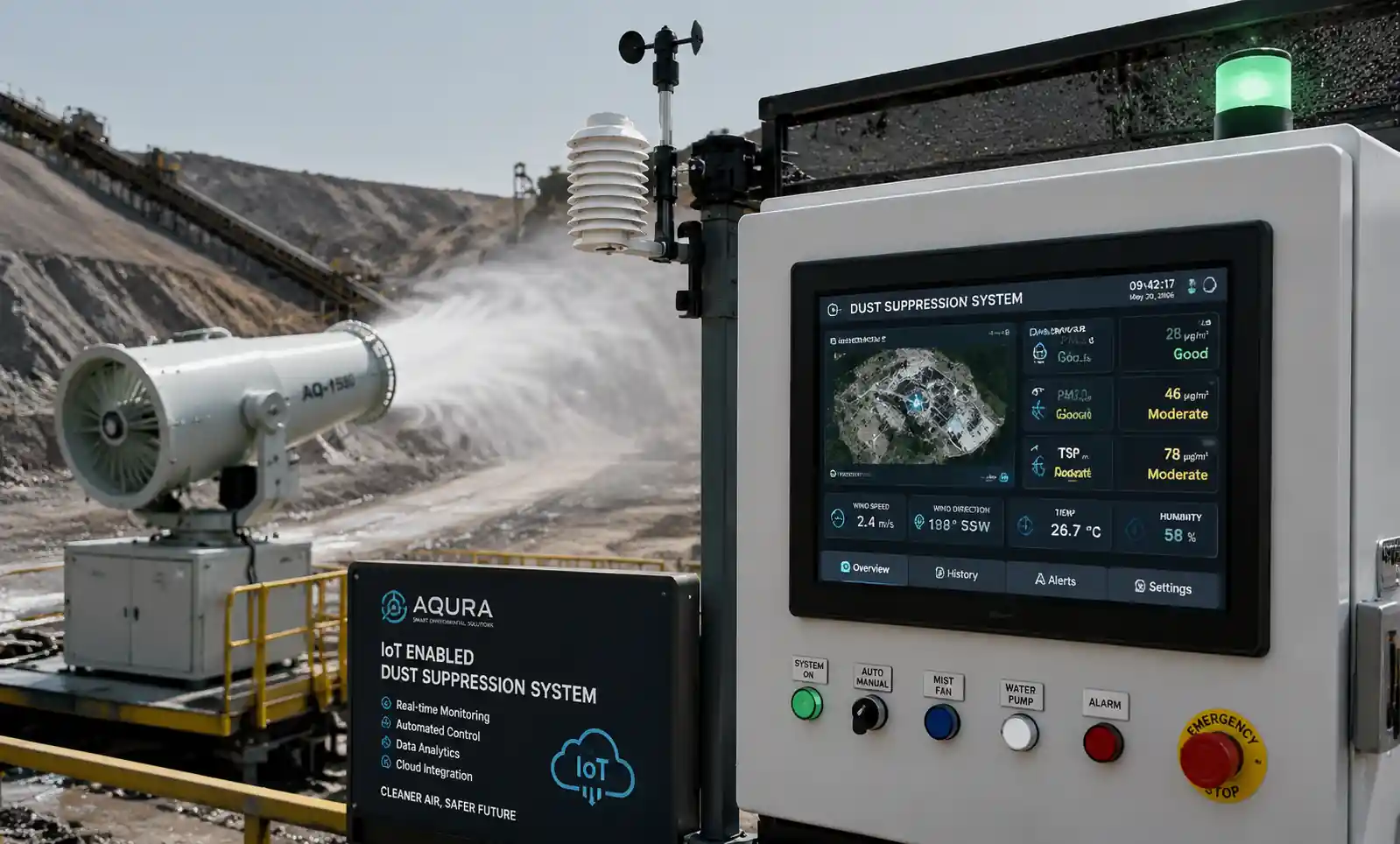
Smart Monitoring and Automation
Advanced systems integrate real-time dust sensors that automatically activate suppression equipment when particulate concentrations exceed thresholds. This responsive operation minimizes water and energy consumption while maintaining continuous compliance.
Weather station integration adjusts system operation based on wind speed, humidity, and temperature—conditions that significantly affect dust generation and suppression effectiveness. Some fog cannons now feature automated positioning that tracks wind direction to maintain optimal mist projection.
Hybrid Systems
Emerging installations combine misting systems for fixed dust sources with mobile fog cannons for area coverage. This integrated approach leverages each technology's strengths while compensating for weaknesses.
Additive Technologies
Dust suppressant additives reduce water surface tension, improving particle binding efficiency. Biodegradable polymers create temporary surface crusts on disturbed soil, preventing dust generation between active suppression periods. These additives work synergistically with both misting systems and fog cannons to extend protection duration per application.
Electrostatic Enhancement
Experimental systems charge water droplets to improve dust particle attraction and capture. While still emerging, electrostatic enhancement shows promise for ultra-fine particle suppression where conventional systems struggle.
Industry Trajectory
The 2026 construction dust control market increasingly favors fog cannons for outdoor applications based on deployment flexibility, coverage efficiency, and total cost of ownership. High-pressure misting maintains dominance in enclosed spaces and permanent industrial installations. Many large contractors now maintain both technology types, deploying systems based on project-specific requirements.
Research continues into machine learning algorithms that predict PM10 dust pollution patterns, enabling preemptive suppression activation before dust concentrations reach problematic levels. This predictive approach represents the industry's future direction—shifting from reactive dust control to proactive prevention.
Conclusion
Selecting between high-pressure misting systems and fog cannons depends on project scale, site characteristics, budget constraints, and operational priorities. Neither technology universally outperforms the other—each excels in specific contexts.
For large outdoor construction sites requiring flexible, wide-area coverage, fog cannons deliver superior performance and economics. Their mobility and rapid deployment capabilities align with dynamic construction environments where dust sources constantly shift.
For enclosed spaces, permanent installations, or applications demanding minimal water application, high-pressure misting systems provide precise, continuous dust suppression. Their fine droplet generation maximizes capture efficiency in controlled environments.
Progressive construction operations increasingly adopt a hybrid approach, maintaining both technologies and deploying systems strategically based on project phases and site conditions. This flexibility ensures optimal dust control regardless of construction activities.
As regulatory standards tighten and worker health awareness increases, effective dust suppression transitions from optional best practice to operational necessity. Both technologies offer proven pathways to compliance, safety, and environmental responsibility—the decision comes down to matching system capabilities to your specific construction challenges.