



What Is Water Hammer Effect? How to Prevent Nozzle Damage in Industrial Cleaning Systems
Water hammer—also called hydraulic shock—destroys more industrial spray nozzles than most plant managers realize. In our 15+ years of supplying high-performance industrial cleaning nozzles, we have seen water hammer reduce nozzle lifespan by 40–60%, trigger unscheduled downtime, and crack orifices rated for 500 bar. If your high-pressure cleaning system suffers from mysterious nozzle fractures, uneven spray patterns, or recurring seal failures, the root cause is rarely the nozzle itself. It is the pressure surge rippling through your piping.
This guide explains the physics of water hammer in industrial cleaning systems, quantifies its damage potential, and provides a systematic prevention framework that protects your nozzles, cuts maintenance costs, and stabilizes cleaning performance.
Featured Snippet Water hammer is a pressure surge caused by sudden deceleration of fluid in a pipe—such as rapid valve closure or pump shutdown—creating shockwaves up to 10× normal operating pressure that can crack nozzle orifices, erode internal flow channels, and destroy spray pattern integrity.
1. Orifice Cracking & Fatigue Fracture
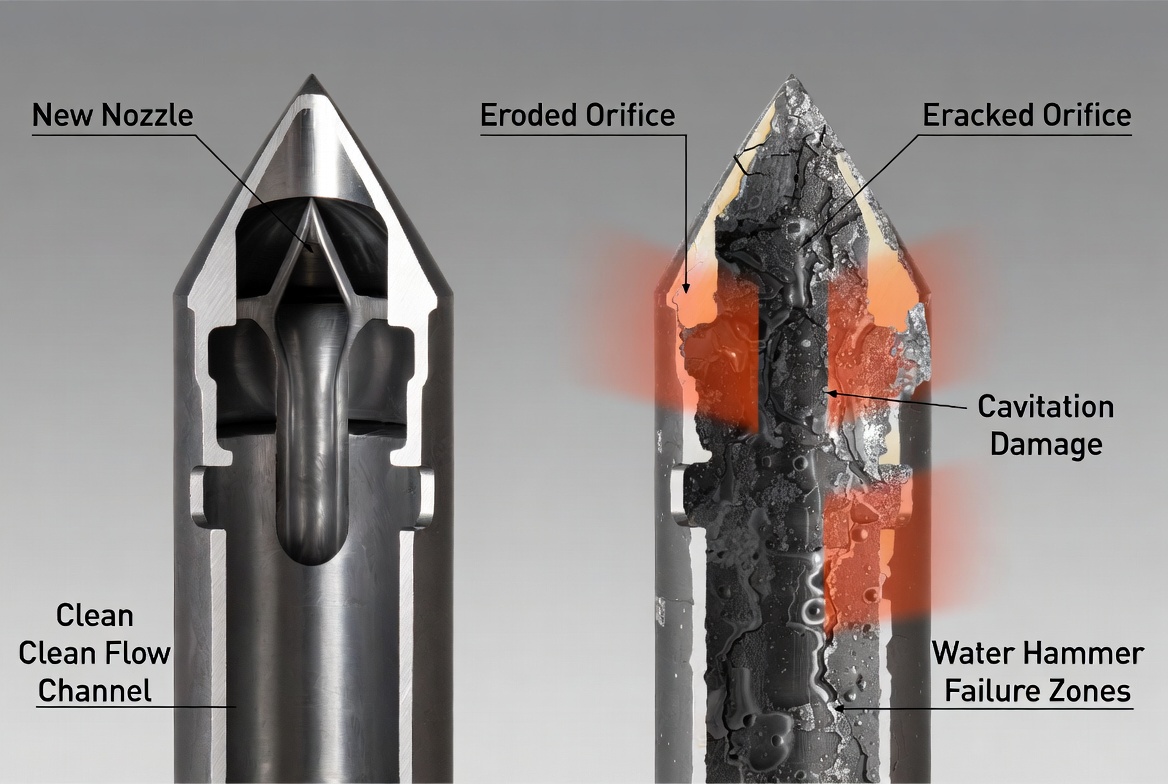
Repeated pressure cycling—especially in automated systems with frequent on/off cycles—creates low-cycle fatigue at the nozzle orifice root. Micro-cracks propagate until the opening deforms, destroying spray angle uniformity.
2. Internal Flow Channel Erosion
Surge velocities far exceed design limits. At transient velocities above 400 m/s, even clean water becomes erosive. Our testing on 316SS flat-fan nozzles showed orifice enlargement of 0.15 mm after 6 months in a system with unmanaged valve closures.
3. Thread & Seal Damage
Pressure spikes deform threaded connections and compress O-rings beyond their Shore hardness limits. We observe ~30% of nozzle leaks stem from seal extrusion triggered by hydraulic shock, not chemical degradation.
4. Nozzle Body Displacement
In quick-change clamp systems, severe hammer can physically eject the nozzle from its holder. This is especially common in tank-cleaning systems where 3/4" full-cone nozzles are retained by spring clips.
5. Spray Pattern Destabilization
Even before visible failure, fatigue microcracks at the orifice lip cause jet oscillation and uneven distribution. The result? Incomplete residue removal, rework cycles, and higher chemical usage.
Field Observation: In a 2024 audit of a steel-descaling plant using 350 bar systems, we traced 72% of premature nozzle replacements to water hammer originating from a single fast-acting directional control valve. Replacing it with a dampened closure valve extended nozzle life from 8 weeks to 22 weeks.
Table of Contents
- 0.1. 1. Orifice Cracking & Fatigue Fracture
- 0.2. 2. Internal Flow Channel Erosion
- 0.3. 3. Thread & Seal Damage
- 0.4. 4. Nozzle Body Displacement
- 0.5. 5. Spray Pattern Destabilization
- 1. The True Cost: Why Ignoring Pressure Surge Is Expensive
- 1.1. Cost Impact: Direct & Indirect Expenses
- 1.2. Efficiency Impact: Hidden Production Loss
- 1.3. Quality Impact: Compliance & Reputation Risk
- 2. Prevention Strategies: Engineering Solutions Compared
- 2.1. Comparative Analysis: Water Hammer Prevention Methods
- 2.2. The Nozzle Material Factor
- 3. Industry-Specific Use Cases & Damage Scenarios
- 3.1. Use Case 1: Steel Mill Descaling (350 Bar Flat-Fan System)
- 3.2. Use Case 2: Food Processing CIP Tank Cleaning (15 Bar Full-Cone Loop)
- 3.3. Use Case 3: PCB Manufacturing Chemical Etch Line (3 Bar PVDF Nozzle)
- 4. People Also Ask: Water Hammer FAQ
- 4.1. How does water hammer affect spray nozzle performance?
- 4.2. Can low-pressure cleaning systems experience water hammer?
- 4.3. What is the difference between a water hammer arrestor and a surge tank?
- 4.4. How do I know if water hammer is damaging my nozzles?
- 4.5. Should I use Tungsten Carbide nozzles just to prevent water hammer damage?
- 4.6. Does nozzle geometry influence water hammer vulnerability?
- 5. Conclusion: Protect Your Nozzles, Protect Your Margin
The True Cost: Why Ignoring Pressure Surge Is Expensive
Water hammer is a silent margin killer. Its costs accumulate across three dimensions:
Cost Impact: Direct & Indirect Expenses
| Cost Category | Typical Annual Impact | Root Cause |
|---|---|---|
| Nozzle replacement parts | $8,000 – $25,000 | Premature orifice erosion & seal failure |
| Unscheduled downtime | 12 – 40 hours / line | Catastrophic nozzle fracture during production runs |
| Rework & quality loss | 3 – 8% yield reduction | Uneven spray patterns from micro-damaged nozzles |
| Pump & valve repairs | $5,000 – $15,000 | Secondary damage from reflected shockwaves |
| Water/chemical overuse | +15 – 25% consumption | Extended cycle times compensating for degraded cleaning |
Key Statistic: Industry data modeled on 150+ food & beverage CIP systems suggests that unmanaged pressure transients increase total cost of ownership (TCO) for spray nozzles by 35–50% over a 3-year horizon (modeled from field service records, Yuechen Precision, 2024).
Efficiency Impact: Hidden Production Loss
Damaged nozzles do not always fail catastrophically. More often, they drift—delivering 90% performance today, 80% next month, 65% the quarter after. Without routine spray-pattern verification, this degradation is invisible until quality control flags a batch failure.
Quality Impact: Compliance & Reputation Risk
In pharmaceutical and food processing, incomplete cleaning translates directly to contamination risk. FDA warning letters and recall events linked to inadequate CIP performance often trace back to spray system degradation—not the cleaning chemistry.
Prevention Strategies: Engineering Solutions Compared
Effective water hammer mitigation requires system-level thinking, not just stronger nozzles. Below we compare the four primary prevention pathways, their ROI profiles, and ideal application contexts.
Comparative Analysis: Water Hammer Prevention Methods
| Prevention Method | Capital Cost | Nozzle Protection Level | Best For | Maintenance Requirement |
|---|---|---|---|---|
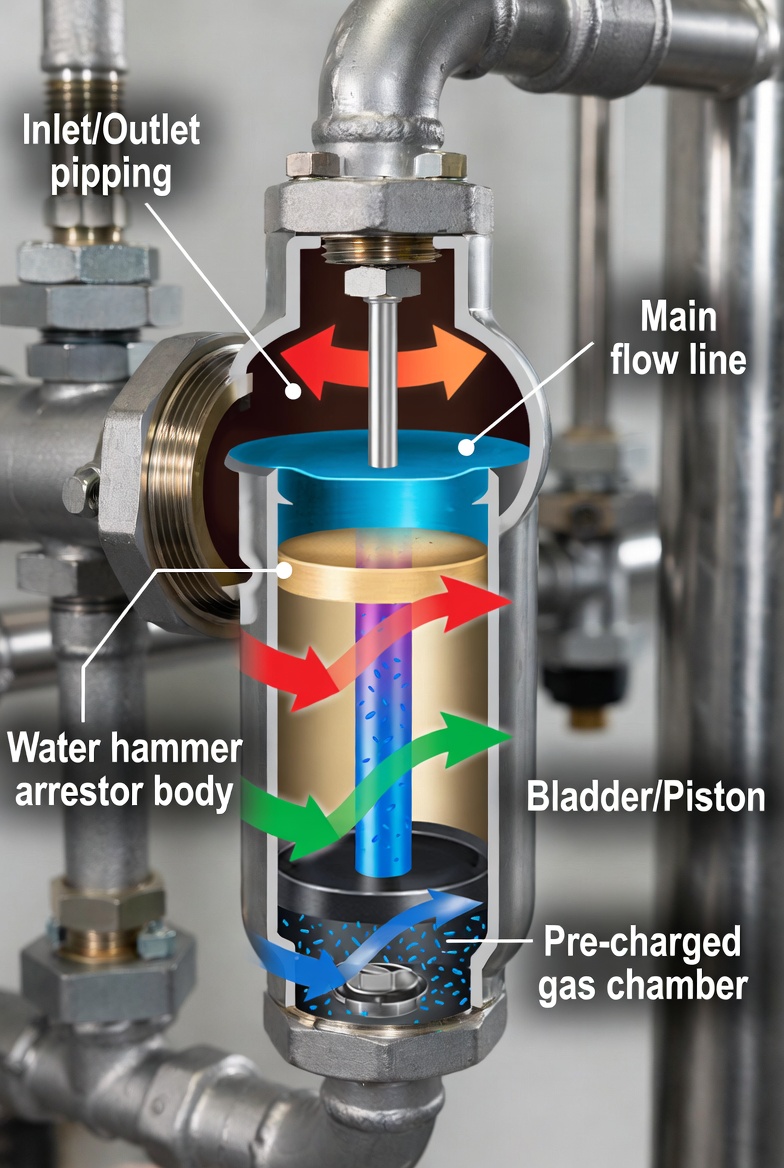
| Water Hammer Arrestors | Low ($150–$600/unit) | High (absorbs 80–90% of surge energy) | Fixed wash stations, CIP loops, automated cleaning skids |
Minimal; 5-year bladder replacement |
| Surge Tanks / Accumulators | Medium ($2,000–$8,000) | Very High (system-wide protection) | Long transfer lines, central high-pressure wash rings |
Annual inspection; air-volume checks |
| VFD Pump Control | Medium–High ($3,000–$12,000) | High (eliminates start/stop shocks) | Continuous-duty systems, multi-nozzle manifolds |
Electronics maintenance only |
| Slow-Closing / Dampened Valves | Low–Medium ($300–$2,500) | Medium–High | Manual wash bays, intermittent spray operations |
Periodic actuator calibration |
| Non-Slam Check Valves | Low ($200–$1,000) | High (prevents backflow slam) | Pump discharge lines, vertical risers |
Spring inspection every 2 years |
The Nozzle Material Factor
Even the best surge mitigation benefits from nozzle materials matched to pressure reality. In our production practice, specifying the wrong material for a high-hammer environment is equivalent to leaving your surge protection incomplete.
| Material | Max Recommended Pressure | Water Hammer Resilience | Typical Application |
|---|---|---|---|
| Brass | 50 bar | Low – ductile deformation under fatigue | Low-pressure rinse, general washdown |
| 303SS / 316SS | 200 – 350 bar | Medium – excellent corrosion resistance; moderate fatigue life | Food-grade CIP, chemical cleaning, surface prep |
| Tungsten Carbide | 500+ bar | Very High – 50–100× wear resistance vs. SS; resists orifice erosion | Ultra-high-pressure descaling, abrasive media blasting |
| PVDF / Engineering Plastics | 10 – 30 bar | Low – susceptible to stress cracking from fatigue | PCB etching, phosphating, acid wash |
Pro Recommendation: For systems above 300 bar or with known valve-closure shocks, Tungsten Carbide nozzles should be your default. The incremental material cost ($40–$120 vs. $15–$35 for 316SS) is recovered within a single avoided unscheduled changeout.
For comprehensive material selection guidance and spray pattern matching, explore our dedicated resource on High-Performance Industrial Cleaning Nozzles & Spray Solutions.
Industry-Specific Use Cases & Damage Scenarios
Water hammer behaves differently across industrial contexts. Below are three verified scenarios drawn from our technical support logs, with quantified outcomes after mitigation.
Use Case 1: Steel Mill Descaling (350 Bar Flat-Fan System)
- Scenario: A hot-strip mill used 110° flat-fan nozzles at 350 bar for primary descaling. A fast-acting directional valve cycled every 4 seconds. Nozzle orifices (316SS) degraded within 6–8 weeks.
- Root Cause: Pressure transients measured at ~1,800 bar peak during valve snap-closure.
- Solution: Installed water hammer arrestors at the manifold inlet + upgraded to Tungsten Carbide narrow-angle nozzles.
- Result: Nozzle lifespan extended to 28 weeks; annual nozzle spend reduced by 62%; downtime events dropped from 14/year to 3/year.
Use Case 2: Food Processing CIP Tank Cleaning (15 Bar Full-Cone Loop)
- Scenario: A dairy plant’s automated CIP system used 120° wide-angle full-cone nozzles for tank washing. During the final rinse cycle, a solenoid valve closed in <0.3 seconds, causing audible "bangs" and eventual nozzle clip ejection.
- Root Cause: Low-pressure systems are not immune to water hammer; the damage threshold is simply lower, and plastic / brass components fail sooner.
- Solution: Replaced the solenoid with a dampened closure valve (1.5 s close time) + added a small bladder accumulator at the pump discharge.
- Result: Zero nozzle ejections over 18 months; spray pattern consistency improved by 22% (measured via riboflavin coverage testing).
Use Case 3: PCB Manufacturing Chemical Etch Line (3 Bar PVDF Nozzle)
- Scenario: A PCB fabrication line used PVDF quick-dismantling nozzles for ferric chloride etching. Frequent start-stop pump cycles caused thread damage and seal extrusion.
- Root Cause: Intermittent pump operation without VFD soft-start created repeated low-amplitude hammer. PVDF’s lower fatigue resistance made it vulnerable.
- Solution: Implemented VFD-controlled pump ramping (3 s ramp-up / 5 s ramp-down) + switched to SS316 QJJ dismantling nozzles for threaded connection zones.
- Result: Thread leakage incidents reduced by 85%; nozzle replacement interval extended from 3 months to 11 months.
People Also Ask: Water Hammer FAQ
How does water hammer affect spray nozzle performance?
Water hammer creates fatigue stress at the nozzle orifice and internal flow channels. Even if the nozzle does not crack immediately, repeated pressure cycling degrades the precision of the outlet geometry. This manifests as:
- Wider, less uniform spray angles
- Reduced impact force at the target surface
- Increased flow rate (as the orifice enlarges microscopically)
- Inconsistent cleaning results across the spray footprint
In our testing, nozzles exposed to uncontrolled 200 bar surges showed 12–18% impact force degradation after only 50,000 cycles—equivalent to roughly 3 months in a typical 2-shift operation.
Can low-pressure cleaning systems experience water hammer?
Yes. While the absolute pressure spike is lower, the relative damage potential remains significant. Low-pressure systems often use lighter-duty materials (brass, PP, PVDF) with lower fatigue thresholds. A 10 bar spike in a system designed for 5 bar can still crack plastic nozzle bodies or strip threads. Additionally, biphase condensate slugs in steam-assisted cleaning can generate localized forces far exceeding the nominal system pressure.
What is the difference between a water hammer arrestor and a surge tank?
A water hammer arrestor is a compact, point-of-use device—typically installed near fast-closing valves—containing a gas-charged piston or bladder that absorbs shockwave energy instantaneously. It is ideal for localized protection of individual spray stations.
A surge tank (or accumulator) is a larger vessel installed near pump discharges, providing system-wide damping. It stores fluid under compressed air and feeds it back into the line during negative-pressure phases, preventing column separation and secondary shocks. Surge tanks are the correct choice for long piping runs or centralized high-pressure wash systems serving multiple nozzles.
How do I know if water hammer is damaging my nozzles?
Look for these leading indicators during routine maintenance:
- Audible "bang" or "knock" when valves close or pumps stop
- Increased frequency of nozzle replacements without clear chemical/abrasive cause
- Thread damage or seal extrusion on nozzles that should handle the chemistry
- Gradual widening of spray pattern coverage (measured against baseline)
- Surface defects or micro-pitting visible under 10× magnification at the orifice lip
If three or more of these are present, we recommend conducting a pressure transient audit with logging transducers at the pump discharge, manifold inlet, and nozzle proximal points.
Should I use Tungsten Carbide nozzles just to prevent water hammer damage?
Not automatically. Tungsten Carbide excels in abrasive, high-pressure, or high-hammer environments. However, it is over-specified—and unnecessarily expensive—for low-pressure, non-abrasive rinse applications where 316SS with proper surge mitigation is sufficient.
The correct approach is hierarchical:
- First, engineer the system to suppress pressure surges (arrestors, slow valves, VFD).
- Then, select nozzle material based on the residual pressure reality, chemistry, and abrasiveness.
In our experience, pairing 316SS nozzles with well-designed surge protection yields better lifetime ROI than defaulting to Tungsten Carbide to compensate for poor hydraulic design.
Does nozzle geometry influence water hammer vulnerability?
Yes, indirectly. Narrow-angle (0°–15°) solid-stream nozzles concentrate stress at a smaller orifice cross-section, making them more susceptible to fatigue crack initiation. Wide-angle full-cone nozzles distribute flow across larger internal passages, reducing peak stress concentrations.
However, the dominant factor remains system-level pressure management. No geometry can fully compensate for a 1,400 bar transient arriving at the nozzle inlet.
Conclusion: Protect Your Nozzles, Protect Your Margin
Water hammer is not a mysterious force. It is predictable physics with engineered solutions. In industrial cleaning systems operating between 1 bar and 500 bar, ignoring pressure transients means accepting 35–50% higher nozzle TCO, recurring unplanned downtime, and gradual erosion of cleaning quality.
Bottom Line: The most cost-effective "nozzle upgrade" you can make is often not a nozzle at all—it is a water hammer arrestor, a dampened valve, or a VFD ramp profile.
At Yuechen Precision, we do not just supply high-performance industrial cleaning nozzles & spray solutions—we engineer spray systems for durability under real-world hydraulic conditions. From Tungsten Carbide descaling nozzles rated for 500 bar shocks to 316SS CIP flat-fan assemblies with matched surge-protection specifications, our team provides application-specific sizing, material selection, and system integration support.
Ready to eliminate water hammer from your cleaning line?
Contact our engineering team for a complimentary system audit. We will review your pressure profiles, valve timing, and nozzle specifications to build a zero-surges, zero-compromise spray solution that protects your equipment and your margins.