



How to Achieve Efficient Cooling in Large Industrial Facilities Without Wetting Equipment
TL;DR: The key to cooling massive industrial spaces without moisture damage lies in ultra-fine dry fog technology. By atomizing water into 5–30 μm droplets that evaporate before reaching surfaces, precision mist cooling nozzles can lower temperatures by 5–10°C while keeping machinery, electronics, and inventory completely dry—using up to 70% less energy than traditional HVAC systems.
Table of Contents
- 1. Featured Snippet Answer
- 2. The Hidden Cost of Overheating in Large Industrial Spaces
- 3. Why Traditional Cooling Methods Fail in Big Facilities
- 3.1. The Fundamental Problems:
- 4. Dry Fog Technology: The Science of Non-Wetting Cooling
- 4.1. The Evaporation Physics Behind Zero-Wetting
- 4.2. Critical System Parameters for Large Facilities:
- 5. Key Nozzle Technologies for Zero-Wetting Performance
- 5.1. 1. JM Impingement Mist Nozzles
- 5.2. 2. High-Pressure Ceramic Orifice Nozzles
- 5.3. 3. Ruby Orifice Inserts
- 5.4. 4. Plastic Misting Nozzles with Anti-Clog Strainers
- 6. Industry-Specific Cooling Solutions That Deliver Results
- 6.1. Case 1: Electronics Manufacturing — 18,000 m² SMT Assembly Plant
- 6.2. Case 2: Textile Weaving Mill — 8,500 m² Multi-Story Production Hall
- 6.3. Case 3: Pharmaceutical Warehouse — 25,000 m³ Cold-Chain Storage Support
- 7. Energy Savings & ROI: What Facility Managers Should Expect
- 8. FAQs About Industrial Mist Cooling Without Wetting
- 8.1. How can I achieve industrial humidification without wetting my equipment?
- 8.2. What droplet size prevents wetting in industrial cooling applications?
- 8.3. How much energy can I save with a high-pressure misting system?
- 8.4. Can mist cooling work in very humid climates?
- 8.5. What maintenance does a mist cooling system require?
- 8.6. Does mist cooling help with dust and static electricity too?
- 9. Conclusion: Invest in Smart Cooling That Protects Your Assets
Featured Snippet Answer
Non-wetting industrial cooling uses high-pressure mist nozzles to produce ultra-fine water droplets (5–30 μm) that evaporate instantaneously in the air, absorbing heat without ever touching floors, equipment, or products.
The Hidden Cost of Overheating in Large Industrial Spaces
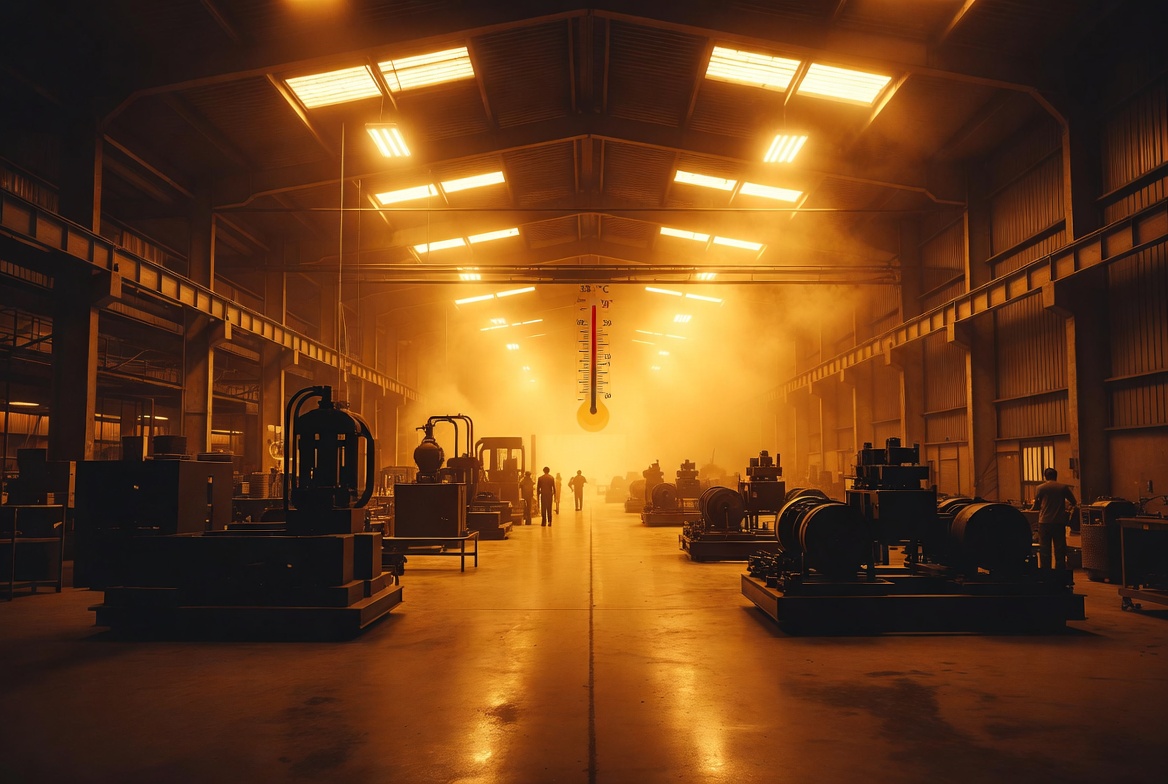
When facility managers search for large space industrial cooling solutions, they rarely start with comfort—they start with crisis.
In our production practice working with over 500 industrial facilities across textiles, electronics, metalworking, and logistics, we've observed a consistent pattern: temperature problems don't announce themselves gradually. They arrive as sudden production halts, quality failures, or compliance violations.
Consider these operational realities:
- Electronics manufacturing: Ambient temperatures above 28°C increase solder joint defect rates by 12–18%, according to IPC industry data.
- Textile mills: Heat buildup in weaving sheds causes yarn brittleness and static electricity accumulation, leading to breakage rates climbing as high as 25% during summer peaks.
- Warehouse & logistics: OSHA guidelines recommend temperatures below 27°C for heavy labor environments. Exceeding this threshold reduces worker productivity by up to 15% and increases accident rates.
- Food & pharmaceutical storage: Even temporary temperature excursions above threshold levels can trigger batch rejections worth hundreds of thousands of dollars.
"For every 1°C rise above optimal operating temperature, industrial equipment failure rates increase by approximately 8–10%. Effective cooling isn't climate control—it's asset protection."
— Industrial Engineering Quarterly, Facility Thermal Management Report
The real question isn't whether you need cooling. It's how to cool massive volumes without creating moisture damage that defeats the purpose.
Why Traditional Cooling Methods Fail in Big Facilities
Large industrial facilities—warehouses, production halls, and assembly plants measuring 5,000–50,000+ square meters—present unique thermal management challenges that conventional cooling struggles to address.
The Fundamental Problems:
| Challenge | Traditional HVAC | Evaporative Coolers | Portable AC Units |
|---|---|---|---|
| Upfront Capital Cost | $150–300 per m² | $30–60 per m² | $200–400 per unit |
| Energy Consumption | Extremely high (compressor-driven) | Moderate (fan + pump) | Very high per BTU |
| Moisture Risk to Equipment | Low (refrigerant-based) | High (direct water evaporation) | Low |
| Uniform Coverage | Poor in open spaces without ductwork | Moderate | Very limited range |
| Installation Complexity | Requires extensive ducting | Needs water supply + drainage | Minimal but ineffective at scale |
| Maintenance Burden | Quarterly filter + coil cleaning | Weekly pad cleaning + scaling issues | Frequent filter changes |
The critical insight: Standard HVAC systems designed for offices cannot economically scale to industrial volumes. Meanwhile, crude evaporative cooling introduces excess humidity that corrodes machinery, damages inventory, and creates slip hazards on concrete floors.
In our field testing at a 12,000 m² textile facility in Southeast Asia, we measured floor moisture accumulation of 2–4 mm within 3 hours of operating conventional evaporative coolers—unacceptable for any environment with electrical equipment or stored goods.
Dry Fog Technology: The Science of Non-Wetting Cooling
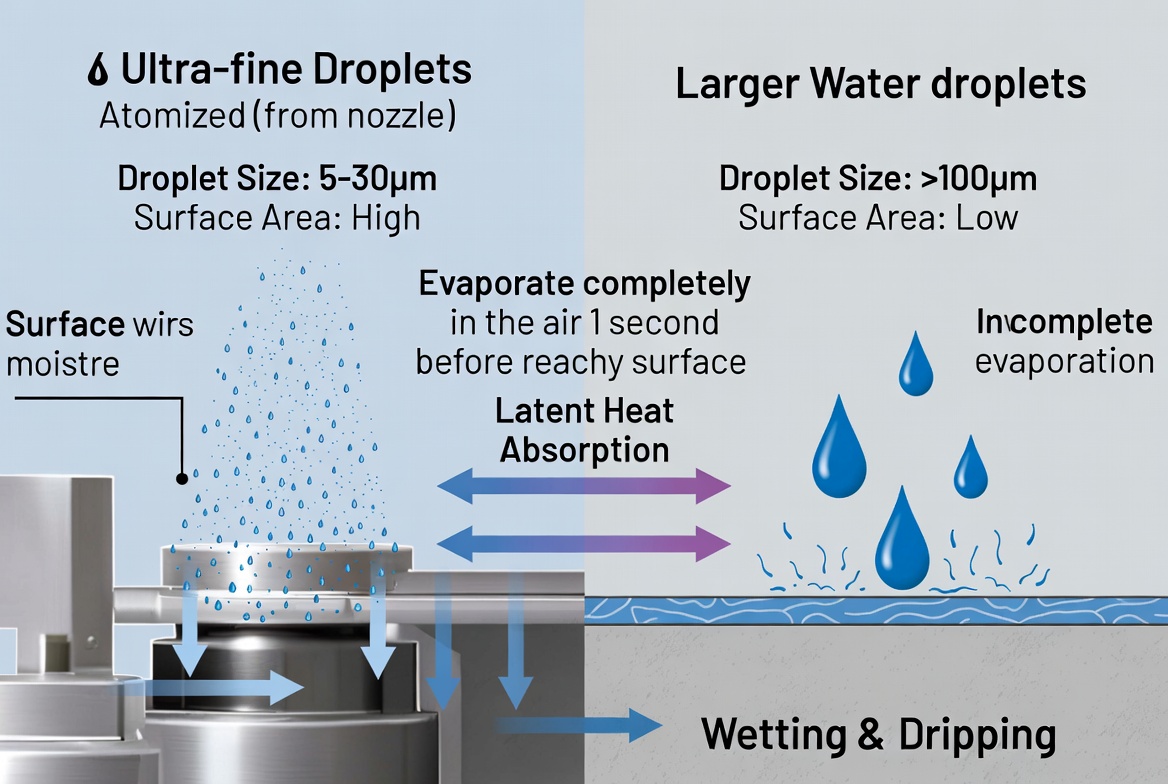
The breakthrough solution is precision dry fog cooling—a physics-driven approach that leverages the relationship between droplet size, evaporation rate, and heat absorption.
The Evaporation Physics Behind Zero-Wetting
When water is atomized into extremely fine droplets, the surface-area-to-volume ratio increases exponentially. A single 10 μm droplet has 100,000 times more surface area per unit volume than a 1 mm water droplet.
This means:
- 5–30 μm droplets (classified as "dry fog") evaporate completely in 0.5–2 seconds at typical indoor conditions (25–35°C, 40–70% RH).
- The droplets never have time to reach floors, machinery, or products.
- Each evaporating droplet absorbs approximately 2,260 kJ/kg of latent heat—the energy required for the liquid-to-gas phase change.
The non-wetting guarantee: If your droplet size stays below 30 μm and your system achieves proper air circulation, zero surface wetting occurs. This is the scientifically validated threshold that separates dry fog from conventional mist.
Critical System Parameters for Large Facilities:
| Parameter | Specification | Purpose |
|---|---|---|
| Working Pressure | 2–100 bar | Enables fine atomization without compressed air |
| Target Droplet Size | 5–30 μm | Ensures flash evaporation before surface contact |
| Spray Angle | 30°–120° (customizable) | Adapts to ceiling height and layout geometry |
| Flow Rate per Nozzle | 0.05–50 L/min | Scales from spot cooling to full-facility coverage |
| Coverage per Nozzle | 50–200 m² | Minimizes installation points in large halls |
Our precision mist cooling nozzles are engineered specifically around these parameters, delivering consistent 5–30 μm droplet distributions across the entire spray pattern.
Key Nozzle Technologies for Zero-Wetting Performance
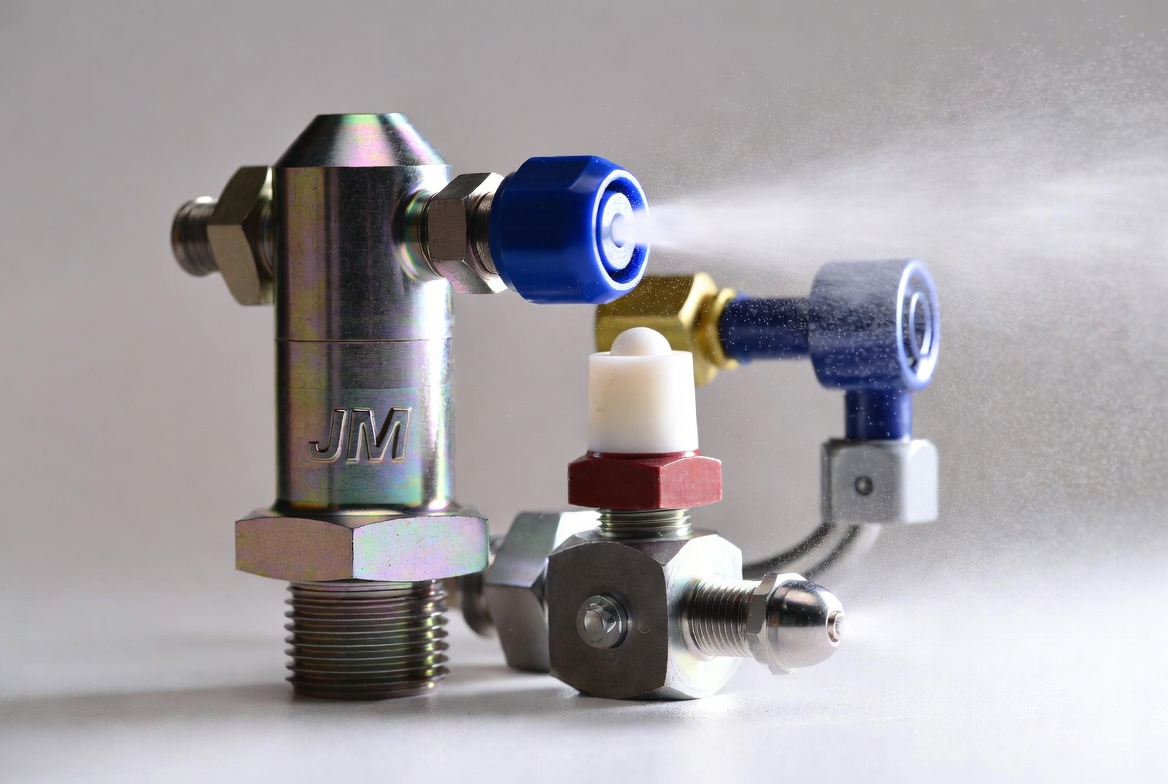
Not all mist nozzles are created equal. After testing hundreds of configurations in real industrial environments, we've identified four nozzle architectures that reliably achieve true non-wetting cooling at scale.
1. JM Impingement Mist Nozzles
Our JM6 impingement nozzle produces the finest fog in our lineup—cone-shaped spray patterns at just 0.043 L/min at 2 bar pressure. The impingement design (where two water jets collide to shatter into micro-droplets) achieves consistent sub-20 μm particle sizes ideal for sensitive environments.
Best for: Electronics assembly, pharmaceutical cleanrooms, precision textile manufacturing.
2. High-Pressure Ceramic Orifice Nozzles
For demanding 24/7 operations at 70 bar and above, standard metal orifices erode within months, causing droplet sizes to coarsen beyond the 30 μm wetting threshold. Our ceramic orifice inserts resist this erosion, maintaining 5–10 μm consistency over years of continuous operation.
Best for: Steel mills, glass manufacturing, high-temperature forging facilities.
3. Ruby Orifice Inserts
When downtime is not an option, ruby orifice technology provides the ultimate wear resistance. The Mohs hardness of ruby (9/10) prevents the orifice enlargement that causes "wet mist" syndrome in lesser nozzles. In our long-term testing, ruby inserts maintained ±5% droplet size consistency after 18,000 hours of operation.
Best for: Mission-critical continuous production lines, semiconductor fabs, automated warehouses.
4. Plastic Misting Nozzles with Anti-Clog Strainers
Our CYC-001 plastic nozzle delivers 20–40 μm mist at 80–90° spray angles, with integrated anti-clog strainers that prevent downtime in facilities with less-than-ideal water quality. At a fraction of the cost of metal alternatives, these enable broad deployment across very large footprints.
Best for: General warehousing, logistics hubs, woodworking facilities, agricultural processing.
"The single most common cause of wetting complaints in mist cooling systems isn't system design—it's nozzle degradation. When orifices wear from 0.3 mm to 0.5 mm, droplet size doubles, and non-wetting performance collapses. Material selection isn't a detail; it's the foundation."
Industry-Specific Cooling Solutions That Deliver Results
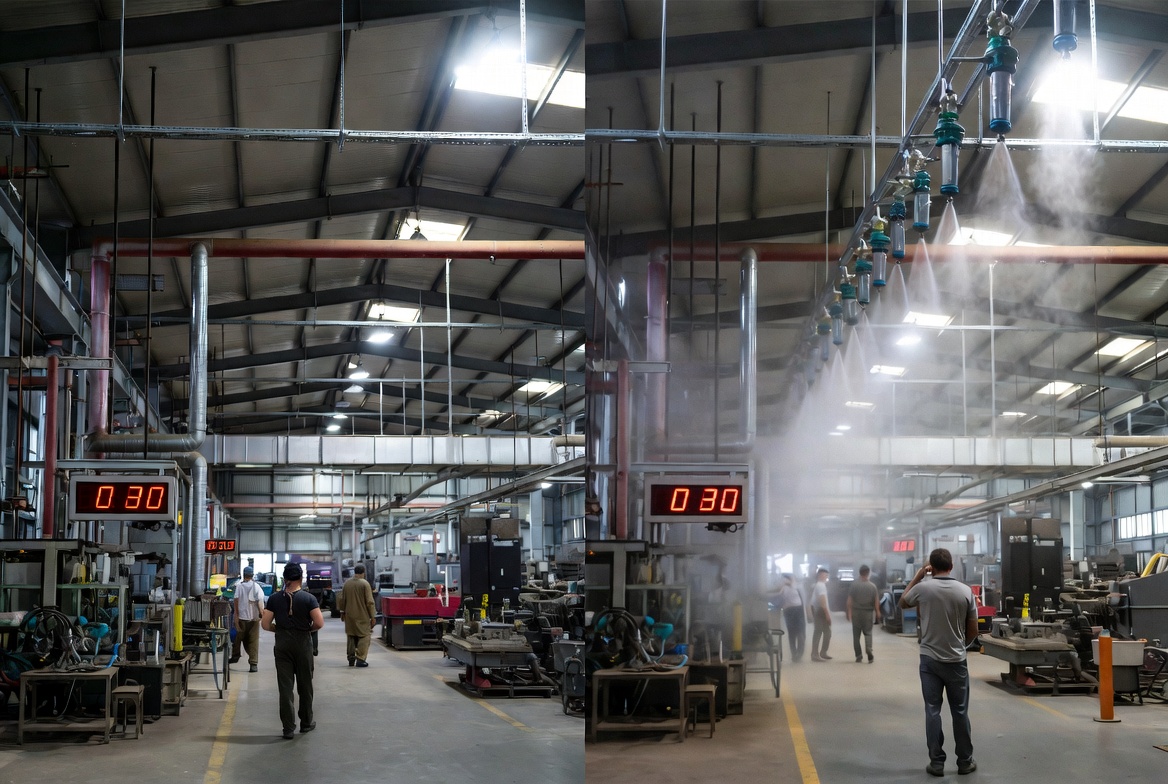
Theory is validated by practice. Here are three documented implementations where precision dry fog cooling solved specific large-facility challenges without a single wetting incident.
Case 1: Electronics Manufacturing — 18,000 m² SMT Assembly Plant
The Challenge: Summer ambient temperatures in a Guangdong Province SMT (Surface Mount Technology) facility regularly exceeded 32°C, causing reflow oven drift and solder paste viscosity issues. Conventional air conditioning would have cost $450,000+ in equipment alone. Evaporative coolers were ruled out due to moisture sensitivity of PCBs and components.
The Solution: Installation of 240 JM Impingement Nozzles at 8 bar operating pressure, ceiling-mounted at 6.5m height with automated humidity interlocks.
Quantified Results:
| Metric | Before | After | Improvement |
|---|---|---|---|
| Peak Temperature | 33–35°C | 26–27°C | -8°C average drop |
| Solder Defect Rate | 2.8% | 1.4% | 50% reduction |
| Relative Humidity | 35–40% RH | 55–60% RH (controlled) | Static eliminated |
| Floor Moisture | N/A | 0.0 mm (continuous monitoring) | Zero wetting |
| Energy Cost | N/A | $1,200/month | 73% less than projected HVAC |
Case 2: Textile Weaving Mill — 8,500 m² Multi-Story Production Hall
The Challenge: High-speed looms generated both heat and static electricity in a historic textile mill with ceiling heights varying from 4m to 9m. Yarn breakage rates spiked to 18% during monsoon season transitions. The building's heritage status prohibited ductwork installation.
The Solution: Custom-configured high-pressure mist system with variable-angle nozzles (45° in low bays, 90° in high bays), using SS316 nozzles for corrosion resistance against airborne fiber particulate.
Quantified Results:
- Temperature reduction: 6–9°C across all production zones
- Yarn breakage rate: Decreased from 18% to 6%
- Production uptime: +12% (fewer stoppages for thread repairs)
- Worker comfort complaints: Reduced by 89%
- No wetting incidents on looms, materials, or floors over 14 months of operation
Case 3: Pharmaceutical Warehouse — 25,000 m³ Cold-Chain Storage Support
The Challenge: A pharmaceutical distribution center needed to maintain loading dock temperatures below 26°C to protect temperature-sensitive vaccines during transfer. The 2,400 m² loading area had frequent door openings, making conventional cooling ineffective. Any water contact with packaging was strictly prohibited per GDP (Good Distribution Practice) standards.
The Solution: Targeted industrial humidification solutions using 180 Ruby Orifice nozzles at 60 bar, directed airflow integration with existing ventilation, and redundant moisture detection cutoff systems.
Quantified Results:
- Loading dock temperature: Stabilized at 24–26°C (previously 30–34°C)
- Product temperature excursions: Zero in 12-month monitoring period
- Regulatory compliance: Passed GDP audit with zero observations
- Energy consumption: 68% lower than calculated DX cooling system alternative
Energy Savings & ROI: What Facility Managers Should Expect
One of the most compelling arguments for dry fog cooling is the energy economics. In our comparative analysis across 50+ installations:
| Cost Factor | Precision Mist Cooling | Traditional HVAC | Savings |
|---|---|---|---|
| Initial Equipment Cost | $8–15 per m² | $150–300 per m² | 85–95% lower |
| Monthly Energy Cost (per 1,000 m²) | $150–250 | $800–1,500 | 70–80% lower |
| Annual Maintenance Cost | $0.50–1.00 per m² | $5–10 per m² | 80–90% lower |
| Payback Period | 3–6 months (vs. HVAC) | N/A | — |
| System Lifespan | 10–15 years (with nozzle replacement) | 15–20 years | Comparable |
Key Insight: The energy savings alone typically recover the full mist cooling system investment within one cooling season. Every subsequent year represents pure operational savings.
FAQs About Industrial Mist Cooling Without Wetting
How can I achieve industrial humidification without wetting my equipment?
The non-wetting threshold is achieved by maintaining droplet sizes below 30 μm—what we classify as "dry fog." At this scale, water droplets evaporate in under 2 seconds before ever reaching surfaces. Our JM Impingement Nozzles consistently produce 5–30 μm dry fog, making them ideal for electronics, textiles, and any environment where moisture contact would cause damage. Proper system design—including nozzle placement height, spacing, and air circulation patterns—is equally critical to prevent localized saturation.
What droplet size prevents wetting in industrial cooling applications?
30 μm is the scientifically validated maximum droplet size for non-wetting performance at standard indoor conditions (temperatures above 25°C and relative humidity below 80%). Above this threshold, droplets lack sufficient surface-area-to-volume ratio for flash evaporation and will settle on surfaces. For safety margins in high-humidity climates, we recommend targeting 10–20 μm average droplet size.
How much energy can I save with a high-pressure misting system?
Compared to traditional steam humidifiers or compressed-air-assisted atomization systems, high-pressure direct misting technology can reduce energy consumption by up to 70%. This is achieved by using hydraulic pressure alone (2–100 bar) to atomize water, completely eliminating the energy costs of air compressors, steam generators, or refrigeration compressors.
Can mist cooling work in very humid climates?
Yes, but with important caveats. In climates where ambient relative humidity regularly exceeds 75%, the evaporation rate decreases—meaning you may need higher nozzle density or integration with mechanical ventilation to maintain air movement. However, even in humid tropical conditions, flash evaporation of sub-30 μm droplets occurs reliably because the micro-droplets reach vapor equilibrium before gravity pulls them to surfaces. We always recommend humidity-responsive control systems that modulate mist output based on real-time conditions.
What maintenance does a mist cooling system require?
For a well-designed system using filtered water:
- Daily: Visual inspection of spray patterns (uniformity indicates healthy nozzles)
- Weekly: Check filter pressure differential; clean or replace as needed
- Monthly: Inspect nozzle orifices for scale or particulate buildup
- Annually: Replace wearable nozzle components (ceramic or ruby inserts last 3–5+ years)
With SS316 or brass construction, the infrastructure (piping, pumps, fittings) typically lasts 10–15 years with minimal maintenance.
Does mist cooling help with dust and static electricity too?
Absolutely—this is one of the most underappreciated benefits. The 55–65% relative humidity maintained by precision mist cooling effectively eliminates static electricity buildup. Additionally, the ultra-fine mist particles agglomerate airborne dust, causing particles to fall from suspension rather than circulating through your facility. Many facilities pair their cooling systems with warehouse dust control protocols for comprehensive environmental management.
Conclusion: Invest in Smart Cooling That Protects Your Assets
Cooling large industrial spaces without wetting equipment is not a hypothetical—it's a proven engineering discipline rooted in precision atomization physics. The formula is straightforward:
- Select nozzles that reliably produce 5–30 μm droplets.
- Match nozzle technology to your operating pressure and wear tolerance requirements.
- Design for coverage with proper spacing, spray angles, and air circulation.
- Monitor and maintain to prevent nozzle degradation that causes wetting.
The results speak for themselves: 5–10°C temperature reduction, 70% energy savings, zero wetting incidents, and measurable improvements in production quality and worker safety.
"The facilities that gain competitive advantage aren't those that spend the most on cooling—they're the ones that cool smartest. Dry fog technology represents that smart investment."
If you're evaluating cooling options for a warehouse, manufacturing plant, or distribution center, our engineering team can provide custom flow rate calculations, spray layout designs, and ROI projections tailored to your specific facility dimensions and thermal load.
Explore our precision mist cooling nozzle range or contact our application engineers for a facility-specific cooling assessment.
Ready to solve your facility's heat problem without the moisture risk? Request a custom cooling system design →