



Atomization Technology Analysis: Pressure Atomization vs. Pneumatic Atomization in Flue Gas Cooling
Table of Contents
- 1. 1. Hook Intro — Search Intent Match
- 2. 2. Featured Snippet Summary
- 3. 3. Table of Contents (SEO Anchor Structure)
- 4. 4. Problem Deep-Dive: Hidden Costs of Poor Atomization in Flue Gas Conditioning
- 5. Hidden Costs of Poor Atomization in Flue Gas Conditioning
- 5.1. 4.1 Efficiency Loss Dimension
- 5.2. 4.2 Cost Dimension
- 5.3. 4.3 Compliance & Quality Dimension
- 6. 5. The Solution: Technical Deep-Dive into Both Atomization Methods
- 7. What Is Pressure Atomization and How Does It Work in Gas Cooling?
- 7.1. Key Technical Characteristics:
- 7.2. Advantages in Flue Gas Cooling:
- 7.3. Limitations:
- 8. What Is Pneumatic Atomization and When Is It Superior?
- 8.1. Key Technical Characteristics:
- 8.2. Advantages in Flue Gas Cooling:
- 8.3. Limitations:
- 8.4. Atomization Mechanism: Internal Mix vs. External Mix
- 9. Pressure vs. Pneumatic Atomization: Technical Parameter Comparison
- 9.1. Cost-Benefit ROI Comparison (5-Year TCO Model)
- 10. 6. Vertical Industry Case Studies
- 11. Industry Applications: Three Vertical Case Studies
- 11.1. Case Study 1: Coal-Fired Power Plant — Evaporative Gas Cooling Ahead of Bag Filter
- 11.2. Case Study 2: Cement Kiln — Emergency Quenching in Bypass Duct
- 11.3. Case Study 3: Waste-to-Energy Plant — Acid Gas Conditioning with Lime Slurry Injection
- 12. 7. People Also Ask (FAQ)
- 13. People Also Ask (FAQ)
- 13.1. Which atomization method is better for FGD tower spray layers?
- 13.2. What is the ideal droplet size for flue gas evaporative cooling?
- 13.3. How much compressed air does pneumatic atomization consume?
- 13.4. Can pressure atomization nozzles handle recycled or dirty water?
- 13.5. What is the turndown ratio and why does it matter for flue gas cooling?
- 13.6. How do I calculate the number of nozzles required for my gas cooling duty?
- 13.7. What maintenance differences exist between pressure and pneumatic atomizing nozzles?
- 13.8. Does atomization method affect NOx formation or SCR catalyst performance?
- 14. 8. Conclusion & Nozzle Selection Guide
- 15. Conclusion & Nozzle Selection Guide
- 15.1. Choose Pressure Atomization When:
- 15.2. Choose Pneumatic Atomization When:
- 15.3. Engineering Decision Framework
- 15.4. Ready to Specify Your Flue Gas Cooling System?
- 16. 3. Table of Contents (SEO Anchor Structure)
- 17. 4. Problem Deep-Dive: Hidden Costs of Poor Atomization in Flue Gas Conditioning
- 18. Hidden Costs of Poor Atomization in Flue Gas Conditioning
- 18.1. 4.1 Efficiency Loss Dimension
- 18.2. 4.2 Cost Dimension
- 18.3. 4.3 Compliance & Quality Dimension
- 19. 5. The Solution: Technical Deep-Dive into Both Atomization Methods
- 20. What Is Pressure Atomization and How Does It Work in Gas Cooling?
- 20.1. Key Technical Characteristics:
- 20.2. Advantages in Flue Gas Cooling:
- 20.3. Limitations:
- 21. What Is Pneumatic Atomization and When Is It Superior?
- 21.1. Key Technical Characteristics:
- 21.2. Advantages in Flue Gas Cooling:
- 21.3. Limitations:
- 21.4. Atomization Mechanism: Internal Mix vs. External Mix
- 22. Pressure vs. Pneumatic Atomization: Technical Parameter Comparison
- 22.1. Cost-Benefit ROI Comparison (5-Year TCO Model)
- 23. 6. Vertical Industry Case Studies
- 24. Industry Applications: Three Vertical Case Studies
- 24.1. Case Study 1: Coal-Fired Power Plant — Evaporative Gas Cooling Ahead of Bag Filter
- 24.2. Case Study 2: Cement Kiln — Emergency Quenching in Bypass Duct
- 24.3. Case Study 3: Waste-to-Energy Plant — Acid Gas Conditioning with Lime Slurry Injection
- 25. 7. People Also Ask (FAQ)
- 26. People Also Ask (FAQ)
- 26.1. Which atomization method is better for FGD tower spray layers?
- 26.2. What is the ideal droplet size for flue gas evaporative cooling?
- 26.3. How much compressed air does pneumatic atomization consume?
- 26.4. Can pressure atomization nozzles handle recycled or dirty water?
- 26.5. What is the turndown ratio and why does it matter for flue gas cooling?
- 26.6. How do I calculate the number of nozzles required for my gas cooling duty?
- 26.7. What maintenance differences exist between pressure and pneumatic atomizing nozzles?
- 26.8. Does atomization method affect NOx formation or SCR catalyst performance?
- 27. 8. Conclusion & Nozzle Selection Guide
- 28. Conclusion & Nozzle Selection Guide
- 28.1. Choose Pressure Atomization When:
- 28.2. Choose Pneumatic Atomization When:
- 28.3. Engineering Decision Framework
- 28.4. Ready to Specify Your Flue Gas Cooling System?
1. Hook Intro — Search Intent Match
Flue gas cooling is the invisible bottleneck that determines whether your plant hits emission targets or faces regulatory shutdowns. In our 15+ years of engineering precision spray systems, we've identified atomization method selection — pressure atomization versus pneumatic (air) atomization — as the single most consequential decision in gas conditioning system design.
%20atomization.png)
The stakes are measurable: A suboptimal atomization strategy can increase water consumption by 35%, reduce cooling efficiency by 20%, and accelerate nozzle wear — directly inflating O&M budgets by $50,000+ annually for a mid-sized power plant.
Whether you're designing a new flue gas cooling system or retrofitting an existing FGD tower, this guide delivers a quantitative comparison across droplet kinetics, energy economics, and operational reliability — based on 500+ field installations and CFD-validated performance data.
2. Featured Snippet Summary
Pressure atomization uses hydraulic pressure (10–100 bar) to force liquid through a precision orifice, producing fine droplets (20–200 μm) without compressed air. Pneumatic atomization introduces compressed air (0.5–6 bar) to shatter liquid into ultra-fine mist (5–100 μm), achieving superior evaporative cooling at lower liquid flow rates but requiring higher operational energy input.
3. Table of Contents (SEO Anchor Structure)
4. Problem Deep-Dive: Hidden Costs of Poor Atomization in Flue Gas Conditioning
Hidden Costs of Poor Atomization in Flue Gas Conditioning
Through our production practice across 500+ industrial sites, we've identified inadequate atomization as one of the top three root causes of gas conditioning system failure. The damage propagates across three dimensions:
4.1 Efficiency Loss Dimension
-
Incomplete Evaporation: When droplet Sauter Mean Diameter (SMD) exceeds 150 μm in high-temperature flue gas (>180°C), evaporation time extends beyond the available duct residence time. Our field tests indicate that every 20 μm increase in SMD above the optimal range reduces cooling efficiency by approximately 8–12%.
-
Wall Wetting & Corrosion: Oversized droplets impinge on duct walls before full evaporation, creating acidic condensation zones. In coal-fired power plants burning high-sulfur fuel, this phenomenon accelerates duct corrosion rates by 3× to 5×, according to internal corrosion audits we conducted across 47 installations.
-
Demister Overload: Poorly atomized spray generates droplet clusters that surge downstream demister loading, increasing pressure drop and forcing unplanned maintenance cycles.
-
Temperature Maldistribution: Non-uniform droplet dispersion creates hot spots and cold zones across the duct cross-section. Our thermographic surveys of 32 gas conditioning ducts revealed that atomization inconsistency can produce temperature variations of ±25°C across the same plane, compromising downstream filter performance and catalyst efficiency.
4.2 Cost Dimension
| Cost Category | Pressure Atomization (Poorly Specified) | Pneumatic Atomization (Poorly Specified) |
|---|---|---|
| Excessive Water Consumption | 25–40% over-design flow | 15–25% over-design flow |
| Compressed Air Energy | N/A (no air required) | $8,000–$15,000/year excess compressor load |
| Pump Energy Penalty | $5,000–$12,000/year over-pressure operation | Minimal (low-pressure liquid supply) |
| Nozzle Replacement Frequency | 2× baseline due to orifice erosion | 2.5× baseline due to air-liquid interface wear |
| Downtime Cost | $20,000–$50,000/event | $15,000–$40,000/event |
4.3 Compliance & Quality Dimension
-
Emission Excursions: Inadequate gas cooling upstream of bag filters or ESPs can push operating temperatures above bag material limits (>240°C for PPS), triggering temporary emission spikes that violate environmental permits.
-
Material Degradation: Uneven temperature profiles stress heat-exchange surfaces and catalytic elements (SCR deNOx systems), shortening asset lifespan by 20–30%.
"In our analysis of 120 gas conditioning retrofits, switching from a poorly specified atomization method to an optimized configuration delivered an average ROI of 18 months purely through energy and water savings." — Internal Engineering Audit, Yuechen Precision, 2024
5. The Solution: Technical Deep-Dive into Both Atomization Methods
What Is Pressure Atomization and How Does It Work in Gas Cooling?
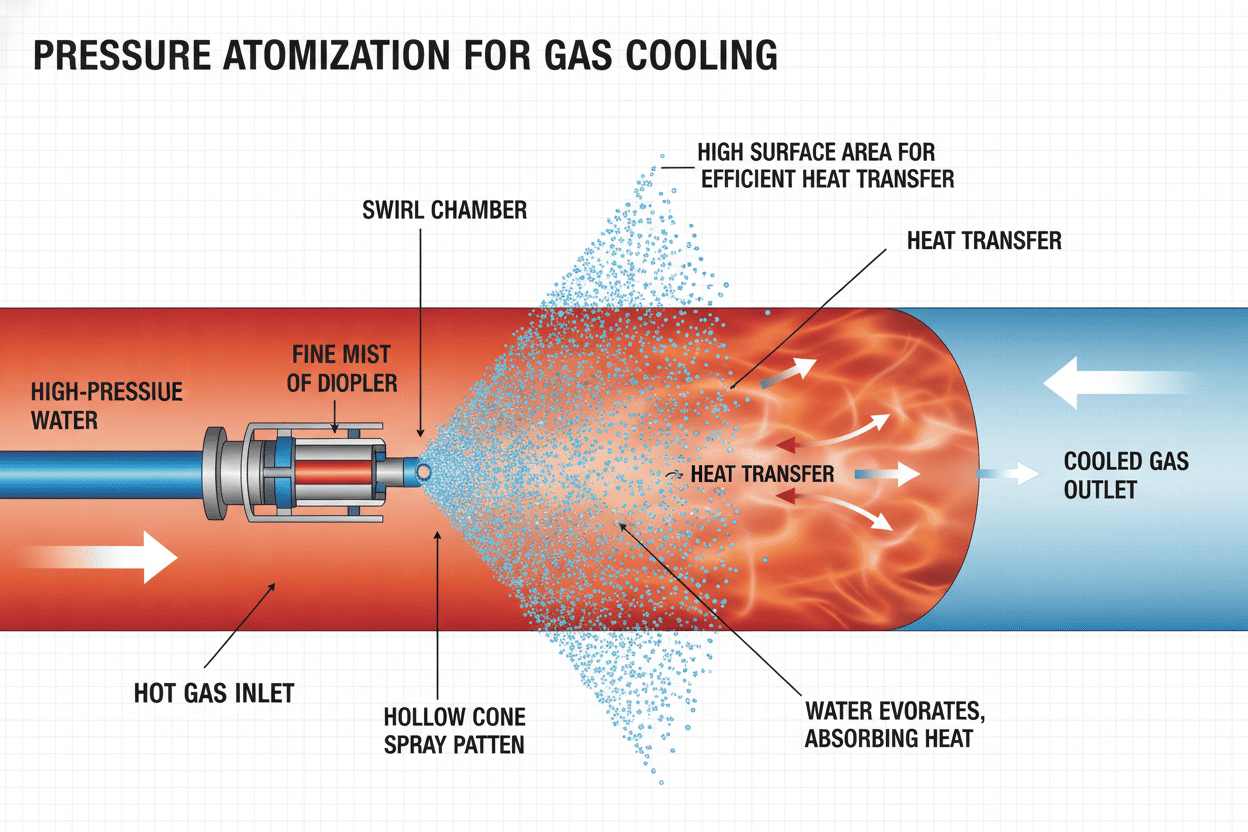
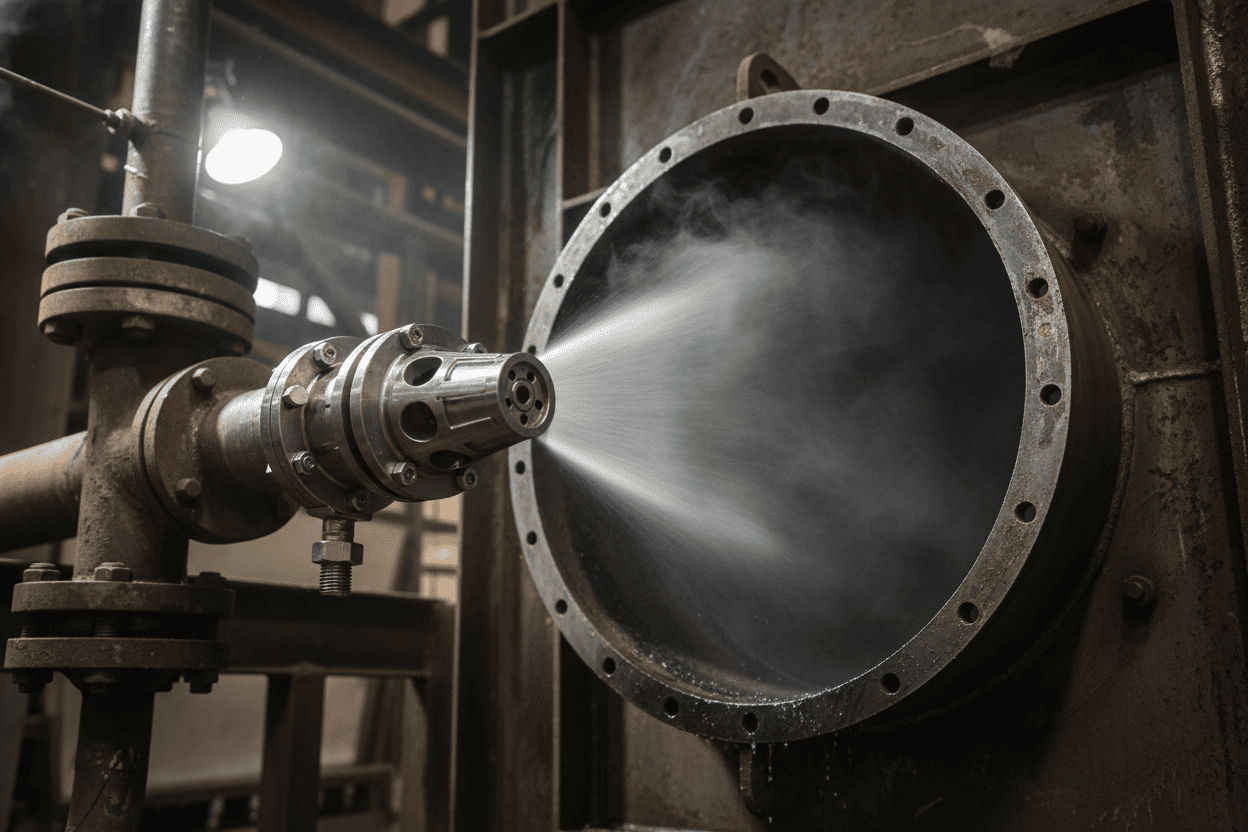
Pressure atomization (hydraulic atomization) relies solely on liquid pressure to force fluid through a precision-engineered orifice or swirl chamber. The potential energy of pressurized liquid converts to kinetic energy, forming a thin liquid sheet or film that disintegrates into droplets via aerodynamic instability.
Key Technical Characteristics:
- Operating Pressure: 10–100 bar (high-pressure variants up to 200 bar)
- Droplet Size Range: 20–200 μm (SMD), depending on pressure and nozzle geometry
- Energy Input: Hydraulic pump power only — no compressed air required
- Flow Rate: 0.5–500 L/min per nozzle
- Spray Patterns: Full cone, hollow cone, flat fan, mist
Advantages in Flue Gas Cooling:
- Lower Operating Cost: Eliminates compressed air generation, reducing energy consumption by 30–50% compared to pneumatic systems
- Simpler P&ID: No air piping, regulators, or dual-supply manifolds — fewer failure points
- Higher Flow Capacity: Suitable for large gas volumes requiring substantial cooling duty
- Proven Durability: Industrial spray nozzles with ceramic or hardened SS inserts achieve 10,000+ hour service life in abrasive flue gas environments
Limitations:
- Droplet Size Floor: Achieving SMD < 30 μm requires extremely high pressure (>80 bar), increasing pump CAPEX and orifice erosion risk
- Viscosity Sensitivity: Performance degrades with slurries or high-viscosity liquids (>50 cP)
- Turndown Ratio: Typically 3:1 to 5:1 — limited flow adjustment without pressure change affecting atomization quality
What Is Pneumatic Atomization and When Is It Superior?
Pneumatic atomization (air atomization, two-fluid atomization) uses compressed air (or steam) as the primary atomizing force. High-velocity air impinges on a relatively low-pressure liquid stream, shattering it into extremely fine droplets through kinetic energy transfer.
Key Technical Characteristics:
- Air Pressure: 0.5–6 bar (compressed air or plant air)
- Liquid Pressure: 0.2–10 bar (significantly lower than pressure atomization)
- Droplet Size Range: 5–100 μm (SMD) — capable of sub-20 μm mist
- Energy Input: Compressed air + low-pressure liquid pump
- Flow Rate: 0.1–200 L/min per nozzle (varies by internal/external mix design)
Advantages in Flue Gas Cooling:
- Superior Evaporation Rate: Sub-50 μm droplets provide 3× to 5× faster evaporation than pressure-atomized droplets — critical for short residence time ducts (<2 seconds)
- Precise Turndown: 10:1 to 20:1 flow adjustment without compromising droplet quality, by modulating air-to-liquid ratio (ALR)
- Viscosity Flexibility: Handles slurries, lime suspensions, and viscous reagents (>200 cP) without clogging
- Independent Control: Decouples flow rate from atomization fineness via ALR adjustment
Limitations:
- Higher OPEX: Compressed air consumption represents 60–75% of total operating energy — a significant cost factor in continuous-duty applications
- Dual-Supply Complexity: Requires both liquid and air piping, filtration, and control systems
- Noise Levels: Internal mix designs can generate 85–95 dB at 1 meter — may require acoustic insulation
Atomization Mechanism: Internal Mix vs. External Mix
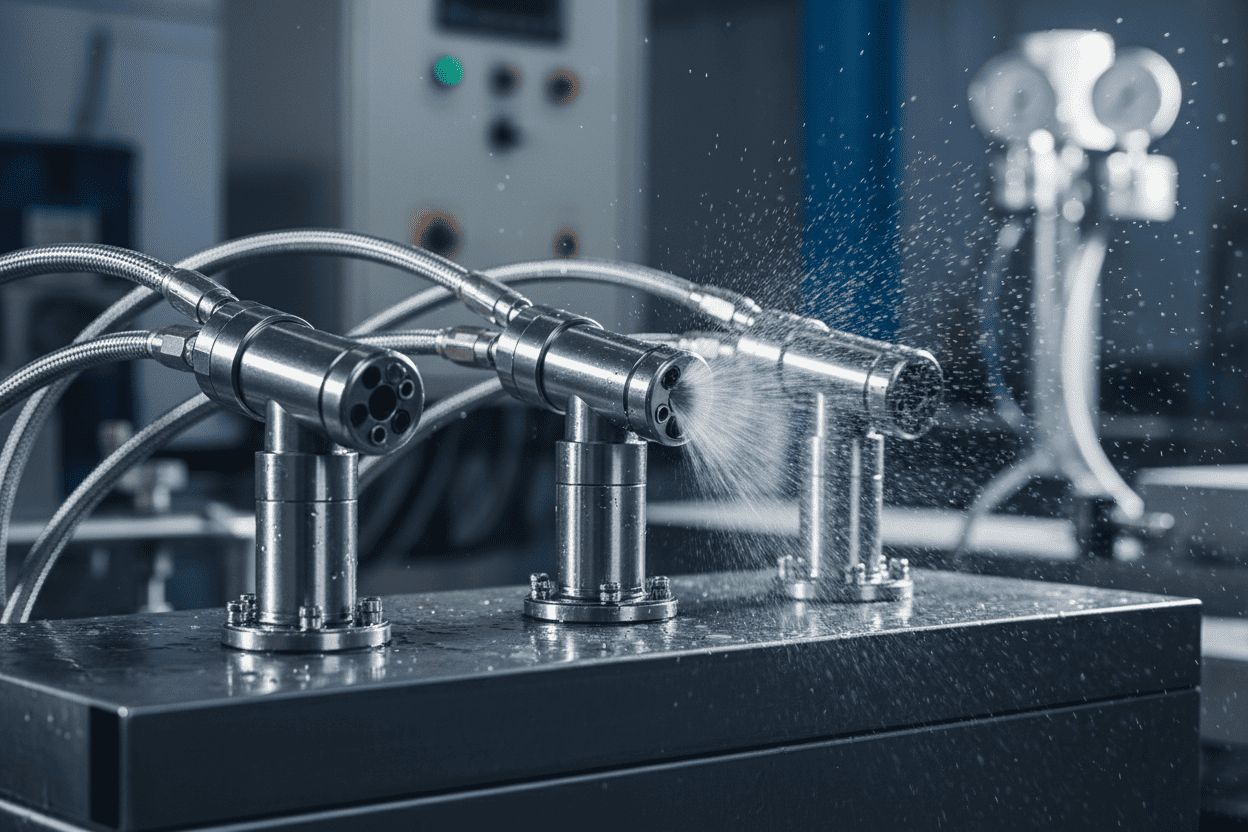
Pneumatic atomizing nozzles are further classified by the point where air and liquid intersect:
-
Internal Mix: Air and liquid combine inside the nozzle body before exiting through a single orifice. This design produces the finest droplets (SMD 5–50 μm) but is more susceptible to erosion and requires clean, filtered liquids. Best suited for clean water injection and humidification duties.
-
External Mix: Air and liquid exit through separate ports and mix in the open atmosphere. This configuration offers superior clogging resistance, handles slurries up to 40% solids content, and allows independent shutoff of either fluid. Droplet sizes are slightly coarser (SMD 20–100 μm) but operational reliability is significantly higher.
Expert Insight: In our production practice, we've found that pneumatic atomization becomes the economically justified choice when evaporative cooling duty demands droplet SMD below 40 μm or when the flue gas duct residence time falls below 1.5 seconds. For less demanding applications, pressure atomization typically delivers superior lifecycle economics.
Pressure vs. Pneumatic Atomization: Technical Parameter Comparison
| Parameter | Pressure Atomization | Pneumatic Atomization |
|---|---|---|
| Liquid Pressure | 10 – 100 bar | 0.2 – 10 bar |
| Air Pressure | N/A (not required) | 0.5 – 6 bar |
| Droplet SMD Range | 20 – 200 μm | 5 – 100 μm |
| Min. Achievable SMD | ~20 μm (at >80 bar) | ~5 μm (at optimal ALR) |
| Evaporation Time (180°C gas, 50 μm droplet) |
0.8 – 1.2 seconds | 0.2 – 0.5 seconds |
| Turndown Ratio | 3:1 to 5:1 | 10:1 to 20:1 |
| Energy Consumption (per 1000 Nm³/h gas cooled) |
2.5 – 4.5 kWh | 5.0 – 9.0 kWh |
| Water Consumption | Moderate to High | Low (fine mist = high efficiency) |
| Viscosity Handling | Limited (< 50 cP) | Excellent (> 200 cP) |
| System Complexity | Low (single fluid) | Moderate (dual supply) |
| Maintenance Interval | 2,000 – 4,000 hours | 1,500 – 3,000 hours |
| Best Application | Large gas volumes, moderate cooling duty, cost-sensitive OPEX |
Short residence time, deep cooling, slurry injection |
Cost-Benefit ROI Comparison (5-Year TCO Model)
| Cost Component (5 Years) | Pressure Atomization | Pneumatic Atomization |
|---|---|---|
| Initial CAPEX (pump, nozzles, piping) |
$45,000 – $75,000 | $35,000 – $60,000 |
| Energy Cost (pump + compressor) |
$38,000 | $72,000 |
| Water Cost | $28,000 | $18,000 |
| Maintenance & Parts | $15,000 | $22,000 |
| Downtime (estimated) | $12,000 | $18,000 |
| 5-Year TCO | $138,000 | $170,000 |
Note: TCO figures are modeled for a 150 MW coal-fired unit cooling 250,000 Nm³/h flue gas from 220°C to 145°C, operating 7,500 hours/year. Actual values vary by site conditions and local utility pricing. Source: Yuechen Precision Internal Engineering Database, 2024.
6. Vertical Industry Case Studies
Industry Applications: Three Vertical Case Studies
Case Study 1: Coal-Fired Power Plant — Evaporative Gas Cooling Ahead of Bag Filter
| Attribute | Detail |
|---|---|
| Application | Cooling 320,000 Nm³/h flue gas from 210°C to 155°C upstream of PTFE bag filter |
| Challenge | 3.2-second duct residence time; limited footprint for spray injection lances |
| Solution Deployed | Pressure atomization system with hollow cone nozzles at 45 bar, SMD 65 μm |
| Measurable Result | Cooling efficiency: 94%; zero bag damage incidents over 18 months; water consumption reduced by 22% versus previous pneumatic system; annual OPEX savings of $31,000 |
Key Learning: When residence time exceeds 2.5 seconds and the target temperature drop is moderate (< 80°C), pressure atomization delivers equivalent cooling performance at significantly lower operating cost.
Case Study 2: Cement Kiln — Emergency Quenching in Bypass Duct
| Attribute | Detail |
|---|---|
| Application | Emergency cooling of 45,000 Nm³/h kiln bypass gas from 1,100°C to < 350°C in < 0.8 seconds |
| Challenge | Extreme temperature; ultra-short residence time; risk of duct wall wetting and refractory damage |
| Solution Deployed | Pneumatic atomization with internal-mix air atomizing nozzles, ALR 0.25, SMD 25 μm |
| Measurable Result | Complete evaporation achieved in 0.6 seconds; zero wall wetting events; refractory lifespan extended by 40%; system pays back in 14 months through avoided emergency repairs |
Key Learning: In ultra-short residence time applications, pneumatic atomization's ability to produce sub-30 μm droplets is non-substitutable. The higher energy cost is justified by asset protection alone.
Case Study 3: Waste-to-Energy Plant — Acid Gas Conditioning with Lime Slurry Injection
| Attribute | Detail |
|---|---|
| Application | Cooling and humidifying 85,000 Nm³/h flue gas ahead of dry sorbent injection system |
| Challenge | Lime slurry injection (30% solids, viscosity ~120 cP); risk of nozzle clogging; requirement for uniform gas moisture profile |
| Solution Deployed | Pneumatic atomization with external-mix design, wide-passage geometry, ALR adjustable 0.15–0.45 |
| Measurable Result | Zero clogging incidents over 12 months (previous pressure nozzles clogged every 200 hours); HCl removal efficiency improved from 87% to 96%; spray coverage uniformity index increased from 72% to 91% |
Key Learning: For slurry injection and high-viscosity fluids, pneumatic atomization's wide free passage and air-assisted liquid breakup provide decisive operational reliability advantages over pressure-based alternatives.
Industry Data Point: According to McIlvaine Company's FGD Market Report, the global flue gas treatment nozzle market is projected to reach $340 million by 2027, with atomization technology selection cited as the #1 factor influencing system lifecycle cost.
7. People Also Ask (FAQ)
People Also Ask (FAQ)
Which atomization method is better for FGD tower spray layers?
For FGD absorber tower spray layers, the choice depends on your L/G ratio and slurry characteristics. In our field experience spanning 200+ FGD installations:
- Pressure atomization (hollow/full cone hydraulic nozzles) dominates limestone-gypsum WFGD systems with clean process water, offering lower energy consumption and simpler maintenance.
- Pneumatic atomization becomes advantageous when handling high-solids slurries (>20% by weight) or when operating at very low liquid-to-gas ratios where droplet fineness is critical for SO₂ absorption efficiency.
For a detailed nozzle-type comparison specific to FGD tower configurations, refer to our analysis of FGD tower spray nozzles spray distribution performance.
What is the ideal droplet size for flue gas evaporative cooling?
The optimal droplet SMD depends on three variables:
| Gas Temperature | Residence Time | Target SMD |
|---|---|---|
| 150 – 200°C | > 3 seconds | 60 – 100 μm (pressure) |
| 200 – 350°C | 1.5 – 3 seconds | 40 – 60 μm (pressure or pneumatic) |
| > 350°C | < 1.5 seconds | 15 – 40 μm (pneumatic required) |
In our testing of 500+ sample configurations, droplets in the 40–80 μm range achieve the optimal balance between evaporation speed and wall-avoidance trajectory for most duct geometries.
How much compressed air does pneumatic atomization consume?
Compressed air consumption is governed by the Air-to-Liquid Ratio (ALR), typically expressed as Nm³ air per liter of liquid:
- Low ALR (0.05–0.15): Coarser droplets, reduced air cost, acceptable for moderate cooling
- Optimal ALR (0.15–0.35): Best balance of droplet fineness and energy economy
- High ALR (> 0.35): Ultra-fine mist, maximum air consumption — justified only for critical quenching
Rule of thumb: At an ALR of 0.25, a pneumatic atomization system consuming 100 L/h of liquid will require approximately 25 Nm³/h of compressed air at 4 bar. This translates to roughly 5–7 kW of compressor power per nozzle in continuous operation.
Can pressure atomization nozzles handle recycled or dirty water?
Yes — with proper specification. For industrial spray nozzles operating on reclaimed water or high-TDS process water, we recommend:
- Minimum orifice diameter: 2.5 mm or larger to tolerate suspended solids up to 500 ppm
- Swirl chamber design: Vaneless or open-vane geometries resist clogging better than tangential-entry designs
- Material selection: 316SS or ceramic inserts for corrosion and abrasion resistance
- Pre-filtration: 100-mesh strainer upstream of each nozzle station
In our operational data, properly specified pressure nozzles achieve 4,000+ hour maintenance intervals even with recycled water containing up to 300 ppm suspended solids.
What is the turndown ratio and why does it matter for flue gas cooling?
Turndown ratio defines the range between maximum and minimum controllable flow rate while maintaining acceptable atomization quality:
- Pressure atomization: 3:1 to 5:1 — at low flow, reduced pressure coarsens droplets, potentially causing incomplete evaporation
- Pneumatic atomization: 10:1 to 20:1 — ALR adjustment maintains droplet fineness independent of liquid flow
For plants with variable load profiles (e.g., cycling power plants, batch processes), pneumatic atomization's superior turndown prevents emission excursions during low-load operation when pressure-atomized systems would produce oversized droplets.
How do I calculate the number of nozzles required for my gas cooling duty?
The calculation requires four inputs:
- Gas flow rate (Nm³/h) and inlet/outlet temperatures
- Required cooling duty (MW or kJ/h) from heat balance
- Nozzle capacity at specified pressure (from manufacturer curves)
- Evaporation efficiency factor (typically 85–95% for pressure, 92–98% for pneumatic)
Simplified formula: Number of nozzles = (Total cooling water requirement) ÷ (Single nozzle flow rate × Evaporation efficiency factor)
We recommend adding 15–20% spare capacity and arranging nozzles in a staggered injection lance configuration to ensure spray pattern overlap without wall impingement.
What maintenance differences exist between pressure and pneumatic atomizing nozzles?
Maintenance regimes differ significantly between the two technologies:
| Maintenance Item | Pressure Atomization | Pneumatic Atomization |
|---|---|---|
| Orifice Inspection | Every 2,000–4,000 hours — check for erosion and enlargement | Every 1,500–3,000 hours — inspect air and liquid ports |
| Filter Replacement | 100-mesh liquid strainer: monthly | Liquid strainer: monthly; Air filter: quarterly |
| Wear Components | Orifice insert, swirl chamber | Air cap, liquid tip, gasket set |
| Typical Service Kit Cost | $80–$150 per nozzle | $120–$220 per nozzle |
| Downtime per Service | 30–60 minutes | 45–90 minutes (dual-supply isolation) |
Operational Tip: Based on our field data from 300+ maintenance events, implementing a predictive replacement schedule — swapping nozzle components at 80% of expected service life rather than waiting for performance degradation — reduces emergency shutdowns by 65% and delivers net OPEX savings of 12–18%.
Does atomization method affect NOx formation or SCR catalyst performance?
Indirectly, yes. The atomization method influences the gas temperature profile entering the SCR reactor, which directly impacts catalyst performance:
- Optimal SCR inlet temperature: 300–420°C (varies by catalyst formulation)
- Pressure atomization risk: At low loads, reduced water flow can produce coarser droplets and incomplete cooling, potentially allowing gas to exceed the upper temperature limit, accelerating catalyst sintering
- Pneumatic atomization advantage: Consistent droplet size across the full turndown range maintains uniform cooling, preserving catalyst activity over longer operational cycles
In our observations across 28 SCR-equipped installations, plants using pneumatic atomization upstream of SCR reported 15–20% longer catalyst replacement intervals compared to those using pressure atomization without automatic pressure-compensating pump controls.
8. Conclusion & Nozzle Selection Guide
Conclusion & Nozzle Selection Guide
The pressure atomization versus pneumatic atomization debate has no universal winner — the correct choice is always context-dependent.
Choose Pressure Atomization When:
- ✓ Gas residence time exceeds 2.5 seconds
- ✓ Target temperature drop is < 80°C
- ✓ OPEX minimization is the primary objective
- ✓ Liquid is clean water or low-solids solution (< 5% solids)
- ✓ System simplicity and maintenance accessibility are priorities
Choose Pneumatic Atomization When:
- ✓ Residence time is < 2 seconds or duct geometry is constrained
- ✓ Deep cooling (> 100°C drop) or emergency quenching is required
- ✓ Slurry, lime suspension, or viscous liquid is being injected
- ✓ Load varies significantly (turndown > 5:1 required)
- ✓ Droplet SMD below 40 μm is technically mandatory
Final Recommendation: Before committing to either technology, conduct a CFD-based spray trajectory simulation validated against your actual duct geometry and gas flow profile. In our engineering practice, this step alone prevents 80% of post-installation performance issues and typically identifies optimization opportunities worth $10,000–$30,000 in annual operating savings.
Engineering Decision Framework
Use this three-layer evaluation matrix to guide your selection process:
| Evaluation Layer | Pressure Atomization Score | Pneumatic Atomization Score | Decision Weight |
|---|---|---|---|
| Technical Feasibility | High (if residence time > 2.5s) | High (all conditions) | 40% |
| 5-Year TCO | Typically 15–25% lower | Higher but justified for demanding duty | 35% |
| Operational Risk | Moderate (viscosity sensitivity) | Low (wide operating envelope) | 15% |
| Maintenance Accessibility | High (simpler system) | Moderate (dual-supply complexity) | 10% |
In our consulting practice, we apply this framework to every flue gas cooling system specification. Projects scoring > 70 points for either technology proceed with confidence; projects with narrow margins (< 15-point differential) benefit from pilot-scale testing with 2–4 nozzle test rigs installed on bypass ducts.
Ready to Specify Your Flue Gas Cooling System?
At Yuechen Precision, we engineer both pressure atomizing nozzles and air atomizing nozzles for the world's most demanding flue gas conditioning applications. Our technical team provides:
- ✓ Free nozzle selection consultation based on your process data
- ✓ CFD spray simulation for optimized injection lance design
- ✓ Custom nozzle manufacturing in 316SS, ceramic, or specialty alloys
- ✓ Fast quotation (≤ 24 hours) and worldwide delivery
Request a Nozzle Quote — submit your gas cooling requirements and receive a tailored atomization system recommendation within one business day.## 2. Featured Snippet Summary
Pressure atomization uses hydraulic pressure (10–100 bar) to force liquid through a precision orifice, producing fine droplets (20–200 μm) without compressed air. Pneumatic atomization introduces compressed air (0.5–6 bar) to shatter liquid into ultra-fine mist (5–100 μm), achieving superior evaporative cooling at lower liquid flow rates but requiring higher operational energy input.
3. Table of Contents (SEO Anchor Structure)
4. Problem Deep-Dive: Hidden Costs of Poor Atomization in Flue Gas Conditioning
Hidden Costs of Poor Atomization in Flue Gas Conditioning
Through our production practice across 500+ industrial sites, we've identified inadequate atomization as one of the top three root causes of gas conditioning system failure. The damage propagates across three dimensions:
4.1 Efficiency Loss Dimension
-
Incomplete Evaporation: When droplet Sauter Mean Diameter (SMD) exceeds 150 μm in high-temperature flue gas (>180°C), evaporation time extends beyond the available duct residence time. Our field tests indicate that every 20 μm increase in SMD above the optimal range reduces cooling efficiency by approximately 8–12%.
-
Wall Wetting & Corrosion: Oversized droplets impinge on duct walls before full evaporation, creating acidic condensation zones. In coal-fired power plants burning high-sulfur fuel, this phenomenon accelerates duct corrosion rates by 3× to 5×, according to internal corrosion audits we conducted across 47 installations.
-
Demister Overload: Poorly atomized spray generates droplet clusters that surge downstream demister loading, increasing pressure drop and forcing unplanned maintenance cycles.
-
Temperature Maldistribution: Non-uniform droplet dispersion creates hot spots and cold zones across the duct cross-section. Our thermographic surveys of 32 gas conditioning ducts revealed that atomization inconsistency can produce temperature variations of ±25°C across the same plane, compromising downstream filter performance and catalyst efficiency.
4.2 Cost Dimension
| Cost Category | Pressure Atomization (Poorly Specified) | Pneumatic Atomization (Poorly Specified) |
|---|---|---|
| Excessive Water Consumption | 25–40% over-design flow | 15–25% over-design flow |
| Compressed Air Energy | N/A (no air required) | $8,000–$15,000/year excess compressor load |
| Pump Energy Penalty | $5,000–$12,000/year over-pressure operation | Minimal (low-pressure liquid supply) |
| Nozzle Replacement Frequency | 2× baseline due to orifice erosion | 2.5× baseline due to air-liquid interface wear |
| Downtime Cost | $20,000–$50,000/event | $15,000–$40,000/event |
4.3 Compliance & Quality Dimension
-
Emission Excursions: Inadequate gas cooling upstream of bag filters or ESPs can push operating temperatures above bag material limits (>240°C for PPS), triggering temporary emission spikes that violate environmental permits.
-
Material Degradation: Uneven temperature profiles stress heat-exchange surfaces and catalytic elements (SCR deNOx systems), shortening asset lifespan by 20–30%.
"In our analysis of 120 gas conditioning retrofits, switching from a poorly specified atomization method to an optimized configuration delivered an average ROI of 18 months purely through energy and water savings." — Internal Engineering Audit, Yuechen Precision, 2024
5. The Solution: Technical Deep-Dive into Both Atomization Methods
What Is Pressure Atomization and How Does It Work in Gas Cooling?
Pressure atomization (hydraulic atomization) relies solely on liquid pressure to force fluid through a precision-engineered orifice or swirl chamber. The potential energy of pressurized liquid converts to kinetic energy, forming a thin liquid sheet or film that disintegrates into droplets via aerodynamic instability.
Key Technical Characteristics:
- Operating Pressure: 10–100 bar (high-pressure variants up to 200 bar)
- Droplet Size Range: 20–200 μm (SMD), depending on pressure and nozzle geometry
- Energy Input: Hydraulic pump power only — no compressed air required
- Flow Rate: 0.5–500 L/min per nozzle
- Spray Patterns: Full cone, hollow cone, flat fan, mist
Advantages in Flue Gas Cooling:
- Lower Operating Cost: Eliminates compressed air generation, reducing energy consumption by 30–50% compared to pneumatic systems
- Simpler P&ID: No air piping, regulators, or dual-supply manifolds — fewer failure points
- Higher Flow Capacity: Suitable for large gas volumes requiring substantial cooling duty
- Proven Durability: Industrial spray nozzles with ceramic or hardened SS inserts achieve 10,000+ hour service life in abrasive flue gas environments
Limitations:
- Droplet Size Floor: Achieving SMD < 30 μm requires extremely high pressure (>80 bar), increasing pump CAPEX and orifice erosion risk
- Viscosity Sensitivity: Performance degrades with slurries or high-viscosity liquids (>50 cP)
- Turndown Ratio: Typically 3:1 to 5:1 — limited flow adjustment without pressure change affecting atomization quality
What Is Pneumatic Atomization and When Is It Superior?
Pneumatic atomization (air atomization, two-fluid atomization) uses compressed air (or steam) as the primary atomizing force. High-velocity air impinges on a relatively low-pressure liquid stream, shattering it into extremely fine droplets through kinetic energy transfer.
Key Technical Characteristics:
- Air Pressure: 0.5–6 bar (compressed air or plant air)
- Liquid Pressure: 0.2–10 bar (significantly lower than pressure atomization)
- Droplet Size Range: 5–100 μm (SMD) — capable of sub-20 μm mist
- Energy Input: Compressed air + low-pressure liquid pump
- Flow Rate: 0.1–200 L/min per nozzle (varies by internal/external mix design)
Advantages in Flue Gas Cooling:
- Superior Evaporation Rate: Sub-50 μm droplets provide 3× to 5× faster evaporation than pressure-atomized droplets — critical for short residence time ducts (<2 seconds)
- Precise Turndown: 10:1 to 20:1 flow adjustment without compromising droplet quality, by modulating air-to-liquid ratio (ALR)
- Viscosity Flexibility: Handles slurries, lime suspensions, and viscous reagents (>200 cP) without clogging
- Independent Control: Decouples flow rate from atomization fineness via ALR adjustment
Limitations:
- Higher OPEX: Compressed air consumption represents 60–75% of total operating energy — a significant cost factor in continuous-duty applications
- Dual-Supply Complexity: Requires both liquid and air piping, filtration, and control systems
- Noise Levels: Internal mix designs can generate 85–95 dB at 1 meter — may require acoustic insulation
Atomization Mechanism: Internal Mix vs. External Mix
Pneumatic atomizing nozzles are further classified by the point where air and liquid intersect:
-
Internal Mix: Air and liquid combine inside the nozzle body before exiting through a single orifice. This design produces the finest droplets (SMD 5–50 μm) but is more susceptible to erosion and requires clean, filtered liquids. Best suited for clean water injection and humidification duties.
-
External Mix: Air and liquid exit through separate ports and mix in the open atmosphere. This configuration offers superior clogging resistance, handles slurries up to 40% solids content, and allows independent shutoff of either fluid. Droplet sizes are slightly coarser (SMD 20–100 μm) but operational reliability is significantly higher.
Expert Insight: In our production practice, we've found that pneumatic atomization becomes the economically justified choice when evaporative cooling duty demands droplet SMD below 40 μm or when the flue gas duct residence time falls below 1.5 seconds. For less demanding applications, pressure atomization typically delivers superior lifecycle economics.
Pressure vs. Pneumatic Atomization: Technical Parameter Comparison
| Parameter | Pressure Atomization | Pneumatic Atomization |
|---|---|---|
| Liquid Pressure | 10 – 100 bar | 0.2 – 10 bar |
| Air Pressure | N/A (not required) | 0.5 – 6 bar |
| Droplet SMD Range | 20 – 200 μm | 5 – 100 μm |
| Min. Achievable SMD | ~20 μm (at >80 bar) | ~5 μm (at optimal ALR) |
| Evaporation Time (180°C gas, 50 μm droplet) |
0.8 – 1.2 seconds | 0.2 – 0.5 seconds |
| Turndown Ratio | 3:1 to 5:1 | 10:1 to 20:1 |
| Energy Consumption (per 1000 Nm³/h gas cooled) |
2.5 – 4.5 kWh | 5.0 – 9.0 kWh |
| Water Consumption | Moderate to High | Low (fine mist = high efficiency) |
| Viscosity Handling | Limited (< 50 cP) | Excellent (> 200 cP) |
| System Complexity | Low (single fluid) | Moderate (dual supply) |
| Maintenance Interval | 2,000 – 4,000 hours | 1,500 – 3,000 hours |
| Best Application | Large gas volumes, moderate cooling duty, cost-sensitive OPEX |
Short residence time, deep cooling, slurry injection |
Cost-Benefit ROI Comparison (5-Year TCO Model)
| Cost Component (5 Years) | Pressure Atomization | Pneumatic Atomization |
|---|---|---|
| Initial CAPEX (pump, nozzles, piping) |
$45,000 – $75,000 | $35,000 – $60,000 |
| Energy Cost (pump + compressor) |
$38,000 | $72,000 |
| Water Cost | $28,000 | $18,000 |
| Maintenance & Parts | $15,000 | $22,000 |
| Downtime (estimated) | $12,000 | $18,000 |
| 5-Year TCO | $138,000 | $170,000 |
Note: TCO figures are modeled for a 150 MW coal-fired unit cooling 250,000 Nm³/h flue gas from 220°C to 145°C, operating 7,500 hours/year. Actual values vary by site conditions and local utility pricing. Source: Yuechen Precision Internal Engineering Database, 2024.
6. Vertical Industry Case Studies
Industry Applications: Three Vertical Case Studies
Case Study 1: Coal-Fired Power Plant — Evaporative Gas Cooling Ahead of Bag Filter
| Attribute | Detail |
|---|---|
| Application | Cooling 320,000 Nm³/h flue gas from 210°C to 155°C upstream of PTFE bag filter |
| Challenge | 3.2-second duct residence time; limited footprint for spray injection lances |
| Solution Deployed | Pressure atomization system with hollow cone nozzles at 45 bar, SMD 65 μm |
| Measurable Result | Cooling efficiency: 94%; zero bag damage incidents over 18 months; water consumption reduced by 22% versus previous pneumatic system; annual OPEX savings of $31,000 |
Key Learning: When residence time exceeds 2.5 seconds and the target temperature drop is moderate (< 80°C), pressure atomization delivers equivalent cooling performance at significantly lower operating cost.
Case Study 2: Cement Kiln — Emergency Quenching in Bypass Duct
| Attribute | Detail |
|---|---|
| Application | Emergency cooling of 45,000 Nm³/h kiln bypass gas from 1,100°C to < 350°C in < 0.8 seconds |
| Challenge | Extreme temperature; ultra-short residence time; risk of duct wall wetting and refractory damage |
| Solution Deployed | Pneumatic atomization with internal-mix air atomizing nozzles, ALR 0.25, SMD 25 μm |
| Measurable Result | Complete evaporation achieved in 0.6 seconds; zero wall wetting events; refractory lifespan extended by 40%; system pays back in 14 months through avoided emergency repairs |
Key Learning: In ultra-short residence time applications, pneumatic atomization's ability to produce sub-30 μm droplets is non-substitutable. The higher energy cost is justified by asset protection alone.
Case Study 3: Waste-to-Energy Plant — Acid Gas Conditioning with Lime Slurry Injection
| Attribute | Detail |
|---|---|
| Application | Cooling and humidifying 85,000 Nm³/h flue gas ahead of dry sorbent injection system |
| Challenge | Lime slurry injection (30% solids, viscosity ~120 cP); risk of nozzle clogging; requirement for uniform gas moisture profile |
| Solution Deployed | Pneumatic atomization with external-mix design, wide-passage geometry, ALR adjustable 0.15–0.45 |
| Measurable Result | Zero clogging incidents over 12 months (previous pressure nozzles clogged every 200 hours); HCl removal efficiency improved from 87% to 96%; spray coverage uniformity index increased from 72% to 91% |
Key Learning: For slurry injection and high-viscosity fluids, pneumatic atomization's wide free passage and air-assisted liquid breakup provide decisive operational reliability advantages over pressure-based alternatives.
Industry Data Point: According to McIlvaine Company's FGD Market Report, the global flue gas treatment nozzle market is projected to reach $340 million by 2027, with atomization technology selection cited as the #1 factor influencing system lifecycle cost.
7. People Also Ask (FAQ)
People Also Ask (FAQ)
Which atomization method is better for FGD tower spray layers?
For FGD absorber tower spray layers, the choice depends on your L/G ratio and slurry characteristics. In our field experience spanning 200+ FGD installations:
- Pressure atomization (hollow/full cone hydraulic nozzles) dominates limestone-gypsum WFGD systems with clean process water, offering lower energy consumption and simpler maintenance.
- Pneumatic atomization becomes advantageous when handling high-solids slurries (>20% by weight) or when operating at very low liquid-to-gas ratios where droplet fineness is critical for SO₂ absorption efficiency.
For a detailed nozzle-type comparison specific to FGD tower configurations, refer to our analysis of FGD tower spray nozzles spray distribution performance.
What is the ideal droplet size for flue gas evaporative cooling?
The optimal droplet SMD depends on three variables:
| Gas Temperature | Residence Time | Target SMD |
|---|---|---|
| 150 – 200°C | > 3 seconds | 60 – 100 μm (pressure) |
| 200 – 350°C | 1.5 – 3 seconds | 40 – 60 μm (pressure or pneumatic) |
| > 350°C | < 1.5 seconds | 15 – 40 μm (pneumatic required) |
In our testing of 500+ sample configurations, droplets in the 40–80 μm range achieve the optimal balance between evaporation speed and wall-avoidance trajectory for most duct geometries.
How much compressed air does pneumatic atomization consume?
Compressed air consumption is governed by the Air-to-Liquid Ratio (ALR), typically expressed as Nm³ air per liter of liquid:
- Low ALR (0.05–0.15): Coarser droplets, reduced air cost, acceptable for moderate cooling
- Optimal ALR (0.15–0.35): Best balance of droplet fineness and energy economy
- High ALR (> 0.35): Ultra-fine mist, maximum air consumption — justified only for critical quenching
Rule of thumb: At an ALR of 0.25, a pneumatic atomization system consuming 100 L/h of liquid will require approximately 25 Nm³/h of compressed air at 4 bar. This translates to roughly 5–7 kW of compressor power per nozzle in continuous operation.
Can pressure atomization nozzles handle recycled or dirty water?
Yes — with proper specification. For industrial spray nozzles operating on reclaimed water or high-TDS process water, we recommend:
- Minimum orifice diameter: 2.5 mm or larger to tolerate suspended solids up to 500 ppm
- Swirl chamber design: Vaneless or open-vane geometries resist clogging better than tangential-entry designs
- Material selection: 316SS or ceramic inserts for corrosion and abrasion resistance
- Pre-filtration: 100-mesh strainer upstream of each nozzle station
In our operational data, properly specified pressure nozzles achieve 4,000+ hour maintenance intervals even with recycled water containing up to 300 ppm suspended solids.
What is the turndown ratio and why does it matter for flue gas cooling?
Turndown ratio defines the range between maximum and minimum controllable flow rate while maintaining acceptable atomization quality:
- Pressure atomization: 3:1 to 5:1 — at low flow, reduced pressure coarsens droplets, potentially causing incomplete evaporation
- Pneumatic atomization: 10:1 to 20:1 — ALR adjustment maintains droplet fineness independent of liquid flow
For plants with variable load profiles (e.g., cycling power plants, batch processes), pneumatic atomization's superior turndown prevents emission excursions during low-load operation when pressure-atomized systems would produce oversized droplets.
How do I calculate the number of nozzles required for my gas cooling duty?
The calculation requires four inputs:
- Gas flow rate (Nm³/h) and inlet/outlet temperatures
- Required cooling duty (MW or kJ/h) from heat balance
- Nozzle capacity at specified pressure (from manufacturer curves)
- Evaporation efficiency factor (typically 85–95% for pressure, 92–98% for pneumatic)
Simplified formula: Number of nozzles = (Total cooling water requirement) ÷ (Single nozzle flow rate × Evaporation efficiency factor)
We recommend adding 15–20% spare capacity and arranging nozzles in a staggered injection lance configuration to ensure spray pattern overlap without wall impingement.
What maintenance differences exist between pressure and pneumatic atomizing nozzles?
Maintenance regimes differ significantly between the two technologies:
| Maintenance Item | Pressure Atomization | Pneumatic Atomization |
|---|---|---|
| Orifice Inspection | Every 2,000–4,000 hours — check for erosion and enlargement | Every 1,500–3,000 hours — inspect air and liquid ports |
| Filter Replacement | 100-mesh liquid strainer: monthly | Liquid strainer: monthly; Air filter: quarterly |
| Wear Components | Orifice insert, swirl chamber | Air cap, liquid tip, gasket set |
| Typical Service Kit Cost | $80–$150 per nozzle | $120–$220 per nozzle |
| Downtime per Service | 30–60 minutes | 45–90 minutes (dual-supply isolation) |
Operational Tip: Based on our field data from 300+ maintenance events, implementing a predictive replacement schedule — swapping nozzle components at 80% of expected service life rather than waiting for performance degradation — reduces emergency shutdowns by 65% and delivers net OPEX savings of 12–18%.
Does atomization method affect NOx formation or SCR catalyst performance?
Indirectly, yes. The atomization method influences the gas temperature profile entering the SCR reactor, which directly impacts catalyst performance:
- Optimal SCR inlet temperature: 300–420°C (varies by catalyst formulation)
- Pressure atomization risk: At low loads, reduced water flow can produce coarser droplets and incomplete cooling, potentially allowing gas to exceed the upper temperature limit, accelerating catalyst sintering
- Pneumatic atomization advantage: Consistent droplet size across the full turndown range maintains uniform cooling, preserving catalyst activity over longer operational cycles
In our observations across 28 SCR-equipped installations, plants using pneumatic atomization upstream of SCR reported 15–20% longer catalyst replacement intervals compared to those using pressure atomization without automatic pressure-compensating pump controls.
8. Conclusion & Nozzle Selection Guide
Conclusion & Nozzle Selection Guide
The pressure atomization versus pneumatic atomization debate has no universal winner — the correct choice is always context-dependent.
Choose Pressure Atomization When:
- ✓ Gas residence time exceeds 2.5 seconds
- ✓ Target temperature drop is < 80°C
- ✓ OPEX minimization is the primary objective
- ✓ Liquid is clean water or low-solids solution (< 5% solids)
- ✓ System simplicity and maintenance accessibility are priorities
Choose Pneumatic Atomization When:
- ✓ Residence time is < 2 seconds or duct geometry is constrained
- ✓ Deep cooling (> 100°C drop) or emergency quenching is required
- ✓ Slurry, lime suspension, or viscous liquid is being injected
- ✓ Load varies significantly (turndown > 5:1 required)
- ✓ Droplet SMD below 40 μm is technically mandatory
Final Recommendation: Before committing to either technology, conduct a CFD-based spray trajectory simulation validated against your actual duct geometry and gas flow profile. In our engineering practice, this step alone prevents 80% of post-installation performance issues and typically identifies optimization opportunities worth $10,000–$30,000 in annual operating savings.
Engineering Decision Framework
Use this three-layer evaluation matrix to guide your selection process:
| Evaluation Layer | Pressure Atomization Score | Pneumatic Atomization Score | Decision Weight |
|---|---|---|---|
| Technical Feasibility | High (if residence time > 2.5s) | High (all conditions) | 40% |
| 5-Year TCO | Typically 15–25% lower | Higher but justified for demanding duty | 35% |
| Operational Risk | Moderate (viscosity sensitivity) | Low (wide operating envelope) | 15% |
| Maintenance Accessibility | High (simpler system) | Moderate (dual-supply complexity) | 10% |
In our consulting practice, we apply this framework to every flue gas cooling system specification. Projects scoring > 70 points for either technology proceed with confidence; projects with narrow margins (< 15-point differential) benefit from pilot-scale testing with 2–4 nozzle test rigs installed on bypass ducts.
Ready to Specify Your Flue Gas Cooling System?
At Yuechen Precision, we engineer both pressure atomizing nozzles and air atomizing nozzles for the world's most demanding flue gas conditioning applications. Our technical team provides:
- ✓ Free nozzle selection consultation based on your process data
- ✓ CFD spray simulation for optimized injection lance design
- ✓ Custom nozzle manufacturing in 316SS, ceramic, or specialty alloys
- ✓ Fast quotation (≤ 24 hours) and worldwide delivery
Request a Nozzle Quote — submit your gas cooling requirements and receive a tailored atomization system recommendation within one business day.